Review Article
Carbon nanoparticles improve lymph node
dissection and parathyroid gland protection during
thyroidectomy: a systematic review and meta-analysis
An-Ping Su, Tao Wei, Yan-Ping Gong, Ri-Xiang Gong, Zhi-Hui Li, Jing-Qiang Zhu
Department of Thyroid Surgery, West China Hospital, Sichuan University, Chengdu 610041, Sichuan Province, China
Received August 17, 2017; Accepted December 29, 2017; Epub February 15, 2018; Published February 28, 2018
Abstract: Objective: To assess whether carbon nanoparticles can effectively improve the quality of lymph node dissection and protect parathyroid glands during thyroidectomy. Methods: A systematic literature search (MED-LINE, OVID, EMBASE, Science Citation Index, and Cochrane Library Central) was performed to identify randomized controlled trials before July 31, 2017. Articles with comparison of use and non-use of carbon nanoparticles during thyroidectomy were included. The primary endpoints were the number of lymph nodes retrieved and the rates of inadvertent parathyroidectomy, hypoparathyroidism, and hypocalcemia. Results: Eight studies were included for analysis. Carbon nanoparticles were associated with more lymph nodes retrieved (mean difference [MD], 2.92; 95% confidence interval [CI], 0.29 to 5.56; P = 0.03) and lower rates of inadvertent parathyroidectomy (odds ratio [OR], 0.24; 95% CI, 0.13-0.43; P < 0.00001), transient hypoparathyroidism (OR, 0.39; 95% CI, 0.24-0.64; P = 0.0002), and hypocalcemia (OR, 0.39; 95% CI, 0.25-0.62; P < 0.0001). There was no significant difference of permanent hypoparathyroidism rates between the patients with use and non-use of carbon nanoparticles (OR, 0.34; 95% CI, 0.05-2.19; P = 0.25). Conclusions: Carbon nanoparticles potentially improve the completeness of lymph nodes dis-section and protect parathyroid glands during thyroidectomy.
Keywords: Carbon nanoparticles, thyroidectomy, lymph nodes dissection, parathyroid gland, hypoparathyroidism
Introduction
The incidence of thyroid cancers has steadily increased over the last decade [1]. Although many patients have an excellent prognosis, there is involvement of cervical lymph nodes in 20 to 90% of cases [2-4]. Insufficient lymph node dissection can easily cause residual can-cer or relapse after surgery, and re-operation may be required. Central lymph nodes are most commonly involved with metastasis. Lymph node metastasis not only has important prog-nostic value for accurate clinical staging, post-operative treatment, follow-up programs and assessment of recurrence risk [5, 6], but also is an independent risk of decreased survival [7, 8]. Therefore, lymph node dissection is widely used for the treatment of thyroid cancers. However, central lymph node dissection is always associated with higher incidence of transient or permanent hypoparathyroidism because of injury to the parathyroid glands
from mechanical or thermal trauma, devascu-larization, or removal [9, 10]. The incidence of transient hypoparathyroidism is reported to be about 10 to 46%, while that of permanent hypo-parathyroidism is as low as zero and as high as 43% [11]. Postoperative hypoparathyroidism can add the hospital cost, affect the quality of life, and increase the risk of medical disputes. Therefore, there is a contradiction between rad-ical dissection of central lymph nodes and pro-tection of parathyroid glands.
without changing the anatomic color of the parathyroid glands. This promotes complete lymph node dissection and facilitates the abili-ty of surgeons to identify and protect parathy-roid glands [12, 13]. Although two studies of meta-analysis have confirmed the effective-ness of carbon nanoparticles, there are some limitations in the two studies, including: 1) many studies for meta-analysis are published in Chinese; 2) some studies are non-random-ized controlled trials; and 3) most studies of randomized controlled trials are low in quality [14, 15]. These limitations make the conclusion in doubt. In addition, some recent studies reported that carbon nanoparticles could not effectively protect parathyroid glands and re- duce the incidence of hypoparathyroidism [16, 17].
Up to now, the efficiency of carbon nanoparti-cles on lymph nodes dissection and parathy-roid glands protection during thyparathy-roidectomy has remained a topic of debate. Therefore, a systematic and comprehensive analysis of the existing evidence for use and non-use of car-bon nanoparticles must be conducted to deter-mine whether carbon nanoparticles can effec-tively improve the completeness of lymph node dissection and protect parathyroid glands dur-ing thyroidectomy.
Materials and methods
Search strategy
Major databases including MEDLINE, OVID, EMBASE, Science Citation Index, and Cochrane Library Central were searched for relevant arti-cles. Randomized controlled trials that com-pared the use and non-use of carbon nanopar-ticles during thyroidectomy published before July 31, 2017, were included in the meta-analy-sis. The following medical search headings were used: carbon nanoparticles, parathyroid gland, hypoparathyroidism, lymph nodes dis-section, and thyroidectomy. The combination of these headings and similar other headings were also searched, including nano-carbon, pa- rathyroid, lymph nodes resection, thyroid resec-tion, and thyroid surgery. The reference list of articles identified were examined to find rele-vant studies that had not been identified by the database searches. Two researchers (Wei T and Gong YP) independently screened the title and abstract of each publication to identify
eli-gible trails. Full articles of elieli-gible studies were then obtained for detailed evaluation. A discus-sion was conducted to resolve any disagree-ment in the selection process. If the procedure failed, a third person (Zhu JQ) adjudicated. Inclusion and exclusion criteria
To be included in the analysis, randomized con-trolled studies had to fit the following criteria: (1) publish on humans in English; (2) be the first surgery of traditional thyroidectomy; (3) report the indication of thyroidectomy; (4) provide a clear documentation of the injection method of carbon nanoparticles suspension; (5) report the outcomes after thyroidectomy, including lymph node dissection, inadvertent parathy-roidectomy, hypoparathyroidism, and hypocal-cemia; and (6) when two or multiple studies were reported by the same authors and/or institution, either the most recent study or the higher quality study was included in the an- alysis. Letters, abstracts, commentaries, case reports, studies lacking control groups, re-operations, endoscopic surgeries, and reviews without original data or appropriate data for extraction were excluded.
Data extraction
Two researchers (Wei T and Gong YP) indepen-dently extracted data from all eligible trails, and then cross-checked the data. Data extracted from each trial included the following parame-ters: first author, study period, participant ch- aracteristics, surgical extent, injection method of carbon nanoparticles suspension, lymph node dissection, inadvertent parathyroidecto-my, hypo-parathyroidism and hypocalcemia. Any disagreements were resolved by the same method as mentioned previously.
Quality assessment
The randomized controlled trials were scored using the Jadad scoring system, which evalu-ates studies based on appropriate randomiza-tion, proper blinding, and an adequate descrip-tion of withdrawals and dropouts [18]. A study was considered high in quality if the quality score is equal to or greater than 3.
Statistical analysis
tion using the software package Revman 5.0 (Copenhagen: The Nordic Cochrane Centre, The Cochrane Collaboration, 2008) [19]. For dichot-omous outcomes, the odds ratio (OR) was cal-culated with a 95% confidence interval (CI). For continuous outcomes, the mean difference (MD) was calculated with its 95% CI. The OR value represented the odds of an adverse event occurring in the carbon nanoparticle group (or black-staining lymph nodes in the carbon na- noparticles group) compared with the control group (or non-black staining lymph nodes in the carbon nanoparticles group) and it was consid-ered statistically significant at a P level of less than 0.05 if the 95% CI did not include the value 1. The MD value represented the differ-ence between the two groups in the continuous variables and it was considered statistically sig-nificant at a P level of less than 0.05 if 95% CI did not cross the value 0. Heterogeneity was assessed using the χ2 and I2, and I2 value of more than 50% was considered statistically sig-nificant. Either the random-effects model or fixed-effects model was used to calculate the pooled effect based on the heterogeneity but it was evaluated first with random-effects model. A funnel plot was constructed to evaluate potential publication bias based on the meta-static lymph nodes and inadvertent parathy- roidectomy.
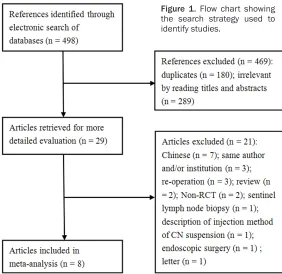
for various reasons as shown in Figure 1. Eight studies [12, 13, 37-42] published between 2014 and 2016 matched the selection criteria and were therefore included.
Study and patient characteristics
[image:3.612.90.372.70.344.2]The study characteristics, patient demography, etiology, surgical procedure, and the quality assessments are shown in Table 1. A total of 844 patients were included in all publications, with 420 in the carbon nanoparticle group and 424 in the control group. The sample size of the studies ranged from 60 to 162 patients and the mean age of the patients varied between 36 and 49 years. The proportion of females varied between 71% and 92%. All the studies looked at malignant lesions. The proportion of papil-lary thyroid cancer varied between 95% and 100%. The two groups had no significant differ-ence in age (MD, -1.43; 95% CI, -5.72 to 2.86; P = 0.51), sex (OR, 0.86; 95% CI, 0.60-1.25; P = 0.44) or etiology (OR, 1.90; 95% CI, 0.51-7.12; P = 0.34). All studies described the surgical procedure but only two studies [40, 41] reveal- ed the details of unilateral and bilateral central lymph node dissection. The proportion of bilat-eral central lymph node dissection was 100%. In addition, there was also no significant differ-ence of tumor size (MD, -0.07; 95% CI, -1.30 to Figure 1. Flow chart showing
the search strategy used to identify studies.
Results
Eligible studies
1.15; P = 0.91), preoperative parathyroid hor-mone (PTH) (MD, -0.37; 95% CI, -2.44 to 1.70; P = 0.73) and calcium (MD, -0.01; 95% CI, -0.06 to 0.04; P = 0.58) between the two groups. Of the eight studies, six [12, 13, 38, 40-42] were high in quality. Carbon nanoparticle suspension was provided by Chongqing LUMMY Phar- maceutical Co., Ltd. The details of the injection method are shown in Table 2. All studies re- vealed that carbon nanoparticle suspension was intraoperatively injected into the thyroid gland. The main difference among the studies were injection point, injection amount, and the interval between injection and thyroidectomy.
Lymph nodes dissection
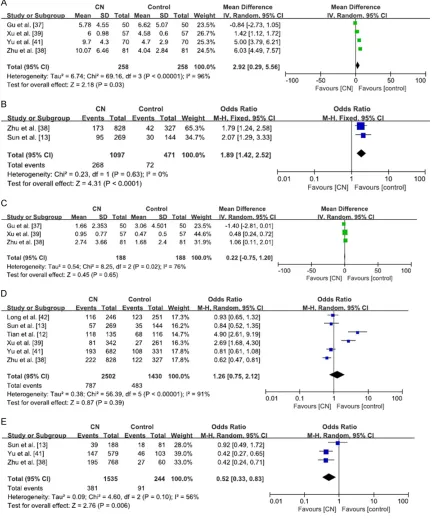
[image:4.612.88.529.85.307.2] [image:4.612.91.300.386.518.2]All results regarding lymph node dissection are showed in Figure 2. Seven studies [12, 13, 37-39, 41, 42] reported on the total number of lymph nodes resected during thyroidectomy. However, three [12, 13, 42] of them did not pro-vide sufficient information for analysis. Meta-analysis of the residual studies with the ran-dom-effects model (I2 = 96%) showed that the total number of lymph nodes retrieved in the carbon nanoparticles group was significantly higher than those retrieved in the control group (MD, 2.92; 95% CI, 0.29 to 5.56; P = 0.03) (Figure 2A). Data on the number of black-stain-ing lymph nodes was available in three studies [13, 38, 41]. The black-staining rate varied between 69.9% and 92.8%. Two studies [13, 38] reported the number of lymph nodes with less than 2 mm. The summarized effect with the fixed-effects model (I2 = 0%) revealed that carbon nanoparticles could significantly im- prove the dissection of lymph nodes with less than 2 mm (OR, 1.89; 95% CI, 1.42-2.52; P < 0.0001) (Figure 2B). Yu et al. [41] also demon-strated that more lymph nodes and metastatic lymph nodes with less than 5 mm in length were detected in the carbon nanoparticles gro- up than in the control group (279 vs 54, P = 0.0001; 78 vs 17, P = 0.0001, respectively). Table 1. General characteristics of the included studies
Author Study period Group Patients (n) Age M/F Etiology (n) Procedure (n) Quality score
Tian et al. [12] 2012.4-2013.10 CN 50 36.4 ± 2.5 5/45 PTC CND 3
Control 50 44.5 ± 5.8 11/39 PTC46, FTC4
Sun et al. [13] 2011.6-2012.8 CN 40 43 (25-71)* 23/57 PTC, FTC CND 3
Control 40
Gu et al. [37] 2012.6-2014.8 CN 50 46.98 ± 9.027 10/40 PTC47, FTC1, MTC2 CND36, CND+LND14 2
Control 50 47.76 ± 13.912 6/44 PTC48, FTC1, MTC1 CND31, CND+LND19 Zhu et al. [38] 2010.4-2011.4 CN 81 46.75 ± 12.09 14/67 PTC CND, CND+LND 3
Control 81 44.31 ± 10.73 16/65
Xu et al. [39] 2013.9-2014.8 CN 57 45.37 ± 10.71 5/52 PTC CND 2
Control 57 42.68 ± 14.43 4/53
Liu et al. [40] 2012.5-2015.5 CN 30 42.87 ± 15.02 7/23 PTC CND 3
Control 30 48.70 ± 11.28 8/22
Yu et al. [41] 2012.1-2013.6 CN 70 44.5 ± 17.4 14/56 PTC CND 4
Control 70 45.5 ± 19.0 17/53
Long et al. [42] 2012.1-2013.5 CN 42 44.5 ± 9.6 9/33 PTC CND35, CND+LND7 4
Control 46 43.8 ± 10.3 11/35 CND37, CND+LND9
M/F = male/female; CN = carbon nanoparticles; PTC = papillary thyroid cancer; FTC = follicular thyroid cancer; MTC = medullary thyroid cancer; CND = central lymph nodes dissection; LND = lateral lymph nodes dissection. *Medians with ranges in parenthe-ses.
Table 2. The injection details of carbon nanopar-ticles suspension
Author Injection
point (n) Injection amount (mL) Interval (min)
Tian et al. [12] 3 0.2 per point 10
Sun et al. [13] 2-4 0.1-0.2 per point NM
Gu et al. [37] 2 0.1-0.15 per point NM
Zhu et al. [38] 1-2 0.1 per point NM
Xu et al. [39] NM 0.5 total 5-10
Liu et al. [40] 3-6 0.4-0.8 per point NM
Yu et al.[41] 2-3 0.1 per point 5
Long et al. [42] 3 0.05 per point 20
Three studies [37-39] provided information on the number of metastatic lymph nodes. Pooled analysis with the random-effects model (I2 = 79%) showed that no statistically significant difference exists between the two groups (MD,
[image:5.612.92.524.76.595.2]the carbon nanoparticles group, while it ranged from 10.3% to 58.6% in the control group. The summarized effect with the random-effects model (I2 = 91%) revealed no significant differ-ence of lymph node metastasis rate between the two groups (31.5% vs 33.8%) (OR, 1.26; 95% CI, 0.75-2.12; P = 0.39) (Figure 2D).
[image:6.612.93.522.75.550.2]lymph nodes were stained black (24.8% vs 37.3%) (OR, 0.52; 95% CI, 0.33-0.83; P = 0.006) (Figure 2E).
Parathyroid glands protection
All results of parathyroid gland protection are summarized in Figure 3. Six studies [12, 13, 38, 39, 41, 42] provided information regarding inadvertent parathyroidectomy. The fixed-eff- ects model was used because of non-signifi-cant heterogeneity (I2 = 0%) between studies. Significantly lower incidence of inadvertent pa- rathyroidectomy was found in the carbon nano- particles group than in the control group (OR, 0.24; 95% CI, 0.13-0.43; P < 0.00001) (Figure 3A). The postoperative levels of PTH were noted in three studies [12, 37, 40]. Tian et al. [12] reported that the difference between the two groups in serum PTH level was statistically sig-nificant at 48 h after surgery (29.66 ± 4.27 ver-sus 23.21 ± 3.61 pg/ml, P < 0.05). However, Gu et al. [37] reported similar PTH levels in the two groups one day after surgery (18.01 ± 12.00 versus 16.67 ± 13.62 pg/ml, P = 0.410).
Liu et al. [40] also reported the PTH levels in the carbon nanoparticles group and control group were 14.62 ± 12.33 pg/mL and 21.14 ± 13.35 pg/mL at 2 h after surgery (P = 0.06). The incidence of transient hypoparathyroidism and permanent hypoparathyroidism were re- corded in four [12, 37, 38, 42] and two [12, 42] studies, respectively. Transient hypoparathyro- idism was found in 17.5% patients (39/223) in the carbon nanoparticles group and 32.2% patients (73/227) in the control group (OR, 0.39; 95% CI, 0.24-0.64; P = 0.0002) (Figure 3B), while permanent hypoparathyroidism was found in 1.1% patients (1/92) in the carbon nanoparticles group and 4.2% patients (4/96) in the control group (OR, 0.34; 95% CI, 0.05-2.19; P = 0.25) (Figure 3C). Five studies [12, 37-39, 41], including 616 patients, were ana-lyzed for the postoperative hypocalcemia rate. The summarized effect with fixed-effects model (I2 = 0%) revealed a statistically significant result favoring the carbon nanoparticles group with a hypocalcemia incidence of 10.7% (33/ 308) compared with a hypocalcemia rate of 23.1% (71/308) in the control group (OR, 0.39; 95% CI, 0.25-0.62; P < 0.0001) (Figure 3D). Publication bias
Funnel plots of the studies that reported on total number of lymph nodes and inadvertent parathyroidectomy are shown in Figure 4. None of the studies exceed the 95% CI and all of them were almost equally distributed around the vertical axis. Therefore, no strong evide- nce of publication bias existed in the meta- analysis.
Discussion
[image:7.612.91.287.71.352.2]Carbon nanoparticles of about 150 nm in diam-eter have strong lymphatic tropism. The gap between capillary endothelial cells ranges from 20 to 50 nm, whereas the gap between endo-thelial cells of lymph capillaries ranges from 120 to 150 nm, along with the hypoplastic ba- sement membrane. Therefore, carbon nanopar-ticles can enter lymphatic capillaries rather than blood vessel capillaries and then gather in the corresponding lymph nodes through ma- crophage pinocytosis. Finally, they lead to the black-staining of the lymph nodes. Based on these features, carbon nanoparticles have be- en used to assist lymph node dissection for gastric cancer and breast cancer, and good Figure 4. Funnel plot of carbon nanoparticle group
results have been achieved [43, 44]. Recently, carbon nanoparticles have been applied to trace lymph nodes in thyroid cancer. They can be preoperatively or intraoperatively injected into thyroid gland. However, there are two obvi-ous disadvantages with preoperative injection. Firstly, ultrasound must be used for guidance to avoid injection into lesions. Secondly, carbon nanoparticles may stain cervical skin black. Although intraoperative injection is widely us- ed, some attention should be paid for the meth-od. When exposing the surgical site, the side and rear parts of the thyroid gland should not be separated to reduce damage to the thyroid capsule and surrounding thyroid lymphatic net-work. In addition, an appropriate amount of car-bon nanoparticle suspension should be inject-ed to prevent the possibility that the extra- vasation of the solution affects the surgical field. In most studies, 0.1 to 0.2 ml per point and two to three points were selected for injection.
The results of the current meta-analysis are in favor of carbon nanoparticles with regard to the total number of lymph nodes resected during thyroidectomy, which is consistent with the pre-vious studies [14, 15]. Application of carbon nanoparticles brings convenience to complete lymph nodes dissection for the following rea-sons: 1) more lymph nodes less than 2 mm in length can be detected intraoperatively; 2) more lymph nodes in the VII region can be detected intraoperatively; and 3) permits easi-er identification of black-staining lymph nodes by pathologists. Because similar numbers of metastatic lymph nodes were found in the two groups, carbon nanoparticles could not eff- ectively improve the detection of metastatic lymph nodes. The result may be attributed to the surgeon’s experience, which is an impor-tant factor for the clearance of metastatic lymph nodes.
The meta-analysis showed a lower metastasis rate when lymph nodes were stained black. Lymphatic capillaries around the metastatic lymph nodes may be blocked by tumor cells. However, many studies found similar metasta-sis rates when lymph nodes were stained black or maintained the original color in the carbon nanoparticles group. The lower metastasis ra- tes of black staining lymph nodes as reported by Zhu et al. [38] and Yu et al. [41] contributed greatly to the result. Because many metastatic
lymph nodes are still stained black, carbon nanoparticles cannot be used to identify the presence or absence of metastasis.
Emerging evidence has shown that there are rich lymphatics and lymphatic capillaries in the thyroid gland, but almost none within the para-thyroid glands [20]. Carbon nanoparticles could stain thyroid gland and lymph nodes black with-out staining the parathyroid, which would make it easy to distinguish parathyroid glands from thyroid nodules (Zuckerkandl nodules) and ly- mph nodes. The present study demonstrated that carbon nanoparticles could reduce the risk of inadvertent parathyroidectomy, leading to a lower incidence of transient hypoparathyroid-ism and hypocalcemia. However, carbon nano- particles did not affect the incidence of per- manent hypoparathyroidism. The number of parathyroid glands accidentally resected or preserved in situ may be attributed to the result because preserving at least one parathyroid gland with an intact blood supply is sufficient to prevent permanent hypoparathyroidism [11]. The incidence of permanent hypoparathyroid-ism after thyroidectomy is also similar whether a parathyroid gland is inadvertently excised or autotransplanted [45].
The current meta-analysis has some limitations and the results should be interpreted with cau-tion. First, all the studies were published from China. Second, a test for heterogeneity was sig-nificant for many outcomes analyzed. The dif-ferences between the studies have led to het-erogeneity, including differences in the injection method of carbon nanoparticles suspension, etiology and surgical extent.
A comprehensive review of the outcomes of carbon nanoparticles for thyroidectomy was performed in this study. The results indicate that carbon nanoparticles potentially improve the completeness of lymph node dissection and protect parathyroid glands during thyroid-ectomy. However, further standardized random-ized controlled trials with a general injection method of carbon nanoparticle suspension, etiology, and surgical extent are required to draw a more definitive conclusion.
Acknowledgements
Disclosure of conflict of interest
None.
Address correspondence to: Jing-Qiang Zhu, Depart- ment of Thyroid Surgery, West China Hospital, Sichuan University, Chengdu 610041, Sichuan Pro- vince, China. E-mail: [email protected]
References
[1] Siegel R, Ma J, Zou Z and Jemal A. Cancer sta-tistics, 2014. CA Cancer J Clin 2014; 64: 9-29. [2] Hundahl SA, Fleming ID, Fremgen AM and
Menck HR. A national cancer data base report on 53,856 cases of thyroid carcinoma treated in the U.S., 1985-1995. Cancer 1998; 83: 2638-2648.
[3] Grebe SK and Hay ID. Thyroid cancer nodal metastases: biologic significance and thera-peutic considerations. Surg Oncol Clin N Am 1996; 5: 43-63.
[4] Chow SM, Law SC, Chan JK, Au SK, Yau S and Lau WH. Papillary microcarcinoma of the thy-roid-prognostic significance of lymph node me-tastasis and multifocality. Cancer 2003; 98: 31-40.
[5] Qubain SW, Nakano S, Baba M, Takao S and Aikou T. Distribution of lymph node microme-tastasis in pN0 well-differentiated thyroid car-cinoma. Surgery 2002; 131: 249-256.
[6] Machens A, Hinze R, Thomusch O and Dralle H. Pattern of nodal metastasis for primary and reoperative thyroid cancer. World J Surg 2002; 26: 22-28.
[7] Moley JF and DeBenedetti MK. Patterns of nodal metastases in palpable medullary thy-roid carcinoma: recommendations for extent of node dissection. Ann Surg 1999; 229: 880-887.
[8] Kim ES, Kim TY, Koh JM, Kim YI, Hong SJ, Kim WB and Shong YK. Completion thyroidectomy in patients with thyroid cancer who initially un-derwent unilateral operation. Clin Endocrinol (Oxf) 2004; 61: 145-148.
[9] Bliss RD, Gauger PG and Delbridge LW. Sur-geon’s approach to the thyroid gland: surgical anatomy and the importance of technique. World J Surg 2000; 24: 891-897.
[10] Ahn D, Sohn JH and Park JY. Surgical complica-tions and recurrence after central neck dissec-tion in cN0 papillary thyroid carcinoma. Auris Nasus Larynx 2014; 41: 63-68.
[11] Song CM, Jung JH, Ji YB, Min HJ, Ahn YH and Tae K. Relationship between hypoparathyroid-ism and the number of parathyroid glands pre-served during thyroidectomy. World J Surg On-col 2014; 12: 200.
[12] Tian W, Jiang Y, Gao B, Zhang X, Zhang S, Zhao J, He Y and Luo D. Application of nano-carbon in lymph node dissection for thyroid cancer and protection of parathyroid glands. Med Sci Monit 2014; 20: 1925-1930.
[13] Sun SP, Zhang Y, Cui ZQ, Chen Q, Zhang W, Zhou CX, Xie PP and Liu BG. Clinical applica-tion of carbon nanoparticle lymph node tracer in the VI region lymph node dissection of dif-ferentiated thyroid cancer. Genet Mol Res 2014; 13: 3432-3437.
[14] Li Y, Jian WH, Guo ZM, Li QL, Lin SJ and Huang HY. A Meta-analysis of carbon nanoparticles for identifying lymph nodes and protecting pa- rathyroid glands during surgery. Otolaryngol Head Neck Surg 2015; 152: 1007-1016. [15] Wang L, Yang D, Lv JY, Yu D and Xin SJ.
Applica-tion of carbon nanoparticles in lymph node dis-section and parathyroid protection during thy-roid cancer surgeries: a systematic review and meta-analysis. Onco Targets Ther 2017; 10: 1247-1260.
[16] Deng W, Li H, Chen Y, Gao Y, Huang H, Lin S, Wang J and Guo Z. Clinical application of car-bon nanoparticles in surgery for papillary thy-roid carcinoma in young patients. Zhonghua Er Bi Yan Hou Tou Jing Wai Ke Za Zhi 2014; 49: 812-816.
[17] Shen H, Wei B, Feng S and Zhou Q. Efficiency of carbon nanoparticles in level VI lymphade-nectomy for thyroid carcinoma and prevention of postoperative hypoparathyroidism. Zhong-hua Er Bi Yan Hou Tou Jing Wai Ke Za Zhi 2014; 49: 817-820.
[18] Jadad AR, Moore RA, Carroll D, Jenkinson C, Reynolds DJ, Gavaghan DJ and McQuay HJ. As-sessing the quality of reports of randomized clinical trials: is blinding necessary?. Control Clin Trials 1996; 17: 1-12.
[19] Clarke M and Horton R. Bringing it all together: Lancet-Cochrane collaborate on systematic re-views. Lancet 2001; 357: 1728.
[20] Huang K, Luo D, Huang M, Long M, Peng X and Li H. Protection of parathyroid function using carbon nanoparticles during thyroid surgery. Otolaryngol Head Neck Surg 2013; 149: 845-850.
[21] Wu G, Cai L, Hu J, Zhao R, Ge J, Zhao Y and Wang Z. The role of medical imaging plus carbon nanoparticles to manage the cervical lymph nodes in patients with thyroid carcino-ma. Lin Chung Er Bi Yan Hou Tou Jing Wai Ke Za Zhi 2014; 28: 1317-1320.
[23] Chaojie Z, Shanshan L, Zhigong Z, Jie H, Shu-wen X, Peizhi F, Jing X, XiaoShu-wen G, Yang L and Wei Z. Evaluation of the clinical value of carbon nanoparticles as lymph node tracer in differen-tiated thyroid carcinoma requiring reoperation. Int J Clin Oncol 2016; 21: 68-74.
[24] Gao B, Tian W, Jiang Y, Zhang S, Guo L, Zhao J, Zhang G, Hao S, Xu Y and Luo D. Application of carbon nanoparticles for parathyroid protec-tion in reoperaprotec-tion of thyroid diseases. Int J Clin Exp Med 2015; 8: 22254-22261.
[25] Hao RT, Chen J, Zhao LH, Liu C, Wang OC, Huang GL, Zhang XH and Zhao J. Sentinel lymph node biopsy using carbon nanoparticles for Chinese patients with papillary thyroid mi-crocarcinoma. Eur J Surg Oncol 2012; 38: 718-724.
[26] Li J, Li X and Wang Z. Negative developing of parathyroid using carbon nanoparticles during thyroid surgery. Gland Surg 2013; 2: 100-101. [27] Wang B, Qiu NC, Zhang W, Shan CX, Jiang ZG,
Liu S and Qiu M. The role of carbon nanoparti-cles in identifying lymph nodes and preserving parathyroid in total endoscopic surgery of thy-roid carcinoma. Surg Endosc 2015; 29: 2914-2920.
[28] Zhang Z and Wang Y. Is carbon nanoparticle useful in thyroid surgery regardless of surgery extent and experience?. Otolaryngol Head Ne- ck Surg 2014; 150: 503.
[29] Wang XL, Wu YH, Xu ZG, Ni S and Liu J. Parathy-roid glands are differentiated from lymph node by activated-carbon particles. Zhonghua Er Bi Yan Hou Tou Jing Wai Ke Za Zhi 2009; 44: 136-140.
[30] Bai YC, Cheng RC, Hong WJ, Ma YH, Qian J and Zhang JM. Thyroid lymphography: a new clini-cal approach for protecting parathyroid in sur-gery. Zhonghua Er Bi Yan Hou Tou Jing Wai Ke Za Zhi 2013; 48: 721-725.
[31] Gao Q and Zhao D. Clinical application of car-bon nanoparticles labeled lymph node in cervi-cal lymph node dissection with papillary thy-roid cancer staged preoperatively as N0. Lin Chung Er Bi Yan Hou Tou Jing Wai Ke Za Zhi 2014; 28: 1938-1940.
[32] Chen W, Lv Y, Xie R, Xu D and Yu J. Application of lymphatic mapping to recognize and protect parathyroid in thyroid carcinoma surgery by us-ing carbon nanoparticles. Lin Chung Er Bi Yan Hou Tou Jing Wai Ke Za Zhi 2014; 28: 1918-1920.
[33] Wu G, Cai L, Hu J, Zhao R, Ge J, Zhao Y, Shi J and Wang Z. Role of carbon nanoparticles in patients with thyroid carcinoma undergoing to-tal thyroidectomy plus bilateral central neck dissection. Zhonghua Yi Xue Za Zhi 2015; 95: 912-916.
[34] Shi C, Tian B, Li S, Shi T, Qin H and Liu S. En-hanced identification and functional protec- tive role of carbon nanoparticles on parathy-roid in thyparathy-roid cancer surgery: a retrospective Chinese population study. Medicine (Balti-more) 2016; 95: e5148.
[35] Wang B, Du ZP, Qiu NC, Liu ME, Liu S, Jiang DZ, Zhang W and Qiu M. Application of carbon nanoparticles accelerates the rapid recovery of parathyroid function during thyroid carcino-ma surgery with central lymph node dissec-tion: a retrospective cohort study. Int J Surg 2016; 36: 164-169.
[36] Zhao WJ, Luo H, Zhou YM, Gou ZH, Wang B and Zhu JQ. Preoperative ultrasound-guided car-bon nanoparticles localization for metastatic lymph nodes in papillary thyroid carcinoma during reoperation: a retrospective cohort stu- dy. Medicine (Baltimore) 2017; 96: e6285. [37] Gu J, Wang J, Nie X, Wang W and Shang J.
Po-tential role for carbon nanoparticles identifica-tion and preservaidentifica-tion in situ of parathyroid glands during total thyroidectomy and central compartment node dissection. Int J Clin Exp Med 2015; 8: 9640-9648.
[38] Zhu Y, Chen X, Zhang H, Chen L, Zhou S, Wu K, Wang Z, Kong L and Zhuang H. Carbon na- noparticle-guided central lymph node dissec-tion in clinically node-negative patients with papillary thyroid carcinoma. Head Neck 2016; 38: 840-845.
[39] Xu XF and Gu J. The application of carbon nanoparticles in the lymph node biopsy of cN0 papillary thyroid carcinoma: a randomized con-trolled clinical trial. Asian J Surg 2017; 40: 345-349.
[40] Liu X, Chang S, Jiang X, Huang P and Yuan Z. Identifying parathyroid glands with carbon nanoparticle suspension does not help protect parathyroid function in thyroid surgery: a pro-spective, randomized control clinical study. Surg Innov 2016; 23: 381-389.
[41] Yu W, Cao X, Xu G, Song Y, Li G, Zheng H and Zhang N. Potential role for carbon nanoparti-cles to guide central neck dissection in pa-tients with papillary thyroid cancer. Surgery 2016; 160: 755-761.
[42] Long M, Luo D, Diao F, Huang M, Huang K, Peng X, Lin S and Li H. A carbon nanoparticle lymphatic tracer protected parathyroid glands during radical thyroidectomy for papillary thy-roid non-microcarcinoma. Surg Innov 2017; 24: 29-34.
alysis using intra-lymph node injection of acti-vated carbon particles (CH40). Jpn J Clin Oncol 1999; 29: 74-77.
[44] Yokota T, Saito T, Narushima Y, Iwamoto K, Iizuka M, Hagiwara A, Sawai K, Kikuchi S, Kunii Y and Yamauchi H. Lymph-node staining with activated carbon CH40: a new method for axil-lary lymph-node dissection in breast cancer. Can J Surg 2000; 43: 191-196.