Original Article
Estimation of optimal minimum
dosage of mycophenolate mofetil in
children with various glomerular diseases
Zhihong Lu1, Haidong Fu1, Lingfei Huang2, Jingjing Wang1, Caiyun Wang1, Jianhua Mao1
Departments of 1Nephrology, 2Pharmacy, The Children’s Hospital of Zhejiang University School of Medicine,
Hangzhou 310003, Zhejiang Province, China
Received February 14, 2017; Accepted May 13, 2017; Epub January 15, 2018; Published January 30, 2018
Abstract: Background: Mycophenolate mofetil (MMF), a common immunosuppressant and a 2-ethyl ester deriva-tive of mycophenolic acid (MPA), has exerted therapeutic efficacy in several kidney diseases. Here, we aimed to investigate the variation of MMF exposure in children with different glomerular diseases and estimate the optimal minimum dosage of MMF. Materials & methods: The serum MPA, the active compound of MMF, was measured in 57 children with primary nephrotic syndrome, Henoch Schönlein purpura nephritis, primary IgA nephropathy, or lupus nephritis. The MPA area under the curve over a 12 hour period (MPA-AUC0-12 h) was calculated and its associations with the patients’ clinical features were analyzed. Receiver operating characteristic curves were performed to ex-plore the optimal minimum MMF dosage. Results: The average of MPA-AUC0-12 h was 36.22 (14.38-91.47) μg·h/mL. MAP-AUC0-12 h of 39/57 patients was more than the target value (30 μg·h/mL). The dose-normalized MPA-AUC0-12 h was associated with plasma albumin but not with other clinical features. The ROC curves analyses indicated that area under the curve (AUC) in PNS was small (0.560) with a low sensitivity (28.6%) when evaluating the optimal minimum MMF dosage. In patients with HSPN, LN, or IgAN, the AUC was 0.829 with 64.0% sensitivity and 100% specificity and an optimal minimum MMF dosage of 588.2 mg/m2 was obtained. Conclusions: MPA-AUC
0-12 h in PNS
varied drastically in regard of MMF dose and should be monitored timely to adjust the MMF dosage while 588.2 mg/ m2 might be used as an optimal minimum dosage of MMF in children with LN, HSPN, or IgAN.
Keywords: Area under curve, children, glomerular disease, mycophenolic acid
Introduction
Mycophenolate mofetil (MMF) is a common immunosuppressant and a 2-ethyl ester deriva-tive of mycophenolic acid (MPA). MMF is metab-olized to MPA, which suppresses inosine mono-phosphate dehydrogenase, inhibiting de novo synthesis of guanine and selectively blocking T & B lymphocyte proliferation in vivo [1, 2]. Due to its treatment efficacy and limited liver and kidney toxicity, MMF is now one of the standard immunosuppressive reagents for kidney [3], liver, and heart transplantation worldwide. It is used to prevent acute organ rejection both in adult and pediatric patients.
Recent reports [4, 5] have confirmed the effi-cacy of MMF in several kidney diseases, such as primary nephrotic syndrome [6, 7], focal segmental glomerulosclerosis [8], and lupus
nephritis [9]. MMF has also been recommend-ed in the 2012 KDIGO Guidelines [10]. MMF usage enables the reduction or withdrawal of steroids reducing their toxicity in the acute phase. MMF is also suitable for long-term treat-ment as it does not cause nephrotoxicity, which is frequently observed after cyclosporine or tacrolimus administration in these patients. The pharmacokinetics of MMF’s main metabo-lite, mycophenolic acid (MPA), is complex. MPA glucuronide (MPAG) undergoes enterohepatic circulation resulting in a secondary MPA con-centration peak at 6-12 hours after MMF administration, which may account for approxi-mately 10%-60% of the total MPA area under curve (AUC).
macologically active. More importantly, phar-macokinetic parameters of MPA, MPAG, and acyl glucuronide of MPA have shown high (approximately 10-fold) inter- and intra-patient variability in both adults and children. The dif-ferences are apparent, especially in children younger than 10 years of age and in adults [11]. To date, it remains unclear whether the target exposure is the same in children and adults, especially as the target MPA AUC values in patients with autoimmune diseases has not yet been established [12].
At present, several studies monitoring MPA-AUC after organic transplantation have been reported, but there is scant literature on MPA-AUC in children with glomerular disease. This study analyzed the MPA of children with glom-erulus disease who were administered only cor-ticosteroids and MMF in an attempt to discern possible factors responsible for the variability in MPA exposure in these patients and esti-mate the optimal minimum dosage of MMF.
Materials and methods
Subjects
The study enrolled 57 children who were hospi-talized in the Department of Nephrology, The Children’s Hospital of Zhejiang University school of Medicine (Hangzhou, China) from September 2014 to June 2015. The children’s guardians gave written informed consent for the participation of their children in the study. The inclusive criteria were: (1) a clinical diagno-sis of steroid sensitive but frequently relapsing (or steroid dependent) nephrotic syndrome, Henoch Schönlein purpura nephritis (HSPN), primary IgA nephropathy (IgAN), or lupus nephri-tis (LN), excluding secondary hepatinephri-tis B virus-associated glomerulonephritis, ANCA associat-ed vasculitis, or herassociat-editary factors; all patient presented with nephrotic syndrome at diagno-sis; (2) no serious gastrointestinal diseases; (3) age of the onset of disease from 1 to 16 years; (4) estimated glomerular filtration rate > 90 ml/ min; (5) no combined use of any other immuno-suppressive agent except steroids; and (6) no combined use of aluminum or magnesium gas-tric mucosa protecting agents or other reagents such as the substrate of uridine diphosphate glucuronosyltramsferase (UGT) [13].
The children with PNS or LN were treated with 2 mg/kg/d prednisone or 0.8 mg/kg/d
methyl-prednisolone tablets to remit the proteinuria firstly. Then all patients including HSPN and IgAN were treated with 1 mg/kg/d prednisone orally every morning combined with MMF treat-ment. Cell Cept (Shanghai Roche Pharma-ceuticals Ltd) was administered orally twice daily at a maximum dose of 1200 mg/m2/d. Methods
A three-point abbreviated pharmacokinetic pro-file for MPA was performed during 0.5~1 month after MMF therapy, based on MPA plasma con-centrations before oral intake of MMF (C0), and at 30 min (C0.5) and 2 hours (C2) thereafter. Peripheral blood specimens measuring approx-imately 2-mL were collected and stored in EDTA-anticoagulant tubes, and the plasma was separated by low-speed centrifugation at 3000 r/min for 5 min. The MPA plasma concentration was determined by the enzyme-multiplied immunoassay technique (EMIT). The reagent and samples were handled strictly in accor-dance with the manufacturer’s instructions for the relevant instruments and reagents. The instrument used in this study was a Viva-E drug concentration analyzer (Siemens, German). The reagents included the EMIT® 2000MPA special kit with supporting standards and controls (Siemens Healthcare Diagnostics).
The MPA-AUC0-12 h was calculated with a three-point abbreviated formula using the blood MPA concentrations at 0 hours, 0.5 hours, and 2 hours after dosing: MPA-AUC0-12 h = 7.75 + (6.49 * C0) + (0.76 * C0.5) + (2.43 * C2) [7, 14]. At the same time, the plasma albumin, creati-nine, GPT, hemoglobin, white blood cell count, and sodium, potassium, and calcium concen-trations before dosing were also measured. All measurements were carried out within 12 hours.
Statistical analysis
Receiver operating characteristics (ROC) curves were performed to investigate the optimal mini-mum MMF dose achieving target value of MPA-AUC (30 μg·h/mL) during treatment [15, 16]. Grouped data were compared by the analysis of variance.
Results
Baseline patient characteristics
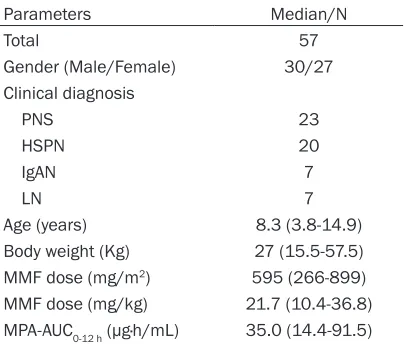
Clinical and biochemical characteristics of the 57 patients recruited for the study were sum-marized in Table 1. There were 23 cases (40.4%) with PNS, 20 cases (35.1%) with HSPN, seven cases (12.3%) with IgAN, and seven cases (12.3%) with LN enrolled in the study. Measurement of MPA-AUC0-12 h
The C0, C0.5, and C2 of all the 57 patients were detected and the MPA-AUC0-12 h was calculated
(Table 2). The MPA-AUC0-12 h ranged from 14.38
μg·h/mL to 91.47 μg·h/mL with an average value of 36.22. MAP-AUC0-12 h of 39 patents was more than the target value (68.4%, 30 μg·h/mL) [15, 16]. Then MPA-AUC0-12 h was normalized by MMF dose per body surface area or MMF dose per total body weight to analyze the effects of individual difference on MPA exposure variation
during treatment of MMF. The dose/body surface area-normalized MPA-AUC0-12 h was 38.6±15.5 μg·h/mL/600 mg/m2 and the coef-ficient of variation was 40.2%. The dose/total body weight-normalized MPA-AUC0-12 h was 1.75±0.73 μg·h/mL/mg/kg and the coefficient of variation was 41.7%.
Correlations of dose-normalized MPA-AUC0-12 h with clinical parameters in various glomerular diseases
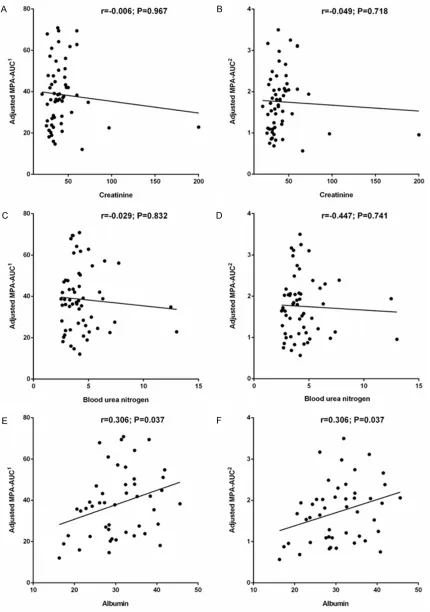
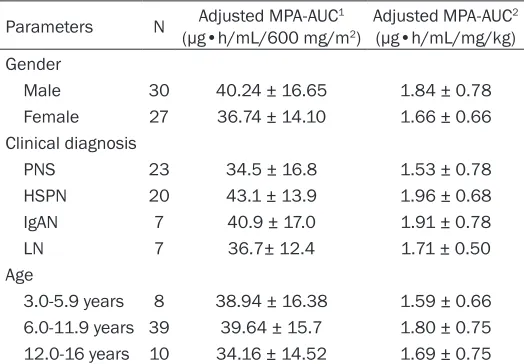
To reveal the factors that effecting dose-nor-malized MPA-AUC0-12 h (normalized by dose/ body surface area or dose/total body weight), its associations with age, weight, gender, serum GPT, creatinine, blood urea nitrogen, white blood cell count, hemoglobin level, pH value, plasma concentration of sodium, potassium, and calcium. The results suggested that only serum albumin was associated with dose-nor-malized MPA-AUC0-12 h (Figure 1 and Table 3). In addition, the patients were also grouped by clinical diagnosis type, gender, and age and then their dose-normalized MPA-AUC0-12 h was compared. Significant difference of dose-nor-malized MPA-AUC0-12 h was still not found among the patients stratified by disease type, gender, or age (Table 4).
Estimation of optimal minimum dosage of MMF in children with various glomerular dis-eases
There were 28 children among the 57 cases with a lower MPA-AUC0-12 h (< 30 μg·h/mL). Next, we tried to estimate MMF dosage (dose/body surface area) before treatment that could achieve targeted value of MPA-AUC0-12 h (30 μg·h/mL), although high variance existed in the dose-normalized MPA-AUC0-12 h. The ROC curves analyses suggested the area under the curve (AUC) in total children was 0.630 with 51.3% sensitivity and 77.8% specificity (Table 5, mini-mum MMF dose = 617.3 mg/m2). Considering the albumin was correlated dosed-normalized MPA-AUC0-12 h, the patients were grouped by 30 g/L albumin and the AUC in patients with albu-min < 30 g/L was 0.616 and that in patients with albumin ≥ 30 g/L was 0.684. In addition, although no significant difference of dose-nor-malized MPA-AUC0-12 h among different disease type was identified, a trend of difference between PNS and HSPN groups was observed (P < 0.1). Then the ROC curves were also
per-Table 1. Basic clinical features of the children
patients with steroid sensitive but frequently relapsing (or steroid dependent) nephrotic syn-drome, Henoch Schönlein puerperal nephritis, primary IgA nephropathy, and lupus nephritis
Parameters Median/N
Total 57
Gender (Male/Female) 30/27
Clinical diagnosis
PNS 23
HSPN 20
IgAN 7
LN 7
Age (years) 8.3 (3.8-14.9)
Body weight (Kg) 27 (15.5-57.5) MMF dose (mg/m2) 595 (266-899)
MMF dose (mg/kg) 21.7 (10.4-36.8) MPA-AUC0-12 h (μg·h/mL) 35.0 (14.4-91.5)
[image:3.612.91.293.133.305.2]Table 2. Pharmacokinetic profile of MPA during MMF treatment in children with various glomerular diseases
Case No. C0 (μg/mL) C0.5 (μg/mL) C2 (μg/mL) MPA-AUC0-12 h
(μg/mL) Adjusted MPA-AUC
1
(μg•h/mL/600 mg/m2) Adjusted MPA-AUC 2
(μg•h/mL/mg/kg)
1 0.96 6.1 1.94 23.33 22.89 0.96
2 0.47 1.18 1.76 15.97 12.08 0.57
3 6.59 39.66 4.45 91.47 61.03 2.49
4 2.44 5.73 2.89 34.96 34.82 1.94
5 0.1 11.92 0.92 19.69 20.80 0.84
6 0.19 17.85 3.15 30.20 50.38 2.05
7 0.22 2.56 1.34 14.38 14.67 0.83
8 0.65 2.21 8.45 34.18 38.56 1.64
9 2.21 17.6 3.21 43.27 37.12 1.90
10 3.7 11.93 3.53 49.41 39.13 1.58
11 1.38 13.48 2.08 32.01 36.10 1.54
12 3.02 5.76 6.57 47.69 42.06 2.19
13 0.93 24.3 3.56 40.90 28.47 1.25
14 1.23 12.31 1.51 28.76 35.46 1.52
15 0.87 2.81 7.66 34.15 27.04 1.09
16 1.04 2.33 4.6 27.45 35.13 1.46
17 0.88 24.27 1.46 35.45 35.74 1.68
18 0.72 28.68 2.04 39.18 37.84 2.08
19 0.56 7.39 1.39 20.38 23.84 1.02
20 3.53 10.45 14.14 72.96 69.46 3.11
21 0.92 21.51 0.85 32.13 22.82 0.96
22 4.08 0.89 2.57 41.15 64.20 2.74
23 1.09 16.84 2.28 33.16 42.02 2.04
24 1.43 25.74 1.43 40.07 43.51 1.84
25 1.75 15.36 5.15 43.30 43.30 2.02
26 2.6 30.36 3.95 57.30 69.44 2.98
27 2.25 14.04 4.58 44.15 36.29 1.81
28 1.92 15.15 3.28 39.70 54.78 2.38
29 0.46 6.17 2.15 20.65 25.89 1.12
30 1.32 18.66 2.15 35.72 38.80 1.64
31 1.27 29.7 2.02 43.47 33.91 1.45
32 1.34 5.96 2.4 26.81 44.82 1.93
33 0.46 5.02 2.14 19.75 18.13 0.75
34 4.02 4.97 2.52 43.74 70.86 3.50
35 2.12 26.31 1.4 44.91 36.37 1.80
36 0.62 5.35 1.48 19.44 38.87 1.81
37 1.3 1.82 8.02 37.06 57.14 2.30
38 1.3 35.94 3.44 51.86 61.82 3.25
39 0.75 5 1.08 19.04 20.28 0.86
40 1.2 11.53 2.47 30.30 24.55 1.21
41 0.48 13.97 1.38 24.84 21.31 1.09
42 1.88 6.42 3.21 32.63 22.52 0.98
43 0.43 3.92 0.97 15.88 18.90 0.88
44 1.25 2.52 2.92 24.87 56.11 2.39
45 2.16 5.16 8.06 45.28 67.91 3.17
ed on MMF exposure in children with glomeru-lar disease. In the present study, we evaluated the MPA-AUC0-12 h children with four types of glo-merular disease by limited sample strategy and investigated its association with clinical param-eters of the patients. And we estimated the optimal minimum MMF dosage when achieving target value of MPA-AUC0-12 h.
In view of the complexity of MPA pharmacoki-netics, it is impossible to confirm whether one particular therapeutic drug monitoring (TDM) strategy for dosage prediction and monitoring is more effective than any other. Although stud-ies have been performed regarding the effect of MPA pharmacokinetic parameters on MPAG or fMPA, MPA-AUC0-12 h is considered the stan-dard criterion for monitoring MPA as it is a reflection of exposure to the drug over the entire dosing period [17]. However, in the clini-cal setting, measuring the full AUC from 0-12 hours is impractical as it requires several blood samples over the 12 hour dosing interval. It is also expensive and difficult to perform in children.
To date, a large number of predictive formulas for measuring MPA-AUC have been developed using limited sampling strategies, however, it is not possible to conclude whether one particu-lar TDM strategy for dose prediction and moni-toring is more effective than another [14, 18-22]. Full 12-hour plasma AUCs are consid-ered the best marker for drug exposure [17], however, it is now widely recognized that the three-point or four-point method for evaluating MPA exposure is reasonable and acceptable in both adults and children [7, 23-27].
47 1.15 10.15 3.13 30.53 47.63 2.04
48 1.03 10.11 2.76 28.83 28.13 1.29
49 2.65 25.86 5.58 58.16 62.81 3.10
50 0.86 1.19 2 19.10 15.96 0.69
51 2.59 20.16 3.91 49.38 47.80 2.17
52 0.58 8.34 1.56 21.64 23.50 1.00
53 2.12 18.6 2.29 41.21 38.32 2.06
54 3.12 14.82 3.51 47.79 41.87 1.72
55 2.1 8.11 4.14 37.60 30.01 1.47
56 1.17 14.06 2.24 31.47 27.57 1.13
57 2.73 31.02 3.74 58.13 51.13 2.66
0, C0.5, and C2: MPA plasma concentrations before oral intake of MMF (C0), and at 30 min (C0.5) and 2 hours (C2). MPA-AUC, mycophenolic acid area under curve exposure; Adjusted MPA-AUC1, MPA-AUC
0-12 h normalized by dose/body surface area; Adjusted MPA-AUC2, MPA-AUC
0-12 h normalized by dose/total body weight.
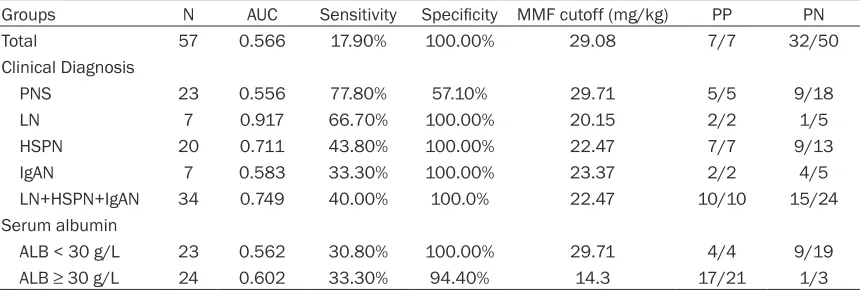
formed in subgroups stratified by disease type. The results indicated that AUC in PNS was smallest (0.560, MMF minimum dosage = 819.4 mg/m2). Its specificity was 100%, how-ever, the sensitivity was low (28.6%). In patients with LN, HSPN, or IgAN, the AUC was 1.000, 0.797, and 0.750, respectively. After including the patients with HSPN, LN or IgAN, the AUC was 0.829 with 64.0% sensitivity and 100% specificity and an optimal minimum MMF dos-age of 588.2 mg/m2. All the 18 patients treat-ed with ≥ 588.2 mg/m2 MMF achieved target value of MPA-AUC0-12 h and only seven patient among the 16 patients treated with < 588.2 mg/m2 MMF achieved the target value. The above results revealed that MPA-AUC0-12 h in PNS varied drastically in regard of MMF dose and MPA-AUC0-12 h should be monitored timely to adjust the MMF dosage. On the contrary, 588.2 mg/m2 might be used as an optimal min-imum dosage of MMF in children with LN, HSPN, or IgAN. MMF dose per total body weight was also used to estimate the optimal mini-mum dosage of MMF with the same method above (Table 6). However, almost all the area under the ROC were smaller than that in evalu-ating MMF dose per total surface area in over-all or in subgroups stratified by disease type or albumin level. The results suggested that using MMF dose per total body weight to estimate the optimal minimum MMF dosage was not the preferred choice.
Discussion
report-Figure 1. The correlation of dose-normalized MPA-AUC0-12 h with serum albumin. MPA-AUC0-12 h was normalized by dose/body surface area (adjusted MPA-AUC1) or dose/total body weight (adjusted MPA-AUC2). The correlation of
[image:6.612.93.523.72.684.2]As MMF exhibits wide inter- and intra-patient pharmacokinetic variability and the measure-ment of MPA-AUC0-12 h is complex and difficult, researchers have tried to determine alternative strategies, such as trough concentration and single concentration time points for dosage prediction and monitoring [28]. A study on acute vs. chronic graft versus host disease found a significant correlation between MPA trough levels and clinical response [29]. Another study performed on Indian renal trans-plant patients revealed that the trough
concen-Additionally, the pharmacokinetics of MMF metabolites in children may be affected by vari-ous factors (treatment duration, therapeutic indication, co-administered drugs, genetics, physiological factors, and environmental fac-tors, as well as kidney or liver dysfunction) [11, 30].
According to the literature, mycophenolate is the substrate of UGT [13], while prednisone, methylprednisolone, or prednisolone have no interaction with UGT [31]. Meanwhile,
predni-Table 3. The Pearson correlation analysis between dose-normalized MPA-AUC0-12 h exposure and
serum biochemical characteristics
Serum biochemical parameters Mean ± SD Adjusted MPA-AUC1 Adjusted MPA-AUC2
r1 P1 r1 P1
Creatinine (μmol/L) 43 ± 25 -0.006 0.967 -0.049 0.718
Blood urea nitrogen (mmol/L) 4.4 ± 2.0 -0.029 0.832 -0.447 0.741
Albumin (g/L) 30.6 ± 7.0 0.306 0.037* 0.306 0.037*
GPT (u/L) 17.3 ± 11.3 -0.133 0.324 -0.095 0.482
Leukocytes (109/L) 10.2 ± 3.9 -0.08 0.559 -0.027 0.845
Hemoglobin (g/L) 133 ± 13 0.017 0.9 0.034 0.800
Potassium (mmol/L) 3.5 ± 0.4 -0.191 0.531 -0.224 0.461
Sodium (mmol/L) 139 ± 3.8 0.451 0.122 0.470 0.105
Calcium (mmol/L) 1.1 ± 0.08 0.271 0.42 0.164 0.630
pH 7.39 ± 0.07 -0.075 0.807 0.026 0.933
PA-AUC, mycophenolic acid area under curve exposure; Adjusted MPA-AUC1, MPA-AUC
0-12 h normalized by dose/body surface area; Adjusted MPA-AUC2, MPA-AUC
[image:7.612.92.523.98.255.2]0-12 h normalized by dose/total body weight; *A P value < 0.05 was considered statistically significant.
Table 4. The dose-normalized MPA-AUC0-12 h in 57 patients
grouped by gender, disease, and age Parameters N (μg•h/mL/600 mg/mAdjusted MPA-AUC12)
Adjusted MPA-AUC2
(μg•h/mL/mg/kg) Gender
Male 30 40.24 ± 16.65 1.84 ± 0.78
Female 27 36.74 ± 14.10 1.66 ± 0.66
Clinical diagnosis
PNS 23 34.5 ± 16.8 1.53 ± 0.78
HSPN 20 43.1 ± 13.9 1.96 ± 0.68
IgAN 7 40.9 ± 17.0 1.91 ± 0.78
LN 7 36.7± 12.4 1.71 ± 0.50
Age
3.0-5.9 years 8 38.94 ± 16.38 1.59 ± 0.66 6.0-11.9 years 39 39.64 ± 15.7 1.80 ± 0.75 12.0-16 years 10 34.16 ± 14.52 1.69 ± 0.75 Abbreviations: PNS, primary nephrotic syndrome; HSPN, Henoch schönlein purpura nephritis; IgAN, primary IgA nephropathy; LN, lupus nephritis; MPA-AUC, mycophenolic acid area under curve exposure. Adjusted MPA-AUC1, MPA-AUC0-12 h normalized by dose/body surface area; Adjusted MPA-AUC2, MPA-AUC0-12 h normalized by dose/total body weight.
tration of MPA significantly correlat-ed with AUC0-12 h (r = 0.69). However, if dosing in routine clinical practice was adjusted based on trough con-centration alone, 41% of patients [25] would require a different dose compared with monitoring using AUC0-12.
[image:7.612.90.352.332.514.2]sone, methylprednisolone, and prednisolone are substrates of CYP3A4 [32], and no effect of mycophenolate on CYP3A4 has been reported. Furthermore, no effect of prednisone on myco-phenolic acid (MPA) trough concentration has been reported in the literature [33], and no impact of methylprednisolone on MPA pharma-cokinetic parameters has been reported in the literature [21].
We also compared the MPA-AUC0-12 h in children with different glomerular diseases and found no differences among the four types of disease studied other than the influence of albumin on MPA-AUC0-12 h in children.
Honarbakhsh et al. [34] studied 31 Iranian patients who received kidney transplants and also received fixed doses of MMF for six months. They found no significant correlation between MPA-AUC0-12 h and age, weight, or MMF daily dosage. We compared the MPA-AUC with different ages and genders in our study, but found no differences. However, a significant correlation was noted between the dose-nor-malized exposure and the age when studying 28 children who received a combination thera-py of MMF and tacrolimus [30].
[image:8.612.95.522.98.244.2]Another study was conducted to characterize the pharmacokinetic parameters of MPA in
Table 5. Estimation of optimal minimum MMF dosage (dose/total body surface) achieving the target
value of MPA-AUC0-12 h (30 μg·h/mL) in children with various glomerular diseases with ROC analysis
Groups N AUC Sensitivity Specificity MMF cutoff (mg/m2) PP PN
Total 57 0.630 51.3% 77.8% 614.8 20/25 5/22
Clinical Diagnosis
PNS 23 0.560 28.6% 100.0% 819.4 4/4 10/19
LN 7 1.000 100.0% 100.0% 594.1 3/3 0/4
HSPN 20 0.797 62.5% 100.0% 563.4 10/10 6/10
IgAN 7 0.750 66.7% 100.0% 554.0 5/5 1/2
LN+HSPN+IgAN 34 0.829 64.0% 100.0% 588.2 18/18 7/16
Serum albumin
ALB < 30 g/L 23 0.616 30.8% 90.0% 717.7 4/5 9/18
ALB ≥ 30 g/L 24 0.684 36.8% 100.0% 667.9 6/6 12/18
Abbreviations: PNS, primary nephrotic syndrome; HSPN, Henoch schönlein purpura nephritis; IgAN, primary IgA nephropathy; LN, lupus nephritis; AUC, area under receiver operating characteristics curve; ALB, albumin; PP: patient proportion with MPA-AUC0-12 h > 30 μg·h/mL in patients treated with MMF dose more than cutoff value; PP: patient proportion with MPA-AUC0-12 h > 30 μg·h/mL in patients treated with MMF dose less than cutoff value.
Table 6. Estimation of optimal minimum MMF dosage (dose/total body weight) achieving the target
value of MPA-AUC0-12 h (30 μg·h/mL) in children with various glomerular diseases with ROC analysis
Groups N AUC Sensitivity Specificity MMF cutoff (mg/kg) PP PN
Total 57 0.566 17.90% 100.00% 29.08 7/7 32/50
Clinical Diagnosis
PNS 23 0.556 77.80% 57.10% 29.71 5/5 9/18
LN 7 0.917 66.70% 100.00% 20.15 2/2 1/5
HSPN 20 0.711 43.80% 100.00% 22.47 7/7 9/13
IgAN 7 0.583 33.30% 100.00% 23.37 2/2 4/5
LN+HSPN+IgAN 34 0.749 40.00% 100.0% 22.47 10/10 15/24
Serum albumin
ALB < 30 g/L 23 0.562 30.80% 100.00% 29.71 4/4 9/19
ALB ≥ 30 g/L 24 0.602 33.30% 94.40% 14.3 17/21 1/3
[image:8.612.92.522.336.481.2]Korean kidney transplant recipients. Patients’ age, weight, body surface area, and renal func-tion did not influence the MPA-AUC0-12 h. But the MPA-AUC0-12 h was significantly different between men and women in spite of the small number of cases studied. They concluded that the free fraction of MPA (fMPA) was not affect-ed by renal function when the creatinine clear-ance was above 40 mL/min [35].
In the current study, we found a correlation between MPA-AUC and albumin but not between MPA-AUC and creatinine. Many stud-ies in the past have indicated that MPA-AUC was related to albumin in organ transplant patients. Recent research on patients after liver transplantation found an inverse relation-ship between serum albumin concentration and MPA clearance (r2 = 0.12, P < 0.05). They also found a significant relationship between creatinine clearance and MPA clearance [27]. Another study in children with PNS found a sig-nificant positive correlation between MPA clear-ance and serum albumin levels less than 30 g/L, but not for serum albumin levels greater than 30 g/L [26]. On the other hand, Zhao et al. [36] studied twenty-three children with PNS and found body weight and serum albumin had a significant impact on MPA clearance. As MPA is bound extensively to serum albumin, the loss of binding protein might lead to greater elimina-tion of MPA by the kidney which might then influence the MPA concentration in the blood and the AUC. The reason that we did not find a correlation between creatinine or blood ureani-trogenand MPA-AUC may be due the fact that the eGFR in all patients recruited was more than 90 ml/min.
No relationship between MPA-AUC0-12 h and serum white blood cell count or hemoglobin level was found. We also did not find any corre-lation between serum pH values, or sodium, potassium, or calcium concentrations and MPA-AUC0-12 h, although Kamińska et al. [37] reported that MMF treatment decreased the plasma sodium concentration and concluded that MMF may affect sodium balance.
In addition, the previous reports suggested that MPA-AUC ≥ 30 μg·h/mL can be used to predict-ed favorable remission in steroid-dependent/ frequent relapsing nephrotic syndrome [15, 16] and was used as a target value. Given that MPA-AUC0-12 h was correlated with MMF dose
per body surface area, we investigated optimal minimum MMF dose achieving the target value of MPA-AUC ≥ 30 μg·h/mL. In total patients and subgroups divided by albumin levels, the factor associated with dose-normalized MPA-AUC0-12 h, AUC and the sensitivity were relative small. After stratification by disease type, the AUC in PNS was only 0.560, however, in the patients with LN, HSPN, or IgAN, the AUC reached up to and anoptimal cutoff of MMF dosage of 588.2 mg/m2 was obtained. The patients with MMF dosage more than 588.2 mg/m2 all achieved the target value of 30 μg·h/mL (18 cases) and seven patients of the left 16 patients whose MMF dosage less than 30 μg·h/mL achieved the target value. The results suggested that MMF efficacy in PNS varied drastically and MPA-AUC0-12 h should be monitored in timely, but in patient with LN, HSPN, or IgAN, 588.2 mg/m2 MMF might be used as an initial dosage and detection of MPA-AUC0-12 h could be avoid. The conclusions should be verified in more pro-spective independent cohorts with large scale samples.
In summary, MPA-AUC exposure in children with glomerular disease displayed individual differ-ences. Plasma albumin levels were found to be associated with MPA-AUC. 588.2 mg/m2 MMF could be used an initial dosage to ensure the MPA-AUC0-12 h in the patients with LN, HSPN, or IgAN achieving the target value of 30 μg·h/mL while MPA-AUC varied largely in PNS and should be monitored in time to adjust MMF dosage.
Acknowledgements
This study was supported by the National Natural Foundation of China (81470939, 81270792 and 81170664), the Specialized Research Fund for the Doctoral Program of Higher Education (20120101110018) and the Science Foundation of Zhejiang Educational Committee (Y201636381). We wish to thank all patients and their family members for par-ticipating in this study.
Disclosure of conflict of interest
None.
Abbreviations
nephropathy; LN, lupus nephritis; MMF, myco-phenolate mofetil; MPA, mycophenolic acid; MPAG, MPA glucuronide; PNS, primary nephrot-ic syndrome; UGT, uridine diphosphate glu- curonosyltramsferase.
Address correspondence to: Dr. Haidong Fu, De- partment of Nephrology, The Children’s Hospital of Zhejiang University School of Medicine, Hangzhou 310003, Zhejiang Province, China. Tel: 0086-571-88873701; Fax: 0086-571-87033296; E-mail: [email protected]
References
[1] Ulinski T, Aoun B. New treatment strategies in idiopathic nephrotic syndrome. Minerva Pediatr 2012; 64: 135-143.
[2] Ulinski T, Aoun B. Pediatric idiopathic nephrotic syndrome: treatment strategies in steroid de-pendent and steroid resistant forms. Curr Med Chem 2010; 17: 847-853.
[3] Rissling O, Glander P, Hambach P, Mai M, Brakemeier S, Klonower D, Halleck F, Singer E, Schrezenmeier EV, Durr M, Neumayer HH, Budde K. No relevant pharmacokinetic interac-tion between pantoprazole and mycopheno-late in renal transplant patients: a randomized crossover study. Br J Clin Pharmacol 2015; 80: 1086-1096.
[4] Baudouin V, Alberti C, Lapeyraque AL, Bensman A, Andre JL, Broux F, Cailliez M, Decramer S, Niaudet P, Deschenes G, Jacqz-Aigrain E, Loirat C. Mycophenolate mofetil for steroid-dependent nephrotic syndrome: a phase II Bayesian trial. Pediatr Nephrol 2012; 27: 389-396.
[5] van Husen M, Kemper MJ. New therapies in steroid-sensitive and steroid-resistant idio-pathic nephrotic syndrome. Pediatr Nephrol 2011; 26: 881-892.
[6] Kang Z, Li Z, Duan C, Wu T, Xun M, Ding Y, Zhang Y, Zhang L, Yin Y. Mycophenolate mofetil therapy for steroid-resistant IgA nephropathy with the nephrotic syndrome in children. Pediatr Nephrol 2015; 30: 1121-1129.
[7] Gellermann J, Weber L, Pape L, Tonshoff B, Hoyer P, Querfeld U; Gesellschaft für Pädiatrische Nephrologie (GPN). Mycophe- nolate mofetil versus cyclosporin a in children with frequently relapsing nephrotic syndrome. J Am Soc Nephrol 2013; 24: 1689-1697. [8] Basu B, Mahapatra TK, Mondal N. Myco-
phenolate mofetil following rituximab in chil-dren with steroid-resistant nephrotic syn-drome. Pediatrics 2015; 136: e132-139. [9] Luszczynska P, Pawinski T. Therapeutic drug
monitoring of mycophenolic acid in lupus ne-phritis: a review of current literature. Ther Drug Monit 2015; 37: 711-717.
[10] Lombel RM, Gipson DS, Hodson EM; Kidney Disease: Improving Global Outcomes. Treat- ment of steroid-sensitive nephrotic syndrome: new guidelines from KDIGO. Pediatr Nephrol 2013; 28: 415-426.
[11] Parant F, Rivet C, Boulieu R, Gagnieu MC, Dumortier J, Boillot O, Lachaux A. Age-related variability of mycophenolate mofetil exposure in stable pediatric liver transplant recipients and influences of donor characteristics. Ther Drug Monit 2009; 31: 727-733.
[12] Abd Rahman AN, Tett SE, Staatz CE. How ac-curate and precise are limited sampling strate-gies in estimating exposure to mycophenolic acid in people with autoimmune disease? Clin Pharmacokinet 2014; 53: 227-245.
[13] Staatz CE, Tett SE. Clinical pharmacokinetics and pharmacodynamics of mycophenolate in solid organ transplant recipients. Clin Pharma- cokinet 2007; 46: 13-58.
[14] Pawinski T, Hale M, Korecka M, Fitzsimmons WE, Shaw LM. Limited sampling strategy for the estimation of mycophenolic acid area un-der the curve in adult renal transplant patients treated with concomitant tacrolimus. Clin Chem 2002; 48: 1497-1504.
[15] Graff J, Scheuermann EH, Brandhorst G, Oellerich M, Gossmann J. Pharmacokinetic analysis of mycophenolate mofetil and enteric-coated mycophenolate sodium in calcineurin-inhibitor-free renal transplant recipients. Ther Drug Monit 2016; 38: 388-92.
[16] Tong K, Mao J, Fu H, Shen H, Liu A, Shu Q, Du L. The value of monitoring the serum concen-tration of mycophenolate mofetil in children with steroid-dependent/frequent relapsing ne-phrotic syndrome. Nephron 2016; 132: 327-334.
[17] Tett SE, Saint-Marcoux F, Staatz CE, Brunet M, Vinks AA, Miura M, Marquet P, Kuypers DR, van Gelder T, Cattaneo D. Mycophenolate, clinical pharmacokinetics, formulations, and methods for assessing drug exposure. Transplant Rev (Orlando) 2011; 25: 47-57.
[18] Bullingham RE, Nicholls AJ, Kamm BR. Clinical pharmacokinetics of mycophenolate mofetil. Clin Pharmacokinet 1998; 34: 429-455. [19] Weber LT, Schutz E, Lamersdorf T, Shipkova M,
Niedmann PD, Oellerich M, Zimmerhackl LB, Staskewitz A, Mehls O, Armstrong VW, Tonshoff B. Therapeutic drug monitoring of total and free mycophenolic acid (MPA) and limited sam-pling strategy for determination of MPA-AUC in paediatric renal transplant recipients. The German Study Group on Mycophenolate Mofetil (MMF) Therapy. Nephrol Dial Transplant 1999; 14 Suppl 4: 34-35.
[21] Kuypers DR, Claes K, Evenepoel P, Maes B, Coosemans W, Pirenne J, Vanrenterghem Y. Long-term changes in mycophenolic acid expo-sure in combination with tacrolimus and corti-costeroids are dose dependent and not reflect-ed by trough plasma concentration: a prospec-tive study in 100 de novo renal allograft recipi-ents. J Clin Pharmacol 2003; 43: 866-880. [22] Filler G. Abbreviated mycophenolic acid AUC
from C0, C1, C2, and C4 is preferable in chil-dren after renal transplantation on mycophe-nolate mofetil and tacrolimus therapy. Transpl Int 2004; 17: 120-125.
[23] Weber LT, Hoecker B, Armstrong VW, Oellerich M, Tonshoff B. Validation of an abbreviated pharmacokinetic profile for the estimation of mycophenolic acid exposure in pediatric renal transplant recipients. Ther Drug Monit 2006; 28: 623-631.
[24] Le Meur Y, Buchler M, Thierry A, Caillard S, Villemain F, Lavaud S, Etienne I, Westeel PF, Hurault de Ligny B, Rostaing L, Thervet E, Szelag JC, Rerolle JP, Rousseau A, Touchard G, Marquet P. Individualized mycophenolate mofetil dosing based on drug exposure signifi-cantly improves patient outcomes after renal transplantation. Am J Transplant 2007; 7: 2496-2503.
[25] Mathew BS, Fleming DH, Annapandian VM, Prasanna S, Prasanna CG, Chandy SJ, John GT. A reliable limited sampling strategy for the esti-mation of mycophenolic acid area under the concentration time curve in adult renal trans-plant patients in the stable posttranstrans-plant pe-riod. Ther Drug Monit 2010; 32: 136-140. [26] Saint-Marcoux F, Guigonis V, Decramer S,
Gandia P, Ranchin B, Parant F, Bessenay L, Libert F, Harambat J, Bouchet S, Broux F, Compagnon P, Marquet P. Development of a Bayesian estimator for the therapeutic drug monitoring of mycophenolate mofetil in chil-dren with idiopathic nephrotic syndrome. Pharmacol Res 2011; 63: 423-431.
[27] Langers P, Press RR, Inderson A, Cremers SC, den Hartigh J, Baranski AG, van Hoek B. Limited sampling model for advanced myco-phenolic acid therapeutic drug monitoring af-ter liver transplantation. Ther Drug Monit 2014; 36: 141-147.
[28] Kuypers DR, Le Meur Y, Cantarovich M, Tredger MJ, Tett SE, Cattaneo D, Tonshoff B, Holt DW, Chapman J, Gelder T; Transplantation Society (TTS) Consensus Group on TDM of MPA. Consensus report on therapeutic drug moni-toring of mycophenolic acid in solid organ transplantation. Clin J Am Soc Nephrol 2010; 5: 341-358.
[29] Hiwarkar P, Shaw BE, Tredger JM, Brown NW, Kulkarni S, Saso R, Evans S, Treleaven J, Davies FE, Ethell ME, Morgan GJ, Potter MN. Mycophenolic acid trough level monitoring: rel-evance in acute and chronic graft versus host disease and its relation with albumin. Clin Transplant 2011; 25: 222-227.
[30] Filler G, Foster J, Berard R, Mai I, Lepage N. Age-dependency of mycophenolate mofetil dosing in combination with tacrolimus after pediatric renal transplantation. Transplant Proc 2004; 36: 1327-1331.
[31] Palanca Arias D, Jorda Lope A, Saiz Ibanez F, Gonzalez-Lamuno Leguina D. Mycophenolate mofetil in four patients with nephrotic syn-drome and focal segmental glomerulosclero-sis. Acta Pediatrica Espanola 2011; 69: 416-420.
[32] Pichard L, Fabre I, Daujat M, Domergue J, Joyeux H, Maurel P. Effect of corticosteroids on the expression of cytochromes P450 and on cyclosporin A oxidase activity in primary cul-tures of human hepatocytes. Mol Pharmacol 1992; 41: 1047-1055.
[33] Gregoor PJ, de Sevaux RG, Hene RJ, Hesse CJ, Hilbrands LB, Vos P, van Gelder T, Hoitsma AJ, Weimar W. Effect of cyclosporine on mycophe-nolic acid trough levels in kidney transplant recipients. Transplantation 1999; 68: 1603-1606.
[34] Honarbakhsh N, Rouini MR, Lesan-Pezeshki M, Javadi MR, Karimzadeh I, Mohebbi N, Gholami K. Mycophenolic acid pharmacokinet-ics early after kidney transplant. Exp Clin Transplant 2013; 11: 112-117.
[35] Cho EK, Han DJ, Kim SC, Burckart GJ, Venkataramanan R, Oh JM. Pharmacokinetic study of mycophenolic acid in Korean kidney transplant patients. J Clin Pharmacol 2004; 44: 743-750.
[36] Zhao W, Elie V, Baudouin V, Bensman A, Andre JL, Brochard K, Broux F, Cailliez M, Loirat C, Jacqz-Aigrain E. Population pharmacokinetics and Bayesian estimator of mycophenolic acid in children with idiopathic nephrotic syndrome. Br J Clin Pharmacol 2010; 69: 358-366. [37] Kaminska J, Sobiak J, Suliburska JM, Duda G,