Abstract
—
The Call admission control (CAC) is a Radio Resource Management (RRM) technique that plays instrumental role in ensuring the desired Quality of Service (QoS) to the users working on different applications with diversified QoS requirements in next generation wireless networks (NGWN). This paper proposes an Analytical system model and the stochastic activity network (SAN) based performance model and an intelligent fuzzy neural model for call admission control for a multi class traffic based Next Generation Wireless Networks. The performance study is made between the analytical model and SAN model .The paper proposes an intelligent Fuzzy Neural call admission control (FNCAC) scheme - an integrated CAC module that combines the linguistic control capabilities of the fuzzy logic controller and the learning capabilities of the neural networks to make the CAC decision. The simulation results are optimistic and indicate that the proposed FNCAC algorithm achieves minimal call blocking probability and performs better when compared to Fuzzy logic based CAC and Conventional CAC methods.Index terms
—
Call admission control, Call blocking probability, Next generation wireless Networks, Fuzzy neural networks, Radio resource management.I. INTRODUCTION
The researchers community strongly believe that the next generation wireless networks will include multiple wireless access technologies, all of which will coexist in a heterogeneous wireless access network environment[1,2] and use a common IP core to realize user-focused service delivery.
The Manuscript received on January 27, 2010.
Ramesh Babu H.S. is with Department of Information Science and Engineering , Acharya Institute of Technology ( affiliated to Visvesvaraya Technological University), Bangalore-560090, INDIA , (phone +91 9448953800, [email protected])
Gowrishankar is with Department of Computer Science and Engineering, B.M.S. College of Engineering, (affiliated to Visvesvaraya Technological University), Bangalore-560019, INDIA ([email protected]) Satyanarayana P.S is with City Engineering College (affiliated to Visvesvaraya Technological University), Bangalore-560062, INDIA, ([email protected])
The coexistence of Heterogeneous radio access technologies (RATs) will noticeably amplify the intensity in development of different high-speed multimedia services, such as video on demand, mobile gaming, Web browsing, video streaming, voice over IP and e-commerce etc. Seamless inter system roaming across heterogeneous wireless access networks will be a major feature in the architecture of next generation wireless networks [3].The future users of mobile communication look for always best connected (ABC), anywhere and anytime in the Complementary access technologies like Wireless Local Area Networks (WLAN), Worldwide Inter operability for Microwave Access (Wi-Max) and Universal Mobile Telecommunication Systems (UMTS) and which may coexist with the satellite networks [4- 6].It is very well evident that no single RAT can provide ubiquitous coverage and continuously high quality service. The mobile users may have to roam among various radio access technologies to keep the network connectivity active to meet the applications/users requirements. With the increase in offered services and access networks, efficient user roaming and management of available radio resources becomes decisive in providing the network stability and QoS provisioning. There are many call admission control(CAC) algorithms proposed in the literature to handle single-class network traffic such as real-time traffic like voice calls [7-10].To serve the multiple classes of traffic we have the Partitioning CAC [11][12] and threshold based CAC [13] .The paper proposes the CAC framework for multi traffic based heterogeneous wireless networks . The resource allocation is a challenging task as the resources are always in scarce in a wireless environment. The efficient and intelligent call admission control policies should be in place which can take care of this contradicting environment to optimize the resource utilization. There are works reported on computation intelligence based call admission control algorithms. These algorithms admit or reject the call by applying computational intelligence techniques like fuzzy logic [14], Genetic algorithm [15], and fuzzy logic with MADM (multi attribute decision making) [16]. The combination of fuzzy and neural networks which forms a hybrid fuzzy neural network (FNN) is used for the radio resource management [17]. These intelligent techniques
An Intelligent Fuzzy Neural Call Admission
Control Mechanism for Guaranteed QoS in
Heterogeneous Wireless Networks
exhibit better efficiency which leads to higher user’s satisfaction. In this paper we propose a fuzzy neural approach based call admission control in a multi class traffic based NGWN. The proposed FNCAC scheme is an integrated CAC module that combines the linguistic control capabilities of the fuzzy logic controller and the learning capabilities of the neural networks. The CAC model is developed using fuzzy neural system based on Recurrent Radial Basis Function Networks (RRBFN). RRBFN has better learning and adaptability that can be used to develop the intelligent system to handle the incoming traffic in the heterogeneous network environment. The proposed FNCAC can achieve reduced call blocking probability keeping the resource utilisation at an optimal level. In the proposed algorithm we have considered three classes of traffic having different QoS requirements and a heterogeneous network environment which can effectively handle this traffic. The traffic classes taken for the study are Conversational traffic, Interactive traffic and back ground traffic which are with varied QoS parameters.
The further sections of the paper are organized as follows. The section II discusses on the soft computing techniques in RRM. The SAN based performance model is presented in section III. The section IV discusses the proposed intelligent FNCAC model. The section V represents the simulation results. The conclusion and future work is indicated in section VI.
II. SOFT COMPUTING TECHNIQUES FOR RRM
The application of intelligent techniques has become wide spread for nonlinear time varying and complex problems that were posing a great challenge to researchers when they used the conventional methods. These soft computing techniques such as fuzzy logic, artificial neural networks and the hybrid systems like fuzzy neural networks have outperformed the conventional algorithmic methods. The advantages of these methods are many, which include most notably learning from experience, scalability, adaptability, moreover the ability to extract the rules without the detailed or accurate mathematical modelling. All these features make the soft computing techniques the best candidates for
solving the complex problems in any domain.
2.1 Fuzzy Logic
The concept of Fuzzy logic has been extensively applied in characterizing the behaviour of nonlinear systems. The nonlinear behaviour of the system can be effectively captured and represented by a set of Fuzzy rules [18]. Many engineering and scientific applications including time series are not only nonlinear but also non-stationary. Such applications cannot be represented by simple Fuzzy rules, because fixed number of rules can describe time invariant systems only and cannot take in to account the non-stationary behaviour. Recently, a new set of Fuzzy rules have been defined to predict the difference of consecutive values of non-stationary time series [19].
The Advantages of Fuzzy Logic approach [20] are easy to understand and build a predictor for any desired accuracy with a simple set of Fuzzy rules, no need of mathematical model for estimation and fast estimation of future values due to the less computational demand. The Limitations of Fuzzy Logic approach is that it works on Single step prediction and it does not have learning capability.
2.2. Neural networks
The neural networks are low-level computational elements that exhibit good performance when they deal with sensory data. They can be applied to the situation where there is sufficient observation data available. The Neural network method is used in any problem of control, prediction and classification. Neural Networks are able to gain this popularity because of the commanding capacity they have in modeling exceptionally complex non linear functions. Neural networks have a biggest advantage in terms of easy to use which is based on training-prediction cycles. Training the neural networks plays crucial role in the system usage of neural networks. The training pattern that contains a predefined set of inputs and expected outputs is used to train the neural networks. Next, in prediction cycle, the outputs
y
y
y
y
w
w
H
id
d
e
n
t
r
an
sf
er
f
u
n
ct
ion
O
u
tp
u
t t
r
an
sf
er
f
u
n
c
ti
on
Bias unit Bias unit
Hidden Layer Output Layer
[image:2.595.156.476.552.718.2]Input Layer
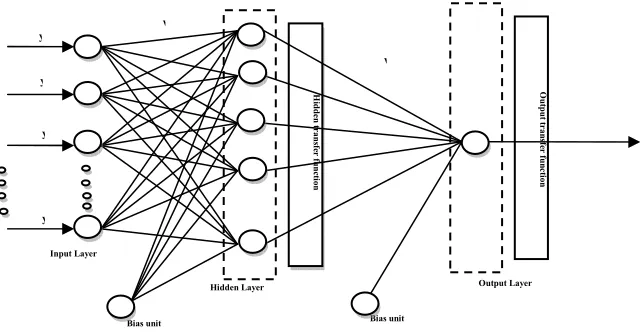
are supplied to the user based on the input values. To make the neural networks to behave like a physical system or predict or control the training set used in the training cycle shall consist of enough information representing all the valid cases [21-23]. Neural Networks are flexible soft computing frameworks for modeling a broad range of nonlinear problems [24]. One significant advantage of the neural network based approach over other classes of nonlinear models is that NNs are universal approximation tools that can approximate large class of functions with a high degree of accuracy [25]. This approximation power of Neural Network model comes from several parallel processing elements, called as ‘neurons’. No prior assumption of the model form is required in the model building process. Instead, the network model is largely determined by characteristics of the data. Single hidden layer feed forward network is the most widely used model for prediction and forecasting of time variant functions. The model is characterized by a network of three layers of simple processing unit connected by non-cyclic links. The architecture of feed-forward neural network is shown in Figure 1.
The relationship between the output y tˆ ( ) and the inputs
{ (y t−1), (y t−2), ..., (y t−n)} can be mathematically
expressed as [26],
Where wi j(i = 0 , 1, 2 . . . . ,n, j = 1 , 2 , . . . . ,Q) and
( 0 , 1 , 2 , . . . . , )
j
w j = Q are model parameters often called connection weights, n is the number of input nodes and Q is the number of hidden nodes.
g
(.)
Represents a transfer function of the processing element, the transfer function can be logistic or Gaussian [27]. The NN model having a logistic or Gaussian transfer function can perform nonlinear functional mapping from the past observation to the future valuey t
ˆ( )
i.e.( )
ˆ ( ) ( 1) , ... ( ) , ( )
y t = f y t− y t−n W +e t . (2)
Where W is a vector of all input parameters and f
( )
. is function determined by network structure and connection weights. Thus, the neural network model is equivalent to nonlinear auto regressive model.The feed forward network can effectively model nonlinear time series. The time-varying wireless network parameters are represented as nonlinear and non-stationary time series. The recurrent connection in NN architecture is also called as ‘short term memory’ and will process the non-stationary behaviour of the time series.
The feed forward NNs can be divided into two classes: static (non-recurrent) and dynamic (recurrent). Static NNs are those, whose output is a linear or nonlinear function of its inputs and for a given input vector generates the same output. These NNs are suitable for spatial pattern analysis. In this case, the relevant information is distributed throughout the spatial coordinates of the input vector. The spatial dependencies in the input data can be found in the areas of pattern recognition and functional approximation [28]. In contrast, dynamic NNs are capable of implementing memories which gives them the possibility of retaining information to be used later. The network can also generate diverse output in response with the same input vector, because the output may also depend on actual state of the memories. Dynamic NNs have inherent characteristic of memorizing the past information for long term or short term periods. These networks are ideal for processing spatio-temporal data. The Recurrent Neural Network (RNN) architecture can be classified into fully interconnected nets, partially connected nets and Locally Recurrent & Globally Feed-forward (LRGF) nets [29].
There are good amount of work reported on the combination of neural and fuzzy logic approaches. This paper concentrates on the recurrent neural networks (RNNs) that have superior capabilities than the feed forward neural networks [32-33]. Since a recurrent neuron has an internal feedback loop to capture the dynamic response of a system without external feedback through delays. The RNNs have the ability to deal with time-varying input or output through their own natural temporal operation [32]. Moreover; the RNNs have dynamic mapping and demonstrate good control performance in the presence of un-modelled dynamics, parameter variations, and external disturbances [32-33]. The RBFN has a faster convergence property than a multilayer perceptron (MLP) because the RBFN has a simple structure. Additionally, the RBFN has a similar feature to the fuzzy system. First, the output value is calculated using the weighted sum method. Then, the number of nodes in the hidden layer of the RBFN is same as the number of if–then rules in the fuzzy system. Finally, the receptive field functions of the RBFN are similar to the membership functions of the premise part in the fuzzy system. This makes the RBFN a very useful technique to be applied to control the dynamic systems. The implementation of RBFN bases using RBFN for recurrent RBFN based FNN improves the accuracy of the approximation function.
The benefits of neural network approach [27] are as follows. First, the NN Prediction accuracy is much superior to conventional approaches. Second, NN Model can be used for single and Multi step forecasting. Third, they are capable of learning the system and demands low computation structures. The limitations of NN approach are: The optimal choice of number of layers and number of neurons in each layer is a heuristic process and it requires expertise in the field of NNs for a model designer. Deciding of the weights to the non-cyclic links will determine the accuracy of forecasting. However, deciding the appropriate weights to the link is once again a heuristic process.
0
1 1
ˆ ( ) ( ) ( )
Q n
j o j ij
j i
y t w w g w w y t i e t
= =
= + + − +
∑
∑
.III. SAN BASED PERFORMANCE MODEL
The SAN is the a stochastic extension of Petri Networks in which the capacity to define temporary characteristics with statistical parameters has been added. The SAN exhibits the innovative graphics which allow the researchers to represent a model with high level of formal specification, expression of behaviours and dependency of the system in an uncomplicated and straightforward way. Petri Nets can in general be considered to constitute a method to model distributed, asynchronous concurrent systems, which have parallel characteristics. It is possible to study the performance and evolution of the system easily using Petri nets as they combine graphic design and extensive mathematical theory to represent a system model. It allows us to graphically construct the model in an spontaneous way by means of basic elements that are interconnected. It is possible to observe the evolution of the model over time and this evolution is determined by the imposed conditions in the graphic definition. It is possible to formulate mathematical equations to determine the performance of the system, as well as its theoretical characteristics. Adding to these features it can also provide feature of analysing, executing or simulating in a computer which is the fundamental capability that Mobius allows us.
The SAN, a variant of stochastic Petri nets, consist of four primitives: places, activities, input gates and output gates.
Places, represented by circles, represent the “state” of the modelled system in other words Place represents the state of the resource and in the proposed model the channel availability state is a Place. The place may contain tokens.
The token is used to represent the instances of a resource for example in the proposed model each channel is represented as a token. Activities (“transitions” in Petri net terminology) represent actions of the modelled system that will change the state of the system, and are of two types: (a) Timed and
(b) Instantaneous. Timed activities (denoted by hollow
vertical bars) have durations which impact the performance of the modelled system. Instantaneous activities (denoted by a thick vertical bar) represent actions that complete in a negligible amount of time compared to other activities in a system.
Firing interval of the timed activity can be any continuous distribution, and in this model new user arrival is the activity.
Input gates have a finite set of inputs and one output, each
input gate is associated with input predicate. The predicate
can define inhibitory condition to each timed or instantaneous activity, here horizontal and vertical guard channel definition act as an inhibitory predicate to the new user arrival. The output gates have finite set of output and single input, each output gate has associated output function and will specify the action to be taken upon completion of the activity. In the proposed model the fading activity will deposit token from place channel availability to channel unavailability. The major challenge in building the practical System-level dependability model needs an efficient modelling environment. There are many modelling tools that are dealing with largeness and complexity in the systems being modelled. These modelling
tools can easily represent, solve, and analyse toy models or highly abstracted system representations. The Mobius is one such modelling tool that is able to address these issues. It provides multiple primitive modelling components facilitating the representation of each part of a system in the study that is most appropriate.
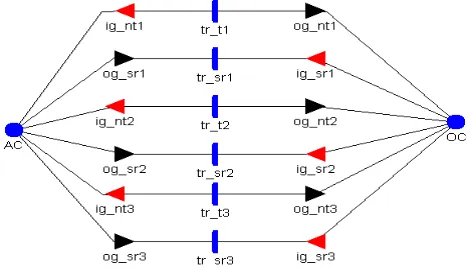
A SAN performance model for the channel usage of type1, type2, and type3 traffic are specified in Figure 2. The performance model of the proposed system is shown in Figure 5 and primitive components used in the proposed model are shown in Table 1.The activities tr_t1, tr_t2 and
tr_t3 represents the new user arrival/call arrival of traffic
type1, traffic type2 and traffic type3 which are timed activities and the firing distribution is a Poisson distribution. The new traffic arrivals have an inhibitory input from the input gate ig_nt1, ig_nt2 and ig_nt3 when the number of
virtual channels is less than A1, A2and A3. The transition
tr_sr1,tr_sr2 and tr_sr3 represent user Service requests from
traffic type1, type2 and type3 to system. Service requests are hyper-exponential distribution. The places AC and OC in the channel usage model indicate available channels and
occupied channels /used channels.
The activity tr_t1 represents the call arrival of traffic
type1 on firing of transition tr_t1, the output gate og_nt1
shown in the Traffic type1 SAN performance model will function and removes single token from place AC and deposit a single token in place OC as shown in figure 2. The transition tr_sr1 represents user Service requests from traffic
type1 to system. Service requests are hyper-exponential distribution. After the call is serviced the channel is released to the timed activity tr_sr1 through inputgate ig_sr1. On
firing tr_sr1 the output gate og_sr1 will draw a token from
OC and deposit the token in place AC.
The performance model for type2 call is represented in figure 2. On firing of transition tr_t2 the output gate og_nt2
of the traffic type2 SAN performance model will function and removes single token from place AC and deposit a single token in place OC. The transition tr_sr2 represents
user Service requests from traffic type2 to system. Service requests are hyper-exponential distribution. After the call is serviced the channel is released to the timed activity tr_sr2
through input gate ig_sr2. On firing tr_sr2 the output gate
og_sr2 will draw a token fromOC and deposit the token in
place AC.
The activity tr_nt3 in figure 1represents the call arrival of
traffic type3 and on firing of transition tr_t3 the output gates
og_nt3 in of the traffic type3 SAN performance will function
and remove single token from place AC and deposit a single token in place OC. The transition tr_sr3 represents user
Service requests from traffic type3 to system. Service requests are hyper-exponential distribution. After the call is serviced the channel is released to the timed activity tr_sr3
through input gate ig_sr3. On firing tr_sr3 the output gate
og_sr3 will draw a token fromOC and deposit the token in
place AC.
The transition tr_t1 represents an event of call arrival of
type1 traffic to the system. The transition new call/user arrival of traffic type1 has an inhibitory input from the input gate ig_nt1, when the total numbers of available channels are
tr_t2 represents an event of call arrival of type2 traffic to the
system. The transition new user arrival of traffic type2 has an inhibitory input from the input gate ig_nt2, when the total
numbers of available channels are less than A2 the transition is tr_t2 is disabled. The tr_t3 is timed transition that
represents the event of arrival of type3 traffic to the system. The transition tr_nt3 is disabled when the available channel
falls below A3.
The figure 3 represents the fading model of the channel and
[image:5.595.330.565.208.345.2]AC and UAC are the places in fading model and will represent channel availability and channel non-availability respectively in the proposed system.
Table 1. Traffic model structural components
The transition tr_fad represent the fading rate in wireless network and fading rate generally follows Weibull distribution. The transition tr_fad is fired if and only if the tokens are available in the place AC and this condition is implemented through input gate ig_fad .Transition tr_rel is the channel recovery process and is assumed to be exponential distribution. When the Timed activity tr_rel is fired the output gate og-rel will draw a token from the place UAC and send it to AC. This is nothing but when a channel fades then the channel will be in UAC state and when channel comes out of fading state it will trigger the transition tr_rel and place the token in AC. In other words the channel after coming out of fading state UAC will enter the available channel state AC. The composed architectural model of the CAC model is represented in figure 4 and
detailed SAN model of the CAC system is represented in figure 5.
IV.FUZZY NEURAL CALL ADMISSION CONTROLLER (FNCAC)
Our proposal to deal with the complex problem of call admission control in heterogeneous wireless network environment supporting multimedia traffic is developed using the hybrid model by combining fuzzy logic which is easy to understand and uses simple linguistic terms and if-
Figure2. Performance model of the network traffic
Figure3. Performance model for channel fading
Figure4. Architectural composed model for CAC system
Figure5. Performance model for CAC system.
Symbol SAN object Description
AC Place Available Virtual Channels
OC Place Used / Consumed Virtual Channels
tr_t1 ,tr_t2, tr_t3
Transitions
Type1 call arrival , Type2 call arrival, Type3 call arrival respectively
tr_sr1tr_sr2tr_sr3
Transitio ns
Service completion of type1 call/traffic, Service completion of type2 call/traffic, Service completion of type3 call/traffic
ig_nt1,ig_nt2,,
ig-nt3
Input gate
Input predicate for type1 Traffic arrival, Input predicate for type2 Traffic arrival, Input predicate
for type3 Traffic arrival,
og_nt1,og_nt1,
og_nt1 Output
gate
Output function for Type1 traffic arrival, Output function for Type2 traffic arrival, Output function for Type3 traffic arrival
ig_sr1,ig_sr2 ,ig-sr3
Input gate
Input predicate for type1 Traffic service, Input predicate for type2 Traffic service, Input predicate for type3 Traffic service.
og_sr1,og_s
r1,og_sr3
Output gate
[image:6.595.91.453.48.229.2]
then rules with neural networks which are smart enough to learn the system characteristics Therefore the Fuzzy neural networks combine the benefit of both neural networks and fuzzy systems to solve the CAC problem. This research work particularly use the feed forward neural networks which has the ability to map any nonlinear and non-stationary function to an arbitrary degree of accuracy [27].One such popular feed-forward network is the Radial Basis Function Network(RBFN). It is a single hidden layer feed-forward network. Each node in the hidden layer has a parameter vector called as centre. These centres are used to compare with network input and produce radically symmetrical response. These responses are scaled by connection weights of the output layer and then produce network output, where Gaussian basis function is used and given by equation (8).
Table 2. Fading Model Structural Components
Symbol SAN object Description
AC Place Channel Availability
UAC Place Unavailability of Channel
tr_fad Transition Channel fading Rate
tr_rel Transition Channel recover y/release rate
ig_fad Input gate Input predicate for channel fading
ig_rel Input Gate Service completion
og_fad Output
gate
Output function for fading transition
og_rel Output
gate
Output function for recovery transition
The radial Basis Function (RBF) has achieved considerable success in nonlinear function prediction but the performance of RBF is less satisfactory for the nonlinear and non-stationary function prediction [28].Recurrent Radial Basis Function Network is a class of locally recurrent & globally
Feed-forward recurrent neural network (LRGF-RNN). In LRGF network the recurrent/self-connection is either in the input layer or in the output layer. RRBFN is having recurrent connection at the input layer. Where
σ
i is the dimension of the influence field of hidden layer neuron, yand
µ
i are input and prototype vector respectively. The Recurrent Radial basis function network considers the time as an internal representation and the non-stationary aspect of nonlinear function can be obtained by having self-connection on the input neuron of sigmoid firing function .The recurrent weights are in the range [-1 , +1 ] with normal distribution. This is a special case of locally recurrent, globally feed-forward neural network [29]. The RRBFN output for Gaussian basis function is as indicated in (8).Wherey
ˆ(.)
is the predicted time series, n is the number of step prediction and j is the number of neurons in the input layer of RRBFN system.
( )
(
)
21 1
ˆ
ex p
m
j j
i n
j i
i i
y
y n
w
µ
σ
=
=
−
=
−
∑
∑
(9)
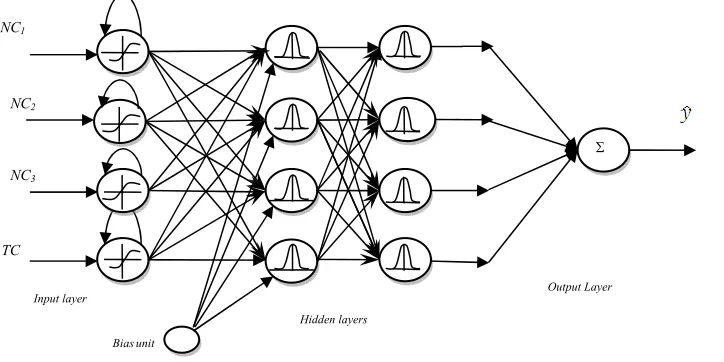
The proposed architecture of RRBFN based FNCAC model is shown in Figure 5. The FNCAC takes the network characteristics of the three networks considered for the study and the requirements of the incoming traffic is taken as inputs. The cost is considered as the bias input .The neural network based Call admission control involves training and
1
ˆ exp
2 n
i i
i i
y
y w
µ
σ
=
−
= −
∑
(8)NC1
NC2
NC3
TC
Input layer
Output Layer
Hidden layers
Biasunit
Σ
Sigmoid R6ecurrent
Linear
testing of RRBFN based CAC controller. The training and testing samples are randomly picked from the sample size of 1000. The RRBFN network has four layers: input, two hidden layers and output layer .For training and testing we have used 250 neurons in the input layer with sigmoid activation function and with the recurrent connections. The range of recurrent weights is -1 to +1. The hidden RRBF layers have 200 neurons with RBF activation function and output layer has single neuron with linear activation.
V. SIMULATION RESULTS AND DISCUSSION
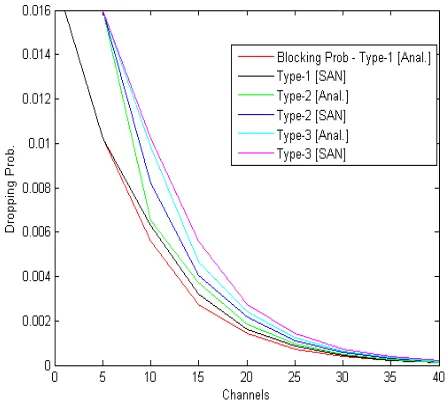
The arrival rate of the calls was taken as the varying traffic intensity and call blocking probability of the type 1, type2, type3 traffic, and overall call blocking probability of the system is plotted. The set of experiments was conducted to compare the call blocking probabilities of the different types of traffic obtained for SAN performance model and the analytical model based on higher order Markov model. The proposed performance model for call admission control mechanism in the heterogeneous RATs and analyzing the call blocking probability keeping the variation in the number of channels was conducted. The graph obtained for the experiment setup conducted considering both the analytical model and SAN model for the blocking probability of type 1, type2 and type3 traffic is shown in figure 7.
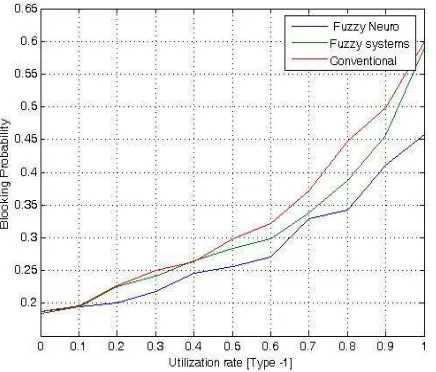
In this section, we present the numerical results and compare the call blocking probabilities of the different types of traffic. The set of experiments were conducted with varying the aggregate traffic and individual traffic of the network and the call blocking probability of Fuzzy neural technique was compared with the conventional CAC and Fuzzy based CAC. The aggregate utilization rate of the calls was considered with the call blocking probability of the FNCAC, conventional CAC and Fuzzy based CAC.As the combined traffic intensity increases the utilization rate also increases. The Fuzzy neural CAC model exhibits better performance in reducing the call blocking probability of the aggregate traffic which is assumed to have the varied traffic component of type1, type2 and type3 traffic. The performance comparison of fuzzy neural method, convention CAC and fuzzy based CAC is plotted in figure 8.
The next set of experiments was conducted to compare the call blocking probabilities of the individual traffic in Fuzzy neural based CAC. The type1 traffic has minimal call blocking probability when compared to type2 and type3 traffic and type3 traffic has higher call blocking probability when compared to type2 and type1 traffic. The simulation results in figure 9 shows that the call blocking probability of the individual types of traffic will increase with the increase in the utilisation rate. The next set of experiments were conducted by considering only one type of traffic and the call blocking probability of the system was plotted for Fuzzy neural technique in comparison with the conventional CAC and Fuzzy based CAC . The graph in figure 10 considers only type1 traffic in the system, figure 11 indicates the blocking probability of type2 traffic for all the three systems .Type3 traffic is considered independently in the system and call blocking probability was studied and is represented in figure 12.The study clearly indicates that the
performance of the FNCAC is better than the other two CAC methods in terms of reduced call blocking probability.
VI. CONCLUSION
In this paper, we have evaluated the analytical model with the performance model developed using SAN and also we have redeveloped an FNCAC and the performance of FNCAC system for next generation networks is compared and validated with the performance of fuzzy based CAC and conventional CAC models .The performance of the analytical model is compared with the SAN model and the simulation results represented in figure 7 indicates that the analytical model and SAN model behaves similarly.
The Performance of FNCAC model in the heterogeneous RATs supporting multimedia traffic is studied pitching upon the call blocking probability by varying the utilization rate of the aggregate traffic and the individual traffic. The simulation study conducted records the following observations. The increase in the utilisation rate increases the call blocking probability of the system for both the aggregate traffic and the individual traffic. The experiment results indicate that the fuzzy neural CAC reduces the blocking probability by around 20% less compared to other methods. Results where both the models are able behave in the similar fashion. The concept of minimizing the call blocking probability is an optimization technique to provide fair QoS to the set of users in the wireless network and there is also a need of intelligent call admission control strategy in the admission control mechanism to make the decision of accepting are rejecting a call keeping the blocking probability minimal in a heterogeneous RATs based network working under dynamic network condition. The future work of this research includes the use of intelligence in CAC decision making process by applying fuzzy Neural Network (NN) technique in making the decision of admitting or rejecting the call.
[image:7.595.310.534.529.732.2]Figure 8 Call blocking probability for the Utilization rate (aggregate)
Figure 9 Individual traffic v/s FNCAC call blocking probability
[image:8.595.320.530.296.473.2]Figure 10 Call blocking probability for Type1 traffic
Figure 11 Call blocking probability for type 2 traffic
Figure 12 Call blocking probability for type 3 traffic
REFERENCES
1. A. Sanmateu et al., “Seamless Mobility across IP Networks Using Mobile IP,” Int’l J. Computers and Telecommunications Networking, vol. 40, Sept. 2002, pp. 181–190.
2. G.Wu et al., “MIRAI Architecture for Heterogeneous Networks,” IEEE Comm., vol. 40, no. 2, 2002, pp. 126–134. 3. S.Y. Hui and K.H. Yeung, “Challenges in the Migration to 4G
Mobile Systems,” IEEE Comm., vol. 41, no. 12, 2003,pp. 54–59. 4. X.G. Wang, J.E. Mellor, G. Min, A QoS-based bandwidth
management scheme in heterogeneous wireless networks international journal of simulation systems, Science and Technology, ISSN: 1473-8031, 5 (1-2) (2004) 9–17. 5. E. Vanem, S. Svaet, F. Paint, Effects of multiple access
alternatives in heterogeneous wireless networks, IEEE Wireless and Networking 3 (2003) 1696–1700.
6. K. Murray, R. Mathur, D. Pesch, Network access and handover control in heterogeneous wireless networks for smart space environments, in: First International Workshop on Management of Ubiquitous Communications and Services, MUCS, Waterford, Ireland, December 11, 2003
7. Y. B. Lin and I. Chlamtac, Wireless and Mobile Network Architecture, John Wiley and Sons, 2001.
[image:8.595.63.271.300.476.2] [image:8.595.59.277.545.731.2]9. R. Guerin, “Queuing-blocking systems with two arrival streams and guarded channels”, IEEE Trans. On Communication, Vol. 36, February 1988, pp. 153-163.
10. L. Huang, S. Kumar, and C.-C. J. Kuo, “Adaptive resource allocation for multimedia QoS management in wireless networks,”IEEE Trans. Vehicular Technology, Vol. 53, 2004, pp. 547-558.
11. Y.-R. Haung and J.-M. Ho, “Distributed call admission control for a heterogeneous PCS network,”IEEE Trans. on Computers, 51, 2002. pp. 1400-1409.
12. J. Ye, J. Hou, and S. Papavassilliou, “A comprehensive resource management for next generation wireless networks”, IEEE Trans. on Mobile Computing, Vol. 1, No. 4, 2002, pp. 249-263. 13. S. E. Ogbonmwan, W. Li and D. Kazakos. “Multi threshold
bandwidth reservation scheme of an integrated voice/data wirelessnetwork, 2005. International Conference on Wireless Networks, Communications and Mobile Computing, Maui, Hawaii, June 2005, pp. 226-231
14. P.M.L. Chan, R.E. Sheriff, Y.F. Hu, P. Conforto, C. Tocci, Mobility management incorporating fuzzy logic for a heterogeneous IP environment, IEEE Communications Magazine 39 (12)(2001) 42–51.
15. D. Karabudak, C. Hung, B. Bing, A call admission control scheme using Genetic algorithms, Symposium on Applied Computing, SAC’04, Nicosia, Cyprus, March 14–17, 2004. 16. O.E. Falowo and H.A. Anthony, Fuzzy logic based call
admission control for next generation wireless networks, in: Proceedings of 3rd International Symposium on Wireless Communication Systems, Valencia, Spain, September 5–8, 2006. 17. R. Agusti, O. Sallent, J. Pe´rez-Romero, L. Giupponi, A
fuzzy-neural based approach for joint radio resource management in a beyond 3G framework, in: 1st International Conference on Quality of Service in Heterogeneous Wired/Wireless Networks (Qshine’04), Dallas, USA, October, 2004.
18. T.Takagi and M.Sugeno, “Fuzzy Identification of Systems and its Application to Modeling and Control”, IEEE Transaction on System, Man and Cybernetics, Vol. 15, 1985, pp 116-132. 19. I. Kim and S.Lee, “A Fuzzy Time Series Prediction Method
Based on Consecutive Values”, IEEE International Conference on Fuzzy systems, Vol.2, 1998, pp 703-707.
20. A.D.Cheok and N.Ertugrul, “Use of Fuzzy Logic for Modeling, Estimation and Prediction In switched Reluctance Motor Device”, IEEE Transaction on Industrial Electronics, Vol.46, No.6, 1999, pp 1207-1224.
21. D. H. Wolpert, “The mathematics of generalization, in The Proceedings of the SFI/CNLS Workshop on Formal Approaches to Supervised Learning, Santa Fe Institute Studies in the Sciences of Complexity, vol. 20.MA: Addison-Wesley, 1994. 22. The lack of A priori distinctions between learning
algorithms,”Neural Computation, vol. 8, no. 7, pp. 1341–1390, 1996.
23. The existence of A priori distinctions between learning algorithms,” Neural Computation, vol. 8, no. 7, pp. 1391–1420, 1996. [Online].
24. P.Zahang and G.M.Qi, “Neural Network Forecasting for Seasonal and Trend Time Series”, European Journal of Operational Research , Vol. 160, 2005, pp 501-514
25. A.Chen, M.T.Leung and D.Hazem, “Application of Neural Networks to an Emerging Financial Market: Forecasting and Trading the Taiwan Stock Index”, Computers and Operational Research, Vol. 30, 2003, pp. 901-923.
26. C.M.Bishop, “Neural Networks for Pattern Recognition”, Ed.1, Oxford University Press, 1995.
27. P.Zahang and G.M.Qi, “Neural Network Forecasting for Seasonal and Trend Time Series”, European Journal of Operational Research , Vol. 160, 2005, pp 501-514
28. M.Li, G.Huang, P.Saratchandran and N.Sundarajan, “Performance Evaluation of GAP-RBF Network in Channel Equalization”, Neural processing Letters, Vol. 22, No. 2, pp.223-233, October 2005.
29. C.S.Leung and A.C.Tsoi, “Combined Learning and Pruning for Recurrent Radial Basis Function Networks Based on Recursive Least Square Algorithm”, Neural Computing and Applications, Vol.15, 2005, pp 62-78.
30. P. Campolucci, A. Uncini, F. Piazza, and B. D. Rao, “On-line learning algorithms for locally recurrent neural networks,” IEEE Transactions on Neural Networks., vol. 10, no. 2, pp. 340–355, Mar. 1999.
31. C. H. Lin, W. D. Chou, and F. J. Lin, “Adaptive hybrid control using a recurrent neural network for a linear synchronous motor servo-drive system,” in IEE Proc., Control Theory Appl., vol. 148, 2001, pp. 156–168