Exploring Multilingual Semantic Role Labeling
Baoli Li, Martin Emms, Saturnino Luz, Carl Vogel Department of Computer Science
Trinity College Dublin Dublin 2, Ireland
{baoli.li,mtemms,luzs,vogel}@cs.tcd.ie
Abstract
This paper describes the multilingual semantic role labeling system of Computational Lin-guistics Group, Trinity College Dublin, for the CoNLL-2009 SRLonly closed shared task. The system consists of two cascaded compo-nents: one for disambiguating predicate word sense, and the other for identifying and classi-fying arguments. Supervised learning tech-niques are utilized in these two components. As each language has its unique characteris-tics, different parameters and strategies have to be taken for different languages, either for providing functions required by a language or for meeting the tight deadline. The system ob-tained labeled F1 69.26 averaging over seven languages (Catalan, Chinese, Czech, English, German, Japanese, and Spanish), which ranks the system fourth among the seven systems participating the SRLonly closed track.
1 Introduction
Semantic role labeling, which aims at computa-tionally identifying and labeling arguments of predicate words, has become a leading research problem in computational linguistics with the ad-vent of various supporting resources (e.g. corpora and lexicons) (Màrquez et al., 2008). Word seman-tic dependencies derived by semanseman-tic role labeling are assumed to facilitate automated interpretation of natural language texts. Moreover, techniques for automatic annotation of semantic dependencies can also play an important role in adding metadata to corpora for the purposes of machine translation and speech processing. We are currently investi-gating such techniques as part of our research into integrated language technology in the Center for
Next Generation Localization (CNGL,
http://www.cngl.ie). The multilingual nature of the CoNLL-2009 shared task on syntactic and seman-tic dependency analysis, which includes Catalan, Chinese, Czech, English, German, Japanese, and
Spanish (Hajič et al., 2009), makes it a good
test-bed for our research.
We decided to participate in the CoNLL-2009 shared task at the beginning of March, signed the agreement for getting the training data on March
2nd, 2009, and obtained all the training data
(espe-cially the part from LDC) on March 4th, 2009. Due
to the tight time constraints of the task, we chose to use existing packages to implement our system. These time constraints also meant that we had to resort to less computationally intensive methods to meet the deadline, especially for some large data-sets (such as the Czech data). In spite of these dif-ficulties and resource limitations, we are proud to be among the 21 teams who successfully submitted the results1.
As a new participant, our goals in attending the CoNLL-2009 SRLonly shared task were to gain more thorough knowledge of this line of research and its state-of-the-art, and to explore how well a system quickly assembled with existing packages can fare at this hard semantic analysis problem.
Following the successful approaches taken by the participants of the CoNLL-2008 shared task (Surdeanu et al., 2008) on monolingual syntactic and semantic dependency analysis, we designed and implemented our CoNLL-2009 SRLonly sys-tem with pipeline architecture. Two main compo-nents are cascaded in this system: one is for
disambiguating predicate word sense2, and the
other for identifying and classifying arguments for
1 According to our correspondence with Dr. Jan Hajič, totally
31 teams among 60 registered ones signed and got the evalua-tion data.
2 As predicate words are marked in the CoNLL-2009 datasets,
we don’t need to identify predicate words.
predicate words. Different supervised learning techniques are utilized in these two components. For predicate word sense disambiguation (WSD), we have experimented with three algorithms: SVM, kNN, and Naïve Bayes. Based on experimental results on the development datasets, we chose SVM and kNN to produce our submitted official results. For argument identification and classifica-tion, we used a maximum entropy classifier for all the seven datasets. As each language has its unique characteristics and peculiarities within the dataset, different parameters and strategies have to be taken for different languages (as detailed below), either for providing functions required by a language or for meeting the tight deadline. Our official submis-sion obtained 69.26 labeled F1 averaging over the seven languages, which ranks our system fourth among the seven systems in the SRLonly closed track.
The rest of this paper is organized as follows. Section 2 discusses the first component of our sys-tem for predicate word sense disambiguation. Sec-tion 3 explains how our system detects and classifies arguments with respect to a predicate word. We present experiments in Section 4, and conclude in Section 5.
2 Predicate Word Sense Disambiguation
This component tries to determine the sense of a predicate word in a specific context. As a sense of a predicate word is often associated with a unique set of possible semantic roles, this task is also called role set determination. Based on the charac-teristics of different languages, we take different strategies in this step, but the same feature set is used for different languages.
2.1 Methods
Intuitively, each predicate word should be treated individually according to the list of its possible senses. We therefore designed an initial solution based on the traditional methods in WSD: repre-sent each sense as a vector from its definition or examples; describe the predicate word for disam-biguation as a vector derived from its context; and finally output the sense which has the highest simi-larity with the current context. We also considered using singular value decomposition (SVD) to over-come the data sparseness problem. Unfortunately, we found this solution didn’t work well in our
pre-liminary experiments. The main problem is that the definition of each sense of a predicate word is not available. What we have is just a few example con-texts for one sense of a predicate word, and these contexts are often not informative enough for WSD. On the other hand, our limited computing resources could not afford SVD operation on a huge matrix.
We finally decided to take each sense tag as a class tag across different words and transform the disambiguation problem into a normal multi-class categorization problem. For example, in the Eng-lish datasets, all predicates with “01” as a sense identifier were counted as examples for the class “01”. With this setting, a predicate word may be assigned an invalid sense tag. It is an indirect solu-tion, but works well. We think there are at least two possible reasons: firstly, most predicate words take their popular sense in running text. For exam-ple, in the English dataset (training and develop-ment), 160,477 of 185,406 predicate occurrences (about 86.55%) take their default sense “01”. Sec-ondly, predicates may share some common role sets, even though their senses may not be exactly the same, e.g. “tell” and “inform”.
Unlike the datasets in other languages, the Japa-nese dataset doesn’t have specialized sense tags annotated for each predicate word, so we simply copy the predicted lemma of a predicate word to its PRED field. For other datasets, we derived a train-ing sample for each predicate word, whose class tag is its sense tag. Then we trained a model from the generated training data with a supervised learn-ing algorithm, and applied the learned model for predicting the sense of a predicate word. This is our base solution.
sense tags as class tags and add a class tag “=” for samples without specialized sense tag.
For each predicate word, we derive a vector de-scribing its context and attributes, each dimension of which corresponds to a feature. We list the fea-ture types in the next subsection. Feafea-tures appear-ing only once are removed. The TF*IDF weightappear-ing schema is used to calculate the weight of a feature.
Three different algorithms were tried during the development period: support vector machines (SVM), distance-weighted k-Nearest Neighbor (kNN) (Li et al., 2004), and Naïve Bayes with mul-tinomial model (Mccallum and Nigam, 1998). As to the SVM algorithm, we used the robust LIBSVM package (Chang and Lin, 2001), with a linear kernel and default values for other parame-ters. The algorithms achieving the best results in our preliminary experiments are chosen for differ-ent languages: SVM for Catalan, Chinese, and Spanish; kNN for German (k=20).
We used kNN for English (k=20) and Czech (k=10) because we could not finish training with SVM on these two datasets in limited time. Even with kNN algorithm, we still had trouble with the English and Czech datasets, because thousands of training samples make the prediction for the evaluation data unacceptably slow. We therefore had to further constrain the search space for a new predicate word to those samples containing the same predicate word. If there are not samples con-taining the same predicate word in the training data, we will assign it the most popular sense tag (e.g. “01” for English).
How to use the provided predicate lexicons is a challenging issue. Lexicons for different languages take different formats and the information included in different lexicons is quite different. We derived a sense list lexicon from the original predicate lexicon for Chinese, Czech, English, and German. Each entry in a sense list lexicon contains a predi-cate word, its internal representation (especially for Czech), and a list of sense tags that the predicate can have. Then we obtained a variant of our base solution, which uses the sense list of a predicate word to filter impossible senses. It works as fol-lows:
- Disambiguate a new predicate with the base
solution;
- Choose the most possible sense from all the
candidate senses obtained in step 1: if the base classifier doesn’t output a vector of
probabilities for classes, only check whether the predicted one is a valid sense for the predicate;
- If there is not a valid sense for a new
cate (including the cases where the predi-cate does not have an entry in the sense list lexicon), output the most popular sense tag; Unfortunately, preliminary experiments on the German and Chinese datasets didn’t support to in-clude such a post-processing stage. The perform-ance with this filtering became a little worse. Therefore, we decided not to use it generally, but one exception is for the Czech data.
With kNN algorithm, we can greatly reduce the time for training the Czech data, but we do have problem with prediction, as there are totally 469,754 samples in the training dataset. It’s a time-consuming task to calculate the similarities be-tween a new sample and all the samples in the training dataset to find its k nearest neighbors, thus we have to limit the search space to those samples that contain the predicate word for disambiguation. To process unseen predicate words, we used the derived sense list lexicon: if a predicate word for disambiguation is out of the sense list lexicon, we simply copy its predicted lemma to the PRED field; if no sample in the training dataset has the same predicate word, we take its first possible sense in the sense list lexicon. With this strategy, our sys-tem can process the huge Czech dataset in short time.
2.2 Features
The features we used in this step include3:
a. [Lemma | (Lemma with POS)] of all words in the
sen-tence;
b. Attributes of predicate word, which is obtained from PFEAT field by splitting the field at symbol “|” and removing the invalid attribute of “*”;
c. [Lemma | POS] bi-grams of predicate word and its [previous | following] one word;
d. [Lemma | POS] tri-grams of predicate word and its [previous | following] two words;
e. [Lemma | (Lemma with POS)] of its most [left | right]
child;
f. [(Lemma+Dependency_Relation+Lemma) | (POS
+Dependency_Relation+POS)] of predicate word and its most [left | right] child;
3 We referred to those CoNLL-2008 participants’ reports, e.g.
g. [Lemma | (Lemma with POS)] of the head of the pre-dicate word;
h. [(Lemma+Dependency_Relation+Lemma) |
(POS+D-ependency_Relation+POS)] of predicate word and its head;
i. [Lemma | (Lemma with POS)] of its [previous | fol-lowing] two brothers;
j. [Lemma | POS | (Dependency relation)] bi-gram of predicate word and its [previous | following] one brother;
k. [Lemma | POS | (Dependency relation)] tri-gram of predicate word and its [previous | following] two brothers.
3 Argument Identification and
Classifica-tion
The second component of our system is used to detect and classify arguments with respect to a predicate word. We take a joint solution rather than solve the problem in two consecutive steps: argu-ment identification and arguargu-ment classification.
3.1 Methods
By introducing an additional argument type tag “_” for non-arguments, we transformed the two tasks (i.e. argument identification and argument classifi-cation) into one multi-class classification problem. As a word can play different roles with respect to different predicate words and a predicate word can be an argument of itself, we generate a training set by deriving a training example from each word-predicate pair. For example, if a sentence with two predicates has 7 words, we will derive 7*2=14 training examples. Therefore, the number of train-ing examples generated in this step will be around
L times larger than that obtained in the previous
step, where L is the average length of sentences.
We chose to use maximum entropy algorithm in this step because of its success in the CoNLL-2008 shared task (Surdeanu et al., 2008). Le Zhang’s maximum entropy package (Zhang, 2006) is inte-grated in our system.
The Czech data cause much trouble again for us, as the training data derived by the above strategy became even larger. We had to use a special strat-egy for the Czech data: we selectively chose word-predicate pairs for generating the training dataset. In other words, not all possible combinations are used. We chose the following words with respect to each predicate: the first and the last two words of a sentence; the words between the predicate and any argument of it; two words before the predicate
or any argument; and two words after the predicate or any argument.
In the Czech and Japanese data, some words may play multiple roles with respect to a predicate word. We thus have to consider multi-label classi-fication problem (Tsoumakas and Katakis, 2007) for these two languages’ data. We tried the follow-ing two solutions:
• Take each role type combination as a class
and transform the multi-label problem to a single-label classification problem;
• Classify a word with a set of binary
classi-fiers: consider each role type individually with a binary classifier; any possible role type will be output; if no role type is ob-tained after considering all the role types, the role type with the highest confidence value will be output; and, if “_” is output with any other role type, remove it.
We used the second solution in our official submission, but we finally found these two solu-tions perform almost the same. The performance difference is very small. We found the cases with multi-labels (actually at most two) in the training data are very limited: 690 of 414,326 in the Czech data and 113 of 46,663 in the Japanese data.
3.2 Features
The features we used in this step include:
a. Whether the current word is a predicate;
b. [Lemma | POS] of current word and its [previous |
fol-lowing] one word;
c. [Lemma | POS] bi-grams of current word and its
[pre-vious | following] one word;
d. POS tri-grams of current word, its previous word and
its following word;
e. Dependency relation of current word to its head;
f. [Lemma | POS] of the head of current word;
g. [Lemma | POS] bi-grams of current word and its head;
h. [(Lemma+Dependency_Relation+Lemma) | (POS+De
pendency_Relation+POS)] of current word and its head;
i. [Lemma | POS] of its most [left | right] child;
j. [Lemma | POS] bi-grams of current word and its most
[left | right] child;
k. [(Lemma+Dependency_Relation+Lemma) | (POS+De
pendency_Relation+POS) of current word and its most [left | right] child;
l. The number of children of the current word and the predicate word;
m. Attributes of the current word, which is obtained from
PFEAT field by splitting the field at symbol “|” and removing the invalid attribute of “*”;
o. [Lemma | POS] of the predicate word and its head; p. Dependency relation of the predicate word to its head;
q. [Lemma | POS] bi-grams of the predicate word and its
head;
r. [(Lemma+Dependency_Relation+Lemma) | (POS+De
pendency_Relation+POS)] of the predicate word and its head;
s. [Lemma | POS] of the most [left | right] child of the predicate word;
t. [(Lemma+Dependency_Relation+Lemma) | (POS+De
pendency_Relation+POS)] of predicate word and its head;
u. [Lemma | POS] bi-gram of the predicate word and its
most [left | right] child;
v. [(Lemma+Dependency_Relation+Lemma) | (POS+De
pendency_Relation+POS)] of the predicate word and its most [left | right] child;
w. The relative position of the current word to the predi-cate one: before, after, or on;
x. The distance of the current word to the predicate one; y. The relative level (up, down, or same) and level
dif-ference on the syntactic dependency tree of the current word to the predicate one;
z. The length of the shortest path between the current word and the predicate word.
4 Experiments
4.1 Datasets
The datasets of the CoNLL-2009 shared task con-tain seven languages: Catalan (CA), Chinese (CN), Czech (CZ), English (EG), German (GE), Japanese (JP), and Spanish (SP). The training and evaluation data of each language (Taulé et al., 2008; Xue et al., 2008; Hajič et al., 2006; Palmer et al., 2002;
Burchardt et al., 2006; Kawahara et al., 2002) have been converted to a uniform CoNLL Shared Task format. Each participating team is required to process all seven language datasets.
Lanuage CA CN CZ EN GE JP SP
Size (KB) 48974 41340 94284 58155 41091 8948 52430 # of
Sen-tences 14924 24039 43955 40613 38020 4643 15984 # of
Predi-cate words 42536 110916 469754 185404 17988 27251 48900 Avg. # of
Predicates
per sentence 2.85 4.61 10.69 4.57 0.47 5.87 3.06 popular
sense tag a2 (37%)
01 (90%)
= (81%)
01 (87%)
1 (75%)
= (100%)
a2 (39%) Table 1. Statistical information of the seven language datasets (training and development).
Table 1 shows some statistical information of both training and development data for each lan-guage. The total size of the uncompressed original data without lexicons is about 345MB. The Czech dataset is the largest one containing 43,955
sen-tences and 469,754 predicate words, while the Japanese dataset the smallest one. On average, 10.69 predicate words appear in a Czech sentence, while only 0.47 predicate words exist in a German sentence. The most popular sense tag in the Czech datasets is “=”, which means the PRED field has the same value as the PLEMMA field or the FORM field. About 81% of Czech predicate words take this value.
4.2 Experimental Results
F1 is used as the main evaluation metric in the CoNLL-2009 shared task. As to the SRLonly track, a joint semantic labeled F1, which considers predi-cate word sense disambiguation and argument la-beling equally, is used to rank systems.
Avg. CA CN CZ EG GE JP SP
69.26 74.06 70.37 57.46 69.63 67.76 72.03 73.54
Table 2. Official results of our system.
Table 2 gives the official results of our system on the evaluation data. The system obtained the best result (74.06) on the Catalan data, but per-formed very poor (57.46) on the Czech data. Ex-cept the Czech data, our system performs quite stable on the other six language data with mean of 71.23 and standard deviation of 2.42.
Avg. CA CN CZ EG GE JP SP
Over-all F1 69.47 74.12 70.52 57.57 70.24 67.97 72.17 73.68 Pred.
WSD F1
86.9 84.42 94.54 72.23 92.98 81.09 99.07 83.96 Arg
I&C F1
57.24 69.29 57.71 33.19 58.25 60.64 52.72 68.86 Arg
I&C PR
69.77 73.43 72.48 62.14 70.14 66.63 69.37 74.23 Arg
I&C RE
[image:5.612.309.547.427.542.2]49.77 65.6 47.94 22.64 49.81 55.64 42.52 64.21
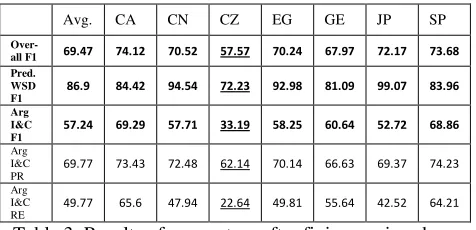
Table 3. Results of our system after fixing a minor bug.
After submitting the official results, we found and fixed a minor bug in the implementation of the second component. Table 3 presents the results of our system after fixing this bug. The overall per-formance doesn’t change much. We further ana-lyzed the bottlenecks by checking the performance of different components.
[image:5.612.73.301.520.632.2]we can get predicate WSD F1 78.66, which further increases the overall labeled F1 on the Czech data to 61.68 from 57.57 and the overall labeled F1 over the seven languages to 70.05 from 69.47.
From table 3, we can see our system performs relatively poorly for argument identification and classification (57.24 vs. 86.9). The system seems too conservative for argument identification, which makes the recall very lower. We explored some strategies for improving the performance of the second component, e.g. separating argument iden-tification and argument classification, and using feature selection (with DF threshold) techniques, but none of them helps much. We are thinking the features currently used may not be effective enough, which deserves further study.
5 Conclusion and Future Work
In this paper, we describe our system for the CoNLL-2009 shared task -- SRLonly closed track. Our system was built on existing packages with a pipeline architecture, which integrated two cas-caded components: predicate word sense disam-biguation and argument identification and classification. Our system performs well at disam-biguating the sense of predicate words, but poorly at identifying and classifying arguments. In the future, we plan to explore much effective features for argument identification and classification.
Acknowledgments
This research was funded by Science Foundation Ireland under the CNGL grant. We used the IITAC Cluster in our initial experiments. We thank IITAC, the HEA, the National Development Plan and the Trinity Centre for High Performance Computing for their support. We are also obliged to John Keeney for helping us running our system on the CNGL servers.
References
Aljoscha Burchardt, Katrin Erk, Anette Frank, Andrea Kowalski, Sebastian Padó and Manfred Pinkal. 2006. The SALSA Corpus: a German Corpus Resource for Lexical Semantics. Proceedings of the 5th Interna-tional Conference on Language Resources and Eval-uation (LREC-2006). Genoa, Italy.
Chih-Chung Chang and Chih-Jen Lin. 2001. LIBSVM: a library for support vector machines. Software available at http://www.csie.ntu.edu.tw/~cjlin/libsvm.
Massimiliano Ciaramita, Giuseppe Attardi, Felice Dell’Orletta, and Mihai Surdeanu. 2008. DeSRL: A Linear-Time Semantic Role Labeling System. Pro-ceedings of the CoNLL-2008.
Jan Hajič, Massimiliano Ciaramita, Richard Johansson,
Daisuke Kawahara, Maria Antonia Martí, Lluís Màrquez, Adam Meyers, Joakim Nivre, Sebastian Padó, Jan Štěpánek, Pavel Straňák, Mihai Surdeanu,
Nianwen Xue and Yi Zhang. 2009. The CoNLL-2009 Shared Task: Syntactic and Semantic Dependencies in Multiple Languages. Proceedings of the 13th Conference on Computational Natural Language Learning (CoNLL-2009). Boulder, Colorado, USA.
Jan Hajič, Jarmila Panevová, Eva Hajičová, Petr Sgall,
Petr Pajas, Jan Štěpánek, Jiří Havelka, Marie
Mikulová and Zdeněk Žabokrtský. 2006. The Prague
Dependency Treebank 2.0. Linguistic Data
Consortium, USA. ISBN 1-58563-370-4.
Daisuke Kawahara, Sadao Kurohashi and Koiti Hasida. 2002. Construction of a Japanese Relevance-tagged Corpus. Proceedings of the 3rd International Confer-ence on Language Resources and Evaluation (LREC-2002). Las Palmas, Spain.
Baoli Li, Qin Lu and Shiwen Yu. 2004. An Adaptive
k-Nearest Neighbor Text Categorization Strategy. ACM
Transactions on Asian Language Information Processing, 3(4): 215-226.
Lluís Màrquez, Xavier Carreras, Kenneth C. Litkowski and Suzanne Stevenson. 2008. Semantic Role Label-ing: An Introduction to the Special Issue. Computa-tional Linguistics, 34(2):145-159.
Andrew Mccallum and Kamal Nigam. 1998. A Com-parison of Event Models for Naive Bayes Text Clas-sification. Proceedings of AAAI/ICML-98 Workshop on Learning for Text Categorization.
Mihai Surdeanu, Richard Johansson, Adam Meyers, Lluis Marquez and Joakim Nivre. 2008. The CoNLL-2008 Shared Task on Joint Parsing of Syntactic and
Semantic Dependencies. Proceedings of the 12th
Conference on Computational Natural Language Learning (CoNLL-2008).
Mariona Taulé, Maria Antònia Martí and Marta Recasens. 2008. AnCora: Multilevel Annotated Corpora for Catalan and Spanish. Proceedings of the 6th International Conference on Language Resources and Evaluation (LREC-2008). Marrakech, Morocco.
Grigorios Tsoumakas and Ioannis Katakis. 2007. Multi-Label Classification: An Overview. International Journal of Data Warehousing and Mining, 3(3):1-13.
Nianwen Xue and Martha Palmer. 2009. Adding semantic roles to the Chinese Treebank. Natural Language Engineering, 15(1):143-172.