Simple Maximum Entropy Models for Multilingual Coreference Resolution
Xinxin Li, Xuan Wang, Xingwei Liao Computer Application Research Center
Harbin Institute of Technology Shenzhen Graduate School Shenzhen, China
Abstract
This paper describes our system participat-ing in the CoNLL-2012 shared task: Mod-eling Multilingual Unrestricted Coreference in Ontonotes. Maximum entropy models are used for our system as classifiers to deter-mine the coreference relationship between ev-ery two mentions (usually noun phrases and pronouns) in each document. We exploit rich lexical, syntactic and semantic features for the system, and the final features are selected us-ing a greedy forward and backward strategy from an initial feature set. Our system partici-pated in the closed track for both English and Chinese languages.
1 Introduction
In this paper, we present our system for the CoNLL-2012 shared task which aims to model coreference resolution for multiple languages. The task of coref-erence resolution is to group different mentions in a document into coreference equivalent classes (Prad-han et al., 2012). Plenty of machine learning al-gorithms such as Decision tree (Ng and Cardie, 2002), maximum entropy model, logistic regres-sion (Bj¨orkelund and Nugues, 2011), Support Vec-tor Machines, have been used to solve this problem. Meanwhile, the CoNLL-2011 shared task on En-glish language show that a well-designed rule-based approach can achieve a comparable performance as a statistical one (Pradhan et al., 2011).
Our system treats coreference resolution problem as classification problem by determining whether every two mentions in a document has a corefer-ence relationship or not. We use maximum entropy
(ME) models to train the classifiers. Previous work reveal that features play an important role on coref-erence resolution problem, and many different kinds of features has been exploited. In this paper, we use many different lexical, syntactic and semantic fea-tures as candidate feafea-tures, and use a greedy forward and backward approach for feature selection for ME models.
2 System Description
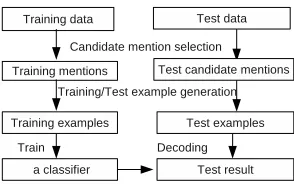
The framework of our system is shown in figure 1. It includes four components: candidate mention selec-tion, training example generaselec-tion, model generaselec-tion, and decoding algorithm for test data. The details of each component as described below.
2.1 Candidate Mention Selection
In both training and test sets, our system only con-sider all noun phrases (NP) and pronouns (PRP, PRP$) as candidate mentions for both English and Chinese. The mentions in each sentence are ob-tained from given syntactic tree by their syntactic label. Other phrases in the syntactic tree are omit-ted due to their small proportion. For example, in the English training dataset, our candidate mentions includes about 91% of golden mentions.
2.2 Training Example Generation
There are many different training example gen-eration algorithms, e.g., McCarthy and Lehnert’s method, Soon et al.s method, Ng and Cardies method (Ng, 2005). For our baseline system, we choose Soon et al.’s method because it is easily un-derstandable, implemented and popularly used. It
Figure 1: The framework of our coreference resolution system
selects pairs of two coreferent mentions as positive examples, and pairs between mentions among the two mentions and the last mention as negative ex-amples.
2.3 Feature Selection
Rich and meaningful features are important for coreference resolution. Our system starts with Soon’s 12 features as baseline features (Soon et al., 2001), and exploits many lexical, syntactic, and se-mantic features as candidate features. Totally 71 fea-tures are considered in our system, and summarized below:
Distance features: sentence distance, distance
in phrases, whether it’s a first mention (Strube et al., 2002)
Lexical features: string match, partial match,
apposition, proper name match, head word match, partial head word match, minimum edit distance (Daum´e III and Marcu, 2005)
Grammatical features: pronoun, demonstrative
noun phrase, embedded noun, gender agree-ment, number agreement (Soon et al., 2001)
Syntactic features: same head, maximal NP,
syntactic path (Yang et al., 2006)
Semantic features: semantic class agreement,
governing verb and its grammatical role, predi-cate (Ponzetto and Strube, 2006)
For English, the number agreement and gender agreement features can be obtained through the gen-der corpus provided. However, there is no corpus for Chinese. Our system obtains this information by collecting dictionaries for number and gender in-formation from training dataset. For example, the
Algorithm 1Greedy forward and backward feature selection
Initialization: all candidate features in setC
Choose initial feature set
Compute F1 with features c
whileforwardjjbackward:
whileforward:
foreach feature f in C-c Compute F1 with features c+f
ifbest(F1) increases:
backward = true, c=c+f,continueforward
elseforward = false
whilebackward:
foreach feature f in in c Compute F1 with features c-f
ifbest(F1) increases:
forward = true, c=c-fcontinuebackward
elsebackward = false
pronoun ”Ö” (he) denotes a male mention, and the
noun phrase ”s Ë” (girlfriend) represents a female
mention. Similarly for number information, e.g., the mentions containing ”” (and), ”¤” (group) are
plural. We use these words to build number and gender dictionaries, and determine the number and gender information of a new mention by checking whether one of the words in the dictionaries is in the mention.
For semantic class agreement feature in English, the relation between two mentions is extracted from WordNet 3.0 (Ng, 2007),(Miller, 1995). There is no corresponding dictionary for Chinese, so we keep it blank. The head word for each mention is se-lected by its dependency head, which can be ex-tracted throught the conversion head rules ( English 1and Chinese2).
Maximum Entropy modeling is used to train the classifier for our system3. We employ a greedy for-ward and backfor-ward procedure for feature selection. The procedure is shown in Algorithm 1.
The algorithm will iterate forward and backward procedures until the performance does not improve. We use two initial feature sets: a blank set and Soon’s baseline feature set. Both feature sets start
1
http://w3.msi.vxu.se/ nivre/research/headrules.txt
with a forward procedure.
2.4 Decoding
For every candidate mention pair, to determine their coreference relationship is simple because the prob-ability whether they are coreferent can be obtained by our maximum entropy model. We can just set a threshold=0:5and select the pairs with
probabil-ity larger than. But usually it is hard for multiple
mentions. Suppose there are three mentions A, B, C where the probability between A and B, A and C is larger than, but B and C is small. Thus choosing
an appropriate decoding algorithm is necessary. We use best-first clustering method for our system which for each candidate mention in a document, chooses the mention before it with best probability larger than threshold. The difference between
En-glish and Chinese is that we consider the coreference relationship of two mentions nested in Chinese, but not in English.
3 Experiments
3.1 Setting
Our system participates in the English and Chinese closed tracks with auto mentions. For both the En-glish and Chinese datasets, we use gold annotated training data for training, and a portion of auto an-notated development data for feature selection. Only part of development data is chosen because the eval-uation procedure takes lot of time. To simplify, We only select one or two file in each directory as our development data.
The performance of the system is evaluated on MUC, B-CUBED, CEAF(M), CEAF(E), BLANC metrics. The official metric is calculated as
(MUC+B 3
+CEAF) =
3.
3.2 Development set
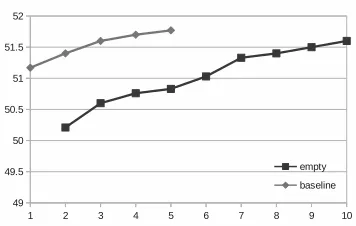
[image:3.612.337.515.61.174.2]Figures 2 and 3 show the performance on the En-glish and Chinese development datasets using fea-ture selection starting from a empty feafea-ture set and Soon’s baseline feature set. The x-axis means the number of iterations with either forward or back-ward selection. The performance on Soon’s baseline feature set for both languages are shown on 1st itera-tion. The performance from empty feature set starts on 2nd iteration. From these figures, we can see that
[image:3.612.337.516.229.337.2]Figure 2: Performance of English development data with Feature selection
Figure 3: Performance of Chinese development data with Feature selection
using feature selection in both initial feature sets, the performance improves.
However the performance of our system is im-proved only on a few iteration. The best system for English stops at the 4th iteration with total 10 fea-tures left, which starts from Soon’s baseline feature set. Similarly, the system for Chinese achieves its best performance at the 4th iteration with only 8 tures. The phenomenon reveals that most of the fea-tures left for our system are still from Soon’s base-line features, and our newly exploited lexical, syn-tactic, and semantic features are not well utilized.
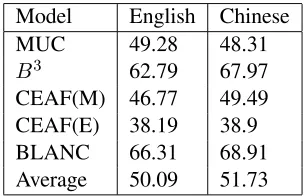
Then we evaluate our model on the entire devel-opment data. The results are shown on Table 1. Comparing Figures 2, 3 and Table 1, we can observe that the performance on entire development data is lower than part one, about 1% decrease.
3.3 Test
Model English Chinese
MUC 49.28 48.31
B 3
62.79 67.97
CEAF(M) 46.77 49.49
CEAF(E) 38.19 38.9
BLANC 66.31 68.91
Average 50.09 51.73
Table 1: Results on entire development data
Model English Chinese
MUC 48.27 48.09
B 3
61.37 68.31
CEAF(M) 44.83 49.92
CEAF(E) 36.68 38.89
BLANC 65.42 71.44
[image:4.612.109.262.59.157.2]Official 48.77 51.76
Table 2: Results on test data
Comparing tables 2 and 1, we can observe that the performance for the Chinese test data is similar as the development data. The result seems reason-able because the model for testing use additional de-velopment data which is much smaller than training data. However, the result on English test data seem a little odd. The performance is about 1.4% less than that on the development data. The result needs fur-ther analysis.
4 Conclusion
In this paper, we presented our coreference resolu-tion system which uses maximum entropy model to determine the coreference relationship between two mentions. Our system exploits many lexical, syn-tactic and semantic features. However, using greedy forward and backward feature selection strategy for ME model, these rich features are not well utilized. In future work we will analyze the reason for this phenomenon and extend these features to other ma-chine learning algorithms.
References
Anders Bj¨orkelund and Pierre Nugues. 2011. Explor-ing lexicalized features for coreference resolution. In
Proceedings of the Fifteenth Conference on Compu-tational Natural Language Learning: Shared Task,
pages 45–50, Portland, Oregon, USA, June. Associ-ation for ComputAssoci-ational Linguistics.
Hal Daum´e III and Daniel Marcu. 2005. A large-scale exploration of effective global features for a joint en-tity detection and tracking model. InProceedings of Human Language Technology Conference and Confer-ence on Empirical Methods in Natural Language Pro-cessing, pages 97–104, Vancouver, British Columbia, Canada, October. Association for Computational Lin-guistics.
George A. Miller. 1995. Wordnet: a lexical database for english. Communications of the ACM, 38:39–41, November.
Vincent Ng and Claire Cardie. 2002. Improving machine learning approaches to coreference resolution. In Pro-ceedings of the ACL, pages 104–111.
Vincent Ng. 2005. Machine learning for coreference res-olution: From local classification to global ranking. In
Proceedings of the 43rd Annual Meeting of the Asso-ciation for Computational Linguistics (ACL’05), pages 157–164, Ann Arbor, Michigan, June. Association for Computational Linguistics.
Vincent Ng. 2007. Semantic class induction and coref-erence resolution. InProceedings of the 45th Annual Meeting of the Association of Computational Linguis-tics, pages 536–543, Prague, Czech Republic, June. Association for Computational Linguistics.
Simone Paolo Ponzetto and Michael Strube. 2006. Ex-ploiting semantic role labeling, wordnet and wikipedia for coreference resolution. InProceedings of the Hu-man Language Technology Conference of the NAACL, Main Conference, pages 192–199, New York City, USA, June. Association for Computational Linguis-tics.
Sameer Pradhan, Lance Ramshaw, Mitchell Marcus, Martha Palmer, Ralph Weischedel, and Nianwen Xue. 2011. Conll-2011 shared task: Modeling unrestricted coreference in ontonotes. InProceedings of the Fif-teenth Conference on Computational Natural Lan-guage Learning: Shared Task, pages 1–27, Portland, Oregon, USA, June. Association for Computational Linguistics.
Sameer Pradhan, Alessandro Moschitti, Nianwen Xue, Olga Uryupina, and Yuchen Zhang. 2012. CoNLL-2012 shared task: Modeling multilingual unrestricted coreference in OntoNotes. In Proceedings of the Sixteenth Conference on Computational Natural Lan-guage Learning (CoNLL 2012), Jeju, Korea.
Wee Meng Soon, Hwee Tou Ng, and Daniel Chung Yong Lim. 2001. A machine learning approach to coref-erence resolution of noun phrases. Comput. Linguist., 27:521–544, December.
reference resolution. In Proceedings of the ACL-02 conference on Empirical methods in natural language processing - Volume 10, EMNLP ’02, pages 312–319, Stroudsburg, PA, USA. Association for Computational Linguistics.