Proceedings of the 2019 Conference on Empirical Methods in Natural Language Processing and the 9th International Joint Conference on Natural Language Processing, pages 496–506,
496
Enhancing Local Feature Extraction with
Global Representation for Neural Text Classification
Guocheng Niu1*, Hengru Xu2*†, Bolei He1, Xinyan Xiao1, Hua Wu1, Sheng Gao2
1 Baidu Inc., Beijing, China
2Beijing University of Posts and Telecommunications
1{niuguocheng, hebolei, xiaoxinyan, wu hua}@baidu.com
2{xuhengru, gaosheng}@bupt.edu.cn
Abstract
For text classification, traditional local fea-ture driven models learn long dependency by deeply stacking or hybrid modeling. This pa-per proposes a novel Encoder1-Encoder2 ar-chitecture, where global information is incor-porated into the procedure of local feature extraction from scratch. In particular, En-coder1 serves as a global information provider, while Encoder2 performs as a local feature extractor and is directly fed into the classi-fier. Meanwhile, two modes are also designed for their interactions. Thanks to the aware-ness of global information, our method is able to learn better instance specific local features and thus avoids complicated upper operations. Experiments conducted on eight benchmark datasets demonstrate that our proposed archi-tecture promotes local feature driven models by a substantial margin and outperforms the previous best models in the fully-supervised setting.
1 Introduction
Text classification is a fundamental task in natural language processing, which is widely used in vari-ous applications such as spam detection, sentiment analysis and topic classification. One of the main-stream approaches firstly utilizes explicit local ex-tractors to identity key local patterns and classifies based on them afterwards. In this paper, we call this line of research aslocal feature driven mod-els.
Lots of proposed methods can be grouped into this scope. Ngrams have been tradition-ally exploited in statistical machine learning ap-proaches (Pang et al.,2002;Wang and Manning,
2012). For deep neural networks, encoding local features into low-dimensional distributed ngrams
?These authors contributed equally to this work. †This work was done while the author was an intern at
Baidu Inc.
Case1:Appleis really amazing! I am fed up to carry my clunky camera.
Case2: Appleis famous around world and de-serves to be called “nutritional powerhouses”.
Table 1: Topic classification examples forTechnology and Health, where Apple is ambiguous within local context.
embeddings (Joulin et al.,2016;Qiao et al.,2018) and simply bagging of them have been proved ef-fective and highly efficient. Convolutional Neu-ral Networks (CNN) (LeCun et al., 2010) are promising methods for their strong capacities in capturing local invariant regularities (Kim,2014). More recently, Wang(2018) proposes the Discon-nected Recurrent Neural Network (DRNN), which utilizes RNN to extract local features for larger windows and has reported best results on several benchmarks.
Despite having good interpretability and re-markable performance, current local feature ex-traction still has one shortcoming. As shown in Table 1, the real meaning of Apple can only be correctly recognized from overall view instead of narrow window. If the local extractor in charge of Apple cannot receive camera and nutritional from the very beginning, it would require compli-cated and costly upper structures to help revise the imprecisely local representation and create newer high-level features, such as deeply stacking ( John-son and Zhang, 2017;Conneau et al.,2016) and hybrid integration (Xiao and Cho,2016). To a cer-tain extend, it is inefficient and hard to train espe-cially in the case of insufficient corpus.
a novel architecture named Encoder1-Encoder21, which innovatively contains two encoders for the identical input sequence respectively, instead of using only one single encoder in previous work. Concretely, the Encoder1 can be any kind of neu-ral network models designed for briefly grasping global background, while the Encoder2 should be a typical local feature driven model. The key point is, the earlier generated global representa-tions from Encoder1 is then incorporated into the local extraction procedure of Encoder2. In this way, local extractors can notice more long-range information on the basis of its natural advantages. As a result, better instance specific local features can be captured and directly utilized for classifica-tion owing to global awareness, which means fur-ther upper complicated operations can be avoided. We conduct experiments on eight public text classification datasets introduced byZhang et al.
(2015). The experimental results show that our proposed architecture promotes local feature driven models by a substantial margin. In fully-supervised settings, our best models achieves new state-of-the-art performances on all benchmark datasets. We further demonstrate the ability and generalization of our architecture in the semi-supervised domain.
Our contributions can be concluded as follows: 1. We propose a novel Encoder1-Encoder2 ar-chitecture, where better instance specific local fea-tures are captured by incorporating global repre-sentations into local extraction procedure.
2. Our architecture has great flexibility. Differ-ent associations among Encoder1, Encoder2 and Interaction Modes are studied, where any kind of combination promotes vanilla CNN or DRNN sig-nificantly.
3. Our architecture is more robust to the win-dow size of local extractors and the corpus scale.
2 Related Work
Local Feature Driven Models FastText uses bag of n-grams embeddings as text representa-tion (Joulin et al., 2016), which has been proved effective and efficient.Qiao et al.(2018) propose a new method of learning and utilizing task specific n-grams embeddings to conquer data sparsity.
1Our code will be available athttps://github.com/PaddleP addle/models/tree/develop/PaddleNLP/Research/EMNLP2019 -GELE. “GELE” is the abbreviation for Global Encoder and Local Encoder, i.e., Encoder1 and Encoder2 respectively.
CNN (LeCun et al., 2010) are representative methods of this category. Convolution opera-tors are performed at every window based lo-cation to extract local features, interleaved with pooling layer for capturing invariant regularities. From Kim (2014), CNN are widely used in text classification. In addition to shallow structure, very deep and more complex CNN based mod-els have also been studied to establish long dis-tance association. Examples are deep character-level CNNs Zhang et al. (2015); Conneau et al.
(2016), deep pyramid CNN Johnson and Zhang
(2017) and convolution-recurrent networks Xiao and Cho(2016), in which recurrent layers are de-signed on top of convolutional layers for learning long-term dependencies between local features.
CNN use simple linear operations on n-gram vectors of each window, which enlightens re-searchers to capture higher order local non-linear feature using RNN.Shi et al.(2016) first replace convolution filters with LSTM for query classifi-cation. Wang(2018) proposes DRNN, which ex-ploits large window size equipped with GRU.
doc-CNN/RNN/ATTENTION S/A S/A S/A CNN/DRNN CNN/DRNN CNN/DRNN
Encoder1
Encoder2
Softmax
!" !# !$ !% (" !" !# !$ (# !# !$ !& (%'#!%'#!%'" !%
Input sequence ⋯
⋯ ⋯
⋯
[image:3.595.107.490.64.245.2]Modes
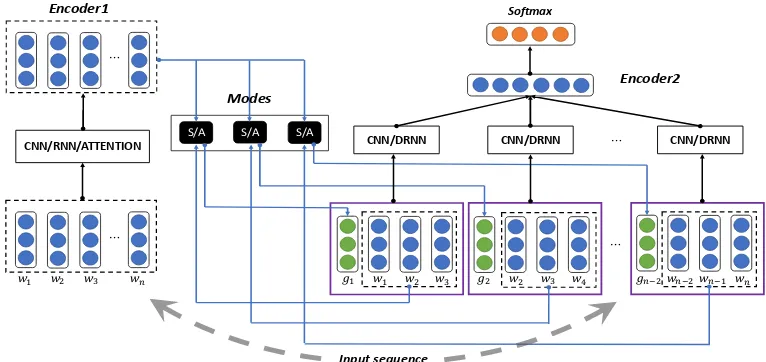
Figure 1: Encoder1-Encoder2 architecture mainly contains three components. (1) Encoder1 serves as a global information provider. (2) Encoder2 is a local feature driven model whose output is directly fed into the classifier. (3) Mode is the interaction manner between them. S and A are abbreviation of SAME and ATTEND respectively.
ument representation.Tai et al.(2015) introduce a tree-structured LSTM for sentiment classification. The attention mechanism proposed by Bah-danau et al.(2014) has achieved great success in machine translation (Vaswani et al., 2017). For text classification which only has single input se-quence, attention based models mainly focus on applying attention mechanism on top of CNN or RNN for selecting the more important informa-tion (Yang et al., 2016; Er et al., 2016). Letarte et al.(2018) andShen et al. (2018) also explore self-attention networks which is CNN/RNN free.
3 Encoder1-Encoder2 Architecture 3.1 Overview
In this paper, we propose a novel neural network architecture named Encoder1-Encoder2 for text classification, which is illustrated in Figure1. The identical input sequence will be encoded twice by two encoders respectively, but only the output of Encoder2 is used directly for the classifier. In par-ticular, the Encoder1 serves as a pioneer for pro-viding global information, while the Encoder2 fo-cuses on extracting better local features by incor-porating the former into the local extraction pro-cedure. Besides, two Interaction Modes are devel-oped for more targeted absorption of global infor-mation.
3.2 Encoder1: Global Information Provider Without loss of generality, we introduce three types of models for Encoder1 in our architecture,
each of which can be an independent global in-formation provider and they are compared in our experiments.
CNNLetxt be thed-dimensional word vector
corresponding to the t-th word in a sequence of
lengthn, xt h+1:t refers to the concatenation of
wordsxt h+1,xt h+2, . . . ,xt with size h andk
number of filters are applied to the input sequence to generate features. Formally, filtersWf are
ap-plied to windowxt h+1:tto computeht:
ht=Conv(xt h+1,xt h+2, . . . ,xt) (1)
=relu(Wfxt h+1:t+bf) (2)
By same padding, filters are applied tonpossible
windows in the sequence and the global represen-tation can be represented asenc1:
enc1 = [h1;h2;. . .;hn] (3)
GRU Gated recurrent units (GRU) are a gat-ing mechanism in RNN (Cho et al.,2014). Two types of gates are used in GRU: reset gate decides how much new information is updated, while up-date gate controls the flow of previous informa-tion. The hidden stateht is computed iteratively
based onht 1 andxt. As a result, the all
previ-ous information can be encoded. For saving space, here we abbreviate it as:
ht=GRU(x1,x2, . . . ,xt) (4)
The global representation produced by GRU is hidden states of all time steps:
Attention We also introduce attention mecha-nism on GRU for enhancing valuable information followingZhou et al.(2016). Define a context vec-toruw to measure the importance of each hidden
statehtin GRU, which is randomly initialized and
learned during training. A normalized importance weight↵tis obtained through a softmax function:
↵t=
exp(tanh(ht)>uw)
P
texp(tanh(ht)>uw)
(6)
The global representation produced by this atten-tion mechanism is expressed as:
enc1 = [↵1h1;↵2h2;. . .;↵nhn] (7)
3.3 Encoder2: Variant Local Extractor Vanilla local feature extractor strictly focuses on a limited size region. Here we propose a vari-ant method. Apart from the expected local con-text, global information distilled by Encoder1 is also absorbed by a local extractor. In this way, the local features extracted by Encoder2 can no-tice the global background while still maintaining the position-invariant local patterns.
For Encoder2, we introduce two kinds of local feature driven models, i.e., CNN and DRNN. The former is good at capturing local spatial structure, while the latter is highlighted in capturing local temporal part. Setgtas the required global
infor-mation for a certain size window starting fromxt,
which will be introduced in3.4in detail.
CNN Here we treat eachgt 2 Rd as a faked
extra global word, and do convolution with win-dow words together. Based on Equation 1, fea-tures produced by filters for windowxt h+1:tcan
be represented as:
ht=Conv(gt,xt h+1,xt h+2, . . . ,xt) (8)
DRNN Different from CNN, DRNN utilizes RNN to extract local features for each win-dow (Wang,2018). To introduce global informa-tion into DRNN, faked global wordgtis filled in
the head of each window like CNN does. Because of the sequential nature of RNN, even for a limited window, global information can be encoded into RNN from scratch and motivate the latter words. Here we use GRU as the local feature extractor, and features produced for windowxt h+1:tcan be
represented as:
ht=GRU(gt,xt h+1,xt h+2, . . . ,xt) (9)
To maintain translation invariant, a max-over-time pooling layer is then applied to CNN or DRNN layer, the pooling result is regarded as the output of Encoder2:
enc2 =maxpool([h1;h2;. . .;hn]) (10)
3.4 Interaction Modes between Encoders Setenc1as the global representation produced by Encoder1, required information for a certain win-dowxt h+1:twith sizehis defined asgt:
gt=G(enc1,xt h+1,xt h+2, . . . ,xt) (11)
whereG is a function of interaction mode. Two
modes are devised from different point of views. SAME Treatenc1 as a “reference book” pro-vided by Encoder1. The basic idea of SAME Mode is each window in Encoder2 will get discriminate guidance regardless of the local in-formation itself. For this purpose, max-over-time pooling is operated onenc1directly to extract the most important information:
ˆ
gt=maxpool(enc1) (12)
ATTENDMode ATTEND utilizes global infor-mation from another perspective. According to different local contexts, the guidances from En-coder1 can be be more targeted. Specifically, we use attention mechanism.
For window xt:t+h 1 with size h, the context vector is the average pooling of local words em-beddings and the importance weight↵t for each
hidden statehtin Encoder1 can be computed as:
↵t=
exp(tanh(ht)>avg(xt:t+h 1)) P
texp(tanh(ht)>avg(xt:t+h 1)) (13)
To maximize the profits obtained from En-coder1, we concatenate both of maxpooling re-sults and attention rere-sults. Thengˆt in ATTEND
mode can be represented as:
ˆ
gt=Concat(maxpool(enc1),
X
t
↵tht) (14)
Finally, to keep consistent dimensions with words in the text, we compressgˆtusing MLP and
formalized asgt, which can be easily embedded
Dataset C L N Test Tasks Yelp P. 2 156 560k 38k SA Yelp F. 5 158 650k 50k SA Amz. P. 2 91 3M 650k SA Amz. F 5 93 3.6M 400k SA AG 4 44 120k 7.6k News Sogou 5 579 450k 60k News Yah. A. 10 112 1.4M 60k QA DBP 14 55 560k 70k Ontology
Table 2: Datasets summary. C: Number of target classes. L: Average sentence length. N: Dataset size. Test: Test set size. In tasks, SA refers to sentiment analysis, and QA refers to question answering.
3.5 Classification Layer
After incorporating the global information ob-tained from Encoder1 into the local feature extrac-tion of Encoder2, the output vector of latter can be regarded as the representation of the entire text. The vector is then fed into a softmax classifier to predict the probability of each category and cross entropy is used as loss function:
ˆ
y=sof tmax(Wcenc2+bc) (15)
H(y,y) =ˆ X
i
yilog ˆyi (16)
whereyˆi is the predicted probability andyi is the
true probability of classi.
4 Experiments
We report experiments with proposed models in comparison with previous methods.
4.1 Experiments Settings
Datasets Publicly available datasets fromZhang et al. (2015) are used to evaluate our models. These datasets contain various domains and sizes, corresponding to sentiment analysis, news classi-fication, question answering, and ontology extrac-tion, which are summarized in Table2.
Model Settings For data preprocessing, all the texts of datasets are tokenized by NLTKs tokenizer (Loper and Bird,2002). For model hyperparame-ters, notations are following in 3.2 and3.3. We adopt CNN, GRU and Attention for Encoder1. In CNN (Encoder1), we use filter windows (h) of [3,5,7]with 128 feature maps (k) each. The
hid-den unit number is 128 in GRU (Encoder1) and Attention (Encoder1). For Encoder2, we conduct experiments based on two types of local feature
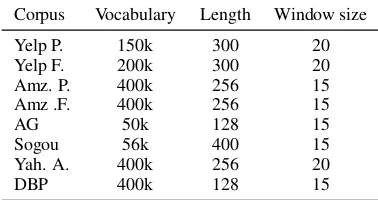
Corpus Vocabulary Length Window size Yelp P. 150k 300 20 Yelp F. 200k 300 20 Amz. P. 400k 256 15 Amz .F. 400k 256 15
AG 50k 128 15
Sogou 56k 400 15 Yah. A. 400k 256 20
[image:5.595.321.510.64.164.2]DBP 400k 128 15
Table 3: Model settings. We limit the vocabulary size and set maximum sequence length. We also show the window size in DRNN following Wang(2018).
extractor, corresponding to CNN and DRNN re-spectively. In CNN (Encoder2), window sizes of filters are of[3,5,7]with 128 feature maps each.
In DRNN (Encoder2), all the dimensions of hid-den states are set to 300. Other settings are shown in Table3, all trainable parameters including em-beddings of words are initialized randomly with-out any pre-trained techniques (Mikolov et al.,
2013;Peters et al.,2018;Devlin et al.,2018).
Training and Validation For each dataset, we randomly split the full training corpus into train-ing and validation set, where the validation size is the same as the corresponding test size. Then the validation set is fixed for all models for fair com-parison. The reported test accuracy is evaluated in the model which has lowest validation error.
AdaDelta (Zeiler, 2012) with ⇢ = 0.95 and
✏ = 1e 6 is chosen to optimize all the train-able parameters. Gradient norm clipping is em-ployed to avoid the gradient explosion problem. L2 normalization is used in all models which in-clude RNN structures. The batch size is set to 64 for Yelp P. and Yelp F. while 128 for other datasets. We train all the models using early stopping with timedelay 10.
4.2 Experimental Results and Analysis Table 4 is the summary of the experimental re-sults. We use underscores to represent the best published models, and bold the best records. Best models in our proposed architecture beat previous state-of-the-art models on all eight text classifica-tion benchmarks.
[image:5.595.82.279.64.164.2]Model Yelp P. Yelp F. Amz. P. Amz. F. AG Sogou Yah. A. DBP bigram-FastText (Joulin et al.,2016) 95.7 63.9 94.6 60.2 92.5 96.8 72.3 98.6 Region-emb (Qiao et al.,2018) 96.2 64.5 95.3 60.8 92.8 97.3 73.4 98.9 SANet(big) (Letarte et al.,2018) 95.2 64.0 95.5 61.3 92.6 - 74.1 98.8 LSTM (Zhang et al.,2015) 94.7 58.2 93.9 59.4 86.1 95.2 70.8 98.6 D-LSTM (Yogatama et al.,2017) 92.6 59.6 - - 92.1 94.9 73.7 98.7 char-CNN (Zhang et al.,2015) 94.7 62.0 94.5 59.6 87.2 95.1 71.2 98.3 VDCNN (Conneau et al.,2016) 95.7 64.7 95.7 63.0 91.3 96.8 73.4 98.7 CNN (Kim,2014) 95.8 64.7 95.2 60.9 91.9 97.1 72.6 98.8 Encoder1-CNN-S (Ours) 96.5 66.2 95.9 63.3 92.5 97.5 74.5 98.8 Encoder1-CNN-A (Ours) 96.5 66.5 96.0 63.3 93.0 97.5 74.6 98.9 DRNN (Wang,2018) 96.3 66.4 95.6 63.0 92.9 96.9 74.3 98.9 Encoder1-DRNN-S (Ours) 96.6 66.8 96.0 63.2 93.0 97.2 74.8 99.0
[image:6.595.78.523.64.272.2]Encoder1-DRNN-A (Ours) 96.7 67.0 96.0 63.1 93.2 97.3 75.0 99.0
Table 4: Test accuracy [%] on several Datasets. We use Encoder1-Encoder2-Mode to represent our architecture, where S indicates mode SAME while A indicates ATTEND. For each specialized Encoder2, we test three different Encoder1. For the sake of brevity, Encoder1 here does not specifically refer to a certain model but the best performance of the three combinations. Detailed experiments results for all combinations of Encoder1-Encoder2-Mode are further reported and compared in Table5. For compared previous models, first block lists n-grams based models including bigram-FastText (Joulin et al.,2016) and region embedding (Qiao et al.,2018). Self-attention Networks SANet (Letarte et al.,2018) is reported in the second block. RNN based models LSTM (Zhang et al., 2015), D-LSTM (Yogatama et al.,2017) and CNN based models char-CNN (Zhang et al.,2015) and VDCNN (Conneau et al.,2016) are listed in third and forth block respectively. Strong local feature driven models CNN (Kim,2014) and DRNN (Wang,2018) are chosen as base model and directly compared with our architecture in last two blocks.
scenes, neither do RNN based methods. We argue that it is because key phrases and word order play an important role in text classification.
For our models, the experimental results show that enhanced local extractors with global encoder outperform vanilla local models by a advanta-geous margin. When CNN is chosen as local ex-tractor, the performance gains are particularly sig-nificant for relatively difficult tasks such as Amz. F.(+2.4%) and Yah. A.(+2.0%). Encoder1-CNN performs even better than VDCNN with 29 volutional layers. The results are satisfying con-sidering that our CNN used as local extractor here is a shallow model with only one layer. Moreover, complicated VDCNN performs best among pub-lished models on larger datasets Amz. P.(95.7%) and Amz. F.(63.0%) but not as expected on smaller AG(91.3%), while our Encoder1-CNN has stable superior performance on all datasets. When DRNN is chosen as local extractor, the bonus from the global encoder is not so big like CNN, but still considerable and stable. Encoder1-DRNN beats DRNN on all datasets with a highest gain up to 0.7%.
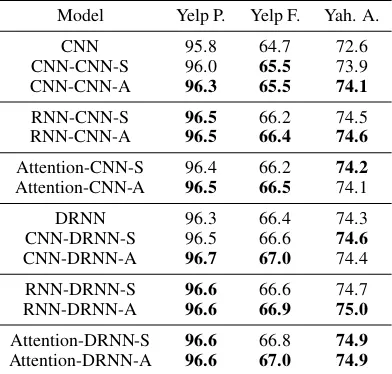
To better analyze the impact of specific En-coder1 (global encoder) and different Interac-tion Modes on architecture performance, Table
5 details all combinations results of Encoder1-Encoder2-Mode on three datasets. We find the local extractor benefits quite a lot for any intro-duced global encoders. Overall, RNN and Atten-tion based global encoders perform well-matched for local extractor, and both of them often perform better than CNN based global encoder. For ex-ample, Attention-CNN wins CNN-CNN 1.0% on Yelp F. and RNN-DRNN wins CNN-DRNN 0.4% on Yah. A. This is intuitive since RNN and Atten-tion are more appropriate in capturing global in-formation compared with CNN, which is critical for local extractor. The structures which special-ize in modeling long-term dependency are more recommended as the global encoder.
(a) Experiments on Yelp F. (b) Experiments on Yah. A.
Figure 2: Model ablation experiments. “Vanilla” is the traditional CNN (Kim,2014). “Concat” simply concate-nates the output of Encoder1 and Encoder2 and directly classifies according to the concatenated result. “Same” indicates the Interaction Mode in our architecture.
Model Yelp P. Yelp F. Yah. A. CNN 95.8 64.7 72.6 CNN-CNN-S 96.0 65.5 73.9 CNN-CNN-A 96.3 65.5 74.1
RNN-CNN-S 96.5 66.2 74.5 RNN-CNN-A 96.5 66.4 74.6
Attention-CNN-S 96.4 66.2 74.2
Attention-CNN-A 96.5 66.5 74.1 DRNN 96.3 66.4 74.3 CNN-DRNN-S 96.5 66.6 74.6
CNN-DRNN-A 96.7 67.0 74.4 RNN-DRNN-S 96.6 66.6 74.7 RNN-DRNN-A 96.6 66.9 75.0
Attention-DRNN-S 96.6 66.8 74.9
Attention-DRNN-A 96.6 67.0 74.9
Table 5: Effect of Encoder1 and Interaction Mode.
assist the local extractor. SAME Mode selects the most important information of global encoder and provides same guidance for each window in En-coder2, while the ATTEND Mode tends to make use of the “reference” with purpose based on dif-ferent local contexts as if we refer to a reference book with initiative questions.
4.3 Model Ablation
In addition to introducing another encoder into vanilla local feature driven models, the greatest novelty of our architecture lies in that the global encoding is used to generate local features di-rectly. Based on this motivation, the local features have the global awareness from the very begin-ning. To verify that our novel architecture makes key contribution to the performance improvement, we carry out model ablation experiments.
Without loss of generality, we use CNN as local extractor here and validate on Yelp F. and Yah. A.
datasets. The results are illustrated in Figure2. Firstly, we list the results of Vanilla CNN, which is regarded as the most primitive state. Sec-ondly, another additional encoder is introduced but they both process inputs independently and then their output representations are concatenated for classification. We call it “Concat”, abbreviated as “C”. For example, RNN-CNN-C stands for con-catenating another RNN. Finally, we upgrade the way to use the introduced encoder as our proposed architecture. Here we list Mode SAME, abbrevi-ated as “S”.
We find CNN-CNN-C loses 0.5% on Yelp P. but wins 0.4% on Yah. A. compared with vanilla CNN. CNN-CNN-C can be viewed as doubling convolution filters and we can observe that intro-ducing more parameters does not always perform better. Meanwhile, RNN-CNN-C wins vanilla CNN 0.7% on Yelp P. and 0.9% on Yah. A. It makes sense since the classifier could use features from CNN and RNN simultaneously and different model structures complement each other for clas-sification. In particular, our architecture performs best for both cases. S wins CNN-CNN-C 1.3% and 0.8%, and RNN-CNN-S wins RNN-CNN-C 0.6% and 1.0% on Yelp P. and Yah. A. respectively. In fact, CNN-CNN-S does not in-troduce new model structure or complicated oper-ations and the number of parameters are almost the same. We attribute the great improvement to our novel mechanism where the global representation conduces to the local extraction.
4.4 Effect of Window Size
[image:7.595.84.280.257.444.2]tun-(a) The impact of window size on CNN. (b) The impact of window size on DRNN.
Figure 3: Window size experiments on Yelp F. ATT is the abbreviation of Attention.
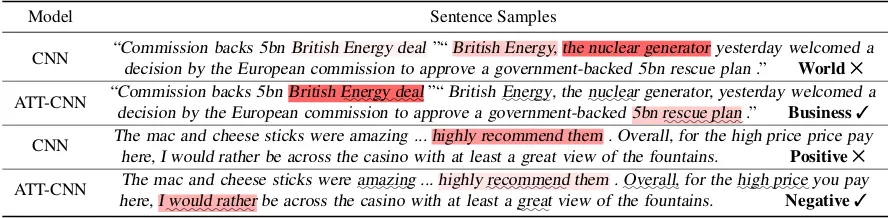
Model Sentence Samples
CNN “Commission backs 5bn British Energy dealdecision by the European commission to approve a government-backed 5bn rescue plan”“British Energy, the nuclear generator yesterday welcomed a.” World5
ATT-CNN “Commission backs 5bn BritishEnergy::::::::::deal”“British::::::Energy, the::::::nuclear generator, yesterday welcomed a
decision by the European commission to approve a government-backed 5bnrescue::::::::::plan.” Business3
CNN The mac and cheese sticks were amazing ... highly recommend them . Overall, for the high price price payhere, I would rather be across the casino with at least a great view of the fountains. Positive5
ATT-CNN The mac and cheese sticks were:::::::amazing ... highly::::::::::recommend them .:::::::Overall, for the::::high:::::price you pay
here, I::::::would:::::rather be across the casino with at least a::::great view of the fountains. Negative3
Table 6: Visualization of chosen samples on AG News and Yelp Review Polarity dataset. We use SAME Interaction Mode in ATT-CNN where ATT is the abbreviation of Attention.
ing in traditional method. Small window sizes may result in the loss of some critical informa-tion whereas large windows result in an enormous parameter space, which could be difficult to train (Lai et al.,2015). In this section, we analyze the impact of different window sizes on model perfor-mances.
As shown in Figure3, both CNN and DRNN are very sensitive to window size, the optimal window size in DRNN can be much larger than CNN due to the sequential memory in RNN structure. Tun-ing these models is often challengTun-ing. In contrast, our Encoder1-Encoder2 architecture is insensitive to the parameter and achieves stable satisfied per-formance in various window sizes. We believe it is because the local extraction has been enhanced by global information and not strictly dependent on large windows to capture long range information.
4.5 Case Study and Visualization
To investigate how our architecture makes a differ-ence in details, we visualize the attending phrases by the neural model in Table6. Qualitatively, we display the contribution of phrases in Encoder2 to classification via max-pooling. The most impor-tant phrases are highlighted red where the inten-sity of the color indicates the contribution. Mean-while, we use waves to roughly indicate the key
phrases with high attention scores in Encoder1. Detailed visualization techniques have been intro-duced inLi et al.(2015).
The first two lines compare CNN with our Attention-CNN on an example from AG News. CNN wrongly captures key phrasesBritish Energy andthe nuclear generator and thus misclassifies the example intoWorld. In contrast, our Attention-CNN is able to correctly classify it intoBusiness. The Encoder1 firstly captures the global descrip-tion byEnergy deal,nuclear, andrescue plan. In-formed with these global information, Encoder2 reduces its attention tonuclear, which implies la-belWorld while captures key phrasesBritish En-ergy deal and 5bn rescue plan. Accordingly the model makes a correct prediction labeled as Busi-ness. For the second example, the global represen-tations include phraseshigh priceand conjunction Overall, making Encoder2 activateI would rather while reduce its sensitivity tohighly recommend themcompared with CNN.
[image:8.595.76.520.208.317.2]4.6 Comparison to Pre-trained Models As shown above, our paper mainly focuses on fully-supervised domain where all model param-eters are trained from scratch. Alternatively, sub-stantial work has shown that pre-trained models are beneficial for various NLP tasks. Typically, they first pre-train neural networks on large-scale unlabeled text corpora, and then finetune the mod-els or representations on downstream tasks.
One kind of pre-trained models is the word embeddings, such as word2vec (Mikolov et al.,
2013) and GloVe (Pennington et al.,2014). More recently, by utilizing larger-scale unsupervised corpus and deeper architecture, pre-trained lan-guage models have shown to be effective in learn-ing common language representations and have achieved great success. Among them, OpenAI GPT (Radford et al.,2018), BERT (Devlin et al.,
2018), XLNet (Yang et al., 2019) and ERNIE 2.0 (Sun et al.,2019) are the most remarkable ex-amples.
In this section, we generalize our architecture to semi-supervised domain which is equipped with pre-trained word embeddings and then compare with popular pre-trained based models. Specifi-cally, we use GloVe vectors2with 300 dimensions to initialize the word embeddings in our architec-ture. BERTBASE3and ERNIE 2.0BASE4with
12-layer Transformer (Vaswani et al.,2017) are cho-sen for comparison. Here we report best model for each specialized Encoder2 with SAME Mode. Results on three datasets are listed in Table7.
Overall, our architecture can be further boosted a lot by utilizing pre-trained word embeddings. For example, Encoder1-DRNN-S obtains a new score of 76.2%(+1.4%) on Yah. A. andEncoder1 -CNN-S gets 94.1%(+1.6%) on AG. Vanilla local extractors also achieve better performance as ex-pected in most instances while our models are still much better than them. Encoder1-CNN-S outper-forms CNN by 0.9%, 1.8% and 2.0% on three datasets respectively, andEncoder1-DRNN-S out-performs DRNN by 0.4%, 0.6% and 0.7%. It shows that our architecture is well generalized and compatible with pre-training techniques.
It is interesting to compare with stronger pre-trained models. Although we obtain close scores on AG, BERT and ERNIE 2.0 indeed achieve
2http://nlp.stanford.edu/projects/glove 3https://github.com/google-research/bert 4https://github.com/PaddlePaddle/ERNIE
Model Yelp F. AG Yah. A.
CNN(n/y) 64.7/64.5 91.9/92.3 72.6/73.7
Encoder1-CNN-S(n/y) 66.2/66.6 92.5/94.1 74.5/75.7 DRNN(n/y) 66.4/66.8 92.9/93.6 74.3/75.5
Encoder1-DRNN-S(n/y) 66.8/67.2 93.0/94.2 74.8/76.2
BERTBASE 67.9 94.2 76.4
ERNIE 2.0BASE 69.1 94.3 77.0
Table 7: Semi-supervised generalization of our archi-tecture and comparison with popular pre-trained mod-els. Here “n” and “y” stand for initializing word em-beddings randomly and with pre-trained GloVe vectors separately.
more advanced results on others and the latter per-forms best on all three datasets. Despite their su-perb accuracy, we argue that the huge models are resource-hungry in practice. Lightweight models still have advantages under some circumstances such as limited memory, longer text data to be pro-cessed and requirements of faster inference time.
5 Conclusion
In this work, we demonstrate the local feature ex-traction can be significantly enhanced with global information. Instead of traditionally exploiting deeper and complicated operations in upper neu-ral layers, our work innovatively provides another lightweight way for improving the ability of neu-ral model. Specifically, we propose a novel archi-tecture named Encoder1-Encoder2 with two In-teraction Modes for their interacting. The archi-tecture has high flexibility and our best models achieve new state-of-the-art performance in fully-supervised setting on all benchmark datasets. We also find that our architecture is insensitive to win-dow size and enjoy a better robustness. In fu-ture work, we plan to validate its effectiveness for multi-label classification. Besides, we are in-terested in incorporating more powerful unsuper-vised methods into our architecture.
Acknowledgments
This work is supported by the Natural Science Foundation of China (No. 61533018). We grate-fully thank the anonymous reviewers for their in-sightful comments.
References
learning to align and translate. arXiv preprint arXiv:1409.0473.
Kyunghyun Cho, Bart Van Merri¨enboer, Caglar Gul-cehre, Dzmitry Bahdanau, Fethi Bougares, Holger Schwenk, and Yoshua Bengio. 2014. Learning phrase representations using rnn encoder-decoder for statistical machine translation. arXiv preprint arXiv:1406.1078.
Junyoung Chung, Caglar Gulcehre, KyungHyun Cho, and Yoshua Bengio. 2014. Empirical evaluation of gated recurrent neural networks on sequence model-ing. arXiv preprint arXiv:1412.3555.
Alexis Conneau, Holger Schwenk, Lo¨ıc Barrault, and Yann Lecun. 2016. Very deep convolutional networks for text classification. arXiv preprint arXiv:1606.01781.
Jacob Devlin, Ming-Wei Chang, Kenton Lee, and Kristina Toutanova. 2018. Bert: Pre-training of deep bidirectional transformers for language understand-ing. arXiv preprint arXiv:1810.04805.
Meng Joo Er, Yong Zhang, Ning Wang, and Mahard-hika Pratama. 2016. Attention pooling-based convo-lutional neural network for sentence modelling. In-formation Sciences, 373:388–403.
Sepp Hochreiter and J¨urgen Schmidhuber. 1997. Long short-term memory. Neural computation, 9(8):1735–1780.
Rie Johnson and Tong Zhang. 2017. Deep pyramid convolutional neural networks for text categoriza-tion. InProceedings of the 55th Annual Meeting of the Association for Computational Linguistics (Vol-ume 1: Long Papers), volume 1, pages 562–570.
Armand Joulin, Edouard Grave, Piotr Bojanowski, and Tomas Mikolov. 2016. Bag of tricks for efficient text classification.arXiv preprint arXiv:1607.01759.
Yoon Kim. 2014. Convolutional neural net-works for sentence classification. arXiv preprint arXiv:1408.5882.
Siwei Lai, Liheng Xu, Kang Liu, and Jun Zhao. 2015. Recurrent convolutional neural networks for text classification. InTwenty-ninth AAAI conference on artificial intelligence.
Yann LeCun, Koray Kavukcuoglu, and Cl´ement Fara-bet. 2010. Convolutional networks and applications in vision. In Proceedings of 2010 IEEE Interna-tional Symposium on Circuits and Systems, pages 253–256. IEEE.
Ga¨el Letarte, Fr´ed´erik Paradis, Philippe Gigu`ere, and Franc¸ois Laviolette. 2018. Importance of self-attention for sentiment analysis. In Proceedings of the 2018 EMNLP Workshop BlackboxNLP: An-alyzing and Interpreting Neural Networks for NLP, pages 267–275.
Jiwei Li, Xinlei Chen, Eduard Hovy, and Dan Jurafsky. 2015. Visualizing and understanding neural models in nlp. arXiv preprint arXiv:1506.01066.
Edward Loper and Steven Bird. 2002. Nltk: the natural language toolkit. arXiv preprint cs/0205028.
Tomas Mikolov, Ilya Sutskever, Kai Chen, Greg S Cor-rado, and Jeff Dean. 2013. Distributed representa-tions of words and phrases and their compositional-ity. InAdvances in neural information processing systems, pages 3111–3119.
Bo Pang, Lillian Lee, and Shivakumar Vaithyanathan. 2002. Thumbs up?: sentiment classification using machine learning techniques. InProceedings of the ACL-02 conference on Empirical methods in natural language processing-Volume 10, pages 79–86. As-sociation for Computational Linguistics.
Jeffrey Pennington, Richard Socher, and Christopher Manning. 2014. Glove: Global vectors for word representation. InProceedings of the 2014 confer-ence on empirical methods in natural language pro-cessing (EMNLP), pages 1532–1543.
Matthew E Peters, Mark Neumann, Mohit Iyyer, Matt Gardner, Christopher Clark, Kenton Lee, and Luke Zettlemoyer. 2018. Deep contextualized word rep-resentations. arXiv preprint arXiv:1802.05365.
Chao Qiao, Bo Huang, Guocheng Niu, Daren Li, Dax-iang Dong, Wei He, Dianhai Yu, and Hua Wu. 2018. Anew method of region embedding for text classi-fication. In International Conference on Learning Representations.
Alec Radford, Karthik Narasimhan, Tim Salimans, and Ilya Sutskever. 2018. Improving language understanding by generative pre-training. URL https://s3-us-west-2. amazonaws. com/openai-assets/researchcovers/languageunsupervised/language understanding paper. pdf.
Tao Shen, Tianyi Zhou, Guodong Long, Jing Jiang, Shirui Pan, and Chengqi Zhang. 2018. Disan: Di-rectional self-attention network for rnn/cnn-free lan-guage understanding. InThirty-Second AAAI Con-ference on Artificial Intelligence.
Yangyang Shi, Kaisheng Yao, Le Tian, and Daxin Jiang. 2016. Deep lstm based feature mapping for query classification. In Proceedings of the 2016 Conference of the North American Chapter of the Association for Computational Linguistics: Human Language Technologies, pages 1501–1511.
Yu Sun, Shuohuan Wang, Yukun Li, Shikun Feng, Hao Tian, Hua Wu, and Haifeng Wang. 2019. Ernie 2.0: A continual pre-training framework for language un-derstanding. arXiv preprint arXiv:1907.12412.
Duyu Tang, Bing Qin, and Ting Liu. 2015. Docu-ment modeling with gated recurrent neural network for sentiment classification. In Proceedings of the 2015 conference on empirical methods in natural language processing, pages 1422–1432.
Ashish Vaswani, Noam Shazeer, Niki Parmar, Jakob Uszkoreit, Llion Jones, Aidan N Gomez, Łukasz Kaiser, and Illia Polosukhin. 2017. Attention is all you need. InAdvances in Neural Information Pro-cessing Systems, pages 5998–6008.
Baoxin Wang. 2018. Disconnected recurrent neural networks for text categorization. InProceedings of the 56th Annual Meeting of the Association for Com-putational Linguistics (Volume 1: Long Papers), volume 1, pages 2311–2320.
Sida Wang and Christopher D Manning. 2012. Base-lines and bigrams: Simple, good sentiment and topic classification. In Proceedings of the 50th Annual Meeting of the Association for Computational Lin-guistics: Short Papers-Volume 2, pages 90–94. As-sociation for Computational Linguistics.
Yijun Xiao and Kyunghyun Cho. 2016. Efficient character-level document classification by combin-ing convolution and recurrent layers. arXiv preprint arXiv:1602.00367.
Zhilin Yang, Zihang Dai, Yiming Yang, Jaime Car-bonell, Ruslan Salakhutdinov, and Quoc V Le. 2019. Xlnet: Generalized autoregressive pretrain-ing for language understandpretrain-ing. arXiv preprint arXiv:1906.08237.
Zichao Yang, Diyi Yang, Chris Dyer, Xiaodong He, Alex Smola, and Eduard Hovy. 2016. Hierarchi-cal attention networks for document classification. InProceedings of the 2016 Conference of the North American Chapter of the Association for Computa-tional Linguistics: Human Language Technologies, pages 1480–1489.
Dani Yogatama, Chris Dyer, Wang Ling, and Phil Blun-som. 2017. Generative and discriminative text clas-sification with recurrent neural networks. arXiv preprint arXiv:1703.01898.
Matthew D Zeiler. 2012. Adadelta: an adaptive learn-ing rate method. arXiv preprint arXiv:1212.5701.
Xiang Zhang, Junbo Zhao, and Yann LeCun. 2015. Character-level convolutional networks for text clas-sification. In Advances in neural information pro-cessing systems, pages 649–657.
Jianyu Zhao, Zhiqiang Zhan, Qichuan Yang, Yang Zhang, Changjian Hu, Zhensheng Li, Liuxin Zhang, and Zhiqiang He. 2018. Adaptive learning of lo-cal semantic and global structure representations for text classification. InProceedings of the 27th Inter-national Conference on Computational Linguistics, pages 2033–2043.
![Table 4: Test accuracy [%] on several Datasets. We use Encoder1-Encoder2-Mode to represent our architecture,where S indicates mode SAME while A indicates ATTEND](https://thumb-us.123doks.com/thumbv2/123dok_us/1336802.665003/6.595.78.523.64.272/accuracy-datasets-encoder-encoder-represent-architecture-indicates-indicates.webp)