A RULE-BASED APPROACH TO EVALUATING IMPORTANCE IN DESCRIPTIVE TEXTS
Danilo Fum(*), Giovanni Gulda(?), Carlo Tasso(~)
Isllmm di Matemadca, Informatica•
SlstemisticaUniversi~ di Udlne Udlne, Italy
ABSTRACT
Importance evaluation is one of the most challenging problems in the f i e l d of text processing. In the paper we focus on the notion of importance from a computational standpoint, and we propose a procedural, rule-based approach to importance evaluation. T h i s novel approach is supported by a prototype experimental system, called importance evaluator, that can deal with descriptive texts taken from computer science l i t e r a t u r e on operating systems. The evaluator relies on a set of importance rules that are used to assign importance values to the different parts of a text and to resolve or explain conflicting evaluations. The system u t i l i z e s world knowledge on the subject domain contained in an encyclopedia and takes into account a goal assigned by the user for specifying the pragmatic aspects of the understanding a c t i v i t y . The paper describes the role of the evaluator in the frame of a larger system for text summarization (SUSY); i t i l l u s t r a t e s i t s overall mode of operation, and discusses some meaningful examples.
I . INTRODUCTION
Text understanding has received increasing attention in recent years. A major problem in this area is that of importance evaluation: not all the components of a sufficiently large and structured piece of text are equally important for the reader, and humans are able to evaluate the relative importance of the parts of the texts they read. This issue has been faced so far only in an
indirect way in the l i t e r a t u r e on discourse structure (Kintsch and van Dijk, 1978; van Dijk and Kintsch, 1983), summarization (Lehrert, 1982 and 1984; Wilensky, 1982; Hahn and Reimer, 1984), and inference (Schank, 1979).
Moreover, several studies in the f i e l d of summarization (e.g.: Schank, 1979 and 1982; Lehnert, 1982 and 1984; Wilensky, 1982) have mostly been concerned with narrative texts
(stories), and i t is not at all obvious that the approaches which proved successful in this area (') also with: Laboratorio di Psicologia E.E., Universita' di Trieste, Trieste, I t a l y
(t) also with: M i l a n Polytechnic A r t i f i c i a l Intelligence Project, Milano, I t a l y
(~) also with: CISM International Center for Mechanical Sciences, Udine, I t a l y
could be applied to descriptive texts as well. Expository prose has i t s own specific features (Graesser, 1981), and i t seems to require different understanding processes, different summarization s k i l l s , and different cognitive models (Lehnert, 1984). Work on the problem of understanding and summarizing expository prose is s t i l l at the very beginning (Hahn and Reimer, 1984).
In this paper we focus on the notion of importance from a computational standpoint, and we propose a rule-based approach to importance evaluation. T h i s research is part of a larger project aimed at developi ng a system for understanding and summarizing descriptive texts (SUSY, a SUmmarizing SYstem), which is in progress a~-~Te University" of
SUSY proposes an approach to descriptive text understanding and summarization (Fum, Guida, and Tasso, 1982, 1983, and 1984) in which the process of representing the meaning of a natural language text is s p l i t into three main tasks, namely: sentence understanding, structure capturing, and i mportance eval uati on.
The sentence understandin 9 phase works on the single s ~ that constitute a given natural language text and maps them into a formal internal representation, called basic linear representation (BLR). The BLR is essentially a propositional language appropriately extended and completed to deal with the most relevant features of text representation, and f u l l y worked out in a way suitable for computer implementation (Fum, Guida, and Tasso, 1984). The BLR representation of a text i s consti tuted by a sequence of I abel ed propositions, each of them constituted by a predicate with instantiated arguments or representing an ISA relation between concepts. This phase includes the understanding of the l i t e r a l meaning of each sentence in the text, the appropriate representation of time relations, and the treatment of quantification and reference.
The structure capturing phase works on the BLR and produces an augmented version of i t , called extended linear representation (ELR). T h i s phase
on two maln points:
recognizing and expliciting the rhetoric structure of the text, which explains how the flow of ideas and the arguments of the writer are organized and implemented in the text.
The importance evaluation phase operates on the ELR and attaches appropriate markers to i t s components in order to produce a new representation, called hierarchical propositional network (HPN). The HPN is a tree-like structure whose n ~ s , corresponding to concepts and propositions of the ELR, are assigned different importance values (integers) according to their relative importance in the text.
Once the HPN representation of a text has been produced, i t is easy to prune the less relevant parts in order to obtain the representation of an appropriate summary to be eventually translated into natural language. These last phases ( i . e . , pruning and generation) are, for the moment, outside the scope of this research.
The purpose of this paper is to investigate in some detail the phase of importance evaluation, and to i l l u s t r a t e the results obtained in the design and experimentation of a prototype system that can produce from the ELR of a given text a reasonable HPN.
The paper is organized as follows: section two introduces the topic of importance evaluation and discusses some basic conceptual aspects, in section three the overall organization of the system is presented with particular attention to knowledge representation, section four i l l u s t r a t e s some examples of importance evaluation, and section five concludes the paper.
2. EVALUATING IMPORTANCE
The topic of importance evaluation has been dealt with in recent years, although often only in a quite indirect way, by several authors and in many different contexts. A part of a text can be considered important in relation to other segments of the same text according to several c r i t e r i a :
i t embodies knowledge necessary to understand other parts of the text (van Dijk, 1977; Kintsch and van Dijk, 1978); - i t is relevant to the topic of discourse
(Lehnert 1982 and 1984);
i t is useful to c l a r i f y the relations that make discourse coherent (Hobbs, 1982); i t relates to the topic-focus articulation (Haji~ova' and Sgall, 1984);
i t refers to objects or relations in the subject domain that are judged to be important a-priori (Schank, 1979);
- i t is unusual, new, or abnormal in the
subject domain (Schank, 1979);
i t generates surprise ( v a n Dijk and Kintsch, 1983);
i t is relevant to some specific reader's goal or need (Fum, Guida, and Tasso, 1982).
In practice, i f we test these c r i t e r i a on sample texts, they result sometimes complementary, sometimes p a r t i a l l y overlapping, sometimes even conflicting. Moreover, different readers may judge d i f f e r e n t l y the importance of the same text; on some parts a general consensus may be achieved, but the evaluation of other parts may be d e f i n i t e l y subjective.
In fact, "important" means "specially relevant to some goal", and, whenever the goal with which a text is read changes, the parts of text which are to be considered important vary accordingly. Even i f the goal of reading is only seldom considered e x p l i c i t l y by humans, s t i l l some goal is always i m p l i c i t l y assumed. Different readers (or the same reader in different moments) may have different goals, and conflicting judgments of importance may be due to the consideration of different goals, rather than to the application of different evaluation procedures.
The above investigation shows that importance is a really multifaceted concept which escapes a simple, e x p l i c i t , algorithmic definition. A procedural, knowledge-based approach comprising a set of rules that can assign relative importance values to the different parts of a text and can resolve or explain conflicting evaluations seems more appropriate. Such an approach allows taking into account in a f l e x i b l e and natural way the variety of knowledge sources and processing a c t i v i t i e s that are involved in importance evaluation. Moreover, i t is expected to be well founded from a cognitive point of v i e w (van Dijk and Kintsch, 1983; Anderson, 1976), as i t allows close and transparent modeling of several processes that occur in human mind.
3. A COMPUTATIONAL APPROACH
Most of the ideas outlined in the previous section have been implemented in the design of a subsystem of SUSY, called the importance evaluator, that takes in input the ELR representation of a natural language text and the representation of a reader's goal and produces in o u t p u t the corresponding HPN. The evaluator is implemented by a rule-based system (Davis and King, 1976) with a forward c h a i n i n g control r e g i m e . Knowledge available to the evaluator comprises two parts: a rule base and an encyclopedia.
classified according to their competence, i . e . to the different types of knowledge utilized for evaluating importance. From this point of view, three classes of rules are considered:
structural rules, which express the fact that some parts of the text can be judged important just by looking at their structure and organization, discarding thei r meaning;
semantic ~ules, which can evaluate importance by specifically taking into account some specific structural features of the text that convey a definite meaning;
encyclopedic rules, which can evaluate importance by comparing the meaning of the text with domain specific knowledge contained in the encyclopedia.
The IF-part of the rules contains conditions that are evaluated with respect to the current HPN ( i n i t i a l l y the ELR), and the THEN-part specifies either an importance evaluation or an action to be performed to further the analysis (e.g., a strategic choice, a criterion to solve conflicting evaluations, etc.).
The evaluation of importance contained in the THEN-part of a rule takes usually the form of an ordering relation (e.g., less, equal, etc.) among importance values of concepts or propositions of the ELR, or i t specifies ranges of importance values (e.g., high, low, etc.). Thus, rules only assert relative importance of different parts of the text: a constraint propagation algorithm w i l l eventually transform these relative evaluations into absolute importance values according to a given scale.
The encyclopedia is the second knowledge source employed by t h e evaluator and i t contains domain specific knowledge. Encyclopedic knowledge is represented through a net of frames. Frames embody, in addition to a header, two kinds of slots:
knowledge slots, that c o n t a i n domain specific knowledge, represented in a form homogeneous with the propositional language of the ELR;
reference slots, containing pointers to other frames that deal with related topics in the subject domain.
This organization allows easy implementation of a property inheritance mechanism.
We now i l l u s t r a t e the notion of goal which is of crucial importance for understanding the overall mode of operation of the evaluator. The goal is a chunk of variable knowledge, assigned by the user taking into account the pragmatic aspects of the understanding a c t i v i t y , that defines the motivations and objectives that are behind the reading process. The role of the goal is twofold:
exerting control on the activation of importance rules that operate on the ELR; selective focusing, i . e . enabling the evaluator to choose from the encyclopedia the pieces of knowledge which are expected to be relevant to the current importance evaluation.
The use of the goal in selective focusing comprises two a c t i v i t i e s :
validating matching between the current ELR and the knowledge contained in a frame header or knowledge slot (direct frame activation), or
activating a new frame pointed at in a reference slot of a currently active frame (i ndi rect frame acti vati on ).
Therefore, the encyclopedia does not contain any a-priory judgment a b o u t importance. Full responsibility of this a c t i v i t y is l e f t to the evaluator, which can interpret the content of the encyclopedia frames according to the current goal and can use the extracted knowledge to support the rule-based evaluation process.
4. SAMPLE OPERATION OF THE EVALUATOR
The current prototype version of the evaluator operates on simple texts taken from s c i e n t i f i c and technical computer science l i t e r a t u r e on operating systems. I t includes about 40 importance rules and a small encyclopedia of about 30 frames. The goal has been assigned a very simple structure: i t is a logical con~)ination of key-terms, chosen in a predefinite set, that represent possible points of view a reader can take in analyzing a text.
In this section we w i l l i l l u s t r a t e some of the most b a s i c mechanisms of importance evaluation through a few examples.
Let us consider the following sample text:
"U-DOS is an operating system developed by Softproducts Ltd. in 1982. I t has a modular organization and is suitable for real-time applications. U-DOS includes powerful tools for interactive processing and supports a sophisticated window management that makes i t user friendly, i . e . easily usable by novices or untrained end-users, Easy operation i s , in fact, the main reason of i t widespread diffusion in the data processing market, especially among CAD/CAM users who appreciate i t s graphic u t i l i t i e s . "
The ELR of this text results (for description of the formalism refer to: and Tasso, 1984):
a com~olete Fum, Guida,
010 *OP-SYSTEM (U-DOS)
030 *PAST (T1) 040 *YEAR-1982 (T1) 045 TIME-SPEC (40,20)
050 HAVE (U-DOS, V1, P) 060 *ORGANIZATION (VI) 070 MODULAR (V1, P) 075 QUAL (70, 60)
080 SUIT (U-DOS, VV2, P) 090 *APPLICATION (VV2) 100 REAL-TIME (VV2, P) 105 QUAL (100, 90)
110 INCLUDE (U-DOS, VV3, P) 120 *TOOL (VV3)
130 POWERFUL (VV3, P) 135 QUAL (130, 120)
140 APPROPRIATE-TO (VV3, V4, P) 145 QUAL (140, 120)
150 *PROCESSING (V4) 160 INTERACTIVE (V4, P) 165 QUAL (160, 150)
170 SUPPORT (U-DOS, V5, P) 180 *WINDOW-MANAGEMENT (V5) 190 SOPHISTICATED (VS, P) 195 QUAL (190, 180)
200 MAKE (VS, U-DOS, 210, P) 205 ENABLE (190, 210)
210 USER-FRIENDLY (U-DOS, P) 215 CLARIFICATION (220, 210)
220 OR (230, 260, P) 230 EASILY (240, P) 240 USE (VV6, U-DOS, P) 245 MOD (230, 240)
250 *NOVICE (VV6) 260 EASILY (270, P) 270 USE (VV7, U-DOS, P) 275 MOD (260, 270)
280 *END-USER (VV7) 290 UNTRAINED (VV7, P) 295 QUAL (290, 280)
300 REASON-FOR (310, 340) 305 RESULT (310, 340)
310 EASILY (320, P) 320 OPERATE (NIL, U-DOS) 325 MOD (310, 320)
330 HAVE (U-DOS, V8, P) 340 *DIFFUSION (V8) 350 LARGE (VS, P) 355 QUAL (350, 340)
360 IN (330, vg, P)
370 *DATA-PROCESSING-MARKET (V9) 380 AMONG (330, VVIO, P)
385 SPECIFICATION (360, 380) 390 *CAD/CAM-USER (VVlO) 400 APPRECIATE (VVlO, VV11, P) 410 *UTILITY (VV11)
420 GRAPHIC (VV11, P) 425 QUAL (420, 410)
430 HAVE (U-DOS, VV11, P)
The set of key-terms that can be used to specify the goal includes, among others: KNOW, BUY, and USE. We assume hereinafter the goal KNOW, i . e . , we are particularly interested in knowing the main technical features of the U-DOS operating system. W i t h such a goal, some pieces of the encyclopedia turn out to be relevant to the evaluation of our sample text, while others are discarded, as i t will be illustrated below.
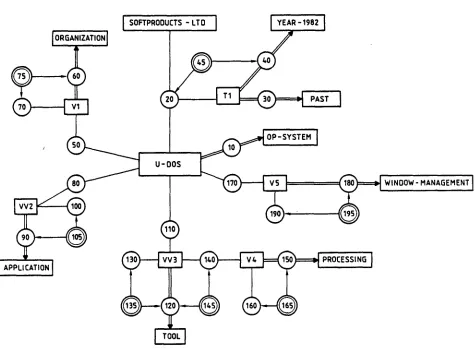
In order to analyze the text, the evaluator generates from the ELR, as a preliminary step, a new structure, called the cohesion graph, that e x p l i c i t l y shows all the references among propositions of the ELR. The cohesion graph is a bipartite graph whose nodes are constituted by concepts and propositions connected by three kinds of arcs:
directed a r c s connecting pairs of propositions ( s a y from P to Q), which represent embedding of a proposition into another (Q in P);
simple arcs, connecting a concept and a proposition, w h i c h indicate that the concept appears as an argument in the proposition;
double directed arcs, connecting two concepts via a propositional node (say from A to B via P), which show that a concept enters as the argument of a proposition stating an ISA relation (P states that A ISA B).
A portion of the cohesion graph of our sample text is shown in Figure 1.
Structural rules can exploit the information provided by the cohesion graph in order to selectively capturing the importance of the different parts of the text. An example of a structural rule is:
Rule $4: Highly Referenced Concept
IF in the cohesion graph there is a concept C which is at least K-referenced
THEN assign C an importance value w(C) = high.
This rule guesses that a concept which is highly referenced in a text is probably important. In our example (where the parameter K is set equal to 3), the concept U-DOS is considered important as i t is highly referenced.
Importance can be evaluated by chaining several rules. As an example, after rule $4 has been applied, the following rule can f i r e :
Rule MT: ISA Proposition
IF a proposition P represents an ISA relation AND
the argument of P is a concept C with importance value w(C)
THEN assign P an importance value w(P) = w(C). The rationale of this rule is that, i f a concept is important, any proposition that states an ISA relation about that concept is important too. This allows, for example, considering proposition 10 (which states that U-DOS is an operating system) as important.
J SOFTPRODUCTS -
LTO
IORGANIZATIONI
I
J YEAR-1982
I
APPLICATION
(
F
U-DOS
OP-SYSTEM J
~
PROCESSING
I
WINDOW-MANAGEMENT
I
Fig. I : (Partial) Cohesion Graph of the Sample Text
of the following rule:
Rule E6: ISA Frame Activation
IF a proposition P represents an ISA relation AND
P has importance value w(P) > low AND
the predicate of P is the header of a frame F in the encyclopedia
THEN activate F.
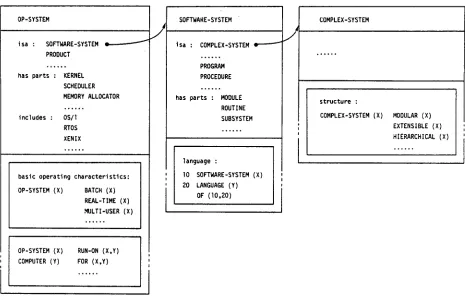
In our example, the fact that proposition 10 is important (w(P) = high) and that i t represents an ISA relation allows the OPERATING-SYSTEM frame to be activated (see Figure 2, where a portion of the encyclopedia relevant to the current example is shown). Note that rule E6 does not d i r e c t l y state whether a proposition or a concept has to be considered important or not, but i t specifies which frames are to be considered relevant in the current context.
Most evaluations are goal dependent and rely on a goal interpreter, able to evaluate a specific piece of ELR or a frame slot of the encyclopedia in order to determine i t s relevance to the current goal. The goal interpreter performs in such a way a complex matching, which allows implementation of selective focusing. Consider, for example, the following rule:
RULE E19: Goal-Dependent Frame Activation
IF the current goal matches a reference slot • R of an active frame
THEN activate the frame whose header is pointed at by R.
[image:5.612.71.546.90.439.2]OP-SYSTEM
isa : SOFTWARE-SYSTEM PRODUCT
has parts : KERNEL SCHEDULER MEMORY ALLOCATOR
includes : OS/I RTOS XENIX
basic operating characteristics:
OP-SYSTEM (X) BATCH (X) REAL-TIME (X) MULTI-USER (X)
OP-SYSTEM (X) RUN-ON (X,Y) COMPUTER (Y) FOR (X,Y)
/
SOFTWARE-SYSTEM isa : COMPLEX-SYSTEMPROGRAM PROCEDURE
has parts : MODULE ROUTINE SUBSYSTEM
language :
lO SOFTWARE-SYSTEM (X) 20 LANGUAGE (Y)
OF (lO,20)
/
COMPLEX-SYSTEM
s t r u c t u r e :
COMPLEX-SYSTEM (X) MODULAR (X) EXTENSIBLE (X) HIERARCHICAL (X)
Fig. 2: Some Frames of the Encyclopedia
Rule E25: Goal Dependent Matching
IF a proposition P matches a pattern contained in a knowledge slot K of an active frame AND
the current g o a l matches K
THEN assign P an importance value w(P) = high.
In our example, since ( i ) the COMPLEX-SYSTEM frame is active and proposition 70 of the ELR matches the pattern MODULAR (ORGANIZATION) of the "structure" slot of the frame, and ( i i ) the goal i n t e r p r e t e r evaluates that the knowledge slot "structure" is relevant to the g o a l KNOW, then proposition 70 is considered important.
As a last example, we i l l u s t r a t e a rule that exploits knowledge concerning the macro-structure of the t e x t :
Rule M9: Macro C l a r i f i c a t i o n
IF i f there exists a macro-proposition CLARIFICATION (P, Q)
THEN assign P and Q importance values such that w(P) < w(Q).
Rule M9 implements the idea that a proposition which is used to c l a r i f y another proposition ( i . e . , i t paraphrases i t s content or explains the meaning of some of i t s terms) has to be considered less important than the proposition i t c l a r i f i e s . This rule can be applied, for example, in rating propositions 210 and 220, the l a t t e r resulting less important than the former.
5. CONCLUSION
The importance evaluator described in the previous sections is written in Franz Lisp and i t is presently running in a prototype version on a SUN-2 workstation. Much experimental work is currently ongoing on this prototype in order to assess i t s operation, enlarge i t s knowledge base, and test i t s performance with a s u f f i c i e n t l y large set of sample t e x t s .
[image:6.612.76.541.93.393.2]The research has disclosed several new directions for future work. Among these we mention:
extending the importance rule base to cover the rhetoric and s t y l i s t i c aspects of the text;
introducing meta-rules to deal with the problems of rule activation scheduling, and of conflict resolution among rules; improving the goal matching techniques in order to implement a flexible mechanism for interpreting the content of encyclopedia frames according to the current goal;
giving the evaluator the capability of changing the goal during the evaluation process, depending on the content of the processed text.
REFERENCES
I.
2.
3.
4.
5.
6.
7.
Anderson J.R. (1976). Language, Memory, and Thought, Hillsdale, NJ: Lawrence ~'-~au m.
Davis R. and King J. (1976). An Overview of Production Systems. In E.W.Elcock and D.Michie (Eds.), Machine Intelligence 8, New York, NY: Wiley, 300-332.
Fum D., Guida G., and Tasso C. (1982). Forward and Backward Reasoning in Automatic Abstracting. In J. Horecky
(Ed.), COLING-82, Amsterdam, NL: North-Holland, 83-88.
Fum D., Guida G., and Tasso C. (1983). Capturing Importance in Natural Language Texts: An HPN-Based Approach. Proc. 2nd Int. Colloquium on the Interdisciplinary ~t-O~-y of the ~ma-'nt-ics of Natura~ L a n . ~ : Meaning and Lexicon, Kleve,
Fum O., Guida G., and Tasso C. (1984). A Propositional Language for Text Representation. In B . G . Bara and G. Guida (Eds.), Computational Models of Natural Language Processing, ms~-m-s~-rda~,
l~-~--~'ortIT~IToTT~'nd, 121-163,
Graesser A.C. (1981). Prose Comprehension Beyond the Word. New York, NY: Springer-Verlag.
Haji~ova' E. and Sgall P. (1984). From Topic and Focus of a Sentence to Linking in a Text. In B.G. Bara and G. Guida
(Eds.), Computational Models of Natural
Language Processing, Amsterdam, NL: North-Holland, 151-163.
8. Hahn U. and Reimer U. (1984). Computing T e x t Constituency: An Algorithmic Approach to the Generation of Text Graphs.
In C.J. van Rijsbergen (Ed.), Research and Development in Information Retrieval, ]~'a,~) rid ge, UK:-- Can~)ridge University
Press, 343-368.
9. Hobbs J.R. ( 1 9 8 2 ) . Towards an Understanding of Coherence in Discourse. In W.G. L~hnert and M.H. Ringle (Eds.), Strategies for N a t u r a l Language Processing, Hi-Tl-sdal e ~ Lawrence Erl baum, ~23-244.
10. Kintsch W. and van Dijk T . A . (1978). Toward a Model of T e x t Comprehension. Psychological Review 85, 363-394.
11. Lehnert W.G. ( 1 9 8 2 ) . Plot Units: A Narrative Summarization Strategy. In W.G. Lehnert and M . H . R i n g l e (Eds.) , St rategi es for N a t u r a l Language Processing, Hi-'~Tsd al e ~ Lawrence Erl baum, 375-414.
12. Lehnert W.G. ( 1 9 8 4 ) . Narrative Complexity Based on Summari zati on Algorithms. In B.G. Bara and G. Guida
(Eds.), Computational Models of Natural Language Processing, Amsterdam, North-Hol I and, 247-259.
13. Schank R . C . ( 1 9 7 9 ) . Interestingness: Controlling Inferences. A r t i f i c i a l Intelligence 12, 273-297.
14. Schank R.C. (1982). Reminding and Memory Organization: An Introduction to MOPs. In W.G. Lehnert and M.H. Ringle (Eds.), Strateg!es for N a t u r a l Language Process I ng, HTITsd al e ~ Lawrence Erl baum, 455-494.
15. van Dijk T.A. ( 1 9 7 7 ) . Semantic Macro Structures and Knowledge Frames in Discourse Comprehension. In M.A. Just and P . A . Carpenter (Eds.), Cognitive Processes in Comprehension, Hillsdale, NJ: Lawrence Er-Tbaum, 3-32.
16. van Dijk T.A. and Kintsch W. (1983). Strategies of Discourse Comprehension.
17.
New York, NY: Academic Press.