Proceedings of the 2019 Conference on Empirical Methods in Natural Language Processing 410
Leveraging
2-hop
Distant Supervision from Table Entity Pairs for
Relation Extraction
Xiang Deng The Ohio State University
Huan Sun
The Ohio State University
Abstract
Distant supervision (DS) has been widely used to automatically construct (noisy) labeled data for relation extraction (RE). Given two enti-ties, distant supervision exploits sentences that directly mention them for predicting their se-mantic relation. We refer to this strategy as 1-hop DS, which unfortunately may not work well for long-tail entities with few support-ing sentences. In this paper, we introduce a new strategy named2-hopDS to enhance dis-tantly supervised RE, based on the observation that there exist a large number of relational ta-bles on the Web which contain entity pairs that share common relations. We refer to such en-tity pairs asanchorsfor each other, and col-lect all sentences that mention the anchor en-tity pairs of a given target enen-tity pair to help relation prediction. We develop a new neu-ral RE methodREDS2 in the multi-instance learning paradigm, which adopts a hierarchi-cal model structure to fuse information respec-tively from 1-hop DS and 2-hop DS. Extensive experimental results on a benchmark dataset show thatREDS2can consistently outperform various baselines across different settings by a substantial margin.1
1 Introduction
Relation extraction (RE) aims to extract semantic relations between two entities from unstructured text and is an important task in natural language processing (NLP). Formally, given an entity pair
(e1, e2) from a knowledge base (KB) and a
sen-tence (instance) that mentions them, RE tries to predict if a relationrfrom a predefined relation set exists betweene1ande2. A special relationNAis
used if none of the predefined relations holds. Given that it is costly to construct large-scale labeled instances for RE, distant supervision (DS)
1Our source code and datasets are at https://
[image:1.595.316.514.231.399.2]github.com/sunlab-osu/REDS2.
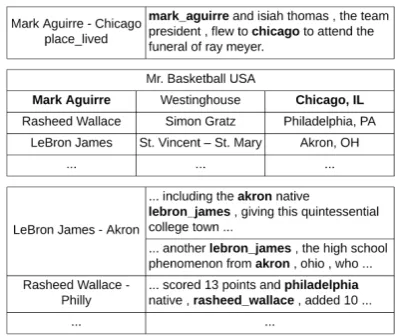
Figure 1: Illustration of2-hopdistant supervision. The top panel shows a target entity pair, one sentence that mentions it, and the relation under study which cannot be inferred from the sentence. The middle gives part of a table from Wikipedia page “Mr. Basketball USA”, where we can extractanchorsfor the target entity pair. The bottom shows some sentences that are associated with the anchors, which more clearly indicate the un-derinvestigated relation and can be utilized to extract relations between the target entity pair.
However, we observe that there can be a large por-tion of entity pairs that have very few supporting sentences (e.g., nearly 75% of entity pairs in the Riedel et al. (2010) dataset only have one single sentence mentioning them), which makes distantly supervised RE even more challenging.
The conventional distant supervision strategy only exploits instances that directly mention a tar-get entity pair, and because of this, we refer to it as 1-hopdistant supervision. On the other hand, there are a large number of Web tables that contain re-lational facts about entities (Cafarella et al.,2008; Venetis et al.,2011;Wang et al.,2012). Owing to the semi-structured nature of tables, we can extract from them sets of entity pairs that share common relations, and sentences mentioning these entity pairs often have similar semantic meanings. Un-der this observation, we introduce a new strategy named2-hopdistant supervision: We define entity pairs that potentially have the same relation with a given target entity pair as anchors, which can be found through Web tables, and aim to fully ex-ploit the sentences that mention those anchor en-tity pairs to augment RE for the target enen-tity pair. Figure1illustrates the 2-hop DS strategy.
The intuition behind 2-hop DS is if the target entity pair holds a certain relation, one of its an-chors is likely to have that relation too and at least one sentence mentioning the anchors should ex-press the relation. Despite being noisy, the 2-hop DS can provide extra, informative supporting sen-tences for the target entity pair. One straightfor-ward approach is to merge the two bags of sen-tences respectively derived from 1-hop and 2-hop DS as one single set and apply existing multi-instance learning models. However, the 2-hop DS strategy also has the wrong labeling problem that already exists in 1-hop DS. Simply mixing the two sets of sentences together may mislead the predic-tion, especially when there is a great disparity in their size. In this paper, we propose REDS22, a new neural relation extraction method in the multi-instance learning paradigm, and design a hierar-chical model structure to fuse information from 1-hop and 2-hop DS. We evaluate REDS2 on a widely used benchmark dataset and show that it consistently outperforms various baseline models by a large margin.
We summarize our contributions as three-fold:
• We introduce 2-hop distant supervision as an
2stands for relation extraction with 2-hop DS.
extension to the conventional distant supervi-sion, and leverage entity pairs in Web tables as anchors to find additional supporting sen-tences to further improve RE.
• We proposeREDS2, a new neural relation ex-traction method based on 2-hop DS and has achieved new state-of-the-art performance in the benchmark dataset (Riedel et al.,2010).
• We release both our source code and an aug-mented benchmark dataset that has entity pairs aligned with those in Web tables, to fa-cilitate future work.
2 Related Work
Distant Supervision. One main drawback of tra-ditional supervised relation extraction models ( Ze-lenko et al.,2003;Mooney and Bunescu,2006) is they require adequate amounts of annotated traing data, which is time consumtraing and labor in-tensive. To address this issue,Mintz et al.(2009) proposes distant supervision (DS) to automati-cally label data by aligning plain text with Free-base. However, DS inevitably accompanies with the wrong labeling problem. To alleviate the noise brought by DS, Riedel et al. (2010) and Hoff-mann et al.(2011) introduce multi-instance learn-ing mechanism, which is originally used to combat the problem of ambiguously-labeled training data when predicting the activity of different drugs ( Di-etterich et al.,1997).
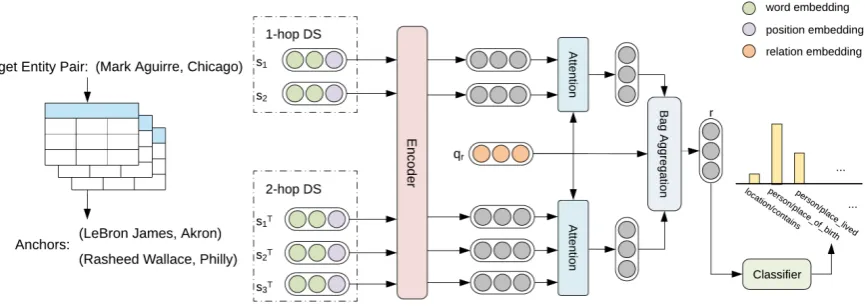
Figure 2: Overview of our methodREDS2.REDS2first obtainsanchorsof the target entity pair and constructs a 2-hop DS bag. Sentences in the 1-hop and 2-hop DS bag are individually encoded with a PCNN sentence encoder (Zeng et al.,2015). We then use selective attention and bag aggregation to get the final representation, based on which a classifier predicts scores for each candidate relation.
improvement to at-least-one multi-instance learn-ing (Zeng et al., 2015). Han et al. (2018) further develops a hierarchical attention scheme to utilize the relation correlations and help predictions for long-tail relations.
Web Table Understanding. Aside from plain texts, there are large amounts of factual knowl-edge in the Web expressed in hundreds of millions of tables and other structured lists (Cafarella et al., 2008;Venetis et al., 2011), which have not been fully explored yet. Table understanding tries to match tables to KB and parse the schemas. Ex-isting methods for table understanding mainly fall into two categories. One is based on local evi-dence (Venetis et al., 2011; Mu˜noz et al., 2014; Ritze et al., 2015). Given one table, the main idea is to first link cells to entities in KB. We can then use existing relations between linked en-tities to infer relations between columns and ex-tract new facts by generalizing to all rows. How-ever, this method requires a high overlap between table and KB, which is hampered by KB incom-pleteness. The other approach tries to leverage features extracted from the table header and col-umn names (Ritze and Bizer, 2017;Cannaviccio et al.,2018). Unfortunately, a large portion of Web tables miss such metadata or contain limited infor-mation, and the second approach will fail in such cases. Although the focus of this paper is the RE task, we believe the idea of connecting Web tables and plain texts using DS can potentially benefit ta-ble understanding as well.
3 Methodology
Given a set of sentences S = {s1, s2, ...} and a
target entity pair (h, t), we will leverage the di-rectly associated sentence bagSh,t ⊆Sby 1-hop distant supervision (1-hop DS bag), and the table expanded sentence bagST
h,t ⊆Sby 2-hop distant supervision (2-hop DS bag), for relation extrac-tion. Sh,t contains all instances mentioning both
handt, whileST
h,t is obtained indirectly through the anchors of(h, t)found in Web tables. Follow-ing previous work (Riedel et al.,2010;Hoffmann et al.,2011), we adopt the multi-instance learning paradigm to measure the probability of(h, t) hav-ing relationr.
Figure 2 gives an overview of our framework with three major components:
• Table-aided Instance Expansion: Given a target entity pair(h, t), we find itsanchor en-tity pairs{(h1, t1),(h2, t2), ...}through Web
tables. We define an anchor entity pair as two entities co-occurring with(h, t) in some ta-ble columns at least once. Sh,tT = Sh1,t1 ∪
Sh2,t2 ∪...is then exploited to augment the
directly associated bagSh,t.
• Sentence Encoding: For each sentencesin bagSh,torSh,tT , a sentence encoder is used to obtain its semantic representations.
then aggregate them for final relation predic-tion.
3.1 Table-aided Instance Expansion
Now we introduce how to construct the table ex-panded sentence bagSh,tT for a given target entity pair(h, t)by 2-hop distant supervision.
3.1.1 Web Tables
Web tables have been found to contain rich facts of entities and relations. It is estimated that out of a total of 14.1 billion tables on the Web, 154 million tables contain relational data (Cafarella et al., 2008) and Wikipedia alone is the source of nearly 1.6 million relational tables ( Bhagavat-ula et al., 2015). Columns of a Wikipedia table can be classified into one of the following data types: ‘empty’, ‘named entity’, ‘number’, ‘date expression’, ‘long text’ and ‘other’ (Zhang,2017). Here we only focus on named entity columns (NE-columns) and the Wikipedia page title, which can be easily linked to KB entities. These entities can be further categorized as:
A topic entity et that the table is centered around. We refer to the Wikipedia article where the table is found and take the entity it describes aset.
Subject entities Es = {es1, es2, ...} that can act as primary keys of the table. Following pre-vious work on Web table analysis (Venetis et al., 2011), we select the leftmost NE-column as sub-ject column and its entities asEs.
Body entitiesE ={e1,1, e1,2, ...} that
com-pose the rest of the table. All entities in non-subject NE-columns are considered asE.
3.1.2 2-hop Distant Supervision
In the conventional distant supervision setting, each entity pair (h, t)is associated with a bag of sentencesSh,t that directly mentionhandt. The intuition behind 2-hop distant supervision is, if
(hi, ti)and(hj, tj)potentially hold the same rela-tion, we can treat them asanchor entity pairsfor each other, and then use the 1-hop DS bagShj,tjto
help with the prediction for(hi, ti)and vice versa. In this paper, we extract anchor entity pairs with the help of Web tables.
We notice that owing to the semi-structured na-ture of tables, (1) subject entities can usually be connected with the topic entity by the same rela-tion. (2) Non-subject columns of a table usually have binary relationships to or are properties of the
subject column. Body entities in the same column share common relations with their corresponding subject entities. For example, in Figure1, the topic entity is “Mr. Basketball USA”; column 1 is the subject column and contains a list of winners of “Mr. Basketball USA”; column 2 and column 3 are high school and city of the subject entity.
Formally, we consider two entity pairs (hi, ti) and(hj, tj)as anchored if there exists a Web table such that either criterion below is met:
• hi =hj =etandti, tj ∈Es.
• hi ∈ Es orti ∈ Es, (hi, hj) is in the same column (and so is (ti, tj)), and (hi, ti) is in the same row (and so is(hj, tj))
The 2-hop DS bag Sh,tT is then constructed as the union of Shi,ti’s, where (hi, ti) is an anchor
entity pair of(h, t).
3.2 Sentence Encoding
Given a sentence s consisting of n words s = {w1, w2, ..., wn}, we use a neural network with an embedding layer and an encoding layer to obtain its low-dimensional vector representation.
3.2.1 Embedding Layer
Each token is first fed into an embedding layer to embed both semantic and positional information.
Word Embedding maps words to vectors of real numbers which preserve syntactic and seman-tic information of words. Here we get a vector representation wi ∈ Rkw for each word from a
pre-trained word embedding matrix.
Position Embedding was proposed by Zeng et al.(2014). Position embedding is used to embed the positional information of each word relative to the head and tail mention. A position embedding matrix is learned in training to compute position representationpi ∈Rkp×2.
Finally, we concatenate the word representa-tion wi and position representation pi to build the input representation xi ∈ Rki (where ki =
kw+kp×2) for each wordwi.
3.2.2 Encoding Layer
A sequence of input representations x = {x1,x2, ...} with a variable length is then fed through the encoding layer and converted to a fixed-sized sentence representation s ∈ Rkh.
(Zeng et al.,2014), PCNN (Zeng et al.,2015) and LSTM-RNN (Miwa and Bansal, 2016). We sim-ply adopt PCNN here, which has been shown very powerful and efficient by a number of previous RE works.
PCNN is an extension to CNN, which first slides a convolution kernel with a window sizem
over the input sequence to get the hidden vectors:
hi= CNN(xi−m−1 2 :i+
m−1
2 ), (1)
A piecewise max-pooling is then applied over the hidden vectors:
[s(1)]j = max
1≤i≤i1
{[hi]j},
[s(2)]j = max ii+1≤i≤i2
{[hi]j}, (2)
[s(3)]j = max i2+1≤i≤n
{[hi]j},
where i1 andi2 are head and tail positions. The
final sentence representation s is composed by concatenating these three pooling results s = [s(1);s(2);s(3)].
3.3 Hierarchical Bag Aggregation
After we get sentence representations{s1,s2, ...} and{sT1,s2T, ...}forS andST, to fuse key infor-mation from these two bags, we adopt a hierarchi-cal aggregation design to obtain the final represen-tationrfor prediction. We first get bag representa-tionhandhT using a sentence-level selective at-tention, and then employ a bag-level aggregation to computer.
3.3.1 Sentence-level Selective Attention Since the wrong labeling problem inevitably ex-ists in both 1-hop and 2-hop distant supervision, here we use selective attention to assign different weights to different sentences given relationrand de-emphasize the noisy sentences. The attention is caculated as follows:
ei =qTrsi,
αi =
exp(ei) Pn
j=1exp(ej)
, (3)
h=
n X
i=1
αisi,
whereqris a query vector assigned to relationr.
h and hT are computed respectively for the two bagsSandST.
3.3.2 Bag-level Aggregation
Since 2-hop DS bag ST is collected indirectly through anchor entity pairs in Web tables, despite that it brings abundant information, it also con-tains a massive amount of noise. Thus treating
ST equally asSmay mislead the prediction, espe-cially when their sizes are extremely imbalanced.
To automatically decide how to balance be-tween S andST, we utilize information from h,
hT andqrto predict a weightβ:
β =σ(W[h;hT;qr] +b), (4)
where vector W and scalar b are learnable vari-ables and σ is the sigmoid function. Next, β is used as a weight to fuse information from 1-hop DS and 2-hop DS, determined bySandST of the current target entity pair and relation r. We then obtain the final representationras:
r=βh+ (1−β)hT, (5)
Finally, we define the conditional probability
P(r|S, ST, θ)as follows,
P(r|S, ST, θ) = Pnexp(r or)
k=1exp(ok)
(6)
whereois the score vector for current target entity pair having each relation,
o=Mr+d, (7)
here M is the representation matrix of relations, which shares weights withqr’s. dis a learnable bias term.
3.4 Optimization
We adopt the cross-entropy loss as the training ob-jevtive function. Given a set of target entity pairs with relations π = {(h1, t1, r1),(h2, t2, r2), ...},
we define the loss function as follows:
J(θ) =− 1 |π|
|π|
X
i=1
logP(ri|Shi,ti, S
T
hi,ti, θ). (8)
All models are trained with stochastic gradient de-scent (SGD) to minimize the objective function. The same sentence encoder is used to encode S
Train Test Overall Non-NA Overall Non-NA # Entity Pairs 291699 18144 96678 1761 # Entity Pairs with|ST|>0 17565 6928 4832 824
% Entity Pairs with|ST|>0 6.02 38.18 5.00 46.79
[image:6.595.319.513.60.159.2]mean|S| 1.69 5.24 1.62 2.78 mean|ST| 147.65 190.61 131.65 217.23
Table 1: Dataset statistics. We show statistics of entity pairs that hold non-NA relations separately from over-all, as they are important relational facts to discover. Among non-NA entity pairs, 38.18% in training and 46.79% in testing have nonempty ST, which
respec-tively have 190.61 and 217.23 sentences on average.
4 Experiments
4.1 Datasets and Evaluation
We evaluate our model on the New York Times (NYT) dataset developed by Riedel et al.(2010), which is widely used in recent works. The dataset has 53 relations including a special relation NA
which indicates none of the other 52 relations ex-ists between the head and tail entity.
We use the WikiTable corpus collected by Bha-gavatula et al.(2015) as our table source. It origi-nally contains around 1.65M tables extracted from Wikipedia pages. Since the NYT dataset is already linked to Freebase, we perform entity linking on the table cells and the Wikipedia page titles using existing mapping from Wikipedia URL to Free-base MID (Machine Identifier). We then align the table corpus with NYT and constructST for en-tity pairs as detailed in section3.1.For both train-ing and testtrain-ing, we only use entity pairs and sen-tences in the original NYT training data for table-aided instance expansion. We set the max size of
ST as 300, and randomly sample 300 sentences if |ST|>300. Statistics of our final dataset is sum-marized in Table1. One can see that 38.18% and 46.79% of relational facts (i.e., entity pairs holding non-NA relations) respectively in the training and testing set can potentially benefit from leveraging 2-hop DS.
Following prior work (Mintz et al., 2009), we use the testing set for held-out evaluation, and evaluate models by comparing the predicted rela-tional facts with those in Freebase. For evaluation, we rank the extracted relational facts based on model confidence and plot precision-recall curves. In addition, we also show the area under the curve (AUC) and precision values at specific recall rates to conduct a more comprehensive comparison.
Window sizem 3 Sentence Representation Sizekh 230
Word Dimensionkw 50 Position Dimensionkp 5 Pre-train Learning RateλP 0.005 Fine-tune Learning RateλF 0.002 Dropout Probabilityp 0.5
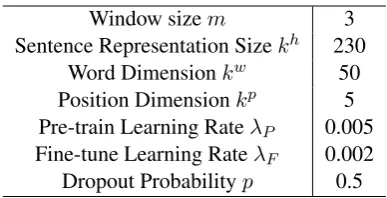
Table 2: Parameter settings inREDS2.
4.2 Baselines
We compareREDS2with the following baselines: PCNN+ATT(Lin et al.,2016). This model uses a PCNN encoder combined with selective attention over sentences. Since this is also the base block of our model, we also refer to it as BASE in this paper.
PCNN+HATT(Han et al.,2018). This is another PCNN based relation extraction model, where the authors use hierarchical attention to model the se-mantic correlations among relations.
RESIDE (Vashishth et al., 2018). It uses Graph Convolutional Networks (GCN) for sentence en-coding, and also leverages relevant side informa-tion like relainforma-tion alias and entity type.
Results of PCNN+HATT and RESIDE are di-rectly taken from the code repositories released by the authors. For PCNN+ATT, we report results ob-tained by our reproduced model, which are close to those shown in (Lin et al., 2016). To simply verify the effectiveness of adding extra support-ing sentences from 2-hop DS, we also compare the following vanilla method with PCNN+ATT: BASE+MERGE. For each target entity pair
(h, t), we simply mergeSandST as one sentence bag, and apply the trained PCNN+ATT (or, BASE) model.
4.3 Implementation Details
We preprocess the WikiTable corpus with PySpark to build index for anchor entity pairs. On a single machine with two 8-core E5 CPUs and 256 GB memory, this processing takes around 20 minutes. We use word embeddings from (Lin et al.,2016) for initialization, which are learned by word2vec tool3 on NYT corpus. The vocabulary is com-posed of words that appear more than 100 times in the corpus and words in an entity mention are concatenated as a single word.
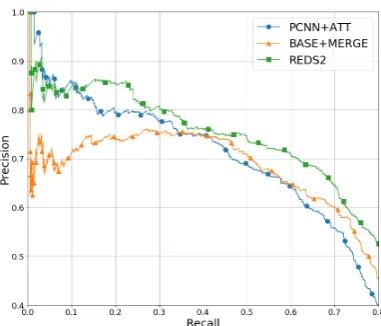
[image:6.595.77.292.61.126.2]Figure 3: Precision-recall curves for the proposed model and various baselines.
Method [email protected] [email protected] [email protected] AUC PCNN+ATT 65.9 58.7 50.4 35.8 PCNN+HATT 79.3 67.2 61.6 42.0 RESIDE 73.6 68.4 59.5 41.5 BASE+MERGE 65.9 64.5 62.4 41.2
[image:7.595.320.511.60.223.2]REDS2 75.9 70.4 65.5 44.7
Table 3: Comparison on Precision@recall and AUC.
To see the effect of 2-hop DS more directly, we set most parameters inREDS2 following Lin et al.(2016). Since the original NYT dataset only contains training and testing set, we randomly sample 20% training data for development. We first pre-train a PCNN+ATT model with only S
and sentence-level selective attention. This BASE model converges in around 100 epochs. We then fine-tune the entire model withST and bag-level aggregation added, which can finish within 50 epochs. Some key parameter settings in REDS2
are summarized in Table2.
In testing phase, inference using 2-hop DS is slower, because the average size of ST is about 100 times that ofS. With single 2080ti GPU, one full pass of testing data takes around 37s using
REDS2, compared with 12s using BASE model.
4.4 Results
4.4.1 Overall Evaluation Results
Evaluation results on all target entity pairs in test-ing set are shown in Figure 3 and Table 3, from which we make the following observations:
[image:7.595.85.279.61.222.2](1) Figure3 shows all models obtain a reason-able precision when recall is smaller than 0.05. With the recall gradually increasing, the perfor-mance of models with 2-hop DS drops slower
Figure 4: Precision-recall curves on the subset of test entity pairs whoseST is not empty, to better show the
effect of hierarchical bag aggregation design.
than those existing methods without. From Fig-ure 3, we can see simply merging ST with S
in BASE+MERGE can boost the performance of basic PCNN+ATT model, and even achieves higher precision than state-of-the-art models like PCNN+HATT when recall is greater than 0.3. This demonstrates that models utilizing 2-hop DS are more robust and remain a reasonable precision when including more lower-ranked relational facts which tend to be more challenging to predict be-cause of insufficient evidence.
(2) As shown in both Figure 3 and Table 3,
REDS2 achieves the best results among all the models. Even when compared with PCNN+HATT and RESIDE which adopt extra relation hierarchy and side information from KB, our model still en-joys a significant performance gain. This is be-cause our method can take advantage of the rich entity pair correlations in Web tables and leverage the extra information brought by 2-hop DS. We an-ticipate ourREDS2model can be further improved by using more advanced sentence encoders and ex-tra mechanisms like reinforcement learning (Feng et al., 2018) and adversarial training (Wu et al., 2017), which we leave for future work.
4.4.2 Effect of Hierarchical Bag Aggregation
To further show the effect of our hierarchical bag aggregation design, here we also plot precision-recall curves in Figure4on a subset of entity pairs in the test set (i.e., 4832 in total according to Table 1) whose table expanded sentence bagST is not empty.
[image:7.595.73.291.272.350.2]en-Test Mode SINGLE MULTIPLE
ONE TWO ALL
Metric [email protected] [email protected] [email protected] AUC [email protected] [email protected] [email protected] AUC [email protected] [email protected] [email protected] AUC [email protected] [email protected] [email protected] AUC PCNN+ATT 57.3 53.0 41.3 30.0 72.9 66.4 57.5 39.0 75.3 69.7 63.8 45.9 80.5 68.6 64.2 48.6 RESIDE 66.9 60.5 51.8 36.2 79.7 70.4 57.4 42.1 77.7 76.1 67.6 46.5 83.2 80.3 73.2 51.9 PCNN+HATT 70.1 59.1 50.8 34.8 74.5 67.4 57.2 40.1 78.4 68.9 65.9 44.5 86.4 75.5 70.0 49.7 BASE+MERGE 62.2 58.5 55.2 35.6 71.4 74.9 73.2 51.3 70.0 71.8 73.9 52.0 70.7 71.1 73.2 52.0
[image:8.595.74.528.61.138.2]REDS2 69.1 61.1 57.4 37.5 82.4 81.9 78.1 56.3 81.4 79.6 76.9 57.2 82.4 79.6 76.6 57.6
Table 4: Comparison on Precision@recall and AUC under different testing settings, detailed in Section4.4.3.
max|ST| [email protected] [email protected] [email protected] AUC 10 57.9 55.8 51.5 36.2 50 69.4 65.7 60.8 42.2 100 70.4 66.7 62.3 43.2 200 72.8 68.4 63.4 44.0 300 75.9 70.4 65.5 44.7
Table 5: Effect of the table expanded sentence bag size
|ST|on Precision@recall and AUC.
tity pair with nonemptyST, the size ofST is usu-ally tens of times the size of S. From Figure 4 we can see BASE+MERGE performs much worse compared with PCNN+ATT when recall is smaller than 0.2. This is because 2-hop DS bag tends to be much larger than 1-hop DS bag, and the model has a larger chance to attend to the noisy sentences obtained from 2-hop DS. While ignoring the in-formation in its directly associated sentences. We alleviate this problem by introducing hierarchical structure to first aggregate the two sets separately and then weight and sum them together. The pro-posed REDS2 model has a comparable precision with PCNN+ATT in the beginning and gradually outperform it.
4.4.3 Effect of Sentence Number
Number of sentences from 1-hop DS. In the originally testing set, there are 79176 entity pairs that are associated with only one sentence, out of which 1149 actually have relations. We hope our model can improve performance on these long-tail entities. FollowingLin et al. (2016), we de-sign the following test settings to evaluate the ef-fect of sentence number: the “SINGLE” test set-ting contains all entity pairs that correspond to only one sentence; the “MULTIPLE” test setting contains the rest of entity pairs that have at least two sentences associated. We further construct the “ONE” testing setting where we randomly se-lect one sentence for each entity pair; the “TWO” setting where we randomly select two sentences for each entity pair and the “ALL” setting where
Relation:country.capital
1-hop ... the golden gate bridge and the petronas towers inkuala lumpur, malaysia, was experienced ...
2-hop a friend fromcardiff, the capital city ofwales, lives for complex ...
Table 6: An example for case study, where the sen-tence with the highest attention weight is selected re-spectively from 1-hop and 2-hop sentence bag.
we use all the associated sentences from MUL-TIPLE. We use all sentences in ST for each en-tity pair if it is nonempty. Results are shown in Table4, from which we can see thatREDS2 and BASE+MERGE have 25.0% and 18.7% improve-ments under AUC compared with PCNN+ATT in the SINGLE setting. Although the performance of all models generally improves as the sentence number increases in MULTIPLE setting, models leveraging 2-hop DS are more stable and have smaller changes. These observations indicate that 2-hop DS is helpful when information obtained by 1-hop DS is insufficient.
Number of sentences from 2-hop DS. We also evaluate how the number of sentences obtained by 2-hop DS will affect the performance of our proposed model. In Table5, we show the perfor-mance of REDS2with different numbers of sen-tences sampled from ST. We observe that: (1) Performance of REDS2 improves as the number of sentences sampled increases. This shows that the selective attention overST can effectively take advantage of the extra information from 2-hop DS while filtering out noisy sentences. (2) Even with 50 randomly sampled sentences, our model
4.5 RE for Entity Pairs with Empty 1-hop Sentence Bag
We observe that there are large amounts of entity pairs in the table corpus that have no associated sentences but have anchor entity pairs mentioned in the text corpus. By leveraging 2-hop distant su-pervision, we can do relation extraction for this set of entity pairs.
We extract a total number of 251917 entity pairs from the WikiTable dataset which do not exist in the NYT dataset but have at least one anchor entity pair that appear in the original NYT training data. We randomly sample 10000 examples and evalu-ate our trained model on them. Surprisingly, the relation extraction result is even better than the re-sult on the NYT test data in Table3, with an over-all AUC of 54.7 and a [email protected] of 71.1. This can be explained partly by two observations: (1) The table corpus generates higher-quality entity pairs, 18% of extracted entity pairs have non-NA rela-tions, compared with only 1.8% in NYT test data. (2) The newly extracted entity pairs have 14 useful anchor entity pairs and 175 2-hop DS sentences on average, which give ample information for predic-tion. This study shows that for two entities that have no directly associated sentences, it is possi-ble to utilize the 2-hop DS to predict their relations accurately.
4.6 Case Study and Error Analysis
In addition to the motivating example from the training set shown in Figure 1, we also demon-strate how 2-hop DS helped relation extraction us-ing an example from the testus-ing set in Table 6. As we can see, the sentence with the highest at-tention weight in 1-hop DS bag does not express the desired relation between the target entity pair whereas that in 2-hop DS bag clearly indicates the
country.capitalrelation.
We also conduct an error analysis by analyz-ing examples where REDS2 gives worse predic-tions than BASE (e.g., assigns a lower score to a correct relation or a higher score to a wrong re-lation), and 50 examples with most disparity in the two methods’ scores are selected. We find that 29 examples have wrong labels caused by KB incompleteness and our model in fact makes the right prediction. 11 examples are due to errors in column processing (e.g., errors in NE/subject column selection and entity linking), 9 are caused by anchor entity pairs with differet relations (e.g.,
(Greece, Atlanta) and (Mexico, Xalapa) are in the same table“National Records in High Jump” under columns (Nation, Place), but only the lat-ter has relation location.contains), and 1 is because of wrong information in the original ta-ble.
5 Conclusion and Future Work
This paper introduces 2-hop distant supervision for relation extraction, based on the intuition that entity pairs in relational Web tables often share common relations. Given a target entity pair, we define and find its anchor entity pairs via Web ta-bles and collect all sentences that mention the an-chor entity pairs to help relation prediction. We develop a new neural RE method REDS2 in the multi-instance learning paradigm which fuses in-formation from 1-hop DS and 2-hop DS using a hierarchical model structure, and substantially outperforms existing RE methods on a bench-mark dataset. Interesting future work includes: (1) Given that information from 2-hop DS is re-dundant and noisy, we can explore smarter sam-pling and/or better bag-level aggregation methods to capture the most representative information. (2) Metadata in Web tables like headers and column names also contain rich information, which can be incorporated to further improve RE performance.
6 Acknowledgments
This research was sponsored in part by the Army Research Office under cooperative agreements NSF Grant IIS1815674, W911NF-17-1-0412, Fu-jitsu gift grant, and Ohio Supercomputer Center [8]. The views and conclusions contained herein are those of the authors and should not be inter-preted as representing the official policies, either expressed or implied, of the Army Research Office or the U.S. Government. The U.S. Government is authorized to reproduce and distribute reprints for Government purposes notwithstanding any copy-right notice herein.
References
Heike Adel and Hinrich Sch¨utze. 2017. Global normal-ization of convolutional neural networks for joint en-tity and relation classification. InProceedings of the 2017 Conference on Empirical Methods in Natural Language Processing, pages 1723–1729.
tables. In International Semantic Web Conference, pages 425–441.
Michael J Cafarella, Alon Halevy, Daisy Zhe Wang, Eugene Wu, and Yang Zhang. 2008. Webtables: ex-ploring the power of tables on the web.Proceedings of the VLDB Endowment, 1(1):538–549.
Matteo Cannaviccio, Lorenzo Ariemma, Denilson Bar-bosa, and Paolo Merialdo. 2018. Leveraging wikipedia table schemas for knowledge graph aug-mentation. InProceedings of the 21st International Workshop on the Web and Databases, page 5. ACM.
Thomas G Dietterich, Richard H Lathrop, and Tom´as Lozano-P´erez. 1997. Solving the multiple instance problem with axis-parallel rectangles. Artificial in-telligence, 89(1-2):31–71.
Jun Feng, Minlie Huang, Li Zhao, Yang Yang, and Xi-aoyan Zhu. 2018. Reinforcement learning for rela-tion classificarela-tion from noisy data. InThirty-Second AAAI Conference on Artificial Intelligence.
Pankaj Gupta, Hinrich Sch¨utze, and Bernt Andrassy. 2016. Table filling multi-task recurrent neural net-work for joint entity and relation extraction. In Pro-ceedings of COLING 2016, the 26th International Conference on Computational Linguistics: Techni-cal Papers, pages 2537–2547.
Xu Han, Pengfei Yu, Zhiyuan Liu, Maosong Sun, and Peng Li. 2018. Hierarchical relation extraction with coarse-to-fine grained attention. In Proceedings of EMNLP.
Raphael Hoffmann, Congle Zhang, Xiao Ling, Luke Zettlemoyer, and Daniel S Weld. 2011. Knowledge-based weak supervision for information extraction of overlapping relations. InProceedings of the 49th Annual Meeting of the Association for Computa-tional Linguistics: Human Language Technologies-Volume 1, pages 541–550. Association for Compu-tational Linguistics.
Guoliang Ji, Kang Liu, Shizhu He, and Jun Zhao. 2017. Distant supervision for relation extraction with sentence-level attention and entity descriptions. InThirty-First AAAI Conference on Artificial Intel-ligence.
Yankai Lin, Shiqi Shen, Zhiyuan Liu, Huanbo Luan, and Maosong Sun. 2016. Neural relation extraction with selective attention over instances. In Proceed-ings of the 54th Annual Meeting of the Association for Computational Linguistics (Volume 1: Long Pa-pers), volume 1, pages 2124–2133.
Mike Mintz, Steven Bills, Rion Snow, and Dan Juraf-sky. 2009. Distant supervision for relation extrac-tion without labeled data. In Proceedings of the Joint Conference of the 47th Annual Meeting of the ACL and the 4th International Joint Conference on Natural Language Processing of the AFNLP: Vol-ume 2-VolVol-ume 2, pages 1003–1011. Association for Computational Linguistics.
Makoto Miwa and Mohit Bansal. 2016. End-to-end re-lation extraction using lstms on sequences and tree structures. InProceedings of the 54th Annual Meet-ing of the Association for Computational LMeet-inguistics (Volume 1: Long Papers), volume 1, pages 1105– 1116.
Raymond J Mooney and Razvan C Bunescu. 2006. Subsequence kernels for relation extraction. In Ad-vances in neural information processing systems, pages 171–178.
Emir Mu˜noz, Aidan Hogan, and Alessandra Mileo. 2014. Using linked data to mine rdf from wikipedia’s tables. InProceedings of the 7th ACM international conference on Web search and data mining, pages 533–542. ACM.
Sebastian Riedel, Limin Yao, and Andrew McCallum. 2010. Modeling relations and their mentions with-out labeled text. In Joint European Conference on Machine Learning and Knowledge Discovery in Databases, pages 148–163. Springer.
Dominique Ritze and Christian Bizer. 2017. Match-ing web tables to dbpedia - A feature utility study. InProceedings of the 20th International Conference on Extending Database Technology, EDBT 2017, Venice, Italy, March 21-24, 2017., pages 210–221.
Dominique Ritze, Oliver Lehmberg, and Christian Bizer. 2015. Matching html tables to dbpedia. In
Proceedings of the 5th International Conference on Web Intelligence, Mining and Semantics, page 10. ACM.
Mihai Surdeanu, Julie Tibshirani, Ramesh Nallapati, and Christopher D Manning. 2012. Multi-instance multi-label learning for relation extraction. In Pro-ceedings of the 2012 Joint Conference on Empirical Methods in Natural Language Processing and Com-putational Natural Language Learning, pages 455– 465.
Shikhar Vashishth, Rishabh Joshi, Sai Suman Prayaga, Chiranjib Bhattacharyya, and Partha Talukdar. 2018. Reside: Improving distantly-supervised neural rela-tion extracrela-tion using side informarela-tion. In Proceed-ings of the 2018 Conference on Empirical Methods in Natural Language Processing, pages 1257–1266.
Petros Venetis, Alon Halevy, Jayant Madhavan, Mar-ius Pas¸ca, Warren Shen, Fei Wu, Gengxin Miao, and Chung Wu. 2011. Recovering semantics of tables on the web. Proceedings of the VLDB Endowment, 4(9):528–538.
Jingjing Wang, Haixun Wang, Zhongyuan Wang, and Kenny Q Zhu. 2012. Understanding tables on the web. In International Conference on Conceptual Modeling, pages 141–155. Springer.
Dmitry Zelenko, Chinatsu Aone, and Anthony Richardella. 2003. Kernel methods for relation ex-traction. Journal of machine learning research, 3(Feb):1083–1106.
Daojian Zeng, Kang Liu, Yubo Chen, and Jun Zhao. 2015. Distant supervision for relation extraction via piecewise convolutional neural networks. In Pro-ceedings of the 2015 Conference on Empirical Meth-ods in Natural Language Processing, pages 1753– 1762.
Daojian Zeng, Kang Liu, Siwei Lai, Guangyou Zhou, and Jun Zhao. 2014. Relation classification via con-volutional deep neural network. In Proceedings of COLING 2014, the 25th International Conference on Computational Linguistics: Technical Papers, pages 2335–2344.