Recognizing Textual Relatedness with Predicate-Argument Structures
Rui Wang
Dept of Computational Linguistics Saarland University
66123 Saarbr¨ucken, Germany
Yi Zhang
Dept of Computational Linguistics Saarland University
LT-Lab, DFKI GmbH D-66123 Saarbr¨ucken, Germany
Abstract
In this paper, we first compare several strategies to handle the newly proposed three-wayRecognizing Textual Entailment (RTE) task. Then we define a new mea-surement for a pair of texts, calledTextual Relatedness, which is a weaker concept than semantic similarity or paraphrase. We show that an alignment model based on the predicate-argument structures using this measurement can help an RTE system to recognize the Unknown cases at the first stage, and contribute to the improvement of the overall performance in the RTE task. In addition, several heterogeneous lexical resources are tested, and different contri-butions from them are observed.
1 Introduction
Recognizing Textual Entailment (RTE) (Dagan et al., 2006) is a task to detect whether one Hypoth-esis (H) can be inferred (or entailed) by a Text (T). Being a challenging task, it has been shown that it is helpful to applications like question an-swering (Harabagiu and Hickl, 2006). The recent research on RTE extends the two-way annotation into three-way1 2, making it even more difficult, but more linguistic-motivated.
The straightforward strategy is to treat it as a three-way classification task, but the performance suffers a significant drop even when using the same classifier and the same feature model. In fact, it can also be dealt with as an extension to the traditional two-way classification, e.g., by
identi-1http://nlp.stanford.edu/RTE3-pilot/ 2http://www.nist.gov/tac/tracks/2008/
rte/rte.08.guidelines.html
fying theEntailment (E) cases first and then fur-ther label theContradiction(C) andUnknown(U) T-H pairs. Some other researchers also work on detecting negative cases, i.e. contradiction, in-stead of entailment (de Marneffe et al., 2008). However, according to our best knowledge, the detailed comparison between these strategies has not been fully explored, let alone the impact of the linguistic motivation behind the strategy selection. This paper will address this issue.
Take the following example from the RTE-4 test set (Giampiccolo et al., 2009) as an example,
T: At least five people have been killed in a head-on train collision in north-eastern France, while others are still trapped in the wreckage. All the victims are adults.
H: A French train crash killed children.
This is a pair of two contradicting texts, the mentioning of events (i.e. train crash) in both T and H are assumed to refer the same event3. In fact, the only contradicting part lies in the sec-ond sentence of T against H, that is, whether there are children among the victims. Therefore, this pair could also be classified as a Known (K) pair (=E∪C) againstUnknown (U) pairs, instead of being classified as a Non-entailment (N) case (=C∪U) against E case in the traditional two-way annotation.
Furthermore, many state-of-the-art RTE ap-proaches which are based on overlapping informa-tion or similarity funcinforma-tions between T and H, in fact over-cover the E cases, and sometimes, cover the C cases as well. Therefore, in this paper, we
3See more details about the annotation guideline at
http://www.nist.gov/tac/tracks/2008/rte/ rte.08.guidelines.html
would like to test whether applying this style of approaches to capture the K cases instead of E cases is more effective. While in lexical seman-tics, semantic relatedness is a weaker concept than semantic similarity, there is no counterpart at the sentence or text level. Therefore, in this paper, we propose aRecognizing Textual Relatedness (RTR) task as a subtask or the first step of RTE. By doing so, we choosepredicate-argument structure (PAS) as the feature representation, which has already been shown quite useful in the previous RTE chal-lenges (Wang and Neumann, 2007).
In order to obtain the PAS, we utilize a Semantic Role Labeling (SRL) system developed by Zhang et al. (2008). Although SRL has been shown to be effective for many tasks, e.g. information extrac-tion, question answering, etc., it has not been suc-cessfully used for RTE, mainly due to the low cov-erage of the verb frame or semantic role resources or the low performance of the automatic SRL sys-tems. The recent CoNLL shared tasks (Surdeanu et al., 2008; Hajiˇc et al., 2009) have been focus-ing on semantic dependency parsfocus-ing along with the traditional syntactic dependency parsing. The PAS from the system output is almost ready for use to build applications based on it. Therefore, another focus of this paper will be to apply SRL to the RTE task. In particular, it can improve the first stage binary classification (K vs. U), and the final result improves as well.
The rest of the paper will be organized as fol-lows: Section 2 will give a brief literature review on both RTE and SRL; Section 3 describes the se-mantic parsing system, which includes a syntactic dependency parser and an SRL system; Section 4 presents an algorithm to align two PASs to recog-nize textual relatedness between T and H, using several lexical resources; The experiments will be described in Section 5, followed by discussions; and the final section will conclude the paper and point out directions to work on in the future.
2 Related Work
Although the term ofTextual Relatednesshas not been widely used by the community (as far as we know), many researchers have already incor-porated modules to tackle it, which are usually implemented as an alignment module before the inference/learning module is applied. For exam-ple, Pado et al. (2009) mentioned two alignment modules, one is a phrase-based alignment system
called MANLI (MacCartney et al., 2008), and the other is a stochastic aligner based on dependency graphs. Siblini and Kosseim (2009) performed the alignment on top of two ontologies. In this paper, we would like to follow this line of research but on another level of representation, i.e. the predicate-argument structures (PAS), together with different lexical semantic resources.
As for the whole RTE task, many people di-rectly do the three-way classification with selec-tive features (e.g. Agichtein et al. (2009)) or dif-ferent inference rules to identify entailment and contradiction simultaneously (e.g. Clark and Har-rison (2009)); while other researchers also extend their two-way classification system into three-way by performing a second-stage classification after-wards. An interesting task proposed by de Marn-effe et al. (2008) suggested an alternative way to deal with the three-way classification, that is, to split out the contradiction cases first. However, it has been shown to be more difficult than the entailment recognition. Based on these previous works and our experimental observations, we pro-pose an alternative two-stage binary classification approach, i.e. to identify the unknown cases from the known cases (entailment and contradiction) first. And the results show that due to the nature of these approaches based on overlapping infor-mation or similarity between T and H, this way of splitting is more reasonable.
3 Semantic Parsing
In order to obtain the predicate-argument struc-tures for the textual entailment corpus, we use the semantic role labeler described in (Zhang et al., 2008). The SRL system is trained on the Wall Street Journal sections of the Penn Treebank us-ing PropBank and NomBank annotation of ver-bal and nominal predicates, and relations to their arguments, and produces as outputs the semantic dependencies. The head words of the arguments (including modifiers) are annotated as a direct de-pendent of the corresponding predicate words, la-beled with the type of the semantic relation (Arg0, Arg1 . . . , and various ArgMs). Note that for the application of SRL in RTE task, the PropBank and NomBank notation appears to be more accessible and robust than the the FrameNet notation (with much more detailed roles or frame elements bond to specific verb frames).
As input, the SRL system requires syntactic dependency analysis. We use the open source MST Parser (McDonald et al., 2005), trained also on the Wall Street Journal Sections of the Penn Treebank, using a projective decoder with second-order features. Then the SRL system goes through a pipeline of 4-stage processing: predicate identifi-cation (PI) identifies words that evokes a semantic predicate; argument identification (AI) identifies the arguments of the predicates; argument classifi-cation (AC) labels the argument with the semantic relations (roles); and predicate classification (PC) further differentiate different use of the predicate word. All components are built as maximal en-tropy based classifiers, with their parameters es-timated by the open source TADM system4, fea-ture sets selected on the development set. Evalu-ation results from previous years’ CoNLL shared tasks show that the system achieves state-of-the-art performance, especially for its out-domain ap-plications.
4 Textual Relatedness
As we mentioned in the introduction, we break down the three-way classification into a two-stage binary classification. Furthermore, we treat the first stage as a subtask of the main task, which determines whether H is relevant to T. Similar to the probabilistic entailment score, we use a relat-edness score to measure such relationship. Due
4http://tadm.sourceforge.net/
to the nature of the entailment recognition that H should be fully entailed by T, we also make this relatedness relationship asymmetric. Roughly speaking, thisRelatedness functionR(T, H) can be described as whether or how relevant H is to some part of T. The relevance can be realized as string similarity, semantic similarity, or being co-occurred in similar contexts.
Before we define the relatedness function for-mally, let us look at the representation again. After semantic parsing described in the previous section, we obtain a PAS for each sentence. On top of it, we define apredicate-argument graph(PAG), the nodes of which are predicates, arguments or some-times both, and the edges of which are labeled se-mantic relations. Notice that each predicate can dominate zero, one, or more arguments, and each argument have one or more predicates which dom-inate it. Furthermore, the graph is not necessar-ily fully connected. Thus, the R(T, H) function can be defined on the dependency representation as follows: if the PAG of H is semantically rel-evant to part of the PAG of T, H is semantically relevant to T.
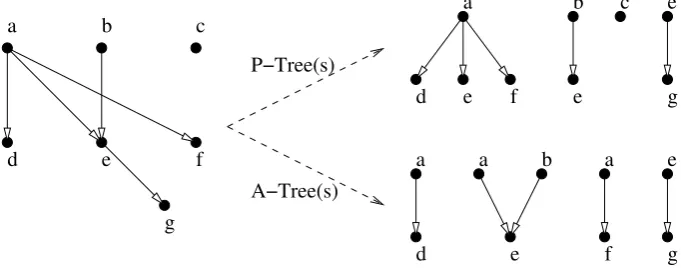
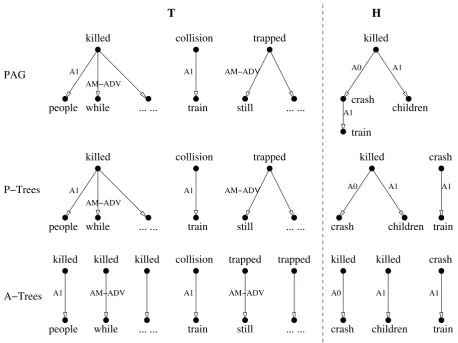
In order to compare the two graphs, we further reduce the alignment complexity by breaking the graphs into sets of trees. Two types of decomposed trees are considered: one is to take each predicate as the root of a tree and arguments as child nodes, and the other is on the contrary, to take each ar-gument as root and their governing predicates as child nodes. We name them asPredicate Trees (P-Trees) andArgument Trees(A-Trees) respectively. To obtain the P-Trees, we enumerate each predi-cate, find all the arguments which it directly dom-inates, and then construct a P-Tree. The algorithm to obtain A-Trees works in the similar way. Fi-nally, we will have a set of P-Trees and a set of A-Trees for each PAG, both of which are simple trees with depth of one. Figure 1 shows an example of such procedures. Notice that we do not consider cross-sentential inference, instead, we simply take the union of tree sets from all the sentences. Figure 2 illustrates the PAG for both T and H after seman-tic parsing, and the resulting P-Trees and A-Trees after applying the decomposition algorithm.
a
d e f
b c e
g e
a
d e
a b a
f e
g
e f
b c
a
d
g
[image:4.595.128.469.67.201.2]A−Tree(s) P−Tree(s)
Figure 1: Decomposition of predicate-argument graphs (left) into P-Trees (right top) and A-Trees (right bottom)
R(T, H) = max
1≤i≤r,1≤j≤s
R(T reeTi, T reeHj)
In order to compare two P-Trees or A-Trees, we further define each predicate-argument pair contained in a tree as a semantic dependency triple. Each semantic dependency triple con-tains a predicate, an argument, and the seman-tic dependency label in between, in the form ofhP redicate, Dependency, Argumenti. Then we define the relatedness function between two trees as the minimum value of the relatedness scores of all the triple pairs from the two trees.
R(T reeT, T reeH) =1≤i≤minn,1≤j≤m
R(hPT, DTi, ATii,hPH, DHj, AHji)
For the relatedness function between two se-mantic dependency triples, we define the follow-ing two settfollow-ings: the FULL match and the NOT
-FULLmatch. Either match requires that the
pred-icates are related at the first place. The former means both the dependencies and the arguments are related; while the latter only requires the de-pendencies to be related.
R(hPT, DT, ATi,hPH, DH, AHi) =
Full R(PT,PH)=R(DT,DH)=R(AT,AH)=1
NotFull R(PT,PH)=R(DT,DH)=1
Other Otherwise
Now, the only missing components in our defi-nition is the relatedness functions between pred-icates, arguments, and semantic dependencies. Fortunately, many people have done research on
semantic relatedness in lexical semantics that we could use. Therefore, these functions can be realized by different string matching algorithms and/or lexical resources. Since the meaning of rel-evance is rather wide, apart from the string match-ing of the lemmas, we also incorporate various resources, from distributionally collected ones to hand-crafted ontologies. We choose VerbOcean (Chklovski and Pantel, 2004) to obtain the relat-edness between predicates (after using WordNet (Fellbaum, 1998) to change all the nominal pred-icates into verbs) and use WordNet for the argu-ment alignargu-ment. For the verb relations in Ver-bOcean, we consider all of them as related; and for WordNet, we not only use the synonyms, hy-ponyms, and hypernyms, but antonyms as well. Consequently, we simplify these basic relatedness functions into a binary decision. If the correspond-ing strcorrespond-ings are matched or the relations mentioned above exist, the two predicates, arguments, or de-pendencies are related; otherwise, not.
In addition, the Normalized Google Distance (NGD) (Cilibrasi and Vitanyi, 2007) is applied to both cases5. As for the comparison between de-pendencies, we simply apply the string matching, except for modifier labels, which we treat them as the same6. In all, the main idea here is to incorpo-rate both distributional semantics and ontological semantics in order to see whether their contribu-tions are overlapping or complementary. In prac-tice, we use empirical value 0.5 as the threshold. Below the threshold means they are related,
oth-5You may find the NGD values of all the con-tent word pairs in RTE-3 and RTE-4 datasets at http://www.coli.uni-sb.de/˜rwang/
resources/RTE3_RTE4_NGD.txt.
crash killed
train
children
A0 A1
A1
while people
A1
[image:5.595.69.528.59.402.2]killed
... ... train collision
still
A1
trapped
... ...
AM−ADV
AM−ADV
A1
crash
train killed
children
A0 A1
crash P−Trees
A−Trees
while people
A1
killed
... ... train collision
still
A1
trapped
... ...
AM−ADV
AM−ADV
killed killed killed collision trapped trapped
people while ... ... train still ... ...
A1 AM−ADV A1 AM−ADV
killed killed crash
train crash children
A1
A0 A1
T H
PAG
Figure 2: Predicate-argument graphs and corresponding P-Trees and A-trees of the T-H pair
erwise not. In order to achieve a better coverage, we use the OR operator to connect all the related-ness functions above, which means, if any of them holds, the two items are related.
Notice that, although we define only the relat-edness between T and H, in principle, the graph representation can also be used for the entailment relationship. However, since it needs more fine-grained analysis and resources, we will leave it as the future work.
5 Experiments
In order to evaluate our method, we setup several experiments. The baseline system here is a simple Naive Bayes classifier with a feature set contain-ing the Bag-of-Words (BoW) overlappcontain-ing ratio be-tween T and H, and also the syntactic dependency overlapping ratio. The feature model combines two baseline systems proposed by previous work, which gives out quite competitive performance. Since the main goal of this paper is to show the impact of the PAS-based alignment module, we will not compare our results with other RTE
sys-tems (In fact, the baseline system already outper-forms the average accuracy score of the RTE-4 challenge).
The main data set used for testing here is the RTE-4 data set with three-way annotations (500 entailment T-H pairs (E), 150 contradiction pairs (C), and 350 unknown pairs (U)). The results on RTE-3 data set (combination of the development set and test set, in all, 822 E pairs, 161 C pairs, and 617 U pairs) is also shown, although the origi-nal annotation is two-way and the three-way anno-tation was done by different researchers after the challenge7.
We will first show the performance of the base-line systems, followed by the results of our PAS-based alignment module and its impact on the whole task. After that, we will also give more de-tailed analysis of our alignment module, according to different lexical relatedness measurements.
5.1 Baselines
The baseline systems used here are based on over-lapping ratio of words and syntactic dependencies between T and H. For the word overlapping ratio, we calculate the number of overlapping tokens be-tween T and H and normalize it by dividing it by the number of tokens in H. The syntactic depen-dency overlapping ratio works similarly: we cal-culate the number of overlapping syntactic depen-dencies and divide it by the number of syntactic dependencies in H, i.e. the same as the number of tokens. Enlightened by the relatedness func-tion, we also allow either FULL match (meaning
both the dependencies and the parent tokens are matched), and NOTFULLmatch (meaning only the
dependencies are matched). Here we only use string match between lemmas and syntactic de-pendencies. Table 1 presents the performance of the baseline system.
The results show that, even with the same clas-sifier and the same feature model, with a proper two-stage strategy, it can already achieve better results than the three-way classification. Note that, the first strategy is not so successful, and that is the traditional two-way annotation of the RTE task. Our explanation here is that the BoW method (even with syntactic dependency features) is based on overlapping information shared by T and H, which essentially means the more informa-tion they share, the more relevant they are, instead of being more similar or the same. Therefore, for the “ECU → E/CU” setting, methods based on overlapping information are not the best choice, while for “ECU → U/EC”, they are more ap-propriate.
In addition, the upper bound numbers show the accuracy when the first-stage classification is per-fect, which give us an indication of how far we could go. The lower upper bound for the second strategy is mainly due to the low proportion of the C cases (15%) in the data set; while the other two both show large space for improvement.
5.2 The PAS-based Alignment Module
In this subsection, we present a separate evalua-tion of our PAS-based alignment module. As we mentioned before (cf. Section 4), there are sev-eral parameters to be tuned in our alignment algo-rithm: a) whether the relatedness function between P-Trees asks for the FULL match; b) whether the
function for A-Trees asks for the FULLmatch; and
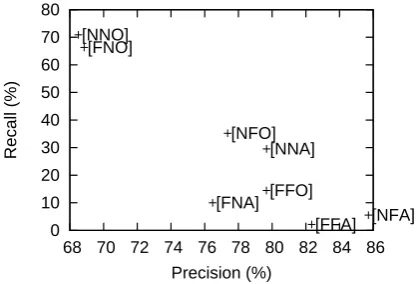
c) whether both P-Trees and A-Trees being related are required or either of them holds is enough. Since they are all binary values, we use the 3-digit code to represent each setting, e.g. [FFO]8 means either P-Trees are FULL matched orA-Trees are
FULLmatched. The performances of different
set-tings of the module are shown in the following Precision-Recall figure 3,
0 10 20 30 40 50 60 70 80
68 70 72 74 76 78 80 82 84 86
Recall (%)
Precision (%)
[FFA] [NFA] [FNA] [FFO]
[NNA] [NFO] [FNO]
[image:6.595.313.522.188.330.2][NNO]
Figure 3: Precision and recall of different align-ment settings
Since we will combine this module with the baseline system and it will be integrated as the first-stage classification, the F1 scores are not in-dicative for selecting the best setting. Intuitively, we may prefer higher precision than recall.
One limitation of our method we need to point out here is that, if some important predicates or ar-guments in H are not (correctly) identified by the SRL system, fewer P-Trees and A-Trees are re-quired to be related to some part of T, thus, the relatedness of the whole pair could easily be satis-fied, leading to false positive cases.
5.3 Impact on the Final Results
The best settings for RTE-3 data set is [NNA] and for RTE-4 data set is [NFO], which are both in the middle of the setting range shown in the previous figure 3.
As for the integration of the PAS-based align-ment model with our BoW-based baseline, we only consider the third two-stage classification strategy in Table 1. Other strategies would also be interesting to try, however, the proposed alignment algorithm exploits relatedness between T and H, which might not be fine-grained enough to detect
Strategies Three-Way Two-Stage
E/C/U E/CU→E/C/U C/EU→C/E/U U/EC→U/E/C
Accuray 53.20% 50.00% 53.50% 54.20%
[image:7.595.114.484.61.106.2]Upper Bound / 82.80% 68.70% 84.90%
Table 1: Performances of the Baselines
entailment or contradiction. New alignment algo-rithm has to be designed to explore other strate-gies. Thus, in this work, we believe that the align-ment algorithm based on PAS (and other methods based on overlapping information between T and H) is suitable for theU/EC → U/E/C classifi-cation strategy.
Table 2 shows the final results.
The first observation is that the improvement of accuracy on the first stage of the classification can be preserved to the final results. And our PAS-based alignment module can help, though there is still large space for improvement. Compared with the significantly improved results on RTE-4, the improvement on RTE-3 is less obvious, mainly due to the relatively lower precision (70.33% vs. 79.67%) of the alignment module itself.
Also, we have to say that the improvement is not as big as we expected. There are several reasons for this. Besides the limitation of our approach mentioned in the previous section, the predicates and arguments themselves might be too sparse to convey all the information we need for the en-tailment detection. In addition, in some sense, the baseline is quite strong for this comparison, since the PAS-based alignment module relies on the overlapping words at the first place, there are quite a few pairs solved by both the main approach and the baseline. Then, it would be interesting to take a closer look at the lexical resources used in the main system, which is another additional knowledge it has, comparing with the baseline.
5.4 Impact of the Lexical Resources
We did an ablation test of the lexical resources used in our alignment module. Recall that we have applied three lexical resources, VerbOcean for the predicate relatedness function, WordNet for the argument relatedness function, and Nor-malized Google Distance for both. Table 3 shows the performances of the system without each of the resources,
The results clearly show that each lexical re-source does contribute some improvement to the final performance of the system and it confirms the idea of combining lexical resources being
ac-quired in different ways. For instance, at the beginning, we expected that the relationship be-tween “people” and “children” could be captured by WordNet, but in fact not. Fortunately, the NGD has a quite low value of this pair of words (0.21), which suggests that they occur together quite of-ten, or in other words, they are relevant.
One interesting future work on this aspect is to substitute the OR connector between these lexical resources with an AND operator. Thus, instead of using them to achieve a higher coverage, whether they could be filters for each other to increase the precision will also be interesting to know.
6 Conclusion and Future Work
In this paper, we address the motivation and issues of casting the three-way RTE problem into a two-stage binary classification task. We apply an SRL system to derive the predicate-argument structure of the input sentences, and propose ways of cal-culating semantic relatedness between the shallow semantic structures of T and H. The experiments show improvements in the first-stage classifica-tion, which accordingly contribute to the final re-sults of the RTE task.
For future work, we would like to see whether the PAS can help the second-stage classification as well, e.g. the semantic dependency of negation (AM-NEG) could be helpful for the contraction recognition. Furthermore, since the PAS is usu-ally a bag of unconnected graphs, we could find a way to joint them together, in order to consider both inter- and intra- sentential inferences based on it.
Systems Baseline1 Baseline2 SRL+Baseline2 The First Stage
Data Sets Three-Way Two-Stage Two-Stage Baseline2 SRL+Baseline2 SRL RTE-3 [NNA] 52.19% 52.50% 53.69%(2.87%↑) 59.50% 60.56%(1.78%↑) 70.33% RTE-4 [NFO] 53.20% 54.20% 56.60%(6.39%↑) 67.10% 70.20%(4.62%↑) 79.67%
Table 2: Results on the Whole Datasets
Data Sets SRL+Baseline SRL+Baseline - VO SRL+Baseline - NGD SRL+Baseline - WN RTE-3 [NNA] 53.69% 53.19%(0.93%↓) 53.50%(0.35%↓) 52.88%(1.51%↓) RTE-4 [NFO] 56.60% 56.00%(1.06%↓) 56.10%(0.88%↓) 55.70%(1.59%↓)
Table 3: Impact of the Lexical Resources
Acknowledgments
The first author is funded by the PIRE PhD scholarship program sponsored by the German Research Foundation (DFG). The second author thanks the German Excellence Cluster of Multi-modal Computing and Interaction for the support of the work.
References
Eugene Agichtein, Walt Askew, and Yandong Liu. 2009. Combining Lexical, Syntactic, and Semantic Evidence for Textual Entailment Classification. In Proceedings of the First Text Analysis Conference (TAC 2008).
Collin F. Baker, Charles J. Fillmore, and John B. Lowe. 1998. The berkeley framenet project. In Proceed-ings of the 36th Annual Meeting of the Associa-tion for ComputaAssocia-tional Linguistics and 17th Inter-national Conference on Computational Linguistics, Volume 1, pages 86–90, Montreal, Canada.
Aljoscha Burchardt, Nils Reiter, Stefan Thater, and Anette Frank. 2007. A semantic approach to textual entailment: System evaluation and task analysis. In Proceedings of the ACL-PASCAL Workshop on Tex-tual Entailment and Paraphrasing, Prague, Czech Republic.
Chris Callison-Burch. 2008. Syntactic constraints on paraphrases extracted from parallel corpora. In Pro-ceedings of EMNLP.
Timothy Chklovski and Patrick Pantel. 2004. VerbO-cean: Mining the Web for Fine-Grained Semantic Verb Relations. In Proceedings of Conference on Empirical Methods in Natural Language Processing (EMNLP-04), Barcelona, Spain.
Rudi Cilibrasi and Paul M. B. Vitanyi. 2007. The Google Similarity Distance. IEEE/ACM Trans-actions on Knowledge and Data Engineering, 19(3):370–383.
Peter Clark and Phil Harrison. 2009. Recognizing Textual Entailment with Logical Inference. In Pro-ceedings of the First Text Analysis Conference (TAC 2008).
Ido Dagan, Oren Glickman, and Bernardo Magnini. 2006. The PASCAL Recognising Textual Entail-ment Challenge. InMachine Learning Challenges, volume 3944 ofLecture Notes in Computer Science, pages 177–190. Springer.
Marie-Catherine de Marneffe, Anna N. Rafferty, and Christopher D. Manning. 2008. Finding contradic-tions in text. InProceedings of ACL-08.
Christiane Fellbaum. 1998. WordNet: An Electronic Lexical Database. MIT Press.
Danilo Giampiccolo, Hoa Trang Dang, Bernardog Magnini, Ido Dagan, Elena Cabrio, and Bill Dolan. 2009. The Fourth PASCAL Recognizing Textual Entailment Challenge. InProceedings of the First Text Analysis Conference (TAC 2008).
Jan Hajiˇc, Massimiliano Ciaramita, Richard Johans-son, Daisuke Kawahara, Maria Ant`onia Mart´ı, Llu´ıs M`arquez, Adam Meyers, Joakim Nivre, Sebastian Pad´o, Jan ˇStˇep´anek, Pavel Straˇn´ak, Mihai Surdeanu, Nianwen Xue, and Yi Zhang. 2009. The CoNLL-2009 shared task: Syntactic and semantic depen-dencies in multiple languages. In Proceedings of the 13th Conference on Computational Natural Lan-guage Learning, Boulder, CO, USA.
Sanda Harabagiu and Andrew Hickl. 2006. Meth-ods for Using Textual Entailment in Open-Domain Question Answering. In Proceedings of COLING-ACL 2006, pages 905–912, Sydney, Australia. Dekang Lin and Patrick Pantel. 2001. DIRT -
Dis-covery of Inference Rules from Text. InIn Proceed-ings of the ACM SIGKDD Conference on Knowledge Discovery and Data Mining.
Bill MacCartney, Michel Galley, and Christopher D. Manning. 2008. A phrase-based alignment model for natural language inference. In Proceedings of EMNLP 2008.
Ryan McDonald, Fernando Pereira, Kiril Ribarov, and Jan Hajic. 2005. Non-Projective Dependency Pars-ing usPars-ing SpannPars-ing Tree Algorithms. In Proceed-ings of hlt-emnlp 2005, pages 523–530, Vancouver, Canada.
Christopher D. Manning. 2009. Deciding en-tailment and contradiction with stochastic and edit distance-based alignment. In Proceedings of the First Text Analysis Conference (TAC 2008). Reda Siblini and Leila Kosseim. 2009. Using
Ontol-ogy Alignment for the TAC RTE Challenge. In Pro-ceedings of the First Text Analysis Conference (TAC 2008).
Mihai Surdeanu, Richard Johansson, Adam Meyers, Llu´ıs M`arquez, and Joakim Nivre. 2008. The CoNLL-2008 shared task on joint parsing of syntac-tic and semansyntac-tic dependencies. In Proceedings of the 12th conference on computational natural lan-guage learning (CoNLL-2008), Manchester, UK. Rui Wang and G¨unter Neumann. 2007.
Recog-nizing textual entailment using a subsequence ker-nel method. In Proceedings of the Twenty-Second AAAI Conference on Artificial Intelligence (AAAI-07), pages 937–942, Vancouver, Canada.