Utilizing Extra-sentential Context for Parsing
Jackie Chi Kit Cheung and Gerald Penn Department of Computer Science
University of Toronto Toronto, ON, M5S 3G4, Canada {jcheung,gpenn}@cs.toronto.edu
Abstract
Syntactic consistency is the preference to reuse a syntactic construction shortly after its appearance in a discourse. We present an anal-ysis of the WSJ portion of the Penn Tree-bank, and show that syntactic consistency is pervasive across productions with various left-hand side nonterminals. Then, we implement a reranking constituent parser that makes use of extra-sentential context in its feature set. Using a linear-chain conditional random field, we improve parsing accuracy over the gen-erative baseline parser on the Penn Treebank WSJ corpus, rivalling a similar model that does not make use of context. We show that the context-aware and the context-ignorant rerankers perform well on different subsets of the evaluation data, suggesting a combined ap-proach would provide further improvement. We also compare parses made by models, and suggest that context can be useful for parsing by capturing structural dependencies between sentences as opposed to lexically governed de-pendencies.
1 Introduction
Recent corpus linguistics work has produced ev-idence of syntactic consistency, the preference to reuse a syntactic construction shortly after its ap-pearance in a discourse (Gries, 2005; Dubey et al., 2005; Reitter, 2008). In addition, experimental stud-ies have confirmed the existence of syntactic prim-ing, the psycholinguistic phenomenon of syntactic consistency1. Both types of studies, however, have
1
Whether or not corpus-based studies of consistency have any bearing on syntactic priming as a reality in the human mind
limited the constructions that are examined to partic-ular syntactic constructions and alternations. For in-stance, Bock (1986) and Gries (2005) examine spe-cific constructions such as the passive voice, dative alternation and particle placement in phrasal verbs, and Dubey et al. (2005) deal with the internal struc-ture of noun phrases. In this work, we extend these results and present an analysis of the distribution of all syntactic productions in the Penn Treebank WSJ corpus. We provide evidence that syntactic consis-tency is a widespread phenomenon across produc-tions of various types of LHS nonterminals, includ-ing all of the commonly occurrinclud-ing ones.
Despite this growing evidence that the probability of syntactic constructions is not independent of the extra-sentential context, current high-performance statistical parsers (e.g. (Petrov and Klein, 2007; Mc-Closky et al., 2006; Finkel et al., 2008)) rely solely on intra-sentential features, considering the partic-ular grammatical constructions and lexical items within the sentence being parsed. We address this by implementing a reranking parser which takes ad-vantage of features based on the context surrounding the sentence. The reranker outperforms the genera-tive baseline parser, and rivals a similar model that does not make use of context. We show that the context-aware and the context-ignorant models per-form well on different subsets of the evaluation data, suggesting a feature set that combines the two mod-els would provide further improvement. Analysis of the rerankings made provides cases where contex-tual information has clearly improved parsing
per-is a subject of debate. See (Pickering and Branigan, 1999) and (Gries, 2005) for opposing viewpoints.
prior denominator
prior numerator pos_adapt numerator pos_adapt denominator
f
p,tf
¬p,tf
¬p,¬tf
p,¬t¬
p
p
¬
t
[image:2.612.315.535.62.255.2]t
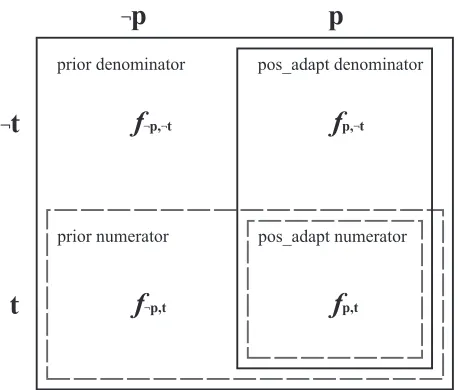
Figure 1: Visual representation of calculation of prior and positive adaptation probabilities. t represents the pres-ence of a construction in the target set. p represents the presence of the construction in the prime set.
formance, indicating the potential of extra-sentential contextual information to aid parsing, especially for structural dependencies between sentences, such as parallelism effects.
2 Syntactic Consistency in the Penn Treebank WSJ
Syntactic consistency has been examined by Dubey et al. (2005) for several English corpora, including the WSJ, Brown, and Switchboard corpora. They have provided evidence that syntactic consistency exists not only within coordinate structures, but also in a variety of other contexts, such as within sen-tences, between sensen-tences, within documents, and between speaker turns in the Switchboard corpus. However, their analysis rests on a selected number of constructions concerning the internal structure of noun phrases. We extend their result here to arbi-trary syntactic productions.
There have also been studies into syntactic con-sistency that consider all syntactic productions in dialogue corpora (Reitter, 2008; Buch and Pietsch, 2010). These studies find an inverse correlation be-tween the probability of the appearance of a
syn-less frequent Production-type deciles more frequent
[image:2.612.65.294.65.260.2]Proportion of consistent production-types
Figure 2: Production-types (singletons removed) catego-rized into deciles by frequency and the proportion of the production-types in that bin that is consistent to a signifi-cant degree.
tactic structure and the distance since its last occur-rence, which indicates syntactic consistency. These studies, however, do not provide consistency results on subsets of production-types, such as by produc-tion LHS as our study does, so the implicaproduc-tions that can be drawn from them for improving parsing are less apparent.
We adopt the measure used by Dubey et al. (2005) to quantify syntactic consistency, adaptation prob-ability. This measure originates in work on lexical priming (Church, 2000), and quantifies the probabil-ity of a target word or constructionwappearing in a “primed” context. Specifically, four frequencies are calculated, based on whether the target construction appears in the previous context (the prime set), and whether the construction appears after this context (the target set):
fp,¬t(w) = # of times w in prime set only
f¬p,t(w) = # of times w in target set only
f¬p,¬t(w) = # of times w in neither set
fp,t(w) = # of times w in both sets
fre-LHS prior pos adapt ratio +> priorsig. insig. +< priorsig.
ADJP 0.03 0.05 1.96 26 251 0
ADVP 0.21 0.24 1.15 26 122 0
NP 0.17 0.22 1.27 281 2284 0
PP 0.56 0.58 1.04 32 125 0
PRN 0.01 0.03 4.60 12 82 0
PRT 0.06 0.08 1.40 3 3 0
QP 0.03 0.18 5.41 24 147 0
S 0.30 0.34 1.13 42 689 1
SBAR 0.15 0.20 1.31 13 68 0
SINV 0.01 0.01 1.00 3 77 0
VP 0.08 0.12 1.56 148 1459 0
WHADVP 0.04 0.08 1.84 2 8 0
WHNP 0.07 0.10 1.39 3 47 0
[image:3.612.116.497.54.258.2]WHPP 0.01 0.02 2.65 1 1 0
Table 1: Weighted average by production frequency among non-singleton production-types of prior and positive adap-tation probabilities, and the ratio between them. The columns on the right show the number of production-types for which the positive adaptation probability is significantly greater than, not different from, or less than the prior probability. We exclude LHSs with a weighted average prior of less than 0.005, due to the small sample size.
quencies. Then, we define the prior and the positive adaptation probability of a construction as follows (See also Figure 1):
prior(w) = fp,t(w) +f¬p,t(w) N
pos adapt(w) = fp,t(w) fp,t(w) +fp,¬t(w)
A positive adaptation probability that is greater than the prior probability would be interpreted as evidence for syntactic consistency for that construc-tion. We conduct χ2 tests for statistical signif-icance testing. We analyze the Penn Treebank WSJ corpus according this schema for all produc-tions that occur in secproduc-tions 2 to 22. These are the standard training and development sets for train-ing parsers. We did not analyze section 23 in or-der not to use its characteristics in designing our reranking parser so that we can use this section as our evaluation test set. Our analysis focuses on the consistency of rules between sentences, so we take the previous sentence within the same article as the prime set, and the current sentence as the target set in calculating the probabilities given above. The raw data from which we produced our analysis are
available at http://www.cs.toronto.edu/
˜jcheung/wsj_parallelism_data.txt.
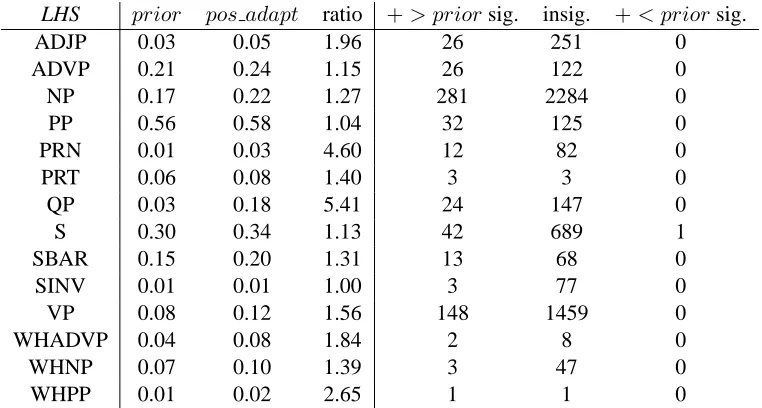
We first present results for consistency in all the production-types2, grouped by the LHS of the pro-duction. Table 1 shows the weighted average prior and positive adaptation probabilities for productions by LHS, where the weighting is done by the num-ber of occurrence of that production. Production-types that only occur once are removed. It also shows the number of production-types in which the positive adaptation probability is statistically signif-icantly greater than, not signifsignif-icantly different from, and significantly lower than the prior probability.
Quite remarkably, very few production-types are significantly less likely to reoccur compared to the prior probability. Also note the wide variety of LHSs for which there is a large number of production-types that are consistent to a significant degree. While a large number of production-types appears not to be significantly more likely to occur in a primed context, this is due to the large number of production-types which only appear a few times. Frequently occurring production-types mostly ex-hibit syntactic consistency.
We show this in Figure 2, in which we put non-singleton production-types into ten bins by
fre-2
That is, all occurrences of a production with a particular
Ten most frequent production-types
production f¬p,t fp,t fp,¬t prior pos adapt ratio
PP→IN NP 5624 26224 5793 0.80 0.82 1.02
NP→NP PP 9033 12451 9388 0.54 0.57 1.05
NP→DT NN 9198 10585 9172 0.50 0.54 1.07
S→NP VP 8745 9897 9033 0.47 0.52 1.11
S→NP VP . 8576 8501 8888 0.43 0.49 1.13
S→VP 8717 7867 9042 0.42 0.47 1.11
NP→PRP 7208 5309 7285 0.32 0.42 1.33
ADVP→RB 7986 3949 7905 0.30 0.33 1.10
NP→NN 7630 3390 7568 0.28 0.31 1.11
VP→TO VP 7039 3552 7250 0.27 0.33 1.23
Ten most consistent among 10% most frequent production-types
production f¬p,t fp,t fp,¬t prior pos adapt ratio
QP→# CD CD 51 18 45 0.00 0.29 163.85
NP→JJ NNPS 52 7 53 0.00 0.12 78.25
NP→NP , ADVP 109 24 99 0.00 0.20 58.05
NP→DT JJ CD NN 63 6 67 0.00 0.08 47.14
PP→IN NP NP 83 10 87 0.00 0.10 43.86
QP→IN $ CD 51 3 49 0.00 0.06 42.28
NP→NP : NP . 237 128 216 0.01 0.37 40.34
INTJ→UH 59 4 60 0.00 0.06 39.26
ADVP→IN NP 108 11 83 0.00 0.12 38.91
[image:4.612.127.486.53.387.2]NP→CD CD 133 21 128 0.00 0.14 36.21
Table 2: Some instances of consistency effects of productions. All productions’pos adaptprobability is significantly greater than itspriorprobability atp <10−6.
quency and calculated the proportion of production-types in that bin for which the positive adaptation probability is significantly greater than the prior. It is clear that the most frequently occurring production-types are also the ones most likely to exhibit evi-dence of syntactic consistency.
Table 2 shows the breakdown of the prior and positive adaptation calculation components for the ten most frequent production-types and the ten most consistent (by the ratiopos adapt/prior) produc-tions among the top decile of production-types. Note that all of these production-types are consistent to a statistically significant degree. Interestingly, many of the most consistent production-types have NP as the LHS, but overall, productions with many differ-ent LHS pardiffer-ents exhibit consistency.
3 A Context-Aware Reranker
Having established evidence for widespread syntac-tic consistency in the WSJ corpus, we now investi-gate incorporating extra-sentential context into a sta-tistical parser. The first decision to make is whether to incorporate the context into a generative or a dis-criminative parsing model.
Employing a generative model would allow us to train the parser in one step, and one such parser which incorporates the previous context has been implemented by Dubey et al. (2006). They imple-ment a PCFG, learning the production probabilities by a variant of standard PCFG-MLE probability es-timation that conditions on whether a rule has re-cently occurred in the context or not:
P(RHS|LHS, P rime) = c(LHS→RHS, P rime)
c(LHS, P rime)
right-hand side of a production, respectively. Prime is a binary variable which is True if and only if the current production has occurred in the prime set (the previous sentence). c represents the frequency count.
The drawback of such a system is that it doubles the state space of the model, and hence likely in-creases the amount of data needed to train the parser to a comparable level of performance as a more com-pact model, or would require elaborate smoothing. Dubey et al. (2006) find that this system performs worse than the baseline PCFG-MLE model, drop-ping F1 from 73.3% to 71.6%3.
We instead opt to incorporate the extra-sentential context into a discriminative reranking parser, which naturally allows additional features to be incorpo-rated into the statistical model. Many discriminative models of constituent parsing have been proposed in recent literature. They can be divided into two broad categories–those that rerank the N-best outputs of a generative parser, and those that make all parsing de-cisions using the discriminative model. We choose to implement an N-best reranking parser so that we can utilize state-of-the-art generative parsers to en-sure a good selection of candidate parses to feed into our reranking module. Also, fully discrimina-tive models tend to suffer from efficiency problems, though recent models have started to overcome this problem (Finkel et al., 2008).
Our approach is similar to N-best reranking parsers such as Charniak and Johnson (2005) and Collins and Koo (2005), which implement a va-riety of features to capture within-sentence lexical and structural dependencies. It is also similar to work which focuses on coordinate noun phrase pars-ing (e.g. (Hogan, 2007; K¨ubler et al., 2009)) in that we also attempt to exploit syntactic parallelism, but in a between-sentence setting rather than in a within-sentence setting that only considers coordination.
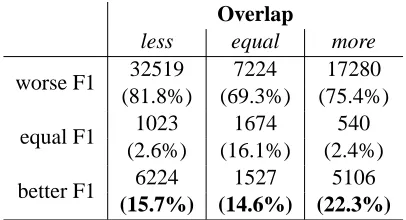
As evidence of the potential of an N-best rerank-ing approach with respect to extra-sentential con-text, we considered the 50-best parses in the devel-opment set produced by the generative parser, and categorized each into one of nine bins depending on whether this candidate parse exhibits more, less,
3A similar model which conditions on whether productions
have previously occurred within the same sentence, however, improves F1 to 73.6%.
Overlap
less equal more
worse F1 32519 7224 17280
(81.8%) (69.3%) (75.4%)
equal F1 1023 1674 540
(2.6%) (16.1%) (2.4%)
better F1 6224 1527 5106
[image:5.612.325.528.54.164.2](15.7%) (14.6%) (22.3%)
Table 3: Correlation between rule overlap and F1 com-pared to the generative baseline for the 50-best parses in the development set.
or the same amount of rule overlap with the previ-ous correct parse than the generative baseline, and whether the candidate parse has a better, worse, or the same F1 measure than the generative baseline (Table 3). We find that a larger percentage of candi-date parses which share more productions with the previous parse are better than the generative base-line parse than for the other categories, and this dif-ference is statistically significant (χ2test).
3.1 Conditional Random Fields
For our statistical reranker, we implement a linear-chain conditional random field (CRF). CRFs are a very flexible class of graphical models which have been used for various sequence and relational la-belling tasks (Lafferty et al., 2001). They have been used for tree labelling, in XML tree labelling (Jousse et al., 2006) and semantic role labelling tasks (Cohn and Blunsom, 2005). They have also been used for shallow parsing (Sha and Pereira, 2003), and full constituent parsing (Finkel et al., 2008; Tsuruoka et al., 2009). We exploit the flexibility of CRFs by in-corporating features that depend on extra-sentential context.
In a linear-chain CRF, the conditional probabil-ity of a sequence of labels y =y{t=1...T}given a se-quence of observed output x =x{t=1...T}and weight vectorθ=θ{k=1...K}is given as follows:
P(y|x) = 1 Zexp(
T
X
t=1
X
k
where Z is the partition function. The feature func-tionsfk(yt−1, yt,x, t)can depend on two neighbour-ing parses, the sentences in the sequence, and the position of the sentence in the sequence. Since our feature functions do not depend on the words or the time-step within the sequence, however, we will writefk(yt−1, yt)from now on.
We treat each document in the corpus as one CRF sequence, and each sentence as one time-step in the sequence. The label sequence then is the se-quence of parses, and the outputs are the sentences in the document. Since there is a large number of parses possible for each sentence and correspond-ingly many possible states for each label variable, we restrict the possible label state-space by extract-ing the N-best parses from a generative parser, and rerank over the sequences of candidate parses thus provided. We use the generative parser of Petrov and Klein (2007), a state-splitting parser that uses an EM algorithm to find splits in the nonterminal sym-bols to maximize training data likelihood. We use the 20-best parses, with an oracle F1 of 94.96% on section 23.
To learn the weight vector, we employ a stochastic gradient ascent method on the conditional log like-lihood, which has been shown to perform well for parsing tasks (Finkel et al., 2008). In standard gra-dient ascent, the conditional log likelihood with a L2 regularization term for a Gaussian prior for a train-ing corpus ofN sequences is
L(θ) =
N
X
i=1
X
t,k
θkfk(y( i) t−1, y
(i) t )
− N
X
i=1
log Z(i)−X k
θk2 2σ2
And the partial derivatives with respect to the weights are ∂L ∂θk = N X i=1 X t
fk(y(t−i)1, y (i) t ) − N X i=1 X t X y,y′
fk(y, y′)P(y, y′|x(i))
−X k
θk
σ2
The first term is the feature counts in the train-ing data, and the second term is the feature expecta-tions according to the current weight vector. The third term corresponds to the penalty to non-zero weight values imposed by regularization. The prob-abilities in the second term can be efficiently calcu-lated by the CRF-version of the forward-backward algorithm.
In standard gradient ascent, we update the weight vector after iterating through the whole training cor-pus. Because this is computationally expensive, we instead use stochastic gradient ascent, which ap-proximates the true gradient by the gradient calcu-lated from a single sample from the training corpus. We thus do not have to sum over the training set in the above expressions. We also employ a learning rate multiplier on the gradient. Thus, the weight up-date for theith encountered training sequence during training is
θ=θ+αi∇Lstochastic(θ)
αi=η
τ ×N τ ×N +i
The learning rate function is modelled on the one used by Finkel et al. (2008). It is designed such that
αiis halved afterτ passes through the training set. We train the model by iterating through the train-ing set in a randomly permuted order, updattrain-ing the weight vector after each sequence. The parameters
η,τ, andσare tuned to the development set. The fi-nal settings we use areη= 0.08,τ = 5, andσ= 50. We use sections 2–21 of the Penn Treebank WSJ for training, 22 for development, and 23 for testing. We conduct 20-fold cross validation to generate the best parses for the training set, as is standard for N-best rerankers.
To rerank, we do inference with the linear-chain CRF for the most likely sequence of parses using the Viterbi algorithm.
3.2 Feature Functions
(1) (S (NP (DT NN)) (VP (VBD)))
(2) (S (NP (NNS)) (VP (VBD)))
Phrasalfeatures:
Template: (parent, childL, childR, repeated)
(S, edge, NP,+), (S, NP, VP,+), (S, VP, edge, +), (NP, edge, NNS,−), (NP, NNS, edge,−), (VP, edge, VBD,+), (VP, VBD, edge,+)
Lexicalfeatures:
Template: (parent, POSL, POSR, repeated)
(S, edge, NNS,−), (S, NNS, VBD,−), (S, VBD, edge,+), (NP, edge, NNS,−), (NP, NNS, edge, −), (VP, edge, VBD, +), (VP, VBD, edge,+)
Figure 3: Example of features extracted from a parse se-quence specified down to the POS level.
we tried was to simply enumerate the (non-lexical) productions inytalong with whether that production is found inyt−1. However, we found that our most successful feature function is to consider overlaps in partial structures of productions.
Specifically, we decompose a tree into all of the nonlexical vertically and horizontally markovized subtrees. Each of the subtrees in yt marked by whether that same subtree occurs in the previous tree is a feature. The simple production represen-tation corresponds to a vertical markovization of 1 and a horizontal markovization of infinite. We found that a vertical markovization of 1 and a horizontal markovization of 2 produced the best results on our data. We will call this model thephrasalmodel.
This schema so far only considers local substruc-tures of parse trees, without being informed by the lexical information found in the leaves of the tree. We try another schema which considers the POS tag sequences found in each subtree. A feature then is the node label of the root of the subtree with the POS tag sequence it dominates, again decomposed into sequences of length 2 by markovization. We will call this model thelexicalmodel.
To extract features from this sequence, we con-sider the substructures in the second parse, and mark whether they are found in the first parse as well. We add edge markers to mark the beginning and end of constituents. See Figure 3 for an example of features
Method F1 (%)
Model-averaged 90.47
Combined, jointly trained−Context 90.33
Combined, jointly trained 90.31
Model-averaged−Context 90.22
lexical−Context 90.21
lexical 90.20
phrasal 90.12
phrasal−Context 89.74
[image:7.612.324.536.54.191.2]Generative 89.70
Table 4: Development set (section 22) results of various models that we trained. Italicized are the models we use for the test set.
extracted by the two models.
We will consider various ways of combining the two schemata above in the next section. In addition, we also add a feature corresponding to the scaled log probability of a parse tree derived from the genera-tive parsing baseline. Scaling is necessary because of the large differences in the magnitude of the log probability for different sentences. The scaling for-mula that we found to work best is to scale the max-imum log probability among the N-best candidate parses to be 1.0 and the minimum to be 0.0.
3.3 Results
LP LR F1 Exact CB 0CB LP LR F1 Exact CB 0CB development set – length≤40 development set – all sentences Generative 90.33 90.20 90.27 39.92 0.68 71.99 89.64 89.75 89.70 37.76 0.82 68.65
+Context 91.25 90.71 90.98 41.25 0.61 73.45 90.62 90.33 90.47 38.88 0.74 70.47
[image:8.612.77.537.54.118.2]−Context 90.85 90.78 90.82 40.62 0.62 73.00 90.28 90.38 90.22 38.24 0.74 70.00
Table 5: Parsing results on the development set (section 22) of the Penn Treebank WSJ (%, except forCB). Generative is the generative baseline of Petrov and Klein (2007),+Context is the best performing reranking model using previous context (model-averaged phrasal and lexical), −Context is the best performing reranking model not using previous context (jointly trainedphrasalandlexical).
LP LR F1 Exact CB 0CB LP LR F1 Exact CB 0CB
test set – length≤40 test set – all sentences
Generative 90.04 89.84 89.94 38.31 0.80 68.33 89.60 89.35 89.47 36.05 0.94 65.81 +Context 90.63 90.11 90.37 39.02 0.73 69.40 90.17 89.64 89.91 36.84 0.87 67.09
−Context 90.64 90.43 90.54 38.62 0.72 69.84 90.20 89.97 90.08 36.47 0.85 67.55
Table 6: Parsing results on the test set (section 23) of the Penn Treebank WSJ (%, except forCB)
development set, so we use the jointly trained model on the test set. We will refer to this model as the context-ignorant or−Context model, as opposed to the previous context-aware or+Context model. The results of these experiments on the development set are shown in Table 4.
PARSEVAL results4 on the development and test set are presented in Tables 5 and 6. We see that the reranked models outperform the generative base-line model in terms of F1, and that the reranked model that uses extra-sentential context outperforms the version that does not use extra-sentential context in the development set, but not in the test set. Us-ing Bikel’s randomized parsUs-ing evaluation compara-tor5, we find that both reranking models outperform the baseline generative model to statistical signifi-cance for recall and precision. The context-ignorant reranker outperforms the context-aware reranker on recall (p < 0.01), but not on precision (p = 0.42). However, the context-aware model has the highest exact match scores in both the development and the test set.
The F1 result suggests two possibilities–either the context-aware model captures the same information as the context-ignorant model, but less effectively, or the two models capture different information about
4
This evaluation ignores punctuation and corresponds to the
new.prmparameter setting on evalb.
5
http://www.cis.upenn.edu/˜dbikel/ software.html
Sec. −Context better same +Context better
22 157 1357 186
23 258 1904 254
Table 7: Context-aware vs. context-ignorant reranking results, by sentential F1.
the parses. Two pieces of evidence point to the latter possibility. First, if the context-aware model were truly inferior, then we would expect it to out-perform the context-ignorant model on almost no sentences. Otherwise, we would expect them to do well on different sentences. Table 7 shows that the aware model outperforms the context-ignorant model on nearly as many trees in the test section as the reverse. Second, if we hypotheti-cally had an oracle that could determine whether the context-ignorant or the context-aware model would be more accurate on a sentence and if the two models were complementary to each other, we would expect to achieve a gain in F1 over the generative baseline which is roughly the sum of the gain achieved by each model separately. This is indeed the case, as we are able to achieve F1s of 91.23% and 90.89% on sections 22 and 23 respectively, roughly twice the improvement that the individual models obtain.
context-System Baseline Best Imp. (rel.) Dubey et al. (2006) 73.3 73.6 0.3 (1.1%) Hogan (2007) 89.4 89.6 0.2 (1.9%)
[image:9.612.80.295.54.103.2]This work 89.5 89.9 0.4 (3.8%)
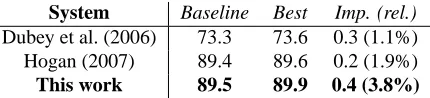
Table 8: A comparison of parsers specialized to exploit intra- or extra-sentential syntactic parallelism on section 23 in terms of the generative baseline they compare them-selves against, the best F1 their non-baseline models achieve, and the absolute and relative improvements.
aware model achieves over the generative baseline to that of other systems specialized to exploit intra-or extra-sentential parallelism. We achieve a greater improvement despite the fact that our generative baseline provides a higher level of performance, and is presumably thus more difficult to improve upon (Table 8). These systems do not compare themselves against a reranked model that does not use paral-lelism as we do in this work.
During inference, the Viterbi algorithm recov-ers the most probable sequence of parses, and this means that we are relying on the generative parser to provide the context (i.e. the previous parses) when analyzing any given sentence. We do another type of oracle analysis in which we provide the parser with the correct, manually annotated parse tree of the previous sentence when extracting features for the current sentence during training and parsing. This “perfect context” model achieves F1s of 90.42% and 90.00% on sections 22 and 23 respectively, which is comparable to the best results of our reranking mod-els. This indicates that the lack of perfect contextual information is not a major obstacle to further im-proving parsing performance.
3.4 Analysis
We now analyze several specific cases in the devel-opment set in which the reranker makes correct use of contextual information. They concretely illustrate how context can improve parsing performance, and confirm our initial intuition that extra-sentential con-text can be useful for parsing. The sentence in (3) and (4) is one such case.
(3) Generative/Context-ignorant: (S (S A BMA spokesman said “runaway medical costs” have
made health insurance “a significant challenge) ,” and (S margins also have been pinched ...) (. .))
(4) Context-aware: (S (NP A BMA spokesman) (VP said “runaway medical costs” have made health insurance “a significant challenge,” and margins also have been pinched ...) (. .))
The baseline and the context-ignorant models parse the sentence as a conjunction of two S clauses, misanalyzing the scope of what is said by the BMA spokesman to the first part of the conjunct. By an-alyzing the features and feature weight values ex-tracted from the parse sequence, we determined that the context-aware reranker is able to correct the analysis of the scoping due to a parallelism in the syntactic structure. Specifically, the substructure
S → V P. is present in both this sentence and the previous sentence of the reranked sequence, which also contains a reporting verb.
(5) (S (NP BMA Corp., Kansas City, Mo.,) (VP said it’s weighing “strategic alternatives” ... and is contacting possible buyers ...) (. .))
As a second example, consider the following sen-tence.
(6) Generative/Context-ignorant: To achieve maximum liquidity and minimize price volatility, (NP either all markets) (VP should be open to trading or none).
(7) Context-aware: To achieve maximum liquidity and minimize price volatility, (CC either) (S (NP all markets) should be open to trading or none).
The original generative and context-ignorant parses posit that “either all markets” is a noun phrase, which is incorrect. Syntactic parallelism cor-rects this for two reasons. First, the reranker prefers a determiner to start an NP in a consistent context, as both surround sentences also contain this sub-structure. Also, the previous sentence also contains a conjunction CC followed by a S node under a S node, which the reranker prefers.
context-awareness to be useful for other types of structural ambiguity such as PP attachment ambi-guity. Notice that the method we employ to cor-rect coordination errors is different from previous approaches which usually rely on lexical or syntac-tic similarity between conjuncts rather than between sentences. Our approach can thus broaden the range of sentences that can be usefully reranked. For ex-ample, there is little similarity between conjuncts to avail of in the second example (Sentences 6 and 7).
Based on these analyses, it appears that con-text awareness provides a source of information for parsing which is not available to context-ignorant parsers. We should thus consider integrating both types of features into the reranking parser to build on the advantages of each. Specifically, within-sentence features are most appropriate for lexi-cal dependencies and some structural dependencies. Extra-sentential features, on the other hand, are ap-propriate for capturing the syntactic consistency ef-fects as we have demonstrated in this paper.
4 Conclusions
In this paper, we have examined evidence for syn-tactic consistency between neighbouring sentences. First, we conducted a corpus analysis of the Penn Treebank WSJ, and shown that parallelism exists between sentences for productions with a variety of LHS types, generalizing previous results for noun phrase structure. Then, we explored a novel source of features for parsing informed by the extra-sentential context. We improved on the parsing ac-curacy over a generative baseline parser, and rival a similar reranking model that does not rely on extra-sentential context. By examining the subsets of the evaluation data on which each model performs best and also individual cases, we argue that con-text allows a type of structural ambiguity resolution not available to parsers which only rely on intra-sentential context.
Acknowledgments
We would like to thank the anonymous reviewers and Timothy Fowler for their comments. This work is supported in part by the Natural Sciences and En-gineering Research Council of Canada.
References
J.K. Bock. 1986. Syntactic persistence in language pro-duction. Cognitive Psychology, 18(3):355–387. A. Buch and C. Pietsch. 2010. Measuring syntactic
priming in dialog corpora. In Proceedings of the Con-ference on Linguistic Evidence 2010: Empirical, The-oretical and Computational Perspectives.
E. Charniak and M. Johnson. 2005. Coarse-to-fine n-best parsing and MaxEnt discriminative reranking. In Pro-ceedings of the 43rd ACL, pages 173–180. Association for Computational Linguistics.
K.W. Church. 2000. Empirical estimates of adaptation: the chance of two Noriegas is closer top/2thanp2
. In Proceedings of 18th COLING, pages 180–186. Asso-ciation for Computational Linguistics.
T. Cohn and P. Blunsom. 2005. Semantic role labelling with tree conditional random fields. In Ninth Confer-ence on Computational Natural Language Learning, pages 169–172.
M. Collins and T. Koo. 2005. Discriminative reranking for natural language parsing. Computational Linguis-tics, 31(1):25–70.
A. Dubey, P. Sturt, and F. Keller. 2005. Parallelism in coordination as an instance of syntactic priming: Evi-dence from corpus-based modeling. In Proceedings of HLT/EMNLP 2005, pages 827–834.
A. Dubey, F. Keller, and P. Sturt. 2006. Integrating syn-tactic priming into an incremental probabilistic parser, with an application to psycholinguistic modeling. In Proceedings of the 21st COLING and the 44th ACL, pages 417–424. Association for Computational Lin-guistics.
J.R. Finkel, A. Kleeman, and C.D. Manning. 2008. Effi-cient, feature-based, conditional random field parsing. Proceedings of ACL-08: HLT, pages 959–967. S.T. Gries. 2005. Syntactic priming: A corpus-based
approach. Journal of Psycholinguistic Research, 34(4):365–399.
D. Hogan. 2007. Coordinate noun phrase disambigua-tion in a generative parsing model. In Proceedings of 45th ACL, volume 45, pages 680–687.
F. Jousse, R. Gilleron, I. Tellier, and M. Tommasi. 2006. Conditional random fields for XML trees. In ECML Workshop on Mining and Learning in Graphs. S. K¨ubler, W. Maier, E. Hinrichs, and E. Klett. 2009.
Parsing coordinations. In Proceedings of the 12th EACL, pages 406–414. Association for Computational Linguistics.
D. McClosky, E. Charniak, and M. Johnson. 2006. Ef-fective self-training for parsing. In Proceedings of HLT-NAACL 2006.
S. Petrov and D. Klein. 2007. Improved inference for unlexicalized parsing. In Proceedings of HLT-NAACL 2007, pages 404–411. Association for Computational Linguistics.
M.J. Pickering and H.P. Branigan. 1999. Syntactic prim-ing in language production. Trends in Cognitive Sci-ences, 3(4):136–141.
D. Reitter. 2008. Context Effects in Language Produc-tion: Models of Syntactic Priming in Dialogue Cor-pora. Ph.D. thesis, University of Edinburgh.
F. Sha and F. Pereira. 2003. Shallow parsing with condi-tional random fields. In Proceedings of HLT-NAACL, pages 213–220.