Relative Rank Statistics for Dialog Analysis
Juan M. Huerta
IBM T.J. Watson Research Center
1101 Kitchawan Road
Yorktown Heights, NY 10598
[email protected]
Abstract
We introduce the relative rank differential sta-tistic which is a non-parametric approach to document and dialog analysis based on word frequency rank-statistics. We also present a simple method to establish semantic saliency in dialog, documents, and dialog segments using these word frequency rank statistics. Applica-tions of our technique include the dynamic tracking of topic and semantic evolution in a dialog, topic detection, automatic generation of document tags, and new story or event detec-tion in conversadetec-tional speech and text. Our ap-proach benefits from the robustness, simplicity and efficiency of non-parametric and rank based approaches and consistently outper-formed term-frequency and TF-IDF cosine dis-tance approaches in several experiments con-ducted.
1
Background
Existing research in dialog analysis has focused on several specific problems including dialog act de-tection (e.g., Byron and Heeman 1998), segmenta-tion and chunking (e.g., Hearst 1993), topic detec-tion (e.g., Zimmerman et al 2005), distilladetec-tion and summarization (e.g., Mishne et al 2005) etc. The breath of this research reflects the increasing im-portance that dialog analysis has for multiple do-mains and applications. While historically, dialog analysis research has initially leveraged the corre-sponding techniques originally intended for textual document analysis, techniques tailored specifically for dialog processing eventually should be able to address the sparseness, noise, and time considera-tions intrinsic to dialog and conversaconsidera-tions.
The approach proposed in this paper focuses on the relative change of rank ordering of words occur-ring in a conversation according to their frequen-cies. Our approach emphasizes relatively improb-able terms by focusing on terms that are relatively unlikely to appear frequently and thus weighting their change in rank more once they are observed. Our technique achieves this in a non-parametric fashion without explicitly computing probabilities, without the assumption of an underlying distribu-tion, and without the computation of likelihoods. In general, non-parametric approaches to data analysis are well known and present several attrac-tive characteristics (as a general reference see Hol-lander and Wolfe 1999). Non-parametric ap-proaches require few assumptions about the data analyzed and can present computational advan-tages over parametric approaches especially when the underlying distributions of the data are not normal. In specific, our approach uses rank order statistics of word-feature frequencies to compute a relative rank-differential statistic.
This paper is organized as follows: in Section 2 we introduce and describe our basic approach (the relative rank differential RRD function and its sorted list). In Section 3 we address the temporal nature of dialogs and describe considerations to dynamically update the RRD statistics in an on-line fashion especially for the case of shifting tem-poral windows of analysis. In Section 4 we relate the RRD approach to relevant existing and previ-ous dialog and text analysis approaches. In Section 5 we illustrate the usefulness of our metric by ana-lyzing a set of conversations in various ways using the RRD. Specifically, in that section we will em-pirically demonstrate its robustness to noise and data sparseness compared to the popular term fre-quency and TF-IDF cosine distance approaches in
a dialog classification task. And finally, in Section 6, we present some concluding remarks and future directions
2
The Relative Rank Differential
Let { 1 , 2 , 3 ...}
u u u u
d d d
d = denote the ranked
dictionary of a language (i.e., the ordered list of words sorted in decreasing order of frequency). The superscript u denotes that this ranked list is based on the universal language. Specifically, the
word diu is the
i
th entry ind
u if its frequency ofoccurrence in the language denoted by f(diu) is larger than
f
(
d
ju)
for everyj
wherei
<
j
(fornotational simplicity we assume that no two words share the same frequency). In the case where want to relax this assumption we simply allow
i
<
j
when
f
(
d
iu)
=
f
(
d
ju)
as long as diu precedes uj
d
lexicographically, or under any other desiredprecedence criteria. For
d
u we assume that0 ) (diu >
f for every entry (i.e., each word has been observed at least once in the language).
Similarly, let now dS ={d1S,d2S,d3S...} de-note the corresponding ranked dictionary for a dia-log, or dialog segment, S (ordered, as in the case of the language dictionary, in decreasing order of frequency)1. The superscript S denotes that this
ranked list is based on the dialog S. The word diS
is the
i
th entry ind
s if its frequency of occurrencein the conversation segment S denoted by f(diS)
is larger than
f
(
d
jS)
for everyj
wherei
<
j
.In this case we allow f(diS)≥0 for every i so that the cardinality of
d
u is the same asd
s.Let
r
d(w
)
denote the rank of wordw
in theranked dictionary d so that, for example,
i d r u
i u
d ( )= .
1
We only consider at this point the case in which both speak-ers’ parts in a dialog interaction are considered jointly (i.e., single channel), however, our method can be easily extended to separate conversation channels. Also, for simplicity we consider at this point only words (or phrases) as features.
Based now on a dialog segment and a universal language, any given word
w
will be associated with a rank ind
u (the universal ranked dictionary) and a rank ind
s, the dialog segment ranked dic-tionary.Let us define now for every word the relative rank differential (RRD) function or statistic2 given by:
(
)
α) (
) ( ) ( )
( ,
w r
w r w r w c
u s u
u s
d d d
d d
− =
The relative rank-differential is the ratio of the absolute difference (or change) in rank between the word’s original position in the universal dictionary and the segment s. The exponent
α
in the de-nominator allows us to emphasize or deemphasize changes in terms according to their position or rank in the language (or universal) dictionary. Typically we will want to increase the denominator’s value (i.e., deemphasize) for terms that have very low frequency (and their rank value in the universal dictionary is large) so that only relatively big changes in rank will result in substantial values of this function.When alpha is zero, the RRD focuses on every word identically as we consider only the absolute change in rank. For alpha equal to 1.0 the relative change in rank gets scaled down linearly according to its rank, while for alphas larger than 1.0 the nu-merator will scale down or reduce to a larger extent the value of relative rank differential for words that have large rank value.
Based on each word’s relative rank differential we can compute the ranked list of words sorted in decreasing order by their corresponding value of relative rank differential. Let this sorted list of words be denoted by
R
(
d
u,
d
S)
=
{
w
1,
w
2,...}
. Sothat
c
(
w
i)
is larger than c(wj)3for every
j
where
i
<
j
.We now provide some intuition on the ranked RRD lists and the RRD function. The ranked dictionary of a language contains information
2
For brevity, we refer to the Relative Rank Differential of a word given two utterances as a statistic. It is not, strictly speaking, a metric or a distance, but rather a function.
3
about the frequency of all words in a language (i.e., across the universe of conversations) while the segment counterpart pertains a single conversation or segment thereof. The relative rank differential tells us how different a word is ranked in a conversation segment from the universal language, but this difference is normalized by the universal rank of the word. Intuitively, and especially when alpha equals 1.0, the RRD denotes some sort of percent change in rank. This also means that this function is less sensitive to small changes in frequency in the case of frequent words and to small changes in rank in case of infrequent words. Finally, the sorted list
R
(
d
u,
d
S)
contains in order of importance the most relatively salient terms of a dialog segment, as measured by relative changes or differences in rank.3
Collecting Rank Statistics
We now discuss how to extend the metrics de-scribed in the previous section to consider finite-time sliding windows of analysis, that is, we de-scribe how to update rank statistics, specifically the ranked lists and relative rank differential informa-tion for every feature in an on-line fashion. This is useful when tracking the evolution of single dia-logs, when focusing the analysis to span shorter regions, as well as to supporting dynamic real-time analytics of large number of dialogs.
To approach this, we decompose the word events (words as they occur in time) into arriving and departing events. An arriving event at time t is a word that is covered by the analysis window at its specific time as the finite length window slides in time, and a departing word at time t is a feature that stops falling within the window of analysis. For simplicity, and without loss of generality, we now assume that we are performing the analysis in real time and that the sliding window of analysis spans from current time t back to (t-T), where T is the length of the window of analysis.
An arriving word at current time t falls into our current window of analysis and thus needs to be processed. To account for these events efficiently, we need a new structure: the temporal event FIFO list (i.e., a queue where events get registered) that keeps track of events as they arrive in time. As an event (word
w
t) arrives it is registered and proc-essed as follows:1. Find the corresponding identifier of
w
t in the universal ranked dictionary and add itas diu at the end of the temporal event list together with its time stamp.
2. The corresponding entry in
d
s, the ranked segment dictionary, is located through anindex list that maps ks u
i d
d → and the segment frequency associated is incre-mentedf(dks)= f(dks)+1
3. Verify if the rank of the feature needs to be updated in the segment rank list. In other words evaluate whether f(dks−1)> f(dks)
still holds true after the update. If this is not true then shift feature up in the rank list (to a higher rank) and shift down the predecessor feature in the rank list. In this single shift-up-down operation, update the index list and the value of k.
4. For every feature shifted down in 3 down re-compute the relative rank differential RRD function and verify if its position needs to be modified in
R
(
d
u,
d
S)
(a sec-ond index list is needed to compute this ef-ficiently).5. Repeat step 3 iteratively until feature is not able to push up any further in the ranked list.
The process for dealing with departing events is quite similar to the arriving process just described. Of course, as the analysis window slides in time, it is necessary to keep track of the temporal event FIFO list to make sure that the events at the top are removed as soon as they fall out of the analysis window. The process is then:
1. The departing event is identified and its corresponding identifier in the universal
ranked dictionary diu is removed from the top of the temporal event list.
2. Its location in
d
sthe ranked segment dic-tionary is located through the index list. The corresponding segment frequency as-sociated is decreased as follows:1 ) ( )
( = ks −
s
k f d
d
f .
words evaluate if ( 1) ( s)
k s
k f d
d
f + < still holds true after the update. If not shift fea-ture down in rank (to a lower rank, denot-ing less frequent occurrence) and shift the successor feature up in the rank list. In this single shift up-down operation, update the index list and the value of k.
4. For every feature shifted up in step 3 re-compute the relative rank differential and verify if its location needs to be modified in
(
u,
S)
d
d
R
5. Repeat step 3 until the feature is not able to shift down any further in the ranked list.
The procedures just described are efficiently implementable as they simply identify entries in rank lists through index lists, update values by in-crementing and dein-crementing variables, and per-formed some localized and limited re-sorting. Ad-ditionally, simple operations like adding data at the end and removing data at the beginning of the FIFO list are needed making it altogether computa-tionally inexpensive.
4
Related Techniques
Our work relates to several existing techniques as follows. Many techniques of text and dialog analy-sis utilize a word frequency vector based approach (e.g., Chu-Carroll et al 1999) in which lexical fea-tures counts (term frequencies) are used to popu-late the vector. Sometimes the term frequency is normalized by document size and weighted by the inverse document frequency (IDF). The TF-IDF and TF metrics are the base of other ap-proaches like discriminative classification (Kuo and Lee 2003; and Li and Huerta 2004), Text Till-ing or topic chains (Hearst 1993; Zechner 2001), and latent semantic indexing (Landauer et al 1998). Ultimately, these types of approaches are the fodation of complex classification and document un-derstanding systems which use these features to-gether with possibly more sophisticated classifica-tion algorithms (e.g., D’Avanzo et al 2007). When using TF and TF-IDF approaches, it is im-portant to notice that by normalizing the term fre-quency by the document length, TF-based ap-proaches are effectively equivalent to estimation of a multinomial distribution. The variance of the es-timate will be larger as the number of observations decreases. Recently, approaches that explicitly
es-tablish this parametric assumption and perform parameter inference have been presented in (Blei et al 2003). This work is an example of the potential complexity associated when performing parameter inference.
The area of adaptation of frequency parameters for ASR, specifically the work of (Church 2000), is relevant to our work in the sense that both ap-proaches emphasize the importance of and present a method to update the lexical or semantic feature statistics on-line.
In the area of non-parametric processing of dialog and text, the work of (Huffaker et al 2006), is very close to the work in this paper as it deals with non-parametric statistics of the word frequencies (rank of occurrences) and uses the Spearman’s Correla-tion Coefficient. Our work differs from this ap-proach in two ways: first, the Relative Rank Dif-ferential tells us about the relative change in rank (while SCC focuses in the absolute change) and secondly, from the ranked RDD list, we can iden-tify the saliency of each term (as opposed to sim-ply computing the overall similarity between two passages).
5
Experiments
In order to illustrate the application of the RRD statistic, we conducted two sets of experiments based on conversations recorded in a large cus-tomer contact center for an American car manufac-turer. In the first group of experiments we took a corpus of 258 hand transcribed dialogs and con-ducted classification experiments using the basic RRD statistic as feature. We compared its per-formance against term frequency and TF-IDF based cosine distance approaches. The second set of experiments is based on ASR transcribed speech and for this we used a second corpus consisting of a set of 44 conversations spanning over 3 hours of conversational speech.
5.1 RRD for Dialog matching
For this set of experiments we used a corpus of 258 hand transcribed conversations. Each dialog was treated like a single document. Using the set of dialogs we constructed different query vectors and affected these queries using various noise condi-tions, and then we utilized these vectors to perform a simple document query classification experiment. We measured the cosine distance between the noisy query vector and the document vector of each document in this corpus. A noisy query is constructing by adding zero mean additive gaus-sian noise to the query vector with amplitude pro-portional to the value of a parameter N and with floor value of zero to avoid negative valued fea-tures. We allow, in these experiments, for counts to have non-integer values; as the dialog becomes larger, the Gaussian assumption holds true due to the Central Limit Theorem, independently of the actual underlying distribution of the noise source. This distortion is intended to mimic the variation between two similar dialogs (or utterances) that are essentially similar, except for a additive zero mean random changes. A good statistic should be able to show robustness to these types of distortions. A correct match is counted when the closest match for each query is the generating document.
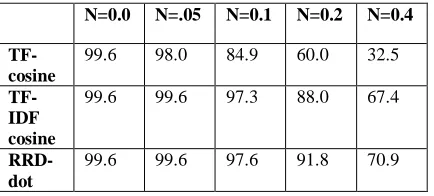
N=0.0 N=.05 N=0.1 N=0.2 N=0.4
TF-cosine
99.6 98.0 84.9 60.0 32.5
TF-IDF cosine
99.6 99.6 97.3 88.0 67.4
RRD-dot
99.6 99.6 97.6 91.8 70.9
Table 1. Query match accuracy for 3 features
un-der several query noise conditions.
Table 1 shows the percent correct matches for the TF, TF-IDF and Relative Rank Differential fea-tures, under various levels of query noise. As we can see, in clean conditions the accuracy of the 3 features is quite high but as the noise conditions increase the accuracy of the 3 techniques decreases substantially. However, the TF feature is much more sensitive to noise than the other two tech-niques. We can see that our technique is better than both TF and TF-IDF in noisy conditions.
We also conducted experiments to test the com-parative robustness or the RRD feature to query
data sparseness. To measure this, we evaluated the accuracy in query-document match when using a random subset of the document as query. Figure 1 show the results of this experiment using the RRD feature, the Term Frequency, and the TF-IDF fea-ture vectors. We can see that with as little as 5% of the document size as query, the RRD achieves close to 90% accuracy while the TF-IDF feature needs up to 20% to achieve the same performance, and the TF counts only need close to 70%.
These results empirically demonstrate that RRD statistics are more robust to noise and to term cov-erage sparseness than TF and TF-IDF.
Figure1. Query match accuracy for 3 feature types
under various query data sparseness conditions
5.2 ASR Based experiments
[image:5.612.72.289.421.519.2]time stamps for the agent and customer are weaved back together.
The overall Word Error Rate is about 24% and var-ies significantly between the set of agents and the set of customers (the set of agents being more ac-curate).
The universal dictionary we used consists exclu-sively of the words occurring in the corpus which total 2046 unique words. Call length ranged from just less than 1 minute to more than 20 minutes with most of the calls lasting between 2 and 3 min-utes. The corpus consists of close to 30k tokens and does not distinguish between agent channel and customer channel. A universal dictionary of ranked words is built from the set of dialogs and each dialog is treated as a segment.
Dialog Tagging and Topic Saliency
In this analysis we look at complete dialogs. A use-ful application of the methods we describe in this work is to identify and separate calls that are inter-esting from non-interinter-esting calls4, furthermore, one could also be interested in singling out which spe-cific terms make this dialog salient. An application of this approach is the automatic generation of tags (e.g., social-network style of document tagging). In our approach, we will identify calls whose top en-tries in their sorted relative rank differential lists are above a certain threshold and deem these calls as semantically salient.
We now describe in detail how an interesting call can be distinguished from a non-interesting call using the relative rank differential statistic.
Figure 2 below shows the ranked dictionary
...} , ,
{ 1S 2S 3S
S
d d d
d = (i.e., the universal rank id’s as a function of their observed ranks) and Figure 3 shows the plot of the sorted relative rank differen-tial list
(
u,
S)
d
d
R
for when the segment corre-sponds to an interesting call (as defined above). The chosen call, specifically shows as topic AIR-BAG deployment in the context of a car accident. Specifically, Figure 2 shows the corresponding rank in the universal ranked dictionary versus the rank in the dialog or segment. We can see that the4
For the purpose of this work, we simply define as an
inter-esting call a call that deals with an infrequent or rare topic
which influences the distribution of keywords and key-phrases. Examples of calls in our domain meeting this criterion are calls dealing with accidents and airbags.
right-most part of the plot is largely monotonic, meaning that most entries of lesser frequency occur in the same ranked order both in the universal and the specific dialog (including zero times for the segment), while a subset across the whole range of the universal dictionary were substantially relo-cated up in the rank (i.e., occurred more frequently in the dialog than in the language). If the plot was a single straight line each word would have the same rank both in the language and in the dialog.
We argue that while the terms of interest lie in that subset of interest in the graph (the terms whose rank increased substantially), not all of those words are equally interesting or important and rather than simply looking at absolute changes in rank we fo-cus on the relative-rank differential RRD metric. Thus, Figure 3 shows the sorted values of the rela-tive rank differential list (with
α
=1.3). The top entries and their rank in the universal dictionary (in parentheses) are: AIRBAGS (253), AS (55), FRONT (321), DEPLOY (369), SIDE (279), AC-CIDENT (687). As we can see, the top entries are distributed across a broad range of ranks in the universal dictionary and relate to the topic of the conversation, which from the top ranked entries are evidently the deployment of front and side airbags during an accident, and thus, for this call were able to identify its semantic saliency from the corpus of conversations.Other interesting or salient calls also showed a similar this profile in the RRD curve.
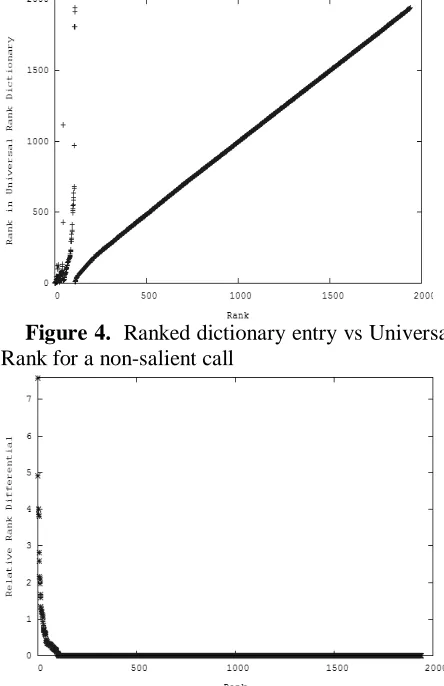
The question now is what the behavior of our ap-proach for uninteresting calls is. We repeated the procedure above for a call which we deemed se-mantically un-interesting (i.e., dealing with a common topic like call transfer and other routine procedures). Figure 4 shows the sorted relative rank differential values and, especially when com-pared with Figure 2, we see a large monotonic component on the higher ranked terms and not so marked discontinuities in the low and mid-range part of the curve.
the interesting call. More importantly, we can now compare Figures 3 and 5 and see that the highest relative rank differential value of the top entry in Figure 3 (larger than 10) is significantly larger than the largest relative rank differential value in Figure 5 (just above 7) reflecting the fact that the relative rank differential metric could be a useful parameter in evaluating semantic saliency of a segment using a static threshold. As an interesting point, con-ceivably the highly ranked features based on RRD could reflect language utilization idiosyncrasies.
Figure 2. Ranked dictionary entry vs Universal
Rank for a salient call
Figure 3. Sorted relative rank differential values
of
(
,
)
S ud
d
R
for a semantically salient call.Figure 4. Ranked dictionary entry vs Universal
Rank for a non-salient call
Figure 5. Sorted relative rank differential values
of
(
,
)
S ud
d
R
for a non-interesting (semanticallynon-salient) call.
6
Conclusions
[image:7.612.315.533.63.221.2] [image:7.612.67.292.65.555.2] [image:7.612.314.536.67.410.2] [image:7.612.72.286.201.371.2]classical non-parametric approaches like block-treatment analysis etc.
We demonstrated that our approach is as effective in query classification as TF and TF-IDF in low noise and no noise (i.e., distortion) conditions, and consistently better than those techniques in noisy conditions. We also found RRD to be more robust to query data sparseness than TF and TF-IDF. These results provide a motivation to combine our statistic with other techniques like topic chains, textilling, latent semantic indexing, and discrimi-nant classification approaches; specifically RRD could replace TF and TF-IDF based features. Future work could focus on applying ranking sta-tistics to techniques for mining and tracking tem-poral and time-changing parameters in conjunction with techniques like (Agrawal and Srikant 1995; Pratt 2001; Last et al 2001).
Another area of possible future work is the detec-tion and separadetec-tion of multiple underlying trends in dialogs. Our approach is also suited for the analy-sis of large streams of real time conversations, and this is a very important area of focus as presently more and more conversational data gets generated through channels like chat, mobile telephony, VoIP etc.
References
Agrawal R. and Srikant R. 1995. Mining Sequential Patterns. In Proc. of the 11th Int'l Conference on Data Engineering, Taipei, Taiwan.
Berger, A. L., Pietra, V. J., and Pietra, S. A. 1996. A maximum entropy approach to natural language processing. Comp. Linguist. 22, 1
Blei D., Ng A., and Jordan M. 2003. Latent Dirichlet allocation. J. of Machine Learning Research
Byron, D. K. and Heeman, P. A. 1998. Discourse Marker Use in Task-Oriented Spoken Dialog. TR664, University of Rochester.
Chu-Carroll, J, and Carpenter R. 1999. Vector-Based Natural Language Call Routing. Journal of Computa-tional Linguistics, 25(30), pp. 361-388
Church, K. 2000. Empirical estimates of adaptation: The chance of two Noriega 's is closer to p/2 than p2. In Coling
D'Avanzo E., Elia A., Kuflik T., Vietri S. 2007. Univer-sity of Salerno, LAKE System at DUC 2007, Proc. Document Understanding Conference
Hearst, M. 1993. TextTiling: A Quantitative Approach to Discourse Segmentation, Technical Report UCB:S2K-93-24, Berkeley, CA
Hollander & Wolfe 1999. Nonparametric Statistical Methods, Second Edition, John Wiley and Sons Huffaker, D., Jorgensen, J., Iacobelli, F., Tepper, P., &
Cassell, J. 2006. Computational Measures for Lan-guage Similarity across Time in Online Communities. Workshop on ACTS at HLT-NAACL, New York City, NY.
Klinkenberg R. and Renz I. 1998. Adaptive information filtering: Learning in the presence of concept drifts. In Learning for Text Categorization, Menlo Park Kuo H.-K.J. and Lee C. H. Discriminative training of
natural language call routers, IEEE Transactions on Speech and Audio Processing, Volume 11, Issue 1, Jan 2003 Page(s): 24 - 35.
Landauer T., Foltz P. W., and Laham D. Introduction to Latent Semantic Analysis Discourse Processes 25, 1998.
Last M., Klein Y., and Kandel A., Knowledge Discov-ery in Time Series Databases IEEE Trans. on Sys-tems, Man, and Cybernetics 31B(2001).
Li X. and Huerta J.M., Discriminative Training of Compound word based Multinomial Classifiers for Speech Routing Proc. ICSLP 2004
Mishne, G., Carmel, D., Hoory, R., Roytman, A., and Soffer, A. 2005. Automatic analysis of call-center conversations. In Proc. of the 14th ACM interna-tional Conference on information and Knowledge. Pratt K. B. Locating patterns in discrete time series.
Master's thesis, Computer Science and Engineering, University of South Florida, 2001.
Stanley K. O. Learning concept drift with a committee of decision trees. Comp. Science Dept., University of Texas-Austin. TR AI-03-302, 2003.
Zechner K. Automatic Summarization of Spoken Dia-logues in Unrestricted Domains. PhD thesis, LTI, CMU, 2001