Robust Textual Inference via Graph Matching
Aria D. Haghighi Dept. of Computer Science
Stanford University Stanford, CA [email protected]
Andrew Y. Ng Dept. of Computer Science
Stanford University Stanford, CA [email protected]
Christopher D. Manning Dept. of Computer Science
Stanford University Stanford, CA [email protected]
Abstract
We present a system for deciding whether a given sentence can be inferred from text. Each sentence is represented as a directed graph (extracted from a depen-dency parser) in which the nodes sent words or phrases, and the links repre-sent syntactic and semantic relationships. We develop a learned graph matching ap-proach to approximate entailment using the amount of the sentence’s semantic content which is contained in the text. We present results on the Recognizing Textual Entailment dataset (Dagan et al., 2005), and show that our approach outperforms Bag-Of-Words and TF-IDF models. In ad-dition, we explore common sources of er-rors in our approach and how to remedy them.
1 Introduction
A fundamental stumbling block for several NLP ap-plications is the lack of robust and accurate seman-tic inference. For instance, question answering sys-tems must be able to recognize, or infer, an answer which may be expressed differently from the query. Information extraction systems must also be able recognize the variability of equivalent linguistic ex-pressions. Document summarization systems must generate succinct sentences which express the same content as the original document. In Machine Trans-lation evaluation, we must be able to recognize
legit-imate translations which structurally differ from our reference translation.
One sub-task underlying these applications is the ability to recognize semantic entailment; whether one piece of text follows from another. In contrast to recent work which has successfully utilized logic-based abductive approaches to inference (Moldovan et al., 2003; Raina et al., 2005b), we adopt a graph-based representation of sentences, and use graph matching approach to measure the semantic over-lap of text. Graph matching techniques have proven to be a useful approach for tractable approximate matching in other domains including computer vi-sion. In the domain of language, graphs provide a natural way to express the dependencies between words and phrases in a sentence. Furthermore, graph matching also has the advantage of providing a framework for structural matching of phrases that would be difficult to resolve at the level of individual words.
2 Task Definition and Data
We describe our approach in the context of the 2005 Recognizing Textual Entailment (RTE) Challenge (Dagan et al., 2005), but note that our approach eas-ily extends to other related inference tasks. The sys-tem presented here was one component of our re-search group’s 2005 RTE submission (Raina et al., 2005a) which was the top-ranking system according to one of the two evaluation metrics.
In the 2005 RTE domain, we are given a set of pairs, each consisting of two parts: 1) the text, a
S
NP-Bezos
NNP
Bezos
VP-established
VBD
established
NP-company
DT
a NN
company
Bezos (person)
company (organization) establish
(VBD)
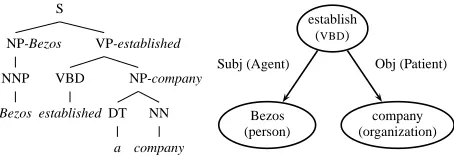
[image:2.612.81.308.57.135.2]Subj (Agent) Obj (Patient)
Figure 1: An example parse tree and the correspond-ing dependency graph. Each phrase of the parse tree is annotated with its head word, and the parentheti-cal edge labels in the dependency graph correspond to semantic roles.
small passage,1 and the hypothesis, a single sen-tence. Our task is to decide if the hypothesis is “en-tailed” by the text. Here, “entails” does not mean strict logical implication, but roughly means that a competent speaker with basic world-knowledge would be happy to conclude the hypothesis given the text. This criterion has an aspect of relevance logic as opposed to material implication: while various additional background information may be needed for the hypothesis to follow, the text must substan-tially support the hypothesis.
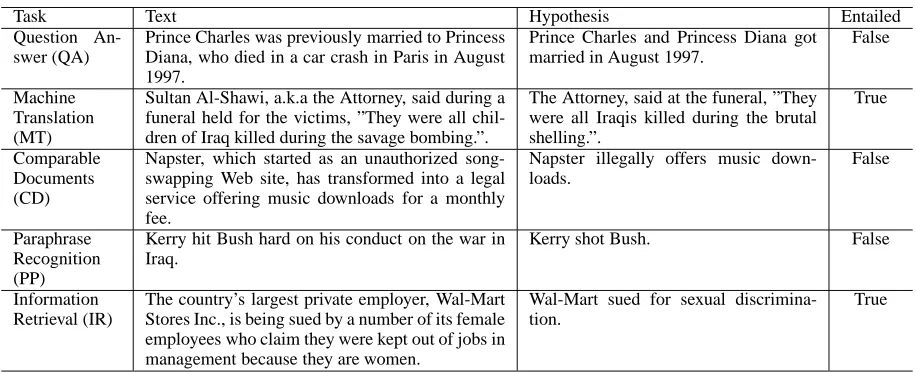
Despite the informality of the criterion and the fact that the available world knowledge is left unspecified, human judges show extremely good agreement on this task – 3 human judges indepen-dent of the organizers calculated agreement rates with the released data set ranging from 91–96% (Da-gan et al., 2005). We believe that this in part reflects that the task is fairly natural to human beings. For a flavor of the nature (and difficulty) of the task, see Table 1.
We give results on the data provided for the RTE task which consists of 567 development pairs and 800 test pairs. In both sets the pairs are divided into 7 tasks – each containing roughly the same number of entailed and not-entailed instances – which were used as both motivation and means for obtaining and constructing the data items. We will use the follow-ing toy example to illustrate our representation and matching technique:
Text: In 1994, Amazon.com was founded by Jeff Bezos. Hypothesis: Bezos established a company.
1Usually a single sentence, but occasionally longer.
3 Semantic Representation
3.1 The Need for Dependencies
Perhaps the most common representation of text for assessing content is “Bag-Of-Words” or “Bag-of-N-Grams” (Papineni et al., 2002). However, such rep-resentations lose syntactic information which can be essential to determining entailment. Consider a Question Answer system searching for an answer to When was Israel established? A representation which did not utilize syntax would probably enthusi-astically return an answer from (the 2005 RTE text): The National Institute for Psychobiology in Israel was established in 1979.
In this example, it’s important to try to match rela-tionships as well as words. In particular, any answer to the question should preserve the dependency be-tween Israel and established. However, in the pro-posed answer, the expected dependency is missing although all the words are present.
Our approach is to view sentences as graphs be-tween words and phrases, where dependency rela-tionships, as in (Lin and Pantel, 2001), are charac-terized by the path between vertices.
Given this representation, we judge entailment by measuring not only how many of the hypothesis ver-tices are matched to the text but also how well the relationships between vertices in the hypothesis are preserved in their textual counterparts. For the re-mainder of the section we outline how we produce graphs from text, and in the next section we intro-duce our graph matching model.
3.2 From Text To Graphs
Starting with raw English text, we use a version of the parser described in (Klein and Manning, 2003), to obtain a parse tree. Then, we derive a dependency tree representation of the sentence using a slightly modified version of Collins’ head propagation rules (Collins, 1999), which make main verbs not auxil-iaries the head of sentences. Edges in the depen-dency graph are labeled by a set of hand-created
tgrep expressions. These labels represent
Task Text Hypothesis Entailed Question
An-swer (QA)
Prince Charles was previously married to Princess Diana, who died in a car crash in Paris in August 1997.
Prince Charles and Princess Diana got married in August 1997.
False
Machine Translation (MT)
Sultan Al-Shawi, a.k.a the Attorney, said during a funeral held for the victims, ”They were all chil-dren of Iraq killed during the savage bombing.”.
The Attorney, said at the funeral, ”They were all Iraqis killed during the brutal shelling.”.
True
Comparable Documents (CD)
Napster, which started as an unauthorized song-swapping Web site, has transformed into a legal service offering music downloads for a monthly fee.
Napster illegally offers music down-loads.
False
Paraphrase Recognition (PP)
Kerry hit Bush hard on his conduct on the war in Iraq.
Kerry shot Bush. False
Information Retrieval (IR)
The country’s largest private employer, Wal-Mart Stores Inc., is being sued by a number of its female employees who claim they were kept out of jobs in management because they are women.
Wal-Mart sued for sexual discrimina-tion.
[image:3.612.86.544.52.238.2]True
Table 1: Some Textual Entailment examples. The last three demonstrate some of the harder instances.
1. Collapse Collocations and Named-Entities: We “collapse” dependency nodes which represent named entities (e.g., Jeff Bezos in Figure fig-example) and also collocations listed in Word-Net, including verbs and their adjacent particles (e.g., blow off in He blew off his work) .
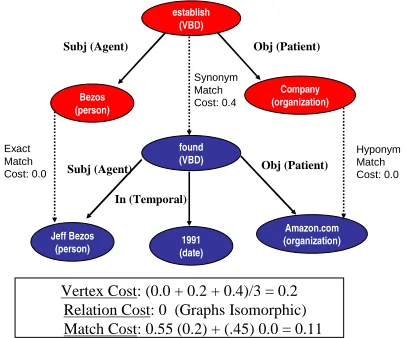
2. Dependency Folding: As in (Lin and Pan-tel, 2001), we found it useful to fold cer-tain dependencies (such as modifying preposi-tions) so that modifiers became labels connect-ing the modifier’s governor and dependent di-rectly. For instance, in the text graph in Figure 2, we have changed in from a word into a rela-tion between its head verb and the head of its NP complement.
3. Semantic Role Labeling: We also augment the graph representation with Probank-style semantic roles via the system described in (Toutanova et al., 2005). Each predicate adds an arc labeled with the appropriate seman-tic role to the head of the argument phrase. This helps to create links between words which share a deep semantic relation not evident in the surface syntax. Additionally, modifying phrases are labeled with their semantic types (e.g., in 1991 is linked by a Temporal edge in the text graph of Figure 2), which should be useful in Question Answering tasks.
4. Coreference Links: Using a co-rereference res-olution tagger,coreflinks are added
through-out the graph. These links allowed connecting the referent entity to the vertices of the referring vertex. In the case of multiple sentence texts, it is our only “link” in the graph between entities in the two sentences.
For the remainder of the paper, we will refer to the text as T and hypothesis as H, and will speak of them in graph terminology. In addition we will useHV and HE to denote the vertices and edges,
respectively, ofH.
4 Entailment by Graph Matching
We take the view that a hypothesis is entailed from the text when the cost of matching the hypothesis graph to the text graph is low. For the remainder of this section, we outline a general model for assign-ing a match cost to graphs.
For hypothesis graph H, and text graph T, a matchingMis a mapping from the vertices ofHto those ofT. For vertexvinH, we will useM(v)to denote its “match” inT. As is common in statistical machine translation, we allow nodes inHto map to fictitious NULL vertices inT if necessary. Suppose the cost of matchingM is Cost(M). IfMis the set of such matchings, we define the cost of matching
HtoT to be
MatchCost(H, T) = min
M∈MCost(M) (1)
is to use the normalized cost for each of the vertex substitutions inM:
VertexCost(M) = 1
Z
X
v∈HV
w(v)VertexSub(v, M(v))
(2) Here, w(v) represents the weight or relative im-portance for vertex v, and Z = Pv∈HV w(v) is a normalization constant. In our implementation, the weight of each vertex was based on the part-of-speech tag of the word or the type of named entity, if applicable. However, there are several other pos-sibilities including using TF-IDF weights for words and phrases.
Notice that when Cost(M) takes the form of (2), computing MatchCost(H, T) is equivalent to finding the minimal cost bipartite graph-matching, which can be efficiently computed using linear pro-gramming.
We would like our cost-model to incorporate some measure of how relationships in H are pre-served in T under M. Ideally, a matching should preserve all local relationships; i.e, ifv→v′
∈HE,
thenM(v) → M(v′) ∈ TE. When this condition
holds for all edges inH,H is isomorphic to a sub-graph ofT.
What we would like is an approximate notion of isomorphism, where we penalize the distortion of each edge relation in H. Consider an edge e = (v, v′)∈HE, and letφM(e)be the path fromM(v)
toM(v′)inT.
Again, suppose we have a model,
PathSub(e, φM(e)) for assessing the “cost” of
substituting a direct relation e ∈ HE for its
coun-terpart, φM(e), under the matching. This leads to
a formulation similar to (2), where we consider the normalized cost of substituting each edge relation inH with a path inT:
RelationCost(M) = 1
Z
X
e∈HE
w(e)PathSub(e, φM(e))
(3) where Z = Pe∈HEw(e) is a normalization con-stant. As in the vertex case, we have weights for each hypothesis edge, w(e), based upon the edge’s label; typically subject and object relations are more important to match than others. Our fi-nal matching cost is given by a convex mixture of
Subj (Agent)
establish (VBD)
Bezos (person)
Company (organization)
Obj (Patient)
Subj (Agent)
found (VBD)
Jeff Bezos (person)
Amazon.com (organization)
Obj (Patient)
In (Temporal)
1991 (date)
Synonym Match Cost: 0.4
Hyponym Match Cost: 0.0 Exact
Match Cost: 0.0
[image:4.612.334.537.56.225.2]Vertex Cost: (0.0 + 0.2 + 0.4)/3 = 0.2 Relation Cost: 0 (Graphs Isomorphic) Match Cost: 0.55 (0.2) + (.45) 0.0 = 0.11
Figure 2: Example graph matching (α = 0.55) for example pair. Dashed lines represent optimal match-ing.
the vertex and relational match costs: Cost(M) =
αVertexCost(M) + (1−α)RelationCost(M). Notice that minimizing Cost(M) is computa-tionally hard since if our PathSub model as-signs zero cost only for preserving edges, then RelationCost(M) = 0if and only ifHis isomorphic to a subgraph ofT. Since subgraph isomophism is an NP-complete problem, we cannot hope to have an efficient exact procedure for minimizing the graph matching cost. As an approximation, we can ef-ficiently find the matching M∗ which minimizes VertexCost(·); we then perform local greedy hill-climbing search, beginning from M∗, to approxi-mate the minimal matching. The allowed operations are changing the assignment of any hypothesis ver-tex to a ver-text one, and, to avoid ridges, swapping two hypothesis assignments
5 Node and Edge Substitution Models
In the previous section we described our graph matching model in terms of our VertexSub model, which gives a cost for substituting one graph vertex for another, and PathSub, which gives a cost for sub-stituting the path relationship between two paths in one graph for that in another. We now outline these models.
5.1 Vertex substitution cost model
given based upon the following conditions:
• Exact Match: v and M(v) are identical words/ phrases.
• Stem Match: vand M(v)’s stems match or one is a derivational form of the other; e.g., matching coaches to coach.
• Synonym Match: vandM(v)are synonyms ac-cording to WordNet (Fellbaum, 1998). In particu-lar we use the top 3 senses of both words to deter-mine synsets.
• Hypernym Match: v is a “kind of” M(v), as determined by WordNet. Note that this feature is asymmetric.
• WordNet Similarity:vandM(v)are similar ac-cording to WordNet::Similarity (Peder-sen et al., 2004). In particular, we use the measure described in (Resnik, 1995). We found it useful to only use similarities above a fixed threshold to ensure precision.
• LSA Match: v and M(v) are distributionally similar according to a freely available Latent Se-mantic Indexing package,2 or for verbs similar according to VerbOcean (Chklovski and Pantel, 2004).
• POS Match: vand M(v) have the same part of speech.
• No Match:M(v)is NULL.
Although the above conditions often produce rea-sonable matchings between text and hypothesis, we found the recall of these lexical resources to be far from adequate. More robust lexical resources would almost certainly boost performance.
5.2 Path substitution cost model
Our PathSub(v → v′, M(v) → M(v′)) model is also based upon a sliding scale cost based upon the following conditions:
• Exact Match: M(v) → M(v′) is an en edge in
T with the same label.
• Partial Match: M(v) →M(v′)is an en edge in
T, not necessarily with the same label.
• Ancestor Match:M(v)is an ancestor ofM(v′). We use an exponentially increasing cost for longer distance relationships.
2Available athttp://infomap.stanford.edu
• Kinked Match: M(v)andM(v′)share a com-mon parent or ancestor inT. We use an exponen-tially increasing cost based on the maximum of the node’s distances to their least common ances-tor inT.
These conditions capture many of the common ways in which relationships between entities are dis-torted in semantically related sentences. For in-stance, in our system, a partial match will occur whenever an edge type differs in detail, for instance use of the preposition towards in one case and to in the other. An ancestor match will occur whenever an indirect relation leads to the insertion of an interven-ing node in the dependency graph, such as matchinterven-ing John is studying French farming vs. John is studying French farming practices.
5.3 Learning Weights
Is it possible to learn weights for the relative impor-tance of the conditions in the VertexSub and PathSub models? Consider the case where match costs are given only by equation (2) and vertices are weighted uniformly (w(v) = 1). Suppose that Φ(v, M(v)) is a vector of features3 indicating the cost accord-ing to each of the conditions listed for matchaccord-ingv
toM(v). Also let w be weights for each element ofΦ(v, M(v)). First we can model the substitution cost for a given matching as:
VertexSub(v, M(v)) = exp (w
TΦ(v, M(v)))
1 + exp (wTΦ(v, M(v)))
Letting s(·) be the 1-sigmoid function used in the right hand side of the equation above, our final matching cost as a function ofwis given by
c(H, T;w) = min
M∈M
1 |HV|
X
v∈H
s(wTΦ(v, M(v)))
(4) Suppose we have a set of text/hypothesis pairs, {(T(1), H(1)), . . . ,(T(n), H(n))}, with labels y(i) which are 1 if H(i) is entailed by T(i) and 0 otherwise. Then we would like to choose w to minimize costs for entailed examples and maximize it for non-entailed pairs:
3In the case of our “match” conditions, these features will
ℓ(w) = X
i:y(i) =1
logc(H(i), T(i);w) +
X
i:y(i)=0
log(1−c(H(i), T(i);w))
Unfortunately,ℓ(w)is not a convex function. No-tice that the cost of each matching, M, implicitly depends on the current setting of the weightsw. It can be shown that since each c(H, T;w) involves minimizingM ∈ M, which depends onw, it is not convex. Therefore, we can’t hope to globally opti-mize our cost functions over wand must settle for an approximation.
One approach is to use coordinate ascent overM
andw. Suppose that we begin with arbitrary weights and given these weights choose M(i) to minimize eachc(H(i), T(i);w). Then we use a relaxed form of the cost function where we use the matchings found in the last step:
ˆ
c(H(i), T(i);w) = 1 |HV|
X
v∈H
s(wTΦ(v, M(i)(v)))
Then we maximize w with respect to ℓ(w) with eachc(·) replaced with the cost-function ˆc(·). This step involves only logistic regression. We repeat this procedure until our weights converge.
To test the effectiveness of the above procedure we compared performance against baseline settings using a random split on the development set. Picking each weight uniformly at random resulted in 53% accuracy. Setting all weights identically to an arbi-trary value gave 54%. The procedure above, where the weights are initialized to the same value, resulted in an accuracy of 57%. However, we believe there is still room for improvement since carefully-hand chosen weights results in comparable performance to the learned weights on the final test set. We be-lieve this setting of learning under matchings is a rather general one and could be beneficial to other domains such as Machine Translation. In the future, we hope to find better approximation techniques for this problem.
6 Checks
One systematic source of error coming from our ba-sic approach is the implicit assumption of upwards
monotonicity of entailment; i.e., ifT entailsHthen adding more words toT should also give us a sen-tence which entailsH. This assumption, also made by other recent abductive approaches (Moldovan et al., 2003), does not hold for several classes of exam-ples. Our formalism does not at present provide a general solution to this issue, but we include special case handling of the most common types of cases, which we outline below.4 These checks are done af-ter graph matching and assume we have stored the minimal cost matching.
Negation Check
Text: Clinton’s book is not a bestseller Hypothesis: Clinton’s book is a bestseller
To catch such examples, we check that each hy-pothesis verb is not matched to a text word which is negated (unless the verb pairs are antonyms) and vice versa. In this instance, the is inH, denoted by isH, is matched to isT which has a negation modifier,
notT, absent for isH. So the negation check fails.
Factive Check
Text: Clonaid claims to have cloned 13 babies worldwide. Hypothesis: Clonaid has cloned 13 babies.
Non-factive verbs (claim, think, charged, etc.) in contrast to factive verbs (know, regret, etc.) have sentential complements which do not represent true propositions. We detect such cases, by checking that each verb inHthat is matched inT does not have a non-factive verb for a parent.
Superlative Check
Text: The Osaka World Trade Center is the tallest building in Western Japan.
Hypothesis: The Osaka World Trade Center is the tallest build-ing in Japan.
In general, superlative modifiers (most, biggest, etc.) invert the typical monotonicity of entailment and must be handled as special cases. For any noun n with a superlative modifier (part-of-speech JJS) inH, we must ensure that all modifier relations ofM(n)are preserved inH. In this example, build-ingH has a superlative modifier tallestH, so we must
ensure that each modifier relation of JapanT, a noun
4All the examples are actual, or slightly altered, RTE
Method
Accuracy
CWS
Random
50.0%
0.500
Bag-Of-Words
49.5%
0.548
TF-IDF
51.8%
0.560
GM-General
56.8%
0.614
[image:7.612.328.544.53.179.2]GM-ByTask
56.7%
0.620
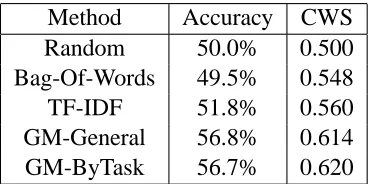
Table 2: Accuracy and confidence weighted score (CWS) for test set using various techniques.
dependent of buildingT, has a WesternT modifier not
inH. So its fails the superlative check.
Additionally, during error analysis on the devel-opment set, we spotted the following cases where our VertexSub function erroneously labeled vertices as similar, and required special case consideration:
• Antonym Check: We consistently found that the
WordNet::Similaritymodules gave
high-similarity to antonyms.5 We explicitly check whether a matching involved antonyms and reject unless one of the vertices had a negation modifier. • Numeric Mismatch: Since numeric expressions typically have the same part-of-speech tag (CD), they were typically matched when exact matches could not be found. However, mismatching nu-merical tokens usually indicated that H was not entailed, and so pairs with a numerical mismatch were rejected.
7 Experiments and Results
For our experiments we used the devolpement and test sets from the Recognizing Textual Entailment challenge (Dagan et al., 2005). We give results for our system as well as for the following systems:
• Bag-Of-Words: We tokenize the text and hypoth-esis and strip the function words, and stem the re-sulting words. The cost is given by the fraction of the hypothesis not matched in the text.
• TF-IDF: Similar to Bag-Of-Words except that there is a tf.idf weight associated with each hy-pothesis word so that more “important” words are higher weight for matching.
5This isn’t necessarily incorrect, but is simply not suitable
for textual inference.
Task GM-General GM-ByTask
Accuracy CWS Accuracy CWS
CD 72.0% 0.742 76.0% 0.771
IE 55.9% 0.583 55.8% 0.595
IR 52.2% 0.564 51.1% 0.572
MT 50.0% 0.497 43.3% 0.489
PP 58.0% 0.741 58.0% 0.746
QA 53.8% 0.537 55.4% 0.556
[image:7.612.102.286.54.146.2]RC 52.1% 0.539 52.9% 0.523
Table 3: Accuracy and confidence weighted score (CWS) split by task on the RTE test set.
We also present results for two graph matching (GM) systems. The GM-General system fits a sin-gle global threshold from the development set. The GM-ByTask system fits a different threshold for each of the tasks.
Our results are summarized in Table 2. As the re-sult indicates, the task is particularly hard; all RTE participants scored between 50% and 60% in terms of overall accuracy (Dagan et al., 2005). Nevever-theless, both GM systems perform better than either Bag-Of-Words or TF-IDF. CWS refers to Confi-dence Weighted Score (also known as average pre-cision). This measure is perhaps a more insightful measure, since it allows the inclusion of a ranking of answers by confidence and assesses whether you are correct on the pairs that you are most confident that you know the answer to. To assess CWS, our
nanswers are sorted in decreasing order by the con-fidence we return, and then for eachi, we calculate
ai, our accuracy on ourimost confident predictions.
Then CWS= n1 Pni=1ai.
We also present results on a per-task basis in Ta-ble 3. Interestingly, there is a large variation in per-formance depending on the task.
8 Conclusion
Text Hypothesis True Ans. Our Ans. Conf Comments A Filipino hostage in Iraq was
re-leased.
A Filipino hostage was freed in Iraq.
True True 0.84 Verb rewrite is handled. Phrasal ordering does not affect cost.
The government announced last week that it plans to raise oil prices.
Oil prices drop. False False 0.95 High cost given for substituting word for its antonym.
Shrek 2 rang up $92 million. Shrek 2 earned $92 million.
True False 0.59 Collocation “rang up” is not known to be similar to “earned”.
Sonia Gandhi can be defeated in the next elections in India by BJP.
Sonia Gandhi is de-feated by BJP.
False True 0.77 “can be” does not indicate the complement event occurs. Fighters loyal to Moqtada al-Sadr
shot down a U.S. helicopter Thurs-day in the holy city of Najaf.
Fighters loyal to Moqtada al-Sadr shot down Najaf.
False True 0.67 Should recognize non-Location cannot be substituted for Loca-tion.
C and D Technologies announced that it has closed the acquisition of Datel, Inc.
Datel Acquired C and D technologies.
False True 0.64 Failed to penalize switch in se-mantic role structure enough
Table 4: Analysis of results on some RTE examples along with out guesses and confidence probabilities
inference of (Moldovan et al., 2003) and have pro-posed a way to capture common cases of this phe-nomenon. We believe that the methods employed in this work show much potential for improving the state-of-the-art in computational semantic inference.
9 Acknowledgments
Many thanks to Rajat Raina, Christopher Cox, Kristina Toutanova, Jenny Finkel, Marie-Catherine de Marneffe, and Bill MacCartney for providing us with linguistic modules and useful discussions. This work was supported by the Advanced Research and Development Activity (ARDA)’s Advanced Ques-tion Answering for Intelligence (AQUAINT) pro-gram.
References
Timothy Chklovski and Patrick Pantel. 2004. VerbO-cean: Mining the web for fine-grained semantic verb relations. In EMNLP.
Michael Collins. 1999. Head-driven statistical models
for natural language parsing. Ph.D. thesis, University
of Pennsylvania.
Ido Dagan, Oren Glickman, and Bernardo Magnini. 2005. The PASCAL recognizing textual entailment challenge. In Proceedings of the PASCAL Challenges
Workshop Recognizing Textual Entailment.
C. Fellbaum. 1998. WordNet: An Electronic Lexical
Database. MIT Press.
Dan Klein and Christopher D. Manning. 2003. Accurate unlexicalized parsing. In ACL, pages 423–430.
Dekang Lin and Patrick Pantel. 2001. DIRT - discovery of inference rules from text. In Knowledge Discovery
and Data Mining, pages 323–328.
Dan I. Moldovan, Christine Clark, Sanda M. Harabagiu, and Steven J. Maiorano. 2003. Cogex: A logic prover for question answering. In HLT-NAACL.
K. Papineni, S. Roukos, T. Ward, and W. Zhu. 2002. Bleu: a method for automatic evaluation of machine translation. In ACL.
Ted Pedersen, Siddharth Parwardhan, and Jason Miche-lizzi. 2004. Wordnet::similarity – measuring the relat-edness of concepts. In AAAI.
Rajat Raina, Aria Haghighi, Christopher Cox, Jenny Finkel, Jeff Michels, Kristina Toutanova, Bill Mac-Cartney, Marie-Catherine de Marneffe, Christopher D. Manning, and Andrew Y. Ng. 2005a. Robust textual inference using diverse knowledge sources. In
Pro-ceedings of the First PASCAL Challenges Workshop.
Southampton, UK.
Rajat Raina, Andrew Y. Ng, and Christopher D. Man-ning. 2005b. Robust textual inference via learning and abductive reasoning. In Proceedings of AAAI 2005. AAAI Press.
Philip Resnik. 1995. Using information content to evalu-ate semantic similarity in a taxonomy. In IJCAI, pages 448–453.
Kristina Toutanova, Aria Haghighi, and Cristiopher Man-ning. 2005. Joint learning improves semantic role la-beling. In Association of Computational Linguistics