Random Indexing using Statistical Weight Functions
James Gorman and James R. Curran
School of Information Technologies University of Sydney
NSW 2006, Australia
{jgorman2,james}@it.usyd.edu.au
Abstract
Random Indexing is a vector space tech-nique that provides an efficient and scal-able approximation to distributional simi-larity problems. We present experiments showing Random Indexing to be poor at handling large volumes of data and evalu-ate the use of weighting functions for im-proving the performance of Random In-dexing. We find that Random Index is ro-bust for small data sets, but performance degrades because of the influence high fre-quency attributes in large data sets. The use of appropriate weight functions im-proves this significantly.
1 Introduction
Synonymy relations between words have been used to inform many Natural Language Processing (NLP) tasks. While these relations can be extracted from manually created resources such as thesauri (e.g. Roget’s Thesaurus) and lexical databases (e.g. WordNet, Fellbaum, 1998), it is often ben-eficial to extract these relationships from a corpus representative of the task.
Manually created resources are expensive and time-consuming to create, and tend to suffer from problems of bias, inconsistency, and limited cover-age. These problems may result in an inappropri-ate vocabulary, where some terms are not present or an unbalanced set of synonyms. In a medical context it is more likely thatadministrationwill re-fer to the giving of medicine than to paper work, whereas in a business context the converse is more likely.
The most common method for automatically creating these resources uses distributional
simi-larity and is based on the distributional
hypoth-esis that similar words appear in similar con-texts. Terms are described by collating
informa-tion about their occurrence in a corpus into vec-tors. These context vectors are then compared for similarity. Existing approaches differ primarily in their definition of context, e.g. the surrounding words or the entire document, and their choice of distance metric for calculating similarity between the context vectors representing each term.
In this paper, we analyse the use of Random In-dexing (Kanerva et al., 2000) for semantic similar-ity measurement. Random Indexing is an approxi-mation technique proposed as an alternative to La-tent Semantic Analysis (LSA, Landauer and Du-mais, 1997). Random Indexing is more scalable and allows for the incremental learning of context information.
Curran and Moens (2002) found that dramati-cally increasing the volume of raw input data for distributional similarity tasks increases the accu-racy of synonyms extracted. Random Indexing performs poorly on these volumes of data. Noting that in many NLP tasks, including distributional similarity, statistical weighting is used to improve performance, we modify the Random Indexing al-gorithm to allow for weighted contexts.
We test the performance of the original and our modified system using existing evaluation metrics. We further evaluate against bilingual lexicon ex-traction using distributional similarity (Sahlgren and Karlgren, 2005). The paper concludes with a more detailed analysis of Random Indexing in terms of both task and corpus composition. We find that Random Index is robust for small cor-pora, but larger corpora require that the contexts be weighted to maintain accuracy.
2 Random Indexing
Random Indexing is an approximating technique proposed by Kanerva et al. (2000) as an alternative to Singular Value Decomposition (SVD) for Latent Semantic Analysis (LSA, Landauer and Dumais, 1997). In LSA, it is assumed that there is some underlying dimensionality in the data, so that the attributes of two or more terms that have similar meanings can be folded onto a single axis.
Sahlgren (2005) criticise LSA for being both computationally inefficient and requiring the for-mation of a full co-occurrence matrix and its de-composition before any similarity measurements can be made. Random Indexing avoids both these by creating a short index vector for each unique context, and producing the context vector for each term by summing index vectors for each context as it is read, allowing an incremental building of the context space.
Hecht-Nielsen (1994) observed that there are many more nearly orthogonal directions in high-dimensional space than there are truly orthogo-nal directions. The random index vectors are
nearly-orthogonal, resulting in an approximate
description of the context space. The approx-imation comes from the Johnson-Lindenstrauss lemma (Johnson and Lindenstrauss, 1984), which states that if we project points in a vector space into a randomly selected subspace of sufficiently high dimensionality, the distances between the points are approximately preserved. Random Pro-jection (Papadimitriou et al., 1998) and Random Mapping (Kaski, 1998) are similar techniques that use this lemma. Achlioptas (2001) showed that most zero-mean distributions with unit variance, including very simple ones like that used in Ran-dom Indexing, produce a mapping that satisfies the lemma. The following description of Ran-dom Indexing is taken from Sahlgren (2005) and Sahlgren and Karlgren (2005).
We allocate a d length index vector to each unique context as is it found. These vectors con-sist of a large number of 0s and a small number () of±1s. Each element is allocated one of these values with the following probability:
+1 with probability/d2
0 with probabilityd−d
−1 with probability/d2
Context vectors are generated on-the-fly. As the corpus is scanned, for each term encountered, its
contexts are extracted. For each new context, an index vector is produced for it as above. The con-text vector is the sum of the index vectors of all the contexts in which the term appears.
The context vector for a termtappearing in one each in the contexts c1 = [1,0,0,−1] and c2 = [0,1,0,−1] would be[1,1,0,−2]. If the context
c1 encountered again, no new index vector would be generated and the existing index vector for c1 would be added to the existing context vector to produce a new context vector fortof[2,1,0,−3]. The distance between these context vectors can then be measured using any vector space distance measure. Sahlgren and Karlgren (2005) use the cosine measure:
cos(θ(u, v)) = ~u·~v
|~u| |~v| =
Pd
i=1~ui~vi
q Pd
i=1~u2i
q Pd
i=1~vi2
Random Indexing allows for incremental sam-pling. This means that the entire data set need not be sampled before similarity between terms can be measured. It also means that additional context information can be added at any time without in-validating the information already produced. This is not feasible with most other word-space mod-els. The approach used by Grefenstette (1994) and Curran (2004) requires the re-computation of all non-linear weights if new data is added, although some of these weights can be approximated when adding new data incrementally. Similarly, new data can be folded into a reduced LSA space, but there is no guarantee that the original smoothing will apply correctly to the new data (Sahlgren, 2005).
3 Weights
Our initial experiments using Random Indexing to extract synonymy relations produced worse re-sults than those using full vector measures, such as JACCARD(Curran, 2004), when the full vector is weighted. We experiment using weight functions with Random Indexing.
Only a linear weighting scheme can be applied while maintaining incremental sampling. While incremental sampling is part of the rationale be-hind its development, it is not required for Ran-dom Indexing to work as a dimensionality reduc-tion technique.
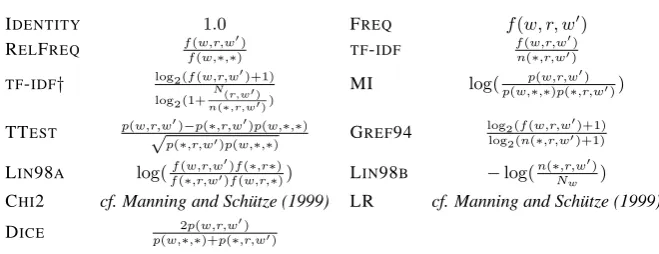
IDENTITY 1.0 FREQ f(w, r, w0
)
RELFREQ ff((w,r,ww,∗,∗0)) TF-IDF fn((w,r,w∗,r,w00))
TF-IDF† log2(f(w,r,w0)+1)
log2(1+
N(r,w0)
n(∗,r,w0))
MI log( p(w,r,w0)
p(w,∗,∗)p(∗,r,w0))
TTEST p(w,r,w√0)−p(∗,r,w0)p(w,∗,∗)
p(∗,r,w0)p(w,∗,∗) GREF94
log2(f(w,r,w0)+1)
log2(n(∗,r,w0)+1)
LIN98A log(ff((∗w,r,w,r,w00))ff(w,r,(∗,r∗∗))) LIN98B −log( n(∗,r,w0)
Nw )
CHI2 cf. Manning and Sch¨utze (1999) LR cf. Manning and Sch¨utze (1999)
[image:3.595.132.462.87.214.2]DICE p(w,2∗p,∗(w,r,w)+p(∗0,r,w) 0)
Table 1: Weight Functions Evaluated
context attribute, a d length index vector will be generated. The context vector of a termwis then created by the weighted sum of each of its at-tributes. The results of the original Random In-dexing algorithm are reproduced using frequency weighting (FREQ).
Weights are generated using the frequency dis-tribution of each term and its contexts. This in-creases the overhead, as we must store the context attributes for each term. Rather than the context vector being generated by adding each individual context, it is generated by adding each the index vector for each unique context multiplied by its weight.
The time to calculate the weight of all attributes of all terms is negligible. The original technique scales toO(dnm)in construction, fornterms and
munique attributes. Our new technique scales to
O(d(a+nm)) for a non-zero context attributes per term, which sinceamis alsoO(dnm).
Following the notation of Curran (2004), a
con-text relation is defined as a tuple(w, r, w0)where
wis a term, which occurs in some grammatical re-lation r with another word w0
in some sentence. We refer to the tuple(r, w0)as an attribute ofw. For example, (dog, direct-obj, walk) indicates that
dogwas the direct object ofwalkin a sentence.
An asterisk indicates the set of all existing val-ues of that component in the tuple.
(w,∗,∗)≡ {(r, w0)|∃(w, r, w0)}
The frequency of a tuple, that is the number of times a word appears in a context is f(w, r, w0
).
f(w,∗,∗)is the instance or token frequency of the contexts in whichwappears.n(w,∗,∗)is the type
frequency. This is the number of attributes ofw.
f(w,∗,∗) ≡ P
(r,w0)∈(w,∗,∗)f(w, r, w0)
p(w,∗,∗) ≡ ff((w,∗,∗∗,,∗∗)) n(w,∗,∗) ≡ |(w,∗,∗)|
Nw ≡ |{w|n(w,∗,∗) >0}|
Most experiments limited weights to the positive range; those evaluated with an unrestricted range are marked with a ± suffix. Some weights were also evaluated with an extra log2(f(w, r, w0) + 1) factor to promote the influence of higher fre-quency attributes, indicated by a LOG suffix. Al-ternative functions are marked with a dagger.
The context vector of each termwis thus:
¯
w= X
(r,w0)∈(w,∗,∗)
~
(r, w0)wgt(w, r, w0
)
where (r, w~ 0) is the index vector of the context
(r, w0
). The weights functions we evaluate are those from Curran (2004) and are given in Table 1.
4 Semantic Similarity
4.1 Distributional Similarity
Measuring distributional similarity first requires the extraction of context information for each of the vocabulary terms from raw text. The contexts for each term are collected together and counted, producing a vector of context attributes and their frequencies in the corpus. These terms are then compared for similarity using a nearest-neighbour search based on distance calculations between the statistical descriptions of their contexts.
The simplest algorithm for finding synonyms is ak-nearest-neighbour search, which involves pair-wise vector comparison of the context vector of the target term with the context vector of every other term in the vocabulary.
We use two types of context extraction to pro-duce both high and low quality context descrip-tions. The high quality contexts were extracted from grammatical relations extracted using the SEXTANT relation extractor (Grefenstette, 1994) and are lemmatised. This is the same data used in Curran (2004).
The low quality contexts were extracted taking a window of one word to the left and right of the target term. The context is marked as to whether it preceded or followed the term. Curran (2004) found this extraction technique to provided rea-sonable results on the non-speech portion of the BNCwhen the data was lemmatised. We do not lemmatise, which produces noisier data.
4.2 Bilingual Lexicon Acquisition
A variation on the extraction of synonymy rela-tions, is the extraction of bilingual lexicons. This is the task of finding for a word in one language words of a similar meaning in a second language. The results of this can be used to aid manual con-struction of resources or directly aid translation.
This task was first approached as a distribu-tional similarity-like problem by Brown et al. (1988). Their approach uses aligned corpora in two or more languages: the source language, from which we are translating, and the target language, to which we are translating. For a each aligned segment, they measure co-occurrence scores be-tween each word in the source segment and each word in the target segment. These co-occurrence scores are used to measure the similarity between source and target language terms
Sahlgren and Karlgren’s approach models the problem as a distributional similarity problem
us-Source Context Target
Language Language
aaabbc I xxyzzz
bcc II wxy
[image:4.595.337.496.62.134.2]aab III xzz
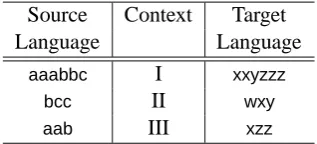
Table 2: Paragraph Aligned Corpora
ing the paragraph as context. In Table 2, the source language is limited to the wordsa,bandcand the target language to the wordsx,yandz. Three para-graphs in each of these languages are presented as pairs of translations labelled as a context: aaabbc
is translated asxxyzzz and labelled context I. The frequency weighted context vector for a is {I:3, III:2}and forxis{I:2, II:1, III:1}.
A translation candidate for a term in the source language is found by measuring the similarity be-tween its context vector and the context vectors of each of the terms in the target language. The most similar target language term is the most likely translation candidate.
Sahlgren and Karlgren (2005) use Random In-dexing to produce the context vectors for the source and target languages. We re-implement their system and apply weighting functions in an attempt to achieve improved results.
5 Experiments
For the experiments extracting synonymy rela-tions, high quality contexts were extracted from the non-speech portion of the British National Corpus (BNC) as described above. This represents 90% of theBNC, or 90 million words.
Comparisons between low frequency terms are less accurate than between high frequency terms as there is less evidence describing them (Cur-ran and Moens, 2002). This is compounded in randomised vector techniques because the ran-domised nature of the representation means that a low frequency term may have a similar context vector to a high frequency term while not sharing many contexts. A frequency cut-off of 100 was found to balance this inaccuracy with the reduc-tion in vocabulary size. This reduces the original 246,046 word vocabulary to 14,862 words. Exper-iments showedd = 1000and= 10to provide a balance between speed and accuracy.
million, 50 million and 100 million words, cho-sen from random documents. This allowed us test the effect of both corpus size and context qual-ity. This produced vocabularies of between 10,380 and 522,163 words in size. Because of the size of the smallest corpora meant that a high cutoff would remove to many terms for a fair test, a cut-off of 5 was applied. The values d = 1000 and
= 6were used.
For our experiments in bilingual lexicon acqui-sition we follow Sahlgren and Karlgren (2005). We use the Spanish-Swedish and the English-German portions of the Europarl corpora (Koehn, 2005).1 These consist of 37,379 aligned para-graphs in Spanish–Swedish and 45,556 in English-German. The text was lemmatised using Con-nexor Machinese (Tapanainen and J¨avinen, 1997)2 producing vocabularies of 42,671 terms of Span-ish, 100,891 terms of SwedSpan-ish, 40,181 terms of English and 70,384 terms of German. We use
d = 600and = 6 and apply a frequency cut-off of 100.
6 Evaluation Measures
The simplest method for evaluation is the direct comparison of extracted synonyms with a man-ually created gold standard (Grefenstette, 1994). To reduce the problem of limited coverage, our evaluation of the extraction of synonyms combines three electronic thesauri: the Macquarie, Roget’s and Moby thesauri.
We follow Curran (2004) and use two perfor-mance measures: direct matches (DIRECT) and inverse rank (INVR). DIRECT is the number of returned synonyms found in the gold standard. INVR is the sum of the inverse rank of each match-ing synonym, e.g. matches at ranks 3, 5 and 28 give an inverse rank score of 13 + 15 + 281 . With at most 100 matching synonyms, the maximum INVR is 5.187. This more fine grained as it incor-porates the both the number of matches and their ranking.
The same 300 single word nouns were used for evaluation as used by Curran (2004) for his large scale evaluation. These were chosen randomly from WordNet such that they covered a range over the following properties: frequency, number of
senses, specificity and concreteness. On average
each evaluation term had 301 gold-standard
syn-1
http://www.statmt.org/europarl/
2http://www.connexor.com/
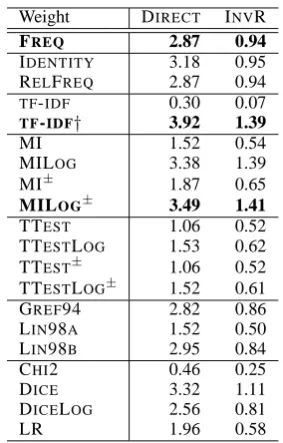
Weight DIRECT INVR FREQ 2.87 0.94
IDENTITY 3.18 0.95
RELFREQ 2.87 0.94
TF-IDF 0.30 0.07
TF-IDF† 3.92 1.39
MI 1.52 0.54
MILOG 3.38 1.39
MI± 1.87 0.65
MILOG± 3.49 1.41
TTEST 1.06 0.52
TTESTLOG 1.53 0.62
TTEST± 1.06 0.52
TTESTLOG± 1.52 0.61
GREF94 2.82 0.86
LIN98A 1.52 0.50
LIN98B 2.95 0.84
CHI2 0.46 0.25
DICE 3.32 1.11
DICELOG 2.56 0.81
[image:5.595.345.487.70.292.2]LR 1.96 0.58
Table 3: Evaluation of synonym extraction
onyms. For each of these terms, the closest 100 terms and their similarity scores were extracted.
For the evaluation of bilingual lexicon acqui-sition we use two online lexical resources used by Sahlgren and Karlgren (2005) as gold stan-dards: Lexin’s online Swedish-Spanish lexicon3 and TU Chemnitz’ online English-German dic-tionary.4 Each of the elements in a compound or multi-word expression is treated as a poten-tial translation. The Germanabblendlicht(low beam light) is treated as a translation candidate for low,
beamandlightseparately.
Low coverage is more of problem than in our thesaurus task as we have not used combined re-sources. There are an average of 19 translations for each of the 3,403 Spanish terms and 197 trans-lations for each of the 4,468 English terms. The English-German translation count is skewed by the presence of connectives in multi-word expres-sions, such asofandon, producing mistranslations. Sahlgren and Karlgren (2005) provide good com-mentary on the evaluation of this task.
Spanish and English are used as the source guages. The 200 closest terms in the target lan-guage are found for all terms in both the source vocabulary and the gold-standards.
We measure the DIRECT score and INVR as above. In addition we measure the precision of the closest translation candidate, as used in Sahlgren and Karlgren (2005).
3
http://lexin.nada.kth.se/sve-spa.shtml
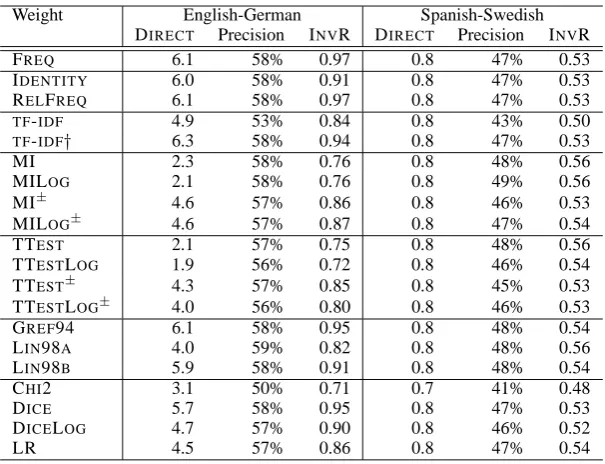
Weight English-German Spanish-Swedish DIRECT Precision INVR DIRECT Precision INVR
FREQ 6.1 58% 0.97 0.8 47% 0.53
IDENTITY 6.0 58% 0.91 0.8 47% 0.53
RELFREQ 6.1 58% 0.97 0.8 47% 0.53
TF-IDF 4.9 53% 0.84 0.8 43% 0.50
TF-IDF† 6.3 58% 0.94 0.8 47% 0.53
MI 2.3 58% 0.76 0.8 48% 0.56
MILOG 2.1 58% 0.76 0.8 49% 0.56
MI± 4.6 57% 0.86 0.8 46% 0.53
MILOG± 4.6 57% 0.87 0.8 47% 0.54
TTEST 2.1 57% 0.75 0.8 48% 0.56
TTESTLOG 1.9 56% 0.72 0.8 46% 0.54
TTEST± 4.3 57% 0.85 0.8 45% 0.53
TTESTLOG± 4.0 56% 0.80 0.8 46% 0.53
GREF94 6.1 58% 0.95 0.8 48% 0.54
LIN98A 4.0 59% 0.82 0.8 48% 0.56
LIN98B 5.9 58% 0.91 0.8 48% 0.54
CHI2 3.1 50% 0.71 0.7 41% 0.48
DICE 5.7 58% 0.95 0.8 47% 0.53
DICELOG 4.7 57% 0.90 0.8 46% 0.52
LR 4.5 57% 0.86 0.8 47% 0.54
Table 4: Evaluation of bilingual lexicon extraction
[image:6.595.148.451.61.293.2]7 Results
Table 3 shows the results for the experiments ex-tracting synonymy. The basic Random Indexing algorithm (FREQ) produces a DIRECT score of 2.87, and an INVR of 0.94. It is interesting that the only other linear weight, IDENTITY, produces more accurate results. This shows high frequency, low information contexts reduce the accuracy of Random Indexing. IDENTITYremoves this effect by ignoring frequency, but does not address the information aspect. A more accurate weight will consider the information provided by a context in its weighting.
There was a large variance in the effective-ness of the other weights and most proved to be detrimental to Random Indexing. TF-IDF was the worst, reducing the DIRECTscore to 0.30 and the INVR to 0.07. TF-IDF†, which is a log-weighted alternative toTF-IDF, produced very good results. With the exception of DICELOG, adding an additional log factor improved performance (TF-IDF†, MILOG and TTESTLOG). Unrestricted ranges improved the MI family, but made no dif-ference to TTEST. Grefenstette’s variation on TF-IDF (GREF94) does not perform as well as TF-IDF†, and Lin’s variations on MI± (LIN98A, LIN98B) do not perform as well as MILOG±.
MILOG±had a higher INVR thanTF-IDF†, but a lower DIRECT score, indicating that it forces more correct results to the top of the results list, but also forces some correct results further down so that they no longer appear in the top 100.
Weight BNC LARGE
DIRECT INVR DIRECT INVR
FREQ 8.9 0.93 7.2 0.85
TF-IDF† 11.8 1.39 12.5 1.50
MILOG± 10.5 1.41 13.8 1.75
Table 5: Evaluation of Random Indexing using a very large corpus
The effect of high frequency contexts is in-creased further as we increase the size of the cor-pus. Table 5 presents results using the 2 billion word corpus used by Curran (2004). This consists of the non-speech portion of theBNC, the Reuter’s Corpus Volume 1 and most of the English news holdings of the LDC in 2003. Contexts were ex-tracted as presented in Section 4. A frequency cut-off of 100 was applied and the values d = 1000
and= 5for FREQand= 10for the improved weights were used.
We see that the very large corpus has reduced the accuracy of frequency weighted Random In-dexing. In contrast, our two top performers have both substantially increased in accuracy, present-ing a 75–100% improvment in performance over FREQ. MILOG± is more accurate than TF-IDF†
for both measures of accuracy now, indicating it is a better weight function for very large data sets.
7.1 Bilingual Lexicon Acquisition
[image:6.595.148.452.62.291.2]0.1 0.2 0.3 0.4 0.5 0.6 0.7 0.8 0.9 1 1.1
0 20 40 60 80 100
I
NV
R
Corpus Size (millions of words) FREQ
[image:7.595.75.295.67.223.2]IDENTITY TF-IDF† MILOG JACCARD
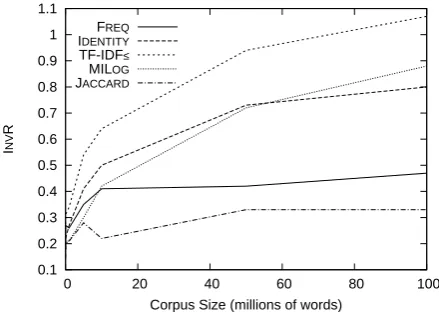
Figure 1: Random Indexing using window-based context
In the English-German corpora we replicate Sahlgren and Karlgren’s (2005) results, with a pre-cision of 58%. This has a DIRECTscore of 6.1 and an INVR of 0.97. The only weight to make an im-provement isTF-IDF†, which has a DIRECTscore of 6.3, but a lower INVR and all weights perform worse in at least one measure.
Our results for the Spanish-Swedish corpora show similar results. Our accuracy is down from that in Sahlgren and Karlgren (2005). This is ex-plained by our application of the frequency cut-off to both the source and target languages. There are more weights with higher accuracies, and fewer with significantly lower accuracies.
7.2 Smaller Corpora
The absence of a substantial improvement in bilin-gual lexicon acquisition requires further investiga-tion. Three main factors differ between our mono-lingual and bimono-lingual experiments: that we are smoothing a homogeneous data set in our mono-lingual experiments and a heterogeneous data set in our bilingual experiments; we are using local grammatical contexts in our monolingual experi-ments and paragraph contexts in our bilingual ex-periments; and, the volume of raw data used in our monolingual experiments is many times that used in our bilingual experiments.
Figure 1 presents results for corpora extracted from the BNC using the window-based context. Results are shown for the original Random Index-ing (FREQ) and usIndex-ing IDENTITY, MILOG± and TF-IDF†, as well as for the full vector measure-ment using JACCARD measure and the TTEST± weight (Curran, 2004). Of the Random Index-ing results FREQ produces the lowest overall
re-sults. It performs better than MILOG± for very small corpora, but produces near constant results for greater corpus sizes. Curran and Moens (2002) found that increasing the volume of input data in-creased the accuracy of results generated using a full vector space model. Without weighting, Ran-dom Indexing fails this, but after weighting is ap-plied Curran and Moens’ results are confirmed.
The quality of context extracted influences how weights perform individually, but Random In-dexing using weights still outperforms not using weights. The relative performance of MILOG± has been reduced when compared with TF-IDF†, but is still greater then FREQ.
Gorman and Curran (2006) showed Random In-dexing to be much faster than full vector space techniques, but with a 46–56% reduction in accu-racy compared to using JACCARD and TTEST±. Using the MI± weight kept the improvement in speed but with only a 10–18% reduction in accu-racy. When JACCARDand TTEST± are used with our low quality contexts they perform consistently worse that Random Indexing. This indicates Ran-dom Indexing is stable in the presence of noisy data. It would be interesting to further compare these results to those produced byLSA.
The results we have presented have shown that applying weights to Random Indexing can im-prove its performance for thesaurus extraction tasks. This improvement is dependent on the vol-ume of raw data used to generate the context in-formation. It is less dependent on the quality of contexts extracted.
What we have not shown is whether this extends to the extraction of bilingual lexicons. The bilin-gual corpora have 12-16 million words per lan-guage, and for this sized corpora we already see substantial improvement with corpora as small as 5 million words (Figure 1). It may be that ex-tracting paragraph-level contexts is not well suited to weighting, or that the heterogeneous nature of the aligned corpora reduces the meaningfulness of weighting. There is also the question as to whether it can be applied to all languages. There is a lack of freely available large-scale multi-lingual resources that makes this difficult to examine.
8 Conclusion
when weights were applied. For smaller data sets we found that Random Indexing was sufficiently robust that weighting had at most a minor effect.
Our weighting schemes removed the possibil-ity of incremental learning of the term space. An interesting direction would be the development of algorithms that allowed the incremental applica-tion of weights, perhaps by re-weighting vectors when a new context is learned.
Other areas left open for investigation are the in-teraction between Random Indexing, weights and the type of context extracted, the use of large-scale bilingual corpora, the acquisition of lexi-cons for non-Indo-European languages and across language family boundaries, and the difference in effect term and paragraph/document contexts for thesaurus extraction.
We have demonstrated that the accuracy of Ran-dom Indexing can be improved by applying weight functions, increasing accuracy by up to 50% on the BNCand 100% on a 2 billion word corpus.
Acknowledgements
We would like to thank Magnus Sahlgren for gen-erously supplying his training and evaluation data and our reviewers for their helpful feedback and corrections. This work has been supported by the Australian Research Council under Discovery Project DP0453131.
References
Dimitris Achlioptas. 2001. Database-friendly random pro-jections. In Symposium on Principles of Database
Sys-tems, pages 274–281, Santa Barbara, CA, USA, 21–23
May.
Peter F. Brown, John Cocke, Stephen A. Della Pietra, Vin-cent J. Della Pietra, Frederick Jelinek, Robert L. Mer-cer, and Paul S. Roossin. 1988. A statistical approach to language translation. In Proceedings of the 12th
Con-ference on Computational linguistics, pages 71–76,
Bu-dapest, Hungry, 22–27 August.
James R. Curran and Marc Moens. 2002. Scaling con-text space. In Proceedings of the 40th Annual Meeting
of the Association for Computational Linguistics, pages
231–238, Philadelphia, PA, USA, 7–12 July.
James R. Curran. 2004. From Distributional to Semantic
Similarity. Ph.D. thesis, University of Edinburgh.
Christiane Fellbaum, editor. 1998. WordNet: an electronic
lexical database. The MIT Press, Cambridge, MA, USA.
James Gorman and James R. Curran. 2006. Scaling distri-butional similarity to large corpora. In Proceedings of the
44th Annual Meeting of the Association for Computational Linguistics, Sydney, Australia, 17–21 July. To appear.
Gregory Grefenstette. 1994. Explorations in Automatic
The-saurus Discovery. Kluwer Academic Publishers, Boston.
Robert Hecht-Nielsen. 1994. Context vectors: general pur-pose approximate meaning representations self-organized from raw data. Computational Intelligence: Imitating Life, pages 43–56.
William B. Johnson and Joram Lindenstrauss. 1984. Exten-sions to Lipshitz mapping into Hilbert space.
Contempo-rary mathematics, 26:189–206.
Pentti Kanerva, Jan Kristoferson, and Anders Holst. 2000. Random indexing of text samples for latent semantic anal-ysis. In Proceedings of the 22nd Annual Conference of the
Cognitive Science Society, page 1036, Philadelphia, PA,
USA, 13–15 August.
Jussi Karlgren and Magnus Sahlgren. 2001. From words to understanding. In Y. Uesaka, P. Kanerva, and H Asoh, ed-itors, Foundations of Real-World Intelligence, pages 294– 308. CSLI Publications, Stanford, CA, USA.
Samuel Kaski. 1998. Dimensionality reduction by random mapping: Fast similarity computation for clustering. In
Proceedings of the International Joint Conference on Neu-ral Networks, pages 413–418. Piscataway, NJ, USA, 31
July–4 August.
Philipp Koehn. 2005. Europarl: A parallel corpus for statis-tical machine translation. In MT Summit X, Phuket, Thai-land, 12–16 September.
Thomas K. Landauer and Susan T. Dumais. 1997. A solution to plato’s problem: The latent semantic analysis theory of acquisition, induction, and representation of knowledge.
Psychological Review, 104(2):211–240, April.
Christopher D. Manning and Hinrich Sch¨utze. 1999.
Foun-dations of Statistical Natural Language Processing. The
MIT Press, Cambridge, MA, USA.
Christos H. Papadimitriou, Hisao Tamaki, Prabhakar Ragha-van, and Santosh Vempala. 1998. Latent semantic index-ing: A probabilistic analysis. In Proceedings of the 17th
ACM Symposium on the Principle of Database Systems,
pages 159–168, Seattle, WA, USA, 2–4 June.
Magnus Sahlgren and Jussi Karlgren. 2005. Automatic bilin-gual lexicon acquisition using random indexing of parallel corpora. Journal of Natural Language Engineering,
Spe-cial Issue on Parallel Texts, 11(3), June.
Magnus Sahlgren. 2005. An introduction to random index-ing. In Methods and Applications of Semantic Indexing
Workshop at the 7th International Conference on Termi-nology and Knowledge Engineering, Copenhagen,
Den-mark, 16 August.
Pasi Tapanainen and Timo J¨avinen. 1997. A non-projective dependency parser. In Proceedings of the 5th Conference
on Applied Natural Language Processing, pages 64–71,