Linking Localisation and Language Resources
David Lewis, Alexander O’Connor, Sebastien Molines, Leroy Finn, Dominic Jones, Stephen Curran, Séamus Lawless
Centre for Next Generation Localisation Knowledge and Data Engineering Group
Trinity College Dublin, Ireland
{Dave.Lewis|Alex.OConnor|moliness|finnle|Dominic.Jones| Stephen.Curran|slawless}@cs.tcd.ie
Abstract. Industrial localisation is changing from the periodic translation of large bodies of content to a long-tail of small, heterogeneous translations processed in an agile and demand-driven manner. Software localisation and crowd-source translation already practice continuous fine-grained distribution of translation work. This requires close integration and round-trip interoperabil-ity between content creation and localisation processes, while at the same time recording the provenance of translated content to maximise it reuse in future translation tasks, and, increasingly, in training Statistical Machine Translation (SMT) engines. This work adopts a Linked Data approach to integrating the content translation roundtrip process with the logging of process quality assur-ance provenassur-ance. This integration supports a pull-based interoperability model that supports continuous synchronising of content and process meta-data be-tween the generating organisation and any number of language service provid-ers or translators. We present a platform architecture for sharing, searching and interlinking of Linked Localisation and Language Data (termed L3Data) on the web. This is accomplished using a semantic schema for L3Data that is compati-ble with existing localisation data exchange standards and can be used to sup-port the round-trip sharing of language resources. The paper describes our ap-proach to development of L3Data schema and data management processes, web-based tools and data sharing infrastructure that use it. An initial proof of concept prototype is presented which implements a web application that seg-ments and machine translates content for crowd-sourced post-editing and rating.
1
Introduction
Technology services such as Statistical Machine Translation (SMT) and text classifi-ers. which are key will be to addressing long-tail localisation efficiently.
This work adopts a Linked Data approach [bizer] to the massively scalable sharing, searching and interlinking of Localisation and Language Linked Data (termed here L3Data) on the web. This is accomplished using a semantic schema for L3Data that is compatible with existing localisation data exchange standards and can be used to support the round-trip sharing of language resources. Multilingual Terminology Data-bases, or Term-Bases, and Translation Memories are shared as they have the greatest impact on conventional localisation productivity and on the training of relevant lan-guage technologies such as SMT. Commercially sustainable sharing of L3Data must work within constraints of copyright, confidentiality and competitive concerns [alle-mang], but by reflecting these in the L3Data schema, fine-grained access control rules allow enterprises to flexibly balance them against the benefits of sharing data.
The paper describes our approach to development of L3Data schema and data management processes, web-based tools and data sharing infrastructure that use it. An initial proof of concept prototype is presented which implements a simple web service for segmenting and machine translating content for crowd-sourced post-editing and rating, built on a triple store that tracks steps in this workflow using an integration of the Open Provenance Model [Moreau] and the XLIFF localization interchange format from OASIS [XLIFF].
2
Motivation
3
Approach
In summary, SMEs now have near-transparent global distribution opportunities, but they are faced with the need to support a bewildering number of locales and languag-es to gain the benefit of such worlwide availability. To addrlanguag-ess this localisation bar-rier for SMEs engaged as provider or consumers in long tail localisation, we propose a solution that combines the carefully targeted and controlled sharing of language resources with open innovation in the use of data-driven language technology servic-es. Specifically this project will develop controlled sharing solutions for multilingual terminology management to support consistency in source language content authoring and its translation and for parallel text management for leverage as TMs and for the training of statistical machine translation (SMT) engines. The premise is that effective use of language resources in long-tail localisation requires low-cost acquisition of domain-specific, quality-assured resources that are best sourced from prior localisa-tion tasks provided these have systematically integrated quality-related provenance annotation into the resources they produce. The sharing solution takes the form of Linked Data on the Web. This builds on the W3C’s Semantic Web Standards RDF, RDFa, RDF(S) and OWL, which allows web content and web data (i.e. deep web content) to be interlinked in a decentralised and distributed manner. The approach is inherently multi-lingual as linked data supports multi-lingual data and meta-data re-presentation enabled through Unicode, element-level language tagging in RDF and International Web Resource identifiers.
3.1 Support for SMT Training
Data-driven language technologies are demonstrating benefits at different stages of the localisation process such as: SMT to support human translation, named entity recognition for terminology management and text classification for translation review. The development of bespoke SMT engines in particular has become increasingly accessible to SMEs thanks to the popularity of the MOSES open source toolkit [koehn]. However, the effectiveness of these technologies is highly sensitive to the relationship of the data upon which they have been trained to the localisation task at hand. Assuring this in long tail localisation requires low cost, but highly agile and responsive acquisition of training data. This can be achieved by continuous and tar-geted sharing of linguistic resources that are the by-products of localisation (i.e. trans-lation memories, term-bases and their QA annotations) across the broadest range of LSPs and their clients. Long-tail localisation inherently requires data linking as the fragmentary nature of the content means that the heterogeneous data must be collated and links kept up-to-date, and places even greater value on agility in sharing to be able to assemble sufficient data to support rapidly changing application domains. Until now there has not been an effective model for rapid language data exchange with suitable provenance needed to address commercial quality and access control concerns.
3.2 Relationship to existing localisation standards
3.3 Use of Linked Data Infrastructure
The L3Data approach combines linked data architectures with fine-grained access control to address the need of data to be distributed but connectable in the rapidly forming value chains. These are the key properties needed to address the heterogene-ous but short-lived jobs typical of long tail localisation. The dereferencable property of RDF-based linked data allows decentralised development of unambiguous schema terms that can be subsequently interlinked, potentially by third parties. The approach enables rapid specialisation of language resources to support innovation in what data and meta-data can be readily shared. The W3C’s standardisation of RDF and RDFS to author schemas and publish data directly on the web and RDFa to link XML content to RDF element has resulted in a growing range of performant and robust linked data stores (‘triple stores’) with web accessible query interfaces (for which a standard query language SPARQL, is typically used). However, localisation support systems typically place emphasis on data handling performance especially for interactive translation tasks such as TM searches. However, an initial comparison on TM look up, using a 3 million word TM typical of the size supported by desktop translation tools, showed only a 20% overhead incurred by an unoptimised off-the-shelf triple store compared to the leading tool (SDL’s Trados ™).
[image:5.595.125.471.393.621.2]4
Implementation
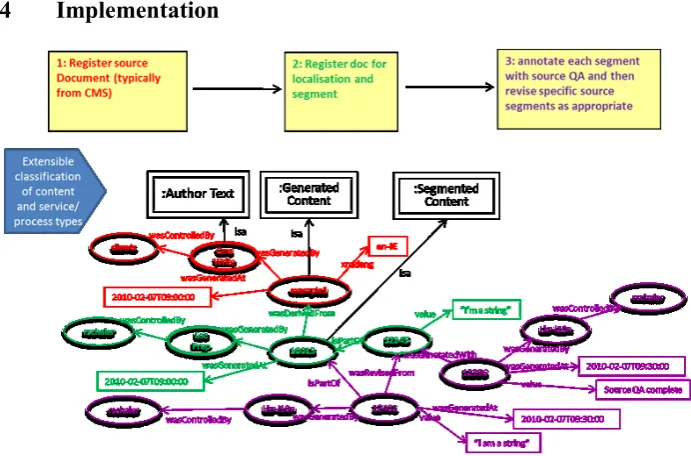
Fig. 1. Example of RDF provenance capture for a three step workflow
ex-tending existing RDF vocabulary, specifically the Open Provenance Model [moreau]. A content processing approach is therefore taken for the L3Data schema, where OPM is used to express the state transformation that operates on content (principally terms and translation units) and its meta-data as the result of content processing by different processes such as authoring/revision, source QA (including terminology usage), TM leverage, SMT usage, human translation, post-editing, target language QA etc. Figure 1 show an example of the RDF provenance data captured for three steps of registering a source document with the system, preparing it for localisation by segmenting and running a controlled language quality check on those segments. This approach can also be used to record value adding operation to shared TM or TB elements, such as adding term translations, definitions or morphologies or identifying terms, or style and domain classification TM entries. OPM serves to capture both the process result-ing in the recorded content transform or annotation and the agent responsible, thereby support the management of acknowledgement and credit for shared language re-sources.
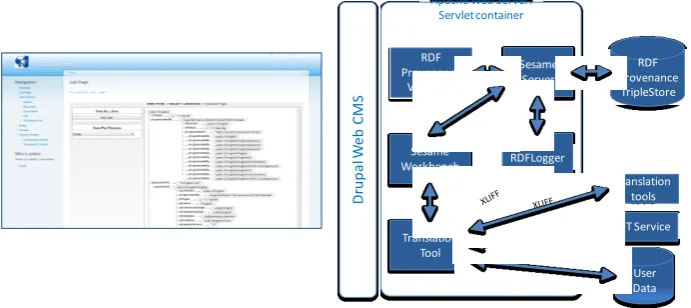
Fig. 2. CMS-Localisation System architecture with provenance visualiser screenshot
Our initial implementation focused on recording transforms produced by external service in a translation workflow that used XLIFF to exchange job data between dif-ferent web services implemented as part of the SOLAS platform developed by the Localisation Research Centre at UL. A generic XLIFF to RDF/OPM transformer was implemented, while user defined extensions in the XLIFF recording the workflow activity routing was used to populate the process property of the activity transform. The different forms of translated content and the processes performed on them were classified from taxonomies for localisation content and service categories [lewis] defined by the Centre for Next Generation Localisation [vanGenabith].
To demonstrate this approach a crowdsourced translation application which has been implemented with a Drupal frontend, via which users can create and contribute to translation jobs in XLIFF. An RDFLogger component is used to change the XLIFF document into RDF provenance statements and then logs these to a triple store. The Sesame Triple Store is used which provides an open source Java framework for
stor-Apache Web Server: Servlet container
Dr
u
p
a
lWe
b
C
M
S
RDF Provenance
TripleStore
User Data RDF
Provenance Visualiser
Sesame Server
RDFLogger
Translation Tool Sesame Workbench
MT Service Translation
ing, querying and reasoning with RDF. A RDF Provenance Visualiser has been im-plemented for exploring outcomes of process steps using the provenance based log-ging of localisation activities. Subsequently a second application offering a simple web based crowd-sourced translation and rating application was developed and is currently being evaluated. Figure 2 outlines the implementation architecture.
5
Future Directions
Our initial evaluation and proof of concept implementation show that a provenance based linked data approach to localisation interoperability is possible, can interoperate with existing standards, namely XLIFF, can provide the basis for web-based transla-tion applicatransla-tions and operates with acceptable performance for small jobs at least.
Our next steps will be working to establish a platform that will allow L3Data to be shared between the conventional actors in the localisation chain, namely the content developing localisation client, LSPs and translators, but to allow this sharing to occur between value networks of peers (rather than just chains of clients and providers [al-lee]), for instance groups of translators cooperating in addressing a large customer domain. We envisage such shared will be mediated by Language Data Resource (LDR) Curators. The TAUS Data Association is a good existing example of such a curator for TMs, but we could see similar roles for TB and for the interlinking and assembly of LDR for SMT training as depicted in the figure below.
The L3Data platform would need to support common features such as the posting of LDR to a value network (including posting corrections, alternates, new language translation or annotation such as ‘see also’ to existing term or translation segment resources), interlink management, access control (possibly using content annotation using RDF encodings of Creative Commons), annotating LDR with QA outcome from translation work (e.g. a poor QA rating on reuse of a previously submitted TM segment in a particular context) and auditing of LDR usage in a job conducted within an actor, (in order to help gauge the benefits yielded by participating in a LDR shar-ing value network)
Acknowledgement This research is supported by the Science Foundation Ireland (Grant 07/CE/I1142) as part of the Centre for Next Generation Localisation (www.cngl.ie) at Trinity College Dublin.
References
[allee] Allee, V., “The Future of Knowledge: Increasing Prosperity through Value Networks”, Butterworth-Heinemann 2002
[allemang] Dean Allemang, “Semantic Web and the Linked Data Enterprise”, in Li n-keding Enterprise Data, (ed) David Woods, Psringer 2010
[buitelaar] Paul Buitelaar, Philipp Cimiano, Peter Haase, Michael Sintek, “Towards Linguistically Grounded Ontologies”Proc of ESWC 2009, LNCS 5554, pp 111-125, 2009
[cruz-lara] Cruz-Lara, S.; Satyendra Gupta; Garcia, J.D.F.; Romary, L.; Multilin-gual information framework for handling textual data in digital media, in proc Active Media Technology, 2005. (AMT 2005), 2005
[koehn] Philipp Koehn, Hieu Hoang, Alexandra Birch, Chris Callison-Burch, Marcel-lo Federico, Nicola Bertoldi, Brooke Cowan, Wade Shen, Christine Moran, Richard Zens, Chris Dyer, Ondrej Bojar, Alexandra Constantin, Evan Herbst, Moses: Open Source Toolkit for Statistical Machine Translation, Annual Meeting of the Association for Computational Linguistics (ACL), demonstra-tion session, Prague, Czech Republic, June 2007.
[lewis] David Lewis, Stephen Curran, Dominic Jones, John Moran, Kevin Feeney (2010). An Open Service Framework for Next Generation Localisation. Web Services and Processing Pipelines in HLT: Tool Evaluation, LR Production and Validation, Malta, 17-18 May 2010, 2009
[marcus] Ann Marcus, “A Demand-Based View of Support From the Funnel to the Cloud”, Service Innovation ConsortiumAugust 2006, access at http://www.serviceinnovation.org/included/docs/kcs_fttcpaper.pdf 18/8/11, [moreau] Luc Moreau, Juliana Freire, Joe Futrelle, Robert E. McGrath, Jim Myers,
and Patrick Paulson, “The Open Provenance Model: An Overview”, IPAW 2008, LNCS 5272, pp. 323–326, 2008
[TBX] Systems to manage terminology, knowledge, and content – TermBase eX-change (TBX), Localization Industry Standards Association, 29 Oct 2008, access from http://www.lisa.org/TBX-Specification.33.0.html on 25 Feb 2010 [TMX] TMX 1.4b Specification OSCAR Recommendation, Localisation Industry
Standards Association, 26 April 2005, accessed from http://www.lisa.org/fileadmin/standards/tmx1.4/tmx.htm on 25 Feb 2010 [vanGenabith] van Genabith, J. (2009) “Next Generation Localisation”, Localisation
Focus: The International Journal of Localisation, Vol. 8 Issue 1, pp 4-10 [XLIFF] XLIFF “A white paper on version 1.2 of the XML Localisation Interchange
File Format (XLIFF)”, Revision: 1.0, 17 Oct 2007 accessed from http://xml.coverpages.org/XLIFF-Core-WhitePaper200710-CSv12.pdf on 25 Feb 2010