Cached Long Short-Term Memory Neural Networks
for Document-Level Sentiment Classification
Jiacheng Xu† Danlu Chen‡ Xipeng Qiu∗‡ Xuanjing Huang‡ Software School, Fudan University†
School of Computer Science, Fudan University‡
Shanghai Key Laboratory of Intelligent Information Processing, Fudan University†‡ 825 Zhangheng Road, Shanghai, China†‡
{jcxu13,dlchen13,xpqiu,xjhuang}@fudan.edu.cn
Abstract
Recently, neural networks have achieved great success on sentiment classification due to their ability to alleviate feature engineering. How-ever, one of the remaining challenges is to model long texts in document-level sentiment classification under a recurrent architecture because of the deficiency of the memory unit. To address this problem, we present a Cached Long Short-Term Memory neural networks (CLSTM) to capture the overall semantic in-formation in long texts. CLSTM introduces a cache mechanism, which divides memory into several groups with different forgetting rates and thus enables the network to keep sentiment information better within a recur-rent unit. The proposed CLSTM outperforms the state-of-the-art models on three publicly available document-level sentiment analysis datasets.
1 Introduction
Sentiment classification is one of the most widely used natural language processing techniques in many areas, such as E-commerce websites, online social networks, political orientation analyses (Wil-son et al., 2009; O’Connor et al., 2010), etc.
Recently, deep learning approaches (Socher et al., 2013; Kim, 2014; Chen et al., 2015; Liu et al., 2016) have gained encouraging results on sentiment clas-sification, which frees researchers from handcrafted feature engineering. Among these methods, Recur-rent Neural Networks (RNNs) are one of the most
∗ Corresponding author.
prevalent architectures because of the ability to han-dle variable-length texts.
Sentence- or paragraph-level sentiment analysis expects the model to extract features from limited source of information, while document-level senti-ment analysis demands more on selecting and stor-ing global sentiment message from long texts with noises and redundant local pattern. Simple RNNs are not powerful enough to handle the overflow and to pick up key sentiment messages from relatively far time-steps .
Efforts have been made to solve such a scalabil-ity problem on long texts by extracting semantic in-formation hierarchically (Tang et al., 2015a; Tai et al., 2015), which first obtain sentence representa-tions and then combine them to generate high-level document embeddings. However, some of these so-lutions either rely on explicita prioristructural as-sumptions or discard the order information within a sentence, which are vulnerable to sudden change or twists in texts especially a long-range one (Mc-Donald et al., 2007; Mikolov et al., 2013). Re-current models match people’s intuition of reading word by word and are capable to model the intrinsic relations between sentences. By keeping the word order, RNNs could extract the sentence representa-tion implicitly and meanwhile analyze the semantic meaning of a whole document without any explicit boundary.
Partially inspired by neural structure of human brain and computer system architecture, we present the Cached Long Short-Term Memory neural net-works (CLSTM) to capture the long-range senti-ment information. In the dual store memory model
proposed by Atkinson and Shiffrin (1968), memo-ries can reside in the short-term “buffer” for a lim-ited time while they are simultaneously strengthen-ing their associations in long-term memory. Accord-ingly, CLSTM equips a standard LSTM with a sim-ilar cache mechanism, whose internal memory is di-vided into several groups with different forgetting rates. A group with high forgetting rate plays a role as a cache in our model, bridging and transiting the information to groups with relatively lower forget-ting rates. With different forgetforget-ting rates, CLSTM learns to capture, remember and forget semantics in-formation through a very long distance.
Our main contributions are as follows:
• We introduce a cache mechanism to diversify the internal memory into several distinct groups with different memory cycles by squashing their forgetting rates. As a result, our model can capture the local and global emotional informa-tion, thereby better summarizing and analyzing sentiment on long texts in an RNN fashion.
• Benefiting from long-term memory unit with a low forgetting rate, we could keep the gradi-ent stable in the long back-propagation process. Hence, our model could converge faster than a standard LSTM.
• Our model outperforms state-of-the-art meth-ods by a large margin on three document-level datasets (Yelp 2013, Yelp 2014 and IMDB). It worth noticing that some of the previous meth-ods have utilized extra user and product infor-mation.
2 Related Work
In this section, we briefly introduce related work in two areas: First, we discuss the existing document-level sentiment classification approaches; Second, we discuss some variants of LSTM which address the problem on storing the long-term information.
2.1 Document-level Sentiment Classification
Document-level sentiment classification is a sticky task in sentiment analysis (Pang and Lee, 2008), which is to infer the sentiment polarity or intensity of a whole document. The most challenging part is that not every part of the document is equally in-formative for inferring the sentiment of the whole
document (Pang and Lee, 2004; Yessenalina et al., 2010). Various methods have been investigated and explored over years (Wilson et al., 2005; Pang and Lee, 2008; Pak and Paroubek, 2010; Yessenalina et al., 2010; Moraes et al., 2013). Most of these methods depend on traditional machine learning al-gorithms, and are in need of effective handcrafted features.
Recently, neural network based methods are prevalent due to their ability of learning discrimina-tive features from data (Socher et al., 2013; Le and Mikolov, 2014; Tang et al., 2015a). Zhu et al. (2015) and Tai et al. (2015) integrate a tree-structured model into LSTM for better semantic composi-tion; Bhatia et al. (2015) enhances document-level sentiment analysis by using extra discourse par-ing results. Most of these models work well on sentence-level or paragraph-level sentiment classifi-cation. When it comes to the document-level sen-timent classification, a bottom-up hierarchical strat-egy is often adopted to alleviate the model complex-ity (Denil et al., 2014; Tang et al., 2015b; Li et al., 2015).
2.2 Memory Augmented Recurrent Models
Although it is widely accepted that LSTM has more long-lasting memory units than RNNs, it still suffers from “forgetting” information which is too far away from the current point (Le et al., 2015; Karpathy et al., 2015). Such a scalability problem of LSTMs is crucial to extend some previous sentence-level work to document-level sentiment analysis.
Various models have been proposed to increase the ability of LSTMs to store long-range informa-tion (Le et al., 2015; Salehinejad, 2016) and two kinds of approaches gain attraction. One is to aug-ment LSTM with an external memory (Sukhbaatar et al., 2015; Monz, 2016), but they are of poor per-formance on time because of the huge external mem-ory matrix. Unlike these methods, we fully exploit the potential of internal memory of LSTM by adjust-ing its forgettadjust-ing rates.
the other updates every 4 time-step). In these meth-ods, different memory groups are not fully inter-connected, and the information is transmitted from faster groups to slower ones, or vice versa.
However, the memory of slower groups are not updated at every step, which may lead to senti-ment information loss and semantic inconsistency. In our proposed CLSTM, we assign different forget-ting rates to memory groups. This novel strategy enable each memory group to be updated at every time-step, and every bit of the long-term and short-term memories in previous time-step to be taken into account when updating.
3 Long Short-Term Memory Networks
Long short-term memory network (LSTM) (Hochre-iter and Schmidhuber, 1997) is a typical recurrent neural network, which alleviates the problem of gra-dient diffusion and explosion. LSTM can capture the long dependencies in a sequence by introducing a memory unit and a gate mechanism which aims to decide how to utilize and update the information kept in memory cell.
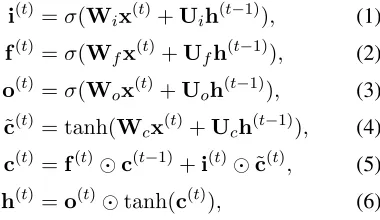
Formally, the update of each LSTM component can be formalized as:
i(t)=σ(Wix(t)+Uih(t−1)), (1)
f(t)=σ(Wfx(t)+Ufh(t−1)), (2)
o(t)=σ(Wox(t)+Uoh(t−1)), (3)
˜
c(t)= tanh(Wcx(t)+Uch(t−1)), (4)
c(t)=f(t)c(t−1)+i(t)˜c(t), (5)
h(t)=o(t)tanh(c(t)), (6)
where σ is the logistic sigmoid function. Opera-tor is the element-wise multiplication operation.
i(t),f(t),o(t)andc(t)are the input gate, forget gate,
output gate, and memory cell activation vector at time-steptrespectively, all of which have the same size as the hidden vector h(t) ∈ RH. W
i, Wf,
Wo ∈ RH×dandUi, Uf, Uo ∈ RH×H are
train-able parameters. Here,Handdare the dimension-ality of hidden layer and input respectively.
+
C
σ
+ C
~
output forget
input
IN
OUT
C
σ
+ C
~
output CIFG
IN
OUT
Figure 1: (a) A standard LSTM unit and (b) a CIFG-LSTM unit. There are three gates in (a), the input gate, forget gate and output gates, while in (b), there are only two gates, the CIFG gate and output gate.
4 Cached Long Short-Term Memory Neural Network
LSTM is supposed to capture the long-term and short-term dependencies simultaneously, but when dealing with considerably long texts, LSTM also fails on capturing and understanding significant sen-timent message (Le et al., 2015). Specifically, the error signal would nevertheless suffer from gradient vanishing in modeling long texts with hundreds of words and thus the network is difficult to train.
Since the standard LSTM inevitably loses valu-able features, we propose a cached long short-term memory neural networks (CLSTM) to capture in-formation in a longer steps by introducing a cache mechanism. Moreover, in order to better control and balance the historical message and the incoming in-formation, we adopt one particular variant of LSTM proposed by Greff et al. (2015), the Coupled Input and Forget Gate LSTM (CIFG-LSTM).
Coupled Input and Forget Gate LSTM Previous studies show that the merged version gives perfor-mance comparable to a standard LSTM on language modeling and classification tasks because using the input gate and forget gate simultaneously incurs re-dundant information (Chung et al., 2014; Greff et al., 2015).
In the CIFG-LSTM, the input gate and forget gate are coupled as one uniform gate, that is, let i(t) = 1−f(t). We use f(t) to denote the coupled gate.
Formally, we will replace Eq. 5 as below:
[image:3.612.335.515.61.137.2]c(t)=f(t)c(t−1)+ (1−f(t))˜c(t) (7)
[image:3.612.108.298.460.570.2]Cached LSTM Cached long short-term mem-ory neural networks (CLSTM) aims at capturing the long-range information by a cache mechanism, which divides memory into several groups, and dif-ferent forgetting rates, regarded as filters, are as-signed to different groups.
Different groups capture different-scale depen-dencies by squashing the scales of forgetting rates. The groups with high forgetting rates are short-term memories, while the groups with low forgetting rates are long-term memories.
Specially, we divide the memory cells into K groups{G1,· · ·, GK}. Each group includes a
in-ternal memory ck, output gate ok and forgetting
raterk. The forgetting rate of different groups are
squashed in distinct ranges.
We modify the update of a LSTM as follows.
r(t)k =ψk
σ(Wkrx(t)+ K
X
j=1
Ujf→kh(tj−1))
,
(8)
o(t)k =σ(Wkox(t)+ K
X
j=1
Ujo→kh(tj−1)), (9)
˜
c(t)k = tanh(Wkcx(t)+ K
X
j=1
Ujc→kh(tj−1)), (10)
ck(t)= (1−r(t)k )ck(t−1)+ (r(t)k )˜c(t)k , (11)
h(t) k =o
(t)
k tanh(c (t)
k ), (12)
where r(t)k represents forgetting rate of the k-th memory group at step t; ψk is a squash function,
which constrains the value of forgetting rate rk
within a range. To better distinguish the different role of each group, its forgetting rate is squashed into a distinct area. The squash functionψk(z)could be
formalized as:
rk=ψk(z) = 1
K ·z+
k−1
K , (13)
where z ∈ (0,1) is computed by logistic sigmoid function. Therefore,rkcan constrain the forgetting
rate in the range of(kK−1,Kk).
Intuitively, if a forgetting raterkapproaches to0,
the groupktends to be the long-term memory; if a
+ SOFTMAX
x1 x2 x3 x4
high medium low input Input
Forward Backward
[image:4.612.334.518.60.194.2]Output
Figure 2: An overview of the proposed architecture. Different styles of arrows indicate different forget-ting rates. Groups with stars are fed to a fully con-nected layers for softmax classification. Here is an instance of B-CLSTM with text length equal to 4
and the number of memory groups is3.
rkapproaches to1, the groupktends to be the
short-term memory. Therefore, groupG1 is the slowest,
while groupGKis the fastest one. The faster groups
are supposed to play a role as a cache, transiting in-formation from faster groups to slower groups.
Bidirectional CLSTM Graves and Schmidhuber (2005) proposed a Bidirectional LSTM (B-LSTM) model, which utilizes additional backward informa-tion and thus enhances the memory capability.
We also employ the bi-directional mechanism on CLSTM and words in a text will receive informa-tion from both sides of the context. Formally, the outputs of forward LSTM for the k-th group is
[−→h(1)k ,−→h(2)k , . . . ,−→h(Tk )]. The outputs of backward
LSTM for thek-th group is[←h−(1)k ,←h−(2)k , . . . ,←h−(Tk )]. Hence, we encode each word wt in a given text
w1:T ash(t)k :
h(t)k =−→hk(t)⊕←h−(t)k , (14)
where the⊕indicates concatenation operation.
Task-specific Output Layer for Document-level Sentiment Classification With the capability of modeling long text, we can use our proposed model to analyze sentiment in a document. Figure 2 gives an overview of the architecture.
Dataset Type Train Size Dev. Size Test Size Class Words/Doc Sents/Doc
IMDB Document 67426 8381 9112 10 394.6 16.08
Yelp 2013 Document 62522 7773 8671 5 189.3 10.89
[image:5.612.107.513.58.106.2]Yelp 2014 Document 183019 22745 25399 5 196.9 11.41
Table 1: Statistics of the three datasets used in this paper. The rating scale (Class) of Yelp2013 and Yelp2014 range from 1 to 5 and that of IMDB ranges from 1 to 10. Words/Doc is the average length of a sample and Sents/Doc is the average number of sentences in a document.
final state of this group to represent a document. As for the B-CLSTM, we concatenate the state of the first group in the forward LSTM at T-th time-step and the first group in the backward LSTM at first time-step.
Then, a fully connected layer followed by a soft-max function is used to predict the probability distri-bution over classes for a given input. Formally, the probability distributionpis:
p= softmax(Wp×z+bp), (15)
whereWp andbp are model’s parameters. Herez
is −→h(T1 ) in CLSTM, and z is[→−h(T1 )⊕←−h(1)1 ]in
B-CLSTM.
5 Training
The objective of our model is to minimize the cross-entropy error of the predicted and true distributions. Besides, the objective includes anL2 regularization
term over all parameters. Formally, suppose we have mtrain sentence and label pairs(w(i)1:T
i, y
(i))m i=1, the
object is to minimize the objective functionJ(θ):
J(θ) =−1
m
m
X
i=1
logp(i)
y(i) + λ
2||θ||
2, (16)
where θ denote all the trainable parameters of our model.
6 Experiment
In this section, we study the empirical result of our model on three datasets for document-level senti-ment classification. Results show that the proposed model outperforms competitor models from several aspects when modelling long texts.
6.1 Datasets
Most existing datasets for sentiment classification such as Stanford Sentiment Treebank (Socher et al.,
2013) are composed of short paragraphs with sev-eral sentences, which cannot evaluate the effective-ness of the model under the circumstance of encod-ing long texts. We evaluate our model on three pop-ular real-world datasets, Yelp 2013, Yelp 2014 and IMDB. Table 1 shows the statistical information of the three datasets. All these datasets can be publicly accessed1. We pre-process and split the datasets in the same way as Tang et al. (2015b) did.
• Yelp 2013andYelp 2014 are review datasets derived from Yelp Dataset Challenge2 of year 2013 and 2014 respectively. The sentiment po-larity of each review is 1 star to 5 stars, which reveals the consumers’ attitude and opinion to-wards the restaurants.
• IMDBis a popular movie review dataset con-sists of 84919 movie reviews ranging from 1 to 10 (Diao et al., 2014). Average length of each review is 394.6 words, which is much larger than the length of two Yelp review datasets.
6.2 Evaluation Metrics
We use Accuracy (Acc.) and MSE as evaluation metrics for sentiment classification. Accuracy is a standard metric to measure the overall classification result and Mean Squared Error (MSE) is used to fig-ure out the divergences between predicted sentiment labels and the ground truth ones.
6.3 Baseline Models
We compare our model, CLSTM and B-CLSTM with the following baseline methods.
• CBOW sums the word vectors and applies a non-linearity followed by a softmax classifica-tion layer.
1http://ir.hit.edu.cn/˜dytang/paper/
acl2015/dataset.7z
Model Acc. (%)IMDBMSE Acc. (%)Yelp 2014MSE Acc. (%)Yelp 2013MSE
CBOW 34.8 2.867 56.8 0.620 54.5 0.706
PV (Tang et al., 2015b) 34.1 3.291 56.4 0.643 55.4 0.692
RNTN+Recurrent (Tang et al., 2015b) 40.0 3.112 58.2 0.674 57.4 0.646 UPNN (CNN) (Tang et al., 2015b) 40.5 2.654 58.5 0.653 57.7 0.659
JMARS* (Diao et al., 2014) - 3.143 - 0.998 - 0.970
UPNN (CNN)* (Tang et al., 2015b) 43.5 2.566 60.8 0.584 59.6 0.615
RNN 20.5 6.163 41.0 1.203 42.8 1.144
LSTM 37.8 2.597 56.3 0.592 53.9 0.656
CIFG-LSTM 39.1 2.467 55.2 0.598 57.3 0.558
CLSTM 42.1 2.399 59.2 0.539 59.4 0.587
BLSTM 43.3 2.231 59.2 0.538 58.4 0.583
CIFG-BLSTM 44.5 2.283 60.1 0.527 59.2 0.554
[image:6.612.98.519.56.239.2]B-CLSTM 46.2 2.112 61.9 0.496 59.8 0.549
Table 2: Sentiment classification results of our model against competitor models on IMDB, Yelp 2014 and Yelp 2013. Evaluation metrics are classification accuracy (Acc.) and MSE. Models with * use user and product information as additional features. Best results in each group are in bold.
Dataset IMDB Yelp13 Yelp14
Hidden layer units 120 120 120
Number of groups 3 4 4
Weight Decay 1e−4 1e−4 5e−4
Batch size 128 64 64
Table 3: Optimal hyper-parameter configuration for three datasets.
• JMARS is one of the state-of-the-art recom-mendation algorithm (Diao et al., 2014), which leverages user and aspects of a review with col-laborative filtering and topic modeling.
• CNNUPNN (CNN) (Tang et al., 2015b) can be regarded as a CNN (Kim, 2014). Multiple fil-ters are sensitive to capture different semantic features during generating a representation in a bottom-up fashion.
• RNNis a basic sequential model to model texts
(Elman, 1991).
• LSTMis a recurrent neural network with mem-ory cells and gating mechanism (Hochreiter and Schmidhuber, 1997).
• BLSTMis the bidirectional version of LSTM, and can capture more structural information and longer distance during looking forward and back (Graves et al., 2013).
• CIFG-LSTM & CIFG-BLSTMare Coupled
Input Forget Gate LSTM and BLSTM,
de-noted as CIFG-LSTM and CIFG-BLSTM re-spectively (Greff et al., 2015). They combine the input and forget gate of LSTM and require smaller number of parameters in comparison with the standard LSTM.
6.4 Hyper-parameters and Initialization
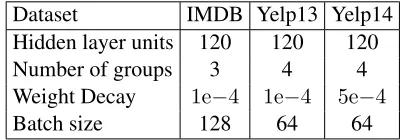
For parameter configuration, we choose parameters on validation set mainly according to classification accuracy for convenience because MSE always has strong correlation with accuracy. The dimension of pre-trained word vectors is 50. We use 120 as the dimension of hidden units, and choose weight de-cay among{5e−4,1e−4,1e−5}. We use Adagrad
(Duchi et al., 2011) as optimizer and its initial learn-ing rate is 0.01. Batch size is chosen among{ 32,
64, 128}for efficiency. For CLSTM, the number of
memory groups is chosen upon each dataset, which will be discussed later. We remain the total number of the hidden units unchanged. Given 120 neurons in all for instance, there are four memory groups and each of them has 30 neurons. This makes model comparable to (B)LSTM. Table 3 shows the optimal hyper-parameter configurations for each dataset.
[image:6.612.84.289.302.372.2]0 2 4 6 8 10 30
40 50 60
Epoches
Acc
(%)
LSTM CIFG-LSTM
BLSTM CIFG-BLSTM
B-CLSTM
(a) Accuracy on Yelp 2013
0 2 4 6 8 10
1.5 2.0
Epoches
MSE
LSTM CIFG-LSTM
BLSTM CIFG-BLSTM
B-CLSTM
[image:7.612.102.518.63.239.2](b) MSE on Yelp 2013
Figure 3: Convergence speed experiment on Yelp 2013. X-axis is the iteration epoches and Y-axis is the classifcication accuracy(%) achieved.
the validation set are chosen for final evaluation on test set.
6.5 Results
The classification accuracy and mean square error (MSE) of our models compared with other competi-tive models are shown in Table 2. When comparing our models to other neural network models, we have several meaningful findings.
1. Among all unidirectional sequential models, RNN fails to capture and store semantic fea-tures while vanilla LSTM preserves sentimen-tal messages much longer than RNN. It shows that internal memory plays a key role in text modeling. CIFG-LSTM gives performance comparable to vanilla LSTM.
2. With the help of bidirectional architecture, models could look backward and forward to capture features in long-range from global per-spective. In sentiment analysis, if users show their opinion at the beginning of their review, single directional models will possibly forget these hints.
3. The proposed CLSTM beats the CIFG-LSTM and vanilla LSTM and even surpasses the bidi-rectional models. In Yelp 2013, CLSTM achieves 59.4% in accuracy, which is only 0.4 percent worse than B-CLSTM, which reveals that the cache mechanism has successfully and effectively stored valuable information without
the support from bidirectional structure. 4. Compared with existing best methods, our
model has achieved new state-of-the-art re-sults by a large margin on all document-level datasets in terms of classification accu-racy. Moreover, B-CLSTM even has surpassed JMARS and CNN (UPNN) methods which uti-lized extra user and product information. 5. In terms of time complexity and numbers of
pa-rameters, our model keeps almost the same as its counterpart models while models of hierar-chically composition may require more compu-tational resources and time.
6.6 Rate of Convergence
1 2 3 4 5 6 59.5
60 60.5 61
Group Number
Acc
(%)
(a) Acc on Yelp 2013
1 2 3 4 5 6
60 61 62
Group Number
(b) Acc on Yelp 2014
1 2 3 4 5 6
44 45 46
Group Number
[image:8.612.106.514.63.196.2](c) Acc on IMDB
Figure 4: Classification accuracy on different number of memory group on three datasets. X-axis is the number of memory group(s).
10 20 30 40 50 60 70 80 90 100
30 35 40 45 50
Length Ranking (%)
Acc
(%)
CBOW CIFG-LSTM CLSTM
CIFG-BLSTM B-CLSTM
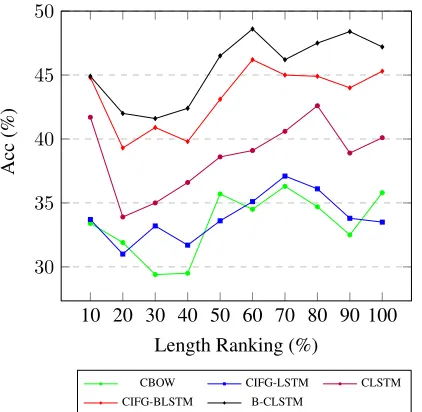
Figure 5: Study of model sensitivity on document length on IMDB. All test samples are sorted by their length and divided into 10 parts. Left most dot means classification accuracy on the shortest 10% samples. X-axis is length ranking from 0% to 100%.
6.7 Effectiveness on Grouping Memory
For the proposed model, the number of memory groups is a highlight. In Figure 4, we plot the best prediction accuracy (Y-axis) achieved in validation set with different number of memory groups on all datasets. From the diagram, we can find that our model outperforms the baseline method. In Yelp 2013, when we split the memory into 4 groups, it achieves the best result among all tested memory group numbers. We can observe the dropping trends when we choose more than 5 groups.
For fair comparisons, we set the total amount of neurons in our model to be same with vanilla LSTM. Therefore, the more groups we split, the less the neu-rons belongs to each group, which leads to a worse capacity than those who have sufficient neurons for each group.
6.8 Sensitivity on Document Length
We also investigate the performance of our model on IMDB when it encodes documents of different lengths. Test samples are divided into 10 groups with regard to the length. From Figure 5, we can draw several thoughtful conclusions.
1. Bidirectional models have much better perfor-mance than the counterpart models.
2. The overall performance of B-CLSTM is bet-ter than CIFG-BLSTM. This means that our model is adaptive to both short texts and long documents. Besides, our model shows power in dealing with very long texts in comparison with CIFG-BLSTM.
3. CBOW is slightly better than CIFG-LSTM due to LSTM forgets a large amount of information during the unidirectional propagation.
7 Conclusion
[image:8.612.84.295.249.455.2]document-level review datasets show that our model outperforms state-of-the-art models by a large mar-gin.
For future work, we are going to design a strategy to dynamically adjust the forgetting rates for fine-grained document-level sentiment analysis.
Acknowledgments
We appreciate the constructive work from Xinchi Chen. Besides, we would like to thank the anony-mous reviewers for their valuable comments. This work was partially funded by National Natural Sci-ence Foundation of China (No. 61532011 and 61672162), the National High Technology Re-search and Development Program of China (No. 2015AA015408).
References
Richard C Atkinson and Richard M Shiffrin. 1968. Hu-man memory: A proposed system and its control pro-cesses. The psychology of learning and motivation, 2:89–195.
Parminder Bhatia, Yangfeng Ji, and Jacob Eisenstein. 2015. Better document-level sentiment analysis from rst discourse parsing. InProceedings of the Confer-ence on Empirical Methods in Natural Language Pro-cessing,(EMNLP).
Xinchi Chen, Xipeng Qiu, Chenxi Zhu, Shiyu Wu, and Xuanjing Huang. 2015. Sentence modeling with gated recursive neural network. In Proceedings of the Conference on Empirical Methods in Natural Lan-guage Processing.
Junyoung Chung, Caglar Gulcehre, KyungHyun Cho, and Yoshua Bengio. 2014. Empirical evaluation of gated recurrent neural networks on sequence model-ing. NIPS Deep Learning Workshop.
Misha Denil, Alban Demiraj, Nal Kalchbrenner, Phil Blunsom, and Nando de Freitas. 2014. Modelling, visualising and summarising documents with a sin-gle convolutional neural network. arXiv preprint arXiv:1406.3830.
Qiming Diao, Minghui Qiu, Chao-Yuan Wu, Alexan-der J. Smola, Jing Jiang, and Chong Wang. 2014. Jointly modeling aspects, ratings and sentiments for movie recommendation (JMARS). In The 20th ACM SIGKDD International Conference on Knowl-edge Discovery and Data Mining, KDD ’14, New York, NY, USA - August 24 - 27, 2014, pages 193–202. John C Duchi, Elad Hazan, and Yoram Singer. 2011.
Adaptive Subgradient Methods for Online Learning
and Stochastic Optimization. Journal of Machine Learning Research, 12:2121–2159.
Salah El Hihi and Yoshua Bengio. 1995. Hierarchical recurrent neural networks for long-term dependencies. InNIPS, pages 493–499.
Jeffrey L Elman. 1991. Distributed representations, simple recurrent networks, and grammatical structure. Machine Learning, 7(2-3):195–225.
Alex Graves and J¨urgen Schmidhuber. 2005. Frame-wise phoneme classification with bidirectional lstm and other neural network architectures. Neural Net-works, 18(5):602–610.
Alan Graves, Navdeep Jaitly, and Abdel-rahman Mo-hamed. 2013. Hybrid speech recognition with deep bidirectional lstm. InAutomatic Speech Recognition and Understanding (ASRU), 2013 IEEE Workshop on, pages 273–278. IEEE.
Klaus Greff, Rupesh Kumar Srivastava, Jan Koutn´ık, Bas R Steunebrink, and J¨urgen Schmidhuber. 2015. LSTM: A Search Space Odyssey. arXiv.org, March. Sepp Hochreiter and J¨urgen Schmidhuber. 1997. Long
short-term memory. Neural computation, 9(8):1735– 1780.
Andrej Karpathy, Justin Johnson, and Fei-Fei Li. 2015. Visualizing and understanding recurrent networks. In-ternational Conference on Learning Representations (ICLR), Workshop Track.
Yoon Kim. 2014. Convolutional neural networks for sen-tence classification. Proceedings of the 2014 Confer-ence on Empirical Methods in Natural Language Pro-cessing (EMNLP), pages 1746-1751.
Jan Koutnik, Klaus Greff, Faustino Gomez, and Juergen Schmidhuber. 2014. A clockwork rnn. pages 1863– 1871.
Quoc V Le and Tomas Mikolov. 2014. Distributed rep-resentations of sentences and documents. In ICML, volume 14, pages 1188–1196.
Quoc V Le, Navdeep Jaitly, and Geoffrey E Hin-ton. 2015. A simple way to initialize recurrent networks of rectified linear units. arXiv preprint arXiv:1504.00941.
Jiwei Li, Thang Luong, Dan Jurafsky, and Eduard H. Hovy. 2015. When are tree structures necessary for deep learning of representations? In Llus Mrquez, Chris Callison-Burch, Jian Su, Daniele Pighin, and Yuval Marton, editors, EMNLP, pages 2304–2314. The Association for Computational Linguistics. PengFei Liu, Xipeng Qiu, Xinchi Chen, Shiyu Wu, and
Pengfei Liu, Xipeng Qiu, and Xuanjing Huang. 2016. Recurrent neural network for text classification with multi-task learning. In Proceedings of International Joint Conference on Artificial Intelligence.
Ryan McDonald, Kerry Hannan, Tyler Neylon, Mike Wells, and Jeff Reynar. 2007. Structured mod-els for fine-to-coarse sentiment analysis. In Annual Meeting-Association For Computational Linguistics, volume 45, page 432. Citeseer.
Tomas Mikolov, Kai Chen, Greg Corrado, and Jeffrey Dean. 2013. Efficient Estimation of Word Represen-tations in Vector Space. arXiv.org.
Ke Tran Arianna Bisazza Christof Monz. 2016. Recur-rent memory networks for language modeling. In Pro-ceedings of NAACL-HLT, pages 321–331.
Rodrigo Moraes, Joao Francisco Valiati, and Wilson P Gavi˜aO Neto. 2013. Document-level senti-ment classification: An empirical comparison between svm and ann. Expert Systems with Applications, 40(2):621–633.
Brendan O’Connor, Ramnath Balasubramanyan, Bryan R Routledge, and Noah A Smith. 2010. From Tweets to Polls: Linking Text Sentiment to Public Opinion Time Series. ICWSM 2010.
Alexander Pak and Patrick Paroubek. 2010. Twitter as a corpus for sentiment analysis and opinion mining. In LREc, volume 10, pages 1320–1326.
Bo Pang and Lillian Lee. 2004. A sentimental edu-cation: Sentiment analysis using subjectivity summa-rization based on minimum cuts. In Proceedings of the 42Nd Annual Meeting on Association for Compu-tational Linguistics, ACL ’04, Stroudsburg, PA, USA. Association for Computational Linguistics.
Bo Pang and Lillian Lee. 2008. Opinion mining and sentiment analysis. Foundations and trends in infor-mation retrieval, 2(1-2):1–135.
Jeffrey Pennington, Richard Socher, and Christopher D Manning. 2014. Glove: Global Vectors for Word Rep-resentation. EMNLP, pages 1532–1543.
Hojjat Salehinejad. 2016. Learning over long time lags. arXiv preprint arXiv:1602.04335.
Richard Socher, Alex Perelygin, Jean Y Wu, Jason Chuang, Christopher D Manning, Andrew Y Ng, and Christopher Potts. 2013. Recursive deep models for semantic compositionality over a sentiment treebank. In Proceedings of the conference on empirical meth-ods in natural language processing (EMNLP), volume 1631, page 1642. Citeseer.
Sainbayar Sukhbaatar, Jason Weston, Rob Fergus, et al. 2015. End-to-end memory networks. InAdvances in Neural Information Processing Systems, pages 2431– 2439.
Kai Sheng Tai, Richard Socher, and Christopher D Man-ning. 2015. Improved Semantic Representations From Tree-Structured Long Short-Term Memory Net-works. ACL, pages 1556–1566.
Duyu Tang, Bing Qin, and Ting Liu. 2015a. Document Modeling with Gated Recurrent Neural Network for Sentiment Classification. EMNLP, pages 1422–1432. Duyu Tang, Bing Qin, and Ting Liu. 2015b. Learning
Semantic Representations of Users and Products for Document Level Sentiment Classification.ACL, pages 1014–1023.
Theresa Wilson, Janyce Wiebe, and Paul Hoffmann. 2005. Recognizing contextual polarity in phrase-level sentiment analysis. InProceedings of the conference on human language technology and empirical methods in natural language processing, pages 347–354. Asso-ciation for Computational Linguistics.
Theresa Wilson, Janyce Wiebe, and Paul Hoffmann. 2009. Recognizing contextual polarity: An explo-ration of features for phrase-level sentiment analysis. Computational linguistics, 35(3):399–433.
Ainur Yessenalina, Yisong Yue, and Claire Cardie. 2010. Multi-level structured models for document-level sen-timent classification. InProceedings of the 2010 Con-ference on Empirical Methods in Natural Language Processing, pages 1046–1056. Association for Com-putational Linguistics.