Speculation and Negation Scope Detection via Convolutional Neural
Networks
Zhong Qian
1, Peifeng Li
1, Qiaoming Zhu
1, Guodong Zhou
1, Zhunchen Luo
2and Wei
Luo
2School of Computer Science and Technology, Soochow University, Suzhou, 215006, China1
China Defense Science and Technology Information Center, Beijing, 100142, China2
[email protected],
{pfli, qmzhu, gdzhou}@suda.edu.cn,z
[email protected], [email protected]
Abstract
Speculation and negation are important infor-mation to identify text factuality. In this paper, we propose a Convolutional Neural Network (CNN)-based model with probabilistic weighted average pooling to address specula-tion and negaspecula-tion scope detecspecula-tion. In particular, our CNN-based model extracts those meaning-ful features from various syntactic paths be-tween the cues and the candidate tokens in both constituency and dependency parse trees. Eval-uation on BioScope shows that our CNN-based model significantly outperforms the state-of-the-art systems on Abstracts, a sub-corpus in BioScope, and achieves comparable perfor-mances on Clinical Records, another sub-corpus in BioScope.
1
Introduction
Factual information is critical to understand a sen-tence or a document in most typical NLP applica-tions. Speculation and negation extraction has been drawing more and more attentions in recent years due to its importance in distinguishing coun-terfactual or uncertain information from the facts. Generally speaking, speculation is a type of uncer-tain expression between ceruncer-tainty and negation, while negation is a grammatical category which reverses the truth value of a proposition.
Commonly, speculation and negation extraction involves two typical subtasks: cue identification and scope detection. Here, a cue is a word or phrase that has speculative or negative meaning
(e.g., suspect, guess, deny, not), while a scope is a text fragment governed by the corresponding cue in a sentence. Consider the following two sentenc-es for examplsentenc-es:
(S1) The doctors warn that smoking [may harm our lungs].
(S2) He does [not like playing football] but likes swimming. 1
In sentence S1, the speculative cue “may” gov-erns the scope “may harm our lungs”, while the negative cue “not” governs the scope “not like playing football”in sentence S2.
Previous work have achieved quite success on cue identification (e.g., with F1-score of 86.79 for speculative cue detection in Tang et al. (2010)). In comparison, speculation and negation scope detec-tion is still a challenge due to its inherent difficul-ties and those upstream errors. In this paper, we focus on scope detection. Previous work on scope detection can be classified into heuristic rules based methods (e.g., Özgür et al., 2009; Øvrelid et al., 2010), machine learning based methods (e.g., Tang et al., 2010; Zou et al., 2013), and hybrid approaches which integrate empirical models with manual rules (Velldal et al., 2012).
Different from those previous studies, this paper presents a Convolutional Neural Network (CNN)-based approach for scope detection. CNN models, firstly invented to capture more abstract features for computer vision (LeCun et al., 1989), have achieved certain success on various NLP tasks in
1 In this paper, cues are in bold face, and scopes are in
[brackets]in the example sentences.
recent years, such as semantic role labeling (Col-lobert et al., 2011), machine translation (Meng et al., 2015; Hu et al., 2015), event extraction (Chen et al., 2015; Nguyen et al., 2015), etc. These stud-ies have proved the ability of CNN models in learning meaningful features.
In particular, our CNN-based model extracts various kinds of meaningful features from the syn-tactic paths between the cue and the candidate to-ken in both constituency and dependency parse trees. The importance of syntactic information in scope detection has been justified in previous work (Velldal et al., 2012; Lapponi et al., 2012; Zou et al., 2013, etc). Our model can also benefit from the ability of neural networks in extracting useful information from syntactic paths (Xu et al., 2015a; Xu et al., 2015b) or more complex syntac-tic trees (Ma et al., 2015; Tai et al., 2015). Moreo-ver, instead of traditional average pooling, our CNN-based model utilizes probabilistic weighted average pooling to alleviate the overfitting prob-lem (Zeiler et al., 2013). Experimental results on BioScope prove the effectiveness of our CNN-based model.
The reminder of this paper is organized as fol-lows: Section 2 gives an overview of the related work. Section 3 describes our CNN-based model with probabilistic weighted average pooling for scope detection. Section 4 illustrates the experi-mental settings, and reports the experiexperi-mental re-sults and analysis. Finally, Section 5 draws the conclusion.
2
Related Work
In this section, we give an overview of previous work on both scope detection and utilization of CNNs in NLP applications.
2.1 Scope Detection
Earlier studies on speculation and negation scope detection focused on developing various heuristic rules manually to detect scopes.
Chapman et al. (2001) developed various regu-lar expressions for negation scope detection. Sub-sequently, various kinds of heuristic rules began to emerge. Özgür et al. (2009) resorted to the part-of-speech of the speculative cues and the syntactic structures of the current sentences for identifying scopes, and developed heuristic rules according to the syntactic trees. Øvrelid et al. (2010)
construct-ed a set of heuristic rules on dependency structures and obtained the accuracy of 66.73% on the CoNLL evaluation data. The approaches based on heuristic rules were effective because the sentence structures in BioScope satisfy some grammatical rules to a certain extent.
With the release of the BioScope corpus (Szar-vas et al., 2008), machine learning based methods began to dominate the research of speculation and negation scope detection.
Morante et al. (2008) regarded negation scope detection as a chunk classification task utilizing lexical and syntactic features. Morante et al. (2009a) further implemented a scope detection system combining three classifiers, i.e., TiMBL, SVM and CRF, based on shallow syntactic fea-tures, and achieved the performance of 77.13% and 73.36% in Percentage of Correct Scopes (PCS) on speculation and negation scope detection on Abstracts, a sub-corpus of BioScope. Velldal et al. (2012) explored a hybrid method, adopting manu-ally crafted rules over dependency parse trees and a discriminative ranking function over nodes in constituent parse trees. Zou et al. (2013) proposed a tree kernel based approach on the syntactic parse trees to detect speculation and negation scopes.
Alternative studies treated scope detection as a sequential labeling task. Tang et al. (2010) pro-posed a CRF model with POS, chunks, NERs, de-pendency relations as features. Similarly, Lapponi et al. (2012) employed a CRF model with lexical and dependency features for negation scope and event resolution on the Conan Doyle corpus. The-se machine learning methods manifest the effec-tiveness of syntactic features.
2.2 CNN based NLP Applications
Currently, CNNs have obtained certain success on various NLP tasks, e.g., part-of-speech tagging, chunking, named entity recognition (Collobert et al., 2011). Specifically, CNNs have been proven effective in extracting sentence-level features. For instance, Zeng et al. (2014) utilized a CNN-based model to extract sentence-level features for rela-tion classificarela-tion. Zhang et al. (2015) proposed a shallow CNN-based model for implicit discourse relation recognition. Chen et al. (2015) presented a CNN-based model with dynamic multi-pooling on event extraction.
a CNN-based model for sentence embedding, uti-lizing dependency tree-based n-grams. Xu et al. (2015a) exploited a CNN-based model to learn features from the shortest dependency path be-tween the subject and the object for semantic rela-tion classificarela-tion.
3
CNN-based Modeling with
Probabilis-tic Weighted Average Pooling
This section describes our CNN-based model for speculation and negation scope detection, which is recast as a classification task to determine whether each token in a sentence belongs to the scope of the corresponding cue or not. Principally, our CNN-based model first extracts path features from syntactic trees with a convolutional layer and con-catenates them with their relative positions into one feature vector, which is then fed into a soft-max layer to compute the confidence scores of its location labels, described in subsection 3.1.
3.1 Token Labeling
We employ following labeling scheme for each candidate token:
A token is labeled as O if it is NOT an ele-ment of a speculation or negation scope;
A token is labeled as B if it is inside a scope and occurs before the cue, i.e., Ptoken<Pcue,
where Ptoken and Pcue are the positions of the
token and the cue in a sentence, respectively;
A token is labeled as A if it is inside a scope
and occurs after the cue (inclusive), i.e., Ptoken ≥Pcue.
Under this scheme, each token in a sentence is classified into B, A or O. For example, the labels of all the tokens in sentence S3 are shown in sen-tence S4.
(S3) They think that [those bacteria may be killed by white blood cells] , but other researchers do not think so.
(S4) They/O think/O that/O [those/B bacteria/B may/A be/A killed/A by/A white/A blood/A cells/A] ,/O but/O other/O researchers/O do/O not/O think/O so/O ./O
The advantage of our scheme is that it can de-scribe the location relationship among the tokens, cues and scopes more precisely than some previ-ous studies, which regarded scope detection as a binary classification task (Øvrelid et al., 2010; Zou et al., 2013). Compared to other schemes with more than two labels (Morante et al., 2009a; Tang et al., 2010; Lapponi et al., 2012), our scheme can much alleviate the imbalance of labels, because the tokens occurring at the first or last positions of the scopes are much fewer than other tokens.
3.2 Input Representation
Figure 1 shows the framework of our model based on neural network. We concentrate on Path Fea-ture and Position Feature. They are concatenated into one feature vector, which is finally fed into the softmax layer to obtain the output vector.
Hidden Layer Word embeddings of
a path
Convolutional Layer
W1× + b1
Max Min Pavg
Path Features
tanh(W2× +b2)
softmax(W3× +b3) Embeddings
Position Features & Path Features Input
Features Position features Path features
Softmax Layer
concatenate
Dropout Layer
×Mmask W0
output
Input may↑MD↑VP↓VP↓NP↓PRPP↓our
not↑neg↑does↓prep↓like↓pcomp↓playing
[image:3.612.78.514.57.253.2]Normalization
Figure 1: The framework of CNN for scope detection. Figure 2: The architecture of CNN-based model to extract
Relative Position has been proven useful in previous studies (Zeng et al., 2014; Chen et al., 2015). In this paper, relative position is defined as the relative distance of the cue to the candidate token. For instance, in sentence S1, the relative distances of the cue “may” to the candidate tokens “warn” and “our” are 3 and -2, respectively. The values of position features are mapped into a vec-tor P of dimension dp, with P initialized randomly.
Instead of the word sequence (e.g., Zeng et al., 2014; Zhang et al. 2015; Chen et al., 2015), we argue that the Shortest Syntactic Path from the cue to the candidate token can offer effective fea-tures to determine whether a token belongs to the scope. It is remarkable that the lowest common ancestor node of the cue and the token is the high-est tree node in the path.
Figure 2 illustrates the architecture of our CNN-based model to extract path features. Here, convo-lutional features are first extracted from the matrix of embeddings of the path, and then fed into the hidden layer to produce more complicated features.
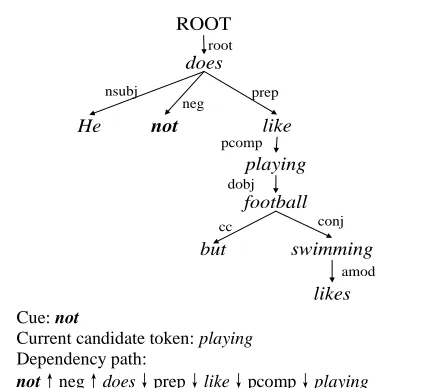
In this paper, the syntactic paths between the cues and the candidate tokens in constituency and dependency parse trees are both considered. Fig-ure 3 presents the constituency parse tree of sen-tence S1 and the constituency path from the cue “may” to the candidate token “our”. It shows that the tokens are at both the beginning and the end of the path with the arrows indicating the directions. Meanwhile, Figure 4 displays the dependency parse tree of sentence S2 and the dependency path
from the cue “not” to the token “playing”.
As the input of our CNN-based model, both the constituency path and the dependency path be-tween the cue and the token can be regarded as the special “sentences” S=(t1, t2,…, tn), whose “words”
can be tokens of sentences, syntactic categories, dependency relations, and arrows.
Similar to other CNN-based models, we also consider a fixed size window of tokens around the current token to capture its local features in the path. Here, the window size is set as an odd num-ber w, indicating that there are (w-1)/2 tokens be-fore and after the candidate token, respectively. In this case, path S is transferred into matrix
0 n
w d
0
X R according to embedding table
0 |T0|
d
R
0
W , where d0 is the dimension of the
em-beddings and |T0| is the size of the table.
3.3 Convolutional Neural Networking
After fed into the convolutional layer, the matrix of the syntactic path X0 is processed with a linear operation:
1 1 0 1
Y W X b (1)
where n1w d0
1
W R is the parameter matrix, and
1
n
1
b R is the bias term. To extract the most active
convolutional features from n1n
1
Y R , we
consid-er two features Cmax and Cmin whose elements are maximum, minimum values of rows in Y1, re-spectively:
ROOT
S
NP VP PERIOD
DT NN
The doctors
VBZ SBAR
warn IN S
that NP
NN
smoking
.
VP
MD
may
VP
VB NP
harmPRPP NNS
our lungs
Cue: may
Current candidate token: our
Constituency path:
[image:4.612.304.528.57.251.2]may↑MD↑VP↓VP↓NP↓PRPP↓our
Figure 3: An example for the constituency parse tree
of sentence S1 and the path from the cue to the candi-date token.
neg ROOT
does root
He nsubj
not like
prep
playing pcomp
football dobj
but cc
swimming conj
likes amod
Cue: not
Current candidate token: playing
Dependency path:
not↑neg↑does↓prep↓like↓pcomp↓playing
[image:4.612.86.289.64.253.2]( )r m a x[ 1( , 0 ),r 1( ,1), ...,r 1( ,r n1)]
C m a x Y Y Y (2)
( )r m in[ 1( , 0 ),r 1( ,1), ...,r 1( ,r n1)]
C m in Y Y Y (3)
where 0 r n11. Moreover, we extract a
con-volutional feature Cpavg, whose elements are probabilistic weighted average values of rows in Y1. Formally, Cpavg can be written as:
1 0 ( ) ( , ) n i i
r p r i
1C p a v g Y (4)
In Equation (4), pi is the probability of the
ele-ment Y1( , )r i in the vector Y1( , )r :
1 0 ( , ) ( , ) i n j r i p r j
1 1 Y Y (5)Cpavg is a variant probabilistic weighted aver-age pooling used by Zeiler et al. (2013). Compared to the standard average pooling, each element in Cpavg has a weight depending on its value. That is, during computing Cpavg, the most active elements with the largest absolute values (i.e., the maximum and minimum values) play the leading roles, while those less active elements with smaller absolute values have less effect. In this way, we can reduce the influence of less active elements, and can cap-ture more active information in Y1( , )r . From this
respect, Cpavg can be regarded as a meaningful convolutional feature.
The extracted convolutional features above are first concatenated into 3n1
R
C , as the output of
the convolutional layer:
[ , ]
C C m a x C m in , C p a v g (6)
Then, C is fed into the hidden layer to learn more complex and meaningful features. Here, we process C with a linear operation just like in the convolutional layer, and choose hyperbolic tanh as the activation function to get 2
2 n
R
Y :
ta n h ( )
2 2 2
Y W C b (7)
where Rn23n1
2
W is the parameter matrix, and
2
n
R
2
b is the bias term. To produce the output of
the hidden layer, a normalization operation is ap-plied to eliminate the manifold differences among various features:
/
2 2
H Y Y (8)
In this way we obtain the path feature n2
H R
for each candidate token and then concatenate it with the position feature P into one vector F0:
[ T, T]T
0
F P H (9)
where nf
R
0
F is the feature vector of a
candi-date token with the dimension equaling the sum of n2 and the dimension of P. Besides, we also
con-sider the dropout operation for regularization to prevent the co-adaptation of hidden units on the penultimate layer:
1 0
F F M (10)
where is an element-wise multiplication and M is a mask vector whose elements follow the Ber-noulli distribution with the probability p of being 1. We determine whether the candidate token is in the scope of the current cue according to its F1.
3.4 Output
Finally, F1 is fed into the softmax layer:
( )
= s o ftm a x 3 1 3
O W F b (11)
where n3nf R
3
W is the parameter matrix, and 3
n
3
b R is the bias term. The dimension of O is n3=3, which is equal to the number of labels
repre-senting whether the token is an element of the scope, just as described in subsection 3.1, and the elements of O can be interpreted as the confidence scores of the three labels, i.e., B, AandO.
To learn the parameters of the network, we su-pervise the predicted labels of O with the gold la-bels in the training set, and utilize the following training objection function:
2
1
1
( ) lo g ( | , )
2
m
i i
i
J p y x m
(12)where p y( i|xi,) is the confidence score of the golden label yi (B, A, O) of the training instance xi,
4
Experimentation
In this section, we first introduce the evaluation data, and then describe the experimental settings. Finally, we report the experimental results and analysis.
4.1 Corpus
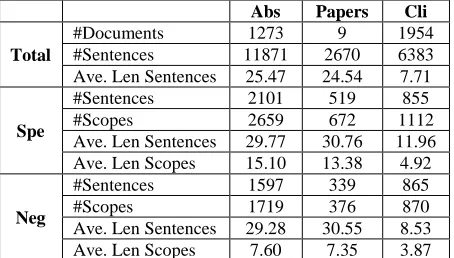
We evaluate our CNN-based model on BioScope (Szarvas et al., 2008; Vincze et al., 2008), a widely used and freely available resource consisting of sentences annotated with speculative and negative cues and their scopes in biomedical domain.
Abs Papers Cli
Total
#Documents 1273 9 1954
#Sentences 11871 2670 6383
Ave. Len Sentences 25.47 24.54 7.71
Spe
#Sentences 2101 519 855
#Scopes 2659 672 1112
Ave. Len Sentences 29.77 30.76 11.96 Ave. Len Scopes 15.10 13.38 4.92
Neg
#Sentences 1597 339 865
#Scopes 1719 376 870
[image:6.612.70.297.226.355.2]Ave. Len Sentences 29.28 30.55 8.53 Ave. Len Scopes 7.60 7.35 3.87 (Notes: “Ave. Len” denotes average length; “Abs”, “Papers” and “Cli” denote Abstracts, Full Papers and Clinical Records, respectively; “Spe” and “Neg” denote speculation and nega-tion, respectively.)
Table 1: Statistics on the BioScope corpus.
BioScope includes 3 different sub-corpora: Ab-stracts of biological papers from the GENIA cor-pus (Collier et al., 1999), Full scientific Papers from Flybase and BMC Bioinformatics website, and Clinical radiology Records corpus. These texts in three sub-corpora ensure that BioScope can cap-ture the heterogeneity of language use in biomedi-cal domain. While Abstracts and Full Papers share the same genre, Clinical Records consists of short-er sentences. Previous studies regarded Abstracts as the main resource for text mining applications due to its public accessibility (e.g. through Pub-Med).
Table 1 shows the statistics of the BioScope corpus. While in both Abstracts and Full Papers, the average lengths of speculation and negation sentences are comparable (Abstracts: 29.77 vs 29.28; Full Papers: 30.76 vs 30.55). However, their average lengths of the negation scopes are shorter than those of speculation ones (Abstracts: 7.60 vs 15.10; Full Papers: 7.35 vs 13.38). Moreo-ver, both the average lengths of sentences and
scopes in Clinical Records are shorter than those of other two sub-corpora (Average length: 11.96 (speculation sentence), 8.53 (negation sentence), 4.92 (speculation scope) and 3.87 (negation scope)).
4.2 Experimental Settings
Following the previous work (e.g., Özgür et al., 2009; Morante et al., 2009a, 2009b; Zou et al., 2013), we divide the Abstracts sub-corpus into 10 folds to perform 10-fold cross-validation. Moreo-ver, to examine the robustness of our CNN-based model towards different text types within biomed-ical domain, all the models are trained on the same Abstracts sub-corpus. Therefore, the results on Abstracts can be regarded as in-domain evaluation while the results on Clinical Records and Full Pa-pers can be regarded as cross-domain evaluation.
For the measurement, traditional Precision, Re-call, and F1-score are used to report the token-based performance in scope detection, while the Percentage of Correct Scopes (PCS) is adopted to report the scope-based performance, which con-siders a scope correct if all the tokens in the sen-tence have been assigned the correct scope classes for a specific cue. Obviously, PCS can better de-scribe the overall performance in scope detection. Besides, Percentage of Correct Left Boundaries (PCLB) and Percentage of Correct Right Bounda-ries (PCRB) are reported as partial measurements.
In all our experiments, both the constituency and dependency parse trees are produced by Stan-ford Parser2. Specially, we train the parser on the GENIA Treebank 1.03 (Tateisi et al., 2005), which contains Penn Treebank-style syntactic (phrase structure) annotation for the GENIA corpus. The parser achieves the performance of 87.12% in F1-score in terms of 10-fold cross-validation on GENIA TreeBank 1.0.
For the hyper-parameters in our CNN-based model, we set d0=100, dp=10, w=3, n1=200,
n2=500, λ=10-4, p=0.8. The embeddings of the
to-kens in ordinary sentences (as word sequences) are initialized by Word2Vec4 (Mikolov et al., 2013).
For the baseline, we utilize the classifier-based baseline developed by Zou et al. (2013). Besides those typical features, constituency and
2
http://nlp.stanford.edu/software/lex-parser.shtml
3 http://www.geniaproject.org/genia-corpus/treebank 4
cy syntactic features are also included. Further-more, Mallet5 is selected as the classifier.
In addition, since our CNN-based model may result in discontinuous blocks, we utilize a post-processing algorithm (Morante et al., 2008) to en-sure the continuity of scopes. Meanwhile, the cue must be in its scope as defined in Bioscope.
4.3 Experimental Results on Abstracts
Table 2 summarizes the performances of scope detection on Abstracts. In Table 2, CNN_C and CNN_D refer the CNN-based model with constit-uency paths and dependency paths, respectively (the same below). It shows that our CNN-based models (both CNN_C and CNN_D) can achieve better performances than the baseline in most measurements. This indicates that our CNN-based models can better extract and model effective fea-tures. Besides, compared to the baseline, our CNN-based models consider fewer features and need less human intervention. It also manifests that our CNN-based models improve significantly more on negation scope detection than on specula-tion scope detecspecula-tion. Much of this is due to the better ability of our CNN-based models in identi-fying the right boundaries of scopes than the left ones on negation scope detection, with the huge gains of 29.44% and 25.25% on PCRB using CNN_C and CNN_D, respectively.
Table 2 illustrates that the performance of spec-ulation scope detection is higher than that of nega-tion (Best PCS: 85.75% vs 77.14%). It is mainly attributed to the shorter scopes of negation cues. Under the circumstances that the average length of negation sentences is almost as long as that of speculation ones (29.28 vs 29.77), shorter negation scopes mean that more tokens do not belong to the scopes, indicating more negative instances. The imbalance between positive and negative instances has negative effects on both the baseline and the
5
http://mallet.cs.umass.edu/
CNN-based models for negation scope detection. Table 2 also shows that our CNN_D outper-forms CNN_C in negation scope detection (PCS: 77.14% vs 70.86%), while our CNN_C performs better than CNN_D in speculation scope detection (PCS: 85.75% vs 74.43%). To explore the results of our CNN-based models in details, we present the analysis of top 10 speculative and negative cues below on CNN_C and CNN_D, respectively.
Figure 5: PCSs of top 10 speculative cues for scope detection
in Abstracts sub-corpus.
Figure 5 illustrates the PCSs of the most fre-quent 10 speculative cues using CNN_C. The cues in the horizontal axis are in the order of lowest to highest in frequency. Among those cues, “ sug-gest”, “may”, “indicate”, and “appear” are commonly used to express opinions of certain in-dividuals. The scopes of these cues are integrated semantic fragments (probably clauses) governed by corresponding cues in grammatical sense, and the tokens in the scope tend to share the same chunk with the cue in the constituency parse tree. Hence, constituency paths are more useful for speculation scope detection. Figure 5 also shows that the PCSs of all the top 10 speculative cues are higher than 70% except “or” (PCS: 60.44%), mainly due to the flexible usage of “or”, which
Systems P(%) R(%) F1 PCLB(%) PCRB(%) PCS(%)
Speculation
Baseline 94.71 90.54 92.56 84.81 85.11 72.47
CNN_C 95.95 95.19 95.56 93.16 91.50 85.75
CNN_D 92.25 94.98 93.55 86.39 84.50 74.43
Negation
Baseline 85.46 72.95 78.63 84.00 58.29 46.42
CNN_C 85.10 92.74 89.64 81.04 87.73 70.86
[image:7.612.79.537.63.146.2] [image:7.612.317.537.287.448.2]CNN_D 89.49 90.54 89.91 91.91 83.54 77.14
can connect two words, two professional terms, or even two clauses.
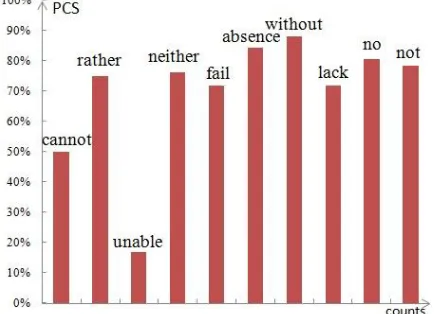
Figure 6: PCSs of top 10 negative cues for scope detection in
[image:8.612.81.534.68.172.2]Abstracts sub-corpus.
Figure 6 illustrates the performances of the most frequent 10 negative cues using CNN_D. In those negative cues, “not” is in the absolute majority, and “not” and “no” cover over 70%. We have no-ticed that most negative cues (e.g., “not”, “no”, “without”, “fail”) are often applied to negate phrases, and the tokens in negation scope tend to have the tight dependency relationship with them. Therefore, our model can achieve better results using dependency paths for negation scope.
In Figure 6, most negative cues have good PCSs (higher than 70%). However, “unable” has poor PCS of 16.67%. This is due to the fact that “ una-ble” usually occurs in the phrase structure “be un-able to”, which often follows a subject. It is nota-ble that a cue is always in its scope and most cues in BioScope are much closer to the left boundaries than to the right ones. Hence, the tokens labeled as B (i.e., inside the scope and before the cue) are much fewer than the ones labeled as A or O. Such imbalance makes it hard to judge whether the to-kens before “unable” are in of its scope or not.
4.4 Experimental Results on Clinical Records and Full Papers
The performances of our CNN-based models on the other two sub-corpora, i.e., Clinical Records and Full Papers, are presented in Table 3. Alt-hough Abstracts and Clinical Records have differ-ent genres, our CNN-based models can obtain sat-isfactory results on Clinical Records using both constituency paths and dependency paths, proving the portability of our models.
Table 3 also shows that the results of negation scope are better than those of speculation scope on Clinical Records (PCS: 89.66% vs 73.92%). We argue the reason is that both the lengths of nega-tion sentences and scopes (8.53 and 3.87, respec-tively) in Clinical Records are much shorter, indi-cating that the structures of negation sentences are simpler than those of speculation ones. After error analysis of speculation scopes, we find that 54.83% of our error scopes contain the annotated scopes, just like sentence S5:
(S5) This does not [appear to represent a stone] and is not mobile.
The annotated scope of the cue “appear” is “appear to represent a stone”. However, our CNN-based model identifies the whole sentence as the scope. These errors indicate that some words may be wrongly identified as the components of scopes because the scopes in Clinical Records are short and their structures are simple.
Compared with Abstracts and Clinical Records, the results on Full Papers are much lower. This is mainly due to the poor PCRBs, indicating a con-siderable quantity of right boundaries of scopes cannot be identified correctly. We should note that the average lengths of both speculation and nega-tion sentences (30.76 and 30.55, respectively) in Full Papers are longer than those in Abstracts and
Systems P(%) R(%) F1 PCLB(%) PCRB(%) PCS(%)
Speculation
Clinical Records
CNN_C 86.85 93.84 90.21 84.35 86.87 73.92
CNN_D 89.02 85.41 87.18 82.91 76.17 64.39
Full Papers
CNN_C 86.78 86.59 86.69 86.01 68.60 59.82
CNN_D 86.13 85.09 85.61 80.95 64.14 52.98
Negation
Clinical Records
CNN_C 88.29 97.00 92.44 95.98 93.45 89.66
CNN_D 91.97 97.03 94.43 95.98 90.57 87.82
Full Papers
CNN_C 80.92 82.26 81.58 82.71 67.29 55.32
[image:8.612.77.294.230.387.2]CNN_D 82.08 84.90 83.46 84.04 64.89 53.99
Clinical Records. Normally, longer sentences mean more complicated syntactic structures.
Besides the results trained on Abstracts, we also consider the 10-fold cross-validation on Clinical Records and Full Papers. The PCSs of speculation and negation scope detection are 74.73% (CNN_C) and 91.03% (CNN_C) on Clinical Records, which are both higher than the ones trained on Abstracts. Remember that Abstracts and Clinical Records come from the different genres. However, we get lower PCSs on Full Papers (49.54% for specula-tion scope detecspecula-tion using CNN_C, and 44.67% for negation scope detection using CNN_C). In addition to the complex structures of long sentenc-es, another reason is that the smaller size of the Full Papers sub-corpus compared to the other two sub-corpora. Fewer sentences and scopes (only 672 speculation scopes in 519 sentences and 376 negation scopes in 339 sentences) mean that we cannot get an excellent model.
4.5 Comparison with the State-of-the-Art
Table 4 compares our CNN-based models with the state-of-the-art systems. It shows that our CNN-based models can achieve higher PCSs (+1.54%) than those of the state-of-the-art systems for spec-ulation scope detection and the second highest PCS for negation scope detection on Abstracts, and can get comparable PCSs on Clinical Records (73.92% vs 78.69% for speculation scopes, 89.66% vs 90.74% for negation scopes). It is worth noting that Abstracts and Clinical Records come from different genres.
It also displays that our CNN-based models per-form worse than the state-of-the-art on Full Papers due to the complex syntactic structures of the sen-tences and the cross-domain nature of our evalua-tion. Although our evaluation on Clinical Records is cross-domain, the sentences in Clinical Records are much simpler and the results on Clinical Rec-ords are satisfactory. Remind that our CNN-based models are all trained on Abstracts. Another rea-son is that those state-of-the-art systems on Full Papers (e.g., Li et al., 2010; Velldal et al., 2012) are tree-based, instead of token-based. Li et al. (2010) proposed a semantic parsing framework and focused on determining whether a constituent, rather than a word, is in the scope of a negative cue. Velldal et al. (2012) presented a hybrid framework, combining a rule-based approach us-ing dependency structures and a data-driven
ap-proach for selecting appropriate subtrees in con-stituent structures. Normally, tree-based models can better capture long-distance syntactic depend-ency than token-based ones. Compared to those tree-based models, however, our CNN-based model needs less manual intervention. To improve the performances of scope detection task, we will explore this alternative in our future work.
System Abs Cli Papers
Spe
Morante (2009a) 77.13 60.59 47.94 Özgür (2009) 79.89 N/A 61.13 Velldal (2012) 79.56 78.69 75.15
Zou (2013) 84.21 72.92 67.24 Ours 85.75 73.92 59.82
Neg
Morante (2008) 57.33 N/A N/A Morante (2009b) 73.36 87.27 50.26
Li (2010) 81.84 89.79 64.02 Velldal (2012) 74.35 90.74 70.21
[image:9.612.315.537.165.297.2]Zou (2013) 76.90 85.31 61.19 Ours 77.14 89.66 55.32
Table 4: Comparison of our CNN-based model with the
state-of-the-art in PCS.
5
Conclusion
This paper proposes a CNN-based model for spec-ulation and negation scope detection. Compared with various lexical and syntactic features adopted in previous studies (e.g., Lapponi et al., 2012; Zou et al., 2013), our CNN-based model only considers the position feature and syntactic path feature.
Experimental results on the BioScope corpus show that our CNN-based model can get the best performances for speculation scopes and the se-cond highest performances for negation scopes on Abstracts in in-domain evaluation. In cross-domain evaluations, we can achieve comparable results on Clinical Records, but our CNN-based model performs worse on Full Papers. This sug-gests our future direction to extend the model from token level to parse tree level in better capturing long-distance syntactic dependency and to address the cross-domain adaptation issue.
Acknowledgments
References
Wendy W. Chapman, Will Bridewell, Paul Hanbury, Gregory F. Cooper, and Bruce G. Buchanan. 2001. Evaluation of Negation Phrases in Narrative Clinical Reports. In Proceedings of American Medical Infor-matics Association Symposium, 2001, pages 105-109.
Yubo Chen, Liheng Xu, Kang Liu, Daojian Zeng, and Jun Zhao. 2015. Event Extraction via Dynamic Mul-ti-Pooling Convolutional Neural Networks. In Pro-ceedings of the 53rd Annual Meeting of the Associa-tion for ComputaAssocia-tional Linguistics and the 7th Inter-national Joint Conference on Natural Language Processing (ACL2015), Beijing, China, July 26-31, 2015, pages 167-176.
Nigel Collier, Hyun Seok Park, Norihiro Ogata, et al. 1999. The GENIA Project: Corpus-based Knowledge Acquisition and Information Extraction from Genome Research Papers. In Proceedings of the European Chapter of the ACL 1999 (EACL 1999).
Ronan Collobert, Jason Weston, Léon Bottou, Michael Karlen, Koray Kavukcuoglu, and Pavel Kuksa. 2011. Natural Language Processing (almost) from Scratch. Journal of Machine Learning Research, 2011, 12(1): 2493-2537.
Baotian Hu, Zhaopeng Tu, Zhengdong Lu, Hang Li, and Qingcai Chen. 2015. Context-Dependent Trans-lation Selection Using Convolutional Neural Net-work. In Proceedings of the 53rd Annual Meeting of the Association for Computational Linguistics and the 7th International Joint Conference on Natural Language Processing (ACL2015), Beijing, China, July 26-31, 2015, pages 536-541.
Emanuele Lapponi, Erik Velldal, Lilja Øvrelid, and Jonathon Read. 2012. UiO2: Sequence-Labeling
Ne-gation Using Dependency Features. In First Joint Conference on Lexical and Computational Semantics (*SEM), Montreal, Canada, June 7-8, 2012, pages 319–327.
Yann LeCun, Bernhard E. Boser, John S. Denker, Don-nie Henderson, R. E. Howard, Wayne E. Hubbard, and Lawrence D. Jackel. 1989. Backpropagation Applied to Handwritten Zip Code Recognition. Neu-ral Computation, 1989, 1(4): 541-551.
Junhui Li, Guodong Zhou, Hongling Wang, and Qiaoming Zhu. 2010. Learning the Scope of Negation via Shallow Semantic Parsing. In Proceedings of the 23rd International Conference on Computational Linguistics (Coling 2010), Beijing, 2010, pages 671-679.
Mingbo Ma, Liang Huang, Bing Xiang, and Bowen Zhou. 2015. Dependency-based Convolutional Neu-ral Networks for Sentence Embedding. In Proceed-ings of the 53rd Annual Meeting of the Association for Computational Linguistics and the 7th Interna-tional Joint Conference on Natural Language Pro-cessing (Short Papers) (ACL2015), Beijing, China, 2015, pages 174-179.
Fandong Meng, Zhengdong Lu, Mingxuan Wang, Hang Li, Wenbin Jiang, and Qun Liu. 2015. Encoding Source Language with Convolutional Neural Net-work for Machine Translation. In Proceedings of the 53rd Annual Meeting of the Association for Compu-tational Linguistics and the 7th International Joint Conference on Natural Language Processing (ACL2015), Beijing, China, July 26-31, 2015, pages 20-30.
Tomas Mikolov, Ilya Sutskever, Kai Chen, Greg Cor-rado, and Jeffrey Dean. 2013. Distributed Represen-tations of Words and Phrases and their Composition-ality. Advances in Neural Information Processing Systems, 2013(26): 3111-3119.
Roser Morante, Anthony Liekens, and Walter Daele-mans. 2008. Learning the Scope of Negation in Bi-omedical Texts. In Proceedings of the 2008 Confer-ence on Empirical Methods in Natural Language Processing (EMNLP 2008), Honolulu, 2008, pages 715-724.
Roser Morante and Walter Daelemans. 2009a. Learning the Scope of Hedge Cues in Biomedical Texts. In Proceedings of the Workshop on BioNLP. Boulder, Colorado, 2009, pages 28-36.
Roser Morante and Walter Daelemans. 2009b. A Met-alearning Approach to Processing the Scope of Ne-gation. In Proceedings of the Thirteenth Conference on Computational Natural Language Learning (CoNLL 2009), Boulder, Colorado, June 2009, pages 21-29.
Thien Huu Nguyen and Ralph Grishman. 2015. Event Detection and Domain Adaptation with Convolu-tional Neural Networks. In Proceedings of the 53rd Annual Meeting of the Association for Computation-al Linguistics and the 7th InternationComputation-al Joint Con-ference on Natural Language Processing (ACL2015), Beijing, China, July 26-31,2015, pages 365-371.
Arzucan Özgür and Dragomir R. Radev. 2009. Detect-ing Speculations and their Scopes in Scientific Text. In Proceedings of the 2009 Conference on Empirical Methods in Natural Language Processing (EMNLP 2009), Singapore, 2009, pages 1398-1407.
In Proceedings of the 23rd International Conference on Computational Linguistics (Coling 2010), Beijing, August 2010, pages 1379-1387.
György Szarvas, Veronika Vincze, Richárd Farkas, and János Csirik. 2008. The BioScope corpus: Annota-tion for NegaAnnota-tion, Uncertainty and their Scope in Bi-omedical Texts. In Proceedings of BioNLP 2008: Current Trends in Biomedical Natural Language Processing, Columbus, Ohio, USA, 2008, pages 38-45.
Kai Sheng Tai, Richard Socher and Christopher D. Manning. 2015. Improved Semantic Representations from Tree-Structured Long Short-Term Memory Networks. In Proceedings of the 53rd Annual Meet-ing of the Association for Computational LMeet-inguistics and the 7th International Joint Conference on Natu-ral Language Processing (ACL-IJCNLP 2015), Bei-jing, China, July 26-31, 2015, pages 1556-1566.
Buzhou Tang, Xiaolong Wang, XuanWang, Bo Yuan, and Shixi Fan. 2010. A Cascade Method for Detect-ing Hedges and their Scope in Natural Language Text. In Proceedings of the Fourteenth Conference on Computational Natural Language Learning (CoNLL 2010): Shared Task, Uppsala, Sweden, 15-16 July 2010, pages 13-17.
Yuka Tateisi, Akane Yakushiji, Tomoko Ohta, and Jun'ichi Tsujii. 2005. Syntax annotation for the GENIA corpus. In Proceedings of IJCNLP 2005, Je-ju Island, Korea, October 2005, pages 222-227.
Erik Velldal, Lilja Øvrelid, Jonathon Read, and Stephan Oepen. 2012. Speculation and Negation: Rules, Rankers, and the Role of Syntax. Computational Linguistics, 2012, 38(2): 369-410.
Andreas Vlachos and Mark Craven. 2010. Detecting Speculative Language Using Syntactic Dependencies and Logistic Regression. In Proceedings of the Four-teenth Conference on Computational Natural Lan-guage Learning (CoNLL 2010): Shared Task, Upp-sala, Sweden, 15-16 July 2010, pages 18-25.
Kun Xu, Yansong Feng, Songfang Huang, and Dong-yan Zhao. 2015a. Semantic Relation Classification via Convolutional Neural Networks with Simple Negative Sampling. In Proceedings of the 2015 Con-ference on Empirical Methods in Natural Language Processing (EMNLP 2015), Lisbon, Portugal, 2015, pages 536-540.
Yan Xu, Lili Mou, Ge Li, Yunchuan Chen, Hao Peng, Zhi Jin. 2015b. Classifying Relations via Long Short Term Memory Networks along Shortest Dependency Paths. In Proceedings of the 2015 Conference on Empirical Methods in Natural Language Processing
(EMNLP 2015), Lisbon, Portugal, 2015, pages 1785-1794.
Matthew D. Zeiler and Rob Fergus. 2013. Stochastic Pooling for Regularization of Deep Convolutional Neural Networks. arXiv preprint arXiv: 1301.3557v1.
Daojian Zeng, Kang Liu, Siwei Lai, Guangyou Zhou, and Jun Zhao. 2014. Relation Classification via Convolutional Deep Neural Network. In Proceed-ings of the 25th International Conference on Compu-tational Linguistics: Technical Papers (COLING 2014), Dublin, Ireland, August 23-29, 2014, pages 2335-2344.
Biao Zhang, Jinsong Su, Deyi Xiong, Yaojie Lu, Hong Duan, and Junfeng Yao. 2015. Shallow Convolu-tional Neural Network for Implicit Discourse Rela-tion RecogniRela-tion. In Proceedings of the 2015 Con-ference on Empirical Methods in Natural Language Processing (EMNLP 2015), Lisbon, Portugal, 17-21 September 2015, pages 2230-2235.