Combining Supervised and Unsupervised Ensembles
for Knowledge Base Population
Nazneen Fatema Rajani and Raymond J. Mooney Department Of Computer Science
The University of Texas at Austin
[email protected], [email protected]
Abstract
We propose an algorithm that combines su-pervised and unsusu-pervised methods to ensem-ble multiple systems for two popular Knowl-edge Base Population (KBP) tasks, Cold Start Slot Filling (CSSF) and Tri-lingual Entity Dis-covery and Linking (TEDL). We demonstrate that it outperforms the best system for both tasks in the 2015 competition, several ensem-bling baselines, as well as a state-of-the-art stacking approach. The success of our tech-nique on two different and challenging prob-lems demonstrates the power and generality of our combined approach to ensembling.
1 Introduction
Ensemblingmultiple systems is a well known
stan-dard approach to improving accuracy in several ma-chine learning applications (Dietterich, 2000). En-sembles have been applied to parsing (Henderson and Brill, 1999), word sense disambiguation (Ped-ersen, 2000), sentiment analysis (Whitehead and Yaeger, 2010) and information extraction (IE) (Flo-rian et al., 2003; McClosky et al., 2012). Recently, using stacking (Wolpert, 1992) to ensemble sys-tems was shown to give state-of-the-art results on slot-filling and entity linking for Knowledge Base
Population (KBP) (Viswanathan et al., 2015;
Ra-jani and Mooney, 2016). Stacking uses supervised learning to train a meta-classifier to combine multi-ple system outputs; therefore, it requires historical data on the performance of each system. Rajani and Mooney (2016) use data from the 2014 iteration of the KBP competition for training and then test on the
data from the 2015 competition, therefore they can only ensemble theshared systems that participated in both years.
However, we would sometimes like to ensem-ble systems for which we have no historical perfor-mance data. For example, due to privacy, some com-panies may be unwilling to share their performance on arbitrary training sets. Simple methods such as voting permit “unsupervised” ensembling, and sev-eral more sophisticated methods have also been de-veloped for this scenario (Wang et al., 2013). How-ever, such methods fail to exploit supervision for those systems for which we do have training data. Therefore, we present an approach that utilizes su-pervisedandunsupervised ensembling to exploit the advantages of both. We first use unsupervised en-sembling to combine systems without training data, and then use stacking to combine this ensembled system with other systems with available training data.
Using this new approach, we demonstrate new state-of-the-art results on two NIST KBP challenge tasks: Cold Start Slot-Filling (CSSF)1 and the
Tri-lingual Entity Discovery and Linking (TEDL) (Ji
et al., 2015). Our approach outperforms the best system as well as other state-of-the-art ensembling methods on both tasks in the most recent 2015 com-petition. There is one previous work on ensembling supervised and unsupervised models using graph-based consensus maximization (Gao et al., 2009), however we show that it does not do as well as our stacking method.
1http://www.nist.gov/tac/2015/KBP/
ColdStart/guidelines.html
2 Overview of KBP Tasks 2.1 Cold Start Slot Filling (CSSF)
The goal of CSSF is to collect information (fills) about specific attributes (slots) for a set of entities (queries) from a given corpus. The query entities can be a person, organization, or geo-political entity (PER/ORG/GPE). The input is a set of queries along with a text corpus in which to look for information. The output is a set of slot fills for each query. Sys-tems must also provide provenance in the form of docid:startoffset-endoffset, where docid specifies a source document and the offsets demarcate the text in this document supporting the filler. Systems may also provide a confidence score to indicate their cer-tainty in the extracted information.
2.2 Tri-lingual Entity Discovery and Linking (TEDL)
The first step in the TEDL task is to discover all en-tity mentions in a corpus with English, Spanish and Chinese documents. The entities can be a person, or-ganization or geo-political entity (PER/ORG/GPE) and in 2015 two more entity types were introduced – facility and location (FAC/LOC). The extracted mentions are then linked to an existing English KB (a version of FreeBase) entity via its ID. If there is no KB entry for an entity, systems are expected to cluster all the mentions for that entity using a NIL ID. The output for the task is a set of extracted men-tions, each with a string, its provenance in the cor-pus, and a corresponding KB ID if the system could successfully link the mention, or else a mention clus-ter with a NIL ID. Systems can also provide a confi-dence score for each mention.
3 Ensembling Algorithm
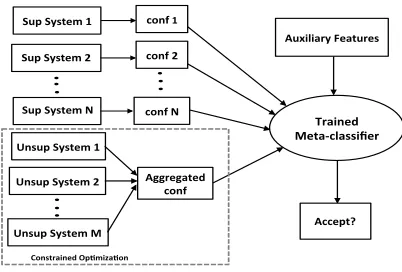
Figure 1 illustrates our system which trains a final meta-classifier for combining multiple systems us-ing confidence scores and other auxiliary features depending on the task.
3.1 Supervised Ensembling Approach
For the KBP systems that are common between years, we use the stacking method of Viswanathan et al. (2015) for these shared systems.
The meta-classifier makes a binary decision for each distinct output represented as akey-valuepair.
Sup System 1
Sup System 2
Sup System N
Unsup System 1
Trained Meta-classifier Auxiliary Features conf 1
conf 2
conf N
Unsup System 2 Aggregated conf
Unsup System M Accept?
[image:2.612.327.528.71.207.2]Constrained OpBmizaBon
Figure 1: Illustration of our approach to combine supervised and unsupervised ensembles.
The function of thekeyis to provide a handle for ag-gregating outputs that are common across systems. For the CSSF task, thekeyfor ensembling multiple systems is a query along with a slot type, for exam-ple, per:age of “Barack Obama” and the valueis a computedslot fill. For TEDL, the key is theKB (or
NIL) ID and the value is a mention, that is a
spe-cific reference to an entity in the text. The top half of Figure 1 illustrates ensembling multiple systems with historical training data using a supervised ap-proach.
3.2 Unsupervised Ensembling Approach
to arrive at a single aggregated confidence value for
eachkey-valuepair. The constraints ensure that the
aggregated confidence score is close to the raw score as well as proportional to the agreement among sys-tems on a value for a given key. Thus for a given key, if a system’s value is also produced by multi-ple other systems, it would have a higher score than if it were not produced by any other system. The authors use the inverse ranking of the average pre-cision previously achieved by individual systems as the weights in their algorithm. However since we use this approach for systems with no historical per-formance data, we use uniform weights across all unsupervised systems for both the tasks.
We use the slot type for the CSSF task and en-tity type for the TEDL task to define the constraints on the values. The output from the constrained op-timization approach for both tasks is a set of key-values with aggregated confidence scores across all unsupervised systems which go directly into the stacker as shown in the lower half of Figure 1. Us-ing the aggregation approach as opposed to directly using the raw confidence scores allows the classifier to meaningfully compare confidence scores across multiple systems although they are produced by very diverse systems.
Another unsupervised ensembling method we tried in place of the constrained optimization ap-proach is the Bipartite Graph based Consensus Max-imization (BGCM) approach of Gao et al. (2009). BGCM is presented as a way of combining super-vised and unsupersuper-vised models, so we compare it to our stacking approach to combining supervised and unsupervised systems, as well as an alternative ap-proach to ensemblingjustthe unsupervised systems before passing their output to the stacker. BGCM performs an optimization over a bipartite graph of systems and outputs, where the objective function favors the smoothness of the label assignments over the graph, as well as penalizing deviations from the initial labeling provided by supervised models.
3.3 Combining Supervised and Unsupervised
We propose a novel approach to combine the afore-mentioned supervised and unsupervised methods us-ing a stacked meta-classifier as the final arbiter for accepting a given key-value. The outputs from the supervised and unsupervised systems are fed into
the stacker in a consistent format such that there is a unique inputkey-value pair. Most KBP teams sub-mit multiple variations of their system. Before en-sembling, we first combine multiple runs of the same team into one. Of the 38 CSSF systems from 10 teams for which we have 2014 data for training and the32systems from13teams that do not have train-ing data, we combine the runs of each team into one to ensure diversity of the final ensemble. For the slot fills that were common between the runs of a given team, we compute an average confidence value, and then add any additional fills that are not common between runs. Thus, we obtained10 systems (one for each team) for which we have supervised data for training stacking. Similarly, we combine the24 TEDL systems from6teams that have 2014 training data and10systems from4teams that did not have training data into one per team. Thus using the no-tation in Figure 1, for TEDL,N = 6andM = 4 while for CSSF,N = 10andM = 13.
The unsupervised method produces aggregated, calibrated confidence scores which go directly into our final meta-classifier. We treat this combination as a single system called theunsupervised ensemble. We add the unsupervised ensemble as an additional system to the stacker, thus giving us a total ofN+ 1, that is11CSSF and7TEDL systems. Once we have extracted the auxiliary features for each of theN su-pervised systems and the unsusu-pervised ensemble for both years, we train the stacker on 2014 systems, and test on the 2015 systems. The unsupervised en-semble for each year is composed of different sys-tems, but hopefully the stacker learns to combine a generic unsupervised ensemble with the supervised systems that are shared across years. This allows the stacker to arbitrate the final correctness of a key-value pair, combining systems for which we have no historical data with systems for which training data isavailable. To learn the meta-classifier, we use an L1-regularized SVM with a linear kernel (Fan et al., 2008) (other classifiers gave similar results).
3.4 Post-processing
Methodology Precision Recall F1
Combined stacking and constrained optimization with auxiliary features 0.4679 0.4314 0.4489
Top ranked SFV system in 2015 (Rodriguez et al., 2015) 0.4930 0.3910 0.4361
Stacking using BGCM instead of constrained optimization 0.5901 0.3021 0.3996
BGCM for combining supervised and unsupervised systems 0.4902 0.3363 0.3989
Stacking with auxiliary features described in (Rajani and Mooney, 2016) 0.4656 0.3312 0.3871
Ensembling approach described in (Viswanathan et al., 2015) 0.5084 0.2855 0.3657
Top ranked CSSF system in 2015 (Angeli et al., 2015) 0.3989 0.3058 0.3462
Oracle Voting baseline (3 or more systems must agree) 0.4384 0.2720 0.3357
[image:4.612.106.542.59.201.2]Constrained optimization approach described in (Wang et al., 2013) 0.1712 0.3998 0.2397
Table 1:Results on 2015 Cold Start Slot Filling (CSSF) task using the official NIST scorer
Methodology Precision Recall F1
Combined stacking and constrained optimization 0.686 0.624 0.653
Stacking using BGCM instead of constrained optimization 0.803 0.525 0.635
BGCM for combining supervised and unsupervised outputs 0.810 0.517 0.631
Stacking with auxiliary features described in (Rajani and Mooney, 2016) 0.813 0.515 0.630
Ensembling approach described in (Viswanathan et al., 2015) 0.814 0.508 0.625
Top ranked TEDL system in 2015 (Sil et al., 2015) 0.693 0.547 0.611
Oracle Voting baseline (4 or more systems must agree) 0.514 0.601 0.554
Constrained optimization approach 0.445 0.176 0.252
Table 2:Results on 2015 Tri-lingual Entity Discovery and Linking (TEDL) using official NIST scorer and CEAF metric
that were classified as correct for the same query and slot type, we include the fill with the highest meta-classifier confidence.
For TEDL, for each entity mention link that is classified as correct, if the link is a KB cluster ID then we include it in the final output, but if the link is a NIL cluster ID then we keep it aside until all mention links are processed. Thereafter, we resolve the NIL IDs across systems since NIL ID’s for each system are unique. We merge NIL clusters across systems into one if there is at least one common en-tity mention among them.
4 Experimental Results
All results were obtained using the official NIST scorers after the competitions ended.2 We compare to the purely supervised approach of Viswanathan et al. (2015) using shared systems between 2014 and 2015, and the constrained optimization approach of Wang et al. (2013) using all 2015 systems. We also compare to BGCM (Gao et al., 2009) in two ways.
2http://www.nist.gov/tac/2015/KBP/
ColdStart/tools.html,https://github.com/ wikilinks/neleval
First, we use BGCM in place of the constrained op-timization approach to ensemble unsupervised sys-tems while keeping the rest of our pipeline the same. Secondly, we also compare to combining both su-pervised and unsusu-pervised systems using BGCM in-stead of stacking. We also include an“oracle” vot-ing ensemblvot-ing baseline, which varies the threshold on the number of systems that must agree to identify an “oracle” threshold that results in the highest F1 score for 2015. We find that for CSSF a threshold of 3, and for TEDL a threshold of4, gives us the best F1 score.
Tables 1 and 2 show CSSF and TEDL results. Our full system, which combines supervised and un-supervised ensembling performed the best on both tasks. TAC-KBP also includes the Slot Filler Val-idation (SFV) task3 where the goal is to ensem-ble/filter outputs from multiple slot filling systems. The top ranked system in 2015 (Rodriguez et al., 2015) does substantially better than many of the other ensembling approaches, but it does not do as well as our best performing system. The purely
3http://www.nist.gov/tac/2015/KBP/
[image:4.612.74.544.65.350.2]0 20000 40000 60000 80000 100000 120000 140000
Supervised Unsupervised Combina8on
TEDL
Unique pairs Common pairs
0 5000 10000 15000 20000 25000 30000 35000
Supervised Unsupervised Combina7on
CSSF
[image:5.612.73.543.57.177.2]Unique pairs Common pairs
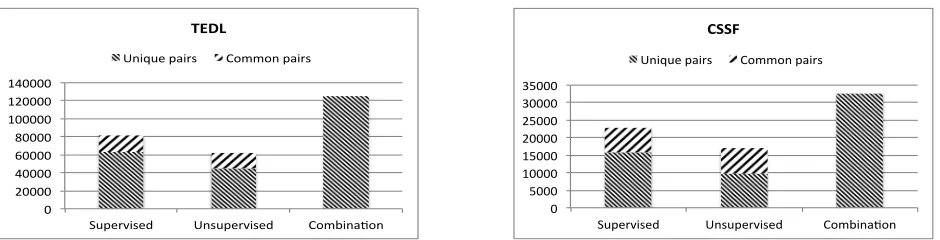
Figure 2:Total number of unique and common input pairs contributed by the supervised and unsupervised systems to the combi-nation for the TEDL and CSSF tasks respectively.
supervised approach of Viswanathan et al. (2015) and the auxiliary features approach of Rajani and Mooney (2016) performs substantially worse, al-though still outperforming the top-ranked individual system in the 2015 competition. These approaches only use the common systems from 2014, thus ig-noring approximately half of the systems. The ap-proach of Wang et al. (2013) performs very poorly by itself; but when combined with stacking gives a boost to recall and thus the overallF1. Note that all our combined methods have a substantially higher recall. The oracle voting baseline also performs very poorly indicating that naive ensembling is not ad-vantageous.
TEDL provides three different approaches to measuring accuracy: entity discovery, entity linking, and mention CEAF (Ji et al., 2015). CEAF finds the optimal alignment between system and gold stan-dard clusters, then evaluates precision and recall micro-averaged. We obtained similar results on all three metrics and only include CEAF. The purely supervised stacking approach over shared systems does not do as well as any of our combined ap-proaches even though it beats the best performing system (i.e. IBM) in the 2015 competition (Sil et al., 2015). The relative ranking of the approaches is similar to those obtained for CSSF, proving that our approach is very general and improves performance on two quite different and challenging problems.
Even though it is obvious that the boost in our recall was because of adding the unsupervised sys-tems, it isn’t clear how many new key-value pairs were generated by these systems. We thus evalu-ated the contribution of the systems ensembled using the supervised approach and those ensembled using
the unsupervised approach, to the final combination for both the tasks. Figure 2 shows the number of unique as well as commonkey-valuepairs that were contributed by each of the approaches. The unique pairs are those that were produced by one approach but not the other and the common pairs are those that were produced by both approaches. The num-ber of unique pairs in the combination is the union of unique pairs in the supervised and unsupervised approaches. We found that approximately one third of the input pairs in the combination came from the unique pairs produced just by the unsupervised sys-tems for both the TEDL and CSSF tasks. Only about 15%and22%of the total input pairs were common between the two approaches for the TEDL and CSSF tasks respectively. Our findings highlight the impor-tance of utilizing systems that do not have historical training data.
5 Conclusion
We presented results on two diverse KBP tasks, showing that a novel stacking-based approach to en-sembling both supervised and unsupervised systems is very promising. The approach outperforms the top ranked systems from both 2015 competitions as well as several other ensembling methods, achiev-ing a new state-of-the-art for both of these impor-tant, challenging tasks. We found that adding the unsupervised ensemble along with the shared sys-tems specifically increased recall substantially.
Acknowledgment
References
Gabor Angeli, Victor Zhong, Danqi Chen, Arun Cha-ganty, Jason Bolton, Melvin Johnson Premkumar, Panupong Pasupat, Sonal Gupta, and Christopher D. Manning. 2015. Bootstrapped Self Training for Knowledge Base Population. In Proceedings of the Eighth Text Analysis Conference (TAC2015).
T. Dietterich. 2000. Ensemble Methods in Machine Learning. In J. Kittler and F. Roli, editors, First International Workshop on Multiple Classifier Sys-tems, Lecture Notes in Computer Science, pages 1–15. Springer-Verlag.
Rong-En Fan, Kai-Wei Chang, Cho-Jui Hsieh, Xiang-Rui Wang, and Chih-Jen Lin. 2008. LIBLINEAR: A li-brary for large linear classification. Journal of Ma-chine Learning Research, 9:1871–1874.
Radu Florian, Abe Ittycheriah, Hongyan Jing, and Tong Zhang. 2003. Named entity recognition through clas-sifier combination. InProceedings of the seventh con-ference on Natural language learning at HLT-NAACL 2003-Volume 4, pages 168–171. Association for Com-putational Linguistics.
Jing Gao, Feng Liang, Wei Fan, Yizhou Sun, and Jiawei Han. 2009. Graph-based consensus maximization among multiple supervised and unsupervised models. In Advances in Neural Information Processing Sys-tems (NIPS2009), pages 585–593.
John C. Henderson and Eric Brill. 1999. Exploiting Diversity in Natural Language Processing: Combin-ing Parsers. In Proceedings of the Conference on Empirical Methods in Natural Language Processing (EMNLP99), pages 187–194, College Park, MD. Heng Ji, Joel Nothman, Ben Hachey, and Radu Florian.
2015. Overview of TAC-KBP2015 Tri-lingual Entity Discovery and Linking. InProceedings of the Eighth Text Analysis Conference (TAC2015).
David McClosky, Sebastian Riedel, Mihai Surdeanu, An-drew McCallum, and Christopher D Manning. 2012. Combining Joint Models for Biomedical Event Extrac-tion. BMC Bioinformatics.
Ted Pedersen. 2000. A Simple Approach to Build-ing Ensembles of Naive Bayesian Classifiers for Word Sense Disambiguation. In North American Chap-ter of the Association for Computational Linguistics (NAACL2000), pages 63–69.
Nazneen Fatema Rajani and Raymond J. Mooney. 2016. Stacking With Auxiliary Features. ArXiv e-prints. Miguel Rodriguez, Sean Goldberg, and Daisy Zhe Wang.
2015. University of Florida DSR lab system for KBP slot filler validation 2015. In Proceedings of the Eighth Text Analysis Conference (TAC2015).
Avirup Sil, Georgiana Dinu, and Radu Florian. 2015. The IBM systems for trilingual entity discovery and
linking at TAC 2015. In Proceedings of the Eighth Text Analysis Conference (TAC2015).
Vidhoon Viswanathan, Nazneen Fatema Rajani, Yinon Bentor, and Raymond J. Mooney. 2015. Stacked Ensembles of Information Extractors for Knowledge-Base Population. InProceedings of the 53rd Annual Meeting of the Association for Computational Linguis-tics (ACL2015), pages 177–187, Beijing, China, July. I-Jeng Wang, Edwina Liu, Cash Costello, and Christine
Piatko. 2013. JHUAPL TAC-KBP2013 Slot Filler Validation System. In Proceedings of the Sixth Text Analysis Conference (TAC2013).
Matthew Whitehead and Larry Yaeger. 2010. Sentiment mining using ensemble classification models. In Tarek Sobh, editor,Innovations and Advances in Computer Sciences and Engineering. SPRINGER, Berlin. David H. Wolpert. 1992. Stacked generalization. Neural