Parsing as Language Modeling
Do Kook Choe Brown University
Providence, RI [email protected]
Eugene Charniak Brown University
Providence, RI [email protected]
Abstract
We recast syntactic parsing as a language modeling problem and use recent advances in neural network language modeling to achieve a new state of the art for constituency Penn Treebank parsing — 93.8 F1on section 23, us-ing 2-21 as trainus-ing, 24 as development, plus tri-training. When trees are converted to Stan-ford dependencies, UAS and LAS are 95.9% and 94.1%.
1 Introduction
Recent work on deep learning syntactic parsing models has achieved notably good results, e.g., Dyer et al. (2016) with 92.4 F1 on Penn Treebank con-stituency parsing and Vinyals et al. (2015) with 92.8 F1. In this paper we borrow from the ap-proaches of both of these works and present a neural-net parse reranker that achieves very good re-sults, 93.8 F1, with a comparatively simple architec-ture.
In the remainder of this section we outline the ma-jor difference between this and previous work — viewing parsing as a language modeling problem. Section 2 looks more closely at three of the most relevant previous papers. We then describe our ex-act model (Section 3), followed by the experimental setup and results (Sections 4 and 5).
(a)
S VP
NP cats chase NP
dogs
(b)
(S (NP dogs )NP(VP chase (NP cats )NP)VP)S
Figure 1: A tree (a) and its sequential form (b). There is a one-to-one mapping between a tree and its sequential form. (Part-of-speech tags are not used.)
1.1 Language Modeling
Formally, a language model (LM) is a probability distribution over strings of a language:
P(x) =P(x1,· · · , xn)
=
n
Y
t=1
P(xt|x1,· · · , xt−1), (1)
wherexis a sentence and tindicates a word
posi-tion. The efforts in language modeling go into com-putingP(xt|x1,· · · , xt−1), which as described next is useful for parsing as well.
1.2 Parsing as Language Modeling
A generative parsing model parses a sentence (x)
into its phrasal structure(y)according to argmax
y0∈Y(x)
P(x,y0),
whereY(x)lists all possible structures ofx. If we
think of a tree(x,y) as a sequence(z)(Vinyals et
al., 2015) as illustrated in Figure 1, we can define a probability distribution over(x,y)as follows:
P(x,y) =P(z) =P(z1,· · · , zm)
=
m
Y
t=1
P(zt|z1,· · · , zt−1), (2)
which is equivalent to Equation (1). We have reduced parsing to language modeling and can use language modeling techniques of estimating
P(zt|z1,· · ·, zt−1)for parsing.
2 Previous Work
We look here at three neural net (NN) models clos-est to our research along various dimensions. The first (Zaremba et al., 2014) gives the basic language modeling architecture that we have adopted, while the other two (Vinyals et al., 2015; Dyer et al., 2016) are parsing models that have the current best results in NN parsing.
2.1 LSTM-LM
The LSTM-LM of Zaremba et al. (2014) turns
(x1,· · · , xt−1) into ht, a hidden state of an LSTM (Hochreiter and Schmidhuber, 1997; Gers et al., 2003; Graves, 2013), and useshtto guessxt:
P(xt|x1,· · ·, xt−1) =P(xt|ht)
= softmax(W ht)[xt],
where W is a parameter matrix and [i]indexesith element of a vector. The simplicity of the model makes it easily extendable and scalable, which has inspired a character-based LSTM-LM that works well for many languages (Kim et al., 2016) and an ensemble of large LSTM-LMs for English with astonishing perplexity of 23.7 (Jozefowicz et al., 2016). In this paper, we build a parsing model based on the LSTM-LM of Zaremba et al. (2014).
2.2 MTP
Vinyals et al. (2015) observe that a phrasal struc-ture (y) can be expressed as a sequence and build
a machine translation parser (MTP), a sequence-to-sequence model, which translatesxinto y using a
conditional probability:
P(y|x) =P(y1,· · · , yl|x)
=
l
Y
t=1
P(yt|x, y1,· · ·, yt−1),
where the conditioning event (x, y1,· · ·, yt−1) is modeled by an LSTM encoder and an LSTM de-coder. The encoder mapsxintohe, a set of vectors
that represents x, and the decoder obtains a sum-mary vector(h0t)which is concatenation of the
de-coder’s hidden state(hdt)and weighted sum of word
representations(Pni=1αihei)with an alignment vec-tor (α). Finally the decoder predicts yt given h0t. Inspired by MTP, our model processes sequential trees.
2.3 RNNG
Recurrent Neural Network Grammars (RNNG), a generative parsing model, defines a joint distribution over a tree in terms of actions the model takes to gen-erate the tree (Dyer et al., 2016):
P(x,y) =P(a) =
m
Y
t=1
P(at|a1,· · ·, at−1), (3)
whereais a sequence of actions whose output
pre-cisely matches the sequence of symbols inz, which
implies Equation (3) is the same as Equation (2). RNNG and our model differ in how they compute the conditioning event(z1,· · · , zt−1): RNNG com-bines hidden states of three LSTMs that keep track of actions the model has taken, an incomplete tree the model has generated and words the model has generated whereas our model uses one LSTM’s hid-den state as shown in the next section.
3 Model
Our model, the model of Zaremba et al. (2014) ap-plied to sequential trees and we call LSTM-LM from now on, is a joint distribution over trees:
P(x,y) =P(z) =
m
Y
t=1
P(zt|z1,· · ·, zt−1)
=
m
Y
t=1
P(zt|ht)
=
m
Y
t=1
wherehtis a hidden state of an LSTM. Due to lack of an algorithm that searches through an exponen-tially large phrase-structure space, we use ann-best
parser to reduceY(x)toY0(x), whose size is poly-nomial, and use LSTM-LM to findythat satisfies
argmax
y0∈Y0(x)P(x,y
0). (4)
3.1 Hyper-parameters
The model has three LSTM layers with 1,500 units and gets trained with truncated backpropagation through time with mini-batch size 20 and step size 50. We initialize starting states with previous mini-batch’s last hidden states (Sutskever, 2013). The forget gate bias is initialized to be one (Jozefowicz et al., 2015) and the rest of model parameters are sampled from U(−0.05,0.05). Dropout is applied
to non-recurrent connections (Pham et al., 2014) and gradients are clipped when their norm is big-ger than 20 (Pascanu et al., 2013). The learning rate is 0.25·0.85max(−15,0) where is an epoch number. For simplicity, we use vanilla softmax over an entire vocabulary as opposed to hierarchical soft-max (Morin and Bengio, 2005) or noise contrastive estimation (Gutmann and Hyv¨arinen, 2012).
4 Experiments
We describe datasets we use for evaluation, detail training and development processes.1
4.1 Data
We use the Wall Street Journal (WSJ) of the Penn Treebank (Marcus et al., 1993) for training (2-21), development (24) and testing (23) and millions of auto-parsed “silver” trees (McClosky et al., 2006; Huang et al., 2010; Vinyals et al., 2015) for tri-training. To obtain silver trees, we parse the en-tire section of the New York Times (NYT) of the fifth Gigaword (Parker et al., 2011) with a prod-uct of eight Berkeley parsers (Petrov, 2010)2 and
ZPar (Zhu et al., 2013) and select 24 million trees on which both parsers agree (Li et al., 2014). We do not resample trees to match the sentence length dis-tribution of the NYT to that of the WSJ (Vinyals et
1The code and trained models used for experiments are
available at github.com/cdg720/emnlp2016.
[image:3.612.319.539.61.201.2]2We use the reimplementation by Huang et al. (2010).
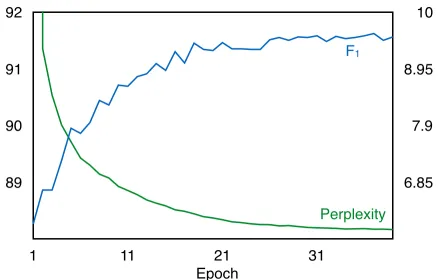
Figure 2: Perplexity and F1on the development set at each epoch during training.
n Oracle Final Exact
10 94.0 91.2 39.8
50 96.7 91.7 40.0
51o 100 93.9 49.7
100 96.3 91.7 39.9
500 97.0 91.8 40.0
Table 1: The performance of LSTM-LM (G) with varyingn-best parses on the dev set. Oracle refers to Charniak parser’s oracle F1. Final and Exact re-port LSTM-LM (G)’s F1 and exact match percent-age respectively. To simulate an optimal scenario, we include gold trees to 50-best trees and rerank them with LSTM-LM (G) (51o).
al., 2015) because in preliminary experiments Char-niak parser (CharChar-niak, 2000) performed better when trained on all of 24 million trees than when trained on resampled two million trees.
Given x, we produce Y0(x), 50-best trees, with Charniak parser and findywith LSTM-LM as Dyer
et al. (2016) do with their discriminative and gener-ative models.3
4.2 Training and Development 4.2.1 Supervision
We unk words that appear fewer than 10 times in the WSJ training (6,922 types) and drop activa-tions with probability 0.7. At the beginning of each epoch, we shuffle the order of trees in the training data. Both perplexity and F1 of LSTM-LM (G) im-prove and then plateau (Figure 2). Perplexity, the
3Dyer et al. (2016)’s discriminative model performs
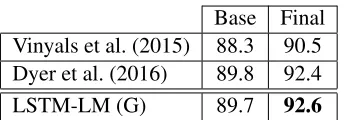
[image:3.612.357.497.244.331.2]Base Final Vinyals et al. (2015) 88.3 90.5 Dyer et al. (2016) 89.8 92.4
[image:4.612.101.273.55.115.2]LSTM-LM (G) 89.7 92.6
Table 2: F1 of models trained on WSJ. Base refers to performance of a single base parser and Final that of a final parser.
model’s training objective, nicely correlates with F1, what we care about. Training takes 12 hours (37 epochs) on a Titan X. We also evaluate our model with varyingn-best trees including optimal 51-best trees that contain gold trees (51o). As shown in Ta-ble 1, the LSTM-LM (G) is robust given sufficiently large n, i.e. 50, but does not exhibit its full capac-ity because of search errors in Charniak parser. We address this problem in Section 5.3.
4.2.2 Semi-supervision
We unk words that appear at most once in the training (21,755 types). We drop activations with probability 0.45, smaller than 0.7, thanks to many silver trees, which help regularization. We train LSTM-LM (GS) on the WSJ and a different set of 400,000 NYT trees for each epoch except for the last one during which we use the WSJ only. Training takes 26 epochs and 68 hours on a Titan X. LSTM-LM (GS) achieves 92.5 F1on the development.
5 Results
5.1 Supervision
As shown in Table 2, with 92.6 F1 LSTM-LM (G) outperforms an ensemble of five MTPs (Vinyals et al., 2015) and RNNG (Dyer et al., 2016), both of which are trained on the WSJ only.
5.2 Semi-supervision
We compare LSTM-LM (GS) to two very strong semi-supervised NN parsers: an ensemble of five MTPs trained on 11 million trees of the high-confidence corpus4(HC) (Vinyals et al., 2015); and
an ensemble of six one-to-many sequence models
4The HC consists of 90,000 gold trees, from the WSJ,
En-glish Web Treebank and Question Treebank, and 11 million sil-ver trees, whose sentence length distribution matches that of the WSJ, parsed and agreed on by Berkeley parser and ZPar.
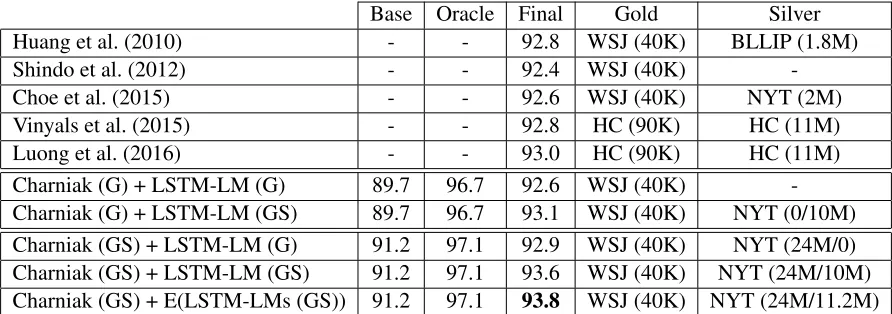
trained on the HC and 4.5 millions of English-German translation sentence pairs (Luong et al., 2016). We also compare LSTM-LM (GS) to best performing non-NN parsers in the literature. Parsers’ parsing performance along with their train-ing data is reported in Table 3. LSTM-LM (GS) out-performs all the other parsers with 93.1 F1.
5.3 Improved Semi-supervision
Due to search errors – good trees are missing in 50-best trees – in Charniak (G), our supervised and semi-supervised models do not exhibit their full po-tentials when Charniak (G) providesY0(x). To mit-igate the search problem, we tri-train Charniak (GS) on all of 24 million NYT trees in addition to the WSJ, to yield Y0(x). As shown in Table 3, both LSTM-LM (G) and LSTM-LM (GS) are affected by the quality ofY0(x). A single LSTM-LM (GS)
together with Charniak (GS) reaches 93.6 and an ensemble of eight LSTM-LMs (GS) with Charniak (GS) achieves a new state of the art, 93.8 F1. When trees are converted to Stanford dependencies,5UAS
and LAS are 95.9% and 94.1%,6 more than 1%
higher than those of the state of the art dependency parser (Andor et al., 2016). Why an indirect method (converting trees to dependencies) is more accu-rate than a direct one (dependency parsing) remains unanswered (Kong and Smith, 2014).
6 Conclusion
The generative parsing model we presented in this paper is very powerful. In fact, we see that a gen-erative parsing model, LSTM-LM, is more effec-tive than discriminaeffec-tive parsing models (Dyer et al., 2016). We suspect building large models with char-acter embeddings would lead to further improve-ment as in language modeling (Kim et al., 2016; Jozefowicz et al., 2016). We also wish to de-velop a complete parsing model using the LSTM-LM framework.
Acknowledgments
We thank the NVIDIA corporation for its dona-tion of a Titan X GPU, Tstaff of Computer Science
5Version 3.3.0.
6We use the CoNLL evaluator available through the CoNLL
Base Oracle Final Gold Silver
Huang et al. (2010) - - 92.8 WSJ (40K) BLLIP (1.8M)
Shindo et al. (2012) - - 92.4 WSJ (40K)
-Choe et al. (2015) - - 92.6 WSJ (40K) NYT (2M)
Vinyals et al. (2015) - - 92.8 HC (90K) HC (11M)
Luong et al. (2016) - - 93.0 HC (90K) HC (11M)
Charniak (G) + LSTM-LM (G) 89.7 96.7 92.6 WSJ (40K)
-Charniak (G) + LSTM-LM (GS) 89.7 96.7 93.1 WSJ (40K) NYT (0/10M)
Charniak (GS) + LSTM-LM (G) 91.2 97.1 92.9 WSJ (40K) NYT (24M/0)
Charniak (GS) + LSTM-LM (GS) 91.2 97.1 93.6 WSJ (40K) NYT (24M/10M)
[image:5.612.83.529.57.214.2]Charniak (GS) + E(LSTM-LMs (GS)) 91.2 97.1 93.8 WSJ (40K) NYT (24M/11.2M) Table 3: Evaluation of models trained on the WSJ and additional resources. Note that the numbers of Vinyals et al. (2015) and Luong et al. (2016) are not directly comparable as their models are evaluated on OntoNotes-style trees instead of PTB-OntoNotes-style trees. E(LSTM-LMs (GS)) is an ensemble of eight LSTM-LMs (GS). X/Y in Silver column indicates the number of silver trees used to train Charniak parser and LSTM-LM. For the ensemble model, we report the maximum number of trees used to train one of LSTM-LMs (GS).
at Brown University for setting up GPU machines and David McClosky for helping us train Charniak parser on millions trees.
References
Daniel Andor, Chris Alberti, David Weiss, Aliaksei Severyn, Alessandro Presta, Kuzman Ganchev, Slav Petrov, and Michael Collins. 2016. Globally normal-ized transition-based neural networks. Proceedings of the 54th Annual Meeting of the Association for Com-putational Linguistics.
Eugene Charniak. 2000. A maximum-entropy-inspired parser. In1st Meeting of the North American Chapter of the Association for Computational Linguistics. Do Kook Choe, David McClosky, and Eugene Charniak.
2015. Syntactic parse fusion. In Proceedings of the 2015 Conference on Empirical Methods in Natural Language Processing.
Chris Dyer, Adhiguna Kuncoro, Miguel Ballesteros, and Noah A Smith. 2016. Recurrent neural network gram-mars. In Proceedings of the 2016 Conference of the North American Chapter of the Association for Com-putational Linguistics: Human Language Technolo-gies.
Felix A Gers, Nicol N Schraudolph, and J¨urgen Schmid-huber. 2003. Learning precise timing with lstm re-current networks. The Journal of Machine Learning Research.
Alex Graves. 2013. Generating sequences with recurrent neural networks. arXiv preprint arXiv:1308.0850.
Michael U. Gutmann and Aapo Hyv¨arinen. 2012. Noise-contrastive estimation of unnormalized statisti-cal models, with applications to natural image statis-tics. The Journal of Machine Learning Research. Sepp Hochreiter and J¨urgen Schmidhuber. 1997. Long
short-term memory.Neural computation.
Zhongqiang Huang, Mary Harper, and Slav Petrov. 2010. Self-training with products of latent variable gram-mars. InProceedings of the 2010 Conference on Em-pirical Methods in Natural Language Processing. Rafal Jozefowicz, Wojciech Zaremba, and Ilya Sutskever.
2015. An empirical exploration of recurrent network architectures. In Proceedings of the 32nd Interna-tional Conference on Machine Learning.
Rafal Jozefowicz, Oriol Vinyals, Mike Schuster, Noam Shazeer, and Yonghui Wu. 2016. Exploring the limits of language modeling. arXiv preprint arXiv:1602.02410.
Yoon Kim, Yacine Jernite, David Sontag, and Alexan-der M. Rush. 2016. Character-aware neural language models. InProceedings of the Thirtieth AAAI Confer-ence on Artificial IntelligConfer-ence.
Lingpeng Kong and Noah A Smith. 2014. An empirical comparison of parsing methods for stanford dependen-cies. arXiv preprint arXiv:1404.4314.
Zhenghua Li, Min Zhang, and Wenliang Chen. 2014. Ambiguity-aware ensemble training for semi-supervised dependency parsing. InProceedings of the 52nd Annual Meeting of the Association for Computa-tional Linguistics.
se-quence to sese-quence learning. International Confer-ence on Learning Representations.
Mitchell P Marcus, Mary Ann Marcinkiewicz, and Beat-rice Santorini. 1993. Building a large annotated cor-pus of english: The penn treebank. Computational lin-guistics.
David McClosky, Eugene Charniak, and Mark Johnson. 2006. Effective self-training for parsing. In Proceed-ings of the Human Language Technology Conference of the NAACL.
Frederic Morin and Yoshua Bengio. 2005. Hierarchi-cal probabilistic neural network language model. In
Proceedings of the Tenth International Workshop on Artificial Intelligence and Statistics.
Robert Parker, David Graff, Junbo Kong, Ke Chen, and Kazuaki Maeda. 2011. English gigaword fifth edition.
Linguistic Data Consortium, LDC2011T07.
Razvan Pascanu, Tomas Mikolov, and Yoshua Bengio. 2013. On the difficulty of training recurrent neural net-works. InProceedings of the 30th International Con-ference on Machine Learning.
Slav Petrov. 2010. Products of random latent variable grammars. In Human Language Technologies: The 2010 Annual Conference of the North American Chap-ter of the Association for Computational Linguistics. Association for Computational Linguistics.
Vu Pham, Th´eodore Bluche, Christopher Kermorvant, and J´erˆome Louradour. 2014. Dropout improves re-current neural networks for handwriting recognition. In2014 14th International Conference on Frontiers in Handwriting Recognition.
Hiroyuki Shindo, Yusuke Miyao, Akinori Fujino, and Masaaki Nagata. 2012. Bayesian symbol-refined tree substitution grammars for syntactic parsing. In Pro-ceedings of the 50th Annual Meeting of the Association for Computational Linguistics.
Ilya Sutskever. 2013. Training recurrent neural net-works. Ph.D. thesis, University of Toronto.
Oriol Vinyals, Łukasz Kaiser, Terry Koo, Slav Petrov, Ilya Sutskever, and Geoffrey Hinton. 2015. Grammar as a foreign language. InAdvances in Neural Informa-tion Processing Systems 28.
Wojciech Zaremba, Ilya Sutskever, and Oriol Vinyals. 2014. Recurrent neural network regularization. arXiv preprint arXiv:1409.2329.