Evaluating the Reliability and Interaction of Recursively Used Feature
Classes for Terminology Extraction
Anna H¨atty
Robert Bosch GmbH Anna.Haetty@ de.bosch.com
Michael Dorna
Robert Bosch GmbH Michael.Dorna@ de.bosch.com
Sabine Schulte im Walde
IMS, University of Stuttgart schulte@
ims.uni-stuttgart.de
Abstract
Feature design and selection is a crucial aspect when treating terminology extrac-tion as a machine learning classificaextrac-tion problem. We designed feature classes which characterize different properties of terms, and propose a new feature class for components of term candidates. By using random forests, we infer optimal features which are later used to build decision tree classifiers. We evaluate our method us-ing the ACL RD-TEC dataset. We demon-strate the importance of the novel feature class for downgrading termhood which ex-ploits properties of term components. Fur-thermore, our classification suggests that the identification of reliable term candi-dates should be performed successively, rather than just once.
1 Introduction
Terms are linguistic units which characterize a specific topic domain. For example, in the area of Computational Linguistics Parsing, Machine TranslationandNatural Language Generationare candidates for single and multi-word terms. Au-tomatic Term Recognition (ATR) is the task of identifying such terms in domain-specific corpora. ATR is an Information Extraction subtask and is used i.a. for compiling dictionaries and for ontol-ogy population (Maynard et al., 2008). A typi-cal ATR system comprises two steps: First, term candidates are selected from text, e.g. by extract-ing sequences which match certain part-of-speech (POS) patterns in text (c.f. Justeson and Katz, 1995). Secondly, term candidates are scored and ranked with regard to their unithood and term-hood.
Unithood denotes to what degree a linguistic
unit is a collocation.Termhoodexpresses to which extent an expression is a term, i.e to which extent it is related to domain-specific concepts (Kagueura and Umino, 1996). Among a large number of mea-sures, association measures like Pointwise Mu-tual Information(PMI) (Church and Hanks, 1989) are used to determine unithood whereas term-document measures liketf-idf (Salton and McGill, 1986) are used to determine termhood. Such mea-sures use distinctive characteristics of terms on how they and their components are distributed within a domain or across domains.
We address term extraction as a machine learn-ing classification problem (c.f. da Silva Conrado et al., 2013). Most importantly, we focus on the interpretability of a trained classifier to understand the contributions of feature classes to the decision process. For this task, we use random forests to automatically detect the best features. These fea-tures are used to build simple decision tree classi-fiers.
For the classification, we use features based on numeric measures which are computed from oc-currences of term candidates, its components and derived symbolic information like POS tags. We call these distributional features. The advantage of relying on such features is that they are simple to compute and easy to compare. By combining machine learning with those features we get a flex-ible system which only needs little further infor-mation to be applicable on different kinds of text. In this work, we investigate the contributions of the different features to term extraction and exper-imentally test with our system if these features are mutually supportive. We also point out the limit of a system solely relying on distributional features.
The paper is organized as follows. Section 2 in-troduces related work. The data used for training and evaluation is presented in Section 3, followed by the feature selection and classification method.
Our feature classes are motivated and defined in Section 4. In Section 5, we investigate the design of our models with a subsequent presentation of experiments and evaluation results in Section 6. In Section 7, we present a second experiment with term candidates which share a component to fur-ther explore their contribution to termhood.
2 Related Work
There are several studies investigating linguistic and numeric features, machine learning or a combination of both to extract collocations or terms. Pecina and Schlesinger (2006) combined 82 association measures to extract Czech bigrams and tested various classifiers. The combination of measures was highly superior to using the best single measure. Ramisch et al. (2010) intro-duced themwetoolkitwhich identifies multi-word expressions from different domains. The tool provides a candidate extraction step in advance, descriptive features (e.g. capitalisation, prefixes) and association measures can be used to train a classifier. The latter ones are extended for multi-word expressions of indefinite length and only comprise measures which do not depend on a contingency table. Karan et al. (2012) extract bigram and trigram collocations for Croatian by relying on association measures, frequency counts, POS-tags and semantic similarities of all word pairs in an n-gram. They found that POS-tags, the semantic features and PMI work best. With regard to terms, Zhang et al. (2008) compare different measures (e.g. tf-idf) for both single- and multi-word term extraction and use a voting algorithm to predict the rank of a term. They emphasize the importance of considering unigram terms and the choice of the corpus. Foo and Merkel (2010) use RIPPER (Cohen, 1995), a rule induction learning system to extract unigram and bigram terms, by using both linguistic and numeric features. They show that the design of the ratio of positive and negative examples while training governs the output rules. Da Silva Conrado et al. (2013) investigate features for the classification of Brazilian Portuguese unigram terms. They use linguistic, statistical and hybrid features, where the context and the potential of a candidate representing a term is investigated. Regarding the features, they find tf-idf essential for all machine learning methods tested.
3 Data and Classification Method 3.1 Corpus and Gold Standard
The underlying data set for the experiments is the ACL RD-TEC 1.01, a corpus designed for the
evaluation of terminology extraction in the area of Computational Linguistics (Zadeh and Hand-schuh, 2014). It extends ACL ARC, an automati-cally segmented and POS-tagged corpus of 10,922 ACL publications from 1965 to 2006. ACL RD-TEC adds a manual annotation of 22,044 valid terms and 61,758 non-terms. The term annota-tions are further refined with a labeling of termi-nology terms which are defined as means to ac-complish a practical task, like methods, systems and algorithms used in Computational Linguistics. We take the valid terms as our gold standard terms. We cleaned the corpus by applying a language detection tool (langdetect2) to each sentence, in
order to remove sentences which are too noisy. A drawback of the corpus is that about 42,000 sentences could not be connected to a document. Thus, if no document was found for a certain term, its term-document measures were set to a default value outside of a feature’s range, or to an extreme value.
was balanced for terms and non-terms to prevent a bias in the classifier. In the first step, everything which is not marked as term is treated as non-term. We only allowed POS patterns also occurring in the term class and chose randomly to get a repre-sentative sample of non-terms. In the second step, we use the explicitly annotated non-term class. Both classifiers produce binary decision trees and an optimized version of the CART algorithm3 is
used.
As split-criterium for the decision trees we used entropy and we only allowed trees to evolve up to five levels, since otherwise they overfit. In ad-dition, trees are very difficult to understand when getting deeper than five levels and we explicitly chose decision trees because of their clear inter-pretability. For the interpretation and evaluation in the following, the construction of the final deci-sion trees for eachn-gram and their classification performances will be used.
4 Feature Classes
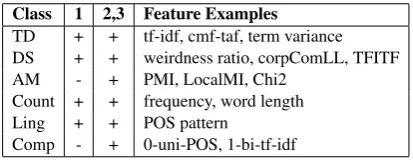
A salient attribute of terms is how they distribute in text. Our feature classes are motivated by three perspectives on that: a) measuring unithood in-volving the distribution of term candidates and their components, b) measuring termhood involv-ing candidate term distributions in different texts and c) recursively measuring unithood and term-hood of term candidate components independently of each other. Concerning the classes defined in the following, point a) is covered by the associa-tion measures, b) by term-document anddomain specificity measuresand c) by thefeatures of com-ponents. In addition, we designed count-based measuresand alinguistic featureto address unit-hood and termunit-hood. However, we expect them to be weaker than the feature classes of a) and b) since they do not relate two distributions. They merely serve for filtering, ruling out very unlikely term candidates.
Term-Document Measures (TD) The term-document measures deal with the distribution of term candidates in certain documents and contrast it to their distribution in the whole corpus. It is as-sumed that terms appear more frequently in only a few documents. We include a range of features dealing with that contrast: variants of tf-idf (Salton and McGill, 1986), i.e. tf-idf (without logarithm),
3http://scikit-learn.org/stable/
modules/tree.html#tree
tf-logged-idf for the document in which the term candidate occurs most often. Furthermore, cor-pus maximum frequencyandcorpus maximum fre-quency & term average frefre-quency (cmf-taf)as de-fined in Tilley (2008), andterm varianceandterm variance qualityas described in Liu et al. (2005) are used. Da Silva Conrado et al. (2013) describe the latter features as useful for term extraction. In addition, we experimented with features describ-ing the relative occurrence of a term in a document or the corpus. For example, the percentiles of doc-ument or corpus frequencies are used as features, to which the frequency of the term under consid-eration can be assigned. Another example is the percentile of the document with the term candi-date’s first position. In the later experiments, these features are assigned little weight by the classifiers which is why we will not go into further detail re-garding them.
Domain Specificity Measures (DS) Measures of domain specificity treat the occurrence of a term in a general corpus and relate it to its occurrence in a domain-specific one. As domain-specific cor-pus, we simply chose the document with the most frequent occurrence of a term candidate. By do-ing that, the problem is omitted that the vocab-ulary of these corpora differs too drastically due to aspects of style. As features weirdness ra-tio for domain specificity, corpora-comparing log-likelihood (corpComLL), term frequency inverse term frequency (TFITF)andcontrastive selection of multi-word terms (CSmw) are used (as defined in Sch¨afer et al., 2015).
Association Measures (AM) Association mea-sures express how strongly words are associated in a complex expression, they measure unithood. 27 association measures defined in Evert (2005) were computed for bigrams, for example Local Mu-tual Information (LocalMI)andMaximum Likeli-hood Estimation (MLE). For trigrams, we selected nine association measures (MLE, PMI, Dice, T-score, Poisson-Stirling, Jaccard, χ2, Simple Log Likelihood and true MI) which are described as useful for trigram association in Lyse and Ander-sen (2012), Ramisch et al. (2010) and the nltk -documentation4.
Count-based Measures (Count) Wermter and Hahn (2006) compare co-occurrence frequencies
and association measures and show that not asso-ciation measures but only linguistically motivated features outperform frequency counts for colloca-tion and terminology extraccolloca-tion. Therefore fre-quenciesof the term candidates are included in the feature set. As described, we do not consider them as being as powerful as association measures (and they only play a minor role in our later models). The second count-based measure isword length. Linguistic Feature (Ling) As linguistic feature, Part-Of-Speech-tags (POS) of the candidates are used to represent distributions over POS patterns. Features of Components (Comp) The compo-nents of a term phrase have frequently played a role in termhood extraction (e.g. Nakagawa and Mori, 2003; Zhang et al., 2012). Our approach dif-fers from the previous ones by adding all feature information of the candidate term components to the candidates’s feature set. I.e., for bigrams the features of its unigrams, and for trigrams the fea-tures of its uni- and bigrams are included. The features will be characterized with the follow-ing scheme: [POSITION IN TERM]-[COMPONENT IS A UNI- OR BIGRAM]-[FEATURE]. Examples would be0-uni-CSmwdenoting the CSmw-feature for the first word X in bigram XY or 1-bi-CSmw denoting the CSmw-feature for second bigram YZ in trigram XYZ. 1-bi-POS != NN NN expresses that the second bigram YZ in trigram XYZ does not consist of nouns.
Class 1 2,3 Feature Examples
TD + + tf-idf, cmf-taf, term variance DS + + weirdness ratio, corpComLL, TFITF AM - + PMI, LocalMI, Chi2
Count + + frequency, word length Ling + + POS pattern
[image:4.595.309.523.63.207.2]Comp - + 0-uni-POS, 1-bi-tf-idf
Table 1: Overview of Feature Classes
An overview of the classes is given in Table 1. The labels 1, 2 and 3 in the table denote uni- to trigrams,+and-express if a class can be applied or not. For unigram terms (SWT) not all feature classes can be applied.
5 Inspecting the Models
[image:4.595.78.285.494.574.2]Combining all previously mentioned features with our classification method (i.e. unigrams, bigrams and trigrams) provides three decision trees. For
Figure 1: Decision Tree for Unigrams
ease of visualization and interpretation, only the first three decision levels are shown in the follow-ing figures (Figures 1 to 3). The tree is only al-lowed to evolve further if the distinction between terms and non-terms could not be made to that point. Furthermore, splitting a node is stopped if there are less than 10 elements in a leaf for one of the classes (even if the tree limit has not been reached yet).
Unigrams The decision tree for unigram classi-fication based on 1608 unigram terms and non-terms is shown in Figure 1. Term variance qual-ity and term variance best classify terms; In the resulting leaf node (rightmost node) 90% of the 324 elements are correct terms. When looking at the false positives in that node, it is striking that the few non-terms remaining in that class are un-expectedly ”usual” (’czech’, ’newspaper’, ’chain’, ’travel’, ’situation’). The reason for this unex-pected classification might result from the context in which the study is conducted: there might be papers which are limited to Czech data or only to newspaper texts.
Figure 2: Decision Tree for Bigrams
Figure 3: Decision Tree for Trigrams
significant the termhood measures are.
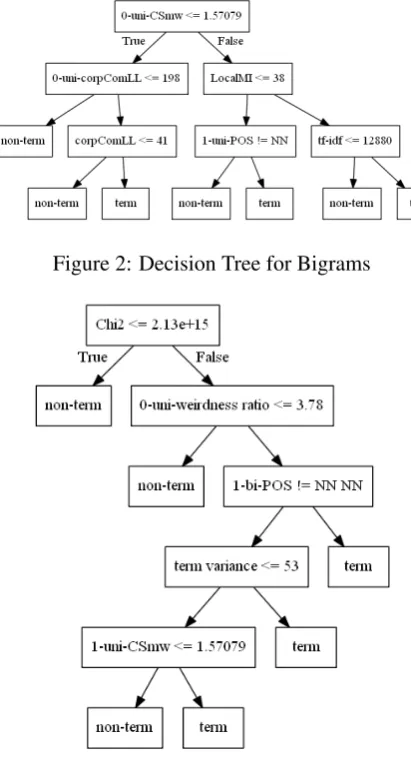
Bigrams The decision tree for the 10,562 ex-tracted bigram candidates is depicted in Figure 2. Features for the first component like 0-uni-CSmw are good indicators for termhood. When inspecting how the bigrams are distinguished by the root node it seems that if the first word of a bigram is a general-language word, the whole bi-gram is unlikely to be a term. There are quite ob-vious examples likethis specification, the parser, a hurry or another expression but also more in-teresting ones likeearlier paper, particular clus-terorgeneral scheme. Nevertheless, in other term leaves there are still quite a few expressions whose first words are not terminological (e.g.simple for-malism, common description, good hypothesis), so there is still room for improvement.
Trigrams The decision tree for trigram classifi-cation of 1706 trigram candidates is shown in
Fig-ure 3. The association measFig-ureχ2(Pearson’s chi-squared test; c.f. Evert, 2005) is by far the most important feature here and the sets are nearly com-pletely distinguished by that feature. Thus, unit-hood nearly merges to termunit-hood here. Besides that, it is again striking that expressions with non-terminological first components are ruled out cor-rectly by the system, e.g.,possible syntactic cate-gory, other natural language, new grammar for-malism. There are also misclassifications (false negatives) like first order logic. The rightmost path produces the purest right-most node com-pared to all previous ones for uni- and bigrams: 94% of the 636 elements are correct terms. Comparison Across the decision trees differ-ent features dominate the tree, which shows that uni-, bi- and trigram terms behave differently and should be treated differently. Nevertheless, they have in common that the trees are dominated by termhood and unithood features and that features for filtering noise like POS patterns and word length occur lower in the tree. This supports the already mentioned claim that several filtering steps should be performed at different stages of the clas-sification. As a second commonality, the trees combine features from various classes in their first decision steps. Especially in the rightmost path, in which terms are separated best in the experi-ments, term-document measures, association mea-sures and domain-specificity meamea-sures of compo-nents are combined. This shows that features from different feature classes interact for achieving a good result.
6 Experiments and Results
Our system is implemented in Python. For the classifications, we used the RandomForestClassi-fier and the DecisionTreeClassifier which are in-cluded in the Python module sklearn (Pedregosa et al., 2011).
Baselines For each n-gram class, the best-working feature is chosen as a baseline. These are the root nodes of the decision trees for all features because these ones are chosen first, given that they make the best decision. The baselines are term variance qualityfor unigrams,0-uni-CSmwfor bi-grams andChi2for trigrams.
are separately trained for each feature class. We do 10-fold cross-validation with a balanced set of terms and non-terms in every step. The perfor-mances of the different classes for unigrams, bi-grams and tribi-grams are shown in Table 2. When considering the overall results (F1-score), it is striking that for bigrams and trigrams the com-ponent features (Comp) achieve the best score, middle-ranking groups are the count-based fea-tures (Count) and the linguistic feature (Ling), and the term-document (TD) and domain-specific fea-tures (DS) are in the lower area. This is quite a sur-prising result since these are the termhood features and therefore the ones to be expected to perform best. For unigrams, in contrast, term-document features and domain specificity are good indica-tors for classification. However, when consider-ing precision, the domain specificity features lag behind. They do not seem to be competitive to term-document metrics in that respect. All in all, domain specificity features do not reach the ex-pected performance here. This is an interesting re-sult because when the domain specificity features are used for the components of ann-gram they ap-pear in the upper part of the tree. We conclude that the features for domain specificity applied to components receive the unexpected application of downgrading the termhood of a term candidate if a component under consideration is unlikely to be terminological.
Feat. Class TD DS Assoc Count Ling Comp
Unigrams
Precision 0.75 0.67 - 0.73 0.63
-Recall 0.71 0.73 - 0.66 0.81
-F1-Score 0.72 0.70 - 0.69 0.70
-Bigrams
Precision 0.72 0.65 0.72 0.73 0.67 0.73
Recall 0.71 0.79 0.65 0.79 0.88 0.88
F1-Score 0.71 0.71 0.68 0.76 0.76 0.80
Trigrams
Precision 0.67 0.59 0.85 0.75 0.80 0.88
Recall 0.72 0.72 0.96 0.82 1.0 0.97
F1-Score 0.69 0.65 0.90 0.78 0.89 0.92
Table 2: Precision, Recall and F1-Scores for Fea-ture Classes
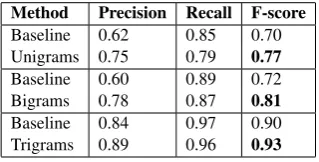
Evaluating All Features As a last step, we evaluate if the combination of different features outperforms the best single feature. For that we do 10-fold cross-validation with a balanced set of terms and non-terms in every step. The results are shown in Table 3. All systems which combine features outperform the baselines. In
addition, they also outperform the best systems which only use one feature class at a time (Table 2). All these improvements are significant, 5
except for the comparison of the overall model for trigrams to the model of its best-working class (features of components). This shows that a combination is not only superior to a baseline but also information from several classes is needed. Term recognition works best for trigrams and is most difficult for unigrams.
Method Precision Recall F-score
Baseline 0.62 0.85 0.70 Unigrams 0.75 0.79 0.77
Baseline 0.60 0.89 0.72 Bigrams 0.78 0.87 0.81
[image:6.595.337.497.220.301.2]Baseline 0.84 0.97 0.90 Trigrams 0.89 0.96 0.93
Table 3: Results
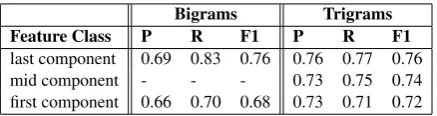
7 The Relevance of the Component Class In the previous experiments we investigated how terms can be distinguished from candidates in the scientific text which are restricted by POS but which are otherwise randomly chosen. For bi-grams and tribi-grams, the component class performs best. Since the components of candidate terms seem to have a major influence on their termhood, we further investigate the components. For that, candidates are not chosen randomly anymore, but are taken from the class explicitly annotated as non-terms by Zadeh and Handschuh (2014). The reason for this is that the elements of the pro-vided annotated term and non-term expressions have identical components in many cases. Like that term candidates with components which are not uniquely terminological or non-terminological are used for training the classifier. Subsets of the classes are compared three times: Only those ele-ments are allowed where either the first, the sec-ond or the third component (in case of trigrams) appears in both classes. The results are presented in Table 4.
The results indicate that a clearly terminological or non-terminological first component has more effect on the termhood of the whole expression than for the last component. If the first compo-nent is fixed and thus is not relevant for scoring termhood, results decrease.
Bigrams Trigrams
Feature Class P R F1 P R F1
[image:7.595.74.293.62.120.2]last component 0.69 0.83 0.76 0.76 0.77 0.76 mid component - - - 0.73 0.75 0.74 first component 0.66 0.70 0.68 0.73 0.71 0.72
Table 4: Results for identical elements for differ-ent compondiffer-ents in term- and non-term class
This is also reflected in the decision trees: For identical heads, the most important feature is the component feature of the first unigram and of the first bigram. For identical modifiers no component feature is chosen as most important feature.
8 Discussion and Future Work
There are two main points why a system like ours only based on distributions reaches its limit. One aspect is the unexpected fluctuations of general-language terms shown especially for unigram term extraction. We found words being classified as terms because they often appear in the context of a special experimental setting. Secondly, our re-sults show that it is harder for such a system to dis-tinguish term candidates with shared components than to distinguish terms from a representative part of the other in-domain text as done in the first ex-periment (Table 3 vs. Table 4).
However, the advantages of our model suggest that it can be applied to extract terms from forum text, a topic which has not received much atten-tion yet. The informaatten-tion used in the model, the features and their application on components of the term candidates, can be easily computed on the text and additional resources are not neces-sarily needed. Another advantage of our model is that it is dynamic. Uni-, bi- and trigrams are quite different in nature which is reflected in the models. It filters improbable term candidates by making several decision steps adapted to the data seen in training. Thus, we might not need a pre-processing step to filter good candidates. In both experiments, with and without an explicitly anno-tated non-term class, applying the features to com-ponents of the candidates improves the extraction. We find that especially the features for the first parts, mostly the modifier, are good dividers for the term and the non-term class. Since the number of non-terminologic modifiers (like judging adjec-tives) will be higher in forum texts, this aspect will be a further advantage.
9 Conclusion
In this work, term extraction was approached as a classification problem using uni-, bi- and trigram term candidates. We used a decision tree classi-fier to model term recognition with focus on the distribution of terms and of its components in text. Different classifier setups were compared: classi-fiers for the single best feature, different feature classes and a combination of all features. In each of those steps classification improves. Neither a feature class nor a special feature constantly dom-inates the classification in all models. The con-struction of the decision trees reveals that there is an interaction of features of different classes. Fea-tures from the most adequate classes to recognize terms, i.e. features which measure termhood and unithood, interact to find the purest term class. The resulting decision trees from the experiments indicate that there should not be a rigid pipeline of two steps, where candidate extraction and filter-ing noise comes first, and subsequently the terms should be scored and ranked. Our results indicate that there should rather be an on-demand filter-ing step, where filterfilter-ing is performed successively during the classification and the threshold for rul-ing out extremely unlikely candidates is adjusted to the decisions made before.
The most interesting finding is that measures of domain specificity perform unexpectedly low for bigram and trigram recognition but when being applied to their unigram components they appear in the upper parts of the tree. When looking into the data, the reason for this seems to be that there is a downgrading of multi-word term candidate phrases (bigrams and trigrams) if a component (preferably the first) is too common to belong to a term. A second experiment, in which we compare term candidates with shared components confirms this finding. The components of terms are ad-dressed in several studies (Erbs et al, 2015; Frantzi el al., 2000; Nakagawa and Mori,2003; Zhang et al., 2012), but to our knowledge this aspect of termhood has not been considered yet.
References
Leo Breiman, Jerome Friedman, Richard Olshen, and Charles Stone. 1984. Classification and Regression Trees. Wadsworth Publishing Company, Belmont, CA.
Leo Breiman. 2001. Random Forests. Machine Learn-ing, 45(1):5-32.
Kenneth W. Church and Patrick Hanks. 1990. Word Association Norms, Mutual Information, and Lexi-cography. InProceedings of the 27th Annual Meet-ing of the Association for Computational LMeet-inguis- Linguis-tics, pages 76-83, Vancouver, British Columbia, Canada.
Jonathan Cohen. 1995. Highlights: Language- and Domain-Independent Automatic Indexing Terms for Abstracting. Journal of the Association for Informa-tion Science and Technology, 46(3):162-174. Merley da Silva Conrado, Thiago S. Pardo, and
Solange O. Rezende. 2013. A Machine Learn-ing Approach to Automatic Term Extraction usLearn-ing a Rich Feature Set. In Proceedings of the 2013 NAACL HLT Student Research Workshop, pages 16-23, Atlanta, Georgia.
Nicolai Erbs, Pedro B. Santos, Torsten Zesch and Iryna Gurevych. 2015. Counting What Counts: Decom-pounding for Keyphrase Extraction. inProceedings of the ACL 2015 Workshop on Novel Computational Approaches to Keyphrase Extraction, pages 10–17, Beijing, China.
Stefan Evert. 2005. The Statistics of Word Cooccur-rences: Word Pairs and Collocations. Dissertation, Institut f¨ur maschinelle Sprachverarbeitung, Univer-sity of Stuttgart.
Jody Foo and Magnus Merkel. 2010. Using Ma-chine Learning to Perform Automatic Term Recog-nition. InProceedings of the 7th LREC - Workshop on Methods for Automatic Acquisition of Language Resources and their Evaluation Methods, pages 49– 54, Malta.
Katerina Frantzi, Sophia Ananiadou and Hideki Mima. 2000. Automatic Recognition of Multiword-Terms: the C-value/NC-value Method. International Jour-nal on Digital Libraries, 3(2): 115-130.
John Justeson and Slava Katz. 1995. Technical Ter-minology: some Linguistic Properties and an Algo-rithm for Identification in Text. Natural Language Engineering, 1(1):9-27.
Kyo Kagueura and Bin Umino. 1996. Methods of Au-tomatic Term Recognition: A Review. Terminology, 3(2): 259-289.
Mladen Karan, Jan ˇSnajder and Bojana D. Baˇsi´c. 2012. Evaluation of Classification Algorithms and Fea-tures for Collocation Extraction in Croatian. In
Proceedings of Eighth International Conference on
Language Resources and Evaluation (LREC’12), pages 657–662, Istanbul, Turkey.
Luying Liu, Jianchu Kang, Jing Yu, and Zhongliang Wang. 2005. A Comparative Study on Unsuper-vised Feature Selection Methods for Text Cluster-ing. In Proceedings of International Conference on Natural Language Processing and Knowledge Engineering (IEEE NLP-KE’05), pages 597–601, Wuhan, China.
Gunn I. Lyse and Gisle Andersen. 2012. Collocations and Statistical Analysis of n-grams: Multiword Ex-pressions in Newspaper Text. Exploring Newspaper Language: Using the Web to Create and Investigate a Large Corpus of Modern Norwegian, Studies in Corpus Linguistics, pages 79–109, John Benjamins Publishing, Amsterdam, Netherlands.
Diana Maynard, Yaoyong Li and Wim Peters. 2003. NLP Techniques for Term Extraction and Ontology Population. InProceedings of the 2008 conference on Ontology Learning and Population: Bridging the Gap between Text and Knowledge, pages 107–127, IOS Press, Amsterdam, Netherlands.
Hiroshi Nakagawa and Tatsunori Mori. 2003. Auto-matic Term Recognition based on Statistics of Com-pound Nouns and their Components. Terminology, 9(2):201–219.
Pavel Pecina and Pavel Schlesinger. 2006. Combining Association Measures for Collocation Extraction. In
Proceedings of the COLING/ACL 2006 Main Con-ference Poster Sessions, pages 651–658, Sydney, Australia.
Fabian Pedregosa, Gael Varoquaux, Alexandre Gram-fort, Vincent Michel, Bertrand Thirion, Olivier Grisel, Mathieu Blondel, Peter Prettenhofer, Ron Weiss, Vincent Dubourg, Jake Vanderplas, Alexan-dre Passos, David Cournapeau, Matthieu Brucher, Matthieu Perrot, and Edouard Duchesnay. 2011. Scikit-learn: Machine Learning in Python. Journal of Machine Learning Research, 12:2825–2830. Carlos Ramisch, Aline Villavicencio, and Christian
Boitet. 2010. mwetoolkit: a Framework for Mul-tiword Expression Identification. In Proceedings of the Seventh conference on International Lan-guage Resources and Evaluation (LREC’10), Val-letta, Malta.
Gerard Salton and Michael McGill. 1986. Introduc-tion to Modern InformaIntroduc-tion Retrieval. McGraw-Hill, Inc., New York, NY, USA.
Johannes Sch¨afer, Ina R¨osiger, Ulrich Heid and Michael Dorna. 2015. Evaluating Noise Reduc-tion Strategies for Terminology ExtracReduc-tion (TIA’15). InProceedings of Terminology and Artificial Intelli-gence, pages 123–131, Granada, Spain.
Joachim Wermter and Udo Hahn. 2006. You Can’t Beat Frequency (Unless You Use Linguistic Knowl-edge) - A Qualitative Evaluation of Association Measures for Collocation and Term Extraction. In
Proceedings of the 21st International Conference on Computational Linguistics and 44th Annual Meet-ing of the Association for Computational LMeet-inguis- Linguis-tics, pages 785-792, Sydney, Australia.
Behrang Q. Zadeh and Siegfried Handschuh. 2014. The ACL RD-TEC: A Dataset for Benchmarking Terminology Extraction and Classification in Com-putational Linguistics. InProceedings of the 4th In-ternational Workshop on Computational Terminol-ogy (Computerm), pages 52-63, Dublin, Ireland. Ziqi Zhang, Jos´e Iria, Christopher Brewster and Fabio
Ciravegna 2008. A Comparative Evaluation of Term Recognition Algorithms. In Proceedings of the Sixth Conference on International Language Re-sources and Evaluation (LREC’08), pages 2108-2113, Marrakech, Morocco.