Joining Hands: Exploiting Monolingual Treebanks for Parsing of
Code-mixing Data
Irshad Ahmad Bhat, Riyaz Ahmad Bhat, Manish Shrivastava and Dipti Misra Sharma
LTRC, IIIT-H, Hyderabad, India
{irshad.bhat,riyaz.bhat,m.shrivastava,dipti}@iiit.ac.in
Abstract
In this paper, we propose efficient and less resource-intensive strategies for pars-ing of code-mixed data. These strategies are not constrained by in-domain anno-tations, rather they leverage pre-existing monolingual annotated resources for train-ing. We show that these methods can pro-duce significantly better results as com-pared to an informed baseline. Besides, we also present a data set of 450 Hindi and English code-mixed tweets of Hindi mul-tilingual speakers for evaluation. The data set is manually annotated with Universal Dependencies.
1 Introduction
Code-switching or code-mixing is a sociolin-guistic phenomenon, where multilingual speak-ers switch back and forth between two or more common languages or language varieties in a
single utterance1. The phenomenon is mostly
prevalent in spoken language and in informal set-tings on social media such as in news groups, blogs, chat forums etc. Computational model-ing of code-mixed data, particularly from social media, is presumed to be more challenging than monolingual data due to various factors. The main contributing factors are non-adherence to a standard grammar, spelling variations and/or back-transliteration. It has been generally ob-served that traditional NLP techniques perform miserably when processing code-mixed language data (Solorio and Liu, 2008b; Vyas et al., 2014; C¸etino˘glu et al., 2016).
1For brevity, we will not differentiate between intra- and inter-sentential mixing of languages and use the terms code-mixing and code-switching interchangeably throughout the paper.
More recently, there has been a surge in stud-ies concerning code-mixed data from social media (Solorio and Liu, 2008a; Solorio and Liu, 2008a; Vyas et al., 2014; Sharma et al., 2016; Rudra et al., 2016; Joshi et al., 2016, and others). Besides these individual research articles, a series of shared-tasks and workshops on preprocessing and shallow syntactic analysis of code-mixed data have also been conducted at multiple venues such as Em-pirical Methods in NLP (EMNLP 2014 and 2016), International Conference on NLP (ICON 2015 and 2016) and Forum for Information Retrieval Evalu-ation (FIRE 2015 and 2016). Most of these works are an attempt to address preprocessing issues– such as language identification and transliteration– that any higher NLP application may face in pro-cessing such data.
Due to paucity of annotated resources in code-mixed genre, the performance of monolingual parsing models is yet to be evaluated on code-mixed structures. This paper serves to fill this gap by presenting an evaluation set annotated with de-pendency structures. Besides, we also propose dif-ferent parsing strategies that exploit nothing but the pre-existing annotated monolingual data. We show that by making trivial adaptations, monolin-gual parsing models can effectively parse code-mixed data.
2 Parsing Strategies
We explore three different parsing strategies to parse code-mixed data and evaluate their perfor-mance on a manually annotated evaluation set. These strategies are distinguished by the way they use pre-existing treebanks for parsing code-mixed data.
• Monolingual: The monolingual method uses
two separate models trained from the respective
monolingual treebanks of the languages which are present in the code-mixed data. We can use the monolingual models in two different ways. Firstly, we can parse each code-mixed sentence by intelligently choosing the monolin-gual model based on the matrix language of
the sentence.2 A clear disadvantage of this
method is that the monolingual parser may not accurately parse those fragments of a sentence which belong to a language unknown to the model. Therefore, we consider this as the base-line method. Secondly, we can base-linearly interpo-late the predictions of both monolingual models at the inference time. The interpolation weights are chosen based on the matrix language of each parsing configuration. The interpolated oracle output is defined as:
y= argmax(λm∗f(φ(cm))+
(1−λm)∗f(φ(cs))) (1)
where f(·) is a softmax layer of our neural
parsing model, φ(cm) and φ(cs) are the
fea-ture functions of the matrix and subordinate
lan-guages respectively andλmis the interpolation
weight for the matrix language (see Section§5
for more details on the parsing model).
Instead of selecting the matrix language at sen-tence level, we define the matrix language in-dividually for each parsing configuration. We define the matrix language of a configuration based on the language tags of top 2 nodes in the stack and buffer belonging to certain syntactic categories such as adposition, auxiliary, particle and verb.
• Multilingual:In the second approach, we train
a single model on a combined treebank of the languages represented in the code-mixed data. This method has a clear advantage over the baseline Monolingual method in that it would be aware of the grammars of both languages of the code-mixed data. However, it may not be able to properly connect the fragments of two languages as the model lacks evidence for such mixed structures in the augmented data. This would particularly happen if the code-mixed languages are typologically diverse.
2In any code-mixed utterance, the matrix language defines the overall grammatical structure of an utterance, while sub-ordinate language represents any individual words or phrases embedded in the matrix language. We use a simple count-based approach to identify the matrix and subordinate lan-guages of a code-mixed sentence.
Moreover, training a parsing model on aug-mented data with more diverse structures will worsen the structural ambiguity problem. But we can easily circumvent this problem by in-cluding token-level language tag as an addi-tional feature in the parsing model (Ammar et al., 2016).
• Multipass:In the Multipass method, we train
two separate models like the Monolingual method. However, we apply these models on the code-mixed data differently. Unlike Mono-lingual method, we use both models simultane-ously for each sentence and pass the input to the models twice. There are two possible ways to accomplish this. We can first parse all the frag-ments of each language using their respective parsing models one by one and then the root nodes of the parsed fragments would be parsed by the matrix language parsing model. Or, we can parse the subordinate language first and then parse the root of the subordinate fragments with the fragments of matrix language using the ma-trix language parser. In both cases, monolingual parsers would not be affected by the cross guage structures. More importantly, matrix lan-guage parser in the second pass would be unaf-fected by the internal structure of the subordi-nate language fragments. But there is a caveat, we need to identify the code-mixed fragments accurately, which is a non-trivial task. In this paper, we use token-level language information to segment tweets into subordinate or matrix language fragments.
3 Code-mixed Dependency Annotations To the best of our knowledge, there is no avail-able code-mixed data set that contains dependency annotations. There are, however, a few available code-mixed data sets that provide annotations re-lated to language of a token, its POS and chunk tags. For an intrinsic evaluation of our parsing models on code-mixed texts, we manually an-notated a data set of Hindi-English code-mixed tweets with dependency structures. The code-mixed tweets were sampled from a large set of tweets of Indian language users that we crawled
from Twitter using Tweepy3–a Twitter API
wrap-per. We used a language identification system
(see§4) to filter Hindi-English code-mixed tweets
from the crawled Twitter data. Only those tweets
were selected that satisfied a minimum ratio of 30:70(%) code-mixing. From this data set, we manually selected 450 tweets for annotation. The selected tweets are thoroughly checked for code-mixing ratio. While calculating the code-code-mixing ratio, we do not consider borrowings from En-glish as an instance of code-mixing. For POS tagging and dependency annotation, we used Uni-versal dependency guidelines (De Marneffe et al., 2014), while language tags are assigned based on the tagset defined in (Solorio et al., 2014; Jamatia et al., 2015). The annotations are split into test-ing and tuntest-ing sets for evaluation and tuntest-ing of our models. The tuning set consists of 225 tweets
(3,467 tokens) with amixing ratioof 0.54 and the
testing set contains 225 tweets (3,322 tokens) with amixing ratioof 0.53. Heremixing ratiois defined as:
1 n
n
X
s=1 Hs
Hs+Es (2)
wherenis the number of sentences in the data
set,HsandEsare the number of Hindi words and
English words in sentencesrespectively.
4 Preprocessing
The parsing strategies that we discussed above for code-mixed texts heavily rely on language identi-fication of individual tokens. Besides we also need normalization of non-standard word forms preva-lent in code-mixed social media content and back-transliteration of Romanized Hindi words. Here we discuss both preprocessing steps in brief.
Language Identification We model language
identification as a classification problem where each token needs to be classified into one of the following tags: ‘Hindi’ (hi), ‘English’ (en), ‘Acronym’ (acro), ‘Named Entity’ (ne) and ‘Uni-versal’ (univ). For this task, we use the feed-forward neural network architecture of Bhat et al.
(2016)4 proposed for Named Entity extraction in
code mixed-data of Indian languages. We train the network with similar feature representations
on the data set provided in ICON 20155 shared
task on language identification. The data set con-tains 728 Facebook comments annotated with the five language tags noted above. We evaluated the
4Due to space limitation we don’t discuss the system ar-chitecture in detail. The interested reader can refer to the original paper for a detailed description.
5http://ltrc.iiit.ac.in/icon2015/
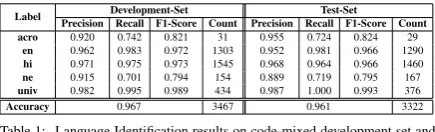
predictions of our identification system against the gold language tags in our code-mixed develop-ment set and test set. Even though the model is trained on a very small data set, its prediction ac-curacy is still above 96% for both the development set and the test set. The results are shown in Table 1.
Normalization and Transliteration We model
the problem of both normalization and back-transliteration of (noisy) Romanized Hindi words as a single transliteration problem. Our goal is to learn a mapping for both standard and non-standard Romanized Hindi word forms to their respective standard forms in Devanagari. For this purpose, we use the structured perceptron of Collins (Collins, 2002) which optimizes a given loss function over the entire observation sequence. For training the model, we use the translitera-tion pairs (87,520) from the Libindic
transliter-ation project6 and Brahmi-Net (Kunchukuttan et
al., 2015) and augmented them with noisy translit-eration pairs (63,554) which are synthetically gen-erated by dropping non-initial vowels and replac-ing consonants based on their phonological prox-imity. We use Giza++ (Och and Ney, 2003) to character align the transliteration pairs for train-ing.
At inference time, our transliteration model would predict the most likely word form for each input word. However, the single-best output from the model may not always be the best option con-sidering an overall sentential context. Contracted word forms in social media content are quite of-ten ambiguous and can represent different stan-dard word forms such as ‘pt’ may refer to ‘put’, ‘pit’, ‘pat’, ‘pot’ and ‘pet’. To resolve this ambi-guity, we extract n-best transliterations from the transliteration model using beam-search decod-ing. The best word sequence is then decoded
using an exact search over bn word sequences7
scored by a tri-gram language model. The lan-guage model is trained on monolingual data us-ing IRSTLM-Toolkit (Federico et al., 2008) with Kneser-Ney smoothing. For English, we use a similar model for normalization which we trained on the noisy word forms (3,90,000) synthetically generated from the English vocabulary.
6https://github.com/libindic/indic-trans
Label Precision Recall F1-Score Count Precision Recall F1-Score CountDevelopment-Set Test-Set acro 0.920 0.742 0.821 31 0.955 0.724 0.824 29
en 0.962 0.983 0.972 1303 0.952 0.981 0.966 1290
hi 0.971 0.975 0.973 1545 0.968 0.964 0.966 1460
ne 0.915 0.701 0.794 154 0.889 0.719 0.795 167
univ 0.982 0.995 0.989 434 0.987 1.000 0.993 376
[image:4.595.72.290.62.128.2]Accuracy 0.967 3467 0.961 3322 Table 1: Language Identification results on code-mixed development set and test set.
5 Experimental Setup
The parsing experiments reported in this paper are conducted using a non-linear neural network-based transition system which is similar to (Chen and Manning, 2014). The models are trained on Universal Dependency Treebanks of Hindi and English released under version 1.4 of Universal Dependencies (Nivre et al., 2016).
Parsing Models Our parsing model is based
on transition-based dependency parsing paradigm (Nivre, 2008). Particularly, we use an arc-eager transition system (Nivre, 2003). The arc-eager system defines a set of configurations for a
sen-tencew1,...,wn, where each configurationC= (S,
B, A) consists of a stack S, a buffer B, and a
set of dependency arcsA. For each sentence, the
parser starts with an initial configuration whereS=
[ROOT],B= [w1,...,wn] andA=∅and terminates
with a configuration Cif the buffer is empty and
the stack contains the ROOT. The parse trees
de-rived from transition sequences are given byA. To
derive the parse tree, the arc-eager system defines
four types of transitions (t): 1) Shift, 2) Left-Arc,
3) Right-Arc, and 4) Reduce.
Similar to (Chen and Manning, 2014), we use a non-linear neural network to predict the transi-tions for the parser configuratransi-tions. The neural net-work model is the standard feed-forward neural network with a single layer of hidden units. We use 200 hidden units and RelU activation func-tion. The output layer uses softmax function for probabilistic multi-class classification. The model is trained by minimizing cross entropy loss with
an l2-regularization over the entire training data.
We also use mini-batch Adagrad for optimization (Duchi et al., 2011) and apply dropout (Hinton et al., 2012).
From each parser configuration, we extract fea-tures related to the top four nodes in the stack, top four nodes in the buffer and leftmost and rightmost children of the top two nodes in the stack and the leftmost child of the top node in the buffer.
POS Models We train POS tagging models
us-ing a similar neural network architecture as
dis-cussed above. Unlike (Collobert et al., 2011), we do not learn separate transition parameters. In-stead we include the structural features in the in-put layer of our model with other lexical and non-lexical units. We use second-order structural fea-tures, two words to either side of the current word, and last three characters of the current word.
We trained two POS tagging models:
Mono-lingualandMultilingual. In the Monolingual ap-proach, we divide each code-mixed sentence into contiguous fragments based on the language tags assigned by the language identifier. Words with language tags other than ‘Hi’ and ‘En’ (such as univ, ne and acro) are merged with the preced-ing fragment. Each fragment is then individually tagged by the monolingual POS taggers trained on their respective monolingual POS data sets. In the Multilingual approach, we train a single model on combined data sets of the languages in the code-mixed data. We concatenate an additional 1x2
vector8 in the input layer of the neural network
representing the language tag of the current word. Table 2 gives the POS tagging accuracies of the two models.
Model LID HINDevelopment-SetENG Total HIN Test-SetENG Total
Monolingual GA 0.849 0.903 0.873 0.832 0.889 0.8600.841 0.892 0.866 0.825 0.883 0.853
Multilingual GA 0.835 0.903 0.867 0.798 0.892 0.8430.830 0.900 0.862 0.790 0.888 0.836
Table 2: POS Tagging accuracies for monolingual and multilingual models. LID = Language tag, G = Gold LID, A = Auto LID.
Word Representations For both POS tagging
and parsing models, we include the lexical fea-tures in the input layer of the Neural Network using the pre-trained word representations while for the non-lexical features, we use randomly
initialized embeddings within a range of −0.25
to +0.25.9 We use Hindi and English monolin-gual corpora to learn the distributed representa-tion of the lexical units. The English monolingual data contains around 280M sentences, while the Hindi data is comparatively smaller and contains around 40M sentences. The word representations are learned using Skip-gram model with negative
sampling which is implemented in word2vec
toolkit (Mikolov et al., 2013). For multilingual models, we use robust projection algorithm of Guo et al. (2015) to induce bilingual representations
8In our experiments we fixed these to be{-0.25,0.25}for Hindi and{0.25,-0.25}for English
Gold (POS + language tag) Auto (POS + language tag)
Data-set Monolingual Interpolated Multilingual Multipassf Multipasss Monolingual Interpolated Multilingual Multipassf Multipasss UAS LAS UAS LAS UAS LAS UAS LAS UAS LAS UAS LAS UAS LAS UAS LAS UAS LAS UAS LAS CMd 60.77 49.24 74.62 64.11 75.77 65.32 69.37 58.83 70.23 59.64 55.80 43.36 68.24 56.07 67.71 55.18 63.34 52.22 64.60 53.03 CMt 60.05 48.52 74.40 63.65 74.16 64.11 68.54 57.87 69.12 58.64 54.95 43.03 65.14 54.00 66.18 54.40 62.37 51.11 63.74 52.34 HINt 93.29 90.60 92.61 89.64 91.96 88.46 93.29 90.60 93.29 90.60 91.92 88.39 91.82 88.34 89.52 84.83 91.92 88.39 91.92 88.39 ENGt 85.12 82.86 84.21 81.82 85.16 82.79 85.12 82.86 85.12 82.86 83.28 79.90 82.08 78.54 82.53 79.11 83.28 79.90 83.28 79.90
Table 3: Accuracy of different parsing strategies on Code-mixed as well as Hindi and English evaluation sets. CMd|t= Code-mixed development and testing sets;
HINt= Hindi test set; ENGt= English test set; Multipassf|s= fragment-wise and subordinate-first parsing methods.
using the monolingual embedding space of En-glish and a bilingual lexicon of Hindi and EnEn-glish
(∼63,000 entries). We extracted the bilingual
lex-icon from ILCI and Bojar Hi-En parallel corpora (Jha, 2010; Bojar et al., 2014).
6 Experiments and Results
We conducted multiple experiments to measure ef-fectiveness of the proposed parsing strategies in both gold and predicted settings. In predicted set-tings, we use the monolingual POS taggers for all the experiments. We used the Monolingual method as the baseline for evaluating other parsing strategies. The baseline model parses each sen-tence in the evaluation sets by either using Hindi or English parsing model based on the matrix lan-guage of the sentence. For baseline and the Mul-tipass methods, we use bilingual embedding space derived from matrix language embedding space (Hindi or English) to represent lexical nodes in the input layer of our parsing architecture. In the In-terpolation method, we use separate monolingual embedding spaces for each model. The interpola-tion weights are tuned using the development set
and the best results are achieved at λm ranging
from 0.7 to 0.8 (see eq. 1). The results of our ex-periments are reported in Table 3. Table 4 shows the impact of sentential decoding for choosing the best normalized and/or back-transliterated tweets
on different parsing strategies (see§4).
First Best K-Best
Data-set Multilingual Interpolated Multilingual Interpolated
UAS LAS UAS LAS UAS LAS UAS LAS CMd 66.21 53.55 66.70 53.68 67.71 55.18 68.24 56.07
[image:5.595.70.526.64.122.2]CMt 65.87 53.92 64.26 53.35 66.18 54.40 65.14 54.00
Table 4: Parsing accuracies with exact search and k-best search (k = 5). CMd|t
= Code-mixed development and testing sets.
All of our parsing models produce results that are at-least 10 LAS points better than our baseline parsers which otherwise provide competitive re-sults on Hindi and English evaluation sets (Straka
et al., 2016).10 Among all the parsing strategies,
the Interpolated methods perform comparatively
10Our results are not directly comparable to (Straka et al., 2016) due to different parsing architectures. While we use a simple greedy, projective transition system, Straka et al. (2016) use a search-based swap system.
better on both monolingual and code-mixed eval-uation sets. Interpolation method manipulates the parameters of both languages quite intelligently at each parsing configuration. Despite being quite accurate on code-mixed evaluation sets, the Mul-tilingual model is less accurate in single language scenario. Also the Multilingual model performs worse for Hindi since its lexical representation is derived from English embedding space. It is at-least 2 LAS points worse than the Interpolated and the Multipass methods. However, unlike the latter methods, the Multilingual models do not have a run-time and computational overhead. In comparison to Interpolated and Multilingual meth-ods, Multipass methods are mostly affected by the errors in language identification. Quite often these errors lead to wrong segmentation of code-mixed fragments which adversely alter their inter-nal structure.
Despite higher gains over the baseline models, the performance of our models is nowhere near the performance of monolingual parsers on newswire texts. This is due to inherent complexities of code-mixed social media content (Solorio and Liu, 2008b; Vyas et al., 2014; C¸etino˘glu et al., 2016).
7 Conclusion
In this paper, we have evaluated different strate-gies for parsing code-mixed data that only lever-age monolingual annotated data. We have shown that code-mixed texts can be efficiently parsed by the monolingual parsing models if they are intel-ligently manipulated. Against an informed mono-lingual baseline, our parsing strategies are at-least 10 LAS points better. Among different strategies that we proposed, Multilingual and Interpolation methods are two competitive methods for parsing code-mixed data.
The code of the parsing models is available
at the GitHub repository https://github.
com/irshadbhat/cm-parser, while the
data can be found under the Universal
Depen-dencies of Hindi at https://github.com/
References
Waleed Ammar, George Mulcaire, Miguel Ballesteros, Chris Dyer, and Noah Smith. 2016. Many lan-guages, one parser. Transactions of the Association for Computational Linguistics, 4:431–444.
Irshad Ahmad Bhat, Manish Shrivastava, and Riyaz Ahmad Bhat. 2016. Code mixed entity ex-traction in indian languages using neural networks. In Proceedings of the Shared Task on Code Mix Entity Extraction in Indian Languages (CMEE-IL). Ondˇrej Bojar, Vojtˇech Diatka, Pavel Rychl´y, Pavel
Straˇn´ak, V´ıt Suchomel, Aleˇs Tamchyna, and Daniel Zeman. 2014. HindEnCorp - Hindi-English and Hindi-only Corpus for Machine Translation. In Nicoletta Calzolari (Conference Chair), Khalid Choukri, Thierry Declerck, Hrafn Loftsson, Bente Maegaard, Joseph Mariani, Asuncion Moreno, Jan Odijk, and Stelios Piperidis, editors, Proceedings of the Ninth International Conference on Language Resources and Evaluation (LREC’14), Reykjavik, Iceland. European Language Resources Association (ELRA).
¨Ozlem C¸etino˘glu, Sarah Schulz, and Ngoc Thang Vu. 2016. Challenges of computational processing of code-switching. InProceedings of the Second Work-shop on Computational Approaches to Code Switch-ing, pages 1–11, Austin, Texas, November. Associa-tion for ComputaAssocia-tional Linguistics.
Danqi Chen and Christopher D. Manning. 2014. A fast and accurate dependency parser using neural net-works. InProceedings of the 2014 Conference on Empirical Methods in Natural Language Processing (EMNLP), volume 1, pages 740–750.
Michael Collins. 2002. Discriminative training meth-ods for hidden markov models: Theory and experi-ments with perceptron algorithms. InProceedings of the 2002 Conference on Empirical Methods in Natural Language Processing, pages 1–8. Associ-ation for ComputAssoci-ational Linguistics, July.
Ronan Collobert, Jason Weston, L´eon Bottou, Michael Karlen, Koray Kavukcuoglu, and Pavel Kuksa. 2011. Natural language processing (almost) from scratch. The Journal of Machine Learning Re-search, 12.
Marie-Catherine De Marneffe, Timothy Dozat, Na-talia Silveira, Katri Haverinen, Filip Ginter, Joakim Nivre, and Christopher D. Manning. 2014. Uni-versal stanford dependencies: A cross-linguistic ty-pology. In Proceedings of the Ninth International Conference on Language Resources and Evaluation, volume 14, pages 4585–92.
John Duchi, Elad Hazan, and Yoram Singer. 2011. Adaptive subgradient methods for online learning and stochastic optimization. Journal of Machine Learning Research, 12(Jul).
Marcello Federico, Nicola Bertoldi, and Mauro Cet-tolo. 2008. Irstlm: an open source toolkit for han-dling large scale language models. InInterspeech, pages 1618–1621.
Jiang Guo, Wanxiang Che, David Yarowsky, Haifeng Wang, and Ting Liu. 2015. Cross-lingual depen-dency parsing based on distributed representations. In Proceedings of the 53rd Annual Meeting of the Association for Computational Linguistics and the 7th International Joint Conference on Natural Lan-guage Processing, volume 1, pages 1234–1244. Geoffrey E. Hinton, Nitish Srivastava, Alex
Krizhevsky, Ilya Sutskever, and Ruslan R. Salakhut-dinov. 2012. Improving neural networks by preventing co-adaptation of feature detectors. arXiv preprint arXiv:1207.0580.
Anupam Jamatia, Bj¨orn Gamb¨ack, and Amitava Das. 2015. Part-of-speech tagging for code-mixed english-hindi twitter and facebook chat messages. page 239.
Girish Nath Jha. 2010. The TDIL program and the Indian language corpora initiative (ILCI). In Pro-ceedings of the Seventh Conference on International Language Resources and Evaluation (LREC 2010). European Language Resources Association (ELRA). Aditya Joshi, Ameya Prabhu, Manish Shrivastava, and Vasudeva Varma. 2016. Towards sub-word level compositions for sentiment analysis of hindi-english code mixed text. InProceedings of COLING 2016, the 26th International Conference on Computational Linguistics: Technical Papers, pages 2482–2491, Osaka, Japan, December. The COLING 2016 Orga-nizing Committee.
Anoop Kunchukuttan, Ratish Puduppully, and Pushpak Bhattacharyya. 2015. Brahmi-net: A transliteration and script conversion system for languages of the in-dian subcontinent.
Tomas Mikolov, Kai Chen, Greg Corrado, and Jef-frey Dean. 2013. Efficient estimation of word representations in vector space. arXiv preprint arXiv:1301.3781.
G¨okrmak, Yoav Goldberg, Xavier G´omez Guino-vart, Berta Gonz´ales Saavedra, Matias Grioni, Nor-munds Gr¯uz¯itis, Bruno Guillaume, Jan Hajiˇc, Linh H`a M, Dag Haug, Barbora Hladk´a, Radu Ion, Elena Irimia, Anders Johannsen, Fredrik Jørgensen, H¨uner Kas¸kara, Hiroshi Kanayama, Jenna Kanerva, Boris Katz, Jessica Kenney, Natalia Kotsyba, Si-mon Krek, Veronika Laippala, Lucia Lam, Phng Lˆe Hng, Alessandro Lenci, Nikola Ljubeˇsi´c, Olga Lyashevskaya, Teresa Lynn, Aibek Makazhanov, Christopher Manning, C˘at˘alina M˘ar˘anduc, David Mareˇcek, H´ector Mart´ınez Alonso, Andr´e Martins, Jan Maˇsek, Yuji Matsumoto, Ryan McDonald, Anna Missil¨a, Verginica Mititelu, Yusuke Miyao, Simon-etta Montemagni, Keiko Sophie Mori, Shunsuke Mori, Bohdan Moskalevskyi, Kadri Muischnek, Nina Mustafina, Kaili M¨u¨urisep, Lng Nguyn Th, Huyn Nguyn Th Minh, Vitaly Nikolaev, Hanna Nurmi, Petya Osenova, Robert ¨Ostling, Lilja Øvre-lid, Valeria Paiva, Elena Pascual, Marco Passarotti, Cenel-Augusto Perez, Slav Petrov, Jussi Piitulainen, Barbara Plank, Martin Popel, Lauma Pretkalnia, Prokopis Prokopidis, Tiina Puolakainen, Sampo Pyysalo, Alexandre Rademaker, Loganathan Ra-masamy, Livy Real, Laura Rituma, Rudolf Rosa, Shadi Saleh, Baiba Saul¯ite, Sebastian Schuster, Wolfgang Seeker, Mojgan Seraji, Lena Shakurova, Mo Shen, Natalia Silveira, Maria Simi, Radu Simionescu, Katalin Simk´o, M´aria ˇSimkov´a, Kiril Simov, Aaron Smith, Carolyn Spadine, Alane Suhr, Umut Sulubacak, Zsolt Sz´ant´o, Takaaki Tanaka, Reut Tsarfaty, Francis Tyers, Sumire Uematsu, Larraitz Uria, Gertjan van Noord, Viktor Varga, Veronika Vincze, Lars Wallin, Jing Xian Wang, Jonathan North Washington, Mats Wir´en, Zdenˇek ˇZabokrtsk´y, Amir Zeldes, Daniel Zeman, and Hanzhi Zhu. 2016. Universal dependencies 1.4. LINDAT/CLARIN digital library at the Institute of Formal and Applied Linguistics, Charles University in Prague.
Joakim Nivre. 2003. An efficient algorithm for pro-jective dependency parsing. In Proceedings of the 8th International Workshop on Parsing Technologies (IWPT).
Joakim Nivre. 2008. Algorithms for deterministic in-cremental dependency parsing. Computational Lin-guistics, 34(4):513–553.
Franz Josef Och and Hermann Ney. 2003. A sys-tematic comparison of various statistical alignment models. Computational linguistics, 29(1):19–51. Koustav Rudra, Shruti Rijhwani, Rafiya Begum, Kalika
Bali, Monojit Choudhury, and Niloy Ganguly. 2016. Understanding language preference for expression of opinion and sentiment: What do hindi-english speakers do on twitter? InProceedings of the 2016 Conference on Empirical Methods in Natural Lan-guage Processing, pages 1131–1141, Austin, Texas, November. Association for Computational Linguis-tics.
Arnav Sharma, Sakshi Gupta, Raveesh Motlani, Piyush Bansal, Manish Shrivastava, Radhika Mamidi, and Dipti M. Sharma. 2016. Shallow parsing pipeline -hindi-english code-mixed social media text. In Pro-ceedings of the 2016 Conference of the North Amer-ican Chapter of the Association for Computational Linguistics: Human Language Technologies, pages 1340–1345, San Diego, California, June. Associa-tion for ComputaAssocia-tional Linguistics.
Thamar Solorio and Yang Liu. 2008a. Learning to pre-dict code-switching points. In Proceedings of the Conference on Empirical Methods in Natural Lan-guage Processing, pages 973–981. Association for Computational Linguistics.
Thamar Solorio and Yang Liu. 2008b. Part-of-speech tagging for english-spanish code-switched text. In Proceedings of the Conference on Empirical Meth-ods in Natural Language Processing, pages 1051– 1060. Association for Computational Linguistics. Thamar Solorio, Elizabeth Blair, Suraj Maharjan, Steve
Bethard, Mona Diab, Mahmoud Gonheim, Abdelati Hawwari, Fahad AlGhamdi, Julia Hirshberg, Alison Chang, and Pascale Fung. 2014. Overview for the first shared task on language identification in code-switched data. InProceedings of the First Workshop on Computational Approaches to Code-Switching. EMNLP 2014, Conference on Empirical Methods in Natural Language Processing, Octobe, 2014, Doha, Qatar.
Milan Straka, Jan Hajic, and Jana Strakov´a. 2016. Udpipe: Trainable pipeline for processing conll-u files performing tokenization, morphological anal-ysis, pos tagging and parsing. In Proceedings of the 10th International Conference on Language Resources and Evaluation (LREC 2016), Portoroˇz, Slovenia, pages 4290–4297.