On the Need of Cross Validation for Discourse Relation Classification
Wei Shi
Dept. of Language Science and Technology Saarland University
66123 Saarbr¨ucken, Germany [email protected]
Vera Demberg
Saarland Informatics Campus Saarland University 66123 Saarbr¨ucken, Germany [email protected]
Abstract
The task of implicit discourse relation classification has received increased atten-tion in recent years, including two CoNNL shared tasks on the topic. Existing ma-chine learning models for the task train on sections 2-21 of the PDTB and test on section 23, which includes a total of 761 implicit discourse relations. In this paper, we’d like to make a methodological point, arguing that the standard test set is too small to draw conclusions about whether the inclusion of certain features constitute a genuine improvement, or whether one got lucky with some properties of the test set, and argue for the adoption of cross val-idation for the discourse relation classifi-cation task by the community.
1 Introduction
Discourse-level relation analysis is relevant to a variety of NLP tasks such as summarization (Yoshida et al., 2014), question answering (Jansen et al., 2014) and machine translation (Meyer et al., 2015). Recent years have seen more and more works on this topic, including two CoNNL shared tasks (Xue et al., 2015; Xue et al., 2016). The community most often uses the Penn Discourse Treebank (PDTB) (Prasad et al., 2008) as a re-source, and has adopted the usual split into train-ing and test data as used for other tasks such as parsing. Because discourse relation annotation is at a higher level than syntactic annotation, this however means that the test set is rather small, and with the amount of alternative features and, more recently, neural network architectures being applied to the problem, we run a serious risk as a community of believing in features that are suc-cessful in getting some improvement on the
spe-cific test set but don’t generalize at all.
In discourse relation parsing, we usually distin-guish between implicit andexplicit discourse re-lations. Explicit relations are marked with a dis-course connective such as “because”, “but”, “if”, while implicit discourse relations are not marked with any discourse connective. The connective serves as a strong cue for the discourse relation, as the example below demonstrates:
“ Typically, money-fund yields beat compara-ble short-term investmentsbecauseportfolio man-agers can vary maturities and go after the highest rates” (Explicit, Contingency.Cause)
“ They desperately needed somebody who showed they cared for them, who loved them. (But) The last thing they needed was an-other drag-down blow.” (Implicit, Compari-son.Contrast)
Previous studies show that the presence of con-nectives can greatly help with classification of the relation and can be disambiguated with 0.93 accu-racy (4-ways) solely on the discourse relation con-nectives (Pitler et al., 2008). In implicit relations, no such strong cue is available and the discourse relation instead needs to be inferred based on the two textual arguments.
In recent studies, various classes of features are explored to capture lexical and semantic reg-ularities for identifying the sense of implicit re-lations, including linguistically informed features like polarity tags, Levin verb classes, length of verb phrases, language model based features, con-textual features, constituent parse features and de-pendency parse features (Lin et al., 2009; Pitler et al., 2009; Zhou et al., 2010; Zhang et al., 2015; Chen et al., 2016). For some of second-level rela-tions (a level of granularity that should be much more meaningful to downstream tasks than the four-way distinction), there are only a dozen
stances, so that it’s important to make maximal use of both the data set for training and testing. The test set that is currently most often used for 11 way classification is section 23 (Lin et al., 2009; Ji and Eisenstein, 2015; Rutherford et al., 2017), which contains only about 761 implicit relations. This small size implies that a gain of 1 percentage point in accuracy corresponds to just classifying an additional 7-8 instances correctly.
This paper therefore aims to demonstrate the degree to which conclusions about the effective-ness of including certain features would depend on whether one evaluates on the standard test section only, or performs cross validation on the whole dataset for second-level discourse relation classi-fication. The model that we use is a neural net-work that takes the words occurring in the rela-tion arguments as input, as well as tradirela-tional fea-tures mentioned above, to make comparisons with most-used section splits. To our knowledge, this is the first paper that systematically evaluates the ef-fect of the train/test split for the implicit discourse relation classification task on PDTB. We report the classification performances on random and con-ventional split sections.
As a model, we use a neural network that also includes some of the surface features that have been shown to be successful in previous work. Our model is competitive with the state of the art. The experiments here are exemplary for what kind of conclusions we would draw from the cross valida-tion vs. from the usual train-test split. We find that results are quite different in the different splits of dataset, which we think is a strong indication that cross validation is important to adopt as a stan-dard practice for the discourse relation classifica-tion community. We view cross validaclassifica-tion as an important method in case other unseen datasets are not available (note that at least for English, new datasets have recently been made available as part of the shared task (Xue et al., (2015; 2016); as well as Rehbein et al., (2016)).
2 Background on Discourse Relation Parsing
Soricut and Marcu (2003) firstly addressed the task of parsing discourse structure within the same sentence. Many of the useful features proposed by them, syntax in particular, revealed that both arguments of the connectives are found in the same sentence. The release of PDTB, the largest
available annotated corpora of discourse relations, opened the door to machine learning based dis-course relation classification.
Feature-based methods exploit discriminative features for implicit relation classification. Pitler et al. (2009) demonstrated that features developed to capture word polarity, verb classes and orienta-tion, as well as some lexical features are strong indicator of the type of discourse relation. Lin et al. (2009) further introduced contextual, con-stituent and dependency parse features. They achieved an accuracy of 40.2% for 11-way classi-fication, a 14.1% absolute improvement over the baseline. With these features, Park and Cardie (2012) provided a systematic study of previously proposed features and identified feature combina-tions. Additional features proposed later include relation specific word similarity (Biran and McK-eown, 2013), Brown clusters and Coreference Pat-terns (Rutherford and Xue, 2014).
Data selection and extension is another main aspect for discourse relation classification, given that the number of training instances is limited and only from a single domain. Wang et al. (2012) pro-posed a novel single centroid clustering algorithm to differentiate typical and atypical examples for each discourse relation. Mihil et al. (2014) and Hernault et al. (2010) proposed semi-supervised learning methods to recognise relations. Ruther-ford and Xue (2015) collected additional training data from unannotated data, selecting instances based on two criteria (the degree to which a con-nective can generally be omitted and the degree to which a connective typically changes the inter-pretation of the relation) improved the inference of implicit discourse relation. Hidey and McK-eown (2016), Quirk and Poon (2016) extended training data with weakly labeled data which are cheaply obtained by distant-supervised learning.
represen-tations for each discourse argument with recur-sive neural network. Ji et al. (2016) introduced a latent variable to recurrent neural network and outperformed in two tasks. Chen et al. (2016) adopted a gated relevance network to capture the semantic interaction between word pairs. Zhang et al. (2016) proposed a neural discourse relation recognizer with a semantic memory and attention weights for implicit discourse relation recognition. The model we use in this paper is most closely related to the neural network model proposed in Rutherford et al. (2017). The model also has access to the traditional features, which are con-catenated to the neural representations of the argu-ments in the output layer. In order to simulate what conclusions we would be drawing from comparing the contributions of the handcrafted surface fea-tures, we calculate accuracy for each of the hand-crafted features.
3 Corpora
The Penn Discourse Treebank (PDTB) We use the Penn Discourse Treebank (Prasad et al., 2008), the largest available manually annotated corpora of discourse on top of one million word tokens from the Wall Street Journal (WSJ). The PDTB provides annotations for explicit and implicit dis-course relations. By definition, an explicit relation contains an explicit discourse connective while the implicit one does not. The PDTB provides a three level hierarchy of relation tags for its annotation. Previous work in this task has been done over two schemes of evaluation: first-level 4-ways classi-fication (Pitler et al., 2009; Rutherford and Xue, 2014; Chen et al., 2016), second-level 11-way classification (Lin et al., 2009; Ji and Eisenstein, 2015). The distribution of second-level relations in PDTB is illustrated in Table 1.
We follow the preprocessing method in (Lin et al., 2009; Rutherford et al., 2017). If the instance is annotated with two relations, we adopt the first one shown up, and remove those relations with too few instances. We treat section 2-21 as train-ing set, section 22 as development set and section 23 as test set for our results reported as “most-used split”. In order to investigate whether the re-sults for benefit of including a certain feature to the model are stable, we conduct 10-fold cross-validation on the whole corpus including sections 0-24. Note that we here included also the valida-tion secvalida-tion for our experiments, to have maximal
data for our demonstration of variability between folds. For best practice when testing new mod-els, we instead recommend to keep the validation set completely separate and do cross-validation for the remaining data. Also note that you might want to choose repeated cross-validation (which simply repeats the cross-validation step several times with the data divided up into different folds) as an alter-native to simple cross-validation performed here. For a more in-detail discussion of cross validation methods, see (Kim, 2009; Bengio and Grandvalet, 2005).
In Table 1, we can see that the different re-lations’ proportions on the training and test set are quite different in the most-used split. For in-stance, temporal relations are under-represented which may lead to a misestimation of the useful-ness of features that are relevant for classifying temporal relations. For our cross validation ex-periments, we evenly divided all the instances in section 0-24 into 10 balanced folds1. The
propor-tions of each class in the training and testing set are identical. With the same distribution of each class, we here avoid having an unbalanced number of in-stances per class among training and testing set.
4 Model
The task is to predict the discourse relation given the two arguments of an implicit instance. As a la-bel set, we use 11-way distinction as proposed in Lin et al., (2009); Ji and Eisenstein (2015). Word Embeddings are trained with the Skip-gram archi-tecture inWord2Vec(Mikolov et al., 2013), which is able to capture semantic and syntactic patterns with an unsupervised method, on the training sec-tions of WSJ data.
Our model is illustrated in Figure 1. Each word is represented as a vector, which is found through a look-up word embedding. Then we get the representations of argument 1 and argument 2 separately after transforming semantic word vec-tors into distributed continuous-value features by LSTM recurrent neural network. With concate-nating feature vector and the instance’s representa-tion, we classify it with a softmax layer and output its label.
ImplementationAll the models are implemented
Figure 1: Long Short-Term Memory Model with surface features.
Relation Train Most-used SplitTest Cross ValidationTrain Test *
Temporal.Asynchronous 542 (4.25%) 12 (1.58%) 583 65
Temporal.Synchrony 150 (1.18%) 5 (0.66%) 155 18
Contingency.Cause 3259 (25.53%) 193 (25.36%) 3581 398
Contingency.Pragmatic cause 55 (0.43%) 5 (0.66%) 61 7
Comparison.Contrast 1600 (12.54%) 126 (16.56%) 1843 205
Comparison.Concession 189 (1.48%) 5 (0.66%) 194 22
Expansion.Conjunction 2869 (22.48%) 116 (15.24%) 3075 342
Expansion.Instantiation 1130 (8.85%) 69 (9.07%) 1254 140
Expansion.Restatement 2481 (19.44%) 190 (24.97%) 2792 311
Expansion.Alternative 151 (1.18%) 15 (1.97%) 160 18
Expansion.List 337 (2.64%) 25 (3.29%) 347 39
Total 12763 761 14045 1565
[image:4.595.98.505.248.442.2]* Numbers are averaged over different folds
Table 1: The distribution of training and test sets in Most-used Split and Cross Validation on level 2 relations in PDTB. Five types that have only have very few training instances are removed.
Models Most-used Split Cross Validation
Most common class 25.36 25.59
Lin et al. (2009) 40.20 -1
Ji & Eisenstein (2015) (surface features only) 40.66
-Rutherford et al. (2017) 39.56
-Neural
Netw
ork No additional surface featuresInquirer Tags 37.6840.46 34.44 (33.58 (±1±1..3736)) (2+,8-)
BrownCluster 38.77 33.83 (±1.59) (3+,7-)
Levin Class 40.92 34.17 (±1.48) (4+,6-)
Verbs 40.21 34.26 (±1.22) (5+,5-)
Modality 40.82 37.65 (±1.83) (6+,4-)
All Features above 38.56 35.90 (±1.32) (2+,8-)
1 “-” means no result currently.
[image:4.595.82.518.516.683.2]in Keras2, which runs on top of Theano. The
archi-tecture of the model we use is illustrated in Figure 1. Regarding the initialization, regularization and learning algorithm, we follow all the settings in (Rutherford et al., 2017). We adopt cross-entropy as our cost function, adagrad as the optimization algorithm, initialized all the weights in the model with uniform random and set dropout layers after the embedding and output layer with a drop rate of 0.2 and 0.5 respectively.
5 Features
For the sake of our cross-validation argument, we choose five kinds of most popular features in discourse relation classification, namelyInquirer Tags (semantic classification tags), Brown Clus-ters,Verbfeatures,Levin classesandModality.
6 Results
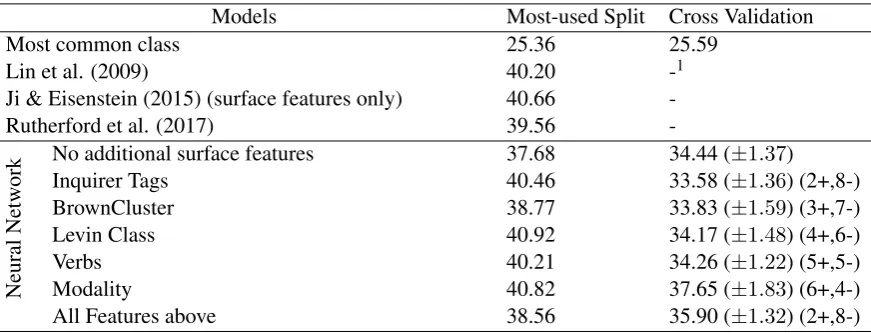
We tested five frequently-used surface features with our model. Results are shown in Table 2. We can see that our implemented model is comparable with state of the art models. Our main point here is however not to argue that we outperform any par-ticular model, but rather we’d like to discuss what conclusions we’d be drawing from adding surface features to our NN model if using the standard test set vs. doing cross validation.
For each cross validation with different features, the separation into train and test sets are identical. We can see that the performances on Most-used Split section is generally 3-7% better than the re-sults for the rest of the corpus. While we would also conclude from our model when evaluated on the standard test set that each of these features contribute some useful information, we can also see that we would come to very different conclu-sions if actually running the cross-validation ex-periment.
Cross Validation is primarily a way of measur-ing the predictive performance of a model. With such a small test set, improvements on the classifi-cation could be the results of many factors. For instance, take a look at the effectiveness of in-cluding Inquirer Tags: these lead to an increase in performance by 2.8% in Most-used Split, but actually only helped on two out of 10-fold in the cross-validation set, overall leading to a small de-crease in performance of the classifier. Similarly,
2https://keras.io/
the verb features seem to indicate a substantial im-provement in relation classification accuracy on the standard test set, but there is no effect at all across the folds.
Other works, such as Berg-Kirkpatrick et al. (2012) strongly recommend significance test-ing to validate metric gains in NLP tasks, even though the relationship between metric gain and statistical significance is complex. We observed that recent papers in discourse relation parsing do not always perform significance testing, and if they do report significance, then oftentimes they do not report the test that was used. We would here like to argue in favour of significance testing with cross validation, as opposed to boot strapping methods that only use the standard test set. Due to the larger amount of data, calculating significance based on the cross validation will give us substan-tially better estimates about the robustness of our results, because it can quantify more exactly the amount of variation with respect to transferring to a new (in-domain) dataset.
7 Conclusion
We have argued that the standard test section of the PDTB is too small to draw conclusions about whether a feature is generally useful or not, espe-cially when using a larger label set, as is the case in recent work using second level labels. While these ideas are far from new and apply also to other NLP tasks with small evaluation sets, we think it is important to discuss this issue, as recent work in the field of discourse relation analysis has mostly ignored the issue of small test set sizes in the PDTB. Our experiments support our claim by showing that features that may look like they im-prove performance on the 11-way classification on the standard test set, did not always show a consis-tent improvement when the training / testing was split up differently. This means that we run a large risk of drawing incorrect conclusions about which features are helpful if we only stick out our small standard test set for evaluation.
8 Acknowledgements
References
Yoshua Bengio and Yves Grandvalet. 2005. Bias in estimating the variance of k-fold cross-validation. In
Statistical modeling and analysis for complex data problems, pages 75–95. Springer.
Yoshua Bengio, R´ejean Ducharme, Pascal Vincent, and Christian Jauvin. 2003. A neural probabilistic lan-guage model. journal of machine learning research, volume3:1137–1155.
Taylor Berg-Kirkpatrick, David Burkett, and Dan Klein. 2012. An empirical investigation of statis-tical significance in nlp. InProceedings of the 2012 Joint Conference on Empirical Methods in Natural Language Processing and Computational Natural Language Learning, pages 995–1005, Jeju Island, Korea. Association for Computational Linguistics. Or Biran and Kathleen McKeown. 2013. Aggregated
word pair features for implicit discourse relation
dis-ambiguation. In Proceedings of the 51st Annual
Meeting of the Association for Computational Lin-guistics, pages 69–73, Sofia, Bulgaria. Association for Computational Linguistics.
Chlo´e Braud and Pascal Denis. 2015. Comparing word representations for implicit discourse relation
classification. In Empirical Methods in Natural
Language Processing (EMNLP 2015), pages 2201– 2211, Lisbonne, Portugal. Association for Computa-tional Linguistics.
Jifan Chen, Qi Zhang, Pengfei Liu, Xipeng Qiu, and Xuanjing Huang. 2016. Implicit discourse rela-tion detecrela-tion via a deep architecture with gated
rel-evance network. InProceedings of the 54th Annual
Meeting of the Association for Computational Lin-guistics (ACL), pages 1726–1735, Berlin, Germany. Association for Computational Linguistics.
Hugo Hernault, Danushka Bollegala, and Mitsuru Ishizuka. 2010. A semi-supervised approach to improve classification of infrequent discourse
rela-tions using feature vector extension. In
Proceed-ings of the 2010 Conference on Empirical Methods in Natural Language Processing, pages 399–409, MIT, Massachusetts, USA. Association for Compu-tational Linguistics.
Christopher Hidey and Kathleen McKeown. 2016. Identifying causal relation using parallel wikipedia
articles. In Proceedings of the 54th Annual
Meet-ing of the Association for Computational LMeet-inguistics (ACL), pages 1424–1433, Berlin,Germany. Associa-tion for ComputaAssocia-tional Linguistics.
Peter Jansen, Mihai Surdeanu, and Peter Clark. 2014. Discourse complements lexical semantics for
non-factoid answer reranking. In Proceedings of the
52nd Annual Meeting of the Association for Com-putational Linguistics, pages 977–986, Baltimore, Maryland, USA. Association for Computational Linguistics.
Yangfeng Ji and Jacob Eisenstein. 2015. One vector is not enough: Entity-augmented distributed semantics for discourse relations. Transactions of the Associ-ation for ComputAssoci-ational Linguistics, volume3:329– 344.
Yangfeng Ji, Gholamreza Haffari, and Jacob Eisen-stein. 2016. A latent variable recurrent neural net-work for discourse relation language models. In
Proceedings of NAACL-HLT 2016, pages 332–342, San Diego, California. Association for Computa-tional Linguistics.
Ji-Hyun Kim. 2009. Estimating classification error rate: Repeated cross-validation, repeated hold-out
and bootstrap. Computational Statistics & Data
Analysis, volume53(11):3735–3745.
Ziheng Lin, Min-Yen Kan, and Hwee Tou Ng. 2009. Recognizing implicit discourse relations in the penn discourse treebank. InProceedings of the 2009 Con-ference on Empirical Methods in Natural Language Processing, pages 343–351, Singapore. Association for Computational Linguistics.
Thomas Meyer, Najeh Hajlaoui, and Andrei Popescu-Belis. 2015. Disambiguating discourse connec-tives for statistical machine translation. IEEE/ACM Transactions on Audio, Speech, and Language Pro-cessing, 23(7):1184–1197.
Claudiu Mih˘ail˘a and Sophia Ananiadou. 2014. Semi-supervised learning of causal relations in biomedical scientific discourse.Biomedical engineering online, 13(2):1.
Tomas Mikolov, Ilya Sutskever, Kai Chen, Greg Cor-rado, and Jeff Dean. 2013. Distributed representa-tions of words and phrases and their
compositional-ity. InAdvances in neural information processing
systems, pages 3111–3119.
Joonsuk Park and Claire Cardie. 2012. Improving im-plicit discourse relation recognition through feature
set optimization. In Proceedings of the 13th
An-nual Meeting of the Special Interest Group on Dis-course and Dialogue (SIGDIAL), pages 108–112, Seoul, South Korea. Association for Computational Linguistics.
Emily Pitler, Mridhula Raghupathy, Hena Mehta, Ani Nenkova, Alan Lee, and Aravind K. Joshi. 2008. Easily identifiable discourse relations. In Proceed-ings of the 22nd International Conference on Com-putational Linguistics (COLING2008), pages 85– 88, Manchester, UK.
Emily Pitler, Annie Louis, and Ani Nenkova. 2009. Automatic sense prediction for implicit discourse re-lations in text. InProceedings of the Joint Confer-ence of the 47th Annual Meeting of the ACL and the 4th International Joint Conference on Natural Lan-guage Processing of the AFNLP: Volume 2-Volume
2, pages 683–691, Suntec, Singapore. Association
Rashmi Prasad, Nikhil Dinesh, Alan Lee, Eleni Milt-sakaki, Livio Robaldo, Aravind K. Joshi, and Bon-nie L. Webber. 2008. The penn discourse tree-bank 2.0. InIn Proceedings of the 6th International Conference on Language Resources and Evalua-tion(LREC), Marrakech, Morocco. European Lan-guage Resources Association.
Chris Quirk and Hoifung Poon. 2016. Distant su-pervision for relation extraction beyond the sentence boundary. arXiv preprint arXiv:1609.04873. Ines Rehbein, Merel Scholman, and Vera Demberg.
2016. Annotating discourse relations in spoken lan-guage: A comparison of the pdtb and ccr
frame-works. In Proceedings of the Tenth International
Conference on Language Resources and Evaluation (LREC 2016), pages 23–28, Portoro, Slovenia. Eu-ropean Language Resources Association.
Attapol Rutherford and Nianwen Xue. 2014. Dis-covering implicit discourse relations through brown cluster pair representation and coreference
pat-terns. In European Chapter of the Association
for Computational Linguistics.(EACL), pages 645– 654, Gothenburg, Sweden. Association for Compu-tational Linguistics.
Attapol Rutherford and Nianwen Xue. 2015. Improv-ing the inference of implicit discourse relations via classifying explicit discourse connectives. In Pro-ceedings of the NAACL-HLT, pages 799–808, Den-ver, Colorado. Association for Computational Lin-guistics.
Attapol Rutherford, Vera Demberg, and Nianwen Xue. 2017. A systematic study of neural discourse
mod-els for implicit discourse relation. In European
Chapter of the Association for Computational Lin-guistics.(EACL), Valencia, Spain. Association for Computational Linguistics.
Radu Soricut and Daniel Marcu. 2003. Sentence level discourse parsing using syntactic and lexical
infor-mation. In Proceedings of the 2003 Conference
of the North American Chapter of the Association for Computational Linguistics on Human Language Technology-Volume 1, pages 149–156, Edmonton. Association for Computational Linguistics.
Xun Wang, Sujian Li, Jiwei Li, and Wenjie Li. 2012. Implicit discourse relation recognition by selecting
typical training examples. In Proceeding of
COL-ING 2012, pages 2757–2772, Mumbai.
Nianwen Xue, Hwee Tou Ng, Sameer Pradhan, Rashmi Prasad Christopher Bryant, and Attapol T. Ruther-ford. 2015. The conll-2015 shared task on shallow
discourse parsing. InProceedings of Conference on
Computational Natural Language Learning: Shared
Task, pages 1–16, Beijing, China. Association for
Computational Linguistics.
Nianwen Xue, Hwee Tou Ng, Attapol Rutherford, Bon-nie Webber, Chuan Wang, and Hongmin Wang.
2016. Conll 2016 shared task on multilingual shal-low discourse parsing. pages 1–19, Berlin, Ger-many. Association for Computational Linguistics. Yasuhisa Yoshida, Jun Suzuki, Tsutomu Hirao, and
Masaaki Nagata. 2014. Dependency-based dis-course parser for single-document summarization. In Proceedings of the 2014 Conference on Em-pirical Methods in Natural Language Processing (EMNLP), pages 1834–1839, Doha, Qatar. Associ-ation for ComputAssoci-ational Linguistics.
Biao Zhang, Jinsong Su, Deyi Xiong, Yaojie Lu, Hong Duan, and Junfeng Yao. 2015. Shallow convo-lutional neural network for implicit discourse
rela-tion recognirela-tion. InProceedings of the 2015
Con-ference on Empirical Methods in Natural Language Processing, pages 2230–2235, Lisbon, Portugal. As-sociation for Computational Linguistics.
Biao Zhang, Deyi Xiong, and Jinsong Su. 2016. Neural discourse relation recognition with semantic
memory.arXiv preprint arXiv:1603.03873.
Zhi-Min Zhou, Yu Xu, Zheng-Yu Niu, Man Lan, Jian Su, and Chew Lim Tan. 2010. Predicting discourse connectives for implicit discourse relation
recog-nition. In Proceedings of the 23rd International