Proceedings of the First Workshop on Commonsense Inference in Natural Language Processing, pages 66–74 66
Commonsense Inference in Natural Language Processing (COIN)
—
Shared Task Report
Simon Ostermann Saarland University / Nuance Communications
Sheng Zhang Johns Hopkins
University
Michael Roth Stuttgart University/
Saarland University
Peter Clark Allen Institute for Artificial Intelligence
Abstract
This paper reports on the results of the shared tasks of the COIN workshop at EMNLP– IJCNLP 2019. The tasks consisted of two machine comprehension evaluations, each of which tested a system’s ability to answer ques-tions/queries about a text. Both evaluations were designed such that systems need to ex-ploit commonsense knowledge, for example, in the form of inferences over information that is available in the common ground but not nec-essarily mentioned in the text. A total of five participating teams submitted systems for the shared tasks, with the best submitted system achieving 90.6% accuracy and 83.7% F1-score on task 1 and task 2, respectively.
1 Introduction
Due to the rise of powerful pre-trained word and sentence representations, automated text process-ing has come a long way in recent years, with systems that perform even better than humans on some datasets (Rajpurkar et al., 2016a). How-ever, natural language understanding also involves complex challenges. One important difference be-tween human and machine text understanding lies in the fact that humans can access commonsense knowledge while processing text, which helps them to draw inferences about facts that are not mentioned in a text, but that are assumed to be common ground.
(1) Max:“It’s 1 pm already, I think we should get lunch.”
Dustin:“Let me get my wallet.”
Consider the conversation in Example 1: Max
will not be surprised that Dustin needs to get his wallet, since she knows that paying is a part of
getting lunch. Also, she knows that a wallet is needed for paying, so Dustin needs to get a wallet
for lunch. This is part of the commonsense knowl-edge about getting lunch and should be known by both persons. For a computer system, inferring such unmentioned facts is a non-trivial challenge. The workshop on Commonsense Inference in NLP (COIN) is focused on such phenomena, looking at models, data, and evaluation methods for com-monsense inference.
This report summarizes the results of the COIN shared tasks, an unofficial extension of the
Sem-Eval 2018 shared task 11, Machine
Comprehen-sion using Commonsense Knowledge(Ostermann et al., 2018b). The tasks aim to evaluate the commonsense inference capabilities of text un-derstanding systems in two settings: Common-sense inference in everyday narrations (task 1) and commonsense inference in news texts (task 2). Framed as machine comprehension evaluations, the datasets used for both tasks contain challeng-ing readchalleng-ing comprehension questions askchalleng-ing for facts that are not explicitly mentioned in the given reading texts.
Several teams participated in the shared tasks
and submitted system description papers. All
make it harder to benefit from redundancy in the training data or large-scale pretraining on similar domains.
In the following, we briefly describe the data sets (§2), baselines and evaluation metrics of the shared tasks (§3) and we present a summary of the participating systems (§4), their results (§5) as well as a discussion thereof (§6).
2 Data and Tasks
Text understanding systems are often evaluated by means of a reading comprehension task, which is also referred to as machine (reading) comprehen-sion (MC). The central idea is that a system has to process a text and then find a correct answer to a question that is asked on the text. Our shared tasks follow this paradigm and use machine comprehen-sion settings to evaluate a model’s capability to perform commonsense inferences. In contrast to most existing MC datasets, the two datasets that are used for our shared tasks, MCScript2.0 ( Os-termann et al.,2019) andReCoRD(Zhang et al.,
2018), are focused on questions that cannot be answered from the text alone, but that require a model to draw inference over unmentioned facts.
(2) Text:Camping is one of my favorite sum-mer vacations. (...) Once I have all my gear and clothing I’ll pack it into my car, making sure to leave room for myself, my dog and anything my friends want to
bring. And then we are ready for our
camping vacation.
Question:What do they put the drinks in? a. Cooler
b. Sleeping bag
Example 2 illustrates the main idea of the
shared tasks. It shows a reading text from MC-Script2.0, together with a question and two can-didate answers. For a human, it is trivial to find that the drinks are put into a cooler rather than the sleeping bag. This information is however not mentioned in the text, so a machine needs to have the capability to infer this fact from commonsense knowledge.
The reading texts of MCScript2.0 are narra-tions about everyday activities (task 1). Due to its domain, MCScript2.0 has a focus on evalu-ating script knowledge, i.e. knowledge about the events and participants of such everyday activities (Schank and Abelson, 1975). Task 2 utilizes the
ReCoRDcorpus (Zhang et al.,2018), which con-tains news texts, a more open domain. The infer-ences that are required for finding answers to the questions inReCoRDare thus of a more general type.
2.1 Task 1: Commonsense Inference in Everyday Narrations
MCScript2.0 is a reading comprehension data set comprising 19,821 questions on 3,487 texts. Each of the questions has two answer candidates, one of which is correct. Questions in the data were anno-tated for reasoning types, i.e. according to whether the answer to a question can be found in the text or needs to be inferred from commonsense knowl-edge. Roughly half of the questions do require in-ferences over commonsense knowledge.
The texts in MCScript2.0 are short narrations (164.4 tokens on average) on a total of 200 dif-ferent everyday activities. All texts were
crowd-sourced on Amazon Mechanical Turk1, by
ask-ing crowd workers to tell a story about one of the 200 scenariosas if talking to a child(Modi et al.,
2016;Ostermann et al.,2018a), resulting in sim-ple texts which explicitly mention many details of a scenario. In the question collection, which was also conducted via crowdsourcing, turkers were then asked to write questions about noun or verb phrases that were highlighted in the texts. After collecting questions, the sentences containing the noun or verb phrases were deleted from the texts. During the answer collection, crowd workers thus had to infer the information required for finding an answer from background knowledge. Five turk-ers wrote correct and incorrect answer candidates for each question, and the most difficult incorrect candidates were selected via adversarial filtering (Zellers et al.,2018).
For our shared task, we use the same data split asOstermann et al. (2019): 14,191 questions on 2,500 texts for the training set, 2,020 questions on 355 texts for the development set and 3,610 ques-tions on 632 texts for the test set. All texts for five scenarios were reserved for the test set only to in-crease difficulty.
2.2 Task 2: Commonsense Inference in News Articles
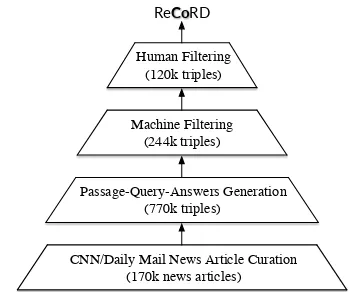
ReCoRDis a large-scale dataset for reading com-prehension, which consists of over 120,000
Machine Filtering (244k triples)
CNN/Daily Mail News Article Curation (170k news articles)
ReCoRD
Human Filtering (120k triples)
Passage-Query-Answers Generation (770k triples)
[image:3.595.90.269.62.208.2]Co
Figure 1:ReCoRDdata collection procedure.
Train Dev. Test Overall
queries 100,730 10,000 10,000 120,730 unique passages 65,709 7,133 7,279 80,121
passage vocab. 352,491 93,171 94,386 395,356 query vocab. 119,069 30,844 31,028 134,397
tokens / passage 169.5 168.6 168.1 169.3 entities / passage 17.8 17.5 17.3 17.8
tokens / query 21.3 22.1 22.2 21.4
Table 1: Statistics ofReCoRD
amples, most of which require commonsense
reasoning. ReCoRD was collected in a
four-stage process (Figure1): (1) curating CNN/Daily Mail news articles, (2) generating passage-query-answers triples based on the news articles, (3) fil-tering out the queries that can be easily answered by state-of-the-art machine comprehension (MC) models, and (4) filtering out the queries ambigu-ous to human readers. All named entities in the passages are possible answers to the queries. Ta-ble1summarizes the data statistics.
3 Shared Task Setup
The baselines for our shared tasks were adapted from Ostermann et al. (2019) and Zhang et al.
(2018), respectively.
3.1 Task 1 Baselines
FollowingOstermann et al.(2019), we present re-sults of three baseline models.
Logistic Regression Model. Merkhofer et al.
(2018) presented a logistic regression classifier for the SemEval 2018 shared task 11, which used
sim-ple overlap features and word patterns on
MC-Script, a predecessor of the dataset used for this task. Their model outperformed many neural net-works in spite of its simplicity.
Attentive Reader. The second baseline model is an attentive reader network (Hermann et al.,
2015). GRU units (Cho et al., 2014) are used to process text, question and answer. A question-aware text representation is computed based on a bilinear attention function, which is then com-bined with a GRU-based answer representation for
prediction. For details, we refer to Ostermann
et al.(2019),Ostermann et al.(2018a) and Chen et al.(2016)
TriAN. As last model, we use the three-way attentive network (TriAN) (Wang et al., 2018), a recurrent neural network that scored the first place in the SemEval 2018 task. They use LSTM units (Hochreiter and Schmidhuber, 1997), sev-eral attention functions, and self attention to com-pute representations for text, question and answer. ConceptNet (Speer et al.,2017), a large common-sense knowledge base containing thousands of en-tities and commonsense relations between them, is used to enhance text representations with com-monsense information, by computing relation em-beddings and appending them to the text
represen-tations. For more information we refer to Wang
et al.(2018).
3.2 Task 2 Baselines
We present five baselines forReCoRD:
BERT (Devlin et al.,2019) is a new language
representation model. Recently fine-tuning the
pre-trained BERT with an additional output layer has created state-of-the-art models on a wide range
of NLP tasks. We formalizedReCoRDas an
ex-tractive QA task like SQuAD, and then reused the fine-tuning script for SQuAD to fine-tune BERT forReCoRD.
KT-NET (Yang et al., 2019a) employs an at-tention mechanism to adaptively select desired knowledge from knowledge bases, and then fuses selected knowledge with BERT to enable context-and knowledge-aware predictions for machine reading comprehension.
[image:3.595.73.293.245.348.2]Rank Team Name Architecture Commonsense Other Resources Tasks
1 PSH–SJTU Transformer (XLNet) - RACE, SWAG 1, 2
2 IIT-KGP Transformer (BERT
+ XLNet)
- RACE 1
3 BLCU-NLP Transformer (BERT) - ReCoRD, RACE 1
4 JDA Transformer (BERT) ConceptNet,
Atomic, Webchild
Wikipedia 1
[image:4.595.75.526.64.184.2]5 KARNA Transformer (BERT) ConceptNet - 1
Table 2: Overview of participating systems
DocQA (Clark and Gardner,2018) is a strong baseline model for extractive QA. It consists of components such as bi-directional attention flow (Seo et al.,2016) and self-attention, both of which are widely used in MC models. We also evaluated a variant of DocQA with ELMo (Peters et al.,2018) to analyze the impact of ELMo on this task.
Random Guess acts as the lower bound of the evaluated models, which randomly picks a named entity from the passage as the answer. The re-ported results are averaged over 5 runs.
3.3 Evaluation
Task 1. The evaluation measure for task 1 is ac-curacy, computed as the number of correctly an-swered questions divided by the number of all questions. We also report accuracy values on ques-tions that crowd workers explicitly annotated as requiring commonsense as well as performance on the five held-out scenarios.
Task 2. We use two evaluation metrics, EM and
F1, similar to those used by SQuAD (Rajpurkar
et al., 2016b). Exact Match (EM) measures the percentage of predictions that match a reference
answer exactly. (Macro-averaged) F1 measures
the average overlap between model predictions and reference answers. For computing F1, we treat prediction and reference answers as bags of to-kens. We take the maximum F1 over all reference answers for a given query, and then average over all queries.
4 Participants
In total, five teams submitted systems in task 1, and one team participated in task 2. All submit-ted models were neural networks, and all made use of pretrained Transformer language models
such asBERT (Devlin et al., 2019). The partic-ipants used a wide range of external corpora and resources to augment their models, ranging from other machine comprehension data sets such as
RACE (Lai et al., 2017) orMCScript(Ostermann et al., 2018a), up to commonsense knowledge databases such asConceptNet(Speer et al.,2017),
WebChild(Tandon et al.,2017) or ATOMIC (Sap et al.,2019). Table2gives a summary of the par-ticipating systems.
• PSH–SJTU(Li et al., 2019) participated in both tasks with a Transformer model based on XLNet (Yang et al., 2019b). For task 1, they pretrain the model in several steps, first on the RACE data (Lai et al.,2017) and then on SWAG (Zellers et al., 2018). For task 2, they do not conduct specific pretraining steps, but implement a range of simple rule-based answer verification strategies to verify the output of the model.
• IIT-KGP (Sharma and Roychowdhury,
2019) present an ensemble of different
pretrained language models, namely BERT and XLNet. Both models are pretrained on the RACE data (Lai et al., 2017), and their output is averaged for a final prediction.
• BLCU-NLP(Liu et al., 2019) use a Trans-former model based on BERT, which is fine-tuned in two stages: they first tune the BERT-based language model on the RACE and ReCoRDdatasets and then (further) train the model for the actual machine comprehension task.
• JDA (Da, 2019) use three different knowl-edge bases, namely ConceptNet (Speer et al.,
relevant edges from the knowledge bases and compute relation embeddings, which are combined with BERT-based word representa-tions with a diadic multiplication operation.
• KARNA(Jain and Singh,2019) use a BERT model, but they enhance the text representa-tion with edges that are extracted from Con-ceptNet. FollowingWang et al.(2018), they extract relations between words in the text and the question/answer, and append them to the text representation. Instead of computing relational embeddings, they append a specific string that describes the relation.
5 Results
Table3shows the performance of the participating systems and the baselines on the task 1 data. We tested for significance using a pairwise approxi-mate randomization test (Yeh, 2000) over ques-tions. Except for the two top scoring systems, each system performs significantly better than the next in rank. All systems significantly outperform the baselines. All systems show a lower performance on commonsense-based questions as compared to the average on all questions, with the difference for the two top-scoring systems being smallest. Surprisingly, all models are able to perform better on the questions from held-out scenarios as com-pared to their performance on all questions. This indicates that all models are able to generalize well from the training material.
Table5shows the systems’ performance on sin-gle question types for task 1. Question types are determined automatically, as described in ( Oster-mann et al., 2019). As can be seen, both top-scoring systems perform well over all different question types, indicating that both systems are able to model a wide range of phenomena. Inter-estingly,whenquestions seem to be the most chal-lenging question type for all systems, indicating difficulties when it comes to model event order-ing information. Also,wherequestions seem to be challenging, at least for some systems.
Table 4 shows EM (%) and F1 (%) of
hu-man perforhu-mance, the PSH-SJTU system as well as baselines on the development and test sets of
task 2. Compared with the best baseline,
KT-NET (Yang et al.,2019a), PSH-SJTU achieves sig-nificantly better scores. On the hidden test set,
they improve EM by 10.08%, and F1 by 8.98%.
# Team Name acc acccs accOOD
1 PSH–SJTU 0.906 0.903 0.915
2 IIT-KGP 0.905∗ 0.894 0.931
3 BLCU-NLP 0.842∗ 0.812 0.838
4 JDA 0.807∗ 0.775 0.796
5 KARNA 0.733∗ 0.697 0.729
- TriAN 0.715 0.666 0.673
- Attentive
Reader
0.651 0.634 0.619
- Logistic 0.608 0.562 0.544
- Human 0.97
Table 3: Performance of participating systems and baselines fortask 1, in total (acc), on commonsense-based questions (acccs), and on out-of-domain
ques-tions that belong to the five held-out scenarios (accOOD). Significant differences in results between
two adjacent lines are marked by an asterisk (* p<0.05) in the upper line. The best model performance per col-umn is marked inbold print.
Dev. Test
EM(%) F1(%) EM(%) F1(%)
Human 91.28 91.64 91.31 91.69
PSH-SJTU 82.72 83.38 83.09 83.74
KT-NET 71.60 73.61 73.01 74.76
BERT-Large 66.11 68.49 67.61 70.01
SAN 48.86 50.08 50.43 51.41
DocQA 44.13 45.39 45.44 46.65
Random 18.41 19.06 18.55 19.12
Table 4: Performance (EM and F1) of human,
partici-pating systems and baselines fortask 2.
Consequently, PSH-SJTU has reduced the gap be-tween human and machine performance, with hu-man perforhu-mance being only 8% higher than PSH-SJTU.
6 Discussion
Pretrained Transformer language models. A main finding of our shared tasks is that large pretrained Transformer language models such as BERT or XLNet perform well even on challeng-ing commonsense inference data. Strikchalleng-ingly, all models generalize well, as can be seen from the
good performance on held-out scenarios. On
[image:5.595.307.526.62.235.2] [image:5.595.310.522.355.498.2]# Team Name what when where who how
1 PSH–SJTU 0.918 0.891 0.890 0.921 0.890
2 IIT-KGP 0.915 0.897 0.890 0.921 0.925
3 BLCU-NLP 0.874 0.800 0.815 0.857 0.870
4 JDA 0.844 0.777 0.744 0.794 0.829
5 KARNA 0.755 0.683 0.734 0.750 0.788
- TriAN 0.749 0.647 0.712 0.730 0.801
- AttentiveReader 0.700 0.578 0.620 0.659 0.726
[image:6.595.149.450.63.203.2]- Logistic 0.644 0.546 0.573 0.663 0.685
Table 5: Performance of participating systems and baselines fortask 1on the 5 most common question types.
can mostly be attributed to the performance on commonsense-based questions: While the perfor-mance of XLNet-based models on such questions is almost on par with their average performance, models based on BERT underperform on com-monsense questions. An interesting observation was made byLi et al. (2019), who found that in-cluding WordNet into a BERT model boosts per-formance, while there is no such boost for an XL-Net model. This seems to indicate that XLXL-Net is able to cover (at least partially) some form of lex-ical background knowledge, as encoded in Word-Net, without explicitly requiring access to such a resource.
Still, when inspecting questions that were not answered correctly by the best scoring model, we found a large number of commonsense-based
when questions that ask for the typical order of events. This indicates that XLNet-based models are only to a certain extent able to model complex phenomena such as temporal order.
Commonsense knowledge databases. Only two participants made use of commonsense knowledge, in the form of knowledge graphs such as ConceptNet. Both participants conducted ablation tests indicating the importance of includ-ing commonsense knowledge. In comparison to
ATOMIC and WebChild, Da (2019) report that
ConceptNet is most beneficial for performance on the task 1 data, which can be explained with its domain: The OMCS (Singh et al., 2002) data are part of the ConceptNet database, and OMCS scenarios were also used to collect texts for the task 1 data.
All in all, powerful pretrained models such as XLNet still outperform approaches that make use of structured knowledge bases, which indicates that they are (at least to some extent) capable of
performing commonsense inference without ex-plicit representations of commonsense knowledge.
Pretraining and finetuning on other data.
Several participants reported effects of pretrain-ing/finetuning their models on related tasks. For instance,Liu et al.(2019) experimented with dif-ferent pretraining corpora and found results to be best when pretraining the encoder of their
BERT model on RACE and ReCoRD. Similarly,
Li et al.(2019) report improved results when us-ing larger data sets from other readus-ing comprehen-sion (RACE) and commonsense inference tasks (SWAG) for training before fine-tuning the model with the actual training data from the shared task.
7 Related Work
Evaluating commonsense inference via machine comprehension has recently moved into the focus of interest. Existing datasets cover various do-mains:
Web texts. TriviaQA(Joshi et al.,2017) is a cor-pus of webcrawled trivia and quiz-league websites together with evidence documents from the web. A large part of questions requires a system to make use of factual commonsense knowledge for
find-ing an answer. CommonsenseQA (Talmor et al.,
2018) consists of 9,000 crowdsourced multiple-choice questions with a focus on relations between entities that appear in ConceptNet (Speer et al.,
2017). Evidence documents were webcrawled
based on the question and added after the crowd-sourcing step.
Fictive texts. NarrativeQA (Koˇcisk´y et al.,
require a system to understand the whole plot of the text and to conduct many successive compli-cated inference steps, under the use of various types of background knowledge.
News texts. NewsQA (Trischler et al., 2017) provides news texts with crowdsourced questions and answers, which are spans of the evidence
doc-uments. The question collection procedure for
NewsQA resulted in a large number of questions that require factual commonsense knowledge for finding an answer.
Other tasks. There have been other attempts at evaluating commonsense inference apart from ma-chine comprehension. One example is the Story
cloze test and the ROC dataset (Mostafazadeh
et al.,2016), where systems have to find the cor-rect ending to a 5-sentence story, using different
types of commonsense knowledge.SWAG(Zellers
et al.,2018) is a natural language inference dataset with a focus on difficult commonsense inferences.
8 Conclusion
This report presented the results of the shared tasks at the Workshop for Commonsense Inference in NLP (COIN). The tasks aimed at evaluating the capability of systems to make use of common-sense knowledge for challenging inference ques-tions in a machine comprehension setting, on ev-eryday narrations (task 1) and news texts (task 2). In total, 5 systems participated in task 1, and one system participated in task 2. All submitted mod-els were Transformer modmod-els, pretrained with a language modeling objective on large amounts of textual data. The best system achieved 90.6% ac-curacy and 83.7% F1-score on task 1 and 2, re-spectively, leaving a gap of 7% and 8% to human performance.
The results of our shared tasks suggest that ex-isting models cover a large part of the common-sense knowledge required for our data sets in the domains of narrations and news texts. This does however not mean that commonsense inference is solved: We found a range of examples in our data that are not successfully covered. Further-more, data sets such asHellaSWAG(Zellers et al.,
2019) show that commonsense inference tasks can be specifically tailored to be hard for Transformer models. We believe that modeling true language understanding requires a shift towards text types and tasks that test commonsense knowledge
go-ing beyond information that can be obtained by exploiting the redundancy of large-scale corpora and/or pretraining on related tasks.
References
Danqi Chen, Jason Bolton, and Christopher D. Man-ning. 2016. A Thorough Examination of the CNN/Daily Mail Reading Comprehension Task. In
Proceedings of the 54th Annual Meeting of the As-sociation for Computational Linguistics (Volume 1:
Long Papers), volume 1, pages 2358–2367.
Kyunghyun Cho, Bart Van Merri¨enboer, Caglar Gul-cehre, Dzmitry Bahdanau, Fethi Bougares, Holger Schwenk, and Yoshua Bengio. 2014. Learning phrase representations using rnn encoder-decoder for statistical machine translation. arXiv preprint arXiv:1406.1078.
Christopher Clark and Matt Gardner. 2018. Simple and effective multi-paragraph reading comprehen-sion. InProceedings of the 56th Annual Meeting of the Association for Computational Linguistics
(Vol-ume 1: Long Papers), pages 845–855. Association
for Computational Linguistics.
Jeffrey Da. 2019. Jeff Da at COIN - Shared Task. In
Proceedings of the 2019 EMNLP Workshop COIN:
Commonsense Inference in NLP.
Jacob Devlin, Ming-Wei Chang, Kenton Lee, and Kristina Toutanova. 2019. Bert: Pre-training of deep bidirectional transformers for language under-standing. InProceedings of the 2019 Conference of the North American Chapter of the Association for Computational Linguistics: Human Language
Tech-nologies, Volume 1 (Long and Short Papers), pages
4171–4186.
Karl Moritz Hermann, Tom´aˇs Koˇcisk´y, Edward Grefenstette, Lasse Espeholt, Will Kay, Mustafa Su-leyman, and Phil Blunsom. 2015. Teaching ma-chines to read and comprehend. InAdvances in
Neu-ral Information Processing Systems, pages 1693–
1701.
Sepp Hochreiter and J¨urgen Schmidhuber. 1997. Long short-term memory. Neural computation, 9(8):1735–1780.
Yash Jain and Chinmay Singh. 2019. KARNA at COIN - Shared Task: Bidirectional Encoder Representa-tions from Transformers with relational knowledge for machine comprehension with common sense . In
Proceedings of the 2019 EMNLP Workshop COIN:
Commonsense Inference in NLP.
Mandar Joshi, Eunsol Choi, Daniel S. Weld, and Luke Zettlemoyer. 2017. TriviaQA: A Large Scale Dis-tantly Supervised Challenge Dataset for Reading Comprehension. InProceedings of the 55th Annual Meeting of the Association for Computational
Lin-guistics, pages 1601–1611. Association for
Tom´aˇs Koˇcisk´y, Jonathan Schwarz, Phil Blunsom, Chris Dyer, Karl Moritz Hermann, G´aabor Melis, and Edward Grefenstette. 2018. The NarrativeQA Reading Comprehension Challenge. Transactions
of the Association of Computational Linguistics,
6:317–328.
Guokun Lai, Qizhe Xie, Hanxiao Liu, Yiming Yang, and Eduard Hovy. 2017. RACE: Large-scale ReAd-ing Comprehension Dataset From Examinations. In
Proceedings of the 2017 Conference on Empirical
Methods in Natural Language Processing, pages
785–794.
Xiepeng Li, Zhexi Zhang, Wei Zhu, Yuan Ni, Peng Gao, Junchi Yan, and Guotong Xie. 2019. Pingan Smart Health and SJTU at COIN - Shared Task: Uti-lizing Pre-trained Language Models and Common-sense Knowledge in Machine Reading Tasks. In
Proceedings of the 2019 EMNLP Workshop COIN:
Commonsense Inference in NLP.
Chunhua Liu, Shike Wang, Bohan Li, and Dong Yu. 2019. BLCU-NLP at COIN - Shared Task: Stage-wise Fine-tuning BERT for Commonsense Inference in Everyday Narrations. InProceedings of the 2019 EMNLP Workshop COIN: Commonsense Inference in NLP.
Xiaodong Liu, Yelong Shen, Kevin Duh, and Jianfeng Gao. 2018. Stochastic answer networks for ma-chine reading comprehension. InProceedings of the 56th Annual Meeting of the Association for Compu-tational Linguistics (Volume 1: Long Papers), pages 1694–1704. Association for Computational Linguis-tics.
Elizabeth M. Merkhofer, John Henderson, David Bloom, Laura Strickhart, and Guido Zarrella. 2018. MITRE at SemEval-2018 Task 11: Commonsense Reasoning without Commonsense Knowledge. In
Proceedings of the 12th International Workshop on
Semantic Evaluations (SemEval-2018), pages 1078–
1082.
Ashutosh Modi, Tatjana Anikina, Simon Ostermann, and Manfred Pinkal. 2016. InScript: Narrative texts annotated with script information. InProceedings of the Tenth International Conference on Language
Re-sources and Evaluation (LREC 2016), pages 3485–
3493. European Language Resources Association (ELRA).
Nasrin Mostafazadeh, Nathanael Chambers, Xiaodong He, Devi Parikh, Dhruv Batra, Lucy Vanderwende, Pushmeet Kohli, and James Allen. 2016. A cor-pus and cloze evaluation for deeper understanding of commonsense stories. In Proceedings of the 2016 Conference of the North American Chapter of the Association for Computational Linguistics: Human
Language Technologies, pages 839–849, San Diego,
California. Association for Computational Linguis-tics.
Simon Ostermann, Ashutosh Modi, Michael Roth, Ste-fan Thater, and Manfred Pinkal. 2018a. MCScript:
A Novel Dataset for Assessing Machine Compre-hension Using Script Knowledge. InProceedings of the 11th International Conference on Language
Re-sources and Evaluation (LREC 2018), pages 3567–
3574.
Simon Ostermann, Michael Roth, Ashutosh Modi, Ste-fan Thater, and Manfred Pinkal. 2018b. SemEval-2018 Task 11: Machine Comprehension using Com-monsense Knowledge. InProceedings of The 12th
International Workshop on Semantic Evaluation,
pages 747–757.
Simon Ostermann, Michael Roth, and Manfred Pinkal. 2019. MCScript2.0: A Machine Comprehen-sion Corpus Focused on Script Events and Partici-pants. InProceedings of the Eighth Joint Confer-ence on Lexical and Computational Semantics (*
SEM 2019), pages 103–117.
Matthew Peters, Mark Neumann, Mohit Iyyer, Matt Gardner, Christopher Clark, Kenton Lee, and Luke Zettlemoyer. 2018. Deep contextualized word repre-sentations. InProceedings of the 2018 Conference of the North American Chapter of the Association for Computational Linguistics: Human Language
Technologies, Volume 1 (Long Papers), pages 2227–
2237. Association for Computational Linguistics.
Pranav Rajpurkar, Jian Zhang, Konstantin Lopyrev, and Percy Liang. 2016a. SQuAD: 100,000+ Questions for Machine Comprehension of Text. In Proceed-ings of the 2016 Conference on Empirical Methods
in Natural Language Processing, pages 2383–2392.
Pranav Rajpurkar, Jian Zhang, Konstantin Lopyrev, and Percy Liang. 2016b. Squad: 100,000+ questions for machine comprehension of text. InProceedings of the 2016 Conference on Empirical Methods in
Natu-ral Language Processing, pages 2383–2392, Austin,
Texas. Association for Computational Linguistics.
Maarten Sap, Ronan Le Bras, Emily Allaway, Chan-dra Bhagavatula, Nicholas Lourie, Hannah Rashkin, Brendan Roof, Noah A Smith, and Yejin Choi. 2019. Atomic: an atlas of machine commonsense for if-then reasoning. In Proceedings of the AAAI Con-ference on Artificial Intelligence, volume 33, pages 3027–3035.
Roger C Schank and Robert P Abelson. 1975. Scripts, Plans, and Knowledge. In Proceedings of the 4th international joint conference on
Artifi-cial intelligence-Volume 1, pages 151–157. Morgan
Kaufmann Publishers Inc.
Minjoon Seo, Aniruddha Kembhavi, Ali Farhadi, and Hannaneh Hajishirzi. 2016. Bidirectional attention flow for machine comprehension. arXiv preprint
arXiv:1611.01603.
Prakhar Sharma and Sumegh Roychowdhury. 2019. IIT-KGP at COIN - Shared Task: Using pre-trained Language Models for modeling Machine Compre-hension. InProceedings of the 2019 EMNLP
Push Singh, Thomas Lin, Erik T. Mueller, Grace Lim, Travell Perkins, and Wan Li Zhu. 2002. Open Mind Common Sense: Knowledge Acquisition from the General Public. InOn the move to Meaningful
In-ternet Systems 2002: CoopIS, DOA, and ODBASE,
pages 1223–1237. Springer.
Robyn Speer, Joshua Chin, and Catherine Havasi. 2017. Conceptnet 5.5: An open multilingual graph of general knowledge. InProceedings of the Thirty-First AAAI Conference on Artificial Intelligence
(AAAI-17), pages 4444–4451.
Alon Talmor, Jonathan Herzig, Nicholas Lourie, and Jonathan Berant. 2018. CommonsenseQA: A Ques-tion Answering Challenge Targeting Commonsense Knowledge. arXiv preprint arXiv:1811.00937.
Niket Tandon, Gerard de Melo, and Gerhard Weikum. 2017. Webchild 2.0: Fine-grained commonsense knowledge distillation. In The 55th Annual Meet-ing of the Association for Computational LMeet-inguis- Linguis-tics, pages 115–120. ACL.
Adam Trischler, Tong Wang, Xingdi Yuan, Justin Har-ris, Alessandro Sordoni, Philip Bachman, and Ka-heer Suleman. 2017. NewsQA: A Machine Compre-hension Dataset. InProceedings of the 2nd
Work-shop on Representation Learning for NLP, pages
191–200.
Ashish Vaswani, Noam Shazeer, Niki Parmar, Jakob Uszkoreit, Llion Jones, Aidan N Gomez, Łukasz Kaiser, and Illia Polosukhin. 2017. Attention is all you need. InAdvances in Neural Information Pro-cessing Systems, pages 5998–6008.
Liang Wang, Meng Sun, Wei Zhao, Kewei Shen, and Jingming Liu. 2018. Yuanfudao at SemEval-2018 Task 11: Three-way Attention and Re-lational Knowledge for Commonsense Machine Comprehension. In Proceedings of the 12th International Workshop on Semantic Evaluations
(SemEval-2018), pages 758–762.
An Yang, Quan Wang, Jing Liu, Kai Liu, Yajuan Lyu, Hua Wu, Qiaoqiao She, and Sujian Li. 2019a. En-hancing pre-trained language representations with rich knowledge for machine reading comprehension.
In Proceedings of the 57th Annual Meeting of the
Association for Computational Linguistics, pages
2346–2357, Florence, Italy. Association for Compu-tational Linguistics.
Zhilin Yang, Zihang Dai, Yiming Yang, Jaime Car-bonell, Ruslan Salakhutdinov, and Quoc V Le. 2019b. Xlnet: Generalized autoregressive pretrain-ing for language understandpretrain-ing. arXiv preprint
arXiv:1906.08237.
Alexander Yeh. 2000. More accurate tests for the statistical significance of the result differences. In
Proc. 17th International Conf. on Computational
Linguistics, pages 947–953, Saarbruken, Germany.
Rowan Zellers, Yonatan Bisk, Roy Schwartz, and Yejin Choi. 2018. SWAG: A Large-Scale Adversarial Dataset for Grounded Commonsense Inference. In
Proceedings of the 2018 Conference on Empirical
Methods in Natural Language Processing, pages
93–104.
Rowan Zellers, Ari Holtzman, Yonatan Bisk, Ali Farhadi, and Yejin Choi. 2019. Hellaswag: Can a machine really finish your sentence? In Proceed-ings of the 57th Annual Meeting of the Association for Computational Linguistics.
Sheng Zhang, Xiaodong Liu, Jingjing Liu, Jianfeng Gao, Kevin Duh, and Benjamin Van Durme. 2018. ReCoRD: Bridging the Gap between Human and Machine Commonsense Reading Comprehension.