Proceedings of the 2019 Conference on Empirical Methods in Natural Language Processing and the 9th International Joint Conference on Natural Language Processing, pages 5625–5635,
5625
Automatic Argument Quality Assessment - New Datasets and Methods
Assaf Toledo∗, Shai Gretz∗, Edo Cohen-Karlik∗, Roni Friedman∗, Elad Venezian, Dan Lahav, Michal Jacovi, Ranit Aharonov and Noam Slonim
IBM Research
Abstract
We explore the task of automatic assessment of argument quality. To that end, we actively collected6.3karguments, more than a factor of five compared to previously examined data. Each argument was explicitly and carefully an-notated for its quality. In addition,14kpairs of arguments were annotated independently, identifying the higher quality argument in each pair. In spite of the inherent subjective nature of the task, both annotation schemes led to sur-prisingly consistent results. We release the la-beled datasets to the community. Furthermore, we suggest neural methods based on a recently released language model, for argument rank-ing as well as for argument-pair classification. In the former task, our results are comparable to state-of-the-art; in the latter task our results significantly outperform earlier methods.
1 Introduction
Computational argumentation has been receiving growing interest in the NLP community in recent years (Reed,2016). With this field rapidly expand-ing, various methods have been developed for sub-tasks such as argument detection (Lippi and Tor-roni,2016;Levy et al.,2014;Rinott et al.,2015), stance detection (Bar-Haim et al.,2017) and argu-ment clustering (Reimers et al.,2019).
Recently, IBM introducedProject Debater, the first AI system able to debate humans on complex topics. The system participated in a live debate against a world champion debater, and was able to mine arguments, use them for composing a speech supporting its side of the debate, and also rebut its human competitor.1 The underlying technology is intended to enhance decision-making.
∗
These authors equally contributed to this work.
1For more details: https://www.research.
ibm.com/artificial-intelligence/ project-debater/live/
More recently, IBM also introduced Speech by Crowd, a service which supports the collection of free-text arguments from large audiences on de-batable topics to generate meaningful narratives. A real-world use-case of Speech by Crowd is in the field of civic engagement, where the aim is to exploit the wisdom of the crowd to enhance deci-sion making on various topics. There are already several public organizations and commercial com-panies in this domain, e.g., Decide Madrid2 and Zencity.3 As part of the development of Speech by Crowd,6.3karguments were collected from con-tributors of various levels, and are released as part of this work.
An important sub-task of such a service is the automatic assessment of argument quality, which has already shown its importance for prospec-tive applications such as automated decision mak-ing (Bench-Capon et al.,2009), argument search (Wachsmuth et al., 2017b), and writing support (Stab and Gurevych,2014). Identifying argument quality in the context of Speech by Crowd allows for the top-quality arguments to surface out of many contributions.
Assessing argument quality has driven practi-tioners in a plethora of fields for centuries from philosophers (Aristotle et al.,1991), through aca-demic debaters, to argumentation scholars (Walton et al.,2008). An inherent difficulty in this domain is the presumably subjective nature of the task.
Wachsmuth et al.(2017a) proposed a taxonomy of quantifiable dimensions of argument quality, com-prised of high-level dimensions such as cogency
andeffectiveness, and sub-dimensions such as rel-evanceandclarity, that together enable the assign-ment of a holistic quality score to an arguassign-ment.
Habernal and Gurevych (2016b) and Simpson
2
https://decide.madrid.es
and Gurevych (2018) take a relative approach and treat the problem as relation classification. They focus onconvincingness– a primary dimen-sion of quality – and determine it by compar-ing pairs of arguments with similar stance. In this view, the convincingness of an individual ar-gument is a derivative of its relative convincing-ness: arguments that are judged as more convinc-ing when compared to others are attributed higher scores. These works explore the labeling and au-tomatic assessment of argument convincingness using two datasets introduced by Habernal and Gurevych (2016b): UKPConvArgRank (hence-forth, UKPRank) and UKPConvArgAll, which contain 1k and 16k arguments and argument-pairs, respectively.
Gleize et al.(2019) also take a relative approach to argument quality, focusing on ranking convinc-ingness of evidence. Their solution is based on a Siamese neural network, which outperforms the results achieved inSimpson and Gurevych(2018) on the UKPdatasets, as well as several baselines on their own dataset,IBM-ConvEnv.4
Here, we extend earlier work in several ways: (1) introducing a large dataset of actively col-lected arguments, carefully annotated for quality; (2) suggesting a method for argument-pair classi-fication, which outperforms state-of-the-art accu-racy on available datasets; (3) suggesting a method for individual argument ranking, which achieves results comparable to the state of the art.
Our data was collected actively, via a dedicated user interface. This is in contrast to previous datasets, which were sampled from online debate portals. We believe that our approach to data col-lection is more controlled and reduces noise in the data, thus making it easier to utilize it in the con-text of learning algorithms (see Section7).
Moreover, we applied various cleansing meth-ods to ensure the high quality of the contributed data and the annotations, as detailed in Section3.
We packaged our data in the following datasets, which are released to the research community5:
• IBM-ArgQ-6.3kArgs- the full dataset, com-prised of all 6.3k arguments that were col-lected and annotated with an individual qual-ity score in the range[0,1].
4As this work is relatively recent and was published after
our submission, we were not able to compare to it.
5https://www.research.ibm.com/
haifa/dept/vst/debating_data.shtml# ArgumentQuality
• IBM-ArgQ-14kPairs-14kargument pairs an-notated with a relative quality label, indicat-ing which argument is of higher quality.
• IBM-ArgQ-5.3kArgs - the subset of 5.3k arguments from IBM-ArgQ-6.3kArgs that passed our cleansing process. This set is used in the argument ranking experiments in Sec-tion9.2, henceforth:IBMRank.
• IBM-ArgQ-9.1kPairs- the subset of9.1k ar-gument pairs fromIBM-ArgQ-14kPairs that passed our cleansing process, used in the argument-pair classification experiments in Section9.1. Henceforth: IBMPairs.
The dataset IBMRank differs from UKPRank
in a number of ways. Firstly, IBMRank includes 5.3karguments, which make it more than 5 times larger thanUKPRank. Secondly, the arguments in
IBMRank were collected actively from contribu-tors. Thirdly, IBMRankincludesexplicit quality-labeling of all individual arguments, which is ab-sent from earlier data, enabling us to explore the potential of training quality-prediction methods on top of such labels, presumably easier to collect.
Finally, with the abundance of technologies such as automated personal assistants, we envi-sion automated argument quality assessment ex-panding to applications that include oral commu-nication. Such use-cases pose new challenges, overlooked by prior work, that mainly focused on written arguments. As an initial attempt to ad-dress these issues, in the newly contributed data we guided annotators to assess the quality of an argument within the context of using the argument as-is to generate a persuasivespeechon the topic. Correspondingly, we expect these data to reflect additional quality dimensions – e.g., a quality pre-mium on efficiently phrased arguments, and low tolerance to blunt mistakes such as typos that may lead to poorly stated arguments.
2 Argument Collection
For the purpose of collecting arguments, we first selected 11 well known controversial con-cepts, common in the debate world, such as So-cial Media, Doping in Sports and Flu vaccina-tion. Using debate jargon, each concept is used to phrase two “motions”, by proposing two specific and opposing policies or views towards that con-cept. For example, for the concept Autonomous Cars, we suggested the motions We should pro-mote Autonomous Cars and We should limit Au-tonomous Cars.6 The full list of motions appears in Table1with the number of arguments collected for each.7
Guidelines Contributors were invited to a dedicated user interface in which they were guided to contribute arguments per concept, using the following concise instructions:
You can submit as many arguments as you like, both pro and con, using original language and no personal information (i.e. information about an identifiable person).
In addition, to exemplify the type of argu-ments that we expect to receive, contributors were shown an example of one argument related to the motion, provided by a professional debater. The arguments collected had to have 8 – 36 words, aimed at obtaining efficiently phrased arguments (longer/shorter arguments were rejected by the UI). In total, we collected6,257arguments.
3 Argument Quality Labeling
We explored two approaches to labeling argument quality: (a) labeling individual arguments (abso-lute approach): each individual argument is di-rectly labeled for its quality; and (b) labeling ar-gument pairs (relative approach): each arar-gument pair is labeled for which of the two arguments is of higher quality. In this section we describe the pros and cons of each approach as well as the as-sociated labeling process.
Approaches to Argument Quality Labeling
The effort in labeling individual arguments scales linearly with the number of arguments, compared to the quadratic scaling of labeling pairs (within the same motion); thus, it is clearly more feasible when considering a large number of arguments. However, the task of determining the quality of
6Habernal and Gurevych(2016b) uses the termtopicfor
what we refer to asmotion.
7In Table1,vvgstands forviolent video games.
Motion #Args
Flu vaccination should be mandatory 204 Flu vaccination should not be mandatory 174
Gambling should be banned 342
[image:3.595.305.526.61.300.2]Gambling should not be banned 382 Online shopping brings more harm than good 198 Online shopping brings more good than harm 215 Social media brings more harm than good 879 Social media brings more good than harm 686 We should adopt cryptocurrency 172 We should abandon cryptocurrency 160 We should adopt vegetarianism 221 We should abandon vegetarianism 179 We should ban the sale of vvg to minors 275 We should allow the sale of vvg to minors 240 We should ban fossil fuels 146 We should not ban fossil fuels 116 We should legalize doping in sport 212 We should ban doping in sport 215 We should limit autonomous cars 313 We should promote autonomous cars 480 We should support information privacy laws 355 We should discourage information privacy laws 93
Table 1: Motion list and statistics on data collection.
arguments in isolation is presumably more chal-lenging; it requires to evaluate the quality of an argument without a clear reference point (except for the motion text). This is where the relative approach has its strength, as it frames the label-ing task in a specific context of two competlabel-ing arguments, and is expected to yield higher inter-annotator agreement. Indeed, a comparative ap-proach is widely used in many NLP applications, e.g. inChen et al.(2013) for assessing reading dif-ficulty of documents and inAranberri et al.(2017) for machine translation. In light of these consider-ations, here we decided to investigate and compare both approaches. We used the Figure Eight plat-form8, with a relatively large number of 15−17 annotators per instance, to improve the reliability of the collected annotations.
3.1 Labeling Individual Arguments
The goal of this task is to assign a quality score for each individual argument. Annotators were presented with the following binary question per argument:
Disregarding your own opinion on the topic, would you recommend a friend preparing a speech supporting/contesting the topic to use this argumentas isin the speech? (yes/no)
All arguments that were collected as described in
Section2were labeled in this task. We model the quality of each individual argument as a real value in the range of [0,1], by calculating the fraction of ‘yes’ answers. To ensure the annotators will carefully read each argument, the labeling of each argument started with a test question about the stance of the argument towards the concept (pro
orcon). The annotators’ performance on these test questions was used in the quality control process described in Section 4, and also in determining which pairs of arguments to label.
3.2 Labeling Argument Pairs
In this task, annotators were presented with a pair of arguments, having the same stance towards the concept (to reduce bias due to the annotator’s opinion), and were asked the following:
Which of the two arguments would have been preferred by most people to support/contest the topic?
Table 2 presents an example of such an ar-gument pair in which the annotators unanimously preferred the first argument.
Argument 1 Argument 2
Children emulate the media they consume and so will be more violent if you don’t ban them from violent video games
These are less fun and more harmful games but specifically violent games are played in groups and exclude softer souls
Table 2: An example of an argument pair for the mo-tionWe should ban the sale of violent video games to minors. The first argument was unanimously preferred by all annotators.
As mentioned, annotating all pairs in a large collection of arguments is often not feasible. Thus, we focused our attention on pairs that are presum-ably most valuable to train a learning algorithm. Specifically, we annotated14krandomly selected pairs, that satisfy the following criteria:
1. At least80%of the annotators agreed on the stance of each argument, aiming to focus on clearly stated arguments.
2. Individual quality scores in each pair differ by at least0.2, aiming for pairs with a rela-tively high chance of a clear winner.
3. The length of both arguments, as measured by number of tokens, differs by≤20%,
aim-ing to focus the task on dimensions beyond argument length.
4 Quality Control
To monitor and ensure the quality of collected annotations, we employed the following analyses:
Kappa Analysis–
1. Pairwise Cohen’s kappa (κ) (Cohen, 1960) is calculated for each pair of annota-tors that share at least 50 common argu-ment/argument pairs judgments, and based only on those common judgments.
2. Annotator-κis obtained by averaging all pair-wiseκfor this annotator as calculated in Step 1, and if and only if this annotator had≥ 5 pairwiseκ values estimated. This is used to ignore annotators as described later.
3. Averaging allAnnotator-κ, calculated in Step 2, results inTask-Average-κ.9
Test Questions Analysis – Hidden embedded test questions, based on ground truth, are often valuable for monitoring crowd work. In our setup, at least one fifth of the judgments provided by each annotator are on test questions. When annotators fail a test question, they are alerted. Thus, beyond monitoring annotator’s quality, test questions also provide annotators feedback on task expectations. In addition, an annotator that fails more than a pre-specified fraction (e.g.,20%) of the test questions is removed from the task, and his judgments are ignored.
High Prior Analysis – An annotator that al-ways answers ’yes’ to a particular question should obviously be ignored; more generally, we dis-carded the judgments contributed by annotators with a relatively high prior to answer positively on the presented questions.
Note, if an annotator is discarded due to fail-ure in any of the above analyses, he is further discarded from the estimation ofAnnotator-κand
Task-Average-κ.
9
5 Data Cleansing
5.1 Cleansing of Individual Arguments Judgments
To enhance the quality of the collected data, we discard judgments by annotators who (1) failed
≥20%of the test-questions10; and/or (2) obtained
Annotator-κ ≤ 0.35 in the stance judgment task; and/or (3) answered ‘yes’ for≥80%of the qual-ity judgment questions. Finally, we discarded ar-guments that were left with less than7valid judg-ments. This process left us with5.3karguments, each with11.4valid annotations on average. The
Task-Average-κ was 0.69 on the stance question and0.1 on the quality question. We refer to the full, unfiltered, set asIBM-ArgQ-6.3kArgs, and to the filtered set asIBM-ArgQ-5.3kArgs(IBMRank). For completeness, we also attempted to utilize an alternative data cleansing tool, MACE (Hovy et al., 2013). We ran MACE with a threshold k, keeping the top k percent of arguments accord-ing to their entropy. We then re-calculated Task-Average-κon the resulting dataset. We ran MACE with k=0.95, as used in Habernal and Gurevych
(2016b), and with k=0.85, as this results in a dataset similar in size to IBMRank. The result-ingTask-Average-κis0.08and0.09, respectively, lower than our reported0.1. We thus maintain our approach to data cleansing as described above.
The low averageκof0.1for quality judgments is expected due to the subjective nature of the task, but nonetheless requires further attention. Based on the following observations, we argue that the labels inferred from these annotations are still meaningful and valuable: (1) the high Task-Average-κon the stance task conveys the annota-tors carefully read the arguments before provid-ing their judgments; (2) we report high agreement of the individual quality labels with the argument-pair annotations, to which much better κ values were obtained (see Section 6.1); (3) we demon-strate that the collected labels can be successfully used by a neural network to predict argument rank-ing (see section9.2), suggesting these labels carry a real signal related to arguments’ properties.
5.2 Cleansing of Argument Pair Labeling
To enhance the quality of the collected pairwise data, we discard judgments by annotators who (1)
10Since quality judgments are relatively subjective, we
fo-cused the test questions on the stance question.
failed≥30%of the test-questions; and/or (2) ob-tainedAnnotator-κ ≤ 0.15in this task. Here, the test questions were directly addressing the (rela-tive) quality judgment of pairs, and not the stance of the arguments. In initial annotation rounds the test questions were created based on the previ-ously collected individual arguments labels - con-sidering pairs in which the difference in individual quality scores was≥ 0.6.11 In following annota-tion rounds, the test quesannota-tions were defined based on pairs for which≥90%of the annotators agreed on the winning pair. Following this process we were left with an average of15.9valid annotations for each pair, and withTask-Average-κof0.42on the quality judgments – a relatively high value for such a subjective task. As an additional cleans-ing, for training the learning algorithms, we con-sidered only pairs for which≥ 70%of the anno-tators agreed on the winner, leaving us with a total of9.1kpairs for training and evaluation. We refer to the full, unfiltered, set asIBM-ArgQ-14kPairs, and to the filtered set asIBM-ArgQ-9.1kPairs.
6 Data Consistency
6.1 Consistency of Labeling Tasks
Provided with both individual and pairwise qual-ity labeling, we estimated the consistency of these two approaches. For each pair of arguments, we define the expected winning argument as the one with the higher individual argument score, and compare that to theactual winning argument, namely the argument preferred by most annota-tors when considering the pair directly. Overall, in75%of the pairs the actual winner was the ex-pected one. Moreover, when focusing on pairs in which the individual argument scores differ by >0.5, this agreement reaches84.3%of pairs.
6.2 Reproducibility Evaluation
An important property of a valid annotation is its reproducibility. For this purpose, a random sample of500argument pairs from theIBMPairs
dataset was relabeled by the crowd. This relabel-ing took place a few months after the main anno-tation tasks, with the exact task and data cleans-ing methods that were employed originally. For measuring correlation, the followingA scorewas defined: the fraction of valid annotations selecting
11Note, that annotators have the option of contesting
“argumentA” in an argument pair(A, B)as hav-ing higher quality, out of the total number of valid annotations. Pearson’s correlation coefficient be-tweenA scorein initial and secondary annotation of the defined sample was0.81.
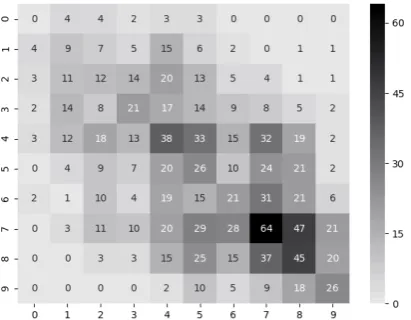
[image:6.595.77.283.322.482.2]A similar process was followed with the indi-vidual arguments quality labeling. Instead of re-labeling, we split existing annotations to two even groups. We chose only individual arguments in which at least14valid annotations remained after data cleansing (1,154 such arguments). This re-sulted in two sets of labels for the same data, each based on at least7annotations. Pearson’s correla-tion coefficient between quality scores of the two sets was0.53. We then divided the quality score, which ranges between 0 to 1, to 10 equal bins. The bin frequency counts between the two sets are dis-played in the heatmap in Figure1.
Figure 1: Counts of quality score bins between two equally sized sets of annotators.
6.3 Transitivity Evaluation
Following Habernal and Gurevych (2016b), we further examined to what extent our labeled pairs satisfytransitivity. Specifically, a triplet of argu-ments(A, B, C) in whichAis preferred overB, and B is preferred over C, is considered transi-tive if and only ifAis also preferred overC. We examined all892 argument triplets for which all pair-wise combinations were labeled, and found that transitivity holds in96.2%of the triplets, fur-ther strengthening the validity of our data.
7 Comparison ofIBMRankand
UKPRank
A distinctive feature of our IBMRank dataset is that it was collected actively, via a dedicated
user interface with clear instructions and en-forced length limitations. Correspondingly, we end up with cleaner texts, that are also more ho-mogeneous in terms of length, compared to the
UKPRankthat relies on arguments collected from debate portals.
Text Cleanliness
We counted tokens representing a malformed span of text in IBMRank and UKPRank. These are HTML markup tags, links, excessive punctua-tion12, and tokens not found in GloVE vocabulary (Pennington et al.,2014). Our findings show that 94.78% of IBMRank arguments contain no mal-formed text, 4.38% include one such token, and 0.71% include two such tokens. In the case of
UKPRank, only 62.36% of the arguments are free of malformed text, 17.59% include one such to-ken, and 20.05% include two or more tokens of malformed text.
Text Length
As depicted in Figure 2, the arguments in IBM-Rankare substantially more homogeneous in their length compared toUKPRank. A potential draw-back of the length limitation is that it possibly prevents any learning system from being able to model long arguments correctly. However, by im-posing this restriction we expect our quality label-ing to be less biased due to argument length, hold-ing greater potential to reveal other properties that contribute to argument quality. We confirmed this intuition with respect to the argument pair labeling as described in Section9.1.
Data Size and Individual Argument Labeling
Finally, IBMRankcovers 5,298arguments, com-pared to 1,052 in UKPRank. In addition, in
UKPRankno individual labeling is provided, and individual quality scores are inferred from pairs la-beling. In contrast, forIBMRankeach argument is individually labeled for quality, and we explicitly demonstrate the consistency of these individual la-beling with the provided pairwise lala-beling.
8 Methods
In this section we describe neural methods for predicting the individual score and the pair-wise
12Sequences of three or more punctuation characters, e.g.
0 50 100 150 200 250 300 350
0 10 20 30 40
Argument Length in IBMRank
0 5 10 15 20 25 30
0 10 20 30 40 50 60 70 80 90 100 110
[image:7.595.73.290.61.350.2]Argument Length in UKPRank
Figure 2: Histograms of argument length inIBMRank
andUKPRank. X-axis: length (token count). Y-axis: the number of arguments at that length.
classification of arguments. We devise two meth-ods corresponding to the two newly introduced datasets. Our methods are based upon a powerful language representational model named Bidirec-tional Encoder Representations from Transform-ers (BERT) (Devlin et al., 2018) which achieves state-of-the-art results on a wide range of tasks in NLP (Wang et al.(2018),Rajpurkar et al.(2016,
2018)). BERT has been extensively trained over large corpora to perform two tasks: (1) Masked Language Model- randomly replace words with a predefined token, [MASK], and predict the miss-ing word. (2) Next Sentence Prediction- given a pair of sentences A and B, predict whether sen-tenceBfollows sentenceA. Due to its bidirectional nature, BERT achieves remarkable results when fine-tuned to different tasks without the need for specific modifications per task. For further details refer toDevlin et al.(2018).
8.1 Argument-Pair Classification
We fine-tune BERT’s Base Uncased English pre-trained model for a binary classification task.13
13Initial experiments with BERT’s Large model showed
only minor improvements, so for the purpose of the
exper-The fine-tuning process is initialized with weights from the general purpose pre-trained model and a task specific weight matrix Wout ∈ R768×2 is
added to the 12-layer base network. Following standard practice with BERT, given a pair of argu-mentsAandB, we feed the network with the fol-lowing sequence ‘[CLS]A[SEP]B’. The[SEP] token indicates to the network that the input is to be treated as a pair and[CLS] is a token which is used to obtain contextual embedding for the en-tire sequence. The network is trained for3epochs with a learning rate of2−5. We refer to this model asArg-Classifier.
8.2 Argument Ranking
For training a model to output a score between [0,1] we obtain contextual embeddings from the Arg-Classifier fine-tuned model. We concatenate the last 4 layers of the model output to obtain an embedding vector of size4×768 = 3072. The embedding vectors are used as input to a neural network with a single output and one hidden layer with300neurons. In order for the network to out-put values in[0,1], we use a sigmoid activation, σsigmoid(x) = 1+1e−x. Denote the weight matrices W1 ∈ R3072×300 andW2 ∈ R300×1, the
regres-sor model,fR, is a 2-layered neural network with
σrelu(x) = max{0, x}activation.fRcan be
writ-ten as:14
fR(x) =σsigmoid W2Tσrelu(W1Tx)
wherex ∈ R3072 is the embedding vector repre-senting an argument. We refer to this regression model asArg-Ranker.
9 Experiments
9.1 Argument-Pair Classification
In this section we evaluate the methods described in Section 8. First, we evaluate the accuracy of
Arg-Classifier on our IBMPairs dataset and on
UKPConvArgStrict (henceforth, UKPStrict), the filtered argument pairs dataset of Habernal and Gurevych (2016b), in k-fold cross-validation.15 We calculate accuracy and ROC area under curve (AUC) for each fold, and report the weighted av-erages over all folds. We also evaluate Simp-son and Gurevych(2018)’sGPPLmedian heuris-tic method with GloVe + ling features in
cross-iments detailed in Section9we used the Base model.
14
We omit bias terms for readability.
validation on ourIBMPairsdataset. For complete-ness, we quote Simpson and Gurevych (2018)’s figures of GPPL opt. andGPC on UKPStrict.16 We add a simple baseline classifying arguments based on their token count (Arg-Length).
IBMPairs
Arg-Length Arg-Classifier GPPL Acc. .55 .80 .71 AUC .59 .86 .78
UKPStrict
[image:8.595.307.524.103.137.2]Arg-Length Arg-Classifier GPPL GPPL opt. GPC Acc. .76 .83 .79 .80 .81 AUC .78 .89 .87 .87 .89
Table 3: Accuracy and AUC onIBMPairsandUKPStrict.
As can be seen in Tables 3, Arg-Classifier im-proves on the GPPL method on both datasets (p .01using two-tailed Wilcoxon signed-rank test).17 We note that Arg-Classifier’s accuracy on the UKPStrict set is higher than all methods tested on this dataset in Habernal and Gurevych
(2016b);Simpson and Gurevych(2018). Interest-ingly, all methods reach higher accuracy on UKP-Strictcompared toIBMPairs, presumably indicat-ing that the data inIBMPairsis more challenging to classify. With regards to Arg-Length, we can see that it is inaccurate onIBMPairsbut achieves a respectable result onUKPStrict. This is in agree-ment with Habernal and Gurevych (2016a) who analyzed the reasons that annotators provided for their labeling. In most cases the reason indicated preference for arguments with more information – which is what longer arguments tend to be better at. This further strengthens the value of creating
IBMPairs and IBMRank as much more homoge-neous datasets in terms of argument length.
9.2 Argument Ranking
We proceed to evaluate the Arg-Ranker on the
IBMRankandUKPRank datasets in k-fold cross-validation, and report weighted correlation mea-sures. We also evaluate theArg-Rankerby feeding it vanilla BERT embeddings, instead of the fine-tuned embeddings generated by theArg-Classifier
model. We refer to this version as
Arg-Ranker-16We were unable to reproduce the results reported in
Simpson and Gurevych (2018) by running theGPPL opt. andGPCalgorithms on theUKPStrictdataset. We have ap-proached the authors and reported the issue, which was not solved by the time this paper was published, and hence we only quote the figures as reported there.
17The results per fold in both tasks are included in the
sup-plementary material.
base. In both Arg-Ranker and Arg-Ranker-base
evaluations we report the mean of 3 runs.18
IBMRank UKPRank
Arg-Ranker-base Arg-Ranker Arg-Ranker-base Arg-Ranker GPPL
r .41 .42 .44 .49 .45
[image:8.595.78.284.140.227.2]ρ .38 .41 .57 .59 .65
Table 4: Pearson’s (r) and Spearman’s (ρ) correla-tion ofArg-Ranker-base,Arg-RankerandGPPLon the
IBMRankandUKPRankdatasets.
As can be seen in Table 4, on the UKPRank
dataset, Arg-Ranker is slightly better thanGPPL
for Pearson’s correlation, but slightly worse for Spearman’s correlation. Additionally, using direct BERT embeddings provides worse correlation19 than using theArg-Classifierembeddings for both datasets, justifying its use. Finally, similarly to the findings in the argument-pair classification task, theIBMRankdataset is harder to predict.20
10 Error Analysis
We present a qualitative analysis of examples that theArg-ClassifierandArg-Rankermodels did not predict correctly. For each of the argument-pair and ranking tasks, we analyzed 50 −100 argu-ments from three motions on which the perfor-mance of the respective model was poor. For each motion we selected the arguments in which the model was most confident in the wrong direction.
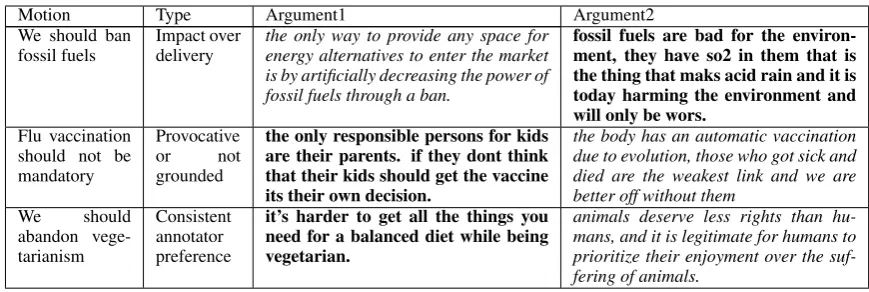
A prominent insight from this analysis, com-mon to both models, is that the model tends to fail when the argument persuasiveness outweighs its delivery quality (such as bad phrasing or ty-pos). An example of this is shown in row 1 of Table5. In this case, Argument2 is labeled as hav-ing a higher quality, even though it contains multi-ple typos, and thus is typical to arguments that the model was trained to avoid selecting.
Another phenomenon that both our models fail to address is arguments that are off-topic, too provocative or not grounded. An example of this, from the argumentpair task, is shown in row 2 -Argument2 is presumably considered harsh by an-notators, even though it is fine in terms of
gram-18
TheGPPLregressor ofSimpson and Gurevych(2018) relies on pair-wise (relative) labeling of arguments and as a result it cannot be used for predicting the individual (abso-lute) labeling of arguments, as inIBMRank.
19Significantly for theIBMRankdata on both measures,
and for theUKPRankon Pearson’s correlation,p.05.
20For the experiments on
Motion Type Argument1 Argument2 We should ban
fossil fuels
Impact over delivery
the only way to provide any space for energy alternatives to enter the market is by artificially decreasing the power of fossil fuels through a ban.
fossil fuels are bad for the environ-ment, they have so2 in them that is the thing that maks acid rain and it is today harming the environment and will only be wors.
Flu vaccination should not be mandatory
Provocative or not grounded
the only responsible persons for kids are their parents. if they dont think that their kids should get the vaccine its their own decision.
the body has an automatic vaccination due to evolution, those who got sick and died are the weakest link and we are better off without them
We should abandon vege-tarianism
Consistent annotator preference
it’s harder to get all the things you need for a balanced diet while being vegetarian.
[image:9.595.80.515.60.206.2]animals deserve less rights than hu-mans, and it is legitimate for humans to prioritize their enjoyment over the suf-fering of animals.
Table 5: Examples of argument pairs for which there is a high difference between the argument selected by the annotators, marked in bold, and the argument predicted to be of higher quality by the model, marked in italics.
matical structure and impact on the topic. These types of arguments are becoming more important to recognize, especially in the “fake-news” era. We leave dealing with them for future work.
Finally, we also notice certain arguments were consistently preferred by annotators, regardless of the quality of the opposing argument. This is a pattern relevant only to theArg-Classifiermodel, shown in row 3.
11 Conclusions and Future Work
A significant barrier in developing automatic methods for estimating argument quality is the lack of suitable data. An important contribution of this work is a newly introduced data composed of6.3kcarefully annotated arguments, compared to 1k arguments in previously considered data. Another barrier is the inherent subjectivity of the
manualtask for determining argument quality. To overcome this issue, we employed a relatively large set of crowd annotators to consider each in-stance, associated with various measures to ensure the quality of the annotations associated with the released data. In addition, while previous work focused on arguments collected from web debate portals, here we collected arguments via a dedi-cated interface, enforcing length limitations, and providing contributors with clear guidance. More-over, previous work relied solely on annotating pairs of arguments, and used these annotations to
inferthe individual ranking of arguments; in con-trast, here, we annotated all individual arguments for their quality, and further annotated14kpairs. This two–fold approach allowed us, for the first time, to explicitly examine the relation between relative (pairwise) annotation and explicit
(indi-vidual) annotation of argument quality. Our anal-ysis suggests that these two schemes provide rela-tively consistent results. In addition, these annota-tion efforts may complement each other. As pairs of arguments with a high difference in individual quality scores appear to agree with argument-pair annotations, one may deduce the latter from the former. Thus, it may be beneficial to dedicate the more expensive pair-wise annotation efforts to pairs in which the difference in individual qual-ity scores is small, reminiscent of active learning (Settles, 2009). In future work we intend to fur-ther investigate this approach, as well as explore in more detail the low fraction of cases where these two schemes led to clearly different results.
The second contribution of this work is suggest-ing neural methods, based onDevlin et al.(2018), for argument ranking as well as for argument-pair classification. In the former task, our re-sults are comparable to state-of-the-art; in the lat-ter task they significantly outperform earlier meth-ods (Habernal and Gurevych,2016b).
Finally, to the best of our knowledge, current approaches do not deal with argument pairs of rel-atively similar quality. A natural extension is to develop a ternary-class classification model that will be trained and evaluated on such pairs, as we intend to explore in future work.
Acknowledgements
References
Nora Aranberri, Gorka Labaka, Arantza D´ıaz de Ilar-raza, and Kepa Sarasola. 2017. Ebaluatoia: crowd evaluation for english–basque machine translation.
Language Resources and Evaluation, 51(4):1053– 1084.
Aristotle, G.A. Kennedy, and G.A. Kennedy. 1991.On Rhetoric: A Theory of Civic Discourse. Oxford Uni-versity Press.
Roy Bar-Haim, Indrajit Bhattacharya, Francesco Din-uzzo, Amrita Saha, and Noam Slonim. 2017. Stance classification of context-dependent claims. In Pro-ceedings of the 15th Conference of the European Chapter of the Association for Computational Lin-guistics: Volume 1, Long Papers, pages 251–261, Valencia, Spain. Association for Computational Lin-guistics.
T Bench-Capon, K Atkinson, and Peter McBurney. 2009.Altruism and agents: an argumentation based approach to designing agent decision mechanisms, pages 1073 – 1080. Unknown Publisher.
Xi Chen, Paul N. Bennett, Kevyn Collins-Thompson, and Eric Horvitz. 2013. Pairwise ranking aggrega-tion in a crowdsourced setting. InProceedings of the Sixth ACM International Conference on Web Search
and Data Mining, WSDM ’13, pages 193–202, New
York, NY, USA. ACM.
Cohen. 1960. A coefficient of agreement for nominal scales. Educ Psychol Meas, pages 37–46.
Jacob Devlin, Ming-Wei Chang, Kenton Lee, and Kristina Toutanova. 2018. BERT: pre-training of deep bidirectional transformers for language under-standing.CoRR, abs/1810.04805.
Martin Gleize, Eyal Shnarch, Leshem Choshen, Lena Dankin, Guy Moshkowich, Ranit Aharonov, and Noam Slonim. 2019. Are you convinced? choos-ing the more convincchoos-ing evidence with a Siamese network. InProceedings of the 57th Annual Meet-ing of the Association for Computational LMeet-inguis- Linguis-tics, pages 967–976, Florence, Italy. Association for Computational Linguistics.
Ivan Habernal and Iryna Gurevych. 2016a. What makes a convincing argument? empirical analysis and detecting attributes of convincingness in web argumentation. In Proceedings of the 2016 Con-ference on Empirical Methods in Natural Language Processing, pages 1214–1223, Austin, Texas. Asso-ciation for Computational Linguistics.
Ivan Habernal and Iryna Gurevych. 2016b. Which ar-gument is more convincing? analyzing and predict-ing convincpredict-ingness of web arguments uspredict-ing bidirec-tional lstm. InProceedings of the 54th Annual Meet-ing of the Association for Computational LMeet-inguistics (Volume 1: Long Papers), pages 1589–1599. Asso-ciation for Computational Linguistics.
Dirk Hovy, Taylor Berg-Kirkpatrick, Ashish Vaswani, and Eduard Hovy. 2013. Learning whom to trust with MACE. InProceedings of the 2013 Conference of the North American Chapter of the Association for Computational Linguistics: Human Language Technologies, pages 1120–1130, Atlanta, Georgia. Association for Computational Linguistics.
Ran Levy, Yonatan Bilu, Daniel Hershcovich, Ehud Aharoni, and Noam Slonim. 2014. Context depen-dent claim detection. InProceedings of COLING 2014, the 25th International Conference on Compu-tational Linguistics: Technical Papers, pages 1489– 1500, Dublin, Ireland. Dublin City University and Association for Computational Linguistics.
Marco Lippi and Paolo Torroni. 2016. Argumentation mining: State of the art and emerging trends. ACM Trans. Internet Technol., 16(2):10:1–10:25.
Jeffrey Pennington, Richard Socher, and Christo-pher D. Manning. 2014. Glove: Global vectors for word representation. InIn EMNLP.
Pranav Rajpurkar, Robin Jia, and Percy Liang. 2018.
Know what you don’t know: Unanswerable ques-tions for squad.CoRR, abs/1806.03822.
Pranav Rajpurkar, Jian Zhang, Konstantin Lopyrev, and Percy Liang. 2016. Squad: 100,000+ questions for machine comprehension of text. InProceedings of the 2016 Conference on Empirical Methods in Nat-ural Language Processing, pages 2383–2392. Asso-ciation for Computational Linguistics.
Chris Reed. 2016. Proceedings of the third work-shop on argument mining (argmining2016). In
Proceedings of the Third Workshop on Argument Mining (ArgMining2016). Association for Compu-tational Linguistics.
Nils Reimers, Benjamin Schiller, Tilman Beck, Jo-hannes Daxenberger, Christian Stab, and Iryna Gurevych. 2019. Classification and clustering of arguments with contextualized word embeddings.
CoRR, abs/1906.09821.
Ruty Rinott, Lena Dankin, Carlos Alzate Perez, Mitesh M. Khapra, Ehud Aharoni, and Noam Slonim. 2015. Show me your evidence - an auto-matic method for context dependent evidence de-tection. InProceedings of the 2015 Conference on Empirical Methods in Natural Language Process-ing, pages 440–450, Lisbon, Portugal. Association for Computational Linguistics.
Burr Settles. 2009. Active learning literature survey. Computer Sciences Technical Report 1648, Univer-sity of Wisconsin–Madison.
Christian Stab and Iryna Gurevych. 2014. Annotating argument components and relations in persuasive es-says. InCOLING, pages 1501–1510. ACL.
Henning Wachsmuth, Nona Naderi, Yufang Hou, Yonatan Bilu, Vinodkumar Prabhakaran, Tim Al-berdingk Thijm, Graeme Hirst, and Benno Stein. 2017a. Computational argumentation quality as-sessment in natural language. InProceedings of the 15th Conference of the European Chapter of the As-sociation for Computational Linguistics: Volume 1, Long Papers, pages 176–187. Association for Com-putational Linguistics.
Henning Wachsmuth, Martin Potthast, Khalid Al Khatib, Yamen Ajjour, Jana Puschmann, Jiani Qu, Jonas Dorsch, Viorel Morari, Janek Bevendorff, and Benno Stein. 2017b. Building an argument search engine for the web. InArgMining@EMNLP, pages 49–59. Association for Computational Linguistics.
Douglas Walton, Chris Reed, and Fabrizio Macagno. 2008. Argumentation Schemes. Cambridge Univer-sity Press.
Alex Wang, Amanpreet Singh, Julian Michael, Felix Hill, Omer Levy, and Samuel R. Bowman. 2018.