Proceedings of the 2nd Workshop on Deep Learning Approaches for Low-Resource NLP (DeepLo), pages 124–131 124
Generation-Distillation for Efficient Natural Language Understanding in
Low-Data Settings
Luke Melas-Kyriazi [email protected]
George Han [email protected]
Celine Liang [email protected]
Abstract
Over the past year, the emergence of trans-fer learning with large-scale language mod-els (LM) has led to dramatic performance im-provements across a broad range of natural language understanding tasks. However, the size and memory footprint of these large LMs makes them difficult to deploy in many sce-narios (e.g. on mobile phones). Recent re-search points to knowledge distillation as a potential solution, showing that when train-ing data for a given task is abundant, it is possible to distill a large (teacher) LM into a small task-specific (student) network with minimal loss of performance. However, when such data is scarce, there remains a signifi-cant performance gap between large pretrained LMs and smaller task-specific models, even when training via distillation. In this paper, we bridge this gap with a novel training approach, called generation-distillation, that leverages large finetuned LMs in two ways: (1) to gen-erate new (unlabeled) training examples, and (2) to distill their knowledge into a small net-work using these examples. Across three low-resource text classification datsets, we achieve comparable performance to BERT while using 300× fewer parameters, and we outperform prior approaches to distillation for text classi-fication while using3×fewer parameters.
1 Introduction
Over the past year, rapid progress in unsupervised language representation learning has led to the development of increasingly powerful and gener-alizable language models (Radford et al., 2019;
Devlin et al., 2018). Widely considered to be NLP’s “ImageNet moment” (Ruder, 2018), this progress has led to dramatic improvements in a wide range of natural language understanding (NLU) tasks, including text classification, sen-timent analysis, and question answering (Wang
et al., 2018; Rajpurkar et al., 2016). The now-common approach for employing these systems using transfer learning is to (1) pretrain a large language model (LM), (2) replace the top layer of the LM with a task-specific layer, and (3) finetune the entire model on a (usually relatively small) labeled dataset. Following this pattern, Peters et al.(2018),Howard and Ruder(2018),Radford et al.(2019), andDevlin et al.(2018) broadly out-perform standard task-specific NLU models (i.e. CNNs/LSTMs), which are initialized from scratch (or only from word embeddings) and trained on the available labeled data.
Notably, transfer learning with LMs vastly out-performs training task-specific from scratch in low data regimes. For example, GPT-2 is capable of generating coherent text in a particular style (i.e. poetry, Java code, questions and answers) when conditioned on only a handful of sentences of that style (Radford et al.,2019). Similarly, on discrim-inative tasks such as question answering, BERT reaches accuracies comparable to previous task-specific models with orders of magnitude less la-beled data (Devlin et al.,2018).
At the same time however, these large language models are extremely unwieldy. The largest ver-sions of GPT-2 and BERT have over 1.5B and 340M parameters, respectively; it is challenging to use either of these models on a modern GPU (with 12GB of VRAM) and nearly impossible to deploy them on mobile or embedded devices. Thus, there is a strong need for efficient task-specific mod-els that can leverage the knowledge from large pretrained models, while remaining highly com-pressed.
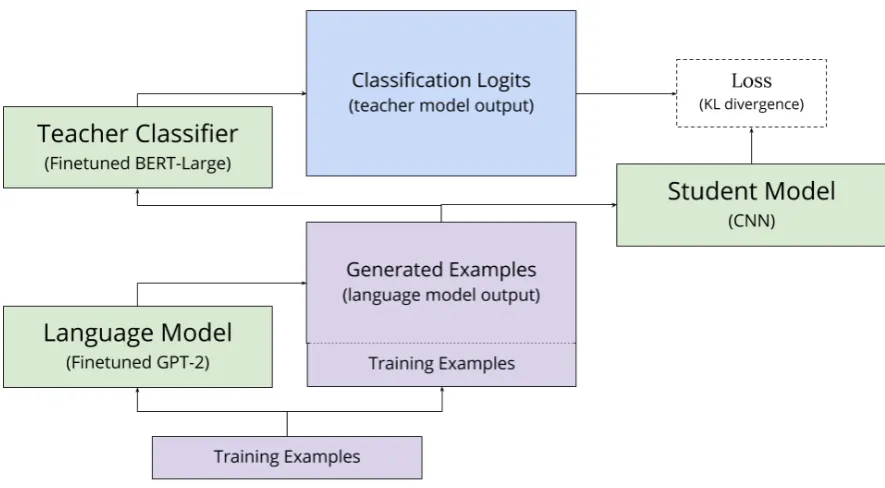
Figure 1: Our proposed generation-distillation training procedure. First, we use a large language model to augment our set of training examples, and second we train our student via distillation with a large language model-based classifier. In the diagram above, green blocks indicate models and purple blocks indicate text data.
multiple large pretrained language models. First, we use a large LM (GPT-2) to generate text in the style of our training examples, augmenting our data with unlabeled synthetic examples. Second, we use the synthetic examples to distill a second large LM (BERT), which has already been fine-tuned for classification, into a small task-specific model (CNN).
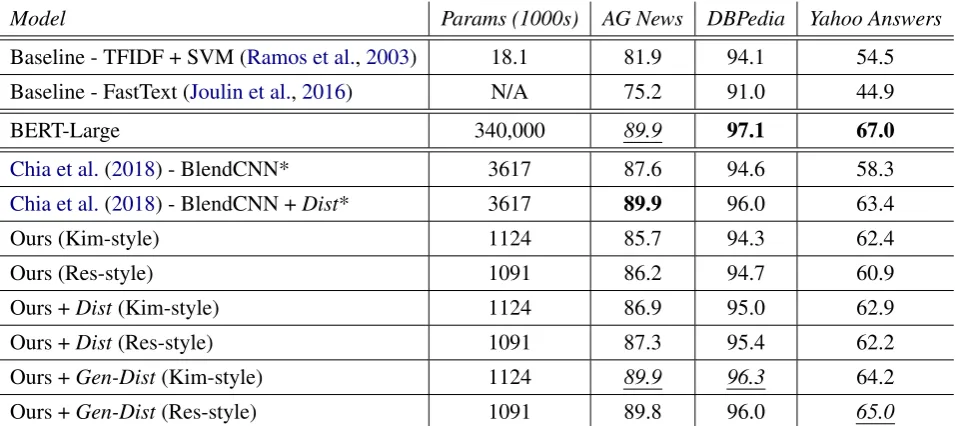
In our experiments, we show that this procedure delivers significant gains over a standard distilla-tion approach in low-data regimes. Specifically, on low-data versions of three widely-adopted text classification datasets (AG News, DBPedia, Ya-hoo Answers), we obtain 98% of BERT’s perfor-mance with 300× fewer parameters. Moreover, compared to prior work on distilling BERT (Chia et al.,2018) on these datasets, we outperform past approaches while using3×fewer parameters.
2 Related Work
Designed to produce contextual word embeddings, large language models (LMs) build upon the now-classic idea of using pretrained word embeddings to initialize the first layer of deep natural language processing models (Collobert et al.,2011). Early proponents of contextual word vectors, including CoVe, ULMFit, and ELMo (McCann et al.,2017;
Howard and Ruder,2018;Peters et al.,2018), ex-tracted word representations from the activations of LSTMs, which were pretrained for either ma-chine translation (CoVe) or for language modeling (ULMFit, ELMo).
Recent work has adopted the transformer ar-chitecture for large-scale language representation. BERT (Devlin et al.,2018) trains a transformer us-ing masked language modelus-ing and next sentence prediction objectives, giving state-of-the-art per-formance across NLU tasks. GPT/GPT-2 ( Rad-ford et al.,2019) trains a unidirectional objective, showing the ability to generate impressively co-herent text.
Model Params (1000s) AG News DBPedia Yahoo Answers
Baseline - TFIDF + SVM (Ramos et al.,2003) 18.1 81.9 94.1 54.5 Baseline - FastText (Joulin et al.,2016) N/A 75.2 91.0 44.9
BERT-Large 340,000 89.9 97.1 67.0
Chia et al.(2018) - BlendCNN* 3617 87.6 94.6 58.3
Chia et al.(2018) - BlendCNN +Dist* 3617 89.9 96.0 63.4
Ours (Kim-style) 1124 85.7 94.3 62.4
Ours (Res-style) 1091 86.2 94.7 60.9
Ours +Dist(Kim-style) 1124 86.9 95.0 62.9
Ours +Dist(Res-style) 1091 87.3 95.4 62.2
[image:3.595.73.551.62.275.2]Ours +Gen-Dist(Kim-style) 1124 89.9 96.3 64.2 Ours +Gen-Dist(Res-style) 1091 89.8 96.0 65.0
Table 1:(Results)A comparison of model size and accuracy on3text classification datasets. Bold font indicates best accuracy and italics+underline indicates second-best accuracy. Generation-distillation broadly improves small model performance over distillation, which in turn broadly improves performance over training from scratch. * results from other papers.
CNNs/LSTMs with fewer parameters, at the cost of a small (but nontrivial) drop in accuracy.
Our project builds on prior work in multiple ways. When performing generation-distillation, we employ a finetuned GPT-2 (Radford et al.,
2019) as our generator and a finetuned BERT (Devlin et al., 2018) as our teacher classifier. Additionally, the distillation component of our generation-distillation approach is similar to the method used in (Chia et al.,2018), but with a dif-ferent loss function (KL divergence in place of mean absolute error).
3 Methodology
As shown in Figure1, our generation-distillation
approach is divided into three steps: finetuning, generation and distillation.
3.1 Finetuning
The first step in our approach involves finetun-ing two different large LMs on our small task-specific dataset. First, we finetune a generative model (in our case, GPT-2) using only the text of the dataset. This model is used to generate new synthetic examples in the generation step. Sec-ond, we finetune a large LM-based classifier (in our case, BERT with an added classification head) using both the text and the labels of the dataset. This model is used as the teacher in the distilla-tionstep.
3.2 Generation
In the generation step, we used a large genera-tive LM, finetuned in the first step, to augment our training dataset with synthetic examples. Specif-ically, we use GPT-2 to generate new sentences in the style of our training dataset and add these to our training dataset. We do not have labels for these generated sentences, but labels are not nec-essary because we train with distillation; our goal in generating synthetic examples is not to improve the large LM-based classifier, but rather to im-prove our ability to distill a large LM-based clas-sifier into a small task-specific clasclas-sifier.
3.3 Distillation
4 Experiments
4.1 Data
We perform text classification on three widely-used datasets:AG News,DBPedia, andYahoo An-swers(Gulli;Auer et al.,2007;Labrou and Finin,
1999). For purposes of comparison, we select our training set using the same procedure asChia et al. (2018), such that the training set contains 100 examples from each class. For the generation-distillation experiments, we use GPT-2 to generate
13600 synthetic training examples on AG News and25000synthetic training examples on DBPe-dia and Yahoo Answers. Combining these with the
400,1400, and1000 original (labeled) examples yields a total of 14000,26400,and26000 exam-ples on AG News, DBPedia, and Yahoo Answers, respectively.
4.2 Finetuning Details and Examples
We finetune GPT-2 345M using Neil Shep-perd’s fork of GPT-2: https://github.com/ nshepperd/gpt-2/blob/finetuning/train.py
Finetuning is performed for a single epoch with a learning rate of2e−5with the Adam optimizer. We use batch size 1 and gradient checkpointing in order to train on a single GPU with 12GB of VRAM. We choose to train for only 1 epoch after examining samples produced by models with dif-ferent amounts of finetuning; due to the small size of the dataset relative to the number of parameters in GPT-2, finetuning for more than 1 epoch results in significant dataset memorization.
For sampling, we perform standard sampling (i.e. sampling from the full output distribution, not top-p or top-k sampling) with temperature param-eterT = 1. Although we do not use k or top-p samtop-pling, we believe it would be interesting to compare the downstream effect of different types of sampling in the future.
In Supplementary Table 3, we show examples of synthetic training texts generated by sampling from the finetuned GPT-2 model, for both DBPe-dia and Yahoo Answers.
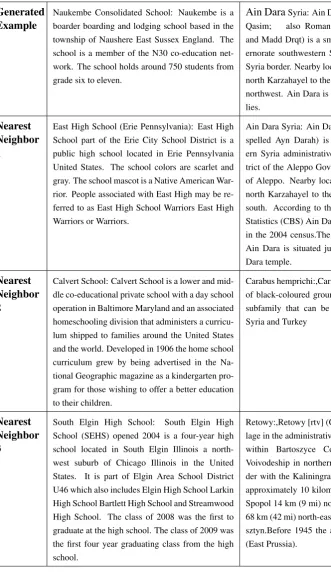
In Supplementary Table 4, we show two syn-thetic training texts along with their nearest neigh-bors in the training set. Nearest neighneigh-bors were calculated by ranking all examples from the train-ing dataset (1400 examples) accordtrain-ing to cosine similarity of TF-IDF vectors. As can be seen in the example in the right column, the GPT-2 lan-guage model has memorized some of the entities
in the training dataset (i.e. the exact words “Ain Dara Syria”), but provides a novel description of the entity. This novel description is factually in-correct, but it may still be helpful in training a text classification model in a low-resource setting, be-cause the words the model generates (i.e. “Syria”, “Turkey”, “Karzahayel”) are broadly related to the original topic/label. For example, they may help the model learn the concept of the class “village”, which is the label of Nearest Neighbor 1.
4.3 Student Models & Optimization
We experiment with two main CNN architectures. The first is a standard CNN architecture fromKim
(2014). The second is a new CNN based on ResNet (He et al.,2016). This “Res-style” model has 3 hidden layers, each with hidden size 100, and dropout probability p = 0.5. We use multi-ple models to demonstrate that our performance improvements over previous approaches are not attributable to architectural changes, and to show that our approach generalizes across architectures. We train the CNNs using Adam (Kingma and Ba, 2014; Loshchilov and Hutter, 2017) with learning rate10−3. Additionally, the CNNs both use 100-dimensional pretrained subword embed-dings (Heinzerling and Strube, 2018), which are finetuned during training.
4.4 Results
We report the performance of our trained models in Table1.
When trained with standard distillation, our KimCNN and ResCNN models perform as would be expected given the strong results inChia et al.
(2018). Our models perform slightly worse than the 8-layer BlendCNN from Chia et al. (2018) on AG News and DBPedia, while performing slightly better on Yahoo Answers. Standard dis-tillation improves their performance, but there re-mains a significant gap between the CNNs and the BERT-Large based classifier. Training with the proposed generation-distillation approach sig-nificantly reduces the gap between the CNNs and BERT-Large; across all datasets, the model trained with generation-distillation matches or exceeds both the model the model trained with standard distillation and the BlendCNN.
4.5 Ablation
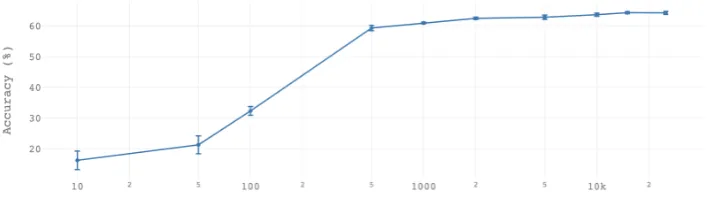
syn-Figure 2: Above, we show how the accuracy of the final distilled model varies with the number of synthetic training examples generated by GPT-2. Error bars show the standard deviation of accuracies on five separate runs. The same GPT-2 model (trained on 100 examples per class, or a total of 1000 examples) was used to generate all synthetic texts.
Hard Labeling vs. Distillation on Generated Examples (Yahoo Answers)
Hard Labeling with BERT Distillation with BERT Accuracy 62.9±0.22 64.2±0.13
Table 2: Above, we show a comparison of hard labeling and distillation for labeling the synthetic examples pro-duced by our generator network. We report the the mean and standard error of the student (Kim) model accuracy across 5 random restarts on the Yahoo Answers dataset. Generation and distillation significantly outperforms generation and hard labeling.
thetic training examples generated by GPT-2. The distilled model is trained entirely on synthetic ex-amples, without ever seeing the original data. The model shows strong performance (60% accuracy) with as few as 500 generated training examples, or
50per class. Moreover, model performance con-tinues to increase with more generated training ex-amples, up to25,000.
In Table 2, we compare two different meth-ods of labeling the synthetic examples produced by our generator network (GPT-2): hard labeling and distillation. Hard labeling refers to taking the maximum-probability class according to our fine-tuned BERT model as the label for each generated example and using a standard cross entropy loss function. Distillation refers to using the proba-bility distribution outputted by BERT as the label for each generated examtple and using a KL di-vergence loss function. Put differently, in the for-mer we use BERT to generate labels, whereas in the latter we use BERT to generate perform dis-tillation. We find that generation and distillation outperforms generation and hard labeling by a sig-nificant margin, consistent with previous work on knowledge distillation (Hinton et al.,2015).
5 Conclusion
In this work, we present a new approach to com-pressing natural language understanding models in low-data regimes. Our approach leverages large finetuned language models in two ways: (1) to generate new (unlabeled) training examples, and (2) to distill their knowledge into a small network using these examples. Across three low-resource text classification datsets, we achieve comparable performance to BERT while using300×fewer pa-rameters, and we outperform prior approaches to distillation for text classification while using3×
fewer parameters. Although we focus on text clas-sification in this paper, our proposed method may be extended to a host of other natural language understanding tasks in low-data settings, such as question answering or extractive summarization.
References
S¨oren Auer, Christian Bizer, Georgi Kobilarov, Jens Lehmann, Richard Cyganiak, and Zachary Ives. 2007. Dbpedia: A nucleus for a web of open data. InThe semantic web, pages 722–735. Springer.
[image:5.595.122.477.94.197.2]2018. Transformer to cnn: Label-scarce distillation for efficient text classification.
Ronan Collobert, Jason Weston, L´eon Bottou, Michael Karlen, Koray Kavukcuoglu, and Pavel P. Kuksa. 2011. Natural language processing (almost) from scratch.CoRR, abs/1103.0398.
Jacob Devlin, Ming-Wei Chang, Kenton Lee, and Kristina Toutanova. 2018. Bert: Pre-training of deep bidirectional transformers for language understand-ing. arXiv preprint arXiv:1810.04805.
Antonio Gulli. [link].
Kaiming He, Xiangyu Zhang, Shaoqing Ren, and Jian Sun. 2016. Deep residual learning for image recog-nition. In Proceedings of the IEEE conference on computer vision and pattern recognition, pages 770– 778.
Benjamin Heinzerling and Michael Strube. 2018. BPEmb: Tokenization-free Pre-trained Subword Embeddings in 275 Languages. In Proceedings of the Eleventh International Conference on Language Resources and Evaluation (LREC 2018), Miyazaki, Japan. European Language Resources Association (ELRA).
Geoffrey Hinton, Oriol Vinyals, and Jeff Dean. 2015. Distilling the knowledge in a neural network. arXiv preprint arXiv:1503.02531.
Jeremy Howard and Sebastian Ruder. 2018. Universal language model fine-tuning for text classification.
ACL 2018.
Armand Joulin, Edouard Grave, Piotr Bojanowski, Matthijs Douze, H´erve J´egou, and Tomas Mikolov. 2016. Fasttext.zip: Compressing text classification models. arXiv preprint arXiv:1612.03651.
Yoon Kim. 2014. Convolutional neural net-works for sentence classification. arXiv preprint arXiv:1408.5882.
Diederik P Kingma and Jimmy Ba. 2014. Adam: A method for stochastic optimization. arXiv preprint arXiv:1412.6980.
Yannis Labrou and Tim Finin. 1999. Yahoo! as an ontology: using yahoo! categories to describe doc-uments. InProceedings of the eighth international conference on Information and knowledge manage-ment, pages 180–187. ACM.
Ilya Loshchilov and Frank Hutter. 2017. Fixing weight decay regularization in adam. arXiv preprint arXiv:1711.05101.
Bryan McCann, James Bradbury, Caiming Xiong, and Richard Socher. 2017. Learned in translation: Con-textualized word vectors. InAdvances in Neural In-formation Processing Systems, pages 6294–6305.
Matthew E Peters, Mark Neumann, Mohit Iyyer, Matt Gardner, Christopher Clark, Kenton Lee, and Luke Zettlemoyer. 2018. Deep contextualized word rep-resentations. NAACL 2018.
Alec Radford, Jeffrey Wu, Rewon Child, David Luan, Dario Amodei, and Ilya Sutskever. 2019. Language models are unsupervised multitask learners. OpenAI Blog, 1:8.
Pranav Rajpurkar, Jian Zhang, Konstantin Lopyrev, and Percy Liang. 2016. Squad: 100, 000+ ques-tions for machine comprehension of text. CoRR, abs/1606.05250.
Juan Ramos et al. 2003. Using tf-idf to determine word relevance in document queries.
Sebastian Ruder. 2018. Nlp’s imagenet moment has arrived.
Raphael Tang, Yao Lu, Linqing Liu, Lili Mou, Olga Vechtomova, and Jimmy Lin. 2019. Distilling task-specific knowledge from bert into simple neural net-works. arXiv preprint arXiv:1903.12136.
Examples of Generated Training Texts
DBPedia
Landmine: Landmine[1] (also known as LNG mine) is a landmine created by the Chernobyl nuclear powerplant. It is a slurry subterranean mine typically laid in shallow pools of water. The mines are connected by run-off points and can be faced off against one another.
Naukembe Consolidated School: Naukembe is a boarder boarding and lodging school based in the township of Naushere East Sussex England. The school is a member of the N30 co-education network. The school holds around 750 students from grade six to eleven.
Peter Moldegrd: Peter Moldegrd (born 6 July 1940) is a Swedish film director known for his 1972 Melancholia. He later worked in Zurich and Hong Kong.
Ain Dara Syria: Ain Dara (Arabic: Andin Qasim Qasim; also Romanized as Andin Qs Qasim and Madd Drqt) is a small village in Doubs Governorate southwestern Syria close to the Turkey-Syria border. Nearby localities include Afrin to the north Karzahayel to the east and Siloamfara to the northwest. Ain Dara is settled by around 30 families.
Yahoo Answers
Why is America the most geographically illiterate first world country?
Where I can get program that erases voice from music track?: Where I can get program that erases voice from music track? nowhere
does anyone know the name of the song that’s used in the ADIDAS commercial Jos +10? (That’s adidas, by the way)?: This commercial was recently in a recent adidas commercial, and they appar-ently used the credits for the commercial, so I saw it and thought it was pretty cool.
What would be a good way to express how you feel about another person?: say something nice, thoughtful, creative, professional... whatever . just let it go and move on, someone else will take care of the rest
Generated Training Examples and their Nearest Neighbors in the Real Training Data (DBPedia)
Generated Example
Naukembe Consolidated School: Naukembe is a boarder boarding and lodging school based in the township of Naushere East Sussex England. The school is a member of the N30 co-education net-work. The school holds around 750 students from grade six to eleven.
Ain DaraSyria: Ain Dara (Arabic: Andin Qasim Qasim; also Romanized as Andin Qs Qasim and Madd Drqt) is a small village in Doubs Gov-ernorate southwestern Syria close to the Turkey-Syria border. Nearby localities include Afrin to the north Karzahayel to the east and Siloamfara to the northwest. Ain Dara is settled by around 30 fami-lies.
Nearest Neighbor 1
East High School (Erie Pennsylvania): East High School part of the Erie City School District is a public high school located in Erie Pennsylvania United States. The school colors are scarlet and gray. The school mascot is a Native American War-rior. People associated with East High may be re-ferred to as East High School Warriors East High Warriors or Warriors.
Ain Dara Syria: Ain Dara (Arabic: Ł\u200e also spelled Ayn Darah) is a small village in north-ern Syria administratively part of the Afrin Dis-trict of the Aleppo Governorate located northwest of Aleppo. Nearby localities include Afrin to the north Karzahayel to the east and Bassouta to the south. According to the Syria Central Bureau of Statistics (CBS) Ain Dara had a population of 248 in the 2004 census.The modern-day settlement of Ain Dara is situated just east of the ancient Ain Dara temple.
Nearest Neighbor 2
Calvert School: Calvert School is a lower and mid-dle co-educational private school with a day school operation in Baltimore Maryland and an associated homeschooling division that administers a curricu-lum shipped to families around the United States and the world. Developed in 1906 the home school curriculum grew by being advertised in the Na-tional Geographic magazine as a kindergarten pro-gram for those wishing to offer a better education to their children.
Carabus hemprichi:,Carabus hemprichi is a species of black-coloured ground beetle in the Carabinae subfamily that can be found in Israel Lebanon Syria and Turkey
Nearest Neighbor 3
South Elgin High School: South Elgin High School (SEHS) opened 2004 is a four-year high school located in South Elgin Illinois a north-west suburb of Chicago Illinois in the United States. It is part of Elgin Area School District U46 which also includes Elgin High School Larkin High School Bartlett High School and Streamwood High School. The class of 2008 was the first to graduate at the high school. The class of 2009 was the first four year graduating class from the high school.
[image:8.595.87.419.120.693.2]Retowy:,Retowy [rtv] (German: Rettauen) is a vil-lage in the administrative district of Gmina Spopol within Bartoszyce County Warmian-Masurian Voivodeship in northern Poland close to the bor-der with the Kaliningrad Oblast of Russia. It lies approximately 10 kilometres (6 mi) north-west of Spopol 14 km (9 mi) north-east of Bartoszyce and 68 km (42 mi) north-east of the regional capital Ol-sztyn.Before 1945 the area was part of Germany (East Prussia).