187
PyOpenDial: A Python-based Domain-Independent Toolkit for
Developing Spoken Dialogue Systems with Probabilistic Rules
Youngsoo Jang1∗, Jongmin Lee1∗, Jaeyoung Park1∗, Kyeng-Hun Lee3, Pierre Lison4, Kee-Eung Kim1,2
1 School of Computing, KAIST, Daejeon, Republic of Korea
2 Graduate School of AI, KAIST, Daejeon, Republic of Korea
3Samsung Electronics, Seoul, Republic of Korea
4Norwegian Computing Center, Oslo, Norway
{ysjang,jmlee,jypark}@ai.kaist.ac.kr,
[email protected], [email protected], [email protected]
Abstract
We present PyOpenDial, a Python-based domain-independent, open-source toolkit for spoken dialogue systems. Recent advances in core components of dialogue systems, such as speech recognition, language understanding, dialogue management, and language genera-tion, harness deep learning to achieve state-of-the-art performance. The original OpenDial, implemented in Java, provides a plugin archi-tecture to integrate external modules, but lacks Python bindings, making it difficult to inter-face with popular deep learning frameworks such as Tensorflow or PyTorch. To this end, we re-implemented OpenDial in Python and extended the toolkit with a number of novel functionalities for neural dialogue state track-ing and action planntrack-ing. We describe the over-all architecture and its extensions, and illus-trate their use on an example where the system response model is implemented with a recur-rent neural network.
1 Introduction
Spoken dialogue systems (SDSs) allow interac-tions between users and machines through nat-ural language conversations. These systems are composed of a broad range of components such as speech recognition, language understanding, dialogue management, language generation, and speech synthesis. Recent SDS frameworks, such as AT&T Statistical Dialogue Toolkit (Williams et al., 2010), OpenDial (Lison and Kennington,
2016), and PyDial (Ultes et al., 2017) aim to integrate these complex and diverse components through a modular architecture.
Spoken dialogue systems may either adopt sym-bolic or statistical approaches to perform
lan-∗
*:These authors contributed equally.
[image:1.595.312.523.227.304.2]This work was supported by MOTIE (KEIT No. 10063424), MSIT (IITP No. 2017-0-01779 XAI, IITP No. 2019-0-00075-001), and Samsung Research.
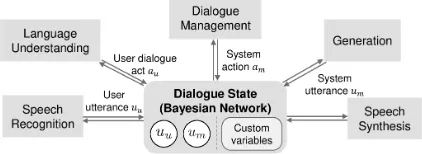
Figure 1: Information-state architecture for PyOpen-Dial.
guage understanding, dialogue management and language generation. Statistical approaches, in-cluding but not limited to (Young et al., 2013;
Ultes et al., 2017) rely on probabilistic models of dialogue interactions and allows these models to be estimated from data. Symbolic approaches, on the other hand, model the dialogue interaction using finite-state automata or logical methods de-signed by the developer. Of our particular interest is OpenDial, a Java-based open-source toolkit that combines the benefits of both statistical and sym-bolic approaches.
In recent years, deep learning has shown to achieve promising performance results in many tasks related to dialogues, such as speech recog-nition (Graves et al.,2013), language understand-ing (Radford et al., 2018), dialogue management (Williams et al., 2017) and language generation (Yu et al.,2016). Given that one of the most pop-ular programming languages for deep learning li-braries is Python, e.g. Tensorflow (Abadi et al.,
2016) and PyTorch (Paszke et al.,2017), the inte-gration of neural conversational models would be a straightforward task if OpenDial itself was writ-ten in Python.
track neural dialogue state and the use of Monte Carlo Tree Search for forward planning. PyOpen-Dial inherits the original architectural design of OpenDial, and extends the XML domain specifi-cation so that various deep learning models can be directly used for SDS components. We include the negotiation dialogue domain in (Lewis et al.,
2017) as an example to show how to integrate with external components trained by deep learning.
2 Architecture
2.1 Dialogue State
PyOpenDial inherits the information-state frame-work in OpenDial (Larsson and Traum, 2000): All the components in the toolkit operates on the shared information state that represents the dia-logue state arising from the interaction between the user and the machine (see Figure1). The dia-logue state is represented by a Bayesian network (BN), a directed graphical model for encoding the probability distribution of the dialogue state. Hence, the dialogue state consists of a factored representation of state variables on a dialogue, which are random variables, and conditional de-pendencies between them.
2.2 Workflow
PyOpenDial adopts the probabilistic rules used in OpenDial (Lison, 2014; Lison and Kennington,
2016) to update the dialogue state represented by a Bayesian Network during the conversation. These rules follow aif...then...elseskeleton that map log-ical conditions on a subset of state variables to a probability or utility distribution on another subset of state variables. Two types of rules are provided: probability rules and utility rules. The probability rule defines the probabilistic change of state vari-ables through a probability distribution over ef-fects, each of which is an assignment on the state variables, given a logical condition of state vari-ables. The utility rule defines utilities on the val-ues of action variables given a logical conditions of state variables. These probabilistic rules are specified in the domain XML file. Examples are shown in Listing1, where line 13-23 contains the probability rule and line 27-38 contains the utility rule.
These probabilistic rules can be grouped ac-cording to subtasks, such as language understand-ing, dialogue management, language generation and etc. Each group is defined as amodel. Each
1<initialstate>
2 <variable id="movie_rnn">
3 <value>@chatbot.MovieRNN</value> 4 </variable>
5 <variable id="music_rnn">
6 <value>@chatbot.MusicRNN</value> 7 </variable>
8</initialstate> 9
10<function name="gen_u_m">chatbot.generate</function> 11<!-- User intent recognition -->
12<modeltrigger="u_u">
13 <rule> 14 <case> 15 <condition>
16 <if var="u_u" value="movie" relation="contains"/>
17 </condition> 18 <effect prob="1">
19 <set var="a_u" value="movie"/>
20 </effect> 21 </case> 22 · · ·
23 </rule> 24</model>
25<!-- System utterance generation -->
26<modeltrigger="a_u">
27 <rule> 28 <case> 29 <condition>
30 <if var="a_u" value="movie"/>
31 </condition> 32 <effect util="1">
33 <set var="u_m"
34 value="@gen_u_m({movie_rnn},{u_u})"/>
35 </effect> 36 </case> 37 · · ·
38 </rule> 39</model>
Listing 1: A simple example domain XML specifica-tion for an RNN-based chat-bot. Here,u ustands for the user utterance,a ufor the user intent andu mfor the system utterance.
model is associated with a subset of state vari-ables, calledtrigger variables. Each model mon-itors the change of its trigger variables. When one or more trigger variables are updated during a conversation, the probabilistic rules on the cor-responding model are applied to the dialogue state by instantiating the rule with the current dialogue state. Note that these updates may result to trigger other models, hence the procedure causes a chain of updates on the dialogue state through the proba-bilistic rules of the models. In summary, the work-flow of PyOpenDial is basically a series of appli-cations of probabilistic rules to the dialogue state.
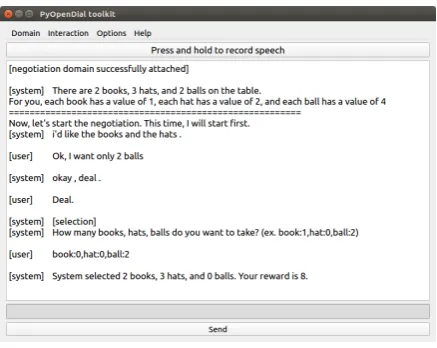
Figure 2: User interface for PyOpenDial.
2.3 Extensions to OpenDial
Custom Variable Types Neural models such as recurrent neural networks (RNNs) have become a popular choice for various dialogue processing tasks, given their capability to be trained end-to-end and infer complex latent representations of the dialogue state. In these models, the dialogue state is typically represented as a vector-valued predic-tion computed from a complex mapping from in-put to outin-put. In contrast, the original OpenDial only supports updates on primitive data types (e.g. boolean, double, string, double array, and set) via human-readable probabilistic rules similar to de-cision trees. In order to overcome this limitation, we extend the specification of the dialogue state to include complex variable types and functional values to allow arbitrarily complex mappings of conditional variables, e.g. latent vectors in neural models that encode the dialogue context.
This is achieved by extending the domain XML specification to allow for variable types expressed through complex functions that can be integrated in probabilistic rules. In Listing 1, two such custom variables are defined: movie rnn and music rnn, which are instances of MovieRNN andMusicRNNrespectively (line 2-7), represent-ing pre-trained RNN-based generation models. Line 10 assignsgen u mto functiongenerate in module chatbot, which executes the neural model. This particular function takes two argu-ments (namely the generation model and a user ut-terance) as input and returns the system utterance as output.
Predictive models Dialogue management is, at its core, a sequential decision-making problem,
where the goal of the system is to select actions that fulfill the system objectives while minimising associated costs. One way to achieve this objec-tive is through forward planning, i.e. enabling the system to search for actions that yield the maxi-mum expected utility over a given horizon. For-ward planning requires the specification of predic-tive models (such as user simulation models) to be able to predict the consequences of the system actions on the current interaction. PyOpenDial provides theplanning-onlyoption to models, which makes the model triggered only when for-ward planning is performed. This allows the sys-tem to explicitly differentiate between observed and predicted values in the dialogue state. The specific use-case of this feature is described in Section4with Listing2(line 30).
3 Implementation
PyOpenDial is implemented in Python and is released under the MIT opensource license. The toolkit is available through the GitHub code repository at (https://github.com/ KAIST-AILab/PyOpenDial) 1. The toolkit additionally provides a graphical user interface that helps fast-prototyping and test-driving the system. The graphical user interface, shown in Figure2, displays the domain and dialogue history and take the user’s next input (text or speech).
PyOpenDial implements all the core compo-nents and modules of OpenDial, including the BN inference algorithm and the probabilistic rule engine. We also introduced a number of new modules, including the Monte-Carlo tree search (MCTS) (Kocsis and Szepesv´ari, 2006) planner and the basic speech-to-text and text-to-speech modules using Google Speech APIs.
MCTS Planner In dialogue management, plan-ning algorithms are often used to search for the system action that maximizes the sum of utilities in the long-term horizon so as to optimally react to the user.
The baseline planning algorithm in OpenDial is a lookahead forward planner that fully expands the search tree up to the planning horizonH:
Qt(b, a) =U(b, a) +γmax a0 Eo|b,a
Qt+1(bao, a0)
where b is the dialogue state, a is the value of the action variables,ois the possible observation
when taking actionain the state b, bao is the di-alogue state updated from b after action a and observation o, γ ∈ [0,1) is the discount factor, U(b, a)is the instantaneous utility ofaat the dia-logue stateb, and QH(b, a) = 0for allb, a.
Af-ter computing Q0(b, a) from the recursive
equa-tion, the forward planner chooses the final value of the action variable given byargmaxaQ0(b, a). A
major limitation of the forward planner is that the search becomes infeasible in the planning horizon as well as the branching factor (i.e. the number of candidate actions and observations).
On the other hand, MCTS combines tree search with Monte-Carlo simulation so that the search effort is non-uniformly invested into promising nodes. One of the most basic MCTS algorithms is UCT (Kocsis and Szepesv´ari,2006), which per-forms iterative simulation on the search tree by following the UCB rule to select actions at inter-mediate nodes
argmaxa
h
Q(b, a) +c
q logN(b)
N(b,a) i
where cis the exploration constant that balances exploration and exploitation trade-off, Q(b, a) is the average of the sampled sum of utilities,N(b)is the number of simulations performed through the dialogue state b, N(b, a) is the number of times actionais selected inb. More recent versions of MCTS algorithms have shown great successes in many large sequential-decision making problems such as playing Go (Silver et al.,2016).
PyOpenDial includes an MCTS planner, and we shall demonstrate its effectiveness in the next sec-tion by comparing its performance with the for-ward planner, using the negotiation dialogue do-main that requires long-term planning.
Google Speech Modules PyOpenDial provides new speech modules based on Google speech API: The speech recognition module that uses Google speech-to-text API and the speech synthesis mod-ule that uses Google text-to-speech API2. These modules can also be replaced with other custom-developed speech recognition and speech synthe-sis modules.
4 Application Domain
In this section, we demonstrate the aptitude of PyOpenDial using the negotiation dialogue do-main (Lewis et al., 2017) as an example. In this
2https://cloud.google.com/text-to-speech, https://cloud.google.com/speech-to-text
1<initialstate> 2 <variable id="rnn">
3 <value>@nego.NegotiationRNN</value> 4 </variable>
5 <variable id="h"><value> </value></variable>
6 · · ·
7</initialstate> 8
9<function name="gen_u_m">nego.gen_u_m</function> 10<function name="gen_u_u">nego.gen_u_u</function> 11<function name="reward">nego.reward</function>
12 · · ·
13<modeltrigger="u_u">
14 <rule> 15 <case> 16 <condition>
17 <if var="current_step" value="Negotiation"/>
18 </condition>
19 <effect util="0.001">
20 <set var="u_m" value="@gen_u_m({rnn},{h},0)"/>
21 </effect> 22 · · ·
23 <effect util="0.001">
24 <set var="u_m" value="@gen_u_m({rnn},{h},19)"/>
25 </effect> 26 </case> 27 </rule> 28</model> 29
30<modeltrigger="u_m" planning-only="true">
31 <rule> 32 <case> 33 <condition>
34 <if var="current_step" value="Negotiation"/>
35 </condition> 36 <effect>
37 <set var="u_u" value="@gen_u_u({rnn},{h})"/>
38 </effect> 39 </case> 40 </rule> 41</model> 42
43<modeltrigger="current_step">
44 <rule> 45 <case> 46 <condition>
47 <if var="current_step" value="Result"/>
48 </condition>
49 <effect util="@reward({rnn},{h})">
50 <set var="current_step" value="Terminated"/>
51 </effect> 52 </case> 53 </rule> 54</model>
55 · · ·
Listing 2: A simplified XML specification for the ne-gotiation dialogue domain.
4.1 Domain Description
In the negotiation dialogue domain, 3 types of items (i.e. books, hats, balls) are divided be-tween two agents through natural language dia-logue. There is a finite amount of each item (5 to 7 total items and 1 to 4 individual items), and the agents have different utility functions that rep-resent the agent’s preference. The utility function for each agent is defined randomly while satisfy-ing the followsatisfy-ing constraints: (1) The maximally achievable utility for each agent should be 10; (2) Each item must always have a non-zero utility for at least one agent; (3) At least one item must al-ways have a non-zero utility for both agents. If an agreement is reached at the end of the nego-tiation, each agent receives a reward equal to the total utility of obtained items. If the decisions are in conflict, both agents receive a reward of 0. Fig-ure2shows the negotiation dialogue example be-tween user and system in PyOpenDial, and List-ing2presents a simplified version of the domain XML specification.
4.2 RNN-based Natural Language Generation Model
In implementing this dialogue system, we first pre-trained an RNN model that imitates negotiation di-alogues between two humans, following the super-vised training scheme described in (Lewis et al.,
2017). This RNN model has the ability to gen-erate natural language utterances, taking into ac-count the previous dialogue history and the given context (i.e. value and count of each item). We use this RNN to generate candidates of system ut-terances (line 19-25 in Listing 2) and to generate user utterances for the user simulation model that is used during multi-horizon planning (line 37 in Listing2). This RNN model uses PyTorch and is imported into PyOpenDial as decribed next.
4.3 Domain XML Specification
In this section, we briefly explain how the negotia-tion domain is specified in the XML format shown in Listing 2, which is an abbreviation of the full version distributed with PyOpenDial.
Declaration We declare rnn state variable, an instance of NegotiationRNN class (line 2-4). The class has a pre-trained RNN model, described in the previous section, as a member variable and generates actual (user or system) utterance through the RNN model. To represent the dialogue
history, we also declare a state variableh(line 5), which maintains the user and system utterances up to the current turn. We then declare two func-tions, gen u m and gen u u, to generate utter-ances (line 9-10).gen u mis used to generate the set of candidate system utterances andgen u uis used as the user simulator in the planner to search for the best system action that maximizes the over-all utility within the planning horizon. Finover-ally, we declare the functionrewardwhich returns the re-ward at the end of the negotiation (line 11)
System Utterance Generation The utility rule specifies the utility associated with each candidate system action. In order to harness the system ut-terance directly generated byNegotiationRNN and support dialogue planning, we add 20 effects in the utility rule, each corresponding to a system utterance sampled fromNegotiationRNN, and assign the same immediate utility of 0.001 (line 13-28)3. The actual, final utility is decided only when the negotiation has finished, and the plan-ner described next will search for the best system utterance (among 20 candidates) using long-term planning.
Planning The planner requires a user simulation model for long-term planning. The user simula-tion model is given in line 30-41. Note that we set the planning-only tag for the user sim-ulation model (line 30), in order to prevent the user simulation model from overwriting the actual user utteranceu uduring planning. At the end of simulated dialogue, the final utility determined by negotiation is obtained from the python function reward. The variablecurrent stepis set to “Terminated” to represent the end of a dialogue.
4.4 Experiments
Using the negotiation dialogue domain, we com-pare the performances of two planning algorithms, the forward planner and the MCTS planner, and a naive baseline that only maximizes the immediate utility without planning. The planning horizons were set to 3 for the forward planner and 7 for the MCTS planner, which made both planners take ap-proximately same amount of search time.
As reported in Table 1, planning (using either Forward or MCTS) improves the negotiation out-come over the baseline in terms of both reward and
Reward Planning time (s) % Agreed Baseline 4.96±0.12 - 81.8 Forward 5.27±0.12 2.28±0.05 87.3 MCTS 5.68±0.12 2.03±0.03 88.9
Table 1: Experimental results for the negotiation ex-ample. Baseline denotes the result of negotiation be-tween two RNN models (without planning). Forward and MCTS represents the negotiation result between the corresponding planner and the RNN model. All the results are averaged over 3000 dialogues and report the
2×(standard error).
agreement rate, and the MCTS planner further out-performs the forward planner. This is mainly due to the fact that the reward signal in the negotia-tion domain only comes at the very end of the di-alogue, thus in the early stages of the didi-alogue, no meaningful reward signal can be obtained within the short planning horizon of the forward planner. In contrast, MCTS performs Monte-Carlo simula-tions all the way towards the end of the dialogue in most cases and thus captures the final utility.
5 Conclusion
In this paper, we presented PyOpenDial, a Python-based open-source dialogue system toolkit that in-herits the architectural design of OpenDial and ex-tends the domain XML specification for integrat-ing deep learnintegrat-ing models.
We showed the aptitude of PyOpenDial by pre-senting how the negotiation dialogue domain can be implemented, seamlessly integrating with deep learning model trained for natural language gen-eration. We also demonstrated the efficacy of the new MCTS dialogue planner, significantly outper-forming the basic forward planner.
We look forward to active contribution from the developer community towards refining and im-proving PyOpenDial.
References
M. Abadi, P. Barham, J. Chen, Z. Chen, A. Davis, J. Dean, M. Devin, S. Ghemawat, G. Irving, M. Is-ard, M. Kudlur, J. Levenberg, R. Monga, S. Moore, D. G. Murray, B. Steiner, P. Tucker, V. Vasudevan, P. Warden, M. Wicke, Y. Yu, and X. Zheng. Ten-sorflow: A system for large-scale machine learning. In 12th USENIX Symposium on Operating Systems Design and Implementation, pages 265–283, 2016.
A. Graves, A. Mohamed, and G. Hinton. Speech recognition with deep recurrent neural networks. In
2013 IEEE International Conference on Acoustics, Speech and Signal Processing, 2013.
L. Kocsis and C. Szepesv´ari. Bandit based Monte-Carlo planning. InEuropean conference on machine learning, pages 282–293, 2006.
S. Larsson and D. R. Traum. Information state and di-alogue management in the TRINDI didi-alogue move engine toolkit. Natural language engineering, 6(3-4):323–340, 2000.
M. Lewis, D. Yarats, Y. Dauphin, D. Parikh, and D. Ba-tra. Deal or no deal? end-to-end learning of nego-tiation dialogues. InProceedings of the 2017 Con-ference on Empirical Methods in Natural Language Processing, pages 2443–2453, 2017.
P. Lison. Structured Probabilistic Modelling for Dia-logue Management. PhD thesis, University of Oslo, February 2014.
P. Lison and C. Kennington. Opendial: A toolkit for developing spoken dialogue systems with prob-abilistic rules. InProceedings of ACL-2016 System Demonstrations, pages 67–72, 2016.
A. Paszke, S. Gross, S. Chintala, G. Chanan, E. Yang, Z. DeVito, Z. Lin, A. Desmaison, L. Antiga, and A. Lerer. Automatic differentiation in PyTorch. 2017.
A. Radford, K. Narasimhan, T. Salimans, and I. Sutskever. Improving language understanding by generative pre-training. 2018.
D. Silver, A. Huang, C. J. Maddison, A. Guez, L. Sifre, G. van den Driessche, J. Schrittwieser, I. Antonoglou, V. Panneershelvam, M. Lanctot, S. Dieleman, D. Grewe, J. Nham, N. Kalch-brenner, I. Sutskever, T. Lillicrap, M. Leach, K. Kavukcuoglu, T. Graepel, and D. Hassabis. Mas-tering the game of Go with deep neural networks and tree search. Nature, pages 484–489, 2016.
S. Ultes, L. M. Rojas Barahona, P.-H. Su, D. Vandyke, D. Kim, I. n. Casanueva, P. Budzianowski, N. Mrkˇsi´c, T.-H. Wen, M. Gasic, and S. Young. PyDial: A Multi-domain Statistical Dialogue Sys-tem Toolkit. InProceedings of ACL 2017, System Demonstrations, pages 73–78, 2017.
J. D. Williams, I. Arizmendi, and A. Conkie. Demon-stration of AT&T “let’s go”: A production-grade sta-tistical spoken dialog system. In2010 IEEE Spoken Language Technology Workshop, 2010.
J. D. Williams, K. Asadi, and G. Zweig. Hybrid code networks: practical and efficient end-to-end dialog control with supervised and reinforcement learning.
CoRR, abs/1702.03274, 2017.
S. Young, M. Gai, B. Thomson, and J. D. Williams. POMDP-based statistical spoken dialog systems: A review.Proceedings of the IEEE, 101(5), 2013.