Proceedings of the 2019 Conference on Empirical Methods in Natural Language Processing 5816
Event Causality Recognition Exploiting Multiple Annotators’ Judgments
and Background Knowledge
Kazuma Kadowaki§‡,Ryu Iida§¶,Kentaro Torisawa§¶,
Jong-Hoon Oh§, andJulien Kloetzer§
§Data-driven Intelligent System Research Center (DIRECT),
National Institute of Information and Communications Technology (NICT)
‡Advanced Technology Laboratory, The Japan Research Institute, Limited ¶Graduate School of Science and Technology, Nara Institute of Science and Technology
{kadowaki,ryu.iida,torisawa,rovellia,julien}@nict.go.jp
Abstract
We propose new BERT-based methods for recognizing event causality such as “smoke cigarettes”→“die of lung cancer” written in web texts. In our methods, we grasp each annotator’s policy by training multiple classi-fiers, each of which predicts the labels given by a single annotator, and combine the re-sulting classifiers’ outputs to predict the fi-nal labels determined by majority vote. Fur-thermore, we investigate the effect of sup-plying background knowledge to our classi-fiers. Since BERT models are pre-trained with a large corpus, some sort of background knowledge for event causality may be learned during pre-training. Our experiments with a Japanese dataset suggest that this is actually the case: Performance improved when we pre-trained the BERT models with web texts con-taining a large number of event causalities in-stead of Wikipedia articles or randomly sam-pled web texts. However, this effect was lim-ited. Therefore, we further improved perfor-mance by simply adding texts related to an in-put causality candidate as background knowl-edge to the input of the BERT models. We be-lieve these findings indicate a promising future research direction.
1 Introduction
Event causality, such as “smoke cigarettes” → “die of lung cancer,” is critical knowledge for NLP applications such as machine reading (Rajpurkar et al., 2016). For the task of recognizing event causality written in web texts, we propose new BERT-based methods that exploit independent la-bels in a gold dataset provided by multiple annota-tors. In the creation of the dataset we used ( Hashi-moto et al.,2014), three annotators independently labeled the data and the final labels were deter-mined by majority vote. In the previous work, each annotator’s independent judgments were ig-nored, but in our proposed method, we exploit
each annotator’s judgments in predicting the ma-jority vote labels.
The dataset we used had a reasonable degree of inter-annotator agreement (Fleiss’ Kappa value was 0.67), but a discrepancy remained among the annotators. Despite this discrepancy, we assume that their judgments are more or less consistent and that we can improve performance by training multiple classifiers, each from the labels provided by an individual annotator to grasp her/his policy, and by combining the resulting outputs of these classifiers.
Researchers have studied how to exploit the differences between the behaviors of annotators and crowd workers to improve the quality of gold datasets (Snow et al.,2008;Zaidan and Callison-Burch, 2011; Zhou et al., 2012; Jurgens, 2013; Plank et al.,2014;Jamison and Gurevych, 2015; Felt et al.,2016;Li et al.,2017). In an attempt that resembles ours, one study (Jamison and Gurevych, 2015) successfully improved the performance of several NLP tasks by computing the agreement ra-tio of each training instance and using only those instances with high agreement. Another work (Plank et al., 2014) improved part-of-speech tag-ging by measuring the inter-annotator agreement on a small number of sampled data and incorpo-rating this value during training via a modified loss function. However, neither of them directly used each annotator’s judgments, as we did in this work.
2006;Riaz and Girju,2010;Do et al., 2011), se-mantic polarities (Hashimoto et al., 2012), an-swers obtained from a web-based open-domain why-QA system and other causality related texts (Kruengkrai et al., 2017), and causality-related word embeddings (Xie and Mu,2019).
In this work, we investigate whether BERT ( De-vlin et al., 2019) (especially its pre-training) en-ables novel ways to exploit background knowl-edge. Our assumption is that if a BERT model is pre-trained using a large amount of causality-rich texts, it can learn some sort of background knowledge from the text. If the pre-training is ad-equately performed, background knowledge in the form of text fragments and a special mechanism for dealing with them might become obsolete. Our experimental results show that a BERT model pre-trained with causality-rich texts achieved sig-nificantly better performance than models using Wikipedia articles or randomly sampled web texts, both of which can be viewed as texts that do not specifically focus on causality. But the BERT model does not seem to sufficiently capture back-ground knowledge, at least in our task setting. Fur-ther improvement is possible by simply concate-nating, to an input causality candidate, text frag-ments related to it as background knowledge.
In our experiments, we show that our best method significantly outperformed a state-of-the-art method (Kruengkrai et al.,2017) by about 5% in average precision.
2 Proposed Method
We propose three BERT-based methods for event-causality recognition, and show an overview of them in Figure1. All of the methods take input matrixx, which represents an input causality can-didate such as “smoke cigarettes”→“die of lung cancer,” and obtain each annotator’s labels (either
ProperCausality or NonProperCausality), which are denoted byyA, yB, and yC for three annota-tors A, B, and C, respectively. These are used for predicting final labels yMV, which are deter-mined by majority vote. Here, we assume that the dataset was labeled by three annotators,A,B and
C, but extending the methods to deal with an arbi-trary number of annotators is straightforward.
The proposed methods compute the probability
P(yMV|x) that a causality candidate represented byxexpresses a proper event causality. We regard the candidate as proper if and only ifP(yMV|x)>
(a) ProposedMulti (b) ProposedSingle
𝑃"#$#(𝑦"|𝐱) 𝑃*#$#(𝑦*|𝐱) 𝑃+#$#(𝑦+|𝐱)
BERT#$#*
BERT#$#"
Avg
BERT#$#+
𝑃(𝑦,-|𝐱)
𝐱 𝑦" 𝑦* 𝑦+
𝑃"#$#(𝑦"|𝐱) 𝑃*#$#(𝑦*|𝐱)𝑃+#$#(𝑦+|𝐱)
BERT#$#
Avg
𝑃(𝑦,-|𝐱)
𝐱
𝑦" 𝑦* 𝑦+
(c) ProposedRU
BERT!" ⊗
𝑃(𝑦'(|𝐱)
𝑦!"
1 − 𝑃!"(𝑎𝑛𝑛|𝐱)
{𝑤233}
𝑃!"(𝑎𝑛𝑛|𝐱) 𝑦'(
𝐱 𝑃5676(𝑦5|𝐱) 𝑃8676(𝑦8|𝐱) 𝑃9676(𝑦9|𝐱)
BERT676
[image:2.595.311.523.62.255.2]𝑦5 𝑦8 𝑦9
Figure 1: Proposed architectures, where red symbols (e.g.,yA) stand for gold labels used in training.
P(yMV|x) =∑
ann
wannPannlbl (y ann|
x) (1)
Pannlbl (y ann|
x) =softmax(WannBERTlbl(x)) (2)
Pru(ann|x) =softmax(WDBERTru(x)) (3)
wann=softmaxann(1−Pru(ann|x)) (4)
WD ∈ R3×d andWann ∈ R2×d are trainable matrices, wheredis size of hidden state in BERT models.
Table 1: Equations used in ProposedRU
θ(θ= 0.5).
ProposedMulti: The outputs of this method are achieved by an ensemble of three classifiers, each of which is independently trained (or, more precisely, fine-tuned) with the judg-ments of one of three annotators to mimic her/his judgments. The architecture of this method is shown in Figure1(a) and consists of three pairs of a BERT model and a sub-sequent softmax layer, where each pair com-putes the probabilityPannlbl (yann|x) of labels
yann of each annotatorann ∈ {A, B, C}, in the same manner as Equation (2) in Table1. Probability P(yMV|x) of final label yMV is the average ofPannlbl (yann|x).
[image:2.595.314.521.304.371.2]Probability distribution(s)
[CLS]
Token embeddings
Segment embeddings
Position embeddings
𝑤" [SEP]
+ + +
Feature embeddings
+ + +
+ + +
E[CLS] E1 EN
E[CLS] E𝑤" E[SEP]
EA EA EA
E0 E1 EN
Eother Earg Eother Feed
forward Add & norm
Add & norm
𝑤#
+
+
+
E2
E𝑤#
EA E2 Epredi 𝑤$ + + + Ei
E𝑤$
EA Ei Epred ... ... ... ... ... ...
cause cause effect
C T1 T2 ... Ti TN
...
...
... ... ... ...
Trm Trm Trm Trm Trm
[image:3.595.76.289.60.207.2]... ... ... ... ... ... ... ... Multi-head attention 𝐱
Figure 2: Proposed BERT architecture and its inputx
is computed in the same way as in Proposed-Multi.
ProposedRU: This method uses the Proposed-Single architecture, which consists of a BERT model (BERTlbl in Figure1(c)) and three softmax layers, to compute probabil-ity Pannlbl (yann|x) for annotator ann. We also add another BERT model (BERTru) and its subsequent softmax layer to the architec-ture to assign a lower weight to the predic-tions of an annotator who is likely to dis-agree with the majority vote. The entire computation is done using the equations in Table1. Since each causality candidate is in-dependently labeled by three annotators, at most one annotator disagrees with the ma-jority vote label. To identify that annotator, BERTru, along with the softmax layer, esti-mates the probabilityPru(ann|x)that anno-tator ann disagrees with the majority vote. We call this probability the relative unreli-ability of ann (Equation (3)). Instead of averagingPannlbl (yann|x)as in ProposedSin-gle, ProposedRUuses the weighted sum of
Pannlbl (yann|x)to predict the final label (Equa-tion (1)). Weight wann is computed from
Pru(ann|x) to consider the relative unreli-ability ofann(Equation (4))1.
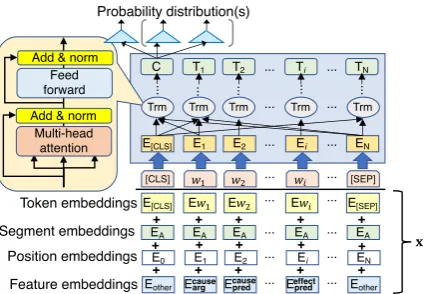
Representation x of the input causality candi-date is computed from the entire sentence (e.g., “He smoked cigarettes and died of lung cancer caused by them”) that contains a pair of cause
1
Note that this method is applicable only for the problem setting in which the final binary-class label is determined by using three annotators’ labels. Some extension is needed for computing relative unreliabilityPru(ann|x)for an arbitrary number of annotators by considering the probability that each annotator agrees with the majority.
L=αLMV+β∑
ann
Llblann+γLru (5)
LMV=−logP(yMV|x) (6)
Llblann=−logP lbl ann(y
ann|
x) (7)
Lru=
{
0 if yA=yB=yC
[image:3.595.313.522.62.152.2]−logPru(ann|x) otherwise (8)
Table 2: Loss functions used in ProposedRU
phrase (“smoke cigarettes”) and effect phrase (“died of lung cancer”). x consists of the token, position, and segment embeddings of each word (Devlin et al., 2019). We distinguish the words in the cause and effect candidates from the other words by giving them feature embeddings; the cause argument, the cause predicate, the effect ar-gument, the effect predicate, and the other words are all given a different feature embedding vector that is randomly initialized (see Figure2).
Note that we followed the fine-tuning scheme presented inDevlin et al.(2019) in the training of ProposedMulti and ProposedSingle. For train-ingProposedRU, we designed a special loss func-tionL in Equation (5) in Table2 as the weighted sum ofLMV, Llbl
ann, andLru, each of which is a loss function for P(yMV|x), Pannlbl (yann|x), and
Pru(ann|x), respectively. Here, α, β, and γ are hyper-parameters (α+β+γ = 1.0).
The BERT model in our methods is pre-trained from scratch using causality-rich texts to investi-gate whether such BERT models can learn back-ground knowledge during their pre-training. We used 19,567,386 sentences from 2,799,079 pas-sages extracted from four billion web pages, where each passage consists of seven sentences and includes at least one event causality detected by a CRF-based causality recognizer2 (Oh et al., 2013) (3,046,619 event causalities were detected in the passages).
We also introduceProposedRU+BK, which in-tegrates the background knowledge used in the previous work intoProposedRU. As input, Pro-posedRU+BKis given apseudo sentence, which is the concatenation of the original input sen-tence andKruengkrai et al.(2017)’s text fragments embodying background knowledge3 along with a
2
The recognizer was applied only to passages that were extracted by specifically focusing on clue terms such as “be-cause.” Event causalities recognized this way are a different type than those under focus in this work.
Krueng-separator to compute input representationx. Here, we hypothesized that BERT models could learn some sort of background knowledge by us-ing causality-rich texts in pre-trainus-ing. To inves-tigate whether this is true, we pre-trained sev-eral BERT models, each using either causality-rich texts or general texts, and then fine-tuned each of the models using the same architecture as used in ProposedRU. We introduceProposedRUwikiand
ProposedRUweb, in which the pre-training is
per-formed from scratch using a single corpus, that is, either Wikipedia articles (19,567,381 sentences retrieved in August 2018) or randomly sampled web texts (19,567,396 sentences in 1,990,472 web pages randomly sampled from the four billion web pages), respectively. The fine-tuning is then done as inProposedRU.
In contrast to the above single-step pre-training, we also attempted to start from the pre-trained model forProposedRUweb, which was pre-trained using general web text, and then additionally pre-train it with causality-rich texts to make the model suitable for causality-event recognition4. More precisely, to focus on the event causality part de-scribed in each passage, we extracted the pairs of cause and effect parts detected by Oh et al. (2013)’s CRF-based causality recognizer and used them as a causality-rich corpus while assuming that the cause and effect are sentence pairs for the next-sentence prediction task (9,783,691 pairs or 19,567,382 sentences). This model is called ProposedRUweb+pairhereafter.
For comparison, we also introduce
Proposed-RUweb+web, which uses another set of web
sen-tences randomly sampled from four billion web pages, as a corpus of the general but not causality-rich texts. The size is the same as that of the cause-effect pairs used forProposedRUweb+pair.
3 Experiments
3.1 Settings
We used the datasets for event-causality recogni-tion in Japanese ofHashimoto et al.(2014). They regard causality candidate A → B proper if and only if “if A happens, the probability of B in-creases.” To annotate this dataset, three
annota-krai et al. (2017) (i.e., short binary patterns, why-QA sys-tem’s answers, and sentences with clue terms). Every text fragment was extracted from four billion Japanese web pages. 4 This approach is recommended by Google’s BERT
implementation ( https://github.com/google-research/bert) for computational efficiency.
Data #Instances #True causalities
Training 107,068 8,986
Development 23,602 3,759
[image:4.595.310.521.61.386.2]Test 23,650 3,647
Table 3: Statistics of datasets
(d) VanillaBERT (e) MajorityMulti
𝑃"#"(𝑦&'|𝐱)
BERT"#" 𝑃(𝑦&'|𝐱)
𝑦&'
𝐱
𝑃"#$#(𝑦'(|𝐱)𝑃,#$#(𝑦'(|𝐱)𝑃-#$#(𝑦'(|𝐱)
BERT#$#,
BERT#$#"
Avg
BERT#$# -𝑃(𝑦'(|𝐱)
𝑦'(
𝐱 We trained a single
BERT model and its softmax layer with majority vote labels.
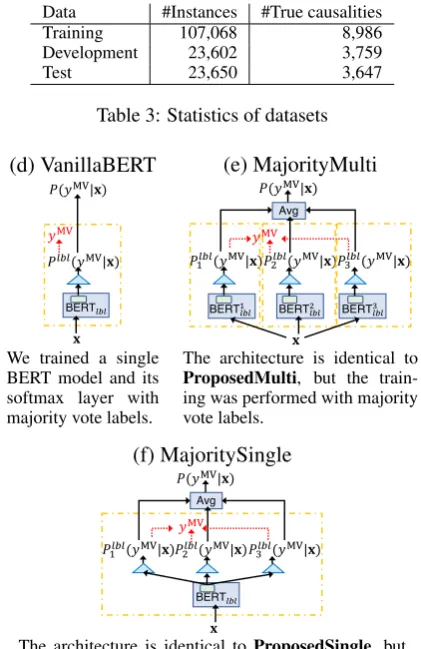
The architecture is identical to ProposedMulti, but the train-ing was performed with majority vote labels.
(f) MajoritySingle
BERT!"!
𝑃$!"!(𝑦'(|𝐱)𝑃,!"!(𝑦'(|𝐱)𝑃-!"!(𝑦'(|𝐱)
Avg 𝑃(𝑦'(|𝐱)
𝑦'(
𝐱
[image:4.595.323.509.63.105.2]The architecture is identical to ProposedSingle, but the training was performed with majority vote labels.
Figure 3: Baseline architectures
tors used their own judgment independently, and each annotator’s individual labels are included in the datasets. Table3shows their statistics5.
As baselines, we used the state-of-the-art method of Kruengkrai et al. (2017), MCNN, which uses a CNN and exploits text fragments retrieved from four billion web pages as back-ground knowledge, and three BERT-based meth-ods, VanillaBERT, MajorityMulti, and Major-itySingle, which use only majority vote labels (Figure3). These BERT-based baselines used the same pre-trained BERT model (pre-trained with causality-rich texts) as in our proposed methods.
As the parameter settings of the pre-training for all of the BERT models, we followed the BERTBASE settings6 (Devlin et al., 2019) except for a batch size of 50. For ProposedRUweb+pair
and ProposedRUweb+web, we additionally
pre-5The number of training instances in Hashimoto et al.
(2014)’s dataset was 112,098, but we excluded the duplicates in it and used the resulting 107,068 instances for training each method.
612-layers, 768 hidden states, 12 heads, and training for
Model R P F Avg.P
MCNN 40.2 61.1 48.5 55.1
[image:5.595.82.281.62.146.2]VanillaBERT 63.6 49.7 55.8* 54.2 MajorityMulti 61.5 51.8 56.2* 55.7 MajoritySingle 48.3 56.8 52.2* 54.4 ProposedMulti 63.9 51.3 56.9* 56.7 ProposeSingle 62.8 52.7 57.3*† 57.1 ProposedRU 64.0 52.0 57.4* 57.4 ‘*’ stands for significant improvement over MCNN and ‘†’ means that over MajorityMulti (McNemar test,p= 0.05).
Table 4: Results of event-causality recognition
Model R P F Avg.P
ProposedRUwiki 57.4 49.6 53.2⋆ 53.3 ProposedRUweb 59.0 50.9 54.6⋆ 54.5
ProposedRU 64.0 52.0 57.4 57.4
[image:5.595.72.285.199.290.2]ProposedRUweb+web 62.5 49.0 54.9⋆ 54.8 ProposedRUweb+pair 64.3 48.2 55.1⋆ 55.3 ProposedRU+BK 67.4 52.3 58.9 59.9 ‘⋆’ stands for significant difference from ProposedRU.
Table 5: Results of ProposedRU and its variants
trained the models for 0.3 million steps with a learning rate of 2e-5. As for the fine-tuning, we chose the combination of epochs {1, 2, 3} and learning rates{5e-6, 1e-5, 2e-5, 3e-5, 4e-5, 5e-5} that achieved the best average precision on 50% of the development dataset, as done inKruengkrai et al. (2017). For ProposedRU and its variants, we additionally optimized theα, β, andγ hyper-parameters in the same way.
3.2 Results
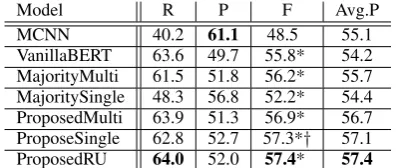
The recall, precision, F1-score, and average pre-cision of each method on the majority vote la-bels of the test dataset are presented in Table4. ProposedRU achieved the best F1-score and av-erage precision. All of the proposed meth-ods (ProposedMulti, ProposedSingle, and Pro-posedRU) outperformed all of the baseline meth-ods (MCNN,VanillaBERT,MajorityMulti, and MajoritySingle) in average precision. This sug-gests that using each annotator’s labels produced a positive effect. The F1-scores ofProposedRU andProposedSinglewere not significantly differ-ent (McNemar test,p= 0.05).
Table5 shows the results of our investiga-tion into the pre-training of some sort of back-ground knowledge. Among the methods to be compared in Table5, the first three methods (i.e.,ProposedRUwiki,ProposedRUweb, and Pro-posedRU) utilized a single-step pre-training from scratch, whereas the next two methods
(Proposed-RUweb+web and ProposedRUweb+pair) performed
additional pre-training before the fine-tuning. The results show that pre-training using causality-rich texts contributes to further performance im-provement than that using general texts, such as Wikipedia articles and random web texts (see ProposedRUvs. ProposedRUwiki,ProposedRU vs. ProposedRUweb, and ProposedRUweb+pair
vs. ProposedRUweb+web). In short, we can
say that BERT might learn some sort of back-ground knowledge from causality-rich texts. An interesting point is that, although the amount of texts used forProposedRUis almost the same as that of the second-step causality-rich pre-training forProposedRUweb+pair, the performance differs
considerably (about 2% difference). This sug-gests that the design of the pre-training steps is not straightforward and thus merits further research.
We further evaluated ProposedRU+BK, in which text fragments embodying background knowledge are concatenated to the input sen-tence as explained in Section2. Table5 shows thatProposedRU+BKimproved the average pre-cision over ProposedRU by about 2.5% (i.e., ProposedRU+BK significantly outperformed the state-of-the-art method, MCNN, by about 5%), suggesting that background knowledge in the form of text fragments is still useful, at least in our cur-rent experimental setting. However, the usefulness might be lost when a model is appropriately pre-trained with a larger amount of texts that covers even more background knowledge.
4 Conclusion
References
Jacob Devlin, Ming-Wei Chang, Kenton Lee, and Kristina Toutanova. 2019. BERT: Pre-training of deep bidirectional transformers for language under-standing. InProceedings of the 2019 Conference of the North American Chapter of the Association for Computational Linguistics: Human Language Tech-nologies, Volume 1 (Long and Short Papers), pages 4171–4186.
Quang Do, Yee Seng Chan, and Dan Roth. 2011. Min-imally supervised event causality identification. In
Proceedings of the 2011 Conference on Empirical Methods in Natural Language Processing, pages 294–303.
Paul Felt, Eric Ringger, and Kevin Seppi. 2016. Semantic annotation aggregation with conditional crowdsourcing models and word embeddings. In
Proceedings of the 26th International Conference on Computational Linguistics, pages 1787–1796.
Ian J. Goodfellow, Jean Pouget-Abadie, Mehdi Mirza, Bing Xu, David Warde-Farley, Sherjil Ozair, Aaron Courville, and Yoshua Bengio. 2014. Generative ad-versarial nets. In Proceedings of the 27th Interna-tional Conference on Neural Information Processing Systems - Volume 2, pages 2672–2680.
Chikara Hashimoto, Kentaro Torisawa, Stijn De Saeger, Jong-Hoon Oh, and Jun’ichi Kazama. 2012. Excitatory or inhibitory: A new semantic orientation extracts contradiction and causality from the web. In Proceedings of the 2012 Joint Confer-ence on Empirical Methods in Natural Language Processing and Computational Natural Language Learning, pages 619–630.
Chikara Hashimoto, Kentaro Torisawa, Julien Kloetzer, Motoki Sano, Istv´an Varga, Jong-Hoon Oh, and Yu-taka Kidawara. 2014. Toward future scenario gener-ation: Extracting event causality exploiting semantic relation, context, and association features. In Pro-ceedings of the 52nd Annual Meeting of the Associa-tion for ComputaAssocia-tional Linguistics, pages 987–997.
Emily Jamison and Iryna Gurevych. 2015. Noise or ad-ditional information? Leveraging crowdsource an-notation item agreement for natural language tasks. In Proceedings of the 2015 Conference on Empiri-cal Methods in Natural Language Processing, pages 291–297.
David Jurgens. 2013. Embracing ambiguity: A com-parison of annotation methodologies for crowd-sourcing word sense labels. In Proceedings of the 2013 Conference of the North American Chapter of the Association for Computational Linguistics: Hu-man Language Technologies, pages 556–562.
Canasai Kruengkrai, Kentaro Torisawa, Chikara Hashi-moto, Julien Kloetzer, Jong-Hoon Oh, and Masahiro Tanaka. 2017. Improving event causality recogni-tion with multiple background knowledge sources using multi-column convolutional neural networks.
InProceedings of the 31st AAAI Conference on Ar-tificial Intelligence, pages 3466–3473.
Jiyi Li, Yukino Baba, and Hisashi Kashima. 2017. Hy-per questions: UnsuHy-pervised targeting of a few ex-perts in crowdsourcing. InProceedings of the 2017 ACM on Conference on Information and Knowledge Management, pages 1069–1078.
Jong-Hoon Oh, Kazuma Kadowaki, Julien Kloetzer, Ryu Iida, and Kentaro Torisawa. 2019. Open-domain why-question answering with adversarial learning to encode answer texts. InProceedings of the 57th Annual Meeting of the Association for Com-putational Linguistics, pages 4227–4237.
Jong-Hoon Oh, Kentaro Torisawa, Chikara Hashimoto, Motoki Sano, Stijn De Saeger, and Kiyonori Ohtake. 2013. Why-question answering using intra- and inter-sentential causal relations. InProceedings of the 51st Annual Meeting of the Association for Com-putational Linguistics, pages 1733–1743.
Barbara Plank, Dirk Hovy, and Anders Søgaard. 2014. Learning part-of-speech taggers with inter-annotator agreement loss. InProceedings of the 14th Confer-ence of the European Chapter of the Association for Computational Linguistics, pages 742–751.
Pranav Rajpurkar, Jian Zhang, Konstantin Lopyrev, and Percy Liang. 2016. Squad: 100,000+ questions for machine comprehension of text. InProceedings of the 2016 Conference on Empirical Methods in Nat-ural Language Processing, pages 2383–2392.
Mehwish Riaz and Roxana Girju. 2010. Another look at causality: Discovering scenario-specific contin-gency relationships with no supervision. 2010 IEEE Fourth International Conference on Semantic Com-puting, pages 361–368.
Rion Snow, Brendan O’Connor, Daniel Jurafsky, and Andrew Ng. 2008. Cheap and fast – but is it good? Evaluating non-expert annotations for natural lan-guage tasks. In Proceedings of the 2008 Confer-ence on Empirical Methods in Natural Language Processing, pages 254–263.
Kentaro Torisawa. 2006. Acquiring inference rules with temporal constraints by using Japanese coordi-nated sentences and noun-verb co-occurrences. In
Proceedings of the Human Language Technology Conference of the North American Chapter of the Association for Computational Linguistics, pages 57–64.
Zhipeng Xie and Feiteng Mu. 2019. Distributed rep-resentation of words in cause and effect spaces. In
Proceedings of the AAAI Conference on Artificial In-telligence, volume 33, pages 7330–7337.