Abstract — As mobile technology is rapidly expanding in many areas, there is a high demand from industry for graduates with mobile development skills. Graduates, who are entering the mobile development world, need to understand how the characteristics of mobile devices and applications affect decisions about software design and be able to select and use appropriate standards, APIs and toolkits to build mobile applications. In view of that, an electronic decision matrix based on Pugh method to be used as one of the learning tool in mobile development course is introduced. The electronic matrix is designed and developed to assist mobile application developers especially the novice, to choose the methodology that suits the requirements of their mobile development projects. Detail descriptions of how the electronic matrix can be used in facilitating the learning process of mobile development are described in this paper.
Keywords: Software Application Development, Mobile Application, Development Methodology
I. INTRODUCTION
As mobile technology is such a rapidly expanding area of business, mobile computing and related development issues of such technology have received significant attention in the academic and industrial research community. There is indeed a high demand from industry for graduates of this course. Thus, it is understandable that many computer science departments in various universities have started offering a graduate-level course on this topic.
Graduates, who are entering the mobile development world, need to understand how the characteristics of mobile devices and applications affect decisions about software design and be able to select and use appropriate standards, APIs and toolkits to build mobile applications. Within this perspective, it is vital to prepare students to work in the area of mobile software application development by introducing them to the relevant technologies and equip them with skills in this area using up-to-date software development tools and APIs.
A. Mobile Application Development Course
Common objectives for mobile development courses offered in higher learning institutions are basically to make sure that students are able to understand the technical challenges posed by current mobile devices and wireless
N.S. Author is an Assoc. Prof. and Deputy Dean of the Faculty of IT, Universiti Utara Malaysia (phone: +6 049284701; fax: +6 049284753; e-mail: [email protected]).
S.M.S Author is a lecturer at the Faculty of IT, Universiti Utara Malaysia (phone: +6 049284701; fax: +6 049284753; e-mail: [email protected]).
communications. At the same time students should be able to evaluate and select appropriate solutions according to user requirement; be competent in the evaluation and selection of software tools for mobile applications and hence be aware of their scope and limitations. Ultimately, they should be able to develop small but realistic applications for mobile devices.
Instructors typically teach software development for mobile devices using simulation environments from development kits such as Java Micro Edition (JME). These simulators, however, lack of complete picture of the real-world behavior of mobile computing devices. Moreover, such learning technique only emphasizes more on the programming solutions needed to develop mobile applications but less on the importance of having a systematic sequence of process for the mobile application development project.
The students should be exposed to the importance of adopting a suitable methodology before they start with the development of mobile project. The use of a methodology is important as a project can be structured into small, well defined activities where the sequence and interaction of these activities can be specified. Moreover, it also improves project planning and control, and provides a better quality system resulting in a better end product, a better development process and a standardized process [1].
Motivated by the above-discussed subject, this paper first discusses the development methodology issues, which is followed by an introduction to md-Matrix, the electronic version of our constructed mobile methodology decision matrix. Next, a discussion on how md-Matrix can be utilized as a learning tool is described. Finally, a conclusion section is outlined.
II. DEVELOPMENT METHODOLOGY ISSUES
Comprehensive development techniques and methodologies often emerge in the wake of new types of systems such as management information systems, decision support systems, and now mobile support systems. Lack of support for the development process and the consequential inadequacy of development practice are foreseen to be the contributable cause to poor systems reliability, low productivity and high maintenance costs later on.
A research done by Barry and Lang [2] found that merely 30% of the respondents (of top Irish companies in general industry) who participated in the survey did not use any methodology in their system development routine. Among the issues are, they felt that using methodology is cumbersome as 61.5% of respondents reported, another significant number of percentage felt that commercial methodologies were too costly and other reason recorded from the survey also says that methodologies do not suit with the “real world” as they require a long training period.
Pastor and Whiddett [3] agreed that the key challenge
m
d-Matrix: Mobile Application Development Tool
among system developers is during the selection of suitable development methodology. The chosen methodology will have a huge impact on different aspects of development; for instance the cost, time, resources needed and etc. Development methodologies vary according to many areas such as the type of applications developed, the end users, the approach taken, the issues addressed and the diagram used. Thus, to select an appropriate methodology which perfectly fits the required purpose and field would be tough, especially to the novice developers.
III. THE MATRIX
md-Matrix (version 1.0 Beta) is an electronic version of a constructed decision matrix based on the Pugh method. In Pugh’s method, decision matrix is prepared in a tabular format with the horizontal axis occupied by list of options and the vertical axis occupied by list of criteria or vice versa. This decision making tool is mainly aimed at assisting software developers especially the novice to choose the most appropriate development methodology for the development project of mobile applications.
The md-Matrix consists of four development methodologies with mobile specific development criteria and these methodologies have been tested with real development projects. The number of methodologies included in the matrix is meant to be representative not exhaustive. In md-Matrix, each methodology is set to be the datum (i.e.
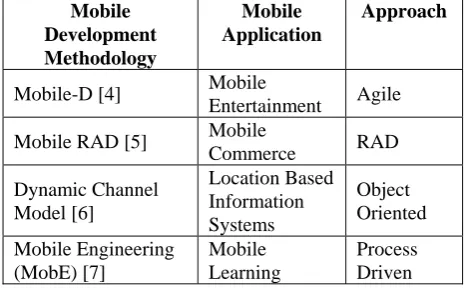
favorite methodology) according to their respective type of mobile applications. The datum will be used in the Pugh process against which all other methodologies are to be evaluated. Table 1 lists the mobile development methodologies used in md-matrix.
On the vertical axis, 21 software development method (SDM) properties originally based on Karam and Casselman [8] research are used as the set of criteria to be considered by the mobile developers before choosing the mobile development methodology for their projects. The list of properties is categorized into these three groups:
Technical properties: deal with a method’s notations and procedures for applying them to solve technical problems,
Usage properties: concern with practical issues such as the availability of training and tool support.
[image:2.595.310.543.64.208.2]Managerial properties: concern with the organized, cost effective development of the end product, including issues like staffing, project planning and cost estimation.
Table 1: Examples of mobile development methodologies Mobile
Development Methodology
Mobile Application
Approach
Mobile-D [4] Mobile
Entertainment Agile Mobile RAD [5] Mobile
Commerce RAD
Dynamic Channel Model [6]
Location Based Information Systems
Object Oriented Mobile Engineering
(MobE) [7]
Mobile Learning
Process Driven This electronic matrix is practically reliable and useful for developers to assist them with decision making process of selecting the right methodology for their development projects. And not just that, developers can also use the result generated from this electronic matrix as the source for quick reference of what are the main steps involved in the suggested methodology. We also believe that the same benefits can be gained if the electronic matrix is to be implemented in the graduate course as a learning tool to educate the students on developing mobile applications. Early education is crucial as to emphasize on the importance of knowing that the absence of methodology is an inhibiting factor to a successful development project.
IV. THE MATRIX AS A LEARNING TOOL
With reference to the issues mentioned above, md-Matrix is introduced to answer the call. As far as the purpose of the electronic matrix is concerned, this decision making tool can be used by the industry and education sectors as an educational tool. Learning institutions can utilize it for teaching purposes to educate the students of the need to have a well structured process of developing mobile applications. Following sections discuss the details of how md-Matrix can be applied in a mobile application development course.
A. Understanding the Criteria of Mobile Development Project
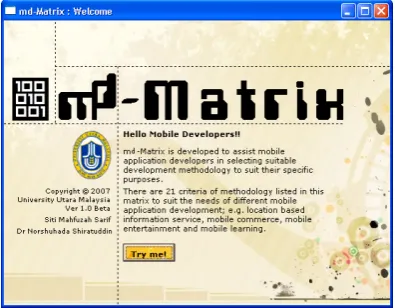
Fig. 1: Welcome screen of md-Matrix
Fig. 2: Screen where user is asked to choose type of application
Having known the type of application to be developed, the instructor should guide the students to understand their project requirements by knowing what criteria that best describe their mobile development projects. Knowing the right set of criteria help them to understand better of what they need and what they do not need for the project. In md-Matrix, students are allowed to choose their preferred criteria by clicking on the checkboxes. Each criterion is labeled with intuitive names, but just in case students still need further definition (see Fig. 3) of the criteria, they can click on the hyperlink labeled as question mark (?) sign after the criterion name and a pop up screen which contains the property definition will appear.
Fig. 3: Pop-up screen with description of the SDM property
The properties of software development method are divided into three categories; Technical Properties, Usage Properties and Managerial Properties. Following table (Table 2) displays the detail of the software development method properties that suit to map the mobile development environment:
Table 2: Properties of software development methods used for mobile applications [8]
Technical Properties
1
Method Philosophy
The methodology considers the importance of scenario-related, interaction-related, user-related dimensions of mobile application development.
2
Life-cycle coverage
Development phases covered by the methodology and the application development paradigm advocated for the method e.g. conventional, prototyping, or transformational.
3
Work products & notations
Method's work products (e.g. concept document, requirements documents, software designs, and test plans) and the notations (e.g. pseudo code, and English text) for documenting them.
4
Problem domain analysis
Method's techniques and tools for analyzing and understanding the problem domain.
5
Procedure
The sequence of steps suggested by the method for each phase. The sequence of steps is a framework for guiding the creative process in a manner that supports the method's philosophy.
6
Guidelines/Criteria/Measures
Major design rules of each phase in the method. A precise design rule is the one that sufficiently detailed for any reasonably trained practitioner to apply under the same circumstances and obtain the same result.
7
Verification
Processes used to determine the degree to which method's work products fulfill requirements.
8
Degree of formality
Measures the extent to which the method's technical aspects are formal. The formality of a method depends on the formality of (1) the notations, (2) the relationships between phases and (3) verification of the relationships between phases.
9
Maintainability/Flexibility
The ability to accommodate change during development and during evolution. Flexibility can be increased by information hiding (abstraction), and concise documentation.
1 0
Reusability
Concerns degree to which project's work products can be reused on another. Example of reuse items are requirement specifications, architectural designs and test cases.
1 1
Concurrent Processing
[image:3.595.73.274.227.394.2] [image:3.595.69.271.582.743.2]1 2
Performance Engineering
Techniques used to shape the design at an early stage when the cost of change is still low. The techniques involve (1) ad hoc methods such as prototyping of critical sections of the application or time budget estimates; (2) formal performance estimation through analytic models or simulations.
1 3
Traceability
Elements of method's traceability involve records of decisions, detailed rules for transitioning between development stages and work products and a record of coverage between work products.
1 4
Method specialization
Considers the degree to which a method can be extended and/or specialized to a particular application domain.
Usage Properties
1 5
Application areas
Application domains for which the method is well suited.
1 6
Reliability
The application size for which a method is believed to be suitable for both development and maintenance. The most reliable source is documented project experience by similar development teams and for similar applications.
1 7
Automated support
Concerns with the availability and usefulness of software tools to support the method's techniques. 1
8
Ease of instruction
Simplicity of method's techniques, notations and instructional mechanisms.
1 9
Method Maturity
A mature method should show multiple uses (at least two) by the same development team.
Managerial Properties
2 0
Development organization
Concerns with (1) methods of cost estimation, project planning and staffing, and (2) methods to determine progress of development or well-defined milestones from which progress can be inferred. 2
1
Ease of integration
A method must be usable with the installed base and with existing tools and techniques within the organizations.
B. Choosing the Right Development Methodology
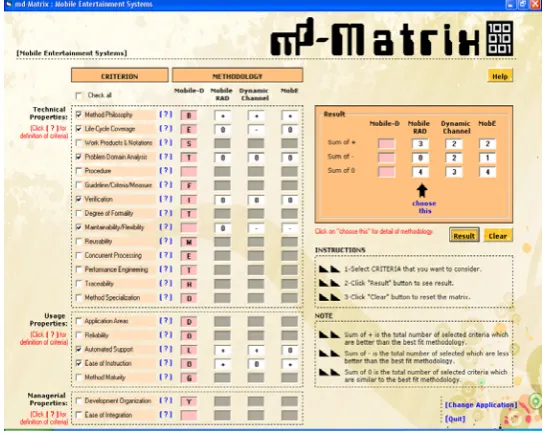
For each type of selected mobile application, one development methodology will automatically be highlighted as the favorite methodology (see Fig. 4). This methodology will be used as the datum against which all others are to be judged.
All the selected criteria will be used as the basis to compare each methodology with the datum (i.e. favorite methodology). Students can click on the “Result” button for the result. The decision matrix will determine the winning methodology by looking at the score pattern of ‘+’ (i.e. better then the datum), ‘-’ (i.e. less than the datum) and ‘0’ (i.e. equivalent to the datum) sign for each. Normally, the matrix will suggest to choose the methodology with the highest score of "Sum of +". If the score for "Sum of +" is similar for
[image:4.595.303.575.163.380.2]at least two of the compared methodologies, the matrix will look for the lowest score of "Sum of -". If the score of "Sum of -" is similar between the compared methodologies which have the highest score of "Sum of +", the matrix will look for the highest score of "Sum of 0" to determine the winning methodology. In cases where the score of "Sum of +" for all compared methodologies is zero, the matrix will suggest to choose the favorite methodology (i.e. datum).
Fig. 4: The screen displays result of decision matrix based on the selected criteria
In md-Matrix, students are allowed to change the combination of criteria that they would like to consider until they have decided on them, thus, making the process iterative. If they want to change the combination of the criteria, they can do so by clicking on the “Clear” button and start selecting for new set of criteria.
Suggested methodology will be highlighted; hyperlink to its description is also included to enable the students to have a quick reference to what the development methodology consists of. Instructors can then discuss the processes involve in the suggested methodology with the students to clarify certain terminology and technology used in the process. Having done this hopefully will open their eyes to have a well structured approach for developing their mobile applications instead of opting for an immature and less developed approach toward systems development.
C. Testing md-Matrix in Class Environment
md-Matrix was tested in a class to measure its usefulness. A group of 23 novice mobile developer students used the decision matrix and were asked to answer the following questions at the end of the session.
Testing Instrument
1. How many minutes did it take for you to go through all parts of md-Matrix and finally come to a decision?
(Fill in the blank with an approximate number of minutes) ______ minutes.
2. Was the format of md-Matrix easy to understand?
3. Was md-Matrix easy for you to use?
FYes FNo
4. Would you use md -Matrix again with other mobile development project?
FYes FNo
5. Would you recommend md -Matrix to others making the decisions on suitable mobile methodology?
FYes FNo
6. In your opinion, would md d-Matrix be most helpful?
FYes FNo
7. What additional criteria of mobile development would you like to see included in md -Matrix?
8. How can md -Matrix be improved so that it is more useful to novice developer making decisions about the selection of suitable mobile development methodology?
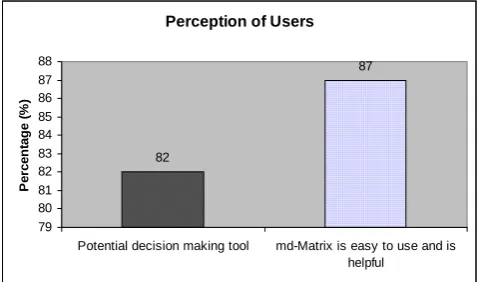
Findings suggest that most participants (about 82%) highly perceived md-Matrix as a potential tool in assisting them in making decision on mobile application development methodology. Most of them also (87%) agreed that md-Matrix is easy to use and is helpful. Refer to Fig. 5.
Perception of Users
82
87
79 80 81 82 83 84 85 86 87 88
Potential decision making tool md-Matrix is easy to use and is helpful
P
e
rc
e
n
ta
g
e
(%
[image:5.595.48.288.326.467.2])
Fig. 5: Perception of potential users of md-Matrix V. CONCLUSION
It is believed that the challenges faced by the new developers in developing mobile applications can be eased if they are appropriately educated about the importance of adopting a suitable methodology in their development process. Perhaps, changes should be made to the curriculum of mobile computing courses so that it will emphasize more on choosing the right development methodology instead of jumping straight to the development process blindly. As the matter of fact, having the right methodology will indeed help to spearhead the delivery process of the product and avoid unnecessary mistake. As a conclusion, the constructed matrix together with its electronic version can be considered as practically reliable and useful in helping mobile developers, especially the novice to choose the most suitable development methodology before they start with the development process.
In addition, the testing phase allowed us to also record a number of comments which we are now considering for the second version of md-Matrix. Among new features are the inclusion of an interface agent to further assist users in making choices and more mobile application development methodologies.
ACKNOWLEDGMENT
We would like to thank our employer, Universiti Utara Malaysia and the Malaysian government, specifically the Ministry of Science, Technology and Innovation for financing this study.
REFERENCES
[1] Avison, D.E. and Fitzgerald, G. “Information Systems Development: Methodologies, Techniques and Tools”. London: Blackwell, 1990. [2] Barry, C. and Lang, M. “A Survey of Multimedia and Web
Development Techniques and Methodology Usage”. IEEE MultiMedia, Vol. 08, No. 2, 2001, pp. 52-60.
[3] Pastor, J. and Whiddett, R.J. “The Relationship between Systems Development Methodologies and Organizational Demographics: A Survey of New Zealand Organizations”. Proceedings of Information Systems Conference of New Zealand, 1996. p.179.
[4] Abrahamsson, P., Hanhineva, A., Hulkko, H., Ihme, T., Jaalinoja, J., Korkala, M., Koskela, J., Kyllonen, P., and Salo, O. “Mobile-D: An Agile Approach for Mobile Application Development”. Proceedings of OOPSLA’04, Vancouver, British Columbia, Canada. 2004, pp. 174-175.
[5] Blue Dot Solutions (2006). Mobile RAD Methodology. [Online] Available http://www.sneller.com/rad.htm
[6] Afonso, A.P., Regateiro, F.S., and Silva, M.J. “Dynamic Channels: A New Development Methodology for Mobile Computing Applications”, 1998 Available http://www.di.fc.ul.pt/biblioteca/tech-reports
[7] Mavromoustakos, S. and Papanikolaou, K.. “Critical Success Factor for the Development of Mobile Learning Applications”. Proceedings of IASTED Conference on Internet and Multimedia Systems and Applications, Innsbruck, Austria, 2006.