Joint Relational Embeddings for Knowledge-based Question Answering
Min-Chul Yang† Nan Duan‡ Ming Zhou‡ Hae-Chang Rim†
†Dept. of Computer & Radio Comms. Engineering, Korea University, Seoul, South Korea ‡Microsoft Research Asia, Beijing, China
{nanduan, mingzhou}@microsoft.com [email protected]
Abstract
Transforming a natural language (NL) question into a corresponding logical form (LF) is central to the knowledge-based question answering (KB-QA) task. Un-like most previous methods that achieve this goal based on mappings between lex-icalized phrases and logical predicates, this paper goes one step further and pro-poses a novel embedding-based approach that maps NL-questions into LFs for KB-QA by leveraging semantic associations between lexical representations and KB-properties in the latent space. Experimen-tal results demonstrate that our proposed method outperforms three KB-QA base-line methods on two publicly released QA data sets.
1 Introduction
Knowledge-based question answering (KB-QA) involves answering questions posed in natural language (NL) using existing knowledge bases (KBs). As most KBs are structured databases, how to transform the input question into its corre-sponding structured query for KB (KB-query) as a logical form (LF), also known as semantic pars-ing, is the central task for KB-QA systems. Pre-vious works (Mooney, 2007; Liang et al., 2011; Cai and Yates, 2013; Fader et al., 2013; Berant et al., 2013; Bao et al., 2014) usually leveraged map-pings between NL phrases and logical predicates as lexical triggers to perform transformation tasks in semantic parsing, but they had to deal with two limitations: (i) as the meaning of a logical pred-icate often has different natural language expres-sion (NLE) forms, the lexical triggers extracted for a predicate may at times are limited in size; (ii) entities detected by the named entity recognition (NER) component will be used to compose the
logical forms together with the logical predicates, so their types should be consistent with the pred-icates as well. However, most NER components used in existing KB-QA systems are independent from the NLE-to-predicate mapping procedure.
We present a novel embedding-based KB-QA method that takes all the aforementioned lim-itations into account, and maps NLE-to-entity and NLE-to-predicate simultaneously using sim-ple vector operations for structured query con-struction. First, low-dimensional embeddings of n-grams, entity types, and predicates are jointly learned from an existing knowledge base and from entries<entitysubj, NL relation phrase, entityobj> that are mined from NL texts labeled as KB-properties with weak supervision. Each such en-try corresponds to an NL expression of a triple <entitysubj, predicate, entityobj>in the KB. These embeddings are used to measure the semantic as-sociations between lexical phrases and two prop-erties of the KB, entity type and logical predicate. Next, given an NL-question, all possible struc-tured queries as candidate LFs are generated and then they are ranked by the similarity between the embeddings of observed features (n-grams) in the NL-question and the embeddings of logical fea-tures in the structured queries. Last, answers are retrieved from the KB using the selected LFs.
The contributions of this work are two-fold: (1) as a smoothing technique, the low-dimensional embeddings can alleviate the coverage issues of lexical triggers; (2) our joint approach integrates entity span selection and predicate mapping tasks for KB-QA. For this we built independent entity embeddings as the additional component, solving the entity disambiguation problem.
2 Related Work
Supervised semantic parsers (Zelle and Mooney, 1996; Zettlemoyer and Collins, 2005; Mooney, 2007) heavily rely on the<sentence, semantic
notation>pairs for lexical trigger extraction and model training. Due to the data annotation re-quirement, such methods are usually restricted to specific domains, and struggle with the coverage issue caused by the limited size of lexical triggers. Studies on weakly supervised semantic parsers have tried to reduce the amount of human supervi-sion by using question-answer pairs (Liang et al., 2011) or distant supervision (Krishnamurthy and Mitchell, 2012) instead of full semantic annota-tions. Still, for KB-QA, the question of how to leverage KB-properties and analyze the question structures remains.
Bordes et al. (2012) and Weston et al. (2013) de-signed embedding models that connect free texts with KBs using the relational learning method (Weston et al., 2010). Their inputs are often statement sentences which include subject and ob-ject entities for a given predicate, whereas NL-questions lack either a subject or object entity that is the potential answer. Hence, we can only use the information of a subject or object entity, which leads to a different training instance generation procedure and a different training criterion.
Recently, researchers have developed open do-main systems based on large scale KBs such as FREEBASE1 (Cai and Yates, 2013; Fader et al., 2013; Berant et al., 2013; Kwiatkowski et al., 2013; Bao et al., 2014; Berant and Liang, 2014; Yao and Van Durme, 2014). Their semantic parsers for Open QA are unified formal and scal-able: they enable the NL-question to be mapped into the appropriate logical form. Our method ob-tains similar logical forms, but using only low-dimensional embeddings of n-grams, entity types, and predicates learned from texts and KB.
3 Setup
3.1 Relational Components for KB-QA Our method learns semantic mappings between NLEs and the KB2 based on the paired
relation-ships of the following three components: C de-notes a set of bag-of-words (or n-grams) as context features (c) for NLEs that are the lexical represen-tations of a logical predicate (p) in KB;T denotes a set of entity types (t) in KB and each type can be used as the abstract expression of a subject entity
1http://www.freebase.com
2For this paper, we used a large scale knowledge base that
contains 2.3B entities, 5.5K predicates, and 18B assertions. A 16-machine cluster was used to host and serve the whole data.
(s) that occurs in the input question;P denotes a set of logical predicates (p) in KB, each of which is the canonical form of different NLEs sharing an identical meaning (bag-of-words;c).
Based on the components defined above, the paired relationships are described as follows: T
-P can investigate the relationship between sub-ject entity and logical predicate, as obsub-ject entity is always missing in KB-QA; C-T can scruti-nize subject entity’s attributes for the entity span selection such as its positional information and relevant entity types to the given context, which may solve the entity disambiguation problem in KB-QA; C-P can leverage the semantic overlap between question contexts (n-gram features) and logical predicates, which is important for mapping NL-questions to their corresponding predicates. 3.2 NLE-KB Pair Extraction
This section describes how we extract the semantic associated pairs of NLE-entries and KB-triples to learn the relational embeddings (Section 4.1). <Relation Mention, Predicate> Pair (MP) Each relation mention denotes a lexical phrase of an existing KB-predicate. Following informa-tion extracinforma-tion methods, such as PATTY (Nakas-hole et al., 2012), we extracted the <relation mention, logical predicate> pairs from English WIKIPEDIA3, which is closely connected to our KB, as follows: Given a KB-triple <entitysubj,
logical predicate, entityobj>, we extracted NLE-entries <entitysubj, relation mention, entityobj> where relation mention is the shortest path be-tween entitysubj and entityobj in the dependency tree of sentences. The assumption is that any re-lation mention (m) in the NLE-entry containing such entity pairs that occurred in the KB-triple is likely to express thepredicate(p) of that triple.
With obtaining high-qualityMPpairs, we kept only relation mentions that were highly associated with a predicate measured by the scoring function:
S(m, p) =PMI(em;ep) +PMI(um;up) (1)
where ex is the set of total pairs of both-side
entities of entry x (m or p) and ux is the set
of unique (distinct) pairs of both-side entities of entry x. In this case, the both-side entities in-dicate entitysubj and entityobj. For a frequency-based probability, PMI(x;y) = logPP(x()x,yP()y)
(Church and Hanks, 1990) can be re-written as PMI(x;y) = log|xT
y|·C
|x|·|y| , where C denotes the total number of items shown in the corpus. The function is partially derived from thesupportscore (Gerber and Ngonga Ngomo, 2011), but we fo-cus on the correlation of shared entity pairs be-tween relation mentions and predicates using the PMIcomputation.
<Question Pattern, Predicate> Pair (QP) Since WIKIPEDIAarticles have no information to leverage interrogative features which highly de-pend on the object entity (answer), it is difficult to distinguish some questions that are composed of only different5W1H words, e.g.,{When|Where}
was Barack Obama born? Hence, we used the method of collecting question patterns with human labeled predicates that are restricted by the set of predicates used inMP (Bao et al., 2014).
4 Embedding-based KB-QA
Our task is as follows. First, our model learns the semantic associations ofC-T,C-P, andT-P (Sec-tion 3.1) based on NLE-KB pairs (Sec(Sec-tion 3.2), and then predicts the semantic-related KB-query which can directly find the answer to a given NL-question.
For our feature space, given an NLE-KB pair, the NLE (relation mention in MP or question pattern in QP) is decomposed into n-gram fea-tures: C = {c | c is a segment of NLE}, and the KB-properties are represented by entity type t ofentitysubj and predicate p. Then we can ob-tain a training tripletw = [C, t, p]. Each feature (c∈ C, t∈ T, p∈ P) is encoded in the distributed representation which isn-dimensional embedding vectors (En):∀x, xencode⇒ E(x)∈En.
All n-gram features (C) for an NLE are merged into one embedding vector to help speed up the learning process: E(C) = Pc∈CE(c)/|C|. This feature representation is inspired by previous work in embedding-based relation extraction (Weston et al., 2013), but differs in the following ways: (1) entity information is represented on a separate em-bedding, but its positional information remains as symbolhentityi; (2) when the vectors are com-bined, we use the average of each index to normal-ize features.
For our joint relational approach, we focus on the set of paired relationshipsR = {C-t, C-p, t -p} that can be semantically leveraged. Formally, these features are embedded into the same latent
space (En) and their semantic similarities can be
computed by a dot product operation:
Sim(a, b) =Sim(rab) =E(a)|E(b) (2)
whererabdenotes a paired relationshipa-b(or(a,
b)) in the above setR. We believe that our joint re-lational learning can smooth the surface (lexical) features for semantic parsing using the aligned en-tity and predicate.
4.1 Joint Relational Embedding Learning Our ranking-based relational learning is based on a ranking loss (Weston et al., 2010) that supports the idea that the similarity scores of observed pairs in the training set (positive instances) should be larger than those of any other pairs (negative in-stances):
∀i, ∀y06=yi, Sim(xi, yi)>1+Sim(xi, y0) (3)
More precisely, for each triplet wi = [Ci, ti, pi]
obtained from an NLE-KB pair, the relationships
Ri = {Ci-ti, Ci-pi, ti-pi} are trained under the
soft ranking criterion, which conducts Stochastic Gradient Descent (SGD). We thus aim to minimize the following:
∀i,∀y06=yi,max(0,1−Sim(xi, yi)+Sim(xi, y0))
(4) Our learning strategy is as follows. First, we ini-tialize embedding space En by randomly giving
mean 0 and standard deviation 1/n to each vec-tor. Then for each training tripletwi, we select the
negative pairs against positive pairs (Ci-ti, Ci-pi,
andti-pi) in the triplet. Last, we make a stochastic
gradient step to minimize Equation 4 and update
Enat each step.
4.2 KB-QA using Embedding Models
Our goal for KB-QA is to translate a given NL-question to a KB-query with the form <subject entity, predicate, ?>, where ? denotes the an-swer entity we are looking for. The decoding pro-cess consists of two stages. The first stage in-volves generating all possible KB-queries (Kq) for
an NL-question q. We first extract n-gram fea-tures (Cq) from the NL-question q. Then for a
KB-query kq, we find all available entity types
(tq) of the identified subject entities (sq) using
q where is the city of david?
ˆ
k(q) [The City of David, contained by, ?]
Cq n-grams of“where ishentityi?”
tq location
[image:4.595.72.291.58.137.2]pq contained by
Table 1: The corresponding KB-queryˆk(q) for a NL-questionqand its decoding tripletwq.
we also represent the above features as the triplet formwiq = [Cqi, tqi, pqi]which is directly linked to a KB-query kiq = [sqi, pqi,?]. The second stage involves ranking candidate KB-queries based on the similarity scores between the following paired relationships from the triplet wiq: Rqi = {Cqi-tqi,
Cqi-pqi,tqi-pqi}. Unlike in the training step, the sim-ilarities ofCqi-tqi andCqi-pqi are computed by sum-mation of all pairwise elements (each context em-beddingE(c), notE(C), with each pairedE(t)or
E(p)) for a more precise measurement. Since sim-ilarites ofRqare calculated on different scales, we
normalize each value using Z-score (Z(x) =x−σµ) (Kreyszig, 1979). The final score is measured by:
Simq2k(q, kq) = X
r∈Rq
Z(Sim(r)) (5)
Then, given any NL-questionq, we can predict the corresponding KB-querykˆ(q):
ˆ
k(q) = arg max
k∈Kq Simq2k(q, k) (6)
Last, we can retrieve an answer from the KB using a structured queryˆk(q). Table 1 shows an example of our decoding process.
Multi-related Question Some questions in-clude two-subject entities, both of which are cru-cial to understanding the question. For the ques-tion who plays gandalf in the lord of the rings?
Gandalf (character) and The Lord Of The
Rings (film) are explicit entities that should be joined to a pair of the two entities (implicit entity). More precisely, the two entities can be combined into oneconcatenatedentity(character-in-film)
using our manual rule, which compares the possi-ble pairs of entity types in the question with the list of pre-defined entity type pairs that can be merged into aconcatenatedentity. Our solution enables a multi-related question to be transformed to a single-related question which can be directly translated to a KB-query. Then, the two entity
# Entries Accuracy
MPpairs 291,585 89%
[image:4.595.335.498.63.108.2]QPpairs 4,764 98%
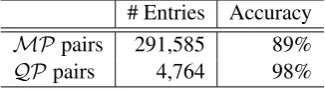
Table 2: Statistics of NLE-KB pairs
mentions are replaced with the symbolhentityi
(who play hentityi in hentityi ?). We re-gard the result of this transformation as one of the candidate KB-queries in the decoding step.
5 Experiments
Experimental Setting We first performed pre-processing, including lowercase transformation, lemmatization and tokenization, on NLE-KB pairs and evaluation data. We used 71,310 n-grams (uni-, bi-, tri-), 990 entity types, and 660 predi-cates as relational components shown in Section 3.1. The sum of these three numbers (72,960) equals the size of the embeddings we are going to learn. In Table 2, we evaluated the quality of NLE-KB pairs (MP andQP) described in Sec-tion 3.2. We can see that the quality ofQPpairs is good, mainly due to human efforts. Also, we ob-tainedMP pairs that have an acceptable quality using threshold 3.0 for Equation 1, which lever-ages the redundancy information in the large-scale data (WIKIPEDIA). For our embedding learning, we set the embedding dimension n to 100, the learning rate (λ) for SGD to 0.0001, and the it-eration number to 30. To make the decoding procedure computable, we kept only the popular KB-entity in the dictionary to map different entity mentions into a KB-entity.
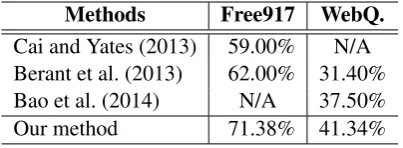
We used two publicly released data sets for QA evaluations: Free917 (Cai and Yates, 2013) in-cludes the annotated lambda calculus forms for each question, and covers 81 domains and 635 Freebase relations; WebQ. (Berant et al., 2013) provides 5,810 question-answer pairs that are built by collecting common questions from Web-query logs and by manually labeling answers. We used the previous three approaches (Cai and Yates, 2013; Berant et al., 2013; Bao et al., 2014) as our baselines.
Methods Free917 WebQ. Cai and Yates (2013) 59.00% N/A Berant et al. (2013) 62.00% 31.40% Bao et al. (2014) N/A 37.50% Our method 71.38% 41.34% Table 3: Accuracy on the evaluation data
[image:5.595.99.263.166.238.2]Methods Free917 WebQ. Our method 71.38% 41.34% w/oT-P 70.65% 40.55% w/oC-T 67.03% 38.44% w/oC-P 31.16% 19.24% Table 4: Ablation of the relationship types
papers. Although the KB used by our system is much larger than FREEBASE, we still think that the experimental results are directly comparable because we disallow all the entities that are not in-cluded in FREEBASE.
Table 3 shows that our method outperforms the baselines on both Free917andWebQ. data sets. We think that using the low-dimensional embed-dings of n-grams rather than the lexical triggers greatly improves the coverage issue. Unlike the previous methods which perform entity disam-biguation and predicate prediction separately, our method jointly performs these two tasks. More precisely, we consider the relationships C-T and
C-Psimultaneously to rank candidate KB-queries. In Table 1, the most independent NER in KB-QA systems may detect David as the subject entity, but our joint approach can predict the appropriate subject entity The City of David by leveraging not only the relationships with other components but also other relationships at once. The syntax-based (grammar formalism) approaches such as Combinatory Categorial Grammar (CCG) may ex-perience errors if a question has grammatical er-rors. However, our bag-of-words model-based ap-proach can handle any question as long as the question contains keywords that can help in un-derstanding it.
Table 4 shows the contributions of the relation-ships (R) between relational components C, T, and P. For each row, we remove the similarity from each of the relationship types described in Section 3.1. We can see that theC-P relationship plays a crucial role in translating NL-questions to KB-queries, while the other two relationships are slightly helpful.
Result Analysis Since the majority of questions inWebQ.tend to be more natural and diverse, our method cannot find the correct answers to many questions. The errors can be caused by any of the following reasons. First, some NLEs cannot be easily linked to existing KB-predicates, mak-ing it difficult to find the answer entity. Second, some entities can be mentioned in several different ways, e.g., nickname (shaq→Shaquille O’neal) and family name (hitler→Adolf Hitler). Third, in terms of KB coverage issues, we cannot detect the entities that are unpopular. Last, feature represen-tation for a question can fail when the question consists of rare n-grams.
The two training sets shown in Section 3.2 are complementary: QP pairs provide more oppor-tunities for us to learn the semantic associations between interrogative words and predicates. Such resources are especially important for understand-ing NL-questions, as most of them start with such 5W1H words; on the other hand, MP pairs en-rich the semantic associations between context in-formation (n-gram features) and predicates.
6 Conclusion
In this paper, we propose a novel method that transforms NL-questions into their corresponding logical forms using joint relational embeddings. We also built a simple and robust KB-QA system based on only the learned embeddings. Such em-beddings learn the semantic associations between natural language statements and KB-properties from NLE-KB pairs that are automatically ex-tracted from English WIKIPEDIAusing KB-triples with weak supervision. Then, we generate all pos-sible structured queries derived from latent logical features of the given NL-question, and rank them based on the similarity scores between those re-lational attributes. The experimental results show that our method outperforms the latest three KB-QA baseline systems. For our future work, we will build concept-level context embeddings by lever-aging latent meanings of NLEs rather than their surface n-grams with the aligned logical features on KB.
References
Junwei Bao, Nan Duan, Ming Zhou, and Tiejun Zhao. 2014. Knowledge-based question answering as ma-chine translation. Proceedings of the 52nd Annual Meeting of the Association for Computational Lin-guistics, pages 967–976. Association for Computa-tional Linguistics.
Jonathan Berant and Percy Liang. 2014. Seman-tic parsing via paraphrasing. Proceedings of the 52nd Annual Meeting of the Association for Com-putational Linguistics, pages 1415–1425. Associa-tion for ComputaAssocia-tional Linguistics.
Jonathan Berant, Andrew Chou, Roy Frostig, and Percy Liang. 2013. Semantic parsing on Freebase from question-answer pairs. In Proceedings of the 2013 Conference on Empirical Methods in Natural Lan-guage Processing, pages 1533–1544, Seattle, Wash-ington, USA, October. Association for Computa-tional Linguistics.
Antoine Bordes, Xavier Glorot, Jason Weston, and Yoshua Bengio. 2012. Joint learning of words and meaning representations for open-text seman-tic parsing. InIn Proceedings of 15th International Conference on Artificial Intelligence and Statistics. Qingqing Cai and Alexander Yates. 2013. Large-scale
semantic parsing via schema matching and lexicon extension. In Association for Computational Lin-guistics (ACL), pages 423–433. The Association for Computer Linguistics.
Kenneth Ward Church and Patrick Hanks. 1990. Word association norms, mutual information, and lexicog-raphy.Comput. Linguist., 16(1):22–29, March. Anthony Fader, Luke S. Zettlemoyer, and Oren Etzioni.
2013. Paraphrase-driven learning for open question answering. In Association for Computational Lin-guistics (ACL), pages 1608–1618. The Association for Computer Linguistics.
Daniel Gerber and Axel-Cyrille Ngonga Ngomo. 2011. Bootstrapping the linked data web. In1st Workshop on Web Scale Knowledge Extraction @ ISWC 2011. E. Kreyszig. 1979. Advanced Engineering
Mathemat-ics. Wiley.
Jayant Krishnamurthy and Tom M. Mitchell. 2012. Weakly supervised training of semantic parsers. In Proceedings of the 2012 Joint Conference on Em-pirical Methods in Natural Language Processing and Computational Natural Language Learning, EMNLP-CoNLL ’12, pages 754–765, Stroudsburg, PA, USA. Association for Computational Linguis-tics.
Tom Kwiatkowski, Eunsol Choi, Yoav Artzi, and Luke Zettlemoyer. 2013. Scaling semantic parsers with on-the-fly ontology matching. In Proceedings of the 2013 Conference on Empirical Methods in Natu-ral Language Processing, pages 1545–1556, Seattle,
Washington, USA, October. Association for Compu-tational Linguistics.
Percy Liang, Michael I. Jordan, and Dan Klein. 2011. Learning dependency-based compositional seman-tics. InProceedings of the 49th Annual Meeting of the Association for Computational Linguistics: Hu-man Language Technologies - Volume 1, HLT ’11, pages 590–599, Stroudsburg, PA, USA. Association for Computational Linguistics.
RaymondJ. Mooney. 2007. Learning for semantic parsing. In Alexander Gelbukh, editor, Computa-tional Linguistics and Intelligent Text Processing, volume 4394 ofLecture Notes in Computer Science, pages 311–324. Springer Berlin Heidelberg. Ndapandula Nakashole, Gerhard Weikum, and Fabian
Suchanek. 2012. Patty: A taxonomy of relational patterns with semantic types. In Proceedings of the 2012 Joint Conference on Empirical Methods in Natural Language Processing and Computational Natural Language Learning, EMNLP-CoNLL ’12, pages 1135–1145, Stroudsburg, PA, USA. Associa-tion for ComputaAssocia-tional Linguistics.
Jason Weston, Samy Bengio, and Nicolas Usunier. 2010. Large scale image annotation: Learning to rank with joint word-image embeddings. Machine Learning, 81(1):21–35, October.
Jason Weston, Antoine Bordes, Oksana Yakhnenko, and Nicolas Usunier. 2013. Connecting language and knowledge bases with embedding models for re-lation extraction. InProceedings of the 2013 Con-ference on Empirical Methods in Natural Language Processing, pages 1366–1371, Seattle, Washington, USA, October. Association for Computational Lin-guistics.
Xuchen Yao and Benjamin Van Durme. 2014. Infor-mation extraction over structured data: Question an-swering with freebase. InProceedings of the 52nd Annual Meeting of the Association for Computa-tional Linguistics, pages 956–966, Baltimore, Mary-land, June. Association for Computational Linguis-tics.
John M. Zelle and Raymond J. Mooney. 1996. Learn-ing to parse database queries usLearn-ing inductive logic programming. InProceedings of the Thirteenth Na-tional Conference on Artificial Intelligence - Volume 2, AAAI’96, pages 1050–1055. AAAI Press. Luke S. Zettlemoyer and Michael Collins. 2005.