A convex relaxation for weakly supervised relation extraction
´Edouard Grave EECS Department
University of California, Berkeley [email protected]
Abstract
A promising approach to relation extrac-tion, called weak or distant supervision, exploits an existing database of facts as training data, by aligning it to an unla-beled collection of text documents. Using this approach, the task of relation extrac-tion can easily be scaled to hundreds of different relationships. However, distant supervision leads to a challenging multi-ple instance, multimulti-ple label learning prob-lem. Most of the proposed solutions to this problem are based on non-convex formu-lations, and are thus prone to local min-ima. In this article, we propose a new approach to the problem of weakly su-pervised relation extraction, based on dis-criminative clustering and leading to a convex formulation. We demonstrate that our approach outperforms state-of-the-art methods on the challenging dataset intro-duced by Riedel et al. (2010).
1 Introduction
Information extraction refers to the broad task of automatically extracting structured information from unstructured documents. An example is the extraction of named entities and the relations be-tween those entities from natural language texts. In the age of the world wide web and big data, information extraction is quickly becoming perva-sive. For example, in 2013, more than 130,000
scientific articles were published about cancer. Keeping track with that quantity of information is almost impossible, and it is thus of utmost im-portance to transform the knowledge contained in this massive amount of documents into structured databases.
Traditional approaches to information extrac-tion relies on supervised learning, yielding high
Knowledge base
r e1 e2
BornIn Lichtenstein New York City
DiedIn Lichtenstein New York City
Sentences Latent labels
Roy Lichtenstein was born in New York City, into an
upper-middle-class family. BornIn
In 1961, Leo Castelli started displaying Lichtenstein’s work
at his gallery inNew York. None
Lichtensteindied of pneumonia
[image:1.595.308.518.202.428.2]in 1997 inNew York City. DiedIn
Figure 1: An example of a knowledge database comprising two facts and training sentences ob-tained by aligning this database to unlabeled text.
precision and recall results (Zelenko et al., 2003). Unfortunately, these approaches need large amount of labeled data, and thus do not scale well to the great number of different types of fact found on the Web or in scientific articles. A promising approach, called distant or weak supervision, is to exploit an existing database of facts as training data, by aligning it to an unlabeled collection of text documents (Craven and Kumlien, 1999).
In this article, we are interested in weakly super-vised extraction of binary relations. A challenge pertaining to weak supervision is that the obtained training data is noisy and ambiguous (Riedel et al., 2010). Let us start with an example: if the factAttended(Turing, King0s College)exists
in the knowledge database and we observe the sen-tence
Turing studied as an undergraduate from 1931 to 1934 at King’s College, Cambridge.
which contains mentions of both entitiesTuring
andKing0s College, then this sentence might
ex-press the fact that Alan Turing attended King’s College, and thus, might be a useful example for learning to extract the relationAttended. How-ever, the sentence
Celebrations for the centenary of Alan Tur-ing are beTur-ing planned at KTur-ing’s College.
also contains mentions of Turing and
King0s College, but do not express the
re-lation Attended. Thus, weak supervision lead to noisy examples. As noted by Riedel et al. (2010), such negative extracted sentences for existing facts can represent more than 30% of the data. Moreover, a given pair of entities, such as (Roy Lichtenstein, New York City), car verify multiple relations, such as BornIn
and DiedIn. Weak supervision thus lead to ambiguous examples.
This challenge is illustrated in Fig. 1. A solution to address it is to formulate the task of weakly su-pervised relation extraction as a multiple instance, multiple label learning problem (Hoffmann et al., 2011; Surdeanu et al., 2012). However, these for-mulations are often non-convex and thus suffer from local minimum.
In this article, we make the following contribu-tions:
• We propose a new convex relaxation for the problem of weakly supervised relation ex-traction, based on discriminative clustering,
• We propose an efficient algorithm to solve the associated convex program,
• We demonstrate that our approach obtains state-of-the-art results on the dataset intro-duced by Riedel et al. (2010).
To our knowledge, this paper is the first to propose a convex formulation for solving the problem of weakly supervised relation extraction.
2 Related work
Supervised learning. Many approaches based on supervised learning have been proposed to solve the problem of relation extraction, and the corresponding literature is to large to be summa-rized here. One of the first supervised method for relation extraction was inspired by syntactic pars-ing: the system described by Miller et al. (1998) combines syntactic and semantic knowledge, and
thus, part-of-speech tagging, parsing, named en-tity recognition and relation extraction all happen at the same time. The problem of relation ex-traction was later formulated as a classification problem: Kambhatla (2004) proposed to solve this problem using maximum entropy models using lexical, syntactic and semantic features. Kernel methods for relation extraction, based on shallow parse trees or dependency trees were introduced by Zelenko et al. (2003), Culotta and Sorensen (2004) and Bunescu and Mooney (2005).
Unsupervised learning. The open information extraction paradigm, simultaneously proposed by Shinyama and Sekine (2006) and Banko et al. (2007), does not rely on any labeled data or even existing relations. Instead, open information ex-traction systems only use an unlabeled corpus, and output a set of extracted relations. Such systems are based on clustering (Shinyama and Sekine, 2006) or self-supervision (Banko et al., 2007). One of the limitations of these systems is the fact that they extract uncanonicalized relations.
Weakly supervised learning. Weakly super-vised learning refers to a broad class of meth-ods, in which the learning system only have ac-cess to partial, ambiguous and noisy labeling. Craven and Kumlien (1999) were the first to pro-pose a weakly supervised relation extractor. They aligned a knowledge database (the Yeast Protein Database) with scientific articles mentioning a par-ticular relation, and then used the extracted sen-tences to learn a classifier for extracting that rela-tion.
Later, many different sources of weak label-ings have been considered. Bellare and McCallum (2007) proposed a method to extract bibliographic relations based on conditional random fields and used a database of BibTex entries as weak super-vision. Wu and Weld (2007) described a method to learn relations based on Wikipedia infoboxes. Knowledge databases, such as Freebase1(Mintz et al., 2009; Sun et al., 2011) and YAGO2 (Nguyen and Moschitti, 2011) were also considered as a source of weak supervision.
Multiple instance learning. The methods we previously mentionned transform the weakly su-pervised problem into a fully susu-pervised one, lead-ing to noisy trainlead-ing datasets (see Fig. 1).
Mul-1www.freebase.com
tiple instance learning (Dietterich et al., 1997) is a paradigm in which the learner receives bags of examples instead of individual examples. A pos-itively labeled bag contains at least one positive example, but might also contains negative exam-ples. In the context of relation extraction, Bunescu and Mooney (2007) introduced a kernel method for multiple instance learning, while Riedel et al. (2010) proposed a solution based on a graphical model.
Both these methods allow only one label per bag, which is an asumption that is not true for relation extraction (see Fig. 1). Thus, Hoffmann et al. (2011) proposed a multiple instance, multi-ple label method, based on an undirected graphical model, to solve the problem of weakly supervised relation extraction. Finally, Surdeanu et al. (2012) also proposed a graphical model to solve this prob-lem. One of their main contributions is to cap-ture dependencies between relation labels, such as the fact that two labels cannot be generated jointly (e.g. the relationsSpouseOfandBornIn).
Discriminative clustering. Our approach is based on the discriminative clustering framework, introduced by Xu et al. (2004). The goal of dis-criminative clustering is to find a labeling of the data points leading to a classifier with low classifi-cation error. Different formulations of discrimina-tive clustering have been proposed, based on sup-port vector machines (Xu et al., 2004), the squared loss (Bach and Harchaoui, 2007) or the logistic loss (Joulin et al., 2010). A big advantage of dis-criminative clustering is that weak supervision or prior information can easily be incorporated. Our work is closely related to the method proposed by Bojanowski et al. (2013) for learning the names of characters in movies.
3 Weakly supervised relation extraction
In this article, our goal is to extract binary relations between entities from natural lan-guage text. Given a set of entities, a binary relation r is a collection of ordered pairs of entities. The statement that a pair of entities
(e1, e2) belongs to the relation r is denoted by
r(e1, e2)and this triple is called afactorrelation instance. For example, the fact that Ernest Hemingway was born in Oak Park is denoted by BornIn(Ernest Hemingway, Oak Park). A given pair of entities, such as
(Edouard Manet, Paris), can belong to
different relations, such asBornInandDiedIn. An entity mentionis a contiguous sequence of tokens refering to an entity, while apair mention
orrelation mention candidateis a sequence of text in which a pair of entities is mentioned. In the following, relation mention candidates will be re-stricted to pair of entities that are mentioned in the same sentence. For example, the sentence:
Ernest Hemingway was born in Oak Park.
contains two entity mentions, corresponding to two relation mention candidates. In-deed, the pairs (Hemingway, Oak Park) and
(Oak Park, Hemingway)are two distinct pairs of entities, where only the first one verifies the rela-tionBornIn.
Given a text corpus,aggregate extraction corre-sponds to the task of extracting a set of facts, such that each extracted fact is expressed at least once in the corpus. On the other hand, the task of senten-tial extractioncorresponds to labeling each rela-tion menrela-tion candidate by the relarela-tion it expresses, or by aNonelabel if it does not express any rela-tion. Given a solution to the sentential extraction problem, it is possible to construct a solution for the aggregate extraction problem by returning all the facts that were detected. We will follow this approach, by building an instance level classifier, and aggregating the results by extracting the facts that were detected at least once in the corpus.
In the following, we will describe a method to learn such a classifier using a database of facts in-stead of a set of labeled sentences. This setting is known as distant supervision orweak supervi-sion, since we do not have access to labeled data on which we could directly train a sentence level relation extractor.
4 General approach
In this section, we propose a two step procedure to solve the problem of weakly supervised relation extraction:
1. First, we describe a method to infer the re-lation labels corresponding to each rere-lation mention candidate of our training set, 2. Second, we train a supervised instance level
relation extractor, using the labels infered during step 1.
(Lichtenstein, New York City) Roy Lichtenstein was
born inNew York City.
Lichtenstein left New Yorkto study in Ohio.
BornIn
DiedIn
N relation mention candidates
represented by vectorsxn I pairs of entitiespi Krelations
Ein Rik
Figure 2: Instance of the weakly supervised relation extraction problem, with notations used in the text.
now describe the approach we propose for the first step.
4.1 Notations
Let(pi)1≤i≤Ibe a collection ofI pairs of entities.
We suppose that we haveN relation mention can-didates, represented by the vectors (xn)1≤n≤N.
LetE∈RI×N be a matrix such thatE
in = 1if the
relation mention candidate n corresponds to the pair of entitiesi, andEin = 0otherwise. The ma-trixEthus indicates which relation mention can-didate corresponds to which pair of entities. We suppose that we haveK relations, indexed by the integers{1, ..., K}. Let R ∈ RI×K be a matrix
such thatRik = 1if the pair of entities iverifies
the relationk, andRik= 0otherwise. The matrix R thus represents the knowledge database. See Fig. 2 for an illustration of these notations.
4.2 Problem formulation
Our goal is to infer a binary matrix
Y ∈ {0,1}N×(K+1), such that Y
nk = 1 if
the relation mention candidate n express the relation kand Ynk = 0 otherwise (and thus, the
integerK+ 1represents the relationNone). We take an approach inspired by the discrimi-native clustering framework of Xu et al. (2004). We are thus looking for a(K+ 1)-class indicator matrixY, such that the classification error of an optimal multiclass classifierfis minimum. Given a multiclass loss function ` and a regularizer Ω, this problem can be formulated as:
min Y minf
N X
n=1
`(yn, f(xn)) + Ω(f),
s.t. Y∈ Y
where yn is the nth line of Y. The constraints
Y ∈ Y are added in order to take into account the information from the weak supervision. We will describe in the next section what kind of con-straints are considered.
4.3 Weak supervision by constrainingY
In this section, we show how the information from the knowledge base can be expressed as con-straints on the matrixY.
First, we suppose that each relation mention candidate express exactly one relation (including theNonerelation). This means that the matrixY
contains exactly one1per line, which is equivalent to the constraint:
∀n∈ {1, ..., N}, XK k=1
Ynk= 1.
Second, if the pair i of entities verifies the rela-tionk we suppose thatat least one relation men-tion candidate indeed express that relamen-tion. Thus we want to impose that for at least one relation mention candidatensuch thatEin = 1, we have Ynk = 1. This is equivalent to the constraint:
∀(i, k)such thatRik = 1, N X
n=1
EinYnk ≥1.
Third, if the pairiof entities does not verify the re-lationk, we suppose that no relation mention can-didate express that relation. Thus, we impose that for all mention candidatensuch thatEin= 1, we haveYnk = 0. This is equivalent to the constraint:
∀(i, k)such thatRik = 0, N X
n=1
EinYnk = 0.
Finally, we do not want too many relation men-tion candidates to be classified asNone. We thus impose
∀i∈ {1, ..., I}, XN n=1
EinYn(K+1) ≤c
N X
n=1
Ein,
We can rewrite these constraints using only ma-trix operations in the following way:
Y1=1
(EY)◦S≥R,˜ (1) where◦ is the Hadamard product (a.k.a. the ele-mentwise product), the matrix S ∈ RI×(K+1) is
defined by
Sik=
1 ifRik= 1
−1 ifRik= 0 or k=K+ 1,
and the matrixR˜ ∈RI×(K+1)is defined by
˜
R = [R,−cE1].
The set Y is thus defined as the set of matrices
Y ∈ {0,1}N×(K+1) that verifies those two linear
constraints. It is important to note that besides the boolean constraints, the two other constraints are convex.
5 Squared loss and convex relaxation
In this section, we describe the problem we ob-tain when using the squared loss, and its associated convex relaxation. We then introduce an efficient algorithm to solve this problem, by computing its dual.
5.1 Primal problem
Following Bach and Harchaoui (2007), we use lin-ear classifiersW ∈ RD×(K+1), the squared loss
and the squared`2-norm as the regularizer. In that
case, our formulation becomes:
min Y,W
1
2kY−XWk2F + λ
2kWk2F,
s.t. Y ∈ {0,1}N×(K+1)
Y1=1, (EY)◦S≥R.
where k · kF is the Frobenius norm and the
ma-trix X = [x1, ...,xN]> ∈ RN×D represents the
relation mention candidates. Thanks to using the squared loss, we have a closed form solution for the matrixW:
W = (X>X+λID)−1X>Y.
Replacing the matrix W by its optimal solution, we obtain the following cost function:
min Y
1
2Y>(IN −X(X>X+λID)−1X>)Y.
Then, by applying the Woodbury matrix identity and relaxing the constraint Y ∈ {0,1}N×(K+1)
intoY ∈ [0,1]N×(K+1), we obtain the following
convex quadratic problem inY:
min Y
1 2tr
Y>(XX>+λI
N)−1Y
,
s.t. Y≥0, Y1=1, (EY)◦S≥R.
Since the inequality constraints might be in-feasible, we add the penalized slack variables
ξ ∈ RI×(K+1), finally obtaining:
min Y,ξ
1 2tr
Y>(XX>+λIN)−1Y
+µkξk1
s.t. Y≥0, ξ≥0, Y1=1,
(EY)◦S≥R−ξ.
This convex problem is a quadratic program. In the following section, we will describe how to solve this problem efficiently, by exploiting the structure of its dual problem.
5.2 Dual problem
The matrixQ = (XX>+λI
N)appearing in the
quadratic program is an N by N matrix, where
N is the number of mention relation candidates. Computing its inverse is thus expensive, sinceN
can be large. Instead, we propose to solve the dual of this problem. Introducing dual variables
Λ ∈ RI×(K+1), Σ ∈ RN×(K+1) andν ∈ RN,
the dual problem is equal to
min
Λ,Σ,ν 1 2tr
Z>QZ−trΛ>R−ν>1
s.t. 0≤Λik ≤µ, 0≤Σnk,
where
Z=E>(S◦Λ) + Σ +ν1>.
The derivation of this dual problem is given in Ap-pendix A.
Using the dual problem, we can thus exploit the sparsity of the matrix Xin the optimization pro-cedure. Second, the constraints imposed on dual variables are simpler than constraints imposed on primal variables. Again, we will exploit this struc-ture in the proposed optimization procedure.
Given a solution of the dual problem, the asso-ciated primal variableYis equal to:
Y= (XX>+λIN)Z.
Thus, we do not need to compute the inverse of the matrix(XX>+λI
N)to obtain a solution to the
primal problem once we have solved the dual.
5.3 Optimization of the dual problem
We propose to solve the dual problem using the accelerated projected gradient descent algo-rithm (Nesterov, 2007; Beck and Teboulle, 2009). Indeed, computing the gradient of the dual cost function is efficient, since the matrixXis sparse. Moreover, the constraints on the dual variables are simple and it is thus efficient to project onto this set of constraints. See Appendix B for more de-tails.
Complexity. The overall complexity of one step of the accelerated projected gradient descent al-gorithm is O(NF K), where F is the average number of features per relation mention candi-date. This means that the complexity of solving the quadratic problem corresponding to our ap-proach is linear with respect to the number N of relation mention candidates, and thus our algo-rithm can scale to large datasets.
5.4 Discussion
Before moving to the experimental sections of this article, we would like to discuss some properties of our approach.
Kernels. First of all, one should note that our proposed formulation only depends on the (lin-ear) kernel matrixXXT. It is thus possible to re-place this matrix by any other kernel. However, in the case of a general kernel, the optimization algorithm presented in the previous section has a quadratic complexityO(KN2)with respect to the
number N of relation mention candidates, and it is thus not applicableas is. We plan to explore the use of kernels in future work.
Rounding. Given a continuous solution Y ∈
[0,1]N×(K+1) of the relaxed problem, a very
sim-ple way to obtain a relation label for each relation mention candidate of the training set is to com-pute the orthogonal projection of the matrixYon the set of indicator matrices
n
M∈ {0,1}N×(K+1)|M1=1o.
This projection consists in taking the maximum value along the rows of the matrixY. It should be noted that the obtained matrix does not neces-sarily verify the inequality constraints defined in Eq. 1. In the following, we will use this rounding, refered to asargmax rounding, to obtain relation labels for each relation mention candidate.
6 Dataset and features
In this section, we describe the dataset used in the experimental section and the features used to rep-resent the data.
6.1 Dataset
We consider the dataset introduced by Riedel et al. (2010). This dataset consists of articles from the New York Times corpus (Sandhaus, 2008), from which named entities where extracted and tagged using the Stanford named entity recog-nizer (Finkel et al., 2005). Consecutive tokens with the same category were treated as a single mention. These named entity mentions were then aligned with the Freebase knowledge database, by using a string match between the mentions and the canonical names of entities in Freebase.
6.2 Features
We use the features extracted by Riedel et al. (2010), which were first introduced by Mintz et al. (2009). These features capture how two en-tity mentions are related in a given sentence, based on syntactic and lexical properties. Lexical fea-tures include: the sequence of words between the two entities, a window ofkwords before the first entity and after the second entity, the correspond-ing part-of-speech tags,etc.. Syntactic features are based on the dependency tree of the sentence, and include: the path between the two entities, neigh-bors of the two entities that do not belong to the path. The OpenNLP3 part-of-speech tagger and the Malt parser (Nivre et al., 2007) were used to extract those features.
0.00
0.05
0.10
0.15
0.20
0.25
0.30
Recall
0.2
0.3
0.4
0.5
0.6
0.7
0.8
0.9
Precision
[image:7.595.97.494.66.380.2]Mintz et al. (2009)
Hoffmann et al. (2011)
Surdeanu et al. (2012)
This work
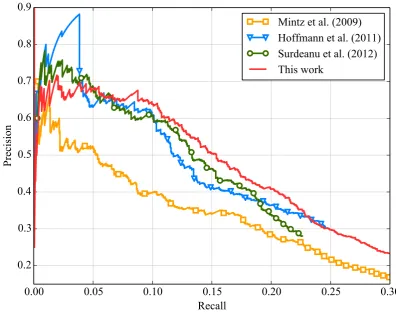
Figure 3: Precision/recall curves for different methods on the Riedel et al. (2010) dataset, for the task of aggregate extraction.
6.3 Implementation details
In this section, we discuss some important imple-mentation details.
Kernel normalization. We normalized the ker-nel matrixXX>, so that its diagonal coefficients
are equal to 1. This corresponds to normalizing the vectorsxnso that they have a unit`2-norm.
Choice of parameters. We kept20%of the ex-amples from the training set as a validation set, in order to choose the parameters of our method. We then re-train a model on the whole training set, us-ing the chosen parameters.
7 Experimental evaluation
In this section, we evaluate our approach to weakly supervised relation extraction by comparing it to state-of-the art methods.
7.1 Baselines
We now briefly present the different methods we compare to.
Mintz et al. This baseline corresponds to the method described by Mintz et al. (2009). We use the implementation of Surdeanu et al. (2012), which slightly differs from the original method: each relation mention candidate is treated inde-pendently (and not collapsed across mentions for a given entity pair). This strategy allows to predict multiple labels for a given entity pair, by OR-ing the predictions for the different mentions.
Hoffmann et al. This method, introduced by Hoffmann et al. (2011), is based on probabilis-tic graphical model of multi-instance multi-label learning. They proposed a learning method for this model, based on the perceptron algo-rithm (Collins, 2002) and a greedy search for the inference. We use the publicly available code of Hoffmannet al.4.
Surdeanu et al. Finally, we compare our method to the one described by Surdeanu et al. (2012). This method is based on a two-layer graphical model, the first layer corresponding to
0.0
0.1
0.2
0.3
0.4
0.5
0.6
Recall
0.0
0.2
0.4
0.6
0.8
1.0
Precision
[image:8.595.103.499.66.381.2]/location/location/contains
/people/person/place_lived
/person/person/nationality
/people/person/place_of_birth
/business/person/company
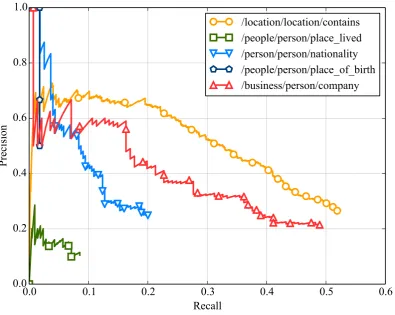
Figure 4: Precision/recall curves per relation for our method, on the Riedel et al. (2010) dataset, for the task of aggregate extraction.
a relation classifier at the mention level, while the second layer is aggregating the different predic-tion for a given entity pair. In particular, this sec-ond layer capture dependencies between relation labels, such as the fact that two labels cannot be generated jointly (e.g.the relationsSpouseOfand
BornIn). This model is trained by using hard discriminative Expectation-Maximization. We use the publicly available code of Surdeanuet al.5.
7.2 Precision / recall curves
Following standard practices in relation extrac-tion, we report precision/recall curves for the dif-ferent models. In order to rank aggregate extrac-tions for our model, the score of an extracted fact
r(e1, e2)is set to the maximal score of the
differ-ent extractions of that fact. This is sometimes ref-ered to as the soft-OR function.
7.3 Discussion
Comparison with the state-of-the-art. We re-port results for the different methods on the dataset
5nlp.stanford.edu/software/mimlre.shtml
introduced by Riedel et al. (2010) in Fig. 3. We observe that our approach generally outperforms the state of the art. Indeed, at equivalent recall, our method achieves better (or similar) precision than the other methods, except for very low re-call (smaller than 0.05). The improvement over the methods proposed by Hoffmann et al. (2011) and Surdeanu et al. (2012), which are currently the best published results on this dataset, can be as high as 5 points in precision for the same recall point. Moreover, our method achieves a higher re-call (0.30) than these two methods (0.25).
0.0 0.1 0.2 0.3 0.4 0.5 0.6 0.7
Recall
0.4
0.5
0.6
0.7
0.8
0.9
1.0
Precision
Hoffmann et al. (2011)
This work
Figure 5: Precision/recall curves for the task of sentential extraction, on the manually labeled dataset of Hoffmann et al. (2011).
only factor in those discrepancies. Indeed, the relation/people/person/place livedand the relation /people/person/place of birth
are more frequent than the relation
/business/person/company, but the ex-traction of the later works much better than the extraction of the two first.
Upon examination of the data, this can partly be explained by the fact that al-most no sentences extracted for the relation
/people/person/place of birth in fact express this relation. In other words, many facts present in Freebase are not expressed in the corpus, and are thus impossible to extract. On the other hand, most facts for the relation
/people/person/place lived are missing in Freebase. Therefore, many extractions produced by our system are considered false, but are in fact true positives. The problem of incomplete knowledge base was studied by Min et al. (2013).
Sentential extraction. We finally report preci-sion/recall curves for the task of sentential extrac-tion, in Fig. 5, using the manually labeled dataset of Hoffmann et al. (2011). We observe that for most values of recall, our method achieves simi-lar precision that the one proposed by Hoffmann et al. (2011), while extending the highest recall from0.52to0.68. Thanks to this higher recall, our method achieves a highest F1 score of0.66, com-pared to0.61obtained by the method proposed by Hoffmann et al. (2011).
Method Runtime
Mintz et al. (2009) 7 min Hoffmann et al. (2011) 2 min Surdeanu et al. (2012) 3 hours
[image:9.595.332.501.63.142.2]This work 3 hours
Table 1: Comparison of running times for the dif-ferent methods compared in the experimental sec-tion.
8 Conclusion
In this article, we introduced a new formulation for weakly supervised relation extraction. Our method is based on a constrained discriminative formulation of the multiple instance, multiple la-bel learning problem. Using the squared loss, we obtained a convex relaxation of this formula-tion, allowing us to obtain an approximate solu-tion to the initial integer quadratic program. Thus, our method is not sensitive to initialization. We demonstrated the competitiveness of our approach on the dataset introduced by Riedel et al. (2010), on which our method outperforms the state of the art methods for weakly supervised relation extrac-tion, on both aggregate and sentential extraction.
As noted earlier, another advantage of our method is the fact that it is easily kernelizable. We would like to explore the use of kernels, such as the ones introduced by Zelenko et al. (2003), Culotta and Sorensen (2004) and Bunescu and Mooney (2005), in future work. We believe that such kernels could improve the relatively low re-call obtained so far by weakly supervised method for relation extraction.
Acknowledgments
The author is supported by a grant from Inria (Associated-team STATWEB) and would like to thank Armand Joulin for helpful discussions.
References
Francis Bach and Za¨ıd Harchaoui. 2007. DIFFRAC: a discriminative and flexible framework for clustering. InAdv. NIPS.
Michele Banko, Michael J Cafarella, Stephen Soder-land, Matthew Broadhead, and Oren Etzioni. 2007. Open information extraction for the web. InIJCAI. Amir Beck and Marc Teboulle. 2009. A fast iterative
[image:9.595.79.284.63.224.2]Kedar Bellare and Andrew McCallum. 2007. Learn-ing extractors from unlabeled text usLearn-ing relevant databases. In Sixth international workshop on in-formation integration on the web.
Piotr Bojanowski, Francis Bach, Ivan Laptev, Jean Ponce, Cordelia Schmid, and Josef Sivic. 2013. Finding actors and actions in movies. In Proceed-ings of ICCV.
Razvan Bunescu and Raymond Mooney. 2005. A shortest path dependency kernel for relation extrac-tion. InProceedings of HLT-EMNLP.
Razvan Bunescu and Raymond Mooney. 2007. Learn-ing to extract relations from the web usLearn-ing minimal supervision. InProceedings of the ACL.
Michael Collins. 2002. Discriminative training meth-ods for hidden markov models: Theory and exper-iments with perceptron algorithms. InProceedings of EMNLP.
Mark Craven and Johan Kumlien. 1999. Constructing biological knowledge bases by extracting informa-tion from text sources. InISMB, volume 1999.
Aron Culotta and Jeffrey Sorensen. 2004. Dependency tree kernels for relation extraction. InProceedings of the ACL.
Thomas G Dietterich, Richard H Lathrop, and Tom´as Lozano-P´erez. 1997. Solving the multiple instance problem with axis-parallel rectangles. Artificial in-telligence, 89(1).
Jenny Rose Finkel, Trond Grenager, and Christopher Manning. 2005. Incorporating non-local informa-tion into informainforma-tion extracinforma-tion systems by Gibbs sampling. InProceedings of the ACL.
Raphael Hoffmann, Congle Zhang, Xiao Ling, Luke Zettlemoyer, and Daniel S Weld. 2011. Knowledge-based weak supervision for information extraction of overlapping relations. InProceedings of the ACL.
Armand Joulin, Jean Ponce, and Francis Bach. 2010. Efficient optimization for discriminative latent class models. InAdv. NIPS.
Nanda Kambhatla. 2004. Combining lexical, syntac-tic, and semantic features with maximum entropy models for information extraction. InProceedings of the ACL.
Scott Miller, Michael Crystal, Heidi Fox, Lance Ramshaw, Richard Schwartz, Rebecca Stone, and Ralph Weischedel. 1998. Algorithms that learn to extract information. InProceedings of MUC-7.
Bonan Min, Ralph Grishman, Li Wan, Chang Wang, and David Gondek. 2013. Distant supervision for relation extraction with an incomplete knowledge base. InProceedings of HLT-NAACL.
Mike Mintz, Steven Bills, Rion Snow, and Dan Ju-rafsky. 2009. Distant supervision for relation ex-traction without labeled data. InProceedings of the ACL-IJCNLP.
Yurii Nesterov. 2007. Gradient methods for minimiz-ing composite objective function.
Truc-Vien T Nguyen and Alessandro Moschitti. 2011. End-to-end relation extraction using distant super-vision from external semantic repositories. In Pro-ceedings of the ACL.
Joakim Nivre, Johan Hall, Jens Nilsson, Atanas Chanev, G¨ulsen Eryigit, Sandra K¨ubler, Svetoslav Marinov, and Erwin Marsi. 2007. MaltParser: A language-independent system for data-driven de-pendency parsing. Natural Language Engineering, 13(02).
Sebastian Riedel, Limin Yao, and Andrew McCallum. 2010. Modeling relations and their mentions with-out labeled text. InMachine Learning and Knowl-edge Discovery in Databases.
Evan Sandhaus. 2008. The new york times annotated corpus. Linguistic Data Consortium, Philadelphia, 6(12).
Yusuke Shinyama and Satoshi Sekine. 2006. Preemp-tive information extraction using unrestricted rela-tion discovery. InProceedings of the HLT-NAACL. Ang Sun, Ralph Grishman, Wei Xu, and Bonan Min.
2011. New york university 2011 system for kbp slot filling. InProceedings of the Text Analytics Confer-ence.
Mihai Surdeanu, Julie Tibshirani, Ramesh Nallapati, and Christopher D Manning. 2012. Multi-instance multi-label learning for relation extraction. In Pro-ceedings of EMNLP-CoNLL.
Fei Wu and Daniel S Weld. 2007. Autonomously semantifying wikipedia. InProceedings of the six-teenth ACM conference on Conference on informa-tion and knowledge management.
Linli Xu, James Neufeld, Bryce Larson, and Dale Schuurmans. 2004. Maximum margin clustering. InAdv. NIPS.
Appendix A Derivation of the dual
In this section, we derive the dual problem of the quadratic program of section 5. We introduce dual variables Λ ∈ RI×(K+1), Σ ∈ RN×(K+1),
Ω ∈ RI×(K+1) andν ∈ RN, such thatΛ ≥ 0, Σ≥0andΩ≥0.
The Lagrangian of the problem is
1 2tr
Y>(XX>+λIN)−1Y
+µX i,k
ξik
−trΛ>((EY)◦S−R+ξ)
−tr(Σ>Y)−tr(Ω>ξ)−ν>(Y1−1).
To find the dual function g we minimize the La-grangian over Y and ξ. Minimizing over ξ, we find that the dual function is equal to−∞unless
µ−Λik−Ωik = 0, in which case, we are left with
1 2tr
Y>(XX>+λI
N)−1Y
−tr((Λ◦S)>EY)−tr(Σ>Y)−tr(1ν>Y) +tr(Λ>R) +ν>1.
Minimizing overY, we then obtain
Y= (XX>+λIN)(E>(S◦Λ) + Σ +ν1>).
ReplacingYby its optimal value, we then obtain the dual function
−12trZ>QZ+trΛ>R+ν>1.
where
Q= (XX>+λIN),
Z=E>(S◦Λ) + Σ +ν1>.
Thus, the dual problem is
max
Λ,Σ,ν −
1 2tr
Z>QZ+trΛ>R+ν>1
s.t. 0≤Λik, 0≤Σnk, 0≤Ωik, µ−Λik−Ωik = 0.
We can then eliminate the dual variableΩ, since the constraints Ωik = µ−Λik andΩik ≥ 0are
equivalent toµ≥Λik. We finally obtain
max
Λ,Σ,ν −
1 2tr
Z>QZ+trΛ>R+ν>1
s.t. 0≤Λik ≤µ, 0≤Σnk.
Appendix B Optimization details
Gradient of the dual cost function. The gradi-ent of the dual cost functionf with respect to the dual variablesΣ,Λandνis equal to
∇Σf = (XX>+λIN)Z,
∇Λf =
(XX>+λIN)ZE>◦S−R,
∇νf = (XX>+λIN)Z1−1.
The most expensive step to compute those gra-dients is to compute the matrix product XX>Z. Since the matrixXis sparse, we efficiently com-pute this product by first computing the product
X>Z, and then by left multiplying the result by
X. The complexity of these two operations is
O(NF K), whereF is the average number of fea-tures per relation mention candidate.
Projecting Σ and Λ. The componentwise pro-jection operators associated to the constraints on
ΣandΛare defined by:
projΣ(Σnk) = max(0,Σnk),
projΛ(Λik) = max(0,min(µ,Λik)).