A Recursive Session Token Protocol For Use in
Computer Forensics and TCP Traceback
Brian Carrier
Clay Shields
Center for Education and Research in
Department of Computer Science
Information Assurance and Security (CERIAS)
Georgetown University
Purdue University
Washington, D.C., 20007
West Lafayette, IN 47907
[email protected]
[email protected]
0 H1 Hn−1 H n
C n−1 H2
C1 C0
H
Fig. 1. Connection chain example betweenH0andHn
Abstract—
We introduce a new protocol designed to assist in the forensic investigation of malicious network-based activity, specifically ad-dressing the stepping-stone scenario in which an attacker uses a chain of connections through many hosts to hide his or her iden-tity. Our protocol, the Session TOken Protocol (STOP), enhances the Identification Protocol (ident) infrastructure by sending re-cursive requests to previous hosts on the connection chain. The protocol has been designed to protect user’s privacy by returning a token that is a hash of connection information; a system adminis-trator can later decide whether to release the information relating to the token depending on the circumstances of the request.
I. INTRODUCTION
To hide the network address of a host used for initiation of a network attack, an attacker will often log into a series of com-promised hosts before attacking his or her intended target. This technique is commonly called stone stepping [23], and is used to allow the attacker to avoid responsibility for his or her
ac-tions. As shown in Figure 1, letHi,0≤i≤n, be a set of
net-work hosts, and let there be a connectionCibetween hostsHi
andHi+1 if there exists an active TCP session between them.
A connection chain,C, between hostsH0andHnis the set of
connectionsCi, where0≤i < n.
The current method of determining the source of an attack is to contact the previous host in the chain and to ask the admin-istrator to investigate his or her system. If a prior hop from that host is discovered, then the administrator of that system must then be contacted, and so on. In practice this type of traceback is often hindered by the fact that many administrators lack the resources, knowledge, trust, or system data to continue the in-vestigation. Particularly, in some instances, there is inadequate logging on a system to determine the previous host of a connec-tion.
This work was conducted within and supported by the Center for Education and Research in Information Assurance and Security (CERIAS).
We present the Session TOken Protocol (STOP) [5], which
is based on theidentprotocol, and helps forensic
investiga-tion of stepping-stone chains while protecting the privacy of users. STOP saves application-level data about the process and user that opened the socket, and can also send requests to pre-vious hosts to identify other hosts in the chain. At each stage, a hashed token is returned; at no point in the protocol does the requester ever directly learn user or process data. Instead, they must redeem the token to the system administrator who can de-termine the merit of releasing user information. Random ses-sion IDs in the requests allow cycle detection. Additionally, to allow for centralized control of security, STOP gives border gateways and firewalls the ability to send requests for inbound or outbound connections.
In the following section we describe previous work in the
area of attack traceback, and outline the operation of theident
protocol. Section III describes the STOP protocol, and imple-mentation results appear in Section IV. Finally, we present comparative performance results in Section V, and follow with our conclusions in Section VI.
II. PREVIOUSWORK
While there has been significant recent interest in determin-ing the source of network attacks, the bulk of this work has been targeted at a separate problem — that of locating the source of spoofed IP packets [16], [4], [15], [17], [14], [6], [7], [2], [19]. While providing a solution to this problem is crucial in provid-ing a response to distributed denial-of-service attacks [22], this work does not allow an attacker to be held accountable for their actions, as attackers rarely send spoofed packets directly from their host. Instead, they connect through a series of compro-mised hosts, and launch their attack from the tail of that chain.
A. Connection Chain Traceback
Previous work in determining the source of network traffic can be divided into two areas; network-based solutions, and host-based solutions.
The first work in connection chain traceback was a network-based solution proposed by Staniford-Chen and Heberlein [18].
They suggested saving content-based thumbprints of active
the thumbprints can be analyzed and pairs of connections statis-tically correlated. This analysis is based solely on packet con-tent and therefore does not work when encryption or compres-sion is used. Additionally, in the United States, it is often illegal for ISPs or officers of the government to examine the contents of packets [12].
Recent work by Zhang and Paxson avoided the problems of using packet content by relying instead on timing analysis of user idle times in interactive connections [23]. Their design places a network analyzer the border of network domains that performs real-time analysis to determine if connections enter-ing and leaventer-ing the domain are part of the same steppenter-ing-stone chain. The times when TCP connections go from an idle state to a non-idle state between inbound and outbound connections are correlated to identify inbound and outbound pairs. As this does not rely on content, it is not affected by use of cryptography or compression. This work was intended to perform an intrusion detection function, so that compromised hosts being used as stepping stones could be easily identified, but the authors have suggested that this technique could be used for traceback if the appropriate analysis were done at each domain on the connec-tion chain.
Yoda and Etoh also avoided using content for analysis by us-ing TCP sequence numbers [21]. TCP sequence numbers for a given connection always increase at a rate proportional to the amount of data transmitted. Therefore, if two connections are in the same chain, then their sequence numbers should increase at the same rate. Their work identifies connection chains by graphing the sequence numbers versus time and calculating the differences between the graphs. If two graphs have little dif-ference, then they are likely to be from the same chain. This design will not work if compression of the data stream occurs differently on each part of the chain, as may be the case in such protocols as SSH [20], because the sequence numbering will be different, nor will it work if link encryption is used as TCP headers will be encrypted.
The sole prior host-based solution that has been proposed
was the Caller Identification System (Caller ID) [11]. The
Caller ID system is a set of protocols designed to authenticate a user and the path of hosts he or she is logged into. Its pri-mary purpose is for authentication, but the data it gathers can also be used to trace an attacker. When a user logs into host
Hifrom hostHi−1,Hisends a request toHi−1with the TCP
port pair. Hi−1identifies the user that has the TCP connection
and returns a cached list of previous host and user name pairs
toHi.Hiverifies the list by sending a request to each host with
the corresponding user name. The host returnsyesif it has a
process running as that user and returnsnootherwise. If any
host returnsnotoHi, then the user is not authorized to log in.
HostHisaves the list in case it receives a request fromHi+1.
This work does not address the problem of mapping an out-going TCP connection with the previous incoming connections. Instead, it simply verifies that a process with the appropriate user name is running on the system. Additionally, as the host saves the list of previous hosts for a user, it will not know which host list to return when the user has several active login ses-sions [3]. This protocol may also add considerable delay while the list of previous hosts is verified.
B. The Identification Protocol
The Identification Protocol (ident) [10] is a simple
proto-col that is designed to allow a server to identify the client-side user name. While the full grammar for the protocol is available in RFC 1413 [10], the protocol works as follows:
1. A client and server establish a TCP connection between TCP
port<CL PORT>on the client and TCP port<SV PORT>on
the server.
2. The server establishes a connection to port 113/TCP on the client and sends the following message:
<CL PORT>,<SV PORT>
3. The client determines which, if any, process has a connection
from port<CL PORT>to port<SV PORT>using the source IP
address of the request.
4. If the process and corresponding UID is found, a message such as is returned:
<CL PORT>,<SV PORT>:USERID:UNIX:<USER ID> or in case of error:
<CL PORT>,<SV PORT>:ERROR:<ERROR MSG>
Asidentreturns user names, it can be invasive on user
pri-vacy and can also be used for other purposes besides security.
Goldsmith showed that theidentRFC did not specify that the
daemon need only return the identity of connections that orig-inated on that host [9]. Therefore, an attacker could establish
a connection with any service, send anidentrequest, and
re-ceive a reply with the user name of the service running. This allows an attacker to determine which services are running as
root. Additionally, web servers can collect email addresses of
users that visit their sites and add them to bulk email lists for SPAM.
Several implementations take additional steps to protect user privacy. The OpenBSD daemon [1] returns a string of 80 ran-dom bits in hex instead of the user id. The ranran-dom token can be redeemed for the user name after proper identification and need have been presented to an administrator. Similarly, the
pidentddaemon [8] can return the user name encrypted using
DES, which can later be decrypted by an administrator. Other
measures include always returning"OTHER"as the operating
system type and returning"UNKNOWN-ERROR"for all errors.
III. A RECURSIVESESSIONTOKENPROTOCOL
STOP provides additional functionality to what is offered
fromident. It can be run on any host with no modification
of protocols, network topology, or kernel. It can also be run in parallel with any of the network-based connection chain analy-sis tools previously proposed.
A. Protocol Design Goals
The design of STOP followed a number of design goals, enu-merated here:
1) Must be backward compatible with the Identification Protocol as specified in RFC1413 [10] because of its widespread usage and implementation.
3) Must provide a mechanism for a server to request that the client save additional data, in addition to just the user name.
4) Must provide a mechanism for a server to request that the client trace the user’s path of previous hosts.
5) Must be configurable such that it can comply with the system security and privacy polices.
6) Should be efficient and not add considerable load to the daemon host or delay to the requester.
7) Should allow a host that is not on the connection chain to make requests.
The standardidentprotocol satisfies goals 1 and 6. Some
implementations satisfy goals 2 and 5 by returning random
to-kens instead of user names and returning"OTHER"instead of
the actual operating system. Theidentprotocol offers
noth-ing similar to goals 3, 4, or 7.
B. Protocol Design
The new protocol builds upon theidentprotocol by
mod-ifying the request message to provide more options and the re-sponse message to protect privacy. The request message now contains a request type, which can be one of the following:
• ID: The daemon saves the user name in its log file and
returns a random token. This is the same behavior as the
originalidentprotocol.
• ID REC: The daemon saves the user name and return a
random token. The daemon then sends anID RECrequest
to the host that the user logged in from. This option also requires a random session identifier to identify cycles in the recursion.
• SV: The daemon saves the user name and other data
asso-ciated with the process that opened the port.
• SV REC: The daemon saves the same data as withSVand
also has the recursive property as described withID REC.
This type also requires a session identifier.
The request may optionally contain an IP address in dotted decimal format that when given is used as the remote address of the TCP connection. This is intended for use by network gateways and Intrusion Detection Systems (IDS). When the IP address is specified, no error messages or user names must be returned, only normal responses with a random token. This pre-vents information gathering by attackers posing as legitimate requesters.
The protocol uses the same response messages as theident
protocol, with three exceptions. "OTHER"is always returned
as the operating system type to satisfy design goal 2 and be-cause the operating system value is not required to identify a
session. The second exception is that"HIDDEN-USER"is no
longer required as an error message. The original intent of this message was to allow a user to specify that his or her user name not be sent to other systems. Our protocol will only return ran-dom tokens and therefore does not need this error type, as the user’s privacy is still preserved. The last change is that only printable ASCII is allowed in the random token. The original protocol allowed the return token to be any octet value except
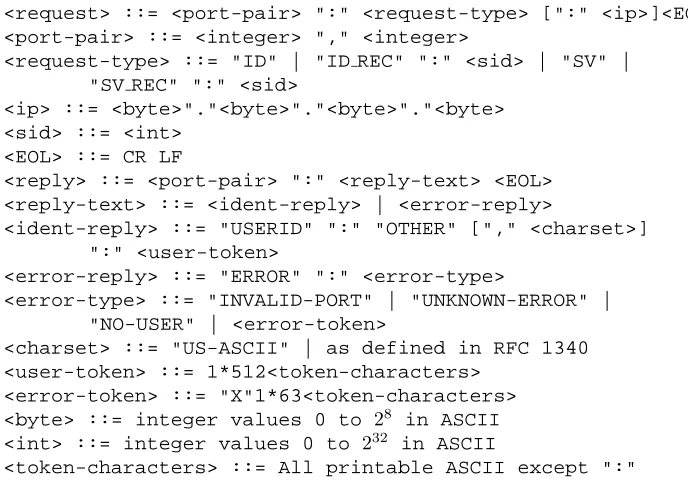
NULL, CR, and LF. As the protocol is returning random to-kens that will be later redeemed for actual data, it will be easier if tokens are generated using only printable ASCII. The full grammar is shown in Figure 2.
Due to the second design goal, STOP by default will return a random token. In some implementations, the user may opt-in to having his or her user name sent to satisfy the requirements by some Internet Relay Chat (IRC) networks.
A daemon that implements this protocol must have the fol-lowing properties:
• Return a random token for all established connections
• Random tokens need not be cryptographically secure, but
must not contain any values related to the request, such as UID, time, or IP address. The tokens must also be the same length for all request types and responses.
• Return an error for requests of TCP sessions that were not
initiated by the local host.
• Return a random token to all requests that specify the
re-mote IP address of the connection; this includes replacing error messages.
• Process requests in the original RFC 1413 format asID
type requests.
• Save additional process data whenSVorSV RECrequests
are received (see Section III-C).
• Send requests with the same type and session identifier
to the hosts that a user logged in from whenID RECor
SV RECrequests are received (see Section III-D).
• Save tokens from recursive requests with the original reply
token. The recursive tokens must not be sent to the original requester.
• Do not process more than one request of typeID RECor
SV RECfrom the same host with the same session
identi-fier for at least 120 seconds. If a second request is received within 120 seconds of the first, return a random token and log the loop detection.
A daemon that implements this protocol should have the fol-lowing properties:
• Provide an option to return a<user-reply>message
with a random token instead of error messages.
• Provide an user-based option to return the actual user name
instead of a random token for anIDtype request. All other
request types must return a random token.
• Provide options for what process and system data to save
on behalf ofSVandSV RECrequests to satisfy policies or
resources such as disk space.
C. Saving Process State
By sending aSVorSV RECrequest to the client, the server
can later gather additional user- and application-level data on the process that made the connection. Upon receiving this re-quest, the daemon will save the additional data to a file in a
directory, such as/var/tokens. Process data that we believe is
important to save include:
• Process name and identifier (PID)
• Parent PID
• Real user id and effective user id
<request> ::= <port-pair> ":" <request-type> [":" <ip>]<EOL> <port-pair> ::= <integer> "," <integer>
<request-type> ::= "ID" | "ID REC" ":" <sid> | "SV" | "SV REC" ":" <sid>
<ip> ::= <byte>"."<byte>"."<byte>"."<byte> <sid> ::= <int>
<EOL> ::= CR LF
<reply> ::= <port-pair> ":" <reply-text> <EOL> <reply-text> ::= <ident-reply> | <error-reply>
<ident-reply> ::= "USERID" ":" "OTHER" ["," <charset>] ":" <user-token>
<error-reply> ::= "ERROR" ":" <error-type>
<error-type> ::= "INVALID-PORT" | "UNKNOWN-ERROR" | "NO-USER" | <error-token>
<charset> ::= "US-ASCII" | as defined in RFC 1340 <user-token> ::= 1*512<token-characters>
<error-token> ::= "X"1*63<token-characters>
<byte> ::= integer values 0 to 28 in ASCII
<int> ::= integer values 0 to 232 in ASCII
<token-characters> ::= All printable ASCII except ":"
Fig. 2. STOP Protocol Grammar
• Terminal device
• List of open sockets, files, and pipes
In addition, the following data should also be saved to help an investigation should one occur.
• Host name
• Boot time
• Operating System, version, kernel date and build
• Address of machine that sent request
• Address and port of remote end of socket
• Address and port of local end of socket
• Type (i.e. SV REC) and time of request
• Entries fromutmpfor all users mentioned in report
D. Recursion
TheID RECandSV RECrequest types allow tokens to be
generated along an entire path of hosts. The original response token should be sent back to the requester before the recursive requests are sent. This is so the requester does not have to wait for all responses to be received. When the responses from the previous host are received, they should be saved with the ran-dom token. If any of the responses are sent to the the requester, then the daemon would be violating design goal 2 because the requester would learn that the previous host is not the end of the chain.
The recursive requests must contain a random session iden-tifier to prevent cycles and a denial of service situation. The
daemon must keep track of theID RECandSV RECrequests
that it has seen within the past 120 seconds. If it receives a du-plicate request for a port pair with the same random identifier and from the same host within 120 seconds, it must not process
the request and return a<user-reply>type message to stop
the cycle. This method will prevent a denial of service situation caused by processing the same request in a cycle, but it will
not prevent one from a flood of requests using different session identifiers. To prevent this situation, the number of requests that are processed at a time must be limited by the daemon.
E. Security Analysis
STOP does not solve all tracing connection chain tracing problems, as the daemon can be killed on any system which
the attacker has gainedrootprivileges. This section will
ana-lyze the effectiveness of the protocol when the daemon of host
Hihas been killed or replaced. It is important to remember that
the logs of any system that has hadrootaccess compromised
are never fully trusted.
If the attacker kills the daemon, then this is the same situation
as though the host was never running it. Therefore,Hi+1will
have a log message indicating thatHihas rejected the network
connection and the attacker’s path can be traced back to only Hi.
If the attacker replaces the daemon with a rogue version, sev-eral situations can occur:
• The daemon does not save any data. This is the same as if
it were not running and the path will be known toHi.
• The daemon does not send recursive requests, which will
cause the path to also end atHiif it is not saving the
pre-vious host data or atHi−1if it is saving the previous host
data.
• The daemon saves false user and recursive data. For
ex-ample, the daemon picks another login session at random, and claims that it is the attacker’s session. This scenario can lead an investigator far from the true path, but the com-promised host would be looked at by following the path of tokens and investigated for malicious activity.
[image:4.612.83.427.52.299.2]that this protocol is not a quick fix to the stepping stone scenario and must be used only as a tool whose data must be verified.
IV. IMPLEMENTATION
A prototype of theSTOPprotocol was implemented by
mod-ifying an open source identdaemon, oidentd[13]. The
STOPdaemon allowed several run-time options including:
• Always return random tokens instead of errors.
• Always return"UNKNOWN-ERROR"for all error types.
• Select what state data to save forSVandSV RECrequests.
• Allow users to opt-in to releasing their user name.
• Restrict the number of active lookups to limit the amount
of processing the daemon does.
When users are allowed to opt-in to their user name being
re-leased, they can create a file named˜/.identwhich contains
a list of hosts that their user name should be sent to. All other hosts are sent a random token.
The prototype was built on Solaris 2.7, OpenBSD 2.8 and Debian Linux 2.2. The process state data was determined in OpenBSD and Solaris using the Kernel VM library functions
and in Linux used theprocf spseudo-file system. As will be
shown in Section V, the OpenBSD and Solaris implementations have better performance because they read directly from kernel memory.
When anIDtype request is received, the daemon acts like
a basicident daemon and determines the UID from kernel
memory, or from the/proc/net/tcpfile in Linux. When
anID REC,SVorSV RECtype request is received, the daemon
identifies the process that has the socket and saves state data about it. It then saves the same data about the parent process and ’walks’ up the process tree by repeating this procedure until the process with PID 0 is reached. Recursive request messages are sent to the remote end of each incoming socket identified during the ’walk’.
Performing a simple ’walk’ up the process tree may not be adequate when tracing malicious users. For example, let an
attacker run the following command to ’pass through’ hostHi:
# nc -l -p 8888 | nc <Hi+1> 8889
This command usesnetcatto listen on port 8888 of hostHiand
pipes data received on that port to anothernetcatprocess that
sends the data to port 8889 on hostHi+1. When the process that
connects toHi+1is analyzed no other sockets are encountered.
Therefore, ifHi+1sent a request of typeSV RECthen no
recur-sive requests will be sent. By resolving the pipe and identifying
the process was at the other end,Hi−1can be determined.
In our implementation, all pipes, local domain sockets (also called UNIX domain sockets), and Internet domain sockets connected to the local host are resolved. This is done by search-ing the file descriptors of all processes. The identified processes are then ’walked’ up and their sockets and pipes are resolved. This continues until all sockets and pipes are resolved.
If the request type is SVor SV REC, then the state data is
stored in a file and the SHA-1 hash of the data is computed and sent to the requester as the random token. The SHA-1 hash is sent to detect any tampering the attacker may do to the data file. For a typical process tree with 6 processes, the output file is roughly 1600 bytes when all variables mentioned in Section
III-C are saved. If the tokens are saved to a small disk, an at-tacker could cause the drive to fill with token files to prevent the system from saving tokens involved with an attack. The data files can also be compressed to roughly 700 bytes.
If a request has typeID RECorSV REC, then the saved
pro-cess data is analyzed for open Internet domain stream sock-ets. We tried to limit requests for inbound sockets only, but this was unsuccessful because only OpenBSD socket structures save data about direction. When the direction is unknown, re-quests are sent to all sockets.
Cycles are detected by keeping a hash table ofID RECand
SV RECrequests. The hash function uses bits from the random
session id, remote address, remote port, and local port.
Experiments were performed to verify that the protocol would trace a connection chain, save appropriate data, and de-tect cycles. The implementations passed all experiments by identifying all hosts in a connection chain of four hosts, sav-ing the correct process and IPC data, and not sendsav-ing requests when a cycle was identified.
V. PERFORMANCE
The Linux and OpenBSD systems that were used to imple-ment this program have identical hardware and were tested for performance results. The systems had a 600 MHz Intel Pentium III processor and 128MB of RAM. The results of two perfor-mance tests are given here, request processing times and system performance.
A. Request Processing Time
The first test program simulated a daemon that would
imple-ment theSTOPprotocol. It forked a new child process, waited
for it to finish, and repeated for a specified number of times. The child process parsed a request string and processed it. The total time was divided by the number of lookups to calculate the average processing time.
The program was first run on a simple process tree, shown in Figure 3, that contained 6 unique processes and contained no forms of IPC. Table I shows the average number of seconds per request from our tests. The first data column shows the
processing time for anIDtype request. As described in Section
III-B, anIDtype request is equivalent to the traditionalident
protocol request. This was run to compare how much longer
a newSVtype request takes over the originalidentrequest.
This shows that Linux is the most efficient at determining the UID of a socket. This operation was performed in Linux by
parsing the/proc/net/tcpfile and in OpenBSD by using
asysctl()system call.
The second data column contains the times for performing
a SV type request and not saving the process data to a file
while the third column contains the times for aSVtype request
and saving the data to a file. As described in Section III-B, a
SVtype request saves state data for the process tree that has
the requested socket open. From the second data column, it is clear that it is much faster to directly access kernel
mem-ory in OpenBSD than by searching and parsing/proc/files.
OpenBSD has a 201% increase in lookup time between a
SCHED
i+1
H
i−1
H
i
TELNET CSH SSHD SSHD INIT
H
Fig. 3. Process tree with 6 unique processes
TABLE I
AVERAGE LOOKUP TIME FOR6UNIQUE PROCESSES
Platform ID SV SVwith file
Linux 0.533 mS 5.718 mS 8.243 mS
OpenBSD 0.803 mS 2.421 mS 7.871 mS
5 5
P8
P2
P1 P3
P
7
P10
P12 P11
P
6
P9
P4
H
i−1
Hi+1
Inheritance
Internet Socket Uni−directional Pipe
H
i
SCHED
INIT
12
11
14 13 2
9 10 1 3
4
7
6
8
P
Fig. 4. Process tree with 14 unique processes
TABLE II
AVERAGE LOOKUP TIME FOR14UNIQUE PROCESSES
Platform SV SVwith 100 procs
Linux 63.354 mS 224.589 mS
OpenBSD 10.256 mS 32.059 mS
973% increase in lookup time. On average, Linux spends 136%
more time performing anSVlookup than OpenBSD does. This
is because OpenBSD can do more in kernel space and Linux
must do file IO and usescanf()to determine process data.
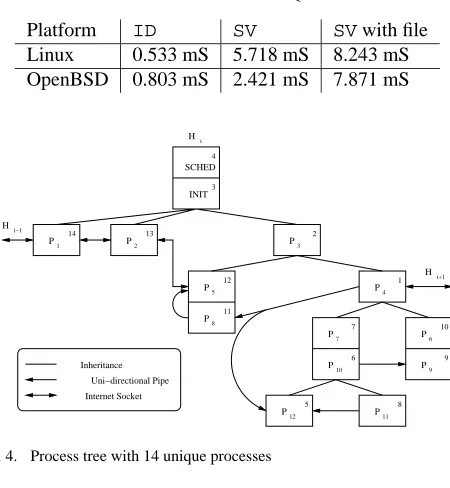
When both platforms write the process data to file, Linux takes only slightly longer, as the write output is the slowest operation. To show that the daemon can handle non-simple process structures, a more complex test environment was used. This structure can be found in Figure 4 and resolves to 14 unique processes, 3 process groups, and contains 6 instances of IPC to resolve using pipes and Internet domain sockets. The structure
contains a one-way communication path fromP4toP1. It was
resolved starting with the outbound socket on processP4. An
example resolution ordering is shown in the upper right of each process box.
The testing program performed lookups on the socket from
0 20 40 60 80 100
0 1000 2000 3000 4000 5000 6000
Overhead (%)
Requests per minute
OpenBSD Linux
Fig. 5. STOP Overhead
P4on a system with no other users and the results can be found
in data column one of Table II. These results show that the OpenBSD lookup time for the 14-processes structure is 324% longer than for the 6-process structure. Linux had a 1008% increase over the 6-process structure and was 518% longer than OpenBSD. The tests were repeated with the addition of 100 processes that had the three standard file descriptors, two open pipe descriptors and one open file descriptor. As the daemon has to search through all file descriptors to resolve pipes, each lookup has to examine 600 additional file descriptors for each of the 6 resolutions. The testing program was run again and the results can be found in the second data column. This shows that the average OpenBSD lookup had a 213% increase with the 100 additional processes, Linux had a 254% increase, and Linux took 600% longer than OpenBSD.
Clearly, resolving processes is an expensive operation, but the complex structure as shown is not typical. As will be shown in the next section, even the complex structure does not greatly impact the system.
B. System Performance
A memory-intensive benchmark program was used to deter-mine the impact that this daemon had on a system. The bench-mark program was executed and timed without the daemon run-ning to determine the base time. The benchmark program was then executed and timed again, but with the daemon processing a specified number of requests per minute. The difference from the base time was calculated as a percentage and can be found in Table III for seven different request rates. Each lookup was
aSVtype request on a 6-process basic process tree with the
output printed to a file. Figure 5 shows a graph of these values. This data shows that the daemon does not pose a significant threat to system performance under typical operation. For a reference value, the average number of logins per minute was calculated from the main student computer at Purdue
Univer-sity. The computer, expert.cc.purdue.edu, is run by
[image:6.612.120.218.54.171.2] [image:6.612.54.279.219.463.2]TABLE III SYSTEM PERFORMANCE DATA
requests per minute
Platform 6 20 60 120 600 3000 6000
Linux 0.12% 0.26% 0.79% 1.55% 7.01% 24.15% 35.92%
OpenBSD 0.01% 0.10% 0.39% 0.83% 3.89% 13.04% 19.20%
another system after logging intoexpert. Few users do this
on a regular basis.
VI. CONCLUSION
This protocol provides data that is commonly missing dur-ing forensic investigations. It provides a record of socket ac-tivity and allows an attacker who is using a series of hosts to be traced. By returning only random tokens, a user’s privacy is protected and other systems cannot rely on it as a method of authentication.
This protocol is most effective when many hosts are running it. Because of that, though this protocol could be used for trac-ing TCP chains across the Internet, we do not expect it to be used there. Instead, it is more useful in a more tightly con-strained environment in which there are enforceable policies that require the STOP daemon to be run. This could be a single network or an intranet, as the ability to make requests on be-half of other machines provides border gateways and intrusion detection systems with a method to request data on suspicious inbound and outbound traffic.
We have shown that this protocol can be implemented and is effective in saving data about a network session and trac-ing connection chains. It can be used in parallel with other traceback techniques such as network traffic analysis to provide application-level data to investigators.
While it is clear that this protocol will not solve the problem of TCP connection-chain traceback in all situations, this col is a further step towards a solution. STOP is the first proto-col that addresses the problem of correlating incoming network connections with outgoing ones in existing operating systems, and allows it to be saved in a privacy-preserving manner.
REFERENCES
[1] OpenBSD operating system v2.8. available at: www.openbsd.org. [2] S. Bellovin. ICMP Traceback Messages. Technical Report
draft-bellovin-itrace-00.txt, IETF Internet draft, March 2000.
[3] F. Buchholz, T. Daniels, B. Kuperman, and C. Shields. Packet Tracker Final Report. Technical Report 2000-23, CERIAS, Purdue University, 2000.
[4] H. Burch and B. Cheswick. Tracing Anonymous Packets to their Ap-proximate Source. In Proceedings of the 14th Conference on Systems
Administration (LISA-2000), New Orleans, LA, December 2000.
[5] B. Carrier. A Recursive Session Token Protocol For Use in Forensics and TCP Traceback. Master’s thesis, CERIAS, Purdue University, 2001. [6] D. Dean, M. Franklin, and A. Stubblefield. An Algebraic Approach to IP
traceback. In Proceedings of the 2001 Network and Distributed System
Security Symposium, San Diego, CA, February 2001.
[7] T. W. Doeppner, P. N. Klein, and A. Koyfman. Using Router Stamping to Identify the Source of IP Packets. In 7th ACM Conference on Computer
and Communications Security, pages 184–189, Athens, Greece,
Novem-ber 2000.
[8] P. Eriksson. pidentd ident daemon v3.0.12. available at: http://www2.lysator.liu.se/˜pen/pidentd/, Dec, 3 2000.
[9] D. Goldsmith. ident-scan. Email post to bugtraq mailing list. Available at: http://lists.insecure.org/bugtraq/1996/Feb/0024.html, Feb 13 1996. [10] M. St. Johns. Identification protocol. RFC 1413, US Department of
De-fense, Feb 1993.
[11] H. T. Jung, H. L. Kim, Y. M. Seo, G. Choe, S. L. Min, C. S. Kim, and K. Koh. Caller Identification System in the Internet Environment. In
UNIX Security Symposium IV Proceedings, pages 69–78, 1993.
[12] S. C. Lee and C. Shields. Tracing the Source of Network Attack: A Technical, Legal, and Societal Problem. In Proceedings of the 2001 IEEE
Workshop on Information Assurance and Security, West Point, NY, June
2001.
[13] R. McCabe. oidentd ident daemon v1.7.1. available at: http://ojnk.sourceforge.net/, Oct, 22 2000.
[14] K. Park and H. Lee. On the effectiveness of probabilistic packet marking for IP traceback under denial of service attack. In Proceedings IEEE
INFOCOM 2001, pages 338–347, April 2001.
[15] S. Savage, D. Wetherall, A. Karlin, and T. Anderson. Practical Network Support for IP Traceback. In Proceedings of the 2000 ACM SIGCOMM
Conference, August 2000.
[16] A. C. Snoeren, C. Partridge, L. A. Sanchez, C. E. Jones, F. Tchakountio, and W. T. Strayer S. T. Kent. Hash-Based IP Traceback. In Proceedings
of the 2001 ACM SIGCOMM, San Diego, CA, August 2001. To Appear.
[17] D. X. Song and A. Perrig. Advanced and Authenticated Marking Schemes for IP Traceback. In Proceedings of the IEEE Infocomm 2001, April 2001. [18] S. Staniford-Chen and L.T. Heberlein. Holding Intruders Accountable on the Internet. In Proceedings of the 1995 IEEE Symposium on Security
and Privacy, pages 39–49, Oakland, CA, May 1995.
[19] S. F. Wu, L. Zhang, D. Massey, and A. Mankin. Intention-Driven ICMP Trace-Back. IETF Internet draft, February 2001. draft-wu-itrace-intention-00.txt.
[20] T. Ylonen. SSH — Secure Login Connections Over the Internet. In 6th
USENIX Security Symposium, pages 37–42, San Jose, CA, USA, July
1996.
[21] K. Yoda and H. Etoh. Finding a Connection Chain for Tracing Intruders. In Proceedings of the 6th European Symposium on Research in Computer
Security (ESORICS 2000), October 2000.
[22] ZDNet Special Report: It’s War! Web Under Attack. http://www.zdnet.com/zdnn/special/doswebattack.html, February 2000. [23] Y. Zhang and V. Paxson. Detecting Stepping Stones. In Proceedings of