By Order of the Secretary of the Army:
CARL E. VUONO
General, United States ArmyChief of Staff
Official:
JOHN A. FULMER
Colonel, United States Army Acting The Adjutant General
DISTRIBUTION:
Active Army, USAR, and ARNG: To be distributed in accordance with DA Form 12-11E, requirements for FM 90-26, Airborne Operations (Qty rqr block no. 4655)
Headquarters Department of the Army Washington, DC, 18 December 1990
AIRBORNE OPERATIONS
CONTENTS
Page
Preface... vii
CHAPTER 1. INTRODUCTION
1-1 Preparation for War ... 1-2 1-2 The Soldier ... 1-2 1-3 The Leader... 1-2 1-4 The Unit... 1-2 1-5 Unit Training Program ... 1-3 1-6 Capabilities of Airborne Forces... 1-3 1-7 Missions of Airborne Forces ... 1-4 1-8 Fundamentals of Airborne Operations... 1-5 1-9 Characteristics of Airborne Operations ... 1-5 1-10 Limitations of Airborne Forces... 1-6 1-11 Phases of Airborne Operations ... 1-6 1-12 Battlefield Operating Systems and Airborne Operations ... 1-7
CHAPTER 2. AIRBORNE PLANNING
Section I. FUNDAMENTALS
2-1. Planning Responsibilities ... 2-1 2-2. Key Personnel Responsibilities ... 2-2
T
his manual discusses the employment of airborne brigades, battalions, and regiments in airborne operations within the context of the AirLand Battle. It sets forth tactical and administrative support doctrine for the employment of Army forces in joint airborne operations. It discusses command and staff procedures, tactics, and techniques used in the planning and execution of parachute operations at brigade and lower echelons.
The discussions are written in general terms so they apply to brigade or smaller units taking part in joint airborne operations. For this reason, the term “airborne force” is used to refer to the Army component in the operation.
The principal tactics and techniques peculiar to airborne operations are of primary concern. Details of unit organization/capabilities, and guidance for employment of units in other than airborne operations are in other field manuals.
This publication implements the following international agreements: STANAG 3466/ASCC 44/18C, Responsibilities of Air Transport Units and User Units in the Loading and Unloading of Transport Aircraft in Tactical Air Transport Operations and STANAG 3570/ASCC 44/13G, Drop Zones and Extraction Zones–Criteria and Markings.
The proponent of this publication is US Army Infantry School. Send comments and recommendations on DA Form 2028 (Recommended Changes to Publications and Blank Forms) directly to the Commandant, United States Army Infantry School, ATTN: ATSH-ATD, Fort Benning, Georgia 31905-5410.
A
INTRODUCTION
irborne forces of the US Army have often demonstrated their ability to conduct decisive, short notice, forced entry operations deep into enemy territory. They seize and maintain the initiative until follow-on forces are committed to the fight and then move to hit the enemy where he is the most vulnerable. The ability to rapidly deploy, land, and sustain a powerful ground combat force is vital to US interests and worldwide commitments.
From their origins early in World War II, the US Army’s airborne forces have dramatically demonstrated their responsiveness and flexibility many times on DZs and battlefields all over the world. As the threat of regional conflict has grown, the XVIII Airborne Corps, the 82d Airborne Division, and the 75th Ranger Regiment have demonstrated that well-trained, determined airborne soldiers armed with modern light weapons and led by skilled officers and NCOs can dominate the close fight and impose their will upon the enemy—wherever he is.
During Operation Just Cause in 1989, the actions of the 75th Ranger Regiment and the 82d Airborne Division clearly demonstrated the advantages of US airborne forces. The operation was well supported by other US Army units, the US Air Force, and US Navy.
On 17 December 1989, the National Command Authority decided to commit specially trained airborne units to military action in Panama. The President established H-hour for 0100 on 20 December, just three days after the decision to intervene. The complex operation was centrally planned due to the need for thoroughly synchronized operations. The mission assigned to the airborne force was to quickly isolate, neutralize, and, if needed, destroy units of the Panamanian Defense Force by overwhelming combat power. These forces were then to link up with elements of the 7th Infantry Division (Light), the 5th Infantry Division (Mechanized), and the 193d Infantry Brigade.
Largely through airborne operations, capable and aggressive combined arms task forces were brought to bear on short notice against u dispersed enemy. Thirty-two separate objectives were attacked at the same time, paralyzing the enemy. The resounding success of Operation Just Cause was due mostly to the parachute assault and rapid follow-on missions made possible by the airborne operation. Operation Just Cause demonstrated once again the capability, flexibility and value of airborne forces.
1-1. PREPARATION FOR WAR
Airborne and ranger units are organized and equipped to conduct parachute assaults to close with the enemy to kill him, to destroy his equipment, and to shatter his will to resist. This close personal fight requires combat-ready units composed of skilled soldiers and resourceful leaders. These units are the result of a tough, thorough, and demanding training program conducted by leaders who understand the effective employment of airborne forces, the combined arms team, and joint operations.
1-2. THE SOLDIER
Paratroopers must be experts in marksmanship, close combat, individual parachute techniques, and fieldcraft. They should be proficient with their assigned weapons and other weapons in the unit. They should also be familiar with foreign-made weapons that the enemy will use. In the close fight, paratroopers must be skilled in employing all weapons to include the rifle, the bayonet the AT4, grenades, mines, and bare hands. They must be confident in their ability to fight with these weapons They must be highly skilled in land navigation, camouflage, and tracking and stalking techniques. Paratroopers must be able to move undetected close to enemy soldiers. Stealth is required for reconnaissance, infiltration, and achieving surprise. Paratroopers must have the skill and the will to dominate the close fight.
1-3. THE LEADER
Infantry leaders must be the most capable soldiers tactically and technically proficient. The quality of the the unit's success or failure in battle. Leaders must
in their unit and be leadership determines be proficient in land navigation and have an appreciation for terrain and parachute assault techniques. For a foot soldier, the terrain is both protector and ally. When properly exploited, it can increase the combat potential of the unit and support the achievement of surprise. All leaders must also be resourceful, tenacious, and decisive warriors. They are the combined arms integrators closest to the fight. They must be highly skilled in the employment of all the weapons and assets in the combined arms team. Leaders must be innovative and flexible when employing their units. They must have the mental agility to quickly grasp the situation and the initiative to take independent action, based on the situation and the commander's intent. Above all, they must personally lead their unit to success in close combat.
1-4. THE UNIT
cohesion is essential to the survival and success of airborne forces in close combat. Cohesion enhances the paratrooper’s will and determination to persevere. to accept the hardships, and to refuse to accept defeat. In the close fight, when the decision hangs in the balance, these are the factors that decide the victor. It is at the small-unit level (squad and platoon) that cohesion and teamwork provide the greatest benefits to the combat effectiveness of the unit. Paratroopers must have complete trust and confidence in their leaders. Leaders earn this trust and confidence by sharing the hardships and by displaying the leadership attributes described in FM 22-100. They must entrust the same confidence in their soldiers for this bonding to develop.
1-5. UNIT TRAINING PROGRAM
The unit training program must instill individual and collective skills and confidence, and must develop combat-ready units. It must consist of difficult, challenging training events that prepare soldiers, leaders, and units for the close fight. It must be conducted IAW FM 25-100, FM 25-101, and the MTP. The program must emphasize physical fitness, marksmanship skills, and parachute techniques. Paratroopers must be challenged to achieve expert proficiency in all of the combat critical skills. Night training, especially night live-fire exercises and parachute assaults, should be routine. The environment of the close fight should be simulated when possible. Training events that require subordinate leaders to use their initiative and take independent action are essential to prepare for decentralized operations that the unit normally conducts. Training to standard also develops cohesive, tenacious squads and platoons that can overcome all obstacles to ensure the safety of their unit and the accomplishment of the mission. The training program must continue after the unit begins conducting combat operations. The skills, teamwork, and cohesion must be sustained as replacements arrive in the unit. This is essential to maintain the combat effectiveness of the unit.
1-6. CAPABILITIES OF AIRBORNE FORCES
Airborne forces may be strategically, operationally, or tactically deployed on short notice to DZs anywhere in the world. They can be employed as a deterrent or combat force.
a. The USAF provides support to airborne operations that include:
• Airlift. • Counterair.
• Close air support.
• Tactical air reconnaissance.
• Air interdiction.
• Special air warfare operations.
• Electronic warfare.
Ž Suppression of enemy air defense.
• Quick response on short notice.
• Ability to bypass all land or sea obstacles. • Surprise.
• Ability to mass rapidly on critical targets.
Airborne forces, when augmented with appropriate combat, CS, and CSS, can conduct sustained combat operations against any enemy.
1-7. MISSIONS OF AIRBORNE FORCES
Airborne forces execute parachute assaults to destroy the enemy and to seize and hold important objectives until linkup is accomplished. The parachute assault enhances the basic infantry combat mission: to close with the enemy by fire and maneuver, to destroy or capture him, and to repel his assaults by fire, close combat, and counterattack.
a. Missions for airborne forces can be strategic, operational, or tactical.
(1) Strategic missions. Simply alerting airborne forces for employment is a show of force that is politically significant in a strategic context. Airborne forces have strategic mobility. They can move from distant bases to strike at important targets deep in enemy-held territory with little warning. Strategic missions may require airborne forces to seize an airhead from which follow-on ground or air operations can be launched. Operation Just Cause was a strategic mission.
(2) Operational missions. Airborne forces can be employed anywhere in the theater of war. They attack deep to achieve operational-level objectives. For example, the seizure of objectives, such as airfields, bridges, or other key terrain deep in the enemy’s rear area, is an operational mission. This is linked to the operational-level commander’s concept and simplifies his accomplishment of assigned tasks. These airborne operations are usually short and require a linkup with other friendly forces or extraction of the airborne force. Operation Market Garden in the fall of 1944 is a good example of an operational mission.
(3) Tactical missions. Airborne forces assault in the rear or to the flank of the enemy, preferably where few fixed defenses exist and where well-organized enemy combat units are not initially present.
(a) Airborne units either assault their objectives and move to link up with friendly forces, or seize an objective and hold for the arrival of other friendly ground forces. They can also be used for rapid reinforcement of friendly ground units.
b. Airborne forces can—
(1) Provide a show of force.
(2) Seize and hold important objectives until linkup or withdrawal.
(3) Seize an advance base to further deploy forces or to deny use of the base by the enemy.
(4) Conduct raids.
(5) Reinforce units beyond the immediate reach of land forces.
(6) Reinforce threatened areas or open flanks.
(7) Deny the enemy key terrain or routes.
(8) Delay, disrupt, and reduce enemy forces.
(9) Conduct economy-of-force operations to free heavier more tactically mobile units.
(10) Exploit the effects of chemical or nuclear weapons.
(11) Conduct operations in all four categories of low intensity conflict:
• Support for insurgency and counterinsurgency.
• Peacekeeping operations.
• Peacetime contingency operations.
• Combatting terrorism.
1-8. FUNDAMENTALS OF AIRBORNE OPERATIONS
The airborne commander and his staff must understand the fundamentals of airborne operations to plan and execute a successful airborne assault. These fundamentals are valid at every level:
a. Airborne forces require specially selected, trained, and highly disciplined soldiers and leaders.
b. Airborne operations must capitalize on surprise.
c. The ground tactical plan must drive all other plans through the reverse planning process.
d. Airborne operations require centralized, detailed planning and aggressive decentralized execution.
1-9. CHARACTERISTICS OF AIRBORNE OPERATIONS
Airborne operations are characterized by the following:
a. Joint operations.
b. A planned linkup with follow-on forces.
d. Robust, flexible command and control that emphasizes mission-type orders.
e. Detailed, universally understood SOP.
f. Aggressive, rapid seizure of the assault objective.
1-10. LIMITATIONS OF AIRBORNE FORCES
The commander and planners must recognize the limitations of airborne forces and plan accordingly. They must consider the following:
a. An airborne force depends on USAF aircraft for long-range movement, fire support, and CSS. The availability and type of aircraft dictates the scope and duration of airborne operations.
b. Airborne forces are vulnerable to enemy attack while en route to the DZ. Although the USAF can conduct limited airdrops without air superiority, large operations require neutralization or suppression of enemy air defenses. This may require SEAD, radar jamming, and fighter aircraft in addition to transport and CAS sorties.
c. After the initial airdrop, the sustained combat power of airborne forces depends on resupply by air. Any interruption in the flow of resupply aircraft can cause a potential weakening of the airborne force. Enemy air defense fires against resupply aircraft and long-range artillery and mortar fires on the DZ can hamper the delivery, collection, or distribution of critical supplies.
d. Once on the ground, the airborne force has limited tactical mobility. That mobility depends on the number and type of vehicles and helicopters that can be brought into the objective area.
e. The airborne force has limited FA and ADA support until additional assets can be introduced into the objective area. Additional target acquisition assets are needed to provide accurate and timely targeting information.
f. Evacuation of casualties from the airhead is difficult. Until evacuation means are available, the brigade must be prepared to provide medical care through the attachment of divisional medical elements.
1-11. PHASES OF AIRBORNE OPERATIONS
An airborne operation is conducted in four closely related phases: marshaling, air movement, landing, and ground tactical.
a. Marshaling Phase. This phase begins with receipt of the warning order; it ends when the transport aircraft departs. During this phase, leaders–
• Plan joint tactics and support.
• Rehearse and conduct briefbacks.
• Assemble and prepare paratroopers, equipment, and supplies.
• Move paratroopers, equipment, and supplies to the departure airfields and load them into aircraft.
b. Air Movement Phase. This phase begins with aircraft takeoff and ends with unit delivery to the DZ(s) or LZ(s).
c. Landing Phase. This phase begins when paratroopers and equipment exit the aircraft by parachute or are airlanded. The phase ends when all elements of the relevant echelon are delivered to the objective area.
d. Ground Tactical Phase. This phase begins with the landing of units and extends through the seizure and consolidation of the initial objective(s). It ends when the mission is completed or the airborne force is extracted or relieved. Subsequent operations can include an offensive operation, defense of key terrain, a linkup, a withdrawal, or any combination.
1-12. BATTLEFIELD OPERATING SYSTEMS AND AIRBORNE OPERATIONS
Airborne operations, like any combat operation, can be considered in terms of the battlefield operating systems. These systems must be considered for each of the four plans required for an airborne assault. (Table 1-1.)
a. Intelligence. The commander must consider the type, number, and location of enemy air defense weapons, observation systems (visual, radar, and satellite), and warning systems. He must also consider the locations and capabilities of enemy reaction forces near the objective. Tactical air reconnaissance requires close joint cooperation, and aerial and satellite photographs and stereoscopic pictures can help offset the lack of terrain reconnaissance before an airborne assault. Commanders insert LRS teams at critical locations for gathering needed information.
(1) Airborne operations, more than any others, are affected by weather. The more territory an airborne operation covers, the greater the need for a long-range weather forecast system. Weather satellites may provide much of the needed information. Some intelligence requirements can only be obtained through HUMINT resources.
(2) The selection of DZs, assault objectives, and subsequent AOs depends on a thorough analysis to capitalize on strengths of the airborne force.
(3) Target acquisition is a vital aspect of the intelligence battlefield operating system. The search, detection, and location of targets are needed for maneuver and CS forces to prepare plans for engaging and destroying the enemy. These intelligence assets also assess target damage.
b. Maneuver. Forces must fit the task. The airborne brigade task force can be part of an airborne assault by a larger unit, or it can constitute the initial assault force, preparing the way for deployment of a follow-on force.
(1) Airborne battalions rarely conduct an airborne assault as an independent operation just to establish an airhead. The battalion is not large enough to adequately defend an airhead that includes the approach and departure routes for airdrop sorties needed to sustain the airborne force. However, airborne raids with withdrawal by air or other means are well within the capabilities of a well-trained battalion TF.
(2) The airborne force must capitalize on surprise. The commander must carefully select the time, place, and manner of delivery for the attack. Everyone concerned must maintain strict security.
(a) The force can maintain deception by masking operations as rehearsal deployments.
(b) The force must neutralize the effectiveness of enemy detection devices through destruction, jamming, or operator distraction. The following actions can help nullify detection devices:
• Airborne forces can fly at low altitudes, using terrain masking and
cloud cover to neutralize the effect of these devices.
• Deception flights can divert the attention of radar operators.
• Airborne forces can change course during the approach to confuse
the operators.
• Night operations increase the possibility of surprise, although they
make assembly of airborne force elements and seizure of assault objectives more difficult.
• They can pre-position to a REMAB from which to conduct the
(3) Rapid seizure of objectives is critical to success; speed and surprise are often more critical than numbers. Often, decisive action with a small force can succeed early where a fully assembled force cannot succeed later.
(4) Planning for a large-scale airborne operation should include preparation for air movement of large ground units to permit prompt reinforcement of paratroopers after their initial landing. To capture a suitable airhead for airland elements, the unit conducting the airborne assault must be able to capture airfields or terrain suitable for landing air transports. They must also be able to prevent enemy direct fire and observed indirect fire on the LZ. The suppression of enemy air defense assets along the aircraft approach and departure routes can be critical to success. Airlanded elements can be committed only when these conditions are met.
c. Fire Support. The primary source of fire support for airborne assaults is the US Air Force. US Navy/Marine Corps air assets and NGF if available will also be used. FA and mortars will provide fire support for the airborne force within 15 minutes after the beginning of the assault.
(1) The USAF must maintain air superiority for the airborne force to succeed in its mission. The more temporary the air superiority, the shorter the time-distance factors and duration of the flight should be. To establish and maintain air superiority, the USAF can neutralize nearby enemy airfields and Cz
facilities.
(2) The commander must plan to neutralize or avoid all antiaircraft installations along the route selected for the flight. This can be a joint responsibility, depending on the availability and capability of fire support assets. For example, when airborne operations are conducted near the sea, NGF may provide much of the fire support to include JSEAD.
(3) The USAF must isolate the objective by attacking the enemy’s ground and air forces. These attacks must begin late enough that the enemy does not identify the objective until it is too late to react effectively. Immediately before an operation, the USAF should consider incapacitating the enemy’s fighter airfields and immobilizing enemy radar, communications facilities, and reserves near the projected airhead. An air attack on any enemy reserves moving toward the airhead can give the airborne unit extra time to seize the assault objectives, to reorganize, and to prepare for the defense.
(4) Airborne units require CAS initially until division and corps artillery can support them.
d. Mobility, Countermobility, and Survivability. Engineers provide–
Mobility. Countermobility. Survivability.
General engineering.
Topographic support to airborne forces.
(1) The nature of airborne operations often requires engineers to fight as infantry more often than in other operations. Engineers must be well trained in this aspect of their mission.
airborne engineer units are prepared to improve or create landing areas for follow-on units, equipment, and supplies.
(3) Countermobility efforts are vital to the survival and success of the airborne force inside the airhead. Obstacles are created or reinforced to secure the airhead and to isolate it from reinforcing enemy forces.
(4) Survivability and fighting positions prepared from local materials are normal in airborne operations. Because airborne engineer units have limited earthmoving equipment, priority in preparing protective positions is normally
given to key antiarmor and other weapon systems, C2-
facilities, and vital supplies.
e. Air Defense. The force must provide its own air defense. This is achieved by establishing an air defense umbrella that is closely integrated with the USAF. Usually, the enemy can respond fastest by air, so rapid establishment of air defense is critical. To reduce fratricide, airborne forces must closely coordinate and train with the USAF.
f. Combat Service Support. Airdrop of equipment and supplies is the main
resupply method for airborne forces and requires extensive planning.
g. Command and Control. Unity of command takes precedence over all other C2
considerations. (Both air and ground units must be under one overall commander.) The senior officer in the landing area commands the airhead until the arrival of the ground force commander. Establishment of the shortest possible chain of command is critical to success.
(1) Redundancy in all C2
systems should be established early in the planning
stages of an airborne operation and maintained throughout the operation.
(2) Airborne operations require CPs both on the ground and in the air. The airborne force headquarters is divided into a mobile forward echelon and a stationary rear echelon. They can operate from a REMAB, an intermediate staging base, or a forward operating base. Commanders of airborne forces should land with the first units so that clear battle directions can be given from the outset.
(3) A highly qualified and trained force is required to successfully plan and execute airborne operations. A mutual understanding of the peculiarities, capabilities, and limitations of both air and ground assets by all leaders involved is critical.
(4) Leaders must train systematically with emphasis on well-functioning joint air-ground communications. ( S e e A p p e n d i x G f o r m o r e d e t a i l e d information.)
AIRBORNE PLANNING
Detailed planning and forceful, competent leadership are the keys to victory. Thorough, flexible planning gives direction to units and leaders, and allows them to concentrate combat power at the decisive point on the battlefield. This chapter summarizes the procedures essential to planning a successful airborne operation.
Section I. FUNDAMENTALS
Airborne operations are characterized by their complexity and joint nature. A successful airborne Operation requires–
• Use of the commander’s estimate and the military decision-making
process.
• Centralized, detailed planning a n d d e c e n t r a l i z e d e x e c u t i o n o f mission-type orders.
• Adherence to the principle of simplicity.
• Use of the reverse-planning process.
2-1. PLANNING RESPONSIBILITIES
The commander of a JTF initiates airborne operations with a planning directive to participating units. The directive is assimilated through normal command channels at corps and division-level, and pertinent information is issued to brigades. The directive must–
Ž Specify missions.
• Outline the command structure.
• Identify participating ground and air forces. • List forces in support.
• Provide a schedule of events.
• State conditions under which the operation will begin, be delayed, be
2-2. KEY PERSONNEL RESPONSIBILITIES
The responsibilities of key personnel include the following:
a. Airborne Commander. The airborne commander establishes
mission-oriented command and control by ensuring that his concept is understood and by defining the responsibilities of key personnel. The airborne commander is responsible for–
(1) Accomplishing the ground mission.
(2) Loading aircraft with equipment and personnel.
(3) Assigning personnel to aircraft and preparing flight forms.
b. Airlift Commander. The airlift commander is responsible for–
(1) Allocating sufficient aircraft to support the ground tactical plan.
(2) Delivering assault elements to the correct DZ.
(3) Conducting resupply and evacuation missions.
c. Joint Responsibilities. The airborne and airlift commanders have joint responsibility for–
(1) Establishing control parties at departure air bases.
(2) Supervising the loading of equipment and soldiers.
(3) Conducting rehearsals.
(4) Coordinating and standardizing SOI and prearranged signals.
(5) Selecting DZs, LZs, and EZs.
(6) Establishing control parties at DZs, LZs, and EZs.
(7) Unloading of aircraft at the LZ.
(8) Preparing the aerial resupply and evacuation plan.
(9) Securing departure airfields.
(10) Preparing the air movement table.
(11) Supervising JAAP procedures.
(12) Coordinating the movement of soldiers and aircraft.
Section
II.
PREPARATION OF PLANS AND
ORDERS
2-3. COMMANDER’S ESTIMATE OF THE SITUATION
This process helps the commander determine how best to accomplish a mission. Airborne commanders and staffs follow five steps to solve problems and plan tactical operations:
STEP 1. Analyze the mission.
STEP 2. Analyze the situation and develop courses of action.
STEP 3. Analyze courses of action.
STEP 4. Compare courses of action.
STEP 5. Make a decision.
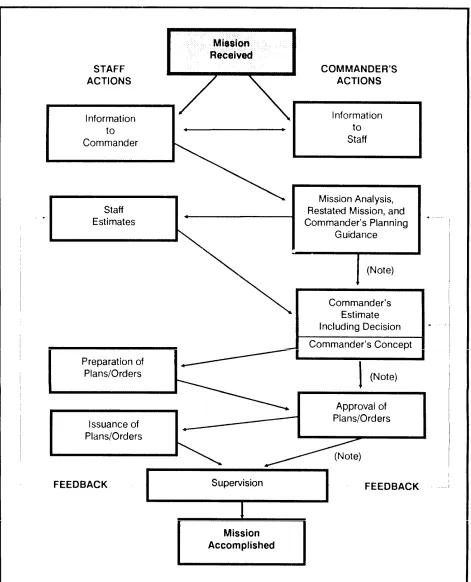
a. Decision-Making Process. The airborne commander, his staff, and his chain of command use the related processes of troop-leading procedure and command and staff actions to develop and execute decisions. (FM 101-5 discusses the military decision-making process in detail.) (Figure 2-1, page 2-4.)
b. Intelligence Preparation of the Battlefield. The IPB process is that portion of the intelligence cycle that integrates enemy doctrine with the weather and terrain, and relates these factors to the mission and the specific battlefield situation. The formal IPB process is performed at division, corps, and higher levels. (See Appendix F.) (FM 34-130 contains a complete discussion of IPB.)
2-4. REVERSE PLANNING PROCESS
The airborne commander and his staff develop, in this order, the ground tactical plan, the landing plan, the air movement plan, and the marshaling plan. The ground tactical plan drives the development of all other plans. (See Appendix F.) (Figure 2-2, page 2-5.)
a. Ground Tactical Plan. The ground tactical plan is the basis for the development of all other plans. The airborne commander and his staff give special consideration to the reassembly and reorganization of the assault forces and to the decentralized nature of initial operations in the objective area. The subordinate commander requires the ground tactical plan of his higher headquarters before he can begin planning. He needs to know the type, location, and size of objectives; the mission and intent of higher headquarters two levels up; and his task and purpose. The ground tactical plan is generated down the chain of command as a mutual effort and includes the following:
• Assault objectives and airhead line.
• Reconnaissance and security forces to include OPs.
• Boundaries. • Task organization. • Designation of reserve.
• Supply (accompanying, follow-up, routine).
Figure 2-2. Reverse planning process.
b. Landing Plan. The landing plan is the airborne commander’s plan that links the air movement plan to the ground tactical plan. It is published at brigade level and below. Before the airborne commander can prepare an overall landing plan, he must know where the subordinate commander wants to put his paratroopers. The landing plan is generated up the chain of command as a mutual effort. The landing plan includes the following:
• DZ/LZ/EZ locations and descriptions.
• Sequence of delivery.
• Method of delivery.
• Place of delivery.
• Time of delivery.
• Assembly plan.
Ž Type landing plan worksheet.
(Chapter 4 provides details
c. Air Movement Plan.
on the landing plan.)
and allocates aircraft. This allows the subordinate commanders to conduct air movement planning. The air movement plan is generated up the chain of command as a mutual effort and includes the following:
• Departure airfields.
• Aircraft by serial.
• Parking diagram.
• Aircraft mission (air movement tables and flight routes).
Ž Unit providing the aircraft.
(Chapter 5 provides details on the air movement plan.)
d. Marshaling Plan. This plan is developed last in the reverse planning process and is based on the requirements of the other plans. It provides the needed information and procedures for units of the airborne force to prepare for combat, to move to departure airfields, and to load aircraft. The marshaling plan also provides detailed instructions for facilities and services needed during marshaling. It is generated down the chain of command and includes the following:
• • • • • • • •
Movement to the marshaling area. Passive defensive measures. Dispersal procedures. Departure airfields. Marshaling camp operations. Briefback schedule.
Preparation for combat (inspection, supervision, rehearsal, and rest). Communications.
(Chapter 6 provides details on the marshaling plan.)
e. Planning Assets. The complexity of air-borne operations demands great attention to detail in the planning process. (Figure 2-3.) Planning is enhanced
when subordinate commanders use–
(1) Small-scale air photos of the landing area.
(2) Large-scale photos of the landing area for selecting avenues of approach and planning ground operations.
(3) Air photo and interpretation reports covering enemy activities and ground and air installations within and adjacent to the projected airhead.
(4) Aerial reconnaissance reports.
(5) Overlays prepared with descriptions of obstacles and defensive works, navigational hindrances, and landing areas.
( 6 )
( 7 )
( 8 )
( 9 )
M a p s .
Information concerning enemy capabilities, methods, and tactics.
Special studies that apply to the airhead.
Figure 2-3. Planning assets.
2-5. PLANNING CONSIDERATIONS
I
a. Echelonment. The airborne commander organizes Army combat elements within an airborne force into three echelons:
(1) Assault echelon. The assault echelon consists of those forces required to seize the assault objectives and the initial airhead, reserves, and supporting units.
(2) Follow-on echelon The follow-on echelon consists of forces required for subsequent operations. It enters the objective area by air or surface movement when required.
(3) Rear Echelon. The rear echelon consists of administrative and service elements that remain in the departure area. These elements may be brought forward to support in the airhead, as required.
b. Concurrent Planning. Commanders plan for all phases of an airborne operation at the same time since all phases are interrelated. This reduces the total planning time. A subordinate unit must maintain plans in draft until the next higher headquarters has finalized its plans.
c. Coordination. Commanders normally provide plans and orders down the
chain of command. For airborne operations, however, higher headquarters often cannot complete their plans until subordinate units have conducted a briefback of their plans.
d. Liaison. Parallel echelons of the airlift and airborne units coordinate continuously from the time of the joint planning conference until the operation is executed or cancelled. Before the operation, complete coordination is essential down to the smallest detail.
(1) Commanders of US Army and USAF units exchange LOs to act as.
advisors and coordinators immediately upon receipt of orders to participate in an airborne operation. Army LOs must be familiar with all aspects of the airborne operation. They must attend briefings and conferences, and must be provided with adequate transportation and communications assets.
(2) Liaison officers are normally exchanged detween the airborne force
and-(a) Army units supporting the operation from outside the objective area.
(b) Airlift elements.
(c) Linkup forces.
(d) Special operations forces, especially AC-130 assets.
(3) The specific duties of liaison officers include the following:
(a) Represent their unit headquarters at the headquarters to which they are detailed.
(b) Act as advisors to the headquarters on matters pertaining to their own commands.
(c) Coordinate matters involving dual responsibility.
(d) Discuss the time, place, personnel required and material to be covered at joint staff meetings.
(f) Examine parallel orders to ensure complete agreement of plans and arrangements.
(g) Assess and plan for the availability and procurement of equipment and facilities required from the higher headquarters
(h) Attend all joint conferences to become acquainted with the agreements reached by the commanders and with the operational plan.
(i) Prepare joint reports.
(j) Obtain copies of the marshaling plan and the parking diagram for their units.
(k) Know the location and capacity of all installations at the airfields and airlanding facilities that concern their units.
(1) Review the plans and arrangements for reserve aircraft if last-minute failures occur; prepare to assist the movement of paratroopers from aborting aircraft to reserve aircraft.
(m) Brief guides, who were furnished by the airborne unit, on airfield traffic procedures and locations of aircraft to be loaded. At dispersed locations, an airborne unit representative is located at the coordination facility to perform this function and to act as individual liaison.
(4) Commanders exchange Los on a continuous duty status at corps and division level. At brigade and lower echelons, the S3 LOs, the S3 air, or unit air movement officer can perform these duties. For operations of less than brigade size, commanders exchange LOs as needed at the discretion of the commanders concerned.
e. Briefbacks. Subordinate commanders must conduct brief backs on all aspects of their plan to the next higher commander. (Figure 2-4, page 2-10.)
This ensures that unit plans are fully coordinated and in concert with the
commander’s intent. Commanders conduct briefbacks on a terrain model, a sand table, or a map. Planning for an airborne operation is a dynamic fast-changing process. A change in one plan has an impact on the other three. Plans remain in draft until every commander in the chain has conducted a briefback. All commanders must inform their subordinates of changes.
f. Rehearsals. Rehearsals are essential to the success of an airborne
operation. They are conducted at every level and involve both air and ground components. They are performed on terrain similar to the objective and under the same conditions. Rehearsals may be conducted on a sand table, terrain model, mock-up, or map if time permits a full-scale rehearsal. Rehearsals are listed in order of priority as follows:
• Ground tactical plan.
• Landing plan with emphasis to assemble on the DZ.
• Air movement plan with emphasis on aircraft loading.
missions. (See FM 7-10, FM 7-20, and FM 7-30 for a detailed discussion of
MOC2
.)
Figure 2-4. Conduct of a briefback.
h. Dissemination. Leaders must be able to make decisions to support the commander’s intent. Plans and intelligence must be brissminated to the lowest level consistent with security requirements.
(1) Security. The staff follows security requirements in disseminating the intelligence required for subordinate units to develop their plans. Intelligence is provided on a need-to-know basis. As H-hour approaches, units are provided with more detailed intelligence.
(2) Precombat briefing. The commitment of an airborne unit is sudden and complete; there is no time for the commander to orient units immediately after landing. Plans and intelligence must be thoroughly briefed before the operation begins.
i. Linkup With Special Operations Forces. When the airborne force follows
an SOF during a deployment, it requests a liaison before arrival in the operational area.
(a) The SOCCE links up with the airborne commander through the SOF LO.
(b) The SOCCE coordinates with the S2/S3 sections and both elements provide the current situation, commander’s intent, and future operations of their respective forces (within OPSEC limits).
(c) The SOCCE provides SOF locations through personal coordination, overlays, and other friendly order-of-battle data to the FSE and brigade operation section.
(d) The SOCCE requests appropriate restrictive fire support coordination measures and provides time windows when these measures are to be effective. The SOCCE must also ensure that FSE dissemination of these measures does not result in OPSEC violations.
(2) Rangers can be OPCON with terminating conditions. They normally conduct a relief in place with conventional forces.
T
GROUND TACTICAL PLAN
he ground tactical plan is the base from which commanders develop all other plans. They must complete the ground tactical plan before finalizing the landing plan, the air movement plan, and the marshaling plan. It provides the commander’s intent, his concept of the operation, fire support plan, and task organization of the units making the initial assault. Ground combat in airborne operations is conducted along conventional lines but under unusual conditions. Once these conditions are appreciated, the tactics and techniques of ground combat can be applied to airborne operations. (See FMs 7-20 and 7-30 for a detailed discussion of combat operations.)
Section I. PLANNING
Once the airborne force commander receives the initiating directive/WO, he begins planning. This dircctivc/WO includes the following:
• Missions for subordinate units.
• The higher commander’s concept of the operation.
• Command structure for the operation.
• Time and duration of the operation.
• Intelligence and security requirements
• Allocation and distribution of airlift assets.
• Unit deployment list and sequence.
• Departure airfields, REMABs, and ISBs.
Ž Signal requirements and instructions.
• Linkup and withdrawal concept.
3-1. ESTIMATE OF THE SITUATION
The military decision-making process incorporating the situation results in a course of action as in any other
estimate of the operation. Unit commanders and staff officers cannot afford to deviate from this accepted procedure for the development process. As a technique, the ground tactical plan will normally be developed as the basic operations order/plan as discussed in FM 7-20 and FM 7-30. This is the most critical phase of the airborne operation because all other plans are based on it. When conducting the estimate, the commander
airborne combat conditions with
a. Mission. The mission of an close with the enemy by means
and staff consider the various aspects of regard to METT-T.
him, or to repel his assault by fire, close combat, and countcrattack. These missions usually require the seizure and defense of objectives and surrounding terrain. Forces rely strongly on the element of surprise. (See Appendix F for detailed information on the application of the IPB process as it relates to airborne operations.)
(1) In early linkup operations, the unit defends only the airhead and the required maneuver space.
(2) In linkup and independent operations, the tactical operation begins with an initial assault; it then passes to the defense of the established airhead until enough forces can be delivered to the objective area.
(3) On reinforcement or on linkup with other ground forces, the airborne units resume the offensive within the commander’s concept of the operation or withdraw to prepare for subsequent operations.
b. Enemy Forces. Commanders analyze all available information to
determine the enemy’s situation. The following factors are considered:
(1)
(2)
(3)
(4)
Enemy morale, leadership, and probable intentions.
Enemy capabilities.
Enemy tactics.
Probable enemy reactions to an airborne assault.
(a) The enemy that can react the fastest poses the most immediate threat.
(b) The enemy that can cause the most damage or prevent the airborne force from accomplishing its mission poses the most significant threat.
(5) Enemy reserves and paramilitary organizations (gendarmeries, police, border guards, and militia) and their ability to mobilize and react. This is especially critical before deep attacks.
(6) Enemy capability to conduct guerrilla, partisan, or sabotage activities and the enemy’s relationship to the local population.
c. Terrain and Weather. Within this category, the staff must consider and act on the following factors
(1) The availability of DZs, LZs. and EZs (division or corps staff provides a landing area study to subordinate elements before the preparation of the landing plan). However, the availability and selection of DZs should not influence the selection of assault objectives, the airhead line, or unit boundaries.
(2) Obstacles within the airhead line and out to the maximum effective range of direct- and indirect-fire weapons, with emphasis on those that can be prepared or reinforced with minimal engineer effort.
(3) Enemy avenues of approach, since the enemy will try to reach and.
(4) Key terrain that can determine how the airborne force can best defend the area in depth.
(5) Friendly and enemy observation and fields of fire (particularly indirect fires and antiarmor weapons).
(6) Cover and concealment (especially for assembly and reorganization).
(7) The staff must also consider the effects of climate and weather on following:
Ž Flight formations.
Ž Trafficability. • Visibility.
Ž Close air support.
• Logistics.
• Personnel and equipment.
d. Troops Available. Commanders consider all forces available
for
the
to accomplish the mission. These include all assigned, attached, and supporting forces.
(1) US ground forces. Commanders evaluate the plans, missions, capabilities, and limitations of US ground forces. They consider whether artillery can support the airborne forces and whether the forces will perform a linkup or passage of lines.
(2) Air Force. Close air support can often make up for the lack of armor and heavy artillery. The airborne commander must consider the USAF ability to sustain the force and must bring knowledgeable airlift and tactical air planners together early.
(3) Navy. The airborne commander examines the availability and feasibility of NGF support and naval or USMC air support. Early arrangements for liaison and coordination must be made to support the operation.
e. Time. Time is critical in all operations. There are several time considerations that are unique to an airborne operation. Significant time may be required to mass the lift force (Air Force aircraft). The time between the initial assault and the deployment of the follow-on echelon must be considered. Supply and CSS planning is driven by the amount of time before linkup or withdrawal.
f. Indigenous Population. The airborne force commander must consider national and regional characteristics such as —
• Religion and customs.
• Politics and tribal affiliations,
• Support (or lack of it) for central and local governments or
occupying powers.
• Loyalty to political or military leaders.
• Available labor.
3-2. DEVELOPMENT OF THE GROUND TACTICAL PLAN
The ground tactical plan incorporates considerations for those actions to be taken in the objective area; for example, during the assault and subsequent operations phases. This will be the first plan to be finalized. It must be keyed on accomplishment of the commander’s concept of the operation.
a. The ground tactical plan is developed as any other tactical plan using the procedure as delineated in FM 7-20, Chapter 2. However, the initial goal of airborne operations is the establishment of an airhead and its subsequent defense.
b. The ground tactical plan’s essential elements are developed in the following sequence: the airhead line and the assault objectives (selected concurrently); the security zone and R&S forces; boundaries and assault task organizations (selected concurrently); and reserves.
3-3. SELECTION OF ASSAULT OBJECTIVES AND AIRHEAD LINE
Based on an analysis of the situation, commanders select specific assault objectives. (Figure 3-1.) Although the airhead line is developed and the assault objectives determined concurrently, the assault objectives dictate the size and shape of the airhead.
a. This selection does not necessarily include those objectives that the force must seize to secure the airhead line. An appropriate assault objective is one which the force must control early in the assault to accomplish the mission, or they must control to enhance the security of the airborne unit during the establishment of the airhead.
(1) Objectives should allow for the accomplishment of mission-essential tasks while meeting the commander’s intent. They can include key terrain within the airhead or terrain required for linkup. For example, the commander has directed the airborne force to secure a bridge for later use by linkup forces. The force must secure this bridge before the enemy can destroy or damage it; therefore, the commander designates the bridge as an assault objective.
(2) The airborne unit is vulnerable from the time it lands until follow-on forces can be delivered to the airhead. A mobile enemy unit attacking the airhead during these early moments can completely disrupt the operation. Therefore, the commander selects as assault objectives terrain that dominates places where high-speed enemy avenues of approach enter the airhead.
(3) Enemy positions that both threaten the mission and are located within the airhead can also be selected as assault objectives. However, commanders would not classify mobile forces as assault objectives.
Figure 3-1. Assault objectives.
b. Other considerations impact on the development and final selection of assault objectives. Subordinate commanders decide the size, type, or disposition of the force to gain/maintain control.
• Division selects brigade assault objectives.
• Brigade selects battalion assault objectives.
• Battalion selects company assault objectives.
(1) Senior commanders choose as few assault objectives as possible since subordinate commanders must select additional objectives to establish a cohesive defense of their assigned sectors of the airhead.
(2) Assault objectives are ranked in order. A unit SOP may predesignate a numbering system for subordinate objectives. For example, all first brigade objectives begin with a "Q", or for OPSEC purposes, they may be randomly numbered or lettered. Priorities are chosen based on the most likely threat or on the needs of the friendly force.
(3) Assault objectives are secured before the defense is setup in the airhead line. The airhead is then cleared of organized enemy resistance and forces are positioned to secure the airhead line.
airborne force to build up its combat power. Once the force secures the airhead, they must clear any enemy force within it; then, they must defend it. The airhead line, which delineates the specific area to be seized, designates the airhead. Several principle factors determine the location, extent, and form of the airhead/airhead line.
(1) The actual trace of the airhead line reflects the control of key/critical terrain essential to the mission. (Figure 3-2.)
(2) The airhead line anchors on obstacles, and the airhead itself takes advantage of existing natural and man-made obstacles.
(3) The airhead contains enough DZs, LZs, and EZs to ensure interior rather than exterior lines of communication and to permit mass rather than piecemeal assault.
(4) The airhead must allow enough space for dispersion to reduce vulnerability to NBC weapons.
(5) The airhead must be large enough to provide for defense in depth, vet small enough for the unit to defend. Although this is largely METT-T dependent, a battalion can defend an airhead 3 to 5 kilometers in diameter. A brigade can occupy an airhead 5 to 8 kilometers in diameter.
3-4. RECONNAISSANCE AND SECURITY FORCES
Security in all directions is an overriding consideration early in any airborne operation, since an airhead is essentially a perimeter defense. In ground operations, there are several security echelons forward of the FEBA.
a. Security forces are landed early in the assault echelon. The reconnaissance and security line is established immediately 4 to 6 kilometers from the airhead line to afford security to the airborne force during its landing and reorganization, In the early stages of an airborne operation, the security force. acts as a screening force. In later stages (when assault missions have been
accomplished, when the airhead is relatively secure, and when more forces
are available), it acts as a guard or covering force. Security forces come under brigade control except during short battalion missions such as raids, when they come under battalion control. The mission of the security force is as follows:
(1) To give the airhead early warning.
(2) TO develop intelligence, including the location, direction, and speed of an enemy attack.
(3) To initially deny the enemy observation of and direct and observed indirect fire on the airhead.
(4) To deceive the enemy as to the actual location of the airhead.
(5) To delay and disrupt the enemy.
b. The need for and positioning of additional security forces is determined by
the next subordinate commander. The security force includes scouts, AT weapons, engineers, Army aviation, and (sometimes) light armor. When possible, mobile forces are selected to facilitate rapid initial movement to
positions and to facilitate withdrawal and adjustment. An aggressive R&S
effort at lower echelons augments the security force. The following
considerations apply to the selection of positions for the screening force:
(1) Locate them within radio communications and fire support range. However, this range can be extended, if necessary, with retransmission stations; split section indirect-fire operations; and attachment of vehicles mortars, or other assets to the security force.
(2) Locate them as roadblocks/obstacles, ambushes, patrols, or sensors (depending on the enemy) on dominant terrain. This allows long range observation and fields of fire out to the maximum range of supporting fires.
(3) Locate them to observe, control, and dominate enemy high speed avenues of approach.
(4) Locate them to deny enemy Iong-range observation and observed indirect fire into the airhead.
(5) Locate them far enough out to provide early warning.
c. Designated forces under control of the airborne commander perform R&S missions beyond the security zone established by ground forces; emphasis is
placed on likely enemy avenues of approach. The mission of these forces is to
gain and maintain contact with enemy units reacting to the airborne assault. This force is mobile and is not used to defend a particular part of the airhead. It can include Army aviation, air cavalry, or light armor; it can be supported with fire from Air Force assets, NGF, or Army missile systems. The following considerations govern the employment of this force:
(1) These forces orient on enemy high-speed avenues of approach to develop intelligence, including the location, direction, and speed of the enemy’s advance.
(2) Commanders of these forces consider known enemy locations, the number of high-speed approaches, and communications-relay abilities while orienting on enemy units.
(3) Usually employed beyond the airhead at a distance based on the tactical situation, these forces protect the main force from surprise attack. The airborne commander can extend their range if communications permit. Aviation assets can extend to 50 kilometers or more, although the commander must consider loiter time so the forces can provide continuous coverage. (FARPs can increase this distance.) Long-range surveillance teams surveil enemy garrisons and major routes into the airhead.
(4) Reconnaissance forces must be mobile and task-organized for mission from cavalry, armor, scout, LRS, and antiarmor units.
3-5. BOUNDARIES AND TASK ORGANIZATION
Commanders visualize the employment of subordinate units to organize them for combat commensurate with the brigade missions.
may
the
a. Boundaries. Commanders use boundaries to assign sectors of
responsibility to major subordinate combat elements, who then clear the area of enemy forces. (Figure 3-3.) In selecting and designating assault boundaries for airborne operations, several points are considered:
(1) Each unit should be able to clear its assigned sector; therefore, commanders must consider boundaries concurrently with task organization. To assign boundaries, commanders subdivide the area into sectors with fairly equal tasks (not necessarily into equal sectors). This requires a careful analysis of the enemy, the tasks to be accomplished, and the terrain within the objective area.
(2) Commanders should avoid splitting (between two units) the responsibility for the defense of an avenue of approach or key terrain.
(3) Commanders should ensure there is adequate maneuver space in the sector, including key terrain features that control it.
(4) Commanders should avoid designating boundaries in such a way that a.
(5) The boundaries should provide adequate room to permit the commander to maneuver forces on both sides of the assault objectives.
(6) The commanders must choose boundaries that are recognizable both on the map and on the ground. Roads should not be used as a boundary because they represent a high-speed avenue of approach and need to be covered with a clear understanding of responsibility. Instead, commanders can use rivers, streams, railroad tracks, the edge of a town, woods, the edge of a swamp, and so on.
(7) Ideally, each battalion sector should include at least one DZ and LZ to enable the battalion and its attachments to land within the assigned sector during the assault. This also facilitates resupply and evacuation of EPWs and casualties. Having an LZ and DZ reduces the problem of coordination with adjacent units. This does not mean that commanders must locate all battalion DZs in the battalion sector. Regardless of boundaries, units should drop on the DZs closest to their assault objectives.
(8) Commanders should establish boundaries that will serve during the assault and during later operations. These should be readily recognizable during limited visibility.
(9) Commanders should choose boundaries that do not require a unit to defend in more than one direction at once. Also, they should not expect a unit to secure objectives within the airhead at the same time they establish its defense.
(10) Boundaries should extend beyond the trace of the security force as far as necessary to coordinate fires. This also allows subordinate units to operate for-ward of the airhead with minimal coordination.
(11) Commanders should plan coordinating points at the intersection of the airhead line and security force ground trace boundaries.
b. Task Organization. Once commanders have determined the principal features of the ground assault plan (scheme of maneuver and fire support), they organize units to execute their assigned missions and they determine boundaries at the same time. To ensure unity of effort or to increase readiness for combat, part or all of the subordinate units of any command can be formed into one or more temporary tactical groupings (teams or task forces), each under a designated commander. No standard team organization can be prescribed in advance to meet all conditions. Infantry units usually form the nucleus tactical groupings of the team; infantry unit commanders lead the teams. These teams are tailored for initial assault by the attachment of required combat, CS, and CSS units. They are attached as soon as possible in the marshaling area. Many of the units detach as soon as centralized control can be regained and the parent unit headquarters can be established on the ground. Other units such as higher echelon assault CPs can be attached for the movement only.
(1) Brigade. Attachments for airborne infantry brigades usually include the following: (a) (b) (c) (d) (c) (f) (g) (h)
An FA battalion.
A combat engineer company.
An MP platoon.
A light armor company/platoon.
An IEW support element, usually from the MI battalion.
A forward area support team.
An ADA battery.
Other assets as determined necessary by the division commander based upon his estimate of the situation.
(2) Battalion. For control, the airborne infantry battalions are usually
reinforced for the airborne assault and organized into task forces. This is especially true if battalions are to land in widely separated DZs or LZs. A battalion TF usually consists of an infantry battalion that is reinforced based on the brigade commander’s estimate of the situation. Reinforcements can include more infantry, armor, antitank, engineer, dedicated artillery, and any other units or detachments needed in the initial attack. As in the brigade. attachments to infantry battalions are made early in the planning phase. They can be withdrawn as soon as the ground situation stabilizes.
c. Organization for Assault Landing. After the task organization of soldiers
for the assault landing is announced, units organize into assault, follow-on, and rear echelons.
(1) Assault echelon. The assault echelon is composed of those forces required to seize the assault objectives and the initial airhead, plus their reserves and supporting soldiers.
(2) Follow-on echelon The airborne force does not need the follow-on echelon in the objective area during the initial assault, but does need it for subsequent operations. When needed, the follow-on echelon enters the objective area as soon as practical by air, surface movement, or a combination of the two. It includes additional vehicles and equipment from assault echelon units, plus more combat, CS, and CSS units. The existence of any one of the following conditions requires an airborne unit to have a follow-on echelon:
• Shortage of aircraft.
• Aircraft that cannot land heavy items of equipment.
• Any enemy situation, terrain, or weather that makes it impossible to
land certain soldiers or equipment in the assault echelon.
Airborne infantry units can be committed to an airborne assault without leaving a follow-on echelon that must be brought forward by means other than air; however. it is often desirable or necessary to leave certain personnel and equipment behind.
(3) Rear echelon. The rear echelon includes the part of an airborne unit that is not considered essential for initial combat operations. It also includes people left at its rear base to perform administrative and service support functions that cannot be done efficiently in the combat area. The rear echelon is normally small for a brigade or battalion. Higher headquarters usually controls the rear echelon for all units. The rear echelon can remain at the REMAB when the unit is to be relieved at an early date; or it can rejoin the unit when the brigade remains committed to sustained combat for a prolonged or indefinite period. Also, if the airborne force continues in the ground combat role after linkup, the rear echelon may be brought forward.
3-6. DESIGNATION OF RESERVE
The employment of the reserve element follows the normal employment of a reserve unit in a ground operation.
a. The Battalion as the Division Reserve. The division reserve can be held in the departure area ready to be committed by air when and where the situation dictates A battalion can be the division reserve. This
large-scale airborne operations when suitable airfields in available; however, it can cause delays in commitment–
• If signal communications fail.
• If the air move is very long.
• If flying weather is unfavorable.
• If time is added for coordination of air cover.
usually happens in the airhead are not
b. Brigade and Battalion Reserves. These reserves enter the airhead as part of the assault echelon. They provide depth to the airhead by blocking penetrations, reinforcing committed units, and counterattacking. They consist of not more than a company at brigade level or a platoon at battalion level; however, their small size is dictated by tactical considerations and assigned missions. Commanders should organize, task, and position the reserve, ensuring that–
(1) The size of the reserve is compatible with likely missions.
(2) The reserve comes from the unit with the fewest priority tasks.
(3) The reserve is not assigned assault objectives or a sector of the airhead to defend.
(4) The reserve is near areas of likely employment such as near the main enemy avenues of approach to speed commitment.
(5) The reserve is mobile. (This can be achieved using organic
vehicles – antiarmor company, support platoon, light armor, and so on.)
(6) The reserve is located in an AA (both initial and subsequent) or battle position, so that it does not interfere with units assigned assault objectives.
(7) The reserve is near an LOC in a covered and concealed location to provide ease of movement, to reinforce, or to block.
(8) The reserve is located within the sector of one unit, if possible.
(9) The reserve’s location allows for dispersion of the force.
(10) The reserve commander prepares and rehearses commitment
contingencies IAW guidance received from the commander designating the r e s e r v e .
Section Il. EXECUTION
Execution of the GTP involves the initial seizure of DZs and LZs in and around the airfield or the actual seizure of an airfield. (See Chapter 7.)
3-7. CONDUCT OF THE ASSAULT
The initial assault emphasizes the coordinated action of small units to seize initial battalion objectives before the surprise advantage has worn off. As assault objectives are seized, the airborne force directs its efforts toward consolidating the airhead.
strength in its defensive positions. Preparation of early defense against armored attack is a major consideration.
b. Units assigned to perform R&S missions land in early serials so they can establish roadblocks; locate enemy forces; disrupt enemy communication facilities; and provide the commander with early warning, security, and information. Since ground reconnaissance by unit commanders is seldom possible before the airborne operation, it must begin as soon as the unit lands. The flow of information must be continuous. Information requirements do not vary from those employed by other ground units. However, the unit’s method of arrival in the combat area makes immediate and thorough reconnaissance and transmission of information to higher headquarters necessary.
c. If the initial objectives are heavily defended, the bulk of the force is assigned the task of seizing these objectives. When initial objectives are lightly defended, the bulk of the force can be employed in clearing assigned sectors and preparing defensive positions in depth. Extensive patrolling is initiated early between adjacent defensive positions within the airhead line, and between the airhead and the R&S line. Army aircraft are well suited for support of this patrolling effort. Contact with any friendly guerrilla forces in the area is established as soon as possible.
d. Personnel are briefed on unit plans, adjacent and higher units’ plans, and alternate plans. This helps units or personnel landing in unplanned areas to direct their efforts to accomplishing the mission. Misdelivered units or personnel establish contact with their respective headquarters as soon as practical.
c. Sufficient communications personnel and equipment must be moved into the airhead in advance of the CP they are to serve to ensure the timely installation of vital communications. As soon as communications and the T h e r e f o r e ,
tactical situation permit, commanders regain centralized C2
.
immediate establishment of the following is necessary for effective C2
:
(1) Command and fire control channels within the airborne forces.
(2) Communications with supporting air and naval forces.
(3) Communications with airlift forces concerned with buildup, air supply, and air evacuation.
(4) Communications with bases in friendly territory.
(5) Communications between widely separated airborne or ground forces, such as linkup forces, with a common or coordinated mission.
f. The commander influences the action by–
• Shifting or allocating fire support means. • Moving forces.
• Modifying missions.
• Changing objectives and boundaries.
• Employing reserves.
• Moving to a place from which he can best exercise personal
g. When initial objectives have been secured, subordinate units seize additional objectives that facilitate the establishment of a coordinated brigade defense or the conduct of future operations. Defensive positions are
organized, communications are supplemented, and reserves are
reconstituted. These and other measures are taken to prepare the force to repel enemy counterattacks, to minimize the effects of attack by nuclear weapons, or to resume the offensive.
h. Reserves prepare and occupy blocking positions, pending commitment. Typical missions for reserves committed during the initial assault include taking over the missions of misdelivered units, dealing with unexpected opposition in seizing assault objectives, and securing the initial airhead.
3-8. DEVELOPMENT OF THE AIRHEAD
After the airborne forces make the initial assault landings and accomplish the initial ground missions, commanders must organize the airhead line.
a. Size. The airhead line extends far enough beyond the landing area to ensure uninterrupted landings of personnel, equipment, and supplies. It secures the requisite terrain features and maneuver space for such future offensive or defensive operations as the mission calls for.
b. Occupation and Organization. Units occupy and organize the airhead line to the extent demanded by the situation. Commanders adjust the disposition of units and installations to fit the terrain and the situation. Units take reconnaissance and security measures; this usually includes the reinforcement of the R&S line. The degree to which the airhead line is actually occupied and organized for defense is largely determined by the mission, enemy
capabilities, and the defensive characteristics of the terrain.
c. Buildup. This proceeds concurrently with the seizure and organization of the airhead line. As more combat personnel arrive and commanders organize them by unit, frontline positions are reinforced, reserves are constituted, and preparations are mare for such offensive operations as the mission requires.
3-9. BUILDUP OF COMBAT POWER
The buildup of combat power is the introduction of the follow-on echelon
into the airhead. This increase of friendly combat power yields a
corresponding ability to condu