IF-Map: An Ontology-Mapping Method
based on Information-Flow Theory
Yannis Kalfoglou1and Marco Schorlemmer2,3 ? Advanced Knowledge Technologies 1
Department of Electronics and Computer Science University of Southampton
2
Centre for Intelligent Systems and their Applications School of Informatics
The University of Edinburgh 3
Escola Universit`aria de Tecnologies d’Informaci´o i Comunicaci´o Universitat Internacional de Catalunya
Abstract. In order to tackle the need of sharing knowledge within and across organisational boundaries, the last decade has seen researchers both in academia and industry advocating for the use of ontologies as a means for providing a shared understanding of common domains. But with the generalised use of large distributed environments such as the World Wide Web came the proliferation of many different ontologies, even for the same or similar domain, hence setting forth a new need of sharing—that of sharing ontologies. In addition, if visions such as the Semantic Web are ever going to become a reality, it will be necessary to provide as much automated support as possible to the task of mapping different ontologies. Although many efforts in ontology mapping have already been carried out, we have noticed that few of them are based on strong theoretical grounds and on principled methodologies. Further-more, many of them are based only on syntactical criteria. In this paper we present a theory and method for automated ontology mapping based on channel theory, a mathematical theory of semantic information flow. We successfully applied our method to a large-scale scenario involving the mapping of several different ontologies of computer-science departments from various UK universities.
1
Introduction
The wide-spread use of ontologies by diverse communities and in a variety of ap-plications is a commonality in today’s knowledge-sharing efforts. They are the backbone for semantically-rich information sharing, a prerequisite for knowledge sharing. As systems become more distributed and disparate within and across organisational boundaries, there is a need to preserve the meaning of concepts
used in everyday transactions of information sharing. The emergence of the Se-mantic Web [5] has made these transactions, arguably, easier to implement and deploy on a large scale in a distributed environment like the Internet. However, at the same time poses some interesting challenges. For instance, we observe that the demand for knowledge sharing has outstripped the current supply. And even when knowledge sharing is feasible, this is only within the boundaries of a specific system, when certain assumptions hold, and within a specific domain. The reason for this shortcoming is, probably, the very environment and technolo-gies that generated a high demand for sharing: The more ontolotechnolo-gies are being deployed on the Semantic Web, the more the demand to share them for the ben-efits of knowledge sharing and semantic interoperability. The sharing of ontology though, is not a solved problem. It has been acknowledged and researched by the knowledge engineering community for years.
In fact, this problem is related to that of integration of heterogeneous data-bases conducted in the 1980s and early 1990s [4, 39], as far as database schemas can be considered a particular kind of lightweight ontologies. These early efforts in information sharing run into the problem of semantic heterogeneity, which re-quired the identification and representation of all semantics useful in performing schema translation and schema integration. Current efforts on ontology sharing build upon the previous experience, but in the light of more broader a concept of ontology, and of more expressive logical formalisms and theories that better capture the semantics and information flow.
One of the aspects in ontology sharing is to perform some sort of mapping between ontology constructs. That is, given two ontologies, one should be able to map concepts found in one ontology onto the ones found in the other. Further, some research suggest that we should also be able to combine ontologies where the product of this combination will be, at the very least, the intersection of the two given ontologies. These are the dominant approaches that have been studied and applied in a variety of systems (see, for example, [35]).
There are, however, some drawbacks that prevent engineers from benefitting from such systems. Firstly, the assumptions made in devising ontology map-pings and in combining ontologies are not always exposed to the community and no technical details are disclosed. Secondly, the systems that perform ontology mapping are often either embedded in an integrated environment for ontology editing or are attached to a specific formalism. Thirdly, in most cases mapping and merging are based on heuristics that mostly use syntactic clues to deter-mine correspondence or equivalence between ontology concepts, but rarely use the meaning of those concepts, i.e., their semantics. Fourthly, most, if not all approaches, do not treat ontological axioms or rules often found in formal on-tologies. Finally, ontology mapping as a term has a different meaning in different works merely due to the lack of a formal account of what ontology mapping is. There is an observed lack of theory behind most of the works in this area.
duality in knowledge sharing, namely that sharing occurs both at the token and at the type level. We draw on sound theoretical ground, but at the same time we are providing a systematic approach for ontology mapping in mechanised and methodological steps.
In particular, we propose an Information-Flow-based method for ontology mapping (hereafter, IF-Map). We are mostly interested in mapping ontologies, but we could extend the approach to merge them, too. IF-Map draws from the works of Schorlemmer on aligning ontologies [38] and on the heuristics defined by Kalfoglou (in [20], pp.95–97), to analyse prospective mappings between ontolo-gies. On the theoretical side, our method is based on the mathematical theory of information flow proposed by Barwise and Seligman [3] and on Kent’s Infor-mation Flow Framework for the IEEE standardisation activity of an upper-level ontology [23], and also on his proposed methodology for merging ontologies [22, 24]. The methodological part of IF-Map has also been influenced by the work of Stumme and Maedche on the FCA-Merge method [41].
We outline a scenario and describe the architecture we have built to perform ontology mapping in Section 2. We briefly provide mathematical preliminaries on information flow and channel theory in Section 3, before we proceed to describe our ontology-mapping method in Section 4, together with an example case of its use. In Section 5 we report on an application of our method and elaborate on scalability issues. We discuss related work in Section 6 and summarise the paper in Section 7.
2
A Scenario and Architecture for Ontology Mapping
We should clarify some terminological issues before we continue with our archi-tecture for ontology mapping. Some researchers view the mapping process as an integral part of alignment or merging. For example Noy and Musen view merg-ing as the creation of “a smerg-ingle coherent ontology that includes the information from all the sources” and alignment as a process in which “the sources must be made consistent and coherent with one another but kept separately” [34]. Clearly, mapping is an essential aspect of alignment and could also be used to initiate merging. In this paper, we adopt a working view of ontology mapping. We do not intend to alter the original ontologies but rather look for possible map-pings between them. To that extent we are compatible with Noy and Musen’s definition of alignment, however, we view alignment as a process that involves merging but without altering the original ontologies. This would be done by constructing a virtual ontology consisting of the mapped constructs of the two input ontologies. This view is more akin to those researchers working on the IEEE SUO initiative—the standardisation of an upper level ontology—where a meta-level framework for relating ontologies based on the Barwise-Seligman the-ory of information flow is currently being developed.1 Although on our scenario we have not yet implemented this aspect, we could extend the existing IF-Map
1
method to perform merging. In the remaining of the paper though, we will focus on ontology mapping only.
2.1 Ontology Mapping Scenario
reference ontology
O0
ww
oooooo ooooo
''
O O O O O O O O O O O
local ontology
O1
''
O O O O O O
local ontology
O2
ww
o o o o o o
global ontology
[image:4.595.184.432.207.318.2]O
Fig. 1.The scenario for ontology mapping.
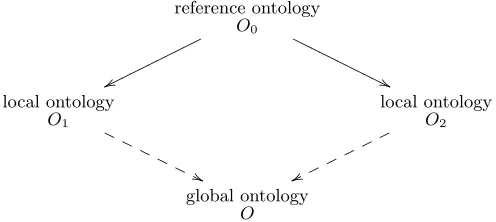
In Figure 1 we illustrate our approach to ontology mapping. In particular, the focus is on the use of information-flow theory as the underpinning mathe-matical foundation for establishing mappings between two ontologies. We shall formalise these mappings in terms oflocal logics andlogic infomorphisms, which we introduce in Section 3.
We assume that, when two communities desire to share knowledge but each one has encoded knowledge according to its own local ontology—O1 and O2 respectively—they have previously agreed upon a common understanding, a ref-erence ontology O0, in order to favour the sharing of knowledge. Typically each community will have its local ontology populated with its own instances, while the reference ontology will not have instances.
But, although having agreed upon a reference ontology, each community might prefer to communicate via its own local ontology, provided these ontolo-gies O1 and O2 (or at least a significant fragment of them) conform to the reference ontologyO0. In this paper we provide a methodology to establish this conformance by looking for, and further generating, ontology mappingsO0→O1 and O0 →O2 from the reference ontology to local ontologies, denoted as solid arrows in Figure 1. The methodology is based upon formalising ontologies as local logics and ontology mappings as logic infomorphisms, as we shall see in Section 3.5.
dashed arrows denote the inclusion of local ontologiesO1andO2into the global ontology O. This inclusions are also ontology mappings as formalised by logic infomorphisms, and hence our methodology IF-Map could be extended in future to include the merging of ontologies according to an alignment structure.
Figure 1 clearly resembles Kent’s proposed two-step process for conceptual knowledge organisation [22, 24]. In fact, the existence of a unique global ontology
O given an alignment O1 ← O0 → O2 consisting of local ontologies and a reference ontology is the consequence of formalising ontologies and ontology mappings as local logics and logic infomorphisms.
2.2 Ontology Mapping Architecture
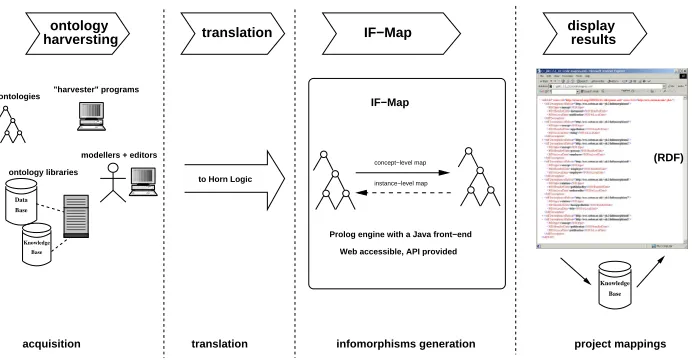
ontologies "harvester" programs
ontology libraries
modellers + editors
to Horn Logic
Prolog engine with a Java front−end Web accessible, API provided
(RDF)
acquisition translation infomorphisms generation project mappings IF−Map
concept−level map
instance−level map translation
harversting ontology
Knowledge Base Base Data
Knowledge Base
[image:5.595.136.482.286.466.2]display results IF−Map
Fig. 2.The IF-Map architecture.
deal with a variety of ontology representation languages ranging from KIF [15] and Ontolingua to OCML [31], RDF [27], Prolog, and native Prot´eg´e knowledge bases.
This introduces the second step in our process, that of translation. Since we have declaratively specified the IF-Map method in Horn logic and execute it with a Prolog interpreter, we partially translate the above formats to Prolog clauses. Our translator programs are either written in-house, or whenever available, we use public translators. For example, there are public RDF-to-Prolog translators2 as well as Ontolingua-to-Prolog translators. In most of these cases though, we found it practical to write our own ones. We did that to have a partial transla-tion, customised for the purposes of ontology mapping. Furthermore, as it has been reported in a large-scale experiment with publicly available translators [7], the Prolog code produced is not elegant or even executable. Our own transla-tors are customised to translate—from KIF, Ontolingua, and Prot´eg´e knowledge bases into Prolog clauses—those constructs that are needed for IF-Map: Class taxonomy, relations and representative instances for classes. Thus, we deliber-ately neglect constructs such as documentation slots, separation of own-slots and template-slots and other object-oriented modelling primitives used in Ontology languages (such as KIF or Ontolingua3) as they are not useful for IF-Map and their absence from the translated Prolog code does not invalidate their mean-ing. For Prot´eg´e knowledge bases we used the built-in Java API to obtain the constructs we wanted, and for RDF we used publicly available RDF to Prolog translators. The issue of a full-blown translation from one formalism to another is a difficult problem, and Corrˆea da Silva et al. [7] offer an account on the effort involved.
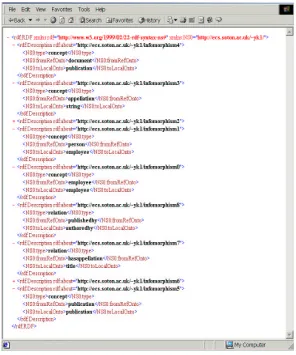
The next step in our process is the main mapping mechanism: The IF-Map method, which we describe in Section 4. We have written a Java front-end to the Prolog-written IF-Map program so that we can access it from the Web, and we are currently in the process of writing a Java API to enable external calls to it from other systems. This step will find logic infomorphisms, if any, between the two ontologies under examination, and in the last step of our process we display them in RDF format. This step involves translating back from Prolog clauses to RDF triples by means of an intermediary Java layer, where RDF is being produced using the Jena RDF API [28]. Finally, we store the results in a knowledge base for future reference and maintenance.
Before proceeding to an example case of the deployment this architecture we shall introduce the theoretical background of IF-Map. Therefore, in the next section we expand on logic infomorphisms and other channel-theoretic notions, and give a formal account of ontology mapping.
2
Like the one from Wielemaker downloadable from http://www.swi-prolog.org/ packages/rdf2pl.html
3
3
Preliminaries
In order to give a formal characterisation of ontology mapping we start from the following basic assumption: If two communities desire to share information but their ontologies differ, we need to align and map their ontologies for the information to flow between them. Consequently, it would be desirable to base a theory of ontology mapping upon a mathematical theory that is capable of describing under which circumstances information flow occurs.
Although there is no such a theory yet, the most promising effort towards such a theory was initiated by Barwise and Perry with situation semantics [2], which was then been further developed by Devlin into a theory of information [8]. Barwise and Seligman’s channel theory is currently the latest stage of this en-deavour [3], and is probably the best place to start establishing a foundation for a theory of ontology mapping.
3.1 Information Flow
Barwise and Seligman propose a mathematical model that aims at establishing the laws that govern the flow of information. It is a general model that attempts to describe the information flow in any kind of distributed system, ranging form actual physical systems like a flashlight connecting a bulb to a switch and a battery, to abstract systems such as a mathematical proof connecting premises and hypothesis with inference steps and conclusions.
It is based on the understanding that information flow results from regular-ities in a distributed system, and that it is by virtue of regularregular-ities among the connections that information of some components of a system carries information of other components. The more regularities the system has, the more informa-tion flows; the more random the system is constituted the less informainforma-tion will be able to flow among its components.
As a notion of a component carrying information about another component, Barwise and Seligman follow Dretske’s characterisation [11], in which assertions of the sort
The rifle shot carried the information that the king was dead to the whole city.
or
The greyness of the sky carries the information that a storm is approach-ing.
are abstractly characterised as following a common pattern
a’s being F carries/bears/conveys the information that b is G.
that the present king is dead as will the present rifle shot not indicate that the king of the neighbouring city is dead. It is the fact that the event token of the rifle shot is connected spatio-temporarily with the event of the king’s death that we know that the information flows. Channel theory formalises this crucial aspect of information flow, namely that it is the tokens and its connections that carry information, so that information flow involves both types and tokens.
3.2 Aligning and Merging Ontologies
With respect to the problem that concerns us here—that of mapping ontologies— the same abstract pattern arises. Two communities with different ontologies will be able to share information when they are capable of establishing connections among their tokens in order to infer the relationship among their types. Let us develop an example taken from [40], which shows the issues one has to take into account when attempting to align the English conceptsriverandstreamwith the French concepts fleuveandrivi`ere. According to Sowa,
In English, size is the feature that distinguishes river from stream; in French, afleuveis a river that flows into the sea, and arivi`ereis either a river or a stream that runs into another river. [40]
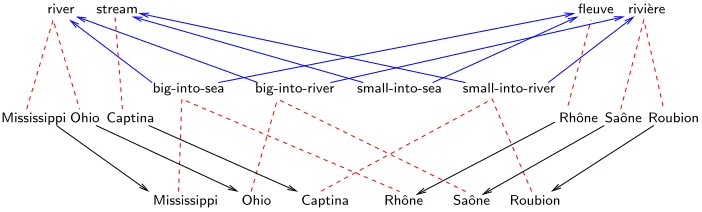
This explains how the concepts need to be merged. Notice that the above quote requires an agreed understanding on how to distinguish between big and small rivers, and between rivers that run into a sea or into other rivers, yielding four types of instances of ‘water-flowing entities’: big-into-sea, big-into-river, small-into-sea, andsmall-into-river.
PSfrag replacements
river stream fleuve rivi`ere
big-into-river
big-into-sea small-into-sea small-into-river
Mississippi Mississippi
Ohio Ohio
Captina
Captina Rhˆone
Rhˆone
Saˆone
Saˆone
Roubion
[image:8.595.135.486.445.551.2]Roubion
Fig. 3.Alignment by means of a pair of maps
The agreed understanding is materialised by two maps that form the alignment. It requires the classification of particular instances of river, stream, fleuve, and
rivi`ere according with the agreed understanding, since it is this agreed way of classification which will determine how the concepts river, stream, fleuve, and
rivi`ere are going to be related to each other.
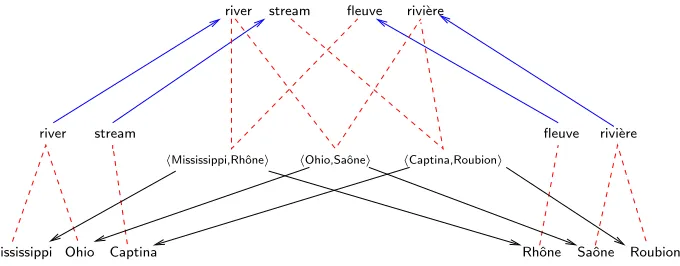
The ultimate goal is to determine the connections that link particular in-stances of typeriver orstreamwith particular instances of typefleuveor rivi`ere, in a way that they respect the agreed understanding. This is done by connect-ing only those instances that conform to the same type accordconnect-ing to the agreed understanding, as illustrated in Figure 4.
PSfrag replacements
river
river
stream
stream fleuve
fleuve
rivi`ere rivi`ere
Mississippi Ohio Captina Rhˆone Saˆone Roubion
[image:9.595.142.482.256.389.2]hMississippi,Rhˆonei hOhio,Saˆonei hCaptina,Roubioni
Fig. 4.Aligning ontologies through a pair of maps
The resulting classification of connectionshMississippi,Rhˆonei,hOhio,Saˆonei, and hCaptina,Roubioni into the four concepts river, stream, fleuve, and rivi`ere, determines a theory of how these concepts are related (e.g., that afleuveis also a river, or that a stream is also a rivi`ere, but not vice versa). Figure 4 shows what in channel theory is known as a an information channel [3]. It captures, by means of two pairs of contra-variant functions, an existing duality between concepts and instances: Each pair consists of a map of concepts on the so called type level and map of instances on the so called token level, and pointing in the opposite direction. From a channel-theoretic perspective, Figure 4 actually illustrates us that sharing knowledge involves a flow of information that crucially depends on how the instances of different agents are connected together. The following table shows theclassification relation, i.e., the connections as classified according to the concept types involved in the example:
river stream fleuve rivi`ere
hMississippi,Rhˆonei 1 0 1 0
hOhio,Saˆonei 1 0 0 1
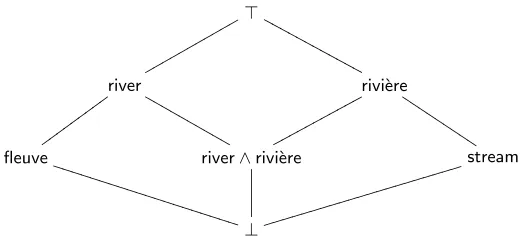
The merged set of concepts {river,stream,fleuve,rivi`ere} has an additional structure that we can deduce from the way the connections of instances are clas-sified with respect to these concepts. Through techniques from formal concepts analysis [14], for instance, we can make such structure explicit in the form of a concept lattice, as shown in Figure 5. The concept hierarchy represented in this lattice depends on the choice of instances and its classification with respect to the agreed understanding. The fact that no instances were classified as of type
small-into-seawas crucial in this example. Notice, also, that the resulting lattice has a node labelled with the concept river∧rivi`ere, which is a formal concept that did not exist in the original vocabularies. It corresponds to the instances of ‘water-flowing entities’ that, although big, flow into other rivers, like Ohioand
Saˆone.
>
qqqqqq qqqq q N N N N N N N N N N N N river vvvv vvvv v M M M M M M M M M
M rivi`ere
pppppp ppppp J J J J J J J J J fleuve U U U U U U U U U U U U U U U U U U U
U river∧rivi`ere stream
iiiiiiii
iiiiiiii iiiii
[image:10.595.177.440.291.414.2]⊥
Fig. 5.Concept lattice
3.3 Channel Theory
Channel theory provides the required mathematical machinery to describe the information flow between communities in terms of their connection by means of tokens and types. In order to specify the regularities of each component in a distributed systems channel theory uses the notion of a local logic. Separate interacting components will typically use different vocabularies, i.e., they will use different systems oftypes, and alsotokens and of how theseclassified according to the types.
Definition 1. A local logicis a quadrupleL= (I, T,|=,`), where
1. I is a set of instances(also called tokens); 2. T is a set of types;
3. |=is aclassification relation, a binary relation between elements ofI andT; 4. `is a consequence relation, a binary relation between subsets of T;
There are two parts of a local logic that are of particular importance in the channel-theory framework. The first one is the triple (I, T,|=), and is called theclassification of the local logic, because the binary relation |= determines a classification of instances in I with respect to types inT. Thus, x|=a means that instance x∈I is classified as of typea∈T.
The second important part is the pair (T,`), which is called the theory of the local logic. This theory is specified by a set of sequents hΓ, ∆i, i.e., pairs whereΓ, ∆⊆T. The set of typesΓ is to be interpreted conjunctively, the set∆
disjunctively, so that an instancex∈I satisfies a sequenthΓ, ∆iprovided that, ifxis ofevery type inΓ, thenxis ofsome type in∆. Sequents that belong to the theory of a logic are calledconstraints and denotedΓ `∆. Theories of local logics must satisfy the following conditions of regularity:4
1. Identity:a`a, for alla∈T;
2. Weakening: IfΓ `∆thenΓ, Γ0`∆, ∆0, for allΓ, Γ0, ∆, ∆0⊆T;
3. Global Cut: IfΓ, T0
0`∆, T10 for each partition5 hT00, T10iof anyT0⊆T, then
Γ `∆, for allΓ, ∆⊆T.
There is an additional element in local logics that we have deliberately left out in Definition 1. Ideally, instances of a local logic adhere to its constraints, although, we cannot presuppose this in general, and exceptions may occur. Local logics also distinguish a subsetN ⊆I ofnormal instances that must satisfy all constraints of the local logic. The idea of a normal instance is needed if we want to model reasonable but unsound flow of information. For the purposes of IF-Map, though, we shall assume that all instances are normal. Such logics are said to besound.
For information to flow between separate components of a distributed system, we need to link local logics that characterise components in a sensible way. This will essentially affect the system of classifications and its associated theory, but in a way that allows the information to flow. This latter is captured with the idea of alogic infomorphism:
Definition 2. A logic infomorphism f :L À L0 from local logic L = (I, T,|= ,`) to local logic L0 = (I0, T0,|=0,`0) is a contra-variant pair of functions f =
hf?, f
?i, wheref?:T →T0 andf?:I0→I, such that, 4
Regularity arises from the observation that, given a classification of instances to types, the set of all sequents that are satisfied by all instances do fulfil these prop-erties.
5
A partition of T0 is a pair hT00, T10i of subsets of T0, such that T00∪T10 = T0 and
T0
1. for allx∈I0 anda∈T,f
?(x)|=aif and only ifx|=0 f?(a); 2. for allΓ, ∆⊆T, if Γ `∆, thenf?[Γ]`0f?[∆].6
The restriction of a logic infomorphism to the classification part of local logics is called only aninfomorphism.
3.4 Ontologies and Ontology Morphisms
For the purposes of IF-Map described in this paper, we adopt a definition of ontology that includes some of the core components that are usually part of an ontology: Concepts, organised in an is-a hierarchy, which we capture with a partial-order relation ‘6’; relations defined over these concepts; and notions of disjointness of two concepts—when no instance can be considered of both concepts—andcoverage of two concept—when all instances are covered by two concepts.7
Disjointness and coverage are typically specified by means of ontological ax-ioms. IF-Map takes these kind of axioms into account including disjointness and coverage into the hierarchy of concepts by means of two binary relations ‘⊥’ and ‘|’, respectively.
Definition 3. An ontologyis a tupleO= (C, R,6,⊥,|, σ)where
1. C is a finite set of concept symbols; 2. Ris a finite set of relation symbols;
3. 6is a reflexive, transitive and anti-symmetric relation on C (a partial or-der);
4. ⊥is a symmetric and irreflexive relation onC (disjointness); 5. |is a symmetric relation on C (coverage); and
6. σ:R→ C+ is the function assigning to each relation symbol its arity; the functor(−)+ sends a set C to the set of finite tuples whose elements are in
C.
When discarding binary relations ⊥and |, this definition is equivalent to that of a core ontology in [41].
When an ontologyO= (C, R,6,⊥,|, σ) is used in some particular application domain, we need to populate it with instances. First, we will have to classify objects of a set X according to the concept symbols inC by defining a binary classification relation |=C. This will determine a classificationC= (X, C,|=C).
Next, we will have to specify over which instances the relations represented by the symbols inRare to hold, thus classifying finite tuples of objects ofX to the relation symbols inR by defining a binary classification relation|=R. This will
determine a classificationR= (X+, R,|=
R). Both classifications will have to be
defined in such a way that the partial order 6, the disjointness⊥, the coverage |, and the arity functionσare respected:
6
f?[Γ] andf?[∆] denote the set images of setsΓ and∆along functionf?, respectively. 7
Definition 4. A populated ontologyis a tuple Oe= (C,R,6,⊥,|, σ)such that C = (X, C,|=C) and R = (X+, R,|=R) are classifications and O = (C, R,6,
⊥,|, σ)is an ontology; we say the ontology is correctwhen, for allx, x1, . . . , xn∈
X,c, d∈C,r∈R, andσ(r) =hc1, . . . , cni, 1. ifx|=Ccandc6d, thenx|=Cd;
2. ifx|=Ccandc⊥d, thenx6|=Cd;
3. ifc|d, thenx|=Ccor x|=Cd;
4. ifhx1, . . . , xni |=Rr thenxi |=Rci, for alli= 1, . . . , n.
Notice that we writeOe for a populated ontology and O for the respective un-populated one.
Transformations of mathematical structures that preserve the structure that characterises them are usually described with homomorphism (or morphisms, for short). Thus, we study the mapping of ontologies through the morphisms of those mathematical structures we have defined for ontologies in Definition 3. The concept of ‘populated ontology’ is central to our approach to ontology mapping, and we shall use it later in Proposition 1 in order to justify the following definition of an ontology morphism:
Definition 5. Given two ontologies O = (C, R,6,⊥,|, σ) and O0 = (C0, R0,
60,⊥0,|0, σ0), an ontology morphism hf?, g?i : O → O0 is a pair of functions f? : C →C0 and g? : R→ R0, such that, for all c, d∈ C, r ∈R, and σ(r) =
hc1, . . . , cni,
1. ifc6d, thenf?(c)60 f?(d); 2. ifc⊥d, thenf?(c)⊥0f?(d); 3. ifc|d, thenf?(c)|0f?(d); 4. ifσ0(
g?(r)) =hc0
1, . . . , c
0
ni, thenc
0
i 6
0
f?(ci), for alli= 1, . . . , n.
3.5 Information Flow between Ontologies
Our approach to ontology mapping is built upon the assumption that, in the context of channel theory, local logics characterise ontologies.
Hence, a populated ontologyOe= (C,R,6,⊥,|, σ)—withC= (X, C,|=C)—
determines a local logicL = (X, C,|=C,`) whose theory (C,`) is given by the
smallest regular consequence relation (i.e., the smallest relation closed under Identity, Weakening, and Global Cut) such that, for allc, d∈C
c`d iff c6d
c, d` iff c⊥d
`c, d iff c|d
The characterisation of an ontology as a local logic justifies the IF-Map method presented in next section, which stems from our intention— explained in Section 2—to map an unpopulated ontologyO= (C, R,6,⊥,|, σ) to a populated one Oe0= (C0,R0,60,⊥0,|0, σ0), by looking at the information flow. For this
given inR to obtain classificationsC= (Y, C,|=C) andR= (Z, R,|=R) (unlike
a populated ontology, the instances ofRneed not to be finite tuples of instances of C), and further establish infomorphismsf :C ÀC0 and g: RÀR0, such
that their type-level components f? and g? constitute an ontology morphism; because in that case we know that the populated ontology Oe0 will be acorrect
extension ofO, in the sense that the images of Oe0’s instances conform toO, as
stated in the following proposition:
Proposition 1. Let O = (C, R,6,⊥,|, σ) be an (unpopulated) ontology, and let Oe0 = (C0,R0,60,⊥0,|0, σ0) be a populated ontology with classifications C0 =
(X0, C0,|=
C0),R0 = (X0+, R0,|=R0). Let C = (Y, C,|=C) and R = (Z, R,|=R)
be two classifications whose types are the concept and relation types of O. If e
O0 is correct and f : C À C0 and g : R À R0 are infomorphisms, such that
(f?, g?) : O → O0 is an ontology morphism, then, for all x, x
1, . . . , xn ∈ X,
c, d∈C,r∈R, andσ(r) =hc1, . . . , cni, 1. f?(x)|=Cc andc6dimply f?(x)|=Cd;
2. f?(x)|=Cc andc⊥dimply f?(x)6|=Cd;
3. c|d impliesf?(x)|=Cc orf?(x)|=Cd;
4. g?(hx1, . . . , xni)|=r impliesf?(xi)|=ci, for alli= 1, . . . , n. Proof.
1. Suppose f?(x) |=C c and c 6d. Sincef is an infomorphism,x|=C0 f?(c). Furthermore, c 6 d implies f?(c) 60 f(d) because hf?, g?i is an ontology morphism; consequently, x |=C0 f?(d). Finally, since f is a infomorphism,
f?(x)|=Cd.
2. Analogous to 1. 3. Analogous to 1.
4. Supposeg?(hx1, . . . , xni)|=r. Becausegis an infomorphism,hx1, . . . , xni |=
g?(r). Letσ(g?(r)) =hc0
1, . . . , c
0
ni. By the correctness of Oe0, xi |=c0i, for all
i= 1, . . . , n, and sincehf?, g?iis an ontology morphism,xi|=f?(ci), for all
i= 1, . . . , n. Consequently, and because f is a infomorphism, f?(xi)|=ci, for alli= 1, . . . , n.
In the next section we describe the ontology mapping method based on the above characterisation of ontologies as local logics, and ontology morphisms as logic infomorphisms.
4
The IF-Map Method
4.1 Reference and Local Ontology
Let us assume that we want to map two ontologies, a reference ontology with a local ontology. We follow the scenario given in Section 2 and assume that the reference ontology has no instances defined, just concept types and constraints over those types. The local ontology, however, has instances classified under its concept types according to a classification relation.
Let the reference ontology beO= (C, R,6,⊥,|, σ), with
– conceptsC={building,vehicle,car}; – relationsR={hasParkingSpaceFor};
– aritiesσ(hasParkingSpaceFor) =hbuilding,vehiclei; and
– partial order 6, disjointness ⊥, and coverage | as defined by the following lattice: ¥ wwww wwww w F F F F F F F F F building 5 5 5 5 5 5 5 5 5 5 5 5 5 5 5 vehicle car wwww wwww w ¤
where¥is the top and¤is the bottom of the lattice, i.e., building|vehicle
andbuilding⊥vehicle.
Let the local ontology beO0 = (C0, R0,60,⊥0,|0, σ0), with
– conceptsC0={house,cottage,automobile};
– relationsR0={hasGarageFor,hasShelterFor};
– arities σ0(hasGarageFor) = hhouse,automobilei, σ0(hasShelterFor) =
hcottage,automobilei; and
– partial order60, disjointness⊥0, and coverage|0 as defined by the following
lattice: ¥ wwww wwww w J J J J J J J J J J house automobile ¨¨¨¨ ¨¨¨¨ ¨¨¨¨ ¨¨¨¨ cottage G G G G G G G G G ¤
where¥is the top and¤is the bottom of the lattice, i.e.,house|0automobile
The local ontology, unlike reference ontology, is populated with instances X = {cabrio,my-home,4wd,new-inn,old-inn,coupe}, which are classified as follows,
|=C0 house cottage automobile
cabrio 0 0 1
my-home 1 0 0
4wd 0 0 1
new-inn 1 1 0
old-inn 1 1 0
coupe 0 0 1
This table contains the following information: cabrio, 4wd andcoupe are auto-mobiles,my-home is a house, new-inn and old-inn are specific kinds of houses, namelycottages. It specifies the classificationC0= (X, C0,|=
C0).
4.2 Characterisation as Local Logics
In order to automatically find mappings between the reference and the local ontologies that conform to the definition of ontology morphism given in Defini-tion 5, we will need to look for logic infomorphisms between the local logics that characterise these ontologies. First we shall concentrate on the concepts symbols and leave the relation symbols for Section 4.4.
The reference ontology, which is not populated, is characterised by the fol-lowing local logic. Its regular theory (C,`) has concept symbols as types, and` is the smallest consequence relation closed by Identity, Weakening, and Global Cut that includes the following constraints:
building,vehicle`
car`vehicle
`building,vehicle
Recall that the comma on the left-hand side of these constraints has conjunctive force whereas on the right-hand side it has disjunctive force. Following this, we can give a declarative reading of the above constraints: Nothing is both a building and a vehicle; all cars are vehicles; and everything is either a building or a vehicle.
Since the reference ontology does not have instances of its own, we will need to provide the theory with a set of instances and a classification of these in-stances with respect to the types. This can be achieved due to a Fundamental Representation Theorem (see [3]), which states that a local logic that is gener-ated from the structure given in a classification is equivalent to the local logic constructed from its theory by generating formally created instances as follows:
1. We take as instancesY all those sequentshΓ, ∆ithat
For the theory given above, these sequents are
h{vehicle,car},{building}i h{building},{vehicle,car}i h{vehicle},{building,car}i
2. We then classify these instances according to the concepts that occur in the left-hand side component of the sequent:
|=C building vehicle car
h{vehicle,car},{building}i 0 1 1
h{building},{vehicle,car}i 1 0 0
h{vehicle},{building,car}i 0 1 0
The generation of instances by means of sequents and their classification to types may not seem obvious, but it is based on the fact that these sequents ‘code’ the content of the classification table (the left-hand sides of the these sequents indicate which columns of the table bear a ‘1’, while the right-hand sides indicate which columns bear a ‘0’). The local logic that characterises the reference ontology, i.e., the ontology given byO, isL= (Y, C,|=C,`).
The local ontology is populated, and hence has already instances and a clas-sification relation. We only need to derive the theory of the local logic that characterises its concept hierarchy as specified in the lattice above. Therefore, its regular theory (C0,`0) has concept symbols as types, and `0 is the
small-est consequence relation closed by Identity, Weakening, and Global Cut that includes the following constraints:
house,automobile`0 cottage`0house
`0
house,automobile
The local logic that characterises the local ontology is, thus, L0 = (X, C0,|= C0
,`0).
4.3 Generation of Ontology Morphisms via Infomorphisms
To map the ontologies, we must find an ontology morphism fromOtoO0, which
means that there must exist a logic infomorphismf =hf?, f
?i from local logic Lto local logicL0. This amounts to first look for an infomorphism between their
respective classifications:
– A map of conceptsf?:C→C0 (concept-level);
Note that an ontology morphism, as defined in Definition 5, only captures the concept-level of the infomorphism, i.e. f?. Butf? has to map the concepts in a way that it respects the hierarchy. One possible way would be:
f?(building) =house
f?(vehicle) =automobile
f?(car) =automobile
However, we should point out that the automatic generation of these maps is growing exponentially. But we can use the constraint that the map has to respect the concept hierarchy and limit the number of possible maps. Once the map is fixed, there is at most one acceptable way to map the instances in order forf
to be an infomorphism.
We do that by building the following table that represents an infomorphism:8 We label rows by the instances inX ={cabrio, . . . ,coupe}of the local ontology, and columns by the reference ontology’s conceptsC={building,vehicle,car}. We put under each of these concepts the values of the column of the local ontology’s classification table that corresponds to the image along the map of ontologiesf?
(i.e., under buildingwe put the column of house):
building vehicle car cabrio 0 1 1
my-home 1 0 0
4wd 0 1 1
new-inn 1 0 0
old-inn 1 0 0
coupe 0 1 1
Each row should identify (taking into account the classification table of the reference ontology) the formal instances to which each local instance should be mapped onto. Hence, we have the following instance-component of our infomor-phism:
f?(cabrio) =h{vehicle,car},{building}i
f?(my-home) =h{building},{vehicle,car}i
f?(4wd) =h{vehicle,car},{building}i
f?(new-inn) =h{building},{vehicle,car}i
f?(old-inn) =h{building},{vehicle,car}i
f?(coupe) =h{vehicle,car},{building}i
We can also interpret the above table (and its resulting mapping of instances) as follows:cabrio is classified as both a vehicle and a car, according to the reference ontology. No other classification is possible without violating the definition of infomorphism. If cabrio was a vehicle but not a car, the local ontology would have been classifying its instances in a way that does not conform to the reference ontology and the fixed map of concepts.
8
4.4 Relations and their Arities
In order to constrain the search space when infomorphisms are generated in an automated way, we use ontological relations to guide the classification process that will result in the ontology mapping, namely by looking for infomorphisms
g:R→R0 in a similar fashion as before. So, in our example case, we have the
following relation defined in the reference ontology:
hasParkingSpaceFor:building×vehicle
that is, the binary relation hasParkingSpaceFor holds over building and vehicle. Similarly, in the local ontology we have the following two binary relations:
hasGarageFor:house×automobile hasShelterFor:cottage×automobile
TheseLocal relations could be used to classify pairs of local instances:
hasShelterFor hasGarageFor
hmy-home,cabrioi 0 0
hmy-home,4wdi 0 0
hmy-home,coupei 1 1
hnew-inn,cabrioi 1 0
hnew-inn,4wdi 0 0
hnew-inn,coupei 1 0
hold-inn,cabrioi 0 0
hold-inn,4wdi 1 0
hold-inn,coupei 0 0
That is, my home has a garage (also considered a shelter) only for a coupe, the new inn has a shelter for a cabrio and a coupe, and the old inn has shelter for a 4wd. We then take these pairs and classify them according to the concepts of the reference ontology to determine the mapping of these ontologies:
1. Generate a classification of the above pairs with respect to the reference ontology’s relation, by taking any of the two columns of the table above; this gives us two possibilities to explore, suppose we choose:
hasParkingSpaceFor
hmy-home,cabrioi 0
hmy-home,4wdi 0
hmy-home,coupei 1
hnew-inn,cabrioi 1
hnew-inn,4wdi 0
hnew-inn,coupei 1
hold-inn,cabrioi 0
hold-inn,4wdi 1
hold-inn,coupei 0
This is the column corresponding to hasShelterFor, and consequently
2. The arity of relation hasParkingSpaceFor forces to classify the instances as follows:
building vehicle car
cabrio 1
my-home 1
4wd 1
new-inn 1 old-inn 1
coupe 1
3. Then we need to complete the table according to the definition of infomor-phism. This is done as follows: Columns have to correspond to columns of the local ontology’s classification table. The only possible completion is:
building vehicle car
cabrio 0 1
my-home 1 0
4wd 0 1
new-inn 1 0
old-inn 1 0
coupe 0 1
Hence,
f?(building) =house
f?(vehicle) =automobile
Rows have to correspond to rows of the reference ontology’s classification table. The only possible completion is:
building vehicle car
cabrio 0 1 1
my-home 1 0 0
4wd 0 1 1
new-inn 1 0 0
old-inn 1 0 0
coupe 0 1 1
Hence,
f?(car) =automobile ,
which completes one possible valid ontology mapping.
4.5 Initiating the IF-Map Method
Our definition of ontology morphism (Definition 5) enforces an arity-compatibili-ty check to ensure that the local instances are mapped onto appropriate reference types. When automating this step though, we have to be careful for undesired assignments. These arise when the prospective relations to be mapped share the same types but do not have the same semantics. For instance, assume that the reference ontology has relation hasJobTitle defined over concepts employee
andstringand the local ontology has relationauthoredBydefined overstringand
employee.9The infomorphism generation will map the reference conceptemployee to the local conceptstringand the reference conceptstring to the local concept
employee, which will inevitably map the hasJobTitle relation to authoredBy by virtue of sharing the same types.
To tackle this problem we are thinking of two possible ways: (a) We provide a partial map of concepts from one ontology to concepts of the other or (b) classify some instances from the local ontology to their counterparts in the reference ontology. This way we can say that the reference concept employee maps onto the local conceptemployeeand the reference concept stringmaps onto the local conceptstring and only this mapping between these types is possible. This will constrain the infomorphism generation and the undesired infomorphisms will not appear. To do this partial mapping automatically we employ a set of heuristics (originally described in [20], pp.95–97, and enhanced for IF-Map). In particular, these heuristics are working on a purely syntactic match fashion but they use theis-a hierarchy and type checking to find types that are shared by relations in both ontologies. The algorithm goes like that:
1. Find relation names from both ontologies that are syntactically equivalent (i.e.,publishedByfrom the reference ontology matchespublishedByfrom the local ontology);
2. check if their argument types match (since we are dealing with binary re-lations, both argument types have to match, for instanceemployee for the reference and ontologies;paperfor the reference and local ontologies); 3. use these types to fix a partial map to start the infomorphism generation; 4. if step 2 fails, then traverse theis-ahierarchy of types and find syntactically
common types that subsume or are subsumed by the common relations’ argument types (we traverse theis-ahierarchy in both directions: We check for parent and child nodes of the starting node);
5. those that are found syntactically equivalent will be used as in step 3 for partially fixing the initial map of the two ontologies;
6. if step 2 yields only one argument type match, use it and do step 4 for the other argument type.
Note that this algorithm relies on the existence of common relation names in both ontologies. These are syntactically invariant type names. We assume
9
that since the role of reference ontologies within a community is to favour the sharing of knowledge expressed by means of different local ontologies, many of the names of concepts and relations used to express the reference ontology are syntactically equivalent to the ones used in the local ontologies to express the same (or similar) concepts and relations. If they are not, in which case we have syntactically variant type names, we use another algorithm which makes use of similar heuristics but the main difference is that step 2 above is now the first step and we don’t employ step 1 at all. This will allow us to find syntactically variant type names that hold over the same argument types (or their dependants after the taxonomy of types has been traversed). However, this algorithm can yield irrelevant results as the types might be semantically different and not be a simple syntactic variation of the same concept.
In this case, the algorithms described cannot initiate IF-Map and then we turn to the second solution proposed above, which is to let the knowledge en-gineer classify instances manually. This solution though, requires familiarisation of the engineer with both the reference and local ontologies.
5
Application of IF-Map
We applied the algorithmic steps described in the illustrative example of Sec-tion 4 in a large-scale experiment that we conducted in the context of the AKT project (http://www.aktors.org). We have not finished our experiments yet, but we have done enough to assess IF-Map. The setting of the experiment is as follows: In the AKT project, five participating universities are contributing their own ontologies representing their own important concepts in the domain of computer science departments in the UK. There is also a reference ontology, AKT Reference, which was built collaboratively by interested participants from all five sites. So, we had to deal with five local ontologies and one reference ontology. The local ontologies were populated whereas the reference ontology was not. That is in-line with the IF-Map scenario we described in Section 4. Furthermore, since local ontologies are maintained locally by each participat-ing site, it is anticipated to face a variety of formalisms and use different tools for ontology design, development, and deployment. IF-Map’s architecture (see Section 2) however, allows for different formalisms to be used as input.
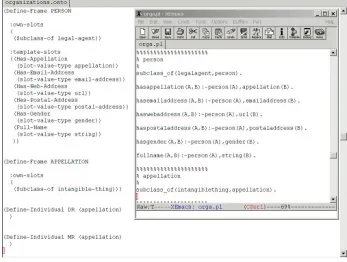
One of our case studies was to apply IF-Map to map AKT Reference to Southampton’s and Edinburgh’s local ontologies, Soton and Edin. These local ontologies are populated with a few thousand instances (ranging from 5k to 18k) and a few hundreds of concepts. There are a few axioms defined, and both have relations.AKT Referenceis more compact, it has no instances and approximately 65 concepts with 45 relations. There are a few axioms defined as well. In Figure 6 we include two screenshots, one from Ontolingua-encodedAKT Reference—in particular, the organisations sub-ontology—and the translated version of this fragment in Prolog clauses.10As we mentioned earlier (Section 2),
10
Fig. 6. A window with an Ontolingua fragment of AKT Referenceoverlapped by a smaller window showing a partial translation of this in Prolog clauses.
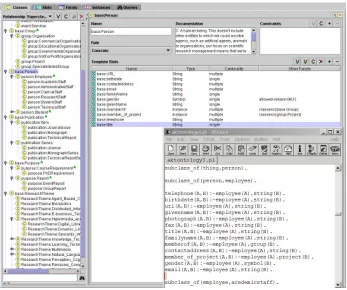
our translation is a partial and customised for the IF-Map application. Therefore, from the Ontolingua fragment shown in Figure 6 we only extract and transform to Prolog clauses the class hierarchy (by regarding frames as classes) and the relations along with their arities (which is used for type checking to bind appro-priate tokens to types when using Prolog’s backward chaining inference engine). In Figure 7 we include two screenshots, one from the Prot´eg´e-edited So-ton—in particular, highlighting the class person and its template slots—and the translated version of this fragment in Prolog clauses. As with the reference ontology translation, we partially translate predefined fragments of the local ontology like class hierarchy and relations along with arities.
Fig. 7.A window with a Prot´eg´e fragment of Sotonoverlapped by a smaller window showing a partial translation of this in Prolog clauses.
have been inappropriate, when for exampletitlerefers to title of a paper. These mappings were generated automatically, and IF-Map initiated these with the semantically-rich heuristics we described in 4.5.
Fig. 8.Results of ontology mapping in Web accessible RDF format.
6
Related work
applied as a method and as a theory for ontology mapping, and being—under circumstances—fully automatic.
Not all of the references we cite here meet these criteria; some provide features that IF-Map does not support and others focus on a single criterion of the list given above. Nevertheless, the diversity of works reported in this section demon-strates the importance of the topic in a number of communities. This paper’s scope, though, prevents us from getting into great detail when describing related work hereinafter, but we give a flavour of the current landscape in ontology map-ping research across different communities. Among the few formal approaches in ontology mapping and merging is that of FCA-Merge [41]. It is based on Formal Concept Analysis [14] and it is aimed, mainly, at merging ontologies. Its devel-opers, Stumme and Maedche, incorporate natural language techniques in their FCA-based method to derive a lattice of concepts. The lattice is then explored manually by a knowledge engineer who will build the merged ontology with semi-automatic guidance from FCA-Merge. In particular, FCA-Merge works as follows: The input to the method are a set of documents—from which concepts will be extracted—together with the ontologies that will be merged. These doc-uments should be representative of the domain at question and be related to the ontologies. They also have to cover all concepts from both ontologies as well as separating them well enough. These strong assumptions have to be met in order to obtain good results from the FCA-Merge. As this method relies heavily on the availability of classified instances in ontologies to be merged, the authors argue that this will not be the case in most ontologies so they opt to extract instances from documents. In this respect, the first step of FCA-Merge could be viewed as an ontology population mechanism. This initial step in FCA-Merge could be skipped though, when there is a shared set of instances classified to the concepts in both ontologies. Once the instances will be extracted,11Stumme and Maedche construct the concept lattice and from there provide semi-automatic support for the knowledge engineer to derive the final merged ontology.
Formal Concept Analysis has also been used by the database community in their federated databases domain. In particular, Schmitt and Saake employ For-mal Concept Analysis techniques to assist database schema integration [37]. The focus of their work is to merge different inheritance hierarchies by decomposing overlapping class extensions into base extensions and use Formal Concept Anal-ysis techniques to inform algorithms for integrating the databases schemata. In the Scalable Knowledge Composition (SKC) project, Jannink et al. [19] presented the use of a rule-based algebra for encapsulating and composing ontologies. On-tologies are clustered in contexts, and the authors use a rule-based algebra to define interfaces to link the extracted contexts with the original ontologies.
Noy and Musen have developed two systems for performing ontology merg-ing and alignment in the Prot´eg´e-2000 ontology development environment [16]: SMART [33] and its successor PROMPT [34]. These tools use linguistic
similar-11
ity matches between concepts for initiating the merging or alignment process and then use the underlying ontological structures provided by the Prot´eg´e-2000 envi-ronment (classes, slots, facets) to inform a set of heuristics for identifying further matches between the ontologies. A similar tool has been developed by McGuin-ness et al. for the Ontolingua ontology editor: Chimaera [29]. As in PROMPT, this tool is interactive and the engineer is in charge of making decisions that will affect the merging.
From the machine learning perspective we report the works of Lacher and Groh [26] and Doan et al. [9] where their systems employ machine learning algorithms in conjunction with similarity measures to yield prospective map-pings between ontology concepts. Other works worth citing here are Chalup-sky’s OntoMorph [6] translation system for symbolic knowledge, Kiryakov et al.’s OntoMap portal [25] for mapping linguistic ontologies, the OBSERVER system [30] by Mena et al. for information integration, Gangemi et al.’s [13] ONIONS methodology for medical ontologies, Visser and Tamma’s heterogene-ity categorisation [42], and the reports from Pinto et al. [35] and Noy and Hafner in [32].
7
Conclusion
In this paper we have presented a novel method and a theory for ontology map-ping. We formalised the notion of ontology, ontology morphism and ontology mapping and linked them to the formal notions of local logic and logic info-morphism stemming from IF theory. We then applied them in a mechanised manner—IF-Map—to map diverse ontologies. The first results are promising for the application of IF-Map to large-scale ontology mapping efforts and we con-tinue researching fruitful extensions of it, such as ontology merging, reasoning about ontology evolution, and inclusion of ontological axioms.
The automation of ontology mapping as provided by IF-Map provides auto-mated support in the alignment of ontologies by automatically generating map-pings between a reference and various local ontologies. For instance, for the special case of data integration, this would correspond to automatic generation of source descriptions, e.g. formalised as views over a mediated schema [18]. The correspondence, though, is not exact, as views over a mediated schema could be more expressive than IF-Maps current concept-to-concept and relation-to-relation mapping.
In this sense it would be interesting to work on the integration of previous approaches to semantic integration by the database community with recent ef-forts carried out by the ontology community (see, e.g., [21]) in the context of our approach to ontology mapping based on the Barwise-Seligman theory of information flow, as it might further illuminate the long road lying ahead.
Acknowledgements
Databases and Applications of Semantics (ODBASE’02), Irvine CA, USA, Oc-tober 2002. We are grateful to Karl Aberer for selecting an extended version of that paper for this special volume, and we would like to thank the audience of ODBASE’02 and the reviewers for their valuable comments.
This work is supported under the Advanced Knowledge Technologies (AKT) Interdisciplinary Research Collaboration (IRC), which is sponsored by the UK Engineering and Physical Sciences Research Council under grant number GR/N15764/01. The AKT IRC comprises the Universities of Aberdeen, Ed-inburgh, Sheffield, Southampton and the Open University.
Marco Schorlemmer is also supported by a ‘Ram´on y Cajal’ Fellowship from the Spanish Ministry of Science and Technology.
References
1. M. Barr. The Chu construction.Theory and Applications of Categories, 2(2):17–35, 1996.
2. J. Barwise and J. Perry. Situations and Attitudes. MIT Press, 1983.
3. J. Barwise and J. Seligman. Information Flow: The Logic of Distributed Systems. Cambridge University Press, 1997.
4. C. Batini, M. Lenxerini, and S. B. Navathe. A comparative analysis of method-ologies for database schema integration. ACM Computing Surveys, 18(4):323–364, 1986.
5. T. Berners-Lee, J. Hendler, and O. Lassila. The semantic web.Scientific American, May 2001.
6. H. Chalupsky. OntoMorph: A translation system for symbolic knowledge. In7th International Conference on Principles of Knowledge Representation and Reason-ing, Breckenridge, Colorado, USA, Apr. 2000.
7. F. Corrˆea da Silva, W. Vasconcelos, D. Robertson, V. Brilhante, A. de Melo, M. Finger, and J. Agust´ı. On the insufficiency of ontologies: Problems in knowl-edge sharing and alternative solutions. Knowledge-Based Systems, 15(3):147–167, 2002.
8. K. Devlin. Logic and Information. Cambridge University Press, 1991.
9. A. Doan, J. Madhavan, P. Domingos, and A. Halevy. Learning to map between on-tologies on the Semantic Web. In11th International World Wide Web Conference, Honolulu, Hawaii, USA, May 2002.
10. J. Domingue. Tadzebao and WebOnto: Discussing, browsing, and editing ontologies on the web. In11th Workshop on Knowledge Acquisition, Modeling and Manage-ment, Banff, Alberta, Canada, Apr. 1998.
11. F. Dretske. Knowledge and the Flow of Information. MIT Press, 1981.
12. A. Farquhar, R. Fikes, and J. Rice. The Ontolingua Server: a tool for collabo-rative ontology construction. International Journal of Human-Computer Studies, 46(6):707–727, 1997.
13. A. Gangemi. Ontology integration: Experiences with medical terminologies. In N. Guarino, editor,Formal Ontology in Information Systems, volume 46 of Fron-tiers in Artificial Intelligence and Applications. IOS Press, 1998.
14. B. Ganter and R. Wille. Formal Concept Analysis. Springer, 1999.
16. W. Grosso, H. Eriksson, R. Fergerson, J. Gennari, S. Tu, and M. Musen. Knowledge modeling at the millennium (the design and evolution of Prot´eg´e-2000). In 12th Workshop on Knowledge Acquisition, Modeling and Management, Banff, Alberta, Canada, Oct. 1999.
17. V. Gupta.Chu Spaces: A Model of Concurrency. PhD thesis, Stanford University, 1994.
18. A. Halevy. Answering queries using views. The VLDB Journal, 10:270–294, 2001. 19. J. Jannink, S. Pichai, D. Verheijen, and G. Wiederhold. Encapsulation and compo-sition of ontologies. InAAAI’98 Workshop on Information Integration, Madison, Wisconsin, USA, July 1998.
20. Y. Kalfoglou. Deploying Ontologies in Software Design. PhD thesis, Division of Informatics, The University of Edinburgh, June 2000.
21. Y. Kalfoglou and M. Schorlemmer. Ontology mapping: The sate of the art. Knowl-edge Engineering Review, 18(2), 2003.
22. R. Kent. The information flow foundation for conceptual knowledge organiza-tion. In 6th International Conference of the International Society for Knowledge Organization, Toronto, Canada, July 2000.
23. R. Kent. A KIF formalization of the IFF category theory ontology. InIJCAI 2001 Workshop of the IEEE Standard Upper Ontology, Seattle, Washington, USA, 2001. 24. R. Kent. The IFF foundation for ontological knowledge organization. InKnowledge Organization and Classification in International Information Retrieval, Cataloging and Classification Quarterly. The Haworth Press Inc., 2003.
25. A. Kiryakov, K. Simov, and M. Dimitrov. OntoMap: Portal for upper-level on-tologies. InSecond International Conference on Formal Ontology in Information Systems, Ogunquit, Maine, USA, Oct. 2001.
26. M. Lacher and G. Groh. Facilitating the exchange of explicit knowledge through ontology mappings. In14th International FLAIRS Conference, Key West, Florida, USA, May 2001.
27. O. Lassila and R. Swick. Resource description framework (RDF) model and syn-tax specification. http://www.w3.org/TR/1999/REC-rdf-synsyn-tax-19990222/, Feb. 1999. W3C Recommendation.
28. B. McBride. Jena: Implementing the RDF model and syntax specification. In
2nd International Workshop on the Semantic Web (SemWeb’2001), volume 40 of
CEUR Workshop Proceedings, Hong Kong, China, May 2001.
29. D. McGuinness, R. Fikes, J. Rice, and S. Wilder. An environment for merging and testing large ontologies. In7th International Conference on Principles of Knowl-edge Representation and Reasoning, Breckenridge, Colorado, USA, Apr. 2000. 30. E. Mena, V. Kashyap, A. Illarramendi, and A. Sheth. Domain specific ontologies
for semantic information brokering on the global information infrastructure. In N. Guarino, editor,Formal Ontology in Information Systems, volume 46 of Fron-tiers in Artificial Intelligence and Applications, pages 269–283. IOS Press, 1998. 31. E. Motta. Reusable Components for Knowledge Modelling: Case Studies in
Para-metric Design Problem Solving, volume 53 of Frontiers in Artificial Intelligence and Applications. IOS Press, 1999.
32. N. Noy and C. Hafner. The state of the art in ontology design: A survey and comparative review. AI Magazine, 18(3):53–74, 1997.
34. N. Noy and M. Musen. PROMPT: Algorithm and tool for automated ontology merging and alignment. In 17th National Conference on Artificial Intelligence (AAAI’00), Austin, Texas, USA, July 2000.
35. S. Pinto, A. G´omez-P´erez, and J. Martins. Some issues on ontology integration. InIJCAI’99 Workshop on Ontologies and Problem-Solving Methods, volume 18 of
CEUR Workshop Proceedings, Stockholm, Sweden, Aug. 1999.
36. V. Pratt. The Stone gamut: A coordination of mathematics. In 10th Annual Symposium on Logic in Computer Science, pages 444–454. IEEE Computer Society Press, 1995.
37. I. Schmitt and G. Saake. Merging inheritance hierarchies for database integra-tion. In3rd IFCIS International Conference on Cooperative Information Systems (CoopIS’98). IEEE Computer Society Press, 1998.
38. M. Schorlemmer. Duality in knowledge sharing. In 7th International Symposium on Artificial Intelligence and Mathematics, Ft. Lauderdale, Florida, USA, 2002. 39. A. Sheth and J. Larson. Federated database systems for managing distributed,
heterogeneous, and autonomous databases. ACM Computing Surveys, 22(3):183– 236, 1990.
40. J. Sowa. Knowledge Representation and Reasoning: Logical, Philosophical, and Computational Foundations. Brooks/Cole, 2000.
41. G. Stumme and A. Maedche. FCA-Merge: Bottom-up merging of ontologies. In
17th International Joint Conference on Artificial Intelligence (IJCAI’01), Seattle, Washington, USA, Aug. 2001.
42. P. Visser and V. Tamma. An exeprience with ontology-based agent clustering. InIJCAI’99 Workshop on Ontologies and Problem-Solving Methods, volume 18 of