The effects of a Self-Alert Training (SAT) program in adults
with ADHD
Simona Salomone1*,Grainne R. Fleming1,Jacqueline M. Shanahan1,Marco Castorina1,
Jessica Bramham2,3,Redmond G. O’Connell1,4 andIan H. Robertson1,4
1Trinity College Institute of Neuroscience, Lloyd Institute, Trinity College Dublin, Dublin, Ireland 2St. Patrick’s University Hospital, Dublin, Ireland
3School of Psychology, University College Dublin, Dublin, Ireland 4School of Psychology, Trinity College Dublin, Dublin, Ireland
Edited by:
Srikantan S. Nagarajan, University of California, San Francisco, USA
Reviewed by:
Mor Nahum, Posit Science Corp., USA
Jyoti Mishra, University of California, San Francisco, USA
*Correspondence:
Simona Salomone, Trinity College Institute of Neuroscience, Lloyd Institute, Trinity College Dublin, Dublin 2, Ireland
e-mail: [email protected]
Attention-Deficit/Hyperactivity Disorder (ADHD), a neuropsychiatric condition characterized by attention and impulsivity problems, is one of the most common behavioral disorders. The first line of treatment for ADHD is psychostimulant medication, but this has limited effectiveness, particularly in adults, and is often associated with adverse side-effects. Thus, it is imperative that new non-pharmaceutical approaches to treatment are developed. This study aims to evaluate the impact of a non-pharmacological Self-Alert Training (SAT) intervention on ADHD symptom prevalence, psychological and cognitive functioning, and on everyday functional impairment in adults with ADHD. Fifty-one adult participants with a current diagnosis of ADHD were randomized to either SAT or a Control Training (CT) program. They were assessed at baseline, immediately following the 5-week training period, and after 3-months using ADHD symptoms scales, as well as a series of neuropsychological tests and psychological questionnaires. Subjective ratings of everyday life attention and memory problems were also collected. The SAT group showed significant improvements in ADHD inattentive and impulsive symptoms, depressive symptoms and in self-efficacy ratings compared to the CT group at both post-training and at the 3-month assessment. Pre-post improvements in SAT participants on untrained cognitive tasks measuring selective attention and executive functions were also observed. Finally, the SAT group reported improved subjective ratings of everyday life attention at both assessment points. This pattern of results suggests that SAT may be beneficial in treating ADHD symptoms as well as psychological and cognitive impairments in adult ADHD. A large-scale randomized controlled trial (RCT) is needed.
Keywords: ADHD, Self-Alert Training, CAARS, biofeedback, everyday life, attention
INTRODUCTION
Attention-Deficit/Hyperactivity Disorder (ADHD) is a neuropsychiatric condition characterized by difficulties with attention, impulsivity and overactivity. ADHD is primarily a behavioral disorder but individuals also exhibit impairments in a number of cognitive domains, particularly in higher-level executive functions such as inhibition and attention (Castellanos and Tannock, 2002; Barkley, 2006). Although it has been thought of as a disorder most commonly present in childhood, it is now known that ADHD can persist into adulthood in some cases (Faraone et al., 2006; Kessler et al., 2006; Miller et al., 2007). Research suggests that adults with ADHD have lower economic status, higher levels of unemployment (Sobanski et al., 2007), and more frequent interactions with the criminal justice system (Fischer et al., 2007). Given the high cost to society of ADHD treatments (Matza et al., 2005), with co-morbid disorders and other associated problems such as higher criminality rates (Fischer et al., 2007), it is imperative that effective interventions for these individuals are developed.
neuropsychological abnormalities associated with ADHD can persist into adulthood (Woods et al., 2002). This has prompted a move toward identifying novel treatment strategies that can address the underlying cognitive and behavioral roots of the disorder.
In an effort to meet this need, O’Connell et al. (2008) developed a novel cognitive training strategy that targets deficits in sustained attention. Impaired sustained attention is a hallmark symptom of ADHD (Woods et al., 2002; Castellanos et al., 2005; Mcavinue et al., 2012). The available evidence from fMRI, PET and pharmacological studies indicates that sustained attention is achieved through a primarily right lateralized, multimodal cortical network that includes the anterior cingulate gyrus, the right dorsolateral prefrontal cortex and the inferior parietal lobule with prominent reciprocal connections to the thalamus and noradrenergic brainstem targets (Peterson and Posner, 2012). The cortical sustained attention network also modulates firing rates in subcortical arousal structures thus helping to maintain the state of alertness during current tasks (Foucher et al., 2004). Studies using different variants of the Continuous Performance Tasks (CPT;Losier et al., 1996; Woods et al., 2002) have consistently found sustained attention deficits in adults with ADHD. Furthermore, several studies have demonstrated sustained attention deficits in people with ADHD in the Sustained Attention to Response Task (SART; O’Connell et al., 2006; Mcavinue et al., 2012) that has been shown to activate right fronto-parietal sustained attention networks (Manly et al., 2003).
Top-down influences on arousal have been explored in studies using biofeedback techniques (Critchley et al., 2002; Lubar, 2003). During biofeedback participants receive real-time visual or auditory information conveying the current level of an otherwise covert biomarker and learn to exert volitional control over that process (Critchley et al., 2002; Nagai et al., 2004). One arousal biomarker that can be modulated during biofeedback interventions is electrodermal activity (EDA) that is recorded as changes in electrical conductance in the skin known as the Skin Conductance Response (SCR;Dawson et al., 2000). The autonomic system is subject to descending cortical and subcortical influences on hypothalamic and brainstem mechanisms and there is evidence that volitional modulation of SCR during biofeedback activates many of the same frontal control regions that have been implicated in top-down sustained attention (Critchley et al., 2002). This provides a basis for hypothesizing that training participants to modulate their SCRs should lead to improvements in sustained attention and associated impulsive behavior.
O’Connell et al. (2008)have investigated this hypothesis by examining an endogenous technique called Self-Alert Training (SAT) which is based on cognitive rehabilitation principles and it seeks to capitalize on the known relationship between sustained attention and arousal. The goal of SAT is to teach participants to transiently increase their arousal at regular intervals in order to offset the periodic decreases in endogenous control that determine momentary lapses of attention. The behavioral strategies involved in SAT arise from an earlier intervention developed by Robertson et al. (1995) which was designed
to remediate the sustained attention deficits of a group of participants with right-hemisphere lesions. While participants performed a variety of routine tasks, the experimenter re-directed attention to the task by combining a loud noise with an instruction to attend, thus using intact bottom-up alerting pathways to re-orient attention. Participants were then gradually taught to initiate this alerting procedure using a self-generated verbal cue, finally learning to “self-alert” without needing to generate verbal cues at all. After training, all participants showed clinically significant improvements on a number of untrained behavioral tasks. SAT extends the behavioral training strategy with the addition of a biofeedback protocol. The objective of SAT is to gradually acquire the ability to control one’s alertness levels in a task-independent manner that can be potentially applied to a variety of real-life settings.
In recent years an increased number of studies have been conducted to evaluate the effects of EEG biofeedback, also known as “neurofeedback”, in the treatment of ADHD. Neurofeedback is a type of biofeedback that is aimed to teach or improve self-regulation over specific aspects of brain activity and implement these self-regulation skills in daily life (Arns et al., 2014). Similarly to SCR biofeedback used during SAT, during neurofeedback subjects receive on-line feedback on a particular brain wave and learn to self-regulate it. Recent reviews have found that neurofeedback can be successful in treating both hyperactive and inattentive symptoms in ADHD and that these positive effects lasted in time (Arns et al., 2014; Micoulaud-Franchi et al., 2014). However, neurofeedback has been criticized of methodological limitations and lack of an adequate control group (Arns et al., 2014). For example, one issue that complicates neurofeedback interventions is the fact that numerous training sessions are needed (30–40 sessions) to obtain significant improvements and therefore neurofeedback protocols may be complex to implement.
The final decision was to combine attentional exercises with psycho-education regarding sustained attention.
The first aim of this study was to assess the effects of SAT on ADHD symptoms. The second aim was to investigate SAT impact on aspects of participants’ psychological functioning, as measured by participants’ self-efficacy ratings of their ability to cope with ADHD symptoms, and rates of psychiatric comorbidities that are often associated with ADHD (i.e., anxiety and depression). The third aim was to investigate whether SAT could improve untrained cognitive functions, such as selective and divided attention and executive functions that are not directed targeted by the intervention. The fourth aim was to investigate the impact of SAT on aspects of participants’ everyday life, as measured by participants’ subjective ratings on everyday life attention and memory problems. We hypothesizes that the SAT group will show more positive changes in ADHD symptoms, psychological functioning and untrained cognitive functions compared to the control group. We also expect greater improvements in subjective ratings of everyday life functioning in the SAT group in comparison with the control group.
MATERIAL AND METHODS PARTICIPANTS
Fifty-one participants were recruited from a specialist adult ADHD service, the Dean Clinic at St. Patrick’s Hospital, Dublin. Inclusion criteria were as follows: age between 18–50 years; full scale IQ > 80, assessed using Wechsler Adult Intelligence Scale—3rd Edition (WAIS–III, Wechsler, 1997); diagnosis of ADHD according to: DSM-IV criteria in both childhood and at present in adulthood using the Conners Adult ADHD Diagnostic Inventory for DSM-IV (CAADID;Epstein et al., 2000) and the Conners’ Adult ADHD Rating Scale (CAARS; Conners et al., 2003) and the Wender Utah Rating Scale (WURS), a retrospective measure of ADHD symptoms in childhood (Ward et al., 1993). The observer versions of both scales were also administered to a close family member or partner; self-reported clinically significant problems in daily life attributable to attentional, executive or arousal deficits (based on interview by a trained clinical psychologist); provision of informed consent. Exclusion criteria were: history of pervasive developmental disorders (e.g., Asperger’s syndrome, autism) or intellectual disability (IQ<80); history or current diagnosis of epilepsy or other neurological condition (e.g., multiple sclerosis, motor neuron disease); history or current diagnosis of schizophrenia, bipolar disorder or other equivalently severe psychiatric condition; current primary diagnosis of substance misuse requiring treatment with priority (i.e., dependent on alcohol or illicit substances). However individuals with recreational alcohol and drug use were included as they are representative of the adult ADHD population.
Participants who met the inclusion criteria were randomly assigned using an automated minimization randomization procedure (Altman and Bland, 2005) which ensured that the two groups did not differ significantly in (a) gender; (b) prescribed psychotropic medication status; (c) alcohol and illegal drug use (sorted according to: alcohol consumption less
than 35 units per week and no illegal drug more than once per month use vs. alcohol consumption more than 35 units per week OR illegal drug use more than once per month). Eight participants in the SAT group and six participants in the placebo group were taking psychostimulant medication for ADHD. Nine participants in the SAT group had comorbid disorders (one insomnia, one dyslexia and seven anxiety and depression) while four CT participants reported comorbid conditions (one depression and three anxiety and depression). The two groups did not differ in terms of gender, estimated IQ, measured by WAIS–III (Wechsler, 1997), mean years of education, and pre-training ADHD symptoms, as measured by the CAARS (Conners et al., 2003) and the WURS (Ward et al., 1993).
Fourteen participants out or the 51 participants who were randomized dropped out during the 5-week training period leaving 18 participants in the SAT group and 19 in the control group who completed the training and pre and post-training assessment. The two groups did not differ in terms of age (t(23)
= 0.94,p = 0.35), years of education (t(23) = 0.39,p = 0.70),
estimated IQ (t(23) = 1.56,p = 0.96). A further 8 participants
dropped out of the study between the post-training and the three-month follow up assessment, leaving 15 participants in the SAT group and 14 participants in the CT group.Figure 1showed the flow of participants through the study. The two groups did not differ for age (t(16) = 0.99, p = 0.40), years of education
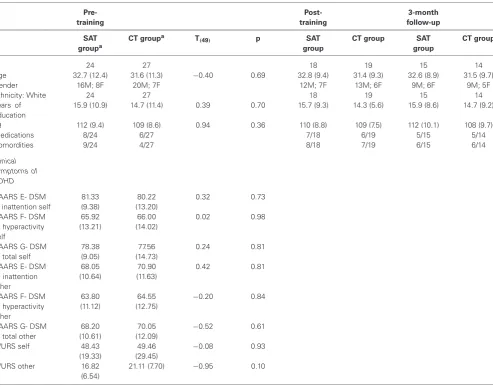
(t(16)= 1.22,p= 0.66), and estimated IQ (t(16)= 1.33,p= 0.89). Demographic characteristics at each time point as well as CAARS and WURS scores at pre-training of SAT and CT participants are presented inTable 1.
PROCEDURE
FIGURE 1 | Consolidated Standard for Reporting Trials (CONSORT) diagram showing the flow of participants through the trial and reasons for dropout. SAT = Self-Alert Training; CT = Control Training.
MEASURES
Adult ADHD symptoms
• TheConners Adult ADHD Rating Scale: Long version (CAARS-S:L;Conners et al., 2003).
• The Conners Adult ADHD Rating Scale Observer: Long Version (CAARS-O:L; Conners et al., 2003). To note, an insufficient number observer forms were returned to perform a well powered analysis (8 forms in the SAT group and 6 in the CT group); therefore these results are not described.
Psychological functioning
• The Generalized Self Efficacy Scale (GSES; Schwarzer and Jerusalem, 1995). The GSES is a 10-item scale designed to assess optimistic self-beliefs and copying skills. Participants rate each question on a scale ranging from 0 to 4, with higher scores indicating higher self-efficacy.
• The Beck Depression Inventory (BDI-II; Beck et al., 1996). The BDI is a 21 questions inventory about the severity of depression’s symptoms Participants rate each question on a scale ranging from 0 to 3, with higher scores indicating higher depression.
Cognitive functions
• Two subtests from the Test of Everyday Attention (TEA; Robertson et al., 1994) were used: Elevator Counting with Distraction, in which participants had to listen to series of tones and count the high-pitched tones only. This task measures auditory selective attention.Telephone Search While Counting
that involve counting a series of tones while looking for symbols on a telephone directory. This task measures divided attention and its final score is called: “Dual Task Decrement”.
• TheHotel Task(Manly et al., 2002) which measures executive functions and is designed to simulate typical day-to-day
activities. The Hotel task is comprised of five distinct activities that would plausibly be completed in the course of running a hotel (i.e., checking guests’ bills, proofreading a leaflet on the hotel’s facilities, ordering labels with guests’ names in alphabetical order, sorting money, etc.,). The participants’ objective in this task is to try to complete as much as they can from each of the five activities over an allocated 10 min period. Performance in the Hotel Task is scored within two categories: Number of Attempted Tasks out of five, and time allocation, measured as the Total Deviation Time from an optimal time allocation of 2 min per activity.
Subjective measures
[image:5.595.52.546.310.697.2]• TheAttention-Related Cognitive Errors Questionnaire (ARCEQ; adapted fromCheyne et al., 2006). The ARCEQ is a 12 items scale that was used as a self-report measure of attention slips
Table 1 | Demographic characteristics at the three assessment points and measures of ADHD symptoms at pre-training in the SAT group (n= 24) and in the CT group (n= 27).
Pre-training
Post-training
3-month follow-up
SAT groupa
CT groupa T
(49) p SAT
group
CT group SAT group
CT group
N 24 27 18 19 15 14
Age 32.7 (12.4) 31.6 (11.3) −0.40 0.69 32.8 (9.4) 31.4 (9.3) 32.6 (8.9) 31.5 (9.7)
Gender 16M; 8F 20M; 7F 12M; 7F 13M; 6F 9M; 6F 9M; 5F
Ethnicity: White 24 27 18 19 15 14
Years of education
15.9 (10.9) 14.7 (11.4) 0.39 0.70 15.7 (9.3) 14.3 (5.6) 15.9 (8.6) 14.7 (9.2)
IQ 112 (9.4) 109 (8.6) 0.94 0.36 110 (8.8) 109 (7.5) 112 (10.1) 108 (9.7)
Medications 8/24 6/27 7/18 6/19 5/15 5/14
Comordities 9/24 4/27 8/18 7/19 6/15 6/14
Clinical symptoms of ADHD
CAARS E- DSM IV inattention self
81.33 (9.38)
80.22 (13.20)
0.32 0.73
CAARS F- DSM IV hyperactivity self
65.92 (13.21)
66.00 (14.02)
0.02 0.98
CAARS G- DSM IV total self
78.38 (9.05)
77.56 (14.73)
0.24 0.81
CAARS E- DSM IV inattention other
68.05 (10.64)
70.90 (11.63)
0.42 0.81
CAARS F- DSM IV hyperactivity other
63.80 (11.12)
64.55 (12.75)
−0.20 0.84
CAARS G- DSM IV total other
68.20 (10.61)
70.05 (12.09)
−0.52 0.61
WURS self 48.43
(19.33)
49.46 (29.45)
−0.08 0.93
WURS other 16.82
(6.54)
21.11 (7.70) −0.95 0.10
and absentmindness in everyday life. Participants rate the frequency with which they experience such slips in attention on a scale ranging from 1 to 5, with higher scores indicating higher absentmindness.
• The Memory Failures Questionnaire (EMFQ; adapted from Cheyne et al., 2006). It is structured in the same way as the ARCEQ and it is a self-report measure of minor memory failures that occur in everyday life. Participants rate the frequency with which they experience memory failures in a series of 12 items that are rated on a scale ranging from 1 to 5, with higher scores representing higher occurrence of memory failures.
SELF-ALERT TRAINING AND CONTROL TRAINING (CT) PROTOCOLS
Participants were asked to attend two training sessions. Each session was carried out on separate days and lasted on average 1 h and 20 min. Training sessions were a means of providing participants with psycho-education regarding sustained attention, arousal, and the role of noradrenaline in mediating levels of cognitive alertness. The role of the trainer was to facilitate and encourage participants’ development over the course of the training. Emphasis was thus placed on the role of the participant in what was essentially a “self-training” scheme.
Self-Alert Training (SAT)
SAT program consisted of an initial phase of psycho-education regarding the nature of alertness and attention, following which participants completed two questionnaires regarding their everyday life attention and memory difficulties. Following this, participants were taught to gain volitional control of their EDA using SAT in three main steps: (1) Eliciting SCR by external alerting. Participants were allowed to view the EDA readings on line and the meaning of this measurement was briefly explained. Then participants were presented with a loud alerting sound in order to demonstrate the responsiveness of their SCRs to changes in arousal. Participants were shown their SCR to this alert in real time. The experimenter asked participants to try to make a link between what they felt inside and the increase they saw in the line. This step was repeated five times and each time participants were allowed to view increases in their SCR waveforms on line (see Figure 2). Participants were instructed to relax as much as possible in between each alert to reduce the number of non-specific SCRs and thus ensure that increases in arousal were clearly observable in the EDA waveform; (2) Cued internally generated SCRs. The alerting sound was removed and the aim was for participants to begin producing internally driven increases in response to a verbal cue from the trainer (the word: “now”). Participants were asked to try to recreate the sudden increase in alertness they felt the first time the experimenter played the loud sound on the laptop. This step was repeated until participants could generate 5 clear increases in their SCR amplitudes. If participants had initial difficulties in generating SCR increases, the trainer guided them through the SAT technique step-by-step and invited them to try this again. There was no time limitation. To note, all our participants
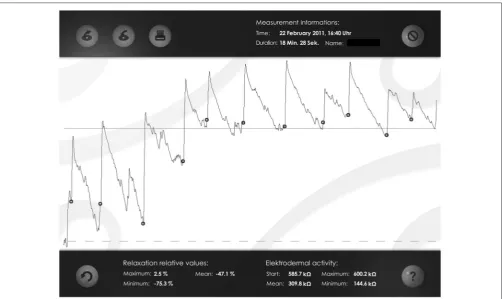
were able to learn the SAT technique by the end of the two training sessions. Participants were instructed to relax as much as possible in between each attempt in order to ensure that increases in arousal were readily observable; (3) Self-initiated control over alertness. In the final step, participants learned to take complete control of their EDA trace without any external prompt from the trainer. Participants were asked to say the word “now” when they were initiating a self-alert. This step was repeated with visual feedback until participants could generate 5 increases in SCR amplitudes. The same procedure was repeated but without visual feedback and participants were not able to view their EDA trace. Participants were asked to say the word “now” before initiating a self-alert and while the trainer checked their performance. This step was repeated until participants could generate 5 SCR increases. Finally, participants were instructed to save each biofeedback session on the laptop. Participants were instructed to relax as much as possible in between each attempt in order to ensure that increases in arousal were readily observable. Figure 2 shows examples of participants’ biofeedback session with several successful alerts.
A series of attentional exercises were also included in the program. To note, these exercises were included in the SAT program to provide participants additional occasions to practice the self-alert technique without the visual feedback from the biofeedback software. Participants were in fact asked to apply self-alerting strategies while practicing the attentional exercises in order to try and improve their performance. In this way they learned to control their alertness levels without visual feedback from their EDA trace, in a task-independent manner. The exercises consist of:
• Sustained Attention to Response Task(SART;Robertson et al., 1997).Three versions of this task were included, each lasting 3 min and 10 s (126 trials). These were: Number SART, Auditory SART and Animal SART. In the Number SART, numbers from 1 to 9 were randomly presented in the center of participants’ training laptop and participants had to press the space bar for each number except 3. Similarly, in the Auditory SART, numbers from 1 to 9 were played on the laptop in a random order and participants had to listen to these numbers and press the space bar for every number except 3. In the Animal SART, nine different animal shapes were randomly presented in the center of the laptop’s screen and participants had to press the space bar for each animal shape except the kangaroo shape. At the end of each exercise participants received feedback on their performance in terms of number of correct responses, omission errors and commission errors.
FIGURE 2 | Examples of participants’ biofeedback session with several successful alerts. The dots indicate the start of a self-alert episode, which is followed by a clear increase (peak) in participants’ Skin Conductance Response (SCR).
keyboard. Participants were instructed to answer as fast but also as accurately as possible. At the end of each exercise participants received feedback on their performance in terms of number of correct responses, omission errors and commission errors.
• Listening Task (this task was modeled from the Lottery task of the TEA, Robertson et al., 1994). Four different audio recordings were included consisting of recorded weather forecasts (downloaded from: www.rte.ie). The length of each recording was 5 min and 46 s. Participants had to listen carefully and indicate the number of times a particular word was pronounced (for example the word “wind” or “cloud”) by writing this number in a box that was presented on the laptop’s screen at the end of each exercise. Participants did not receive feedback on this task.
Each exercise was briefly demonstrated and participants were encouraged to apply the self-alert technique to improve their performance. Each practice of an attentional exercise was automatically saved by the training software in a database. Finally, participants were also invited to think about high-risk situations for attentional failures in their everyday life were encouraged to apply the SAT techniques in their day-to-day life during these problematic situations to increase their alertness. Participants were then provided with a laptop containing specialized SAT software and an EDA kit to take home. Participants were asked to practice 20 min of SAT-biofeedback exercises and 10 min of
computerized exercises and to apply self-alerting during exercises for 5 days out of each week for 5-weeks.
Control Training (CT)
participants’ frustration and loss of motivation to complete the training.
STATISTICAL ANALYSIS
Intention-to-treat (ITT) analysis was used. A mixed analysis of covariance (ANCOVA), including one between subjects variable, Group (two levels: SAT group, CT group), one within subjects variable, Time (three levels: pre-training assessment, post-training assessment, 3-month follow up) and one covariate, pre-training assessment was run for each measure. Post hoc
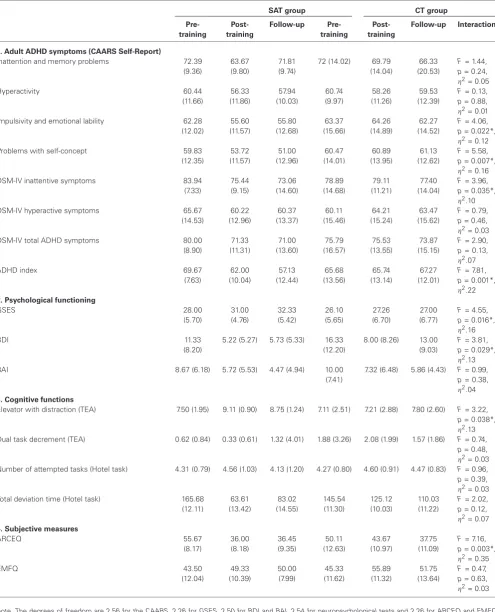
comparisons were run using Bonferrorni correction to investigate between groups differences at each assessment session separately. Bonferroni correction accounted for all tests within each domain, as in our analysis it was applied for each outcome measure of ADHD symptoms, cognitive functions, psychological symptoms and everyday life subjective ratings.Table 2 presents the mean values and standard deviations obtained by the SAT group and the CT group at each time points for each measure and interactions effects of the ANCOVAs analysis for each measure.
RESULTS
ADULT ADHD SYMPTOMS (CAARS SELF REPORT)
ANCOVA analysis showed that there was a significant Time
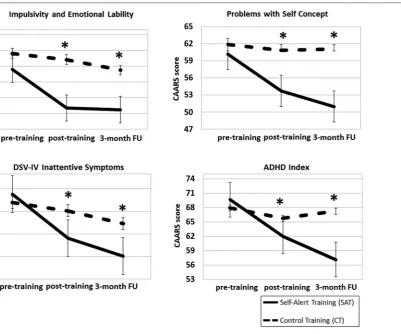
× Group interaction for Impulsivity and Emotional Lability (F(2,56) = 4.06, p = 0.022, η2 = 0.12). Post hoc comparisons
indicated that the SAT group showed significantly lower scores compared to the CT group at the post-training assessment (mean difference = 3.69, SD = 1.63, p = 0.032) and that this effect was maintained at the 3-month follow up (mean difference = 4.24, SD = 1.58, p = 0.012). There was a significant Time ×
Group effect for Problems with Self Concept (F(2,56) = 5.58, p = 0.007, η2 = 0.16), driven by significantly lower scores in
the SAT group compared to the CT group at post-training (mean difference = 3.22, SD = 1.68, p = 0.041) and at the 3-month follow up (mean difference = 3.71, SD = 1.74,
p= 0.032). There was a significant Time×Group effect for DSM-IV Inattentive Symptoms (F(2,56) = 3.96,p= 0.035;η2= 0.10). Post hoc analysis revealed that the SAT group had significantly lower scores compare to the CT group at post-training (mean difference = 4.18, SD = 1.37,p= 0.003) and that this effect was maintained at the 3-month follow up (mean difference = 5.64, SD = 2.02,p= 0.009). A significant Time ×group interaction was found for ADHD Index (F(2.56)= 7.81,p= 0.001;η2= 0.22),
driven by significantly lower scores in the SAT group compared to the CT group at post-training (mean difference = 4.44, SD = 1.45,p= 0.005) and at the 3-month follow up (mean difference = 4.86, SD = 1.82,p= 0.017). No significant Time×Group effects were found for Attention and Memory Problems, Hyperactivity and Restlessness, DSM-IV Hyperactive Symptoms and DSM-IV Total Symptoms (allp> 0.1). CAARS—Self Report scores at the three time points in the two groups are illustrated inFigure 3.
PSYCHOLOGICAL FUNCTIONING
ANCOVA analysis showed a significant Time×Group interaction for the GSES (F(2,26) = 4.55, p = 0.016, η2 = 0.16). Post hoc comparisons indicated that the SAT group showed significantly higher self-efficacy scores compared to the CT group
immediately after training (mean difference =−2.90, SD = 0.77,
p = 0.001) and at the 3-month follow up (mean difference =
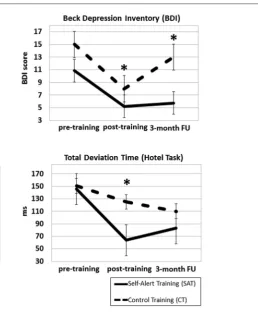
−4.02, SD = 1.02,p= 0.001). A significant Time×Group effect emerged for The BDI (F(2,50)= 3.81,p= 0.029,η2= 0.13), driven
by significantly lower depression ratings in the SAT group than in the CT group at post-training (mean difference = 7.81, SD = 1.23,p<0.000) and at the 3-month follow up (mean difference = 4.82, SD = 1.26,p= 0.001). No significant group difference emerged for the BAI (p= 0.38). GSES and BDI scores at the three assessment points for the SAT group and CT group are shown in Figure 4A.
COGNITIVE FUNCTIONS
ANCOVA analyses revealed a significant Time× Group effect on the Elevator Counting with Distraction (F(2,54) = 3.22,
p= 0.038,p= 0.013,η2= 0.12).Post hoccomparisons indicated that the SAT group improved significantly more than the CT group at post-training (mean difference = −0.85, SD = 0.35,
p = 0.023), but this improvement was not maintained at the 3-month follow up (mean difference = −0.17, SD = 0.23,
p = 0.47). The ANCOVA for the Total Deviation Time in the Hotel Task was not significant (F(2,54)= 1.02,p= 0.14,p= 0.013, η2 = 0.07), however post hoc analysis revealed that the SAT
group improved significantly more than the CT group at the post-training assessment (mean difference = 44.69, SD = 19.08,
p = 0.027), but this improvement was not maintained at the 3-month follow up (mean difference = 21.65, SD = 13.55,
p= 0.06). No significant differences between groups emerged on the Dual Task Decrement and on Number of Attempted Tasks in the Hotel Task (bothp> 0.2).Figure 4Bshowed the two groups’ scores on cognitive tasks at the three time points.
SUBJECTIVE MEASURES
ANCOVA analysis showed a significant Time×Group interaction for the ARCEQ (F(2,26) = 7.16, p= 0.003,η2 = 0.35).Post hoc
comparisons indicated that the SAT group showed significantly lower ratings of attentional slips compared to the CT group at post-training (mean difference = 10.35, SD = 1.62,p<0.000) and that this effect was maintained at the 3-month follow up (mean difference = 12.78, SD = 1.70,p<0.000). No significant difference between groups emerged for the MFQ (p= 0.63). ARCEQ scores in the two groups at the three assessment points are shown in Figure 5.
INDIVIDUAL DIFFERENCES IN TIME SPENT TRAINING
Participants in the SAT group spent a mean of 2.7 h in attentional exercises (range: 9.40 h to 10.5 min) and they completed, on average, 49.1 attentional exercises (range: 168–3; SD = 48.5) over the 5-weeks. SAT participants did a mean of 36.6 biofeedback sessions (range: 116–4) and the mean time spent in biofeedback training was 3.5 h (range: 21.36 h-38 min) over the 5 week period. The mean duration of a biofeedback session was 9.2 min (range: 17.59–3.54 min; SD = 6.7). Participants in the CT group spent a mean of 4.2 h in attentional exercises (range: 11.54 h-10.5 min) and they completed, on average, 57.5 attentional exercises (range: 204–3; SD = 68.8) over 5-weeks. Independent sample
Table 2 | Mean scores (and Standard Deviations) on ADHD symptom measures, social functioning and psychiatric comorbidities’ scales, neuropsychological tests and subjective attention and memory ratings for the SAT group and CT group, results of the ANCOVAs and between group effect sizes.
SAT group CT group
Pre-training Post-training Follow-up Pre-training Post-training Follow-up Interaction
1. Adult ADHD symptoms (CAARS Self-Report)
Inattention and memory problems 72.39
(9.36)
63.67 (9.80)
71.81 (9.74)
72 (14.02) 69.79 (14.04)
66.33 (20.53)
F= 1.44,
p= 0.24, η2= 0.05
Hyperactivity 60.44 (11.66) 56.33 (11.86) 57.94 (10.03) 60.74 (9.97) 58.26 (11.26) 59.53 (12.39)
F= 0.13,
p= 0.88, η2= 0.01
Impulsivity and emotional lability 62.28
(12.02) 55.60 (11.57) 55.80 (12.68) 63.37 (15.66) 64.26 (14.89) 62.27 (14.52)
F= 4.06,
p= 0.022*, η2= 0.12
Problems with self-concept 59.83
(12.35) 53.72 (11.57) 51.00 (12.96) 60.47 (14.01) 60.89 (13.95) 61.13 (12.62)
F= 5.58,
p= 0.007*, η2= 0.16
DSM-IV inattentive symptoms 83.94
(7.33) 75.44 (9.15) 73.06 (14.60) 78.89 (14.68) 79.11 (11.21) 77.40 (14.04)
F= 3.96,
p= 0.035*, η2.10
DSM-IV hyperactive symptoms 65.67
(14.53) 60.22 (12.96) 60.37 (13.37) 60.11 (15.46) 64.21 (15.24) 63.47 (15.62)
F= 0.79,
p= 0.46, η2= 0.03
DSM-IV total ADHD symptoms 80.00
(8.90) 71.33 (11.31) 71.00 (13.60) 75.79 (16.57) 75.53 (13.55) 73.87 (15.15)
F= 2.90,
p= 0.13, η2.07
ADHD index 69.67
(7.63) 62.00 (10.04) 57.13 (12.44) 65.68 (13.56) 65.74 (13.14) 67.27 (12.01)
F= 7.81,
p= 0.001*, η2.22
2. Psychological functioning
GSES 28.00 (5.70) 31.00 (4.76) 32.33 (5.42) 26.10 (5.65) 27.26 (6.70) 27.00 (6.77)
F= 4.55,
p= 0.016*, η2.16
BDI 11.33
(8.20)
5.22 (5.27) 5.73 (5.33) 16.33 (12.20)
8.00 (8.26) 13.00 (9.03)
F= 3.81,
p= 0.029*, η2.13
BAI 8.67 (6.18) 5.72 (5.53) 4.47 (4.94) 10.00
(7.41)
7.32 (6.48) 5.86 (4.43) F= 0.99,
p= 0.38, η2.04
3. Cognitive functions
Elevator with distraction (TEA) 7.50 (1.95) 9.11 (0.90) 8.75 (1.24) 7.11 (2.51) 7.21 (2.88) 7.80 (2.60) F= 3.22,
p= 0.038*, η2.13
Dual task decrement (TEA) 0.62 (0.84) 0.33 (0.61) 1.32 (4.01) 1.88 (3.26) 2.08 (1.99) 1.57 (1.86) F= 0.74,
p= 0.48, η2= 0.03
Number of attempted tasks (Hotel task) 4.31 (0.79) 4.56 (1.03) 4.13 (1.20) 4.27 (0.80) 4.60 (0.91) 4.47 (0.83) F= 0.96,
p= 0.39, η2= 0.03
Total deviation time (Hotel task) 165.68
(12.11) 63.61 (13.42) 83.02 (14.55) 145.54 (11.30) 125.12 (10.03) 110.03 (11.22)
F= 2.02,
p= 0.12, η2= 0.07
4. Subjective measures
ARCEQ 55.67 (8.17) 36.00 (8.18) 36.45 (9.35) 50.11 (12.63) 43.67 (10.97) 37.75 (11.09)
F= 7.16,
p= 0.003*, η2= 0.35
EMFQ 43.50 (12.04) 49.33 (10.39) 50.00 (7.99) 45.33 (11.62) 55.89 (11.32) 51.75 (13.64)
F= 0.47,
p= 0.63, η2= 0.03
Note. The degrees of freedom are 2,56 for the CAARS, 2,26 for GSES, 2.50 for BDI and BAI, 2,54 for neuropsychological tests and 2,26 for ARCEQ and EMFQ.
FIGURE 3 | Mean scores for the Self-Alert Training (SAT) and Control Training (CT) on the CAARS Self-Report at pre and post-training and at the 3-month follow up. Participants in the SAT group showed significantly
decreased ADHD symptoms compared to CT participants at post-training and after 3 months. Error bars represent standard errors.∗Indicates statistically significant difference.
SAT group and the CT group in the mean number of attentional exercises practiced (t(29)=−1.076,p= 0.291) and in the mean total training time (t(31)= 1.554,p= 0.130).
In order to examine whether there was a dose-response relationship between time spent training and the degree of improvement, correlations were run between the total amount of time sent training by SAT participants and the proportional improvement at post-training assessment for all measures that showed a significant Time × Group interaction. Proportional improvement was calculated by subtracting post-training scores from pre-training scores. There was a significant negative correlation between total time spent training and participants’ ratings on CAARS inattentive symptoms (r(48) = −0.77,
[image:10.595.47.295.58.385.2]p <0.000), indicating that longer SAT practice was associated with greater reductions in ADHD inattentive symptoms. There were no other significant correlations (all p > 0.1). Figure 6 illustrates a scatter plot showing the significant correlation between ADHD inattentive symptoms and time spent training.
DISCUSSION
The first aim of this study was to evaluate the efficacy of partially home-based SAT program on ADHD symptoms in
FIGURE 4 | Mean scores for the Self-Alert Training (SAT) and the Control Training (CT) group on the Generalized Self-Efficacy Scale (GSES) and Beck Depression Inventory (BDI) (A) and on the Elevator Counting with Distraction and Total Deviation Time (B) at pre and post-training and at
the 3-month follow up. The SAT group showed increased significantly self-efficacy scores, decreased depressive symptoms at both assessments and improved scores in both cognitive tasks after training. Error bars represent standard errors.∗Indicates statistically significant difference.
beliefs in patients with depression (Trebo et al., 2007; Wolinsky et al., 2009). The third aim of this study was to investigate SAT effects on a range of untrained cognitive functions. Improvements were observed at post-training in the SAT group on selective attention and executive functions. It is important to note that the training protocol did not involve practising these neuropsychological tasks and, as a result, these behavioral effects may indicate that SAT can lead to a generalization of training effects to untrained cognitive tasks. The improvements on inattentive symptoms following SAT may also have led to a generally enhanced level of attention and this can have facilitated SAT participants’ performance on these untrained tasks. However, these effects were not maintained at the three-month follow up, thus suggesting that SAT needs to be implemented for a longer period to maintain these improvements. Clearly, replications of these findings are needed to better explain these transfer effects. The fourth aim of this study was to assess the impact of SAT on aspects of participants’ everyday life functioning. SAT participants showed significant reduction of everyday life attentional slips, as measured by subjective ratings in the ARCEQ. This suggests that ADHD participants have learned to successfully apply the training strategies in a range of real life situations.
Our results indicate that the SAT program may lead to reduced self-reported ADHD symptoms and that these
FIGURE 5 | Mean scores for the Self-Alert Training (SAT) and Control Training (CT) group at pre and post-training and at the 3-month follow up on the Attention related Cognitive Error Questionnaire (ARCEQ). SAT participants significantly decreased their subjective ratings of attentional slips compared to CT participants after training and at the 3-month follow up. Error bars represent standard errors.∗Indicates
statistically significant difference.
FIGURE 6 | Scatter plot depicting the relationship between the total number of hours spent training and proportional reduction in DSM-IV Inattentive Symptoms scores for SAT participants.
and these have shown inconclusive results. For example, a recent study (Bink et al., 2014) found no improvements after neurofeedback in executive functions in a group of adolescents with ADHD while another study (Steiner et al., 2014) reported moderate improvements in an index of attention and executive functions in children with ADHD. This evidence suggests that more research is needed to develop behavioral treatments that can address underlying neuropsychological deficits in adults with ADHD. Our results also found reduced subject ratings of attentional slips. To note, the final aim of SAT was to teach participants the ability to self-alert in real life settings to flexibly increase attention, thus emphasis was placed on the application of self-alert techniques in real life. This result indicates that SAT
can potentially be used to help adults with ADHD to manage and control their own attentional symptoms in day-to-day settings. To our knowledge, no neurofeedback studies have implemented techniques to promote generalization to daily life (Arns et al., 2014). Research on psychoeducation in adults with ADHD (Vidal et al., 2013) has found improvements in participants’ quality of life after treatment. Clearly, new strategies in behavioral interventions should be developed that can address everyday life functional impairments in adults with ADHD in order to increase their quality of life.
Some methodological advantages also emerged in our study. For example, compared to classic neurofeedback protocols, that require at least 30 training sessions, or other more complex behavioral interventions, our training program may be easier to implement as it requires participants to attend two lab-based training sessions while the remaining part of the program is self-administered and can be carried out at participants’ homes. This may increase treatment’s flexibility and may provide a more user-friendly approach for participants. Furthermore, studies that have evaluated the efficacy of behavioral intervention as well neurofeedback protocols in ADHD (Sonuga-Barke et al., 2013; Micoulaud-Franchi et al., 2014) have highlighted a common issue regarding assessments’ blindness to evaluate efficacy of intervention. In fact the majority of behavioral treatment studies in ADHD have employed ratings completed by assessors who were aware of the participant’s treatment conditions (Sonuga-Barke et al., 2013). Recent reviews on neurofeedback trials have also stressed the importance of blind assessments (Sonuga-Barke et al., 2013; Micoulaud-Franchi et al., 2014), as results indicated that probably blinded assessment is influenced more by random error and is more unstable than unblinded assessment (Micoulaud-Franchi et al., 2014). In our study, participants’ and observers were both blind to their group allocation and efforts were made to maintain blindness of participants, observers and researchers during the study.
[image:12.595.47.292.327.506.2]aspects of their daily training and how to embed this into their day-to-day schedules. This may help to increase participants’ awareness on the training’s commitments and feasibility. Another suggestion for future studies may be to involve participants’ partner or a close relative into the training program to increase treatment’s compliance and persistence. Third, the control group was required to simply practise repetitive attentional exercises. This likely resulted in a lower level of engagement in the control participants, as suggested by higher drop-out rates in the CT group compared to the SAT group. More engaging CT program is desirable in order to increase control participants’ motivation to continue their training. Fourth, we used subjective questionnaires’ ratings to evaluate the impact of SAT in everyday life. However, measures of everyday life functioning are available that have higher ecological validity, such as the Goal Attainment Scaling (GAS; Kiresuk et al., 2009). This scale involves the selection of participants’ tailored everyday life goals based on aspects of daily functioning participants would like to improve, and related subjective goal ratings to evaluate pre-post training changes (Clare et al., 2009). The use of a goal attainment procedure would enable to better assess the training’s ecological validity.
Despite these difficulties and given the limitations of classic pharmacological and behavioral treatments for ADHD (Asherson, 2005; Sonuga-Barke et al., 2013), it is hoped that this type of behavioral training may in future be used to form the basis for a clinically oriented method in the multimodal treatment of ADHD in adults. Future work should aim to conduct a full scale RCT to allow to investigate consistent effects of SAT in a larger sample of adults with ADHD. Given the life-long nature of ADHD (Faraone et al., 2006), future research should also include several distal follow-up assessments to explore long-term effects of SAT in adult ADHD.
AUTHORS AND CONTRIBUTORS
Design of the work, data acquisition, analysis and interpretation: Simona Salomone (design, data collection, analysis and interpretation), Grainne Ruth Fleming (data collection), Jacqueline Marie Shanahan (data collection), Marco Castorina (programming of the training programs and data collection), Redmond G. O’Connell (design, and data interpretation), Jessica Bramham (design and data interpretation), Ian H. Robertson (design and data interpretation). Drafting the work or revising it critically for important intellectual content: Simona Salomone, Grainne Ruth Fleming, Redmond G. O’Connell, Jessica Bramham, and Ian H. Robertson. Substantial contributions to the conception or design of the work: Simona Salomone, Redmond G. O’Connell, Jessica Bramham, Ian H. Robertson. Final approval of the version to be published: Simona Salomone, Grainne Ruth Fleming, Jacqueline Marie Shanahan, Marco Castorina, Redmond G. O’Connell, Jessica Bramham, Ian H. Robertson. Agreement to be accountable for all aspects of the work in ensuring that questions related to the accuracy or integrity of any part of the work are appropriately investigated and resolved: Simona Salomone, Grainne Ruth Fleming, Jacqueline Marie Shanahan, Marco Castorina, Redmond G. O’Connell, Jessica Bramham, and Ian H. Robertson.
ACKNOWLEDGMENTS
The authors would like to acknowledge with thanks the funding of the Irish Health Research Board in carrying out this research, grant number: H01352. We would also like to thank Dr. Aisling Parsons, Sophia Kilcullen and all participants who took part in this study.
REFERENCES
Altman, D. G., and Bland, J. M. (2005). Treatment allocation by minimisation.BMJ
330:843. doi: 10.1136/bmj.330.7495.843
Arns, M., Heinrich, H., and Strehl, U. (2014). Evaluation of neurofeedback in ADHD: the long and winding road.Biol. Psychol.95, 108–115. doi: 10.1016/j. biopsycho.2013.11.013
Asherson, P. (2005). Clinical assessment and treatment of attention deficit hyperactivity disorder in adults.Expert Rev. Neurother.5, 525–539. doi: 10. 1586/14737175.5.4.525
Barkley, R. A. (2006).Attention-Deficit Hyperactivity Disorder: A Handbook for Diagnosis and Treatment.3rd Edn. New York: Guilford.
Beck, A. T., and Steer, R. A. (1993).Beck Anxiety Inventory.San Antonio: The Psychological Corporation, Harcourt Brace an Company.
Beck, A. T., Steer, R. A., and Brown, G. K. (1996).Beck Depression Inventory.San Antonio: The Psychological Corporation, Harcourt Brace and Company. Biederman, J. (2005). Attention-deficit/hyiperactivity disorder: a selective
overview.Biol. Psychiatry57, 1215–1220. doi: 10.1016/j.biopsych.2004.10.020 Bink, M., van Nieuwenhuizen, C., Popma, A., Bongers, I. L., and van Boxtel, G. J.
(2014). Neurocognitive effects of neurofeedback in adolescents with ADHD: a randomized controlled trial.J. Clin. Psychiatry75, 535–542. doi: 10.4088/jcp. 13m08590
Castellanos, F. X., Sonuga-Barke, E. J., Scheres, A., Di Martino, A., Hyde, C., and Walters, J. R. (2005). Varieties of attention-deficit/hyperactivity disorder-related intra-individual variability. Biol. Psychiatry57, 1416–1423. doi: 10. 1016/j.biopsych.2004.12.005
Castellanos, F. X., and Tannock, R. (2002). Neuroscience of attention deficit/hyperactivity disorder: the research of endophenotypes. Nat. Rev. Neurosci.3, 617–628. doi: 10.1038/nrn896
Cheyne, J. A., Carriere, J. S. A., and Smilek, D. (2006). Absent-mindedness: lapses of conscious awareness and everyday cognitive failures.Conscious. Cogn.15, 578– 592. doi: 10.1016/j.concog.2005.11.009
Clare, L., van Paasschen, J., Evans, S. J., Parkinson, C., Woods, R. T., and Linden, D. E. (2009). Goal-oriented cognitive rehabilitation for an individual with mild cognitive impairment: behavioral and neuroimaging outcomes.Neurocase15, 318–331. doi: 10.1080/13554790902783116
Conners, C. K., Erhart, D., and Sparrow, E. (2003).Conners’ Adult ADHD Rating Scales (CAARS).Toronto: MHS.
Critchley, H. D., Melmed, R. N., Featherstone, E., Mathias, C. J., and Dolan, R. J. (2002). Volitional control of autonomic arousal: a functional magnetic resonance study. NeuroImage 16, 909–919. doi: 10.1006/nimg.20 02.1147
Dawson, M. E., Schell, A. M., and Filion, D. L. (2000). “The electrodermal system,” inHandbook of Psychophysiology, ed J. T. Cacioppo (USA: Cambridge University Press), 159–181.
Dupaul, G. J. (2006). Academic achievements in children with ADHD.J. Am. Acad. Child Adolesc. Psychiatry 45, 766–767. doi: 10.1016/s0890-8567(09) 61520-3
Epstein, J. N., Johnson, D., and Conners, C. K. (2000).Conners’ Adult ADHD Diagnostic Interview for DSM-IV (CAADID).North Tonawanda, NY: Multi-Health Systems.
Faraone, S. V., Biederman, J., and Mick, E. (2006). The age-dependent decline of attention deficit hyperactivity disorder: a meta-analysis of follow-up studies.
Psychol. Med.36, 159–165. doi: 10.1017/s003329170500471x
Fischer, A. G., Bau, C. H., Grevet, E. H., Salgado, C. A., Victor, M. M., Kalil, K. L., et al. (2007). The role of comorbid major depressive disorder in the clinical presentation of adult ADHD.J. Psychiatr. Res.41, 991–996. doi: 10. 1016/j.jpsychires.2006.09.008
Kessler, R. C., Adler, L., Barkley, R., Biederman, J., Conners, C. K., Demler, O., et al. (2006). The prevalence and correlates of adult ADHD in the United States: results from the National Comorbidity Survey Replication.Am. J. Psychiatry163, 716–723. doi: 10.1176/appi.ajp.163.4.716
Kiresuk, T., Smith, A., and Cardillo, J. E. (2009). Goal Attainment Scaling (GAS) in rehabilitation: a practical guide.Clin. Rehabil.23, 362–370. doi: 10. 1177/0269215508101742
Logan, G. D., Cowan, W. B., and Davis, K. A. (1984). On the ability to inhibit simple and choice reaction time responses: a model and a method.J. Exp. Psychol. Hum. Percept. Perform.10, 276–291. doi: 10.1037//0096-1523.10.2.276
Losier, B. J., Mcgrath, P. J., and Kelin, R. M. (1996). Error patterns on the continuous performance test in non-medicated and medicated samples of children with and without ADHD: a meta-analytic review.J. Child Psychol. Psychiatry37, 971–987. doi: 10.1111/j.1469-7610.1996.tb01494.x
Lubar, J. F. (2003). “Neurofeedback for the management of attention deficits disorders,” inBiofeedback: A Practitioner’s Guide, eds M. Schwartz and F. Andraisck (New York: The Guilford Press), 408–438.
Madras, B. K., Miller, G. M., and Fischman, A. J. (2005). The dopamine transporter and ADHD.Biol. Psychiatry57, 1397–1409. doi: 10.1016/j.biopsych.2004.10.011 Manly, T., Hawkins, K., Evans, J., Woldt, K., and Robertson, I. H. (2002). Rehabilitation of executive function: facilitation of effective goal management on complex tasks using periodic auditory alerts.Neuropsychologia40, 271–281. doi: 10.1016/s0028-3932(01)00094-x
Manly, T., Owen, A. M., McAvinue, L., Datta, A., Lewis, G. H., Scott, S. K., et al. (2003). Enhancing the sensitivity of a sustained attention task to frontal damage: convergent clinical and functional imaging evidence.Neurocase9, 340–349. doi: 10.1076/neur.9.4.340.15553
Matza, L. S., Paramore, C., and Prasad, M. (2005). A review of the economic burden of ADHD.Cost Eff. Resour. Alloc.9, 3–5. doi: 10.1186/1478-7547-3-5 Mcavinue, L., Vangkilde, S., Johnson, K. A., Habekost, T., Kyllingsbæk, S.,
Bundesen, C., et al. (2012). A componential analysis of visual attention in children with ADHD.J. Atten. Disord.doi: 10.1177/1087054712461935. [Epub ahead of print].
Micoulaud-Franchi, J. A., Geoffroy, P. A., Fond, G., Lopez, R., Bioulac, S., and Philip, P. (2014). EEG neurofeedback treatments in children with ADHD: an updated meta-analysis of randomized controlled trials.Front. Hum. Neurosci.
13:906. doi: 10.3389/fnhum.2014.00906
Miller, T. W., Nigg, J. T., and Faraone, S. V. (2007). Axis I and Axis II comorbidity in adults with ADHD.J. Abnorm. Psychol.116, 519–528. doi: 10.1037/0021-843x. 116.3.519
Nagai, Y., Critchley, H. D., Featherstone, E., Trimble, M. R., and Dolan, R. J. (2004). Activity in ventromedial prefrontal cortex covaries with sympathetic skin conductance level: a physiological account of a “default mode” of brain function.Neuroimage22, 243–251. doi: 10.1016/j.neuroimage.2004.01.019 O’Connell, R. G., Bellgrove, M. A., Dockree, P. M., Lau, A., Fitzgerald, M., and
Robertson, I. H. (2008). Self-Alert training: volitional modulation of autonomic arousal improves sustained attention.Neuropsychologia46, 1379–1390. doi: 10. 1016/j.neuropsychologia.2007.12.018
O’Connell, R. G., Bellgrove, M. A., Dockree, P. M., and Robertson, I. H. (2006). Cognitive remediation in ADHD: effects of periodic non-contingent alerts on sustained attention to response.Neuropsychol. Rehabil.16, 653–665. doi: 10. 1080/09602010500200250
Peterson, S. E., and Posner, M. I. (2012). The attention system of the human brain: 20 years after.Annu. Rev. Neurosci.35, 73–89. doi: 10.1146/annurev-neuro-062111-150525
Robertson, I. H., Manly, T., Andrade, J., Baddeley, B. T., and Yiend, J. (1997). ‘Oops!’: performance correlates of everyday attentional failures in traumatic brain injured and normal subjects. Neuropsychologia 35, 747–758. doi: 10. 1016/s0028-3932(97)00015-8
Robertson, I. H., Tegnér, R., Tham, K., Lo, A., and Nimmo-Smith, I. (1995). Sustained attention training for unilateral neglect: theoretical and rehabilitation implications.J. Clin. Exp. Neuropsychol.17, 416–430. doi: 10. 1080/01688639508405133
Robertson, I. H., Ward, T., Ridgeway, V., and Nimmo-Smith, I. (1994).The Test of Everyday Attention.Bury St. Edmunds: Thames Valley Test Company. Safren, S. A. (2006). Cognitive-behavioral approaches to ADHD treatment in
adulthood.J. Clin. Psychiatry67, 46–50.
Schwarzer, R., and Jerusalem, M. (1995). “Generalized self-efficacy scale,” in
Measures in Health Psychology: A User’s Portfolio. Causal and Control Beliefs,
eds J. Weinman, S. Wright and M. Johnston (Windsor, UK: NFER-NELSON), 35–37.
Simkin, D. R., Thatcher, R. W., and Lubar, J. (2014). Quantitative EEG and neurofeedback in children and adolescents: anxiety disorders, depressive disorders, comorbid addiction and attention-deficit/hyperactivity disorder and brain injury.Child Adolesc. Psychiatr. Clin. N. Am.23, 427–464. doi: 10.1016/j. chc.2014.03.001
Sobanski, E., Brüggemann, D., Alm, B., Kern, S., Deschner, M., Schubert, T., et al. (2007). Psychiatric comorbidity and functional impairment in a clinically referred sample of adults with attention-deficit/hyperactivity disorder (ADHD).
Eur. Arch. Psychiatry Clin. Neurosci.257, 371–377. doi: 10.1007/s00406-007-0712-8
Solanto, M. V., Marks, D. J., Mitchell, K. J., Wasserstein, J., and Kofman, M. D. (2008). Development of a new psychosocial treatment for adult ADHD.J. Atten. Disord.11, 728–736. doi: 10.1177/1087054707305100
Sonuga-Barke, J. S., Brandeis, D., Cortese, S., Daley, D., Ferrin, M., Holtmann, M., et al. (2013). Nonpharmacological interventions for ADHD: systematic review and meta-analysis of randomized controlled trials of dietary and psychological treatments.Am. J. Psychiatry170, 275–289. doi: 10.1176/appi.ajp. 2012.12070991
Steiner, N. J., Frenette, E. C., Rene, K. M., Brennan, R. T., and Perrin, E. C. (2014). Neurofeedback and cognitive attention training for children with attention-deficit hyperactivity disorder in schools.J. Dev. Behav. Pediatr.35, 18–27. doi: 10. 1097/DBP.0000000000000009
Stevenson, C. S., Stevenson, R. J., and Whitmout, S. (2003). A self-directed psychosocial intervention with minimal therapist contact for adults with attention deficit-hyperactivity disorder.Clin. Psychol. Psychother.10, 93–101. doi: 10.1002/cpp.356
Trebo, E., Holzner, B., Pircher, M., Prunnlechner, R., and Günther, V. (2007). The effects of a computer based assisted cognitive training on neuropsychological parameters, mood and dysfunctional cognitions in depressive patients.
Neuropsychiatr.21, 207–215.
Vidal, R., Bosch, R., Nogueira, M., Gómez-Barros, N., Valero, S., Palomar, G., et al. (2013). Psychoeducation for adults with attention deficit hyperactivity disorder vs. cognitive behavioral group therapy: a randomized controlled pilot study.J. Nerv. Ment. Dis.201, 894–900. doi: 10.1097/nmd.0b013e3182a5c2c5 Ward, M. F., Wender, P. H., and Reimherr, F. W. (1993). The Wender Utah
rating scale: an aid in the retrospective diagnosis of childhood attention deficit hyperactivity disorder.Am. J. Psychiatry150, 885–890. doi: 10.1176/ajp. 150.6.885
Wechsler, D. (1997).Wechsler Adult Intelligence Scale - Third Edition (WAIS-III).
San Antonio: The psychological corporation.
Wolinsky, F. D., Vander Weg, M. W., Martin, R., Unverzagt, F. W., Ball, K. K., Jones, R. N., et al. (2009). The effect of speed-of-processing training on depressive symptoms in ACTIVE.J. Gerontol. A Biol. Sci. Med. Sci.64, 468–472. doi: 10. 1093/gerona/gln044
Woods, S. P., Lovejoy, D. W., and Ball, J. D. (2002). Neuropsychological characteristics of adults with ADHD: a comprehensive review of initial studies. Clin. Neuropsychol. 16, 12–34. doi: 10.1076/clin.16.1. 12.8336
Conflict of Interest Statement: The authors declare that the research was conducted in the absence of any commercial or financial relationships that could be construed as a potential conflict of interest.
Received: 25 November 2014; accepted: 17 January 2015; published online: 10 February 2015.
Citation: Salomone S, Fleming GR, Shanahan JM, Castorina M, Bramham J, O’Connell RG and Robertson IH (2015) The effects of a Self-Alert Training (SAT) program in adults with ADHD. Front. Hum. Neurosci. 9:45. doi: 10.3389/fnhum.2015.00045
This article was submitted to the journal Frontiers in Human Neuroscience.