MCWP 3-17
Engineering Operations
To Our Readers
Changes:
Readers of this publication are encouraged to submit suggestions and changes that
will improve it. Recommendations may be sent directly to Commanding General, Marine
Corps Combat Development Command, Doctrine Division (C 42), 3300 Russell Road, Suite
318A, Quantico, VA 22134-5021 or by fax to 703-784-2917 (DSN 278-2917) or by E-mail to
. Recommendations should include the following information:
l
Location of change
Publication number and title
Current page number
Paragraph number (if applicable)
Line number
Figure or table number (if applicable)
l
Nature of change
Add, delete
Proposed new text, preferably double-spaced and typewritten
lJustification and/or source of change
Additional copies:
A printed copy of this publication may be obtained from Marine Corps
Logistics Base, Albany, GA 31704-5001, by following the instructions in MCBul 5600,
Marine Corps Doctrinal Publications Status.
An electronic copy may be obtained from the
Doctrine Division, MCCDC, world wide web home page which is found at the following
uni-versal reference locator:
http://www.doctrine.quantico.usmc.mil
.
Engineering Operations
Table of Contents
Page Chapter 1. MAGTF Engineering
MAGTF Engineer Staff 1-2
Engineer Organizations in the Ground Combat Element 1-3 Engineer Organizations in the Aviation Combat Element 1-5 Engineer Organizations in the Combat Service Support Element 1-8 Specialized Command and Support of Engineer Organizations 1-14
Chapter 2. Engineer Information
Intelligence Preparation of the Battlespace 2-1
Engineer Battlespace Assessment 2-1
Targeting 2-2
Chapter 3. Engineering Reconnaissance
Reconnaissance Missions 3-1
Offensive and Defensive Operations 3-2
Chapter 4. Combat Engineering Operations
Barrier, Obstacles, and Mines 4-1
Obstacles 4-2
Obstacle Planning 4-3
Mine Warfare 4-5
Mobility 4-8
Countermobility 4-11
Survivability 4-11
Specialized Demolition 4-12
Engineers as Infantry 4-13
Chapter 5. General Engineering Operations
Construction Types 5-1
New Airfield Construction 5-1
Rapid Runway Repair 5-2
Bridging Support 5-3
Follow-on Breaching and/or Area Clearance 5-3
Electrical Support 5-4
Bulk Liquid 5-4
Explosive Ordnance Disposal 5-4
Chapter 6. Engineer Planning for Operations
Scope of Engineer Operations 6-1
Preparing for Engineer Operations 6-1
The Engineer’s Role in the Planning Process 6-3
Engineering Operations—MCWP 3-17
Page Chapter 7. Operational Situations and Environments
Joint Operations 7-1
Maritime Prepositioning Forces Operations 7-1
Jungle Operations 7-1
Mountain Operations 7-2
Cold Weather Operations 7-2
Desert Operations 7-3
River-Crossing Operations 7-4
Military Operations on Urbanized Terrain 7-4
Assault on a Fortified Position 7-5
Helicopterborne Operations 7-5
Amphibious Operations 7-6
Chapter 8. Engineer Implications in Emerging Concepts
Operational Maneuver from the Sea 8-1
General Engineering 8-1
Ship-to-Objective Maneuver 8-2
Appendices
FASCAM Characteristics A-1
Glossary B-1
Engineering Operations
Table of Contents
Page Chapter 1. MAGTF Engineering
MAGTF Engineer Staff 1-2
Engineer Organizations in the Ground Combat Element 1-3 Engineer Organizations in the Aviation Combat Element 1-5 Engineer Organizations in the Combat Service Support Element 1-8 Specialized Command and Support of Engineer Organizations 1-14
Chapter 2. Engineer Information
Intelligence Preparation of the Battlespace 2-1
Engineer Battlespace Assessment 2-1
Targeting 2-2
Chapter 3. Engineering Reconnaissance
Reconnaissance Missions 3-1
Offensive and Defensive Operations 3-2
Chapter 4. Combat Engineering Operations
Barrier, Obstacles, and Mines 4-1
Obstacles 4-2
Obstacle Planning 4-3
Mine Warfare 4-5
Mobility 4-8
Countermobility 4-11
Survivability 4-11
Specialized Demolition 4-12
Engineers as Infantry 4-13
Chapter 5. General Engineering Operations
Construction Types 5-1
New Airfield Construction 5-1
Rapid Runway Repair 5-2
Bridging Support 5-3
Follow-on Breaching and/or Area Clearance 5-3
Electrical Support 5-4
Bulk Liquid 5-4
Explosive Ordnance Disposal 5-4
Chapter 6. Engineer Planning for Operations
Scope of Engineer Operations 6-1
Preparing for Engineer Operations 6-1
The Engineer’s Role in the Planning Process 6-3
Engineering Operations—MCWP 3-17
Page Chapter 7. Operational Situations and Environments
Joint Operations 7-1
Maritime Prepositioning Forces Operations 7-1
Jungle Operations 7-1
Mountain Operations 7-2
Cold Weather Operations 7-2
Desert Operations 7-3
River-Crossing Operations 7-4
Military Operations on Urbanized Terrain 7-4
Assault on a Fortified Position 7-5
Helicopterborne Operations 7-5
Amphibious Operations 7-6
Chapter 8. Engineer Implications in Emerging Concepts
Operational Maneuver from the Sea 8-1
General Engineering 8-1
Ship-to-Objective Maneuver 8-2
Appendices
FASCAM Characteristics A-1
Glossary B-1
DEPARTMENT OF THE NAVY Headquarters United States Marine Corps
Washington, D.C. 20380-1775
14 February 2000
FOREWORD
Marine Corps Warfighting Publication (MCWP) 3-17, Engineering Operations
provides doctrine and supporting tactics, techniques, and procedures (TTP) for the planning and execution of engineer support to the MAGTF. This publication provides general information on the numerous capabilities engineers bring to the battle, from planning through to the execution of an operation. Engineers provide one of the most versatile resources a commander has in a MAGTF. They can provide the means to creatively apply the art and science of tactics in any situation encountered.
This publication reflects the Marine Corps warfighting philosophy and explains how engineer operations contribute to our ability to wage maneuver warfare. It provides guidance for planning and coordinating engineer support and explains the unique command and support relationships of engineers. MCWP 3-17 is the lead publication in a series of engineer-related doctrinal publications. As such, it ties the specific TTP described in supporting publications with applicable engineer functions. This publication is designed primarily for engineer unit commanders, their staffs, and anyone involved in engineer planning, but is also useful to any commanders and their staffs that work with engineer units.
MCWP 3-17 supersedes FMFM 13, MAGTF Engineer Operations, dated 10 February 1992.
Reviewed and approved this date.
BY DIRECTION OF THE COMMANDANT OF THE MARINE CORPS
J.E. RHODES
Lieutenant General, U.S. Marine Corps Commanding General
Marine Corps Combat Development Command
Chapter 1
MAGTF Engineering
The role of today’s engineers in Marine air-ground task force (MAGTF) operations was founded in the needs and experiences of World War II. Geographic isolation and dispersion of objectives compounded with the limits of then existing technology required the ability to improve remote sites in order to effectively use these locations to prosecute the war.
This new mission requirement for the Marine Corps meant creating organic units with the specialized e q u i p m e n t a n d t r a i n i n g n e e d e d t o s u p p o r t t h e existing warfighting mission. This necessity for e n g i n e e r i n g s u p p o r t a l s o l e d t o t h e N a v a l Construction Force (NCF) becoming integral to some Marine engineering operations. By the end of the war, engineering had progressed to the level of p r o v i d i n g w a r f i g h t i n g s k i l l s t h a t a l l o w e d commanders to modify the battlespace to their advantage through the applications of mobility, c o u n t e r m o b i l i t y , s u r v i v a b i l i t y , a n d g e n e r a l engineering.
Today, the combat engineer brings both constructive (e.g., building bunkers, providing utilities) and destructive (e.g., demolition, breaching) support c a p a b i l i t i e s t o t h e b a t t l e f i e l d . T h i s u n i q u e combination of diametric capabilities provides knowledge, experience, and skills to commanders at the operational and tactical levels with which they c a n , f o r e x a m p l e , r e d u c e f r i c t i o n , f a c i l i t a t e maneuver, and improve the morale of friendly forces o r c r e a t e f r i c t i o n a n d d i s o r d e r f o r t h e e n e m y . Examples of these include maintaining roads to reduce maintenance of motor transport assets or p r o v i d i n g s h o w e r s t o f r o n t - l i n e c o m b a t a n t s . Establishing obstacles or destroying existing roads or bridges can inhibit the enemy’s ability to quickly m a n e u v e r f o r c e s i n t h e a t t a c k o r d e f e n s e . Modifications to the physical battlespace permits commanders to achieve faster tempo and better focus of military power. Examples of these would be the establishment of forward arming and refueling points
(FARPs) to reduce turnaround time of aviation assets or reinforcing an infantry position with obstacles, bunkers, and mines. This allows a commander to shift combat power to another location to support a m a i n e f f o r t w h i l e m i n i m i z i n g r i s k b y n o t compromising security of the remaining forces.
Although current doctrine calls for attacking and exploiting the enemy’s vulnerabilities, factors outside of the commander’s control (e.g., time, terrain, weather, the enemy’s actions) can force commanders into actions against enemy strengths. Combat engineers earn their title most notably through assault breaching of enemy fortifications or by their contribution of firepower in the form of provisional infantry support. These capabilities can be decisive in maintaining momentum in the attack or responding quickly to the enemy’s actions or reactions. In military operations other than war (MOOTW) engineers play a significant role in d i v e r s e s i t u a t i o n s s u c h a s d i s a s t e r r e c o v e r y , humanitarian relief, and peacekeeping operations. These are a few examples of when an engineer unit can bring to bear its unique skills and capabilities to support commanders in achieving their mission(s).
Engineering Operations—MCWP 3-17
1-2
MAGTF ENGINEER STAFF
The MAGTF commander’s staff engineers develop engineer policy, guidance, and standards for the engineer effort throughout the battlespace. The e n g i n e e r s a r e t h e f o c a l p o i n t f o r p l a n n i n g , monitoring, and coordinating engineer efforts supporting air, ground, and combat service support operations and providing engineer assistance to the principal staffs. The engineers are responsible for e s t i m a t i n g , r e c o m m e n d i n g , a n d d e t e r m i n i n g requirements and preparing engineer annexes and detailed plans for publication.
Organization
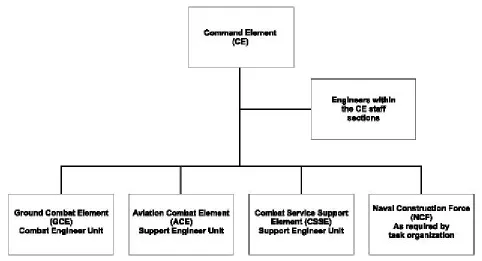
The number of engineers in the MAGTF command elements will depend upon the mission, structure of the MAGTF, and the magnitude of engineer effort. MAGTF tables of organization (T/Os) provide for e n g i n e e r s a n d w i l l l i k e l y b e s t a f f e d b a s e d o n expected missions. When the MAGTF command element is the nucleus of a joint force or combined headquarters, the engineer staff can be augmented with other U.S. or allied service engineers to provide the necessary personnel and experience required to conduct complex joint force and multinational operations. Because engineers are normally located in several sections of the headquarters, they can
provide great flexibility in orchestrating diverse engineer operations and allow for the greatest visibility of engineer capabilities, requirements, and responsibilities.
Functions
The engineers must work closely with other staff sections to integrate engineer considerations and r e q u i r e m e n t s i n t o a l l p h a s e s o f p l a n n i n g a n d execution. These phases include—
l Intelligence. Throughout the intelligence cycle, the engineers assist the G/S-2 in coordinating intelligence requirements. The engineers provide technical assistance in identifying, p r i o r i t i z i n g , a n d v a l i d a t i n g e n g i n e e r intelligence needs and in coordinating the c o l l e c t i o n o f e n g i n e e r i n f o r m a t i o n ( s e e chapter 2).
[image:10.612.60.542.71.332.2]l Operations. The engineers monitor the deployment, employment, and mission status of MAGTF engineer forces. The engineers f o cus the use of engineer capabilities to support the concept of operations. It is vital that engineers maintain situational awareness of the maneuver forces’ current and future courses of action (COAs) so that existing facilities (e.g., main supply route (MSR), tunnels, and bridges) do not constrain their
Engineering Operations—MCWP 3-17
1-3
proposed actions. During the targeting process, the engineers provide engineer target and risk analysis to help minimize the destruction of facilities so the damage does not exceed our a b i l i t y t o r e p a i r t h e m f o r u s e i n f u t u r e operations.
l Plans. The engineers work with the planners to maintain knowledge of future plans and their i m p l i c a t i o n s f o r e n g i n e e r r e q u i r e m e n t s . Engineer planners will identify all potential e n g i n e e r r e q u i r e m e n t s ( e . g . , m o b i l i t y , countermobility, survivability, topographic support, civil-military operations support, f a c i l i t i e s , r e a l e s t a t e , r e a l p r o p e r t y m a i n t e n a n c e , e n g i n e e r i n g s e r v i c e s , e n v i r o n m e n t a l c o n t r o l , a n d c o n s t r u c t i o n support) during the planning process. Chapter 3 provides information on potential engineer requirements.
l Facilities. A real property entity consisting of one or more of the following: a building, a structure, a utility system, pavement, and underlying land. (JP 1-02) The engineers coordinate facility services for the MAGTF and organizations supporting the MAGTF in the area of operations (AO).
Real Estate. The engineers are responsible for obtaining property during operations, based on the law of land warfare, host nation agreements, or other agreements. Property is obtained based on MAGTF facility requirements. Property is seized only when it is imperative to the necessities of war. Priorities for property acquisition are established based on the time the property is needed.
Real Property Maintenance. The engineers manage the leased properties and facilities so they are maintained according to the conditions of the lease, and that the property meets its functional purpose.
C o n s t r u c t i o n . T h e e n g i n e e r s m o n i t o r t h e construction efforts of the MAGTF engineer forces, and based on commander’s guidance, formulates construction policies, priorities, and standards.
Environmental Considerations
Operations should be planned and conducted with appropriate consideration for their effects on the environment in accordance with applicable U.S. and h o s t n a t i o n a g r e e m e n t s , e n v i r o n m e n t a l l a w s , policies, and regulations. Engineers are responsible for coordinating the environmental protection effort in the AO. Engineers assist the MAGTF commander
in coordinating environmental protection efforts in the AO. Environmental concerns are a part of any operation to include policies originating in the U.S., h o s t n a t i o n s , a n d a l l i e d f o r c e s . S p e c i f i c a l l y , engineers may be required to advise commanders how to minimize adverse effects of operational plans or how to resolve existing situations created by friendly or enemy forces.
Logistics
Engineers manage the bulk storage of fuel and water throughout the AO. Additionally, the engineers also assist logistics forces in monitoring the inventory and flow of Class IV material and recommend reordering levels.
Explosive Ordnance Disposal
Engineers are normally responsible for planning and coordinating explosive ordnance disposal (EOD) support. These activities include incidence response, area clearance operations, and foreign ordnance exploitation.
ENGINEER ORGANIZATIONS IN
THE GROUND COMBAT ELEMENT
The combat engineer battalion (CEB) is the Marine division commander’s organic combat engineering force. The CEB enhances the momentum and tempo of maneuver units and helps shape the battlespace for the Marine division. The battalion supports task-organized ground combat elements with combat engineer support to meet mobility, countermobility, and survivability requirements during offensive and defensive operations.
Mission
The CEB’s mission is to enhance the mobility, countermobility, and survivability of the Marine d i v i s i o n t h r o u g h c o m b a t a n d l i m i t e d g e n e r a l e n g i n e e r i n g s u p p o r t . T h e C E B p e r f o r m s t h e following tasks:
l Conduct engineer reconnaissance to support the division’s intelligence collection plan.
l Plan, organize, and construct obstacle systems.
l Plan, organize, and conduct breaching operations.
Engineering Operations—MCWP 3-17
1-4 l Employ assault bridging and other standard
b r i d g i n g s y s t e m s w h e n a u g m e n t e d w i t h equipment and trained personnel.
l Provide expedient repair and reinforcement of existing bridges.
l Construct expedient short span bridges from local material.
l Construct and maintain limited combat roads and trails in support of division operations (construction and maintenance requirements are limited to those that can be performed with organic equipment and personnel).
l Provide mission essential temporary vertical and horizontal construction.
l Provide provisional infantry.
Organization
Figure 1-2 illustrates the CEB organization.
Command and Control
The battalion commander organizes the battalion staff to enable command and control of the battalion and any engineer reinforcing elements (e.g., support from engineer support battalion). Collection efforts of higher and subordinate units, external agencies, and the battalion’s S-2 are integrated to meet all intelligence requirements. The CEB intelligence officer actively participates in the engineer portion of the division intelligence collection effort. The battalion is capable of self-administration.
Firepower
The CEB’s organic firepower consists of individual w e a p o n s , m a c h i n e g u n s , a n d l i g h t a n t i a r m o r weapons.
Transportation
The battalion requires motor transport support to move the battalion as a unit. However, there are adequate ground transportation assets (e.g., medical and logistic support vehicles including heavy trucks) organic to the battalion to accomplish its primary mission. Most of the battalion’s engineer assets require surface transportation; however, some engineer equipment is helicopter transportable.
Combat Service Support Capabilities
Combat service support (CSS) capabilities provide—
l Organic supply support.
l Organizational (1st and 2d echelon) m a i n t e n a n c e o n o r g a n i c e q u i p m e n t . Intermediate (3d and 4th echelon) maintenance is provided by Maintenance Battalion, force service support group (FSSG).
l Organic transportation support required to accomplish its mission.
l Limited general engineering capability.
l Routine and limited emergency medical support to the battalion.
l Administrative, postal and chaplain support to the battalion.
Concept of Employment
[image:12.612.135.466.533.694.2]The CEB organizes to support the engineering requirements of the division. The battalion can task-organize elements in support of subordinate units or can mass to concentrate engineer effort. If ground operations require decentralized combat engineering, the CEB still supports engineer requirements behind the forward line of own troops (FLOT).
Engineering Operations—MCWP 3-17
1-5
For planning and training purposes, each combat engineer company maintains a traditional direct support relationship with an infantry regiment or a regimental landing team (RLT) and each subordinate combat engineer platoon regularly supports an infantry battalion or battalion landing team (BLT). However, in planning for contingencies, a regiment or RLT may require a CEB (-) vice a reinforced company to provide broader scope and greater depth for tactical mobility and other combat engineering s u p p o r t . C o m b a t e n g i n e e r u n i t s a r e t y p i c a l l y reinforced by elements of engineer support and headquarters and service (H&S) companies to p r o v i d e t h e f u l l s p e c t r u m o f c o m b a t e n g i n e e r support. Likewise, engineering support to a BLT can be increased. The fourth combat engineer company of the CEB is normally kept in general support of the division. Traditional support relationships can be altered if mission analysis indicates that combat engineer support to other units (e.g., tanks company, assault amphibious vehicle [AAV] company, light armored vehicle [LAV] platoon) is more efficient. Mission, enemy, terrain and weather, troops and support available-time available (METT-T) is always considered in task-organizing and attaching combat e n g i n e e r u n i t s t o b e s t s u p p o r t t h e c o n c e p t o f operations.
If the requirement for combat engineer support exceeds the capability of the CEB, engineer support battalion (ESB) assets located in the CSSE provide reinforcement. The ESB, NCF, U.S. Army, host nation or other sources can also provide general engineering support capabilities beyond those organic to the CEB.
The scope of division combat operations may require reinforced combat engineer companies to directly support infantry or other task groups. This direct support relationship permits efficient control, maximizes productivity, and reduces administrative and logistical burdens. Direct combat engineer support of a maneuver company should be for limited duration and for specific tasks.
Headquarters and Service Company
Mission. The primary mission of the H&S company is to provide command, control, and administrative support for the battalion. This includes the provision of supply, food services, communications, chaplain services, and medical support.
C o n c e p t o f E m p l o y m e n t . T h e H & S c o m p a n y d e c e n t r a l i z e s i t s s u p p o r t f u n c t i o n s o f s u p p l y ,
communications, medical, chaplain, and messing to the extent necessary to meet battalion operational requirements. The company headquarters directs and controls all matters regarding internal administration, logistics, and security of the company.
Combat Engineer Company
M i s s i o n . T h e m i s s i o n o f t h e c o m b a t e n g i n e e r company is to enhance the mobility, countermobility, and survivability of the supporting ground combat element with combat engineering.
C o n c e p t o f E m p l o y m e n t . A combat engineer company normally operates under the control of the CEB commander when the battalion headquarters is a s h o r e . T h e c o m p a n y m a y o p e r a t e u n d e r t h e centralized control of the company commander or be i n w i d e l y d i s p e r s e d a r e a s w i t h t h e p l a t o o n commanders exercising more direct control of the companies assets, and the company commander a c t i n g a s a d v i s o r t o t h e i n f a n t r y r e g i m e n t a l c o m m a n d e r . A d d i t i o n a l l y , c o m b a t e n g i n e e r c o m p a n i e s c a n p r o v i d e g e n e r a l s u p p o r t t o t h e division and other task-organized maneuver units (e.g., light armored reconnaissance, tank, and AAV battalions).
Engineer Support Company
M i s s i o n . The mission of the engineer support company is to provide personnel and equipment or t a s k - o r g a n i z e d h e a v y e q u i p m e n t , u t i l i t i e s , maintenance, and motor transport support to other elements of the battalion.
Concept of Employment. The engineer support company provides essential engineering support in the forward areas and supports all CEB functional responsibilities. The company employs specialists, as individuals or in small units, for a specific mission in support of the combat engineer companies, however, the company is normally centrally controlled by the CEB commander.
ENGINEER ORGANIZATIONS IN
THE AVIATION COMBAT
ELEMENT
Engineering Operations—MCWP 3-17
1-6
airfields. To operate in a variety of forward-based environments requires a full range of aviation ground support (AGS) capabilities which are organic to the ACE. When an ACE operates from the sea or a forward base, AGS is essential to operations.
To provide AGS to the ACE requires organic task-organized units. In the Marine aircraft wing, the Marine wing support groups (MWSGs) and their s u b o r d i n a t e M a r i n e w i n g s u p p o r t s q u a d r o n s (MWSS) are responsible for providing AGS. The following functional areas of support comprise AGS and the services provided by the MWSG and/or M W S S . T h e s e 1 3 f u n c t i o n a l a r e a s a r e f u r t h e r categorized under two main categories: ground services support and air base services support.
Ground Services Support
Ground services support are activities and tasks necessary to establish and maintain base camp operations associated with an airfield. The following AGS functions are under ground services support:
l Internal airfield communications.
l Construction.
l Utilities.
l Materials handling equipment.
l Motor transport.
l Field messing.
l Medical services.
l Law enforcement services.
Air Base Services Support
Air base services support are activities and tasks necessary to establish and operate tactical air bases. The following AGS functions are found under the air base services support:
l Explosive ordnance disposal.
l Aircraft rescue and firefighting.
l Aircraft recovery services.
l Fuel services.
l Weather services.
The Marine Wing Support Group
Engineer support is integral to the success of the ACE. Ground services and air base operations require extensive engineer support. The MWSG and MWSS engineer section provides engineering support for forward-based air operations.
Mission. The MWSG provides essential AGS to the Marine aircraft wing (MAW) and its components. MWSG engineer assets support airfield operations and aviation combat elements in both expeditionary a n d f i x e d - b a s e l o c a t i o n s . E n g i n e e r t a s k s a n d functions performed by the MWSG are primarily general engineering oriented.
[image:14.612.166.443.495.702.2]Organization. Four squadrons compose the MWSG. All squadrons routinely operate in direct support of the MAW, and are structured to provide AGS for one airfield and two remote sites. The Personnel Support Detachment (PSD) provides administrative support to the MWSG and its squadrons (See figure 1-3).
Engineering Operations—MCWP 3-17
1-7 Command and Control. The MWSG normally has four support squadrons, two for fixed-wing aircraft and two for rotary wing aircraft. Each squadron provides direct support to a designated Marine air group (MAG).
Firepower. The MWSG’s firepower consists of individual weapons for self-defense purposes only.
Mobility. Adequate ground mobility (command, medical, and logistic support vehicles including heavy trucks) is organic to the MWSG. The MWSG requires external transportation support to effect displacement of the entire unit.
C o m b a t S e r v i c e S u p p o r t C a p a b i l i t i e s . C S S capabilities provide—
l Organic supply support.
l Organizational (1st and 2d echelon) m a i n t e n a n c e o n o r g a n i c e q u i p m e n t . Intermediate (3d and limited 4th echelon) maintenance is provided by Maintenance Battalion, FSSG.
l Organic transportation support required to accomplish its mission.
l Organic engineering support required to accomplish its mission.
l Routine and limited emergency medical support.
l Airfield security and law enforcement services.
Concept of Employment. The MWSG provides essential AGS for the MAW and organizes to provide one or more MWSS’s in support of a designated fixed-wing and/or rotary wing component of an ACE. MWSG maintains decentralized control of support squadron operations, except for squadrons collocated with or near the MWSG headquarters. The MWSG and its subordinate elements provide a wide variety of AGS of which engineering is only a portion. Since the bulk of the engineering support required is general engineering oriented, the MWSG i s a s s i s t e d b y t h e E S B a n d t h e n a v a l m o b i l e construction battalions (NMCB) as required.
Marine Wing Support Squadron
M i s s i o n . T h e M W S S p r o v i d e s e s s e n t i a l A G S support to a designated fixed-wing and/or rotary wing component of an ACE and supporting or attached elements of the Marine air control group.
[image:15.612.72.555.449.698.2]Organization. The MWSS is an integral part of the ACE. Both fixed-wing and rotary wing support squadrons organize identically with only slight variations in their authorized tables of equipment and personnel. The MWSS, as shown in figure 1-4, consists of a squadron headquarters, executive staff (S-1 through S-4), military police and flight line security department, and equipment maintenance department. The S-3 holds staff cognizance over internal airfield communications, airfield operations
Engineering Operations—MCWP 3-17
1-8
division, motor transport operations division, and engineer operations division. The S-4 holds staff cognizance over food services, medical, supply, maintenance, and fiscal divisions.
The engineer operations division of the MWSS organizes to provide limited combat and general engineering support to designated components of the ACE. Engineers located in the airfield operations division receive, store, and dispense aviation and ground fuels from various types of expeditionary fuel systems.
The engineer operations division is capable of—
l Providing engineer reconnaissance and survey.
l Repairing, improving, and maintaining existing road networks for the ACE.
l Constructing and maintaining expedient roads.
l Constructing, maintaining, and improving vertical or short takeoff and landing sites.
l Constructing and maintaining mission essential base camp requirements (temporary bunkers, aircraft revetments, and strongbacks).
l Providing technical and equipment assistance for erection of pre-engineered buildings.
l Providing utilities support (mobile electric power, water, potable water production, bath a n d l a u n d r y f a c i l i t i e s , a n d r e f r i g e r a t i o n services).
l Developing, improving, and maintaining drainage systems.
l Providing technical assistance to support camouflage requirements.
l Assessing bomb damage and providing minimal rapid runway repair (RRR).
l Providing material handling equipment services.
l Providing for EOD.
Command and Control. The squadron commander performs command and staff functions necessary for p l a n n i n g , d i r e c t i n g , a n d s u p e r v i s i n g a s s i g n e d missions. The MWSS operates under the centralized control of the MWSS commander, however, task-organized units may provide direct support to forward airbases or FARPs.
Firepower. The MWSS’s firepower consists of individual weapons and machine guns.
Mobility. Organizational vehicles of the squadron provide sufficient transportation for command,
control, and routine support activities. The squadron requires external transportation to displace as a unit.
C o m b a t S e r v i c e S u p p o r t C a p a b i l i t i e s . CSS capabilities provide—
l Organic ground supply support except for Navy funded equipment that requires support from a designated aviation supply element.
l Organizational (1st and 2d echelon) m a i n t e n a n c e o n o r g a n i c e q u i p m e n t ; intermediate (3d and 4th echelon) maintenance is provided by maintenance battalion, FSSG.
l Sufficient motor transport equipment to accomplish its mission.
l Limited general engineering capability required for the squadron’s mission.
l Routine and limited emergency medical support.
l Service company, H&S battalion, FSSG, provides service support.
Concept of Employment. The MWSS provides all A G S , i n c l u d i n g e n g i n e e r i n g , t o d e s i g n a t e d components of the ACE and simplifies command relationships by providing a single commander for all matters pertaining to AGS.
ENGINEER ORGANIZATIONS IN
THE COMBAT SERVICE SUPPORT
ELEMENT
Engineering Operations—MCWP 3-17
1-9
The Engineer Support Battalion
The ESB exists to provide a combat engineering capability for the entire MAGTF. The battalion provides the initial engineering support necessary to meet the combat and general engineering, bulk liquid, and utility support requirements of the MAGTF.
Mission. The mission of the ESB is to provide combat engineering and limited general engineering, bulk liquid, and utility support to the MAGTF. The ESB performs the following tasks:
l Combat engineering support.
l Standard and nonstandard bridging.
l EOD support.
l Handling, storing, and dispensing bulk fuel (Class III and Class III[A]).
l Tactical utility support.
l Expeditionary vertical and horizontal construction.
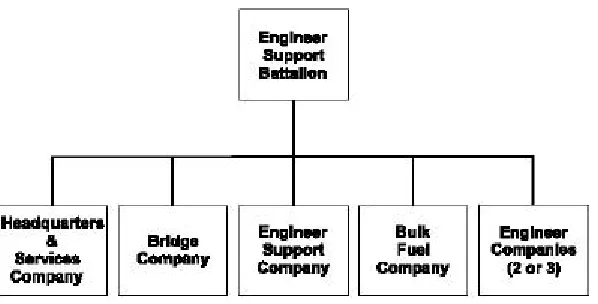
Organization. Figure 1-5 shows the organization of the ESB. The Bridging Company may be found assigned as a Reserve unit vice an active fleet asset.
Command and Control. The staff administers, directs, and supervises operations of the battalion and e n g i n e e r r e i n f o r c i n g e l e m e n t s . T h e b a t t a l i o n normally operates under the centralized control of the battalion commander. Engineer companies and platoons are sometimes attached to combat service support detachments in order to provide direct support to units throughout the MAGTF.
F i r e p o w e r . T h e E S B ’ s f i r e p o w e r c o n s i s t s o f i n d i v i d u a l w e a p o n s , m a c h i n e g u n s , a n d l i g h t antiarmor weapons.
Mobility. Adequate ground transportation to move essential command and operational elements is organic to the battalion. External motor transport support is required to move all assets (e.g., bulk fuel [Classes III and Class III (A)], bulk water, bridging, and heavy engineer equipment).
C o m b a t S e r v i c e S u p p o r t C a p a b i l i t i e s . CSS capabilities provide—
l Organic supply support.
l Organizational (1st and 2d echelon) m a i n t e n a n c e o n o r g a n i c e q u i p m e n t ; Intermediate (3d and 4th echelon) maintenance support is provided by maintenance battalion, FSSG.
l Organic transportation support required to accomplish its mission.
l Limited general engineering support.
l Routine and limited emergency medical support to the battalion.
l Administrative, postal, and chaplain support to the battalion.
[image:17.612.169.468.546.698.2]C o n c e p t o f E m p l o y m e n t . T h e E S B p r o v i d e s combat and limited general engineering in general support of the MAGTF. The battalion can provide separate units to support specific requirements; i.e., a combat engineer company to reinforce the CEB or MWSG. The battalion regains operational control of a l l o f i t s c o m m i t t e d a s s e t s w h e n t h e F S S G i s established ashore. Operating under centralized control, the battalion gives depth to the overall engineering effort by providing the GCE and ACE e n g i n e e r s u p p o r t t h a t e x c e e d s t h e i r o r g a n i c capabilities. The battalion works in concert with the NCF to provide comprehensive engineer support to the MAGTF.
Engineering Operations—MCWP 3-17
1-10
Headquarters and Service Company
Mission. The mission of H&S company is to provide command and control, administration, and command support functions for the ESB. The H&S company also provides EOD support to the MAGTF.
C o n c e p t o f E m p l o y m e n t . T h e H & S c o m p a n y provides the necessary command and control and command support functions for the coordination of battalion operations. Additionally, it provides EOD support to the MAGTF by providing EOD personnel to fill T/O requirements or task-organized EOD teams to support specialized missions.
Engineer Support Company
M i s s i o n . The mission of the engineer support company is to provide direct maintenance support for specified equipment organic to the battalion, direct transportation and services support to the battalion, and general support and/or reinforcing augmentation to the combat engineer companies of the battalion. The engineer support company is responsible for maintaining and providing—
l Engineer equipment for all units of the battalion.
l Utility support throughout the MAGTF.
Concept of Employment. The engineer support company provides task-organized elements as part of a battalion unit that is capable of rendering combat engineering, general engineering, and utilities capabilities to the MAGTF.
Combat Engineer Company
Mission. The combat engineer company provides combat engineering and limited general engineering support to the MAGTF.
Concept of Employment. The company normally operates under the centralized control of the ESB but can operate independently when reinforced with equipment and personnel.
Bridge Company
Mission. The mission of the bridge company is to provide standard bridging and ferrying support to enhance the mobility of the MAGTF.
Concept of Employment. The bridge company provides standard prefabricated bridge and ferry assets for the supported unit and limited construction m a n p o w e r . W h e n n e c e s s a r y , c o m b a t e n g i n e e r
c o m p a n i e s o r o t h e r l a b o r s o u r c e s w i t h i n t h e supported organization construct bridges and ferries from bridge company assets.
Bulk Fuel Company
Mission. The mission of the bulk fuel company is to receipt, store, and provide limited distribution of bulk f u e l ( C l a s s I I I a n d C l a s s I I I [ A ] ) t o M A G T F elements.
This support includes—
l Distribution to, but not within, air bases during a m p h i b i o u s o p e r a t i o n s a n d s u b s e q u e n t operations ashore.
l Distribution of Class III (A) products of the required type, quality, and purity to supported air elements.
Concept of Employment. The bulk fuel company provides detachments to the MAGTF’s CSSE. During amphibious operations, bulk fuel company elements are responsible for receiving fuel from lines established by the amphibious construction battalion of the naval beach group at the high water mark. The amount of fuel required and the systems necessary to support the requirement determine detachment size. Smaller detachments can use components of the expeditionary refueling system (e.g., 500-gallon fabric fuel tanks) to establish forward vehicle refueling points using either ground or helicopter transportation. Normally, the entire company deploys to support a MEF.
Explosive Ordnance Disposal Platoon
Mission. The EOD platoon’s mission is to neutralize hazards associated with unexploded U.S. and foreign ordnance and to disseminate technical information on enemy weapons and explosive ordnance material. This includes detection, identification, recovery, evacuation, and disposal of items of unexploded o r d n a n c e . D i s p o s a l c a n i n c l u d e d i s a r m i n g , destruction onsite, or removal and destruction off site. Ordnance types include—
l Conventional.
l Improvised.
l Nuclear.
l Biological.
l Chemical.
Engineering Operations—MCWP 3-17
1-11
c a p a b i l i t i e s o f o t h e r c o m p o n e n t s o f t h e MAGTF organizations to neutralize.
EOD personnel support the MAGTF by providing—
l Enhanced mobility through ordnance disposal (conventional, improvised, nuclear, biological, and chemical [NBC]).
l Foreign ordnance information and/or intelligence through collection, evaluation, and exploitation.
l U.S. ordnance information and/or intelligence t h r o u g h c o l l e c t i o n , e v a l u a t i o n , a n d exploitation.
l Direct action (DA) role supporting MEU (SOC [special operations capable]) operations.
C o n c e p t o f E m p l o y m e n t . T h e E O D p l a t o o n provides task-organized teams to the combat service support element of the MAGTF.
Naval Construction Force
Joint Pub 4-04, Joint Doctrine for Civil Engineering Support, describes the basis for NCF support to the Fleet Marine Forces stating (see also publications MCWP 4-11.5/NWP 4-04.1, Seabee Operations in the MAGTF):
In addition to, or coincident with, component missions specified by the Commander in Chief ( C I N C ) , t h e N a v y p r o v i d e s g e n e r a l engineering support to MAGTFs. This support consists of NCF units under the operational control of a MAGTF. These NCF units are n e c e s s a r y t o r e i n f o r c e a n d a u g m e n t t h e MAGTF’s limited engineering capability. They are integral to the organization of the MAGTF and ensure immediate and effective delivery of CSS tasks. [emphasis added]
Terms of Reference
Although an informal and deeply rooted relationship between Marines and Seabees existed since World War II, this relationship had no formal basis until 1 May 1987 when the Marine Corps and Navy adopted the terms of reference (TOR). The overall objective of the TOR is to achieve a coordinated program ensuring the full and effective use of Seabee capabilities when employed in support of MAGTF o p e r a t i o n s . A n e v o l v i n g d o c u m e n t , t h e T O R provides a means to address and resolve matters of mutual concern related to Seabee operations in the MAGTF.
The TOR provides historical background for the relationship between Marines and Seabees and
describes the Seabees’ organizational and functional capabilities, to include those Seabee units that would not normally be under the operational control of a MAGTF. It also establishes tactics, techniques, and procedures aimed at improving the interoperability of t h e M a r i n e s a n d S e a b e e s . F o r d e t a i l s o n t h e T O R , NCF organizations, and operations, see MCWP 4- 11.5/NWP 4-04.1, Seabee Operationsin the MAGTF.
Mission. Seabee units reinforce and augment the limited general engineering capabilities of the MAGTF and broaden the naval civil engineering spectrum of construction to enhance and sustain MAGTF operations ashore. Along with their general engineering efforts, Seabees also contribute military and amphibious assault construction support and enhance the MAGTF’s capability to provide disaster relief and forces for civic action operations.
Concept of Operations. As assets of Commander, U n i t e d S t a t e s A t l a n t i c F l e e t ( L A N T F L T ) a n d Commander, United States Pacific Fleet (PACFLT), the Seabees consist of active and reserve operational units. Most units are under operational control (OPCON) of either Commander, Second Naval Construction Brigade (COMSECONDNCB) or Commander, Third Naval Construction Brigade (COMTHIRDNCB) which are type commanders reporting directly to the two fleet commanders. The backbone of the Seabees is the naval construction regiments (NCRs) and their highly capable NMCB. T h e r e a r e a l s o s e v e r a l o t h e r t y p e s o f S e a b e e organizations fulfilling varying roles and missions. A c t i v e N M C B s , d e p l o y i n g t o f o u r p e r m a n e n t overseas deployment sites, constitute forward presence for the Seabees. An additional four NMCBs are in homeport status at any time, training for upcoming deployments. The bulk of the NCF is reserve units that provide additional and specialized c o n t i n g e n c y e n g i n e e r i n g a n d c o n s t r u c t i o n capabilities.
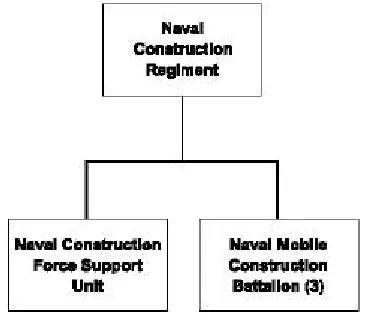
Naval Construction Regiment
The NCR consists of two or more NMCBs and a CE operating in a specific geographic area or operating in support of a specific military operation. The NCR i s t h e c o m m a n d a n d c o n t r o l e l e m e n t f o r a l l subordinate Seabee units assigned to support a MEF-sized MAGTF.
Engineering Operations—MCWP 3-17
1-12
equipment and materials. The CE has a planning, estimating, and engineering capability above the NMCB’s.
O r g a n i z a t i o n . Figure 1-6 illustrates the NCR organization.
Combat Service Support Capabilities. Combat service support capabilities provide—
l Organic supply support. The MAGTF G/S-4 coordinates procurement of Class IV materials for tasked projects undertaken by subordinate Seabee units.
l Organizational and intermediate (first through fourth echelon) maintenance on engineer organizational equipment. Organizational ( s e c o n d e c h e l o n ) m a i n t e n a n c e o f communications equipment and assigned weapons, less optical equipment.
l Organic transportation support to accomplish a s s i g n e d m i s s i o n s . H o w e v e r , a d d i t i o n a l support is required to displace as an entire unit.
l Construction engineering only.
l S e l f - a d m i n i s t r a t i o n , l i m i t e d o r g a n i c disbursing, postal, security, legal, civil affairs, graves registration, and information systems support.
l Food services support to itself only.
CSS has no capability for organic medical or dental capabilities, it is dependent on collocated MEF and/ or NMCB medical and dental assets.
Concept of Employment. The NCR CE is task-organized and equipped for employment as an assigned force in support of MEF-sized operations
when two or more NMCBs, operating in a specific area, are supporting the MEF. The NCR CE structure provides air- or surface-deployable elements in support of a specific military operation.
Generally, the NCR CE can—
l Conduct operations in all climate extremes.
l Maintain an organic table of allowance (TOA) capable of sustaining operations planned or envisioned under contingency or general war conditions for 60 days without resupply, except that Class I material is limited to 5 days, Class III is limited to 3 days, and Class V is limited to 15 days. Organic Class IV is limited to those materials required to construct the command element’s base camp. Resupply past the time frames noted is the responsibility of the supported MAGTF.
l Perform its mission using basic individual protective measures in a chemical, biological, a n d r a d i o l o g i c a l ( C B R ) - c o n t a m i n a t e d environment for 30 days.
Depending on the unit size and scope of the NCF support, an NCR (or NMCB) may be assigned OPCON to the FSSG or designated as a separate major subordinate command (MSC) by the MAGTF or MEF commander.
Naval Mobile Construction Battalion
The mission of the NMCB is to provide responsive military construction support to Navy, Marine Corps, and other forces in military operations; to construct and maintain base facilities; to repair battle damaged facilities and to conduct limited defensive operations as required by the circumstances of the deployment situation. It can also accomplish disaster control and recovery efforts when required. Specifically, the NMCB—
[image:20.612.70.253.154.314.2]l Performs tactical construction including pre-engineered buildings, bunkers, and towers; horizontal construction including unpaved roads and expeditionary airfields for fixed- and rotary wing aircraft consisting of mat runways and taxiways, helicopter landing areas, parking aprons, revetments, and FARPs; contingency staging facilities such as ammunition supply points (ASPs); power generation and water purification systems; beach improvements, beach exits, helicopter pads, and minor roads and camps; installation of standard bridging (e.g., medium girder bridges [MGBs]) and
Engineering Operations—MCWP 3-17
1-13
non-standard bridging; and maintenance, repair, and construction of MSRs.
l Performs base construction, to include p r e - e n g i n e e r e d b u i l d i n g s , c o n c r e t e a n d masonry buildings, and steel and concrete non-standard bridging; horizontal construction including asphalt roads, asphalt and concrete r u n w a y s , a n d p a v e d s t o r a g e , s t a g i n g , o r parking areas; and base power plant, sewage and water systems, water purification and desalination systems, and wire communication systems.
l Performs construction engineering including surveying and drafting; materials testing; and planning, estimating, and designing for local expedient projects.
l Performs specialized construction including well-drilling operations and other operations of limited scope (e.g., batch plant, quarry, rock crusher, dredging, block plant, sawmill, and pile driving operations).
l Conducts war damage repair (WDR) and RRR operations to include repairs to base camp utility systems; Petroleum, oils, and lubricants (POL) and bulk liquid distribution and storage systems; and communications facilities.
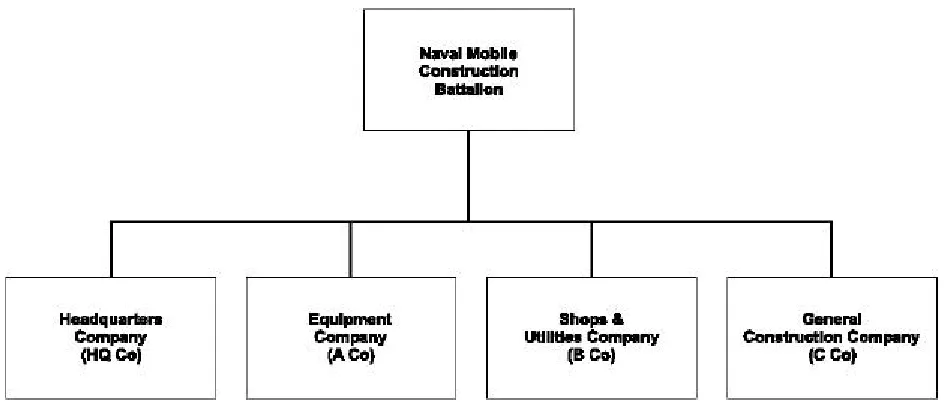
The NMCB normally functions as an integral unit. The NMCB generally consists of a headquarters company, one equipment company, one shop and
u t i l i t i e s c o m p a n y , a n d t w o t o t h r e e g e n e r a l construction companies. See figure 1-7.
Combat service support capabilities provide—
l Organic supply support. Procurement of Class IV materials for tasked projects is coordinated with the supported MAGTF G/S-4.
l Organizational and intermediate (first through fourth echelon) maintenance for engineer organic equipment and for naval construction for a support unit (NCFSU) augmentation equipment, as well as organizational (second echelon) maintenance of communications equipment and assigned weapons, less optical equipment.
l Organic transportation equipment to accomplish assigned missions and tasks.
l Construction engineering
l Routine and limited organic emergency m e d i c a l a n d d e n t a l s u p p o r t . H a s l i m i t e d ancillary capability (e.g., laboratory and X ray).
l Self-administration, organic ship services, disbursing, postal, legal, chaplain, and graves registration services support. The NMCB is capable of providing food services support to itself and collocated NCF units.
[image:21.612.74.546.465.670.2]The NMCB can function as an integral unit of the NCR or operate as a separate unit. The NMCB can
Engineering Operations—MCWP 3-17
1-14
provide task-organized detachments, up to 50 percent of its organizational size, to address specific support requirements. Nearly 85 percent of each NMCB can d e p l o y a s a n a i r e c h e l o n v i a s t r a t e g i c a i r l i f t (approximately 87 C-141, 44 C-17, or 30 C-5 equivalent lifts), with the remaining 15 percent (known as the sea echelon) following via sealift. Additionally, the NMCB—
l Conducts operations in climate extremes ranging from cold weather to tropical or desert environments.
l Maintains an organic TOA capable of sustaining construction operations planned or envisioned under contingency or general war conditions for 60 days without resupply, except that Class I material is limited to 5 days, Class III is limited to 3 days, and Class V is limited to 15 days. Class IV is limited to those materials required to construct the NMCB’s base camp. Resupply past the time frames noted is the responsibility of the supported MAGTF’s G-4, to be coordinated through the cognizant NCR’s command element if the N M C B i s t a s k - o r g a n i z e d i n a n a v a l construction regiment.
l Conducts construction operations in a MOOTW environment and in unsecured and isolated locations without protection of the supported MAGTF.
SPECIALIZED COMMAND AND
SUPPORT OF ENGINEER
ORGANIZATIONS
The concept of task organization dictates that the mission parameters drive the decision on the best way to organize MAGTF elements to support the m i s s i o n . A n u m b e r o f c o m b a t a n d s u p p o r t organizations have proven effective in facilitating timely and adaptive engineer support. Two of those organizations, engineer groups and liaisons, can have a great impact on small- and large-scale engineer operations.
Engineer Groups
An engineer group is a large, task-organized unit of combat support and CSS units from available Marine Corps, NCF, and engineer attachments from other U.S. military forces and host nation assets. The group supports a specific operation and disbands at the end of the operation. The establishment of an engineer group to support operations requiring extensive e n g i n e e r s u p p o r t c a n p r o v i d e t h e M A G T F commander with better visibility of infrastructure requirements and development and greater flexibility managing scarce engineer resources.
Liaison
Liaison is not a specific command and control structure in normal MAGTF organizations, but it provides advantages to the commander that would not otherwise exist. Liaison is the contact maintained between military force elements to provide mutual understanding and unity of purpose and action. Liaison between maneuver forces and engineer units ensures identification of operational requirements and aids in resource management. Formal and informal contact between staffs and commands at higher, lower, adjacent, supporting, and supported command levels is essential to the planning and execution of military operations. Engineer staffs and commands should develop temporary and permanent liaison elements to facilitate engineer planning and effective communications.
Chapter 2
Engineer Information
Engineer information is the result of organizing, collating, comparing, processing, analyzing, and filtering raw data requested by or provided by engineer units. It is then related to specific military activities and used by commanders in planning military operations and construction. Engineer information is comprehensive—it covers fields and levels of MAGTF engineering activity. It is also a part of geospatial intelligence. Engineer information includes, but is not limited to—
l Terrain, encompassing the location, identity, a n d p h y s i c a l d e s c r i p t i o n o f n a t u r a l a n d manmade features.
l Research, design, and employment of materials; techniques corresponding to that material; and techniques of interest and use to engineers.
l Order of battle of engineer units and similar information on civilian organizations capable of performing engineer missions.
INTELLIGENCE PREPARATION OF
THE BATTLESPACE
Intelligence preparation of the battlespace (IPB) is a systematic and continuous approach to analyzing the enemy, weather, and terrain in a specific geographic area. IPB uses enemy doctrinal norms and orders of battle to template enemy forces. It also attempts to a n t i c i p a t e t h e i r c a p a b i l i t i e s a n d p r e d i c t t h e i r intentions. Engineers must understand the G/S-2 doctrinal and situation template to analyze threat capabilities and the order of battle. The situation template becomes the foundation for the G/S-2 and e n g i n e e r c o o r d i n a t i o n . F o r e x a m p l e , o b s t a c l e intelligence and templating are developed in concert with the G/S-2’s templating of a motorized rifle battalion’s defense. The engineer G/S-2 will use the situation template to further develop intelligence r e q u i r e m e n t s ( I R s ) , p r i o r i t y i n t e l l i g e n c e requirements (PIRs), and named areas of interest ( N A I s ) t o s u p p o r t t h e e v e n t t e m p l a t e a n d t h e collection plan. The engineer will ensure obstacle i n t e l l i g e n c e c o l l e c t i o n i s i n t e g r a t e d i n t o t h e collection plan.
The IPB consists of the following three elements:
l Modified combined obstacle overlay.
l Enemy mission and capabilities.
l Friendly capabilities.
ENGINEER BATTLESPACE
ASSESSMENT
The engineer battlespace assessment (EBA) is developed in conjunction with the IPB, and focuses on engineer-specific intelligence. The engineer develops facts and assumptions and supports the IPB process by analyzing the terrain and weather and a s s e s s i n g t h e i r i m p a c t o n m i l i t a r y e n g i n e e r operations.
The engineer will analyze the terrain using the following five military aspects of terrain:
l Key terrain.
l Observation and fields of fire.
l Cover and concealment.
l Obstacles.
l Avenues of approach (AA).
Terrain analysis reduces the uncertainties regarding the effects of natural and manmade terrain on friendly and enemy operations.
Modified Combined Obstacle Overlay
Analyzing the military aspects of the terrain is accomplished primarily through preparing the modified combined obstacle overlay (MCOO) d e v e l o p e d b y t h e G / S - 2 w i t h t h e e n g i n e e r ’ s assistance. The MCOO graphically identifies AAs, cross-country mobility classifications, mobility corridors, and existing and future obstacle systems. A slope overlay can determine trafficability and intervisibility for intelligence collection, target acquisition, weapons capabilities, and obstacle integration. These products will be used for COA development and analysis.
Enemy Mission and Capabilities
Engineering Operations—MCWP 3-17
2-2
consider its doctrinal use of engineers. The engineer staff uses the G/S-2’s doctrinal and situation template to develop the threat engineer order of battle. The engineer staff officer will further assess the enemy’s m o b i l i t y , c o u n t e r m o b i l i t y , a n d s u r v i v a b i l i t y capabilities and template the enemy’s engineer effort. In coordination with the G/S-2, engineers will recommend IR and/or PIRs, attempt to augment the reconnaissance effort, and monitor the collection effort to confirm or deny the situation template.
In the defense, the engineer templates the enemy’s—
l Mobility capabilities and locations.
l Use of scatterable mine (SCATMINE) and other mines.
l Engineers in the reconnaissance effort.
l High-value targets (HVT) (e.g., bridging and breaching assets).
In the offense, the engineer templates the enemy’s—
l Tactical and protective obstacle effort and reinforcing fires.
l Use of SCATMINE and other mines.
l Survivability and fortification effort.
Friendly Capabilities
F r i e n d l y c a p a b i l i t i e s a r e b a s e d o n a v a i l a b l e manpower, equipment, resources, and training. Specific friendly considerations include relationship between survivability and countermobility (e.g., construct antitank ditch versus construct hull defilade positions versus construct turret defilade positions). The engineer staff uses the information developed in t h e m i s s i o n a n a l y s i s t o p r o d u c e t h e f r i e n d l y capabilities analysis. While task-organizing the engineer organizations, the engineer staff considers t h e p o s s i b i l i t y o f a d d i t i o n a l s u p p o r t f r o m t h e maneuver force and the higher-ranking engineer. Engineers must also consider the availability of critical resources. After determining the total assets available, the engineer staff uses planning factors or known unit work rates to determine the friendly capabilities.
The engineer staff officer combines the analysis of the terrain and the enemy and friendly capabilities to form facts and assumptions about—
l Enemy engineer effort and the most probable enemy COA.
l Critical friendly and enemy tactical events.
l Enemy vulnerabilities.
l Potential effect of these factors on the mission.
The facts-and-assumptions process is lengthy, and the engineer staff must focus on the information r e q u i r e d b y t h e m a n e u v e r c o m m a n d e r a n d t h e commander’s staff to make decisions. The EBA is a continuous process. Each time new information is collected, the engineer must evaluate the impact and/ or effect on the mission and refine the facts and assumptions as necessary.
TARGETING
The purpose of targeting is to attack vulnerable enemy installations, units, or equipment that best support the mission’s accomplishment. The targeting e f f o r t i s f o c u s e d o n t h e c o m m a n d e r ’ s i n t e n t . Targeting is “The process of selecting targets and matching the appropriate response to them, taking account of operational requirements and capabilities. The analysis of enemy situations relative to the commander’s mission, objectives, and capabilities at the commander’s disposal, to identify and nominate specific vulnerabilities that, if exploited, will accomplish the commander’s purpose through delaying, disrupting, disabling, or destroying enemy forces or resources critical to the enemy. See also joint targeting coordination board.” (JP 1-02)
The engineer’s role in the targeting process is analyzing facility targets and providing targeting information on obstacle plans to the fire support c o o r d i n a t o r ( F S C ) . T a r g e t a n a l y s i s e x a m i n e s potential targets to determine military importance, priority of attack, and weapon effects required to obtain a desired level of damage. The engineer staff must analyze the loss or damage to terrain, facilities, and infrastructure and their effect on the mobility, survivability, and sustainability of the force. If the facility or infrastructure is only targeted for damage, the engineer staff needs to determine the level of destruction the target can withstand yet be repairable with organic engineer capabilities for friendly use.
T h e e n g i n e e r s t a f f m u s t p r o v i d e t h e F S C t h e following information on obstacles for inclusion in the target list:
l Location.
Engineering Operations—MCWP 3-17
2-3 l Description (type of obstacle and
construction).
l Vulnerability.
l Recovery time (estimated time for the enemy to repair obstacle).
l Accessibility (location of the obstacles to other terrain or cultural features that may limit the direction or angle of attack).
l Importance.
Chapter 3
Engineering Reconnaissance
Engineer reconnaissance collects data that provides engineers within a MAGTF information on terrain, hydrographics, meteorological, and infrastructure (e.g., built-up areas, transportation networks, utilities, existing natural or manmade obstacles) necessary to support the commanders with their planning for ongoing or future operations. Engineer r e c o n n a i s s a n c e i s v i t a l t o s u c c e s s f u l M A G T F operations. The following are the fundamentals of engineer reconnaissance:
l Orient on the location or movement of the objectives relative to engineers.
l Discover gaps and other weaknesses in enemy dispositions.
l Confirm trafficability and other terrain characteristics.
l Report all information accurately.
l Avoid decisive engagement.
l Develop situation and rapidly—
n Deploy.
n Reconnoiter.
n Take a course of action.
n Report.
n Egress.
RECONNAISSANCE MISSIONS
The reconnaissance mission relates not only to the e n g i n e e r m o b i l i t y m i s s i o n b u t a l s o t o countermobility, survivability, and general engineer missions. See MCRP 3-17A/FM 5-34, Engineer Field Data, and MCRP 3-17B, Engineer Forms and Reports, for the appropriate forms to support the following missions.
Route Reconnaissance
Route reconnaissance obtains information about enemy obstacles (including NBC contamination), route conditions, and critical terrain features along a s p e c i f i c r o u t e . T h e t e c h n i q u e s a r e l e s s t i m e -consuming and are performed more rapidly than other types of reconnaissance. Imagery, maps, and intelligence studies identify likely beach, landing zone, or inland exits and movement routes.
Zone Reconnaissance
Zone reconnaissance is used when the enemy’s location is in doubt or if it is desired to locate suitable routes or determine conditions of cross-country trafficability. It obtains detailed information about routes, obstacles, key terrain, and enemy activity in a zone established by definite lateral boundaries.
Area Reconnaissance
Area reconnaissance obtains detailed information about all routes, obstacles, and enemy forces within any clearly defined area. Details can include size and layout of towns; types, densities, and locations of woods; or possible fording sites of water obstacles. It is the most time-consuming of the three types of reconnaissance. Types of area reconnaissance include—
Water Reconnaissance. Initially, the landing force b r i n g s p o t a b l e w a t e r a s h o r e . E n g i n e e r reconnaissance locates and develops additional water sources ashore. Ground engineer reconnaissance confirms sources previously determined by aerial photos, maps, and intelligence studies.
Engineer Material Reconnaissance. Engineer reconnaissance locates sources of lumber, timbers, standing timber, gravel, rock, sand, and other local construction materials. It may also locate enemy engineer construction equipment and/or facilities such as parts stores, asphalt or concrete batch plants, and heavy machinery.
A i r f i e l d S i t e R e c o n n a i s s a n c e . A i r f i e l d s i t e selection begins prior to friendly forces going ashore. This can be accomplished by studying maps, photos, and products from other imagery and intelligence sources and flying over the site. Because micro-terrain can severely affect airfield operations, final selection is not done until physical reconnaissance confirms the utility of the landing sites designated prior to the assault and quantifies upgrade and/or repair requirements.
Reconnaissance Considerations
Engineering Operations—MCWP 3-17
3-2
MAGTF should be involved in evaluating the impact o f t h i s o n a n y m i s s i o n . R e c o n n a i s s a n c e considerations for missions also include—
l Mobility—
n Route reconnaissance. Enemy obstacle barrier reconnaissance.
n Bypasses identification.
l Countermobility—
n Barrier Planning.
n Target and/or obstacle folders and target analysis.
l Survivability—
n Friendly forces emplacement.
l General Engineering—
n Utility assets location.
n Water points location.
n L o c a l c o n s t r u c t i o n m a t e r i a l s identification.
n Existing facilities location.
OFFENSIVE AND DEFENSIVE
OPERATIONS
Engineer reconnaissance in the offense should be placed far enough forward of the maneuver elements perform proper route and obstacle reconnaissance. This must be done in order to return information to the rear in a timely manner. Engineer reconnaissance should have the capability to—
l Provide a detailed report of all existing and reinforcing obstacles along the maneuver
element’s axis of attack. The reports should include estimates for breaching.
l Provide information on routes along the axis of advance that may influence the commander’s plan such as vulnerabilities and critical choke points.
l Provide information on water, electric, fuel, and other engineer resources.
l Locate bypasses far enough in advance of the l e a d e l e m e n t t o p r e v e n t s l o w i n g t h e momentum of the maneuver element’s attack.
l Provide information about the countermobility capability of the enemy.
The major use of the engineer reconnaissance in the defense is to provide information for the obstacle a n d / o r b a r r i e r p l a n . T h i s i n f o r m a t i o n m a y b e obtained forward of the forward edge of the battle area (FEBA), to the rear of the FEBA, or to the flanks. Specific requirements in the defense are—
l Detailed information on choke points.
l Detailed demolition estimates for the creation of obstacles.
l Resources for obstacle construction.
l Routes in support of a retrograde or lateral movement.
l Route reconnaissance on likely avenues of approach for the enemy.
l Enemy’s breaching capability.
l Obstacle emplacement in the enemy’s rear capability.
Chapter 4
Combat Engineering Operations
“Every successful military operation is directed toward a clearly defined, decisive, and attainable objective. The ultimate military objective is to defeat the enemy’s forces or destroy his will to fight.”
—MCWP 3-1, Ground Combat Operations
C o m b a t e n g i n e e r i n g i s a n i n t e g r a l p a r t o f t h e MAGTF’s ability to maneuver. Combat engineers e n h a n c e t h e f o r c e ’ s m o m e n t u m b y p h y s i c a l l y shaping the battlespace to make the most efficient use of the space and time necessary to generate mass and speed while denying the enemy unencumbered maneuver. By improving the battlespace, combat engineers accelerate the concentration of combat power, increasing the velocity and tempo of the force necessary to exploit critical enemy vulnerabilities. B y r e i n f o r c i n g t h e n a t u r a l r e s t r i c t i o n s o f t h e battlespace, combat engineers limit the enemy’s ability to generate tempo and velocity. These limitations increase the enemy’s reaction time and physically and psychologically degrade his will to fight.
BARRIER, OBSTACLES, AND
MINES
“Employment of barriers, obstacles, and mine warfare can, in concert with other capabilities, enhance a commander’s ability to mass combat power, sustain the force, conduct offensive or defensive operations, achieve surprise, and use key terrain, airfields, or sea routes. A commander must consider both friendly and enemy employment of these capabilities in preparing plans and conducting operations.” (JP 3-15, Joint Doctrine for Barriers, Obstacles, and Mine Warfare) Barriers, obstacles, and mines have a significant impact on operations. C o m m a n d e r s m u s t c o n s t a n t l y c o n s i d e r t h e advantages and disadvantages of their employment and countering them during planning and execution.
Barriers, obstacles, and mines—
l Inflict significant equipment and psychological damage and personnel casualties on the enemy with minimal risk to friendly forces.
l Extend, strengthen, and deepen other defensive and offensive measures to support the concept of operations.
l Immobilize the enemy until barriers, obstacles, or minefields are bypassed, breached, or cleared.
l Exploit geographic features.
l Free forces for other employment.
l Create uncertainty for the enemy commander.
Disadvantages of barriers, obstacles, and mines include—
l Amount of time, material, equipment, and transportation that their creation and removal can consume. Creation and removal will be manpower-intensive and hazardous.
l Bypassability, breachabili