ISSN Online: 2160-5920 ISSN Print: 2160-5912
DOI: 10.4236/iim.2018.103006 May 14, 2018 79 Intelligent Information Management
New Measures of Chinese University Library
Knowledge Service under the Cloudization
Background
Jiayin Liu
1, Chen Chen
21Library, Nanjing University of Aeronautics and Astronautics, Nanjing, China
2Institute of Scientific and Technical Information, Nanjing University of Aeronautics and Astronautics, Nanjing, China
Abstract
This article mainly explores and analyzes the application of network broadcast in the lecture service of university library under the cloudization background. By using the online survey method to investigate the lectures in some univer-sities, it introduces the classification and characteristics of the network broadcast and obtains the advantage of network broadcast applied to lecture training through making contrast between the means of network multimedia. The result shows that the introduction of network broadcast can realize more customized, virtual and specialized lecture services, and facilitate the trans-formation of university library services in the digital era.
Keywords
University Library, Network Broadcast, Lecture Training, Information Services, Information Literacy
1. Introduction
University library is an important place for students to acquire knowledge, broaden their horizons, develop skills, improve their professional learning and lifelong learning ability, and is their “second classroom”. The lecture service is an important part of education for university library users and also an important window for the communication between teachers and students. With the help of this way, it can change “passive service” into “active transmission”, which can not only improve the readers’ information literacy and promote library re-sources and services, but also can enhance the academic atmosphere of the li-brary and attract more readers to promote the its development.
How to cite this paper: Liu, J.Y. and Chen, C. (2018) New Measures of Chinese Uni-versity Library Knowledge Service under the Cloudization Background. Intelligent Information Management, 10, 79-86.
https://doi.org/10.4236/iim.2018.103006
Received: March 8, 2018 Accepted: May 11, 2018 Published: May 14, 2018
Copyright © 2018 by authors and Scientific Research Publishing Inc. This work is licensed under the Creative Commons Attribution International License (CC BY 4.0).
http://creativecommons.org/licenses/by/4.0/
DOI: 10.4236/iim.2018.103006 80 Intelligent Information Management Network broadcast is a new form of network media, which refers to that the scene produces and delivers information synchronously along with the occur-rence, progress and process of certain event and has the information distribution method with two-way circulation process. At present, there are nearly 200 live platforms in China, with 200 million users and about 9 billion yuan of market size. The year of 2016 has become a truly “the first year of network broadcast”. Network broadcast has become the most eye-catching “tuyere” in the Internet industry [1].
The university library has always been the leader and practitioner of new technology. Nowadays, the change of digital environment is redefining the status and function of the library and it is facing a new round of transformation and upgrading. Through the investigation and analysis of the present situation of university library lectures and combined with characteristic of network broad-cast, the author discusses how to apply this novel way to lecture service and in-formation literacy education.
2. Present Situation of University Library Training Lectures
2.1. Related Research Review
At present, there have been a lot of researches on the training lectures of univer-sity libraries. The author has carried out literature research and combed about the relevant literatures in recent three years, and roughly divides them into three categories.
The first category is the empirical study based on the present situation inves-tigation. Though conducting a survey about the classification and main content of user training lecture of 12 university libraries at home, Han Li points out problems of university library user training lecture which exists in the aspects of publicity, content setting, lecture attendance, and acquisition of courseware, puts forward solutions according to the practice of training lectures and predicts the development trend of library user training lectures [2]. Frandsen and Tibyam-pansha explored how library training can promote electronic resource usage. The result shows that training sessions increase the usage of library e-resources significantly; however, the effect seems to be short-lived and training sessions alone may not increase the overall long-term usage [3].
Chapu-DOI: 10.4236/iim.2018.103006 81 Intelligent Information Management tula, A.H surveys the use of Whatsapp, Facebook and other public platform in carrying out lectures and puts forward suggestions, such as scientific setting of lecture menu, the application of mass texting and interactional function in lecture survey, lecture reservation and establishment of group lecture platform and so on. The third category is to carry out the contrast research at home and abroad [6].
The third category is to carry out the contrast research at home and abroad. Hai Lan, Li Gang and others adopts web-based survey to collect the data of reader training lectures carried out at domestic and foreign university libraries, have analyzed its similarities and differences through comparison of its form and content, have expounded the characteristics of lectures and at last, have pro-posed suggestions towards university library about perfection of reader training lecture from the three aspects: satisfy information requirements of readers in different levels, expand the forms of reader training lecture and strengthen the teaching staff construction of training lecture [7].
Existing researches have made helpful discussions about various aspects of university library lectures from survey, application and comparison, which can be seen the importance of lecture service on university libraries. However, at present, there are few case analyses that introduce network broadcast, the form and content of library lecture change along with time, pay attention to explore its development mode and fit the reader demand, which is worthy of attention.
2.2. Research about Some Universities
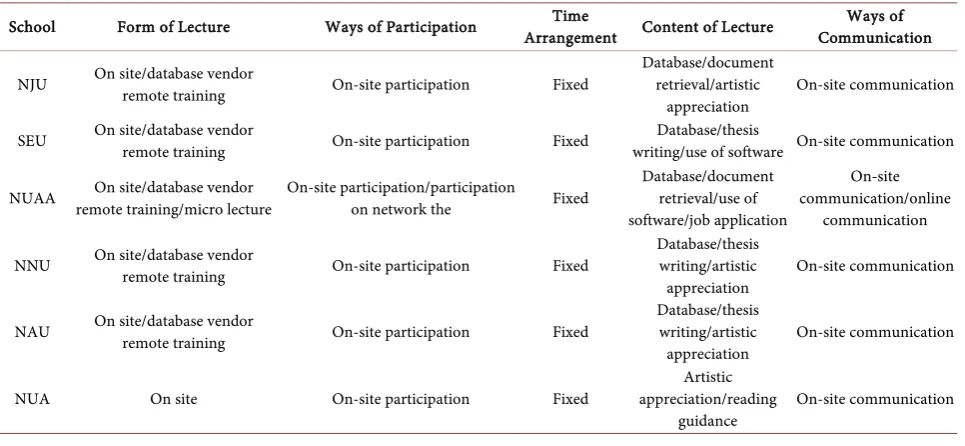
[image:3.595.58.541.501.724.2]At the beginning of the study, the author investigated the situation of some uni-versities through webpage retrieval. It contains 985, 211 and general undergra-duate level, which involves comprehensive, technical, agricultural, normal and artistic properties, and basically involves various colleges and universities. The results are shown in Table 1.
Table 1. Comparison of the present situation of some university lectures.
School Form of Lecture Ways of Participation Arrangement Content of Lecture Time Communication Ways of
NJU On site/database vendor remote training On-site participation Fixed Database/document retrieval/artistic
appreciation On-site communication SEU On site/database vendor remote training On-site participation Fixed writing/use of software On-site communication Database/thesis
NUAA remote training/micro lecture On site/database vendor On-site participation/participation on network the Fixed Database/document retrieval/use of software/job application
On-site communication/online
communication
NNU On site/database vendor remote training On-site participation Fixed Database/thesis writing/artistic
appreciation On-site communication
NAU On site/database vendor remote training On-site participation Fixed Database/thesis writing/artistic
appreciation On-site communication
NUA On site On-site participation Fixed appreciation/reading Artistic
DOI: 10.4236/iim.2018.103006 82 Intelligent Information Management
2.3. Analysis of Current Situation and Existing Problems
2.3.1. Single Form and Inconveniences in Participation
According to the results of the survey, the lecture forms of the above six univer-sities are mainly on-site lecture in the library and the remote online training of database vendors. Some schools have special lectures on specific subjects and specific levels of readers, but the fixed time and place have a high requirement on readers, and when the time is difficult to arrange, it is easy for readers to miss and difficult to make up.
2.3.2. Single Form and Inconveniences in Participation
According to several years of data statistics, the normal lectures of library are basically the same every year, with fewer famous special lectures. This is may the positioning of the library itself, but if there is no new idea, it is hard to attract readers in new era who have increasingly sharp taste and multiple channels of information acquisition. At the same time, there is limited time for answering and communicating on the on-site lecture, and many audiences with enthusiasm and problems fail to solve the problem on the spot and can’t communicate fur-ther after the lecture.
2.3.3. Lack of Publicity and Stuck in their University
Through the author's investigation, we find that on the one hand, the publicity of lecture in each school is different, but generally it is weaker, and it in only li-mited to posters in libraries, grade QQ group transmission and WeChat official accounts push, which doesn’t form better social publicity, and many readers even don’t know the existence of lectures; on the other hand, the lecture com-munication among universities is limited, and meanwhile, it is difficult to basi-cally cover the social people outside school who have information requirements. As a result, the number of lectures is small, but many readers who are in need are not satisfied.
3. Network Broadcast Platform and Application Analysis
3.1. Classification and Characteristics of Live Broadcast Platforms
From the classification of live broadcast channels, the platform mainly includes PC terminal and mobile terminal. There is no strict boundary between the two platforms, and both of them can be watched on their web pages or mobile ter-minals and show a trend of integrated development. The differences between the two platforms are mainly reflected in the way they are recommended to be watched, which also leads to huge differences in the main direction of the live broadcast platform, the type of anchors and the audience’s preferences.DOI: 10.4236/iim.2018.103006 83 Intelligent Information Management broadcasting platform is a kind of live broadcast platform with good develop-ment, mature business model and stable audience at present. However, the emerging vertical field broadcasting platform focuses on the single field, uses the long tail theory to capture the market segmentation and satisfies the certain needs of audience in entertainment, education and consulting.
In terms of communication characteristics, network broadcast has the charac-teristics of time fragmentation, instant interaction, bullet screen culture and quick sharing. Time fragmentation means that network broadcast can be watched in a fragmental time, without the need for the fixed time; instant inte-raction is similar to social software. The two-way real-time inteinte-raction of live streaming software is difficult for other words and video communication me-thods to match; as a subculture, bullet screen culture realizes the organic circula-tion of cultural produccircula-tion and consumpcircula-tion in network broadcast; quick shar-ing refers to the ability of the audience to share the broadcast to friends circle, micro blog and other social software easily by sending a link or QR code, the au-dience is accurate, and spread quickly.
3.2. Comparative Analysis of Network Broadcast Platforms
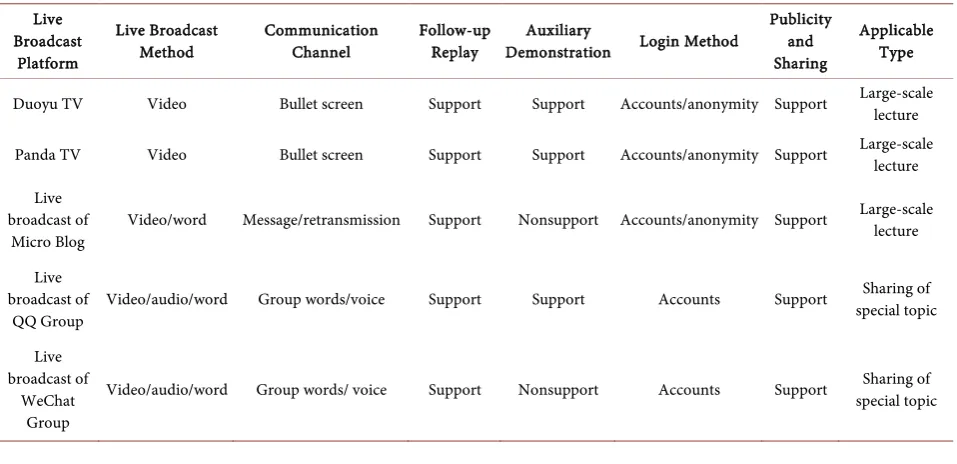
[image:5.595.60.539.496.728.2]As mentioned above, the types and amount of network broadcast platform are various at present. Through the network investigation and contrast, the author has chosen six network broadcast platform with broad user base, relatively com-plete function and characteristics, including PC terminal and mobile terminal. Meanwhile, according to the requirements of library lectures, pay attention to understand live broadcast methods, communication channel, follow-up replay, auxiliary demonstration and other aspects, and make a judgment on the applica-ble types. The results are shown in Taapplica-ble 2.
Table 2. Common network broadcast platform.
Live Broadcast
Platform
Live Broadcast
Method Communication Channel Follow-up Replay Demonstration Auxiliary Login Method
Publicity and Sharing
Applicable Type
Duoyu TV Video Bullet screen Support Support Accounts/anonymity Support Large-scale lecture
Panda TV Video Bullet screen Support Support Accounts/anonymity Support Large-scale lecture
Live broadcast of
Micro Blog Video/word Message/retransmission Support Nonsupport Accounts/anonymity Support
Large-scale lecture
Live broadcast of
QQ Group Video/audio/word Group words/voice Support Support Accounts Support
Sharing of special topic
Live broadcast of
WeChat Group
DOI: 10.4236/iim.2018.103006 84 Intelligent Information Management
3.3. Contrastive Analysis on the Application of Network Broadcast
and Other Network Platforms
Before the network broadcast rises, the university library has used wed-based multimedia to make a lot of beneficial explorations about their lecture forms, and among them, some prominent ways are: introduction of the database ven-dor training platform, the construction and use of MOOC platform and lecture resources sharing through FTP or network disk. Through survey, the author finds that although these methods have their own characteristics, they are not consistent with the objectives of the lecture activities in general, users have low enthusiasm in participation and the functional experience is unsatisfactory. The training platform of database vendors needs to register special accounts and wait for specific time, the lecture content is fixed, and various operations cannot meet the requirements of lecturers well; MOOC are more suitable for the study of professional courses but lack of real-time interactive experience of lectures; re-source sharing can only show part of the lecture, and PPT or lecture notes are only a supplement to the speaker. In general, the existing functions of network broadcast platform are more suitable for the in-depth development of lecture training than other methods.
4. Advantage Analysis on Application of Network Broadcast
in Lecture Training
4.1. Reduce the Cost of Libraries and Readers
Entity library lectures invite experts, arrange staff and prepare equipment and site, which will bring a series of economic cost, but if putting part of the lecture on the Internet, it only needs simple recording and camera equipment as well as network, which is very simple and convenient; at the same time, readers are free to choose time to tune in and watch and don’t need to line up in advance. Make use of the fragmental time to study, which can reduce the time cost. Both sides get more information at a lower information cost and achieve a win-win situa-tion.
4.2. Break the Traditional Time and Territorial Restriction
DOI: 10.4236/iim.2018.103006 85 Intelligent Information Management
4.3. Conveniently Subdivide Groups and Diversify Forms
Traditional lectures label suitable people or majors, but most of the lectures are aimed at all readers, and there are fewer lecture contents for the minority and professional lecturers. Most of the lecturers are professionals and the chances for ordinary people to share knowledge and get on the platform are relatively small. However, the broadcasting cost of network broadcast is reduced and the con-venience is greatly enhanced, which can satisfy the demands of more subdivi-sion, make small groups fully share and communication and make individuals with professional knowledge and skill sharing willingness can give a lecture as a speaker. And the subdivision of audience and rise in the number of speakers make the lecture forms more diversified, and in the future, it can conduct out-door field visits like practice base outside libraries and contrast and communica-tion in public libraries, etc.
4.4. Provide Free Exchange and Feedback Platform
Network broadcast makes communication become timelier, and through mes-sage and bullet screens, readers can easily ask and communicate as well as can have the follow-up communication with speakers and other readers after the lecture, and even build a long-term relationship through social software. In terms of library, feedback of readers can be conveyed more timely and be im-proved continuously; for speakers, questions in past lectures have become real-time communication, which can be more closely related to the needs of the readers in lecture and control the situation in the process, and speakers them-selves can also gain improvement.
4.5. Expand Resource Reuse and Social Services
There are usually lecture alliances among public libraries, sharing resources of each library and social organization, while most lectures of university library are only limited to their own school. The introduction of the network broadcast makes it very convenient for universities to share lecture resource with each other. The lecture in single school can benefit many universities through spread of social media. The screen recording and sound recording of network broadcast can be used repeatedly in different times, and compared with simple download-ing of PPT, it is more comprehensive. The general trend of library development is to keep pace with social development, and modern libraries need to enhance the correlation with the society, participate in the process of social development and realize its own value from it. There exist various difficulties in the social open of university library at present, but network broadcast can benefit social person outside the school without increasing the operating costs of university li-braries, which can be a window of social service for university library.
5. Conclusion and Prospect
DOI: 10.4236/iim.2018.103006 86 Intelligent Information Management university library, and introduce network broadcast to realize more customized, specialized and virtualized service, which also is one of methods for university library to indicate its social functions and professional value to digital age. The research scope of this paper is limited to Chinese universities, and only relevant suggestions are put forward. In subsequent research, practical activities need to be carried out. Although there are many details such as copyright of live broad-cast and workflow system needing to be perfected in actual operation, no matter how to change, it is an eternal pursuit of library, a growing organism, to serve for readers and save their time.
Acknowledgements
This work was funded by the Project of Philosophy and Social Science of univer-sities in Jiangsu Province (2014SJD051) and the Fundamental Research Funds for the Central Universities (NR2014048).
References
[1] iiMedia Research. Special Research on 2016 Chinese Live Broadcast Online Indus-try. http://www.iimedia.cn/42373.html
[2] Han, L. (2014) Analysis of Current Situation and Problems of User Training Lec-tures in University Libraries—Based on the Investigation of 12 University Libraries in China. Information Research, 6, 132-135.
[3] Frandsen, T.F., Tibyampansha, D., Ibrahim, G.R., et al. (2017) Library Training to Promote Electronic Resource Usage: A Case Study in Information Literacy Assess-ment. 6285.
[4] Chen, Q. and Zhou, J.F. (2016) Analysis on Application of Micro-Video in Training Lectures of University Library. Researches in Library Science, 4, 88-93.
[5] Zhou, Y.X. and Xiong, Y. (2017) Live Broadcast Classroom: A Feasible Solution for Chinese Rural Weak Education. International Journal of Distance Education Tech-nologies, 15, 31-46. https://doi.org/10.4018/IJDET.2017070103
[6] Chaputula, A.H. and Mutula, S. (2018) Provision of Library and Information Ser-vices through Mobile Phones in Public University Libraries in Malawi. 2.