Framework for manufacturing organisations
KHAMKHAM, Mohamed
Available from Sheffield Hallam University Research Archive (SHURA) at: http://shura.shu.ac.uk/19159/
This document is the author deposited version. You are advised to consult the publisher's version if you wish to cite from it.
Published version
KHAMKHAM, Mohamed (2017). Development of an integrated quality management Framework for manufacturing organisations. Doctoral, Sheffield Hallam University.
Copyright and re-use policy
See http://shura.shu.ac.uk/information.html
Sheffield Hallam University Research Archive
Development of an integrated quality management
Framework for manufacturing organisations
Mohamed Khamkham
A thesis submitted in partial fulfilment of the requirements of
Sheffield Hallam University for the degree of Doctor of
Philosophy
Acknowledgements
First of all, I would like to express my sincere and earnest thanks to Allah’s greatness for the gift of life, for His blessings and for giving me the health and strength to finish this work.
Secondly, I am wholeheartedly thankful to my supervisor, Prof Sameh Saad, for his guidance and continuous encouragement throughout the research. I am grateful and speechless for his invaluable support and dedication.
I would like also to extend my gratitude to those who participated in the questionnaire surveys resulting in its high response rate. Without their valuable contributions, this research would not be accurate.
My profound gratitude also goes to my brother and friend, Sulieman Agela, who had offered me this opportunity to study PhD in the United Kingdom.
I would like to acknowledge and pray for the spirit of my brother Mousa who had offered me this opportunity to complete may postgraduate study, and the spirit of my father who was the last words to me pray every success in this journey and also the spirit of my mother who was pried to me with every reconcile. I owe my sincerest thanks and gratitude to my wife, who in addition to her continued encouragement and understanding took the load of the children, home (and me) and provided an environment that, allowed me minimal disruption in order to finish this study successfully.
AHP: Analytic Hierarchy Process ASQ: American Society for Quality
ARMI model: (Approve, Resources, Member, Interested, Interested party) COPQ: Cost of Poor Quality
CP: Process Capability Potential CPk:Process Capability Actual CSFs: Critical Success Factors CTC: Critical To Cost
CTQ: Critical, To, Quality CTS: Critical To Schedule DFSS: Design for Six-Sigma
DMAIC: Define, Measure, Analyse, Improve and Control DMDIV: Define, Measure, Design, Improve and Verify DOE: Design of Experiment
DPMO: Defect per Million Opportunity DPU: Defect per Unit
EFA: Exploratory Factor Analysis FA: Factor Analysis
FMEA: Failure Mode Effect and Analysis
GRPI checklist: (Group, Resources, Process, Interpersonal Relations) IQM: Integration Quality Management
IQM-FW: Integrated Quality Management Framework ISO: International Organisation for Standardization KIP: Key Indicator Performance
LSS: Lean Six-Sigma
PDCA: Plan, Do, Check and Act QCC: Quality Control Circle
QFD: Quality Function Deployment QIT: Quality Improvement Team ROI: Return on Investment RPN: Risk Priority Number RTY: Rolled Throughput Yield
SIPOC: Supplier Input Process Output Customer SPC: Statistical Process Control
SPSS: Statistical Package for Social Science SS: Six-Sigma
SS-TQM: Six-Sigma TQM integrated Model SUF: Single Unite Flow
TPM: Total Productive Maintenance TQM: Total Quality Management VOB: Voice of Business
VOC: Voce of Customer VOP: Voice of Process VSM: Value Stream Mapping
Saad, M.S. and Khamkham, M. (2016),"Development of Lean Six-Sigma conceptual implementation model for manufacturing organisations", Proceeding
of the 14th International Conference on Manufacturing Research, incorporating
the 31st National Conference on Manufacturing Research, September 6-8,
2016, Loughborough University, UK, Vol 3, pp. 497-502.
Saad, M.S. and Khamkham, M. (2016).
"
A conceptual model for successful implementation of lean Six-Sigma for manufacturing organisations".International Journal of Lean Six Sigma.
Saad, M.S. and Khamkham, M. (2017), "Development of a business excellence conceptual model for manufacturing organization - A Six-Sigma and TQM integrated approach". Proceeding of the 15th International Conference on Manufacturing Research, incorporating the 32st National Conference on
Manufacturing Research, September 5-7, 2017, Greenwich university London
UK
During the last couple of decade's operation management methods such as Six-Sigma, Lean Manufacturing and TQM have been implemented by many organizations to facilitate the production lines and to improving the operation performance. However, none of these models able to solve all organisation problems when implemented alone, whereas integrated management models such as Lean Six-Sigma, have been empowered organisations to exceed the improvement rates and achieves competitive advantage. The aim of this research study is to develop an integrated quality management framework, consists of two models which are; Lean Sigma integrated model and
Six-Sigma TQM integrated model, to help manufacturing organisations to eliminate
the quality issues and to improve and modernize quality system.
The study explores the literature pertinent to the topic, in order to identify the key drivers that are required to develop the proposed models and the framework. The study adopted a quantitative approach method for developing and validating the proposed models and the framework. Initially, Questionnaire surveys were conducted for the validation of the proposed models, the models were endorsed by a significant number of industrialists, quality professionals and academics from various manufacturing organisations. The models were integrated together and, therefore, the key drivers for developing the framework were identified. Furthermore, a multi-criteria decision-making method (AHP) was applied to evaluate and prioritise the key components of the framework. Based on an (AHP) evaluation the framework is designed and its implementation procedures were developed. The questionnaire survey was designed and conducted for the purpose of validating the framework and its implementation procedures.
The key findings of this study clearly demonstrated that the development of the proposed models and the framework should enable manufacturing organisations to achieve their desired objectives effectively.
Table of Contents
Chapter One: ... 18
Introduction ... 18
1.1. Introduction ... 18
1.2. Background ... 18
1.3. Research questions ... 20
1.4. Research aim ... 20
1.5. Research objectives ... 21
1.6. Overview of the thesis ... 22
Chapter two: ... 26
Literature review ... 26
2.1. Introduction to Quality management ... 26
2.1.1. Definition and concept of Quality management ... 28
2.1.2. Quality management methods, tools and techniques ... 29
2.1.3. The importance of quality tools and techniques ... 30
2.2. Six-Sigma Initiative ... 30
2.2.1. What does Six-sigma mean? ... 31
2.2.2. Six-Sigma strategy ... 32
2.2.3. Six-sigma methodology ... 32
2.2.4. Six-Sigma tools and techniques ... 34
2.2.5. Six-Sigma and statistical thinking ... 36
2.3. The Lean Manufacturing Approach ... 36
2.3.1. The concept of Lean manufacturing ... 37
2.3.2. Principles of Lean Manufacturing ... 38
2.3.3. Lean tools and techniques ... 39
2.3.4. DMAIC methodology and Lean manufacturing ... 40
2.3.5. The similarity and differences between Six-Sigma and Lean ... 41
2.4. Total Quality Management (TQM) ... 43
2.4.1. TQM definition ... 43
2.4.2. Concept of TQM ... 44
2.4.3. Essential elements of TQM ... 44
2.4.4. TQM strategy and organisation change ... 45
2.4.5. The similarity and differences between Six-Sigma and TQM ... 45
2.5.1. The essential elements for incorporating the integrated approaches ... 47
2.5.2. How methods and techniques are being integrated? ... 48
2.5.3. The key motivation for the integrated approach to quality management ... 49
2.5.3.1 The key drivers of the integrated approach in quality management ... 49
2.5.4. What methods and techniques are often being integrated? ... 51
2.5.5. Project motivation for integrating the selected methods ... 52
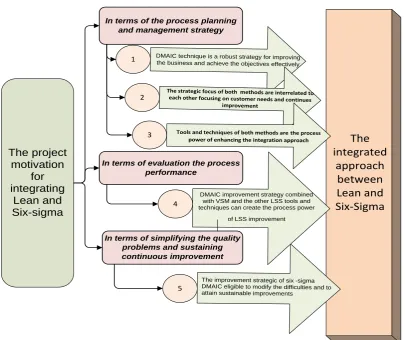
2.5.5.1. The project motivation for integrating Lean and Six-Sigma ... 53
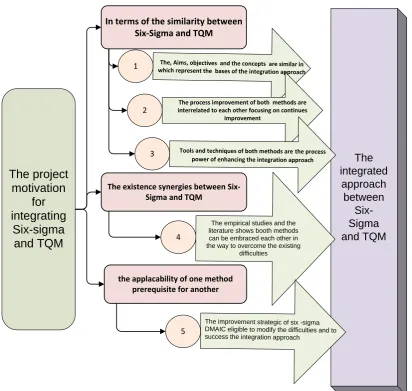
2.5.5.2. The project motivation for integrating Six-Sigma and TQM ... 55
2.6. The relationship between the organization and the methods selected ... 57
2.6.1. The relationship between the organisation and TQM ... 58
2.6.2. The relationship between the organisation and Six-Sigma ... 58
2.6.3. The relationship between the organisation and Lean manufacturing ... 59
2.6.4. The relationship between the Six-Sigma and TQM ... 59
2.6.5. The relationship between Lean manufacturing and Six-Sigma ... 60
2.7. Summary of the chapter ... 61
Chapter Three: ... 63
Research methodology ... 63
3.1. Introduction ... 64
3.2. Introduction to research methodology ... 64
3.2.1. Research philosophy ... 65
3.2.2. Research approaches ... 67
3.2.2.1. Quantitative research method ... 68
3.2.2.2. Qualitative research method ... 68
3.2.2.3. Mixed method ... 69
3.3. Research design and strategy ... 69
3.3.1. Selection of the research methodology and techniques ... 70
3.3.1.1. Literature review ... 71
3.3.1.2. Questionnaire survey ... 72
3.4. Samples selection ... 74
3.5. Data collection and analysis... 75
3.5.1. Integrity data analysis ... 76
3.5.2. Descriptive analysis ... 76
3.6. Analytical procedures and validity of the research ... 77
3.6.2. Analytical Hierarchy Process (AHP) ... 78
3.7. Pilot study ... 78
3.8. Research validation ... 79
3.8.1. Reliability analysis ... 80
3.8.2. Validity analysis ... 81
3.8.2.1. Construct validity ... 81
3.8.2.2. Selection the measures of validity analysis ... 82
3.9. Summary of the research methodology ... 88
Chapter Four: ... 89
Development and validation of Lean Six-Sigma integrated model ... 89
4.1. Introduction ... 90
4.2. What makes Lean Six-Sigma different? ... 91
4.3. The requirements for Lean Six-Sigma implementation ... 92
4.4. Critical Success Factors of Lean Six-Sigma ... 93
4.5. The proposed LSS integrated model ... 94
4.6. Validation of the LSS integrated Model ... 97
4.6.1 Research methodology ... 97
4.6.2. Data collection and analysis ... 98
4.6.2.1. Integrity data analysis ... 99
4.6.2.2. Descriptive analysis ... 103
4.7. Validation of the critical success factors ... 116
4.7.1. Results of factor analysis ... 116
4.8. Discussion ... 121
4.9. Conclusion ... 123
Chapter 5: ... 124
Development and validation of Six-Sigma and TQM integrated model ... 124
5.1. Introduction ... 125
5.2. Integrating Six-Sigma and TQM ... 126
5.2.1. The critical components of Six-Sigma implementation ... 127
5.2.2. The critical components of TQM implementation ... 129
5.3. The CSFs for successful implementation of the SS-TQM integrated model ... 130
5.4. Business excellence in quality management system ... 131
5.7. Validation of the SS-TQM integrated Model ... 136
5.7.1. Research methodology ... 136
5.7.2. Data collection and analysis ... 137
5.7.2.1. Integrity data analysis ... 137
5.7.2.2. Descriptive analysis ... 141
5.8. Validation of the critical success factors ... 152
5.8.1. Results of factor analysis test ... 152
5.9. Discussion ... 157
5.10. Conclusions ... 158
Chapter Six ... 159
The AHP model for evaluating and prioritizing the key drivers of the proposed Quality Management Integrated Framework ... 159
6.1. Introduction ... 159
6.2. Integrating LSS model with SS-TQM model ... 160
6.3. Identifying the key driver for developing the proposed management quality framework ... 162
6.4. Analytical hierarchy process (AHP) ... 164
6.5. Development of the proposed AHP model ... 166
6.6. Validation of the proposed AHP Model ... 167
6.6.1. Data collection and analysis ... 169
6.6.1.1 Respondents background results ... 169
6.6.1.2. Results of data generation ... 170
6.6.2. Generating of the comparison matrix ... 170
6.6.3 Pairwise matrix evaluation ... 174
6.6.3.1 Problem modelling ... 174
6.6.3.2. Results of the priority preference of sub-criteria with respect to main criteria ... 176
6.6.3.3. Synthesizing the results ... 177
6.6.3.4. Results of the priority preference of the global weights ... 177
6.6.4. Sensitivity analysis ... 178
6.5. Discussion ... 183
6.6. Conclusion ... 185
Chapter Seven ... 186
7.1. Introduction ... 187
7.2. The proposed integrated quality management framework ... 187
7.2.1. The main body of the framework ... 188
7.2.2. The main elements of the framework ... 188
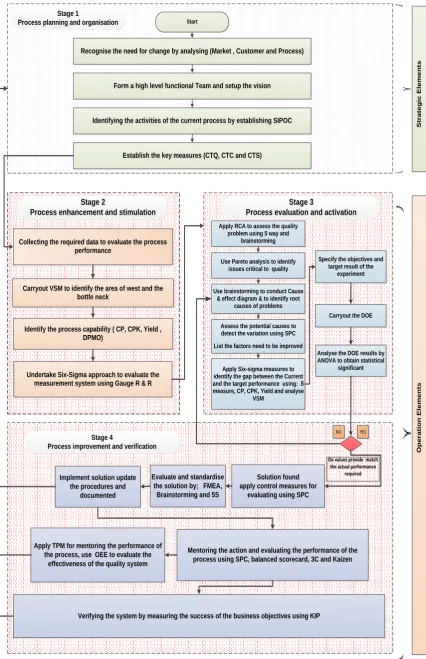
7.2.3. The operational mechanism of the framework ... 188
7.3. The implementation procedures of IQM framework ... 190
7.3.1. Phase1: Strategic Planning. ... 190
7.3.1.1. Strategic soft factors ... 190
7.3.1.2. Strategic planning steps ... 192
7.3.2. Phase 2; Measurement and evaluation ... 195
7.3.2.1. Data collection to evaluate the current process performance ... 195
7.3.2.2. Evaluating the current process by studying the current VSM ... 195
7.3.2.3. Evaluating the measurements to establish the performance capability ... 196
7.3.3. Phase 3; Analysis and activation ... 196
7.3.3.1. Evaluating the quality system and identifying the significant problems ... 196
7.3.3.2. Undertaken RCA to analyze the causes of the problems ... 196
7.3.3.3. Applying SPC to analyse the potential causes of the problems and detect the variation ... 197
7.3.3.4. Identifying the gap between the current and the desired performance ... 198
7.3.4. Phase 4; Improvement and monitoring ... 198
7.3.4.1. Identification of the objectives needed to conduct DOE ... 199
7.3.4.2. Conducting DOE ... 200
7.3.4.3. Analyse the results of DOE to obtain statistics significance ... 201
7.3.4.4. Evaluate the possible solutions ... 202
7.3.4.5. Identify the solution and analyse the risk ... 202
7.3.4.6. Standardising the work and implementing the solution ... 202
7.3.4.7. Monitoring and enhancing the operation performance ... 203
7.3.5. Phase 5; Verifying and continuous improvement ... 204
7.3.5.1. Creating and implementing a control plan ... 204
7.3.5.2. Update the actions aimed at improvement to achieve high quality ... 204
7.3.5.3. Document the quality issues ... 204
7.3.5.4. Evaluating the operating performance and verifying the quality system ... 205
7.4. The CSFs for successful implementation of the proposed framework ... 207
7.5. Conclusion ... 208
Validation of the proposed framework ... 209
8.1. Introduction ... 209
8.2. Research methodology ... 210
8.3. Data collection and analysis... 211
8.3.1. Integrity data analysis ... 212
8.3.1.1. Reliability analysis ... 212
8.3.1.2. Validity test and validation the proposed framework ... 214
8.3.2. Descriptive analysis ... 215
8.3.2.1 Section A: Background information. ... 215
8.3.2.2. Section B: Validation of the proposed framework ... 218
8.3.2.3. Evaluation the implementation procedures of the framework ... 222
8.3.3. Evaluation the importance of the CSFs for the successful implementation of the proposed framework ... 231
8.3.4. Validation of the CSFs for successful implementation the proposed framework ... 232
8.3.4.1. Results of factor analysis ... 233
8.4. Discussion ... 236
8.5. Conclusion ... 238
Chapter 9 ... 239
Conclusions, recommendations, contributions to knowledge, research limitations and future work ... 239
9.1. Introduction ... 240
9.2. Conclusions ... 240
9.2.1 Literature review ... 240
9.2.2. The proposed integrated LSS model ... 241
9.2.3 The proposed integrated SS-TQM model ... 242
9.2.4. Analytical hierarchy process model ... 244
9.2.5 The proposed integrated framework ... 245
9.3. Contributions to knowledge ... 247
9.4. Research limitation ... 248
9.5. Recommendations for further research ... 248
References... 250
Appendixes... 265
Appendix A ... 265
A-2: Questionnaire 2; Evaluation of the proposed SS_TQM Integrated model ... 274
A-3: Questionnaire 3; Evaluation the proposed integrated quality management framework ... 283
Appendix B ... 292
Evaluating and prioritisation the main components of the framework ... 292
Appendix C ... 323
The rest of descriptive analysis of LSS integrated model ... 323
Appendix D ... 331
The rest of descriptive analysis of SS-TQM integrated model ... 331
Appendix E ... 341
The rest of the descriptive analysis of the proposed framework ... 341
List of figures
Figure 2. 1. Phases of DMAIC ... 33Figure 2. 2. The project motivation for the integration of Lean and Six-Sigma ... 54
Figure 2. 3. The project motivation for the integration of Six-Sigma and TQM ... 57
Figure 3. 1. A nested figure of the research methodology ... 65
Figure 3. 2 selection of the research methodology ... 71
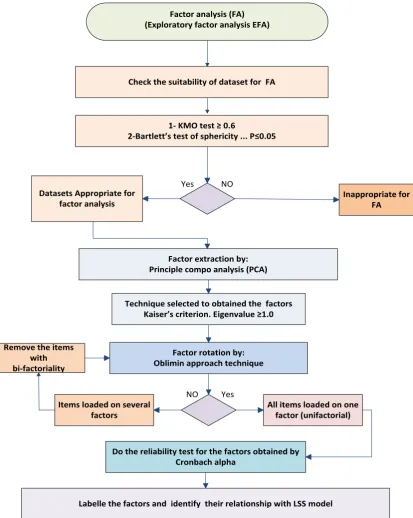
Figure 3. 3. The main steps for calculating factor analysis in this study ... 87
Figure 4. 1. LSS conceptual model for manufacturing organisations ... 96
Figure 4. 2. Areas of industry represented by respondent's organisations... 105
Figure 4. 3. Organisations location ... 106
Figure 4. 4. The correlation among latent factor1 and CSFs ... 120
Figure 4. 5. The correlation among latent factor 2 and CSFs ... 121
Figure 4. 6. Respondents view on the validity of the proposed model ... 122
Figure 5. 1. The components of TQM implementation process ... 129
Figure 5. 2. The strategic plan for integrating Six-Sigma and TQM ... 132
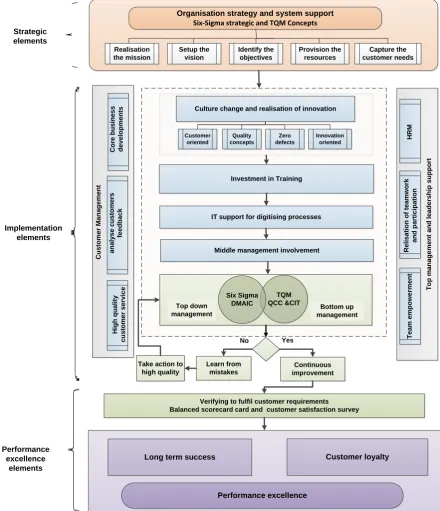
Figure 5. 3. Six-Sigma TQM integrated conceptual model ... 135
Figure 5. 4. The correlation among latent factor 1 and CSFs ... 156
Figure 5. 5. The correlation among latent factor 2 and the CSFs ... 157
Figure 5. 6. Respondent's judgement with regard to the proposed model ... 158
Figure 6. 1. The proposed multi criteria decision making model ... 167
Figure 6. 2. Respondent's information, years of experience ... 169
Figure 6. 4. A hierarchal view of the entire structure ... 174
Figure 6. 5. Pairwise comparison ... 175
Figure 6. 6. The priority preference of the main criteria ... 175
Figure 6. 7. . The priority weights of the sub-criteria with respect with strategic planning ... 177
Figure 6. 8. The priority global weights of the sub-criteria ... 178
Figure 6. 9. The actual results of sensitivity study with respect to the goal ... 180
Figure 6. 10. Five scenarios of sensitivity results of the first scenario ... 181
Figure 6. 11. The priority weights of the strategic drivers with respect to the goal 184 Figure 7. 1. An integrated quality management framework for manufacturing organisations ... 189
Figure 8. 1. Latent factor 1; strategic elements ... 236
Figure 8. 2. Latent factor 2; operational elements ... 236
Figure 8. 3. Respondents judgment about the evaluation of the framework ... 237
List of tables
Table 2. 1. Sigma levels, dpmo and yield of process (Pyzdek et al., 2014)………...31Table 2. 2 The damdv methodology adopted from Mehrjerdi (2011)……….34
Table 2. 3 Six-Sigma tools and techniques ……….35
Table 2. 4 The differences and similarities between Six-Sigma and Lean manufacturing adopted from Andersson et al. (2006)……….42
Table 2. 5 The similarity and differences between Six-Sigma and TQM adopted from (Andersson et al., 2006)... 46
Table 2. 6 The methods and techniques are often found to be integratedthroughout the literature, adapted from Johannes, (2011)………52
Table 3. 1. A summary of philosophy considerations ... 67
Table 3. 3. The main steps of data analysis ... 76
Table 4. 1. Reliability statistics ... 99
Table 4. 2. Item internal correlation of the items measured ... 100
Table 4. 3. Item-total statistics ... 101
Table 4. 4. Reliability statistics ... 102
Table 4. 5. Item-total statistics ... 102
Table 4. 6. Test statistics ... 103
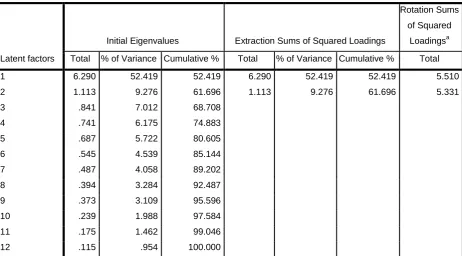
Table 4. 8. KMO and bartlett's test ... 117
Table 4. 9. Total variance explained ... 117
Table 4. 10. Pattern matrix ... 118
Table 4. 11. Pattern matrix ... 119
Table 4. 12. Structure matrix ... 120
Table 5. 1. Reliability statistics ... 138
Table 5. 2. Item-total statistics ... 139
Table 5. 3. Reliability statistics ... 140
Table 5. 4. Test statistics ... 140
Table 5. 5. Organisation position ... 142
Table 5. 6. Aria of industry ... 142
Table 5. 7. Country organisation location ... 143
Table 5. 8. KMO and bartlett's test ... 153
Table 5. 9. Total variance explained ... 153
Table 5. 10. Pattern matrix ... 154
Table 5. 11. Pattern matrix ... 155
Table 5. 12. Structure matrix ... 156
Table 6. 1. Likert scale of relative importance ... 168
Table 6. 2. Comparison matrix of main criteria ... 171
Table 6. 3. Comparison matrix of sub-criteria with respect to strategic planning .. 171
Table 6. 4. Comparison matrix of sub-criteria with respect to measurement and evaluation ... 172
Table 6. 5. Comparison matrix of sub-criteria with respect to analysis and activation ... 172
Table 6. 6. Comparison matrix of sub-criteria with respect to improvement and monitoring ... 173
Table 6. 7. Comparison matrix of sub-criteria with respect to verification and continuous improvement ... 173
Table 7. 1. The main pillars of balanced scorecard... 206
Table 8. 1. Reliability statistics ... 212
Table 8. 2. Item-total statistics ... 213
Table 8. 3. Reliability statistics ... 213
Table 8. 4. Item-total statistics ... 214
Table 8. 5. Test statistics ... 215
Table 8. 7. Area of industry ... 216
Table 8. 8. Organisations location ... 217
Table 8. 9. The suitability/capability of the framework ... 218
Table 8. 10. Ability of the framework to determine competitiveness and profit ... 219
Table 8. 11. Ability of the framework to deal with quality problems ... 220
Table 8. 12. Ability of the framework for implementing in practice ... 221
Table 8. 13. Ability of the framework to achieve long term success ... 221
Table 8. 14. The completeness in the contents of the proposed framework ... 222
Table 8. 15. Evaluation of the contents of strategic soft factors ... 223
Table 8. 16. Evaluation of the applicability of the soft factors of the strategic planning in phase one ... 223
Table 8. 17. Evaluation of any soft factors missing and should be added to the strategic planning phase ... 223
Table 8. 18. Evaluation of the contents of the strategic steps for preceding the planning process in phase one ... 224
Table 8. 19. Evaluation of any missing in strategic steps and should be added to the strategic planning phase ... 224
Table 8. 20. Evaluation of the contents of phase two (measurement and evaluation) ... 224
Table 8. 21. Evaluation of the applicability of the contents in phase two to meet the key target ... 225
Table 8. 22. Evaluation of any missing in the contents of measurement and evaluation phase ... 225
Table 8. 23. Evaluation of the contents of phase three (analysis and activation) ... 226
Table 8. 24. Evaluation of the applicability of the contents in phase three capable to meet the key target (analysis and activation) ... 226
Table 8. 25. Evaluation of any missing in the contents of phase four of the framework ... 227
Table 8. 26. Evaluation of the contents of phase four of the proposed framework (improvement and monitoring) ... 227
Table 8. 27. Evaluation of the applicability of the contents in phase four capable to meet the key target (improvement and monitoring) ... 228
Table 8. 28. Evaluation of any missing in the contents of phase four of the proposed framework ... 228
Table 8. 30. Evaluation of the applicability of the contents in phase five capable
to meet the key target (verification and continuous improvement) ... 229
Table 8. 31. Evaluation of any missing information in the contents of phase five of the framework ... 229
Table 8. 32. Evaluation of the soft implementation factors of the framework ... 230
Table 8. 33. The soft implementation factors covering anything missing which should be added ... 230
Table 8. 34. KMO and Bartlett's test ... 233
Table 8. 35. Total variance explained ... 233
Table 8. 36. Pattern matrix ... 234
Chapter One:
Introduction
1.1. Introduction
The thesis in this introductory chapter presents the context for this research; it starts with a brief background to the research and then states the aim and the objectives of the research. In the final section, there is an outline of the structure of the theses.
1.2. Background
Quality managers nowadays are usually overstrained to identify the proper method for achieving the quality goals in their organisations. However, many manufacturing organisations, particularly in the developing countries, are facing many challenges with respect to improving the level of quality compared with competitors Porter and Yegin (2006). In this regard, (Triki et al., 2006) stated that such organisations often suffer from a lack of quality experience and absence of a systematic approach towards organisation management.
quality system. Thus, in response to those challenges that quality managers are facing, integration quality management concept can bridge this gap and overcome quality management problems and put the quality system of manufacturing organisation in place more effectively. (Johannes, 2013) argued that integrated quality management methods would be the key development in today’s business environment. Therefore, the most effective quality methods for an integrated approach according to Antony (2009) stated that many academics and practitioners agreed that Six-Sigma is one of the superior quality initiatives in terms of decreasing the defects and variations of the system. Demast (2004) declares that Six-Sigma is the greatest complete strategy. Yang (2012) argues that TQM is also classified as one of the best initiatives in terms of continuous improvement and quality commitment with Cheng (2008) confirming that TQM is the prime component of Six-Sigma.
Reichhart and Holweg, (2007) suggested that Lean manufacturing is another effective method for simplifying the production lines and achieving the process performance, though, Lean is also focused on achieving cost reduction through the elimination of waste and fully utilise the workers' capabilities.
1.3. Research questions
The general question:
How can manufacturing organisations develop and implement a quality management framework which reaches its full potential through the use of a manufacturing philosophy and quality management initiatives?
The sub-questions are all connected to the overall question:
What are the successful production methods and quality management
initiatives that can lead to developing an effective integrated quality
management framework? And how can be used together?
What is a powerful model that can be used to improve the manufacturing
processes and how it can be developed and validated?
What is the superior model that can be used for enhancing and unifying
the quality management system of manufacturing organisations? And how
can be developed and validated?
What are the main factors that can lead to combining the models selected
above in order to develop the integrated framework and how can be
implemented and validated?
1.4. Research aim
1.5. Research objectives
1. To carry out a comprehensive literature review to establish current knowledge and identify research gaps.
2. To identify the key drivers that can lead to a successful development of a quality management framework, which consists of two models namely; Lean and Six-Sigma integrated model and TQM and Six-Sigma integrated model.
3. To develop and validate Lean and Six-Sigma integrated model to improve the processes in manufacturing organisations.
4. To develop and validate TQM and Six-Sigma integrated model to unify the management system and achieve business excellence in a manufacturing organisation.
5. To identify the key drivers that can lead to a successful integration between Lean Six-Sigma model and Six-Sigma TQM model developed above to produce a robust quality management system for manufacturing organisations.
6. To develop and validate an appropriate framework by integrating Lean Six-Sigma model and Six-Six-Sigma TQM model for the manufacturing companies to improve and modernise the quality system.
7. To identify the critical success factors that lead to a successful implementation of the tools and techniques of TQM, Lean manufacturing and Six-Sigma Methods in an integrated fashion.
1.6. Overview of the thesis
The thesis is organised into nine chapters relating to various research objectives and the adopted research design as follows:
Chapter One:Introduction
This chapter provides an introduction to the research study, research questions, aims and objectives, and an overview of the thesis structure and summary of the chapter.
Chapter Two: Literature review
The chapter provides a comprehensive review of the literature on the following topics;
1. Introduction to quality management;
2. Quality management methods tools and techniques and the differences between them;
3. The Six-Sigma initiative; 4. Lean manufacturing;
5. The differences and similarities between Six-Sigma and Lean; 6. The TQM method;
7. The differences and similarity between Six-Sigma and TQM;
8. The integrated approach in quality management, existing integration approaches, methods and techniques often being integrated and how methods and techniques are being integrated;
9. The project motivation for integrating Six-Sigma and Lean 10. The project motivation for integrating Six-sigma and TQM;
11. The critical success factors for the usage of each method mentioned above and
Chapter Three: This chapter provides an introduction to the research methodology, then it presents an overview of the research philosophy, research approach and research techniques. Additionally, it outlines the common research design and strategy employed in the study, after that it provides, in detail, the selection of the research strategy and the necessary analytical tools and techniques that have been adopted for validating the research. Finally, it concludes with a summary of the chapter.
Chapter Four: Development and validating of LSS integrated model
This chapter illustrates the requirements for integrating Lean and Six-Sigma, then listing the CSFs for successful implementation of LSS. The chapter presents the development of LSS model and identifies the main component of the model and its implementation steps. In addition, it provides the required methodology for validating the model, the results of data analysis and, finally, it concludes with a comprehensive discussion and draws conclusions on the chapter.
Chapter Five: Development and validating SS-TQM integrated model
the results of data analysis and the final discussion are included at the end of the chapter. Finally, the study concluded with brief conclusions on the chapter.
Chapter Six: Identifying and evaluating the key drivers for development of the proposed framework
The chapter demonstrated how LSS model can be integrated with SS-TQM model and shows how the key drivers for developing the proposed framework were identified. It also provides brief discussion about AHP as a means for assessing the key drivers of the proposed framework, then it presents the development of AHP model for evaluating and prioritising the key components of the framework, hence the required steps for validating the model which are elaborated on, in detail, at the end of the chapter, concluding with a discussion.
Chapter Seven: Development an integrated quality management framework for manufacturing organisations
The chapter provides in-depth information on the development of the proposed framework, the main components of the framework and procedures for its implementation; it includes the mechanism of the framework for attaining high-quality performance and business excellence within manufacturing organisations.
Chapter Eight: Validation of the proposed framework
Chapter two:
Literature review
2.1. Introduction to Quality management ... 26
2.1.1. Definition and concept of Quality management ... 28
2.1.2. Quality management methods, tools and techniques ... 29
2.1.3. The importance of quality tools and techniques ... 30
2.2. Six-Sigma Initiative ... 30
2.2.1. What does Six-sigma mean? ... 31
2.2.2. Six-Sigma strategy ... 32
2.2.3. Six-sigma methodology ... 32
2.2.4. Six-Sigma tools and techniques ... 34
2.2.5. Six-Sigma and statistical thinking ... 36
2.3. The Lean Manufacturing Approach ... 36
2.3.1. The concept of Lean manufacturing ... 37
2.3.2. Principles of Lean Manufacturing ... 38
2.3.3. Lean tools and techniques ... 39
2.3.4. DMAIC methodology and Lean manufacturing ... 40
2.3.5. The similarity and differences between Six-Sigma and Lean ... 41
2.4. Total Quality Management (TQM) ... 43
2.4.1. TQM definition ... 43
2.4.2. Concept of TQM ... 44
2.4.3. Essential elements of TQM ... 44
2.4.4. TQM strategy and organisation change ... 45
2.4.5. The similarity and differences between Six-Sigma and TQM... 45
2.5. Integration approach in quality management ... 47
2.5.1. The essential elements for incorporating the integrated approaches ... 47
2.5.2. How methods and techniques are being integrated? ... 48
2.5.3. The key motivation for the integrated approach to quality management ... 49
2.5.3.1 The key drivers of the integrated approach in quality management ... 49
2.5.4. What methods and techniques are often being integrated? ... 51
2.5.5. Project motivation for integrating the selected methods ... 52
2.5.5.1. The project motivation for integrating Lean and Six-Sigma ... 53
2.5.5.2. The project motivation for integrating Six-Sigma and TQM ... 55
2.6. The relationship between the organization and the methods selected ... 57
2.6.1. The relationship between the organisation and TQM ... 58
2.6.2. The relationship between the organisation and Six-Sigma ... 58
2.6.3. The relationship between the organisation and Lean manufacturing ... 59
2.6.4. The relationship between the Six-Sigma and TQM ... 59
2.6.5. The relationship between Lean manufacturing and Six-Sigma ... 60
2.1. Introduction to Quality management
Quality is a management philosophy developed over decades based on three interrelated approaches which incorporate; business strategy, methodology, tools and techniques. Many authors contributed to the development of that philosophy including Deming, Juran, Ishikawa, Crosby, Shewhart, and Feigenbaum (Juran, 1999). The key role of quality management is to identify the opportunities for improvement within processes, products, and services in order to accomplish high performance in operations and, thereby, satisfy customer requirements (Vive (2005). As such, quality management has gained considerable attention in the last three decades in order to enable organisations to meet the required demand, satisfy customer needs and achieve competitive advantages.
2.1.1. Definition and concept of Quality management
Quality is a subjective term; each quality authors has own definition; however, all definitions in the literature has the same objectives, the common definitions of quality according to the quality gurus are;
“Non-faulty systems” (Deming, 2000) “Fitness for use” (Juran, 1988)
And “Conformance to requirements” (Crosby, 1996)
(Deming, 2000; and Crosby, 1992) stated that quality in technical usage can have two meanings; one the attributes, features, functions of product or services that are applicable to satisfy the required needs of the customer, the other is product and services free of errors, defects and any deficiencies. Juran (1999,) further defined the meaning of quality overall as freedom of deficiencies which means that a product, service and the whole processes are required to be free of errors, defects and waste. In this sense, quality is the scope of an organisation to achieve its main goals. In addition (Juran, 1999) stated high quality enables companies to achieve customer satisfaction, meet product scalable and achieve competitive advantage, to increase market share and increase income. In order to achieve high quality, firms must be controlled the following factors;
Reduce the error rate;
Decrease the rework;
Avoid or decrease the field failures;
Reduce customer dissatisfaction and
2.1.2. Quality management methods, tools and techniques
De Mast (2004.pp199) defined quality methods suggesting; "improvement
strategy comprises a coherent series of concepts, steps, methodological rules
and tools that guide a quality professional in bringing the quality of a process or
product to unprecedented levels (breakthrough)". The most common quality
management methods developed and implemented in practice for over decades are; TQM, Six-Sigma and ISO. However, quality management tools and techniques are integrated means used for assessing the quality issues and monitoring the operation performance, the quality tool is a device that has a
clear role and narrow usage, whereas quality technique has a wider application
(Mcquater, et, al., 1995; Johannes, 2013). According to (Mcquater, et, al., 1995) classified the tools and techniques based on its applications and functions as following;
Examples of tools
Cause and effect diagrams;
Pareto analysis;
Control charts;
Histograms and
Flowcharts..etc.
Examples of techniques
Statistical process control(SPC);
Quality function deployment (QFD);
Design of experiments and
2.1.3. The importance of quality tools and techniques
Quality tools and techniques play an important role in terms of guiding an organisation in achieving continuous improvement, Mcquater et al., (1995) summarised the importance of quality tools and techniques in the manufacturing process as follows:
For the evaluation and monitoring the process and product;
For the Involvement of teamwork in the improvement process;
To solve problems easily;
To help for sustaining continuous improvement;
To reinforce staff through problem-solving and
To improve the daily activity business process.
2.2. Six-Sigma Initiative
2.2.1. What does Six-sigma mean?
Sigma (Ϭ) is a Greek letter used by statisticians for measuring the variability; however, (Ϭ) also refers to the standard deviation measure, Six (6) is a number refers to the number of the standard deviation on either side of the process mean, where, in statistical science, the normal distribution for any sample data comprises six standard deviations (Mehrjerdi, 2004). In addition, Mehrjerdi (2011) stated that a Sigma level indicates the number of defects that are likely to have occurred; however, the higher the Sigma level indicated that the process attained the fewer the defects. Therefore, the Sigma process corresponds with the defects level which must be 3.4 defects per million opportunities (DPMO) or less based on the Six-Sigma target; table (2.1) demonstrates the Sigma level corresponded with the DPMO and the expected yield for each level.
Table 2. 1. Sigma levels, DPMO and Yield of process (Pyzdek et al., 2014)
Six-Sigma is several packages of statistic metrics and management strategies integrated as a rigours discipline which can be divided into three parts; Strategy, Methodology and Metrics (tools and techniques) (Snee and Hoerl, 2005).
Yield of process (%) DPMO Sigma level
68.26 690 000 1.0
95.46 308 000 2.0
99.74 66 8000 3.0
99.9936 6 210 4.0
99.99994 320 5.0
2.2.2. Six-Sigma strategy
Snee and Hoerl (2005); Henderson and Evans (2000), Yang (2012) stated that the ultimate goal of Six-Sigma is to enable organisations to deliver the greatest value to the customer and employees; therefore, the key strategy of Six-Sigma are:
Customer focus; means to understand the customer requirements proactively and to take proper actions to fully meet the customer needs which is defined and determined using CTQ techniques or QFD.
Reduce variation; the manufacturing and services process should be set up to produce no much variation in order to meet customer needs. The set of statistical and quality tools that are employed to control the variation within the process
Reduce defects; the products and services must be produced or delivered free of defects or maximum 3.4 DPMO.
Centred around the target; the focus is to produce superior results and to obtain an unprecedented level of improvement (Six-Sigma breakthrough).
2.2.3. Six-sigma methodology
DMAIC; stand for; Define, Measure, Analysis, Improve and Control.
DMAIC is considered the most powerful process of Six-Sigma in terms of
problem-solving, within existing process, where the power of DMAIC comes from the
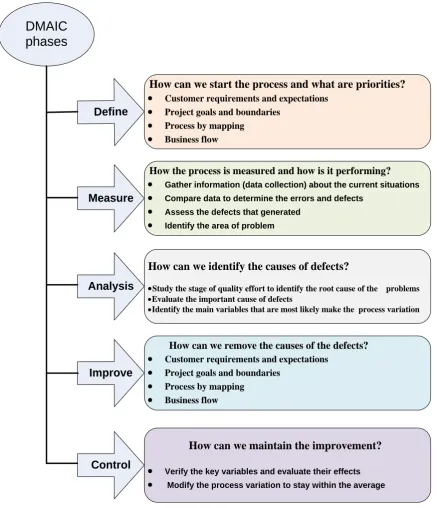
effectiveness of the five phases: define, measure, analyse, improve and control. The function and the mechanism of these steps are described in figure (2.1) below:
How can we start the process and what are priorities?
Customer requirements and expectations Project goals and boundaries
Process by mapping Business flow Define
Control Analysis
Improve Measure
How the process is measured and how is it performing?
Gather information (data collection) about the current situations
Compare data to determine the errors and defects
Assess the defects that generated
Identify the area of problem
How can we identify the causes of defects?
Study the stage of quality effort to identify the root cause of the problems
Evaluate the important cause of defects
Identify the main variables that are most likely make the process variation
How can we remove the causes of the defects?
Customer requirements and expectations Project goals and boundaries
Process by mapping Business flow
How can we maintain the improvement?
Verify the key variables and evaluate their effects
Modify the process variation to stay within the average
[image:35.595.116.556.197.706.2]DMAIC phases
DMADV; stand for Define, Measure, Analyse, Design and Verify
DMADV is the second methodology of Six-Sigma focussed on improvement and is similar to the DAMIC phases; however, DMADV includes two different phases: verifying and design. DMADV is an improvement process that is basically used to organise the process, or to develop, or design a new product. It aims to obtain more accurate and effective findings and to achieve high-quality performance free of deficiencies as well as to guarantee the incremental improvement in the system. Seen and Hoerl (2005) stated that General Electric company (GE) corporation developed the DMADV roadmap for the design of projects which is termed Design For Six-Sigma (DFSS) and since that time it has become the second methodology for design new product of Six-Sigma. The DMADV process contains the five steps demonstrated in the table (2. 2) below:
Table 2. 2 The DAMDV methodology adopted from Mehrjerdi (2011)
DMADV Phases
Purpose
Define Identifying the customer requirements and the project goals Measure Determine the characteristics and the specifications to fulfil
the customer’s needs
Analyse Evaluate the product design to satisfy the customer needs Design Simplify the details of the product or process to fulfil the
customer needs
Verify Validate the system ability and the design performance to verify the design’s capability and performance
2.2.4. Six-Sigma tools and techniques
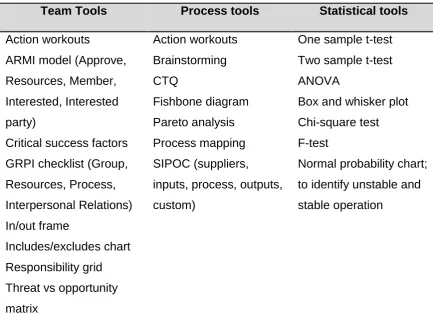
experience of General Electric company (GE) in Six-Sigma, the projects who intend to implement Six-Sigma should be armed with three group of tools; Team tools, Process tools and Statistics tools. All of these tools can provide the Six-Sigma team and leadership with the required skills to run the projects, these tools support leaders in terms of establishing the project team and sustain it. The following is a comprehensive list of the commonly-used Six-Sigma tools and techniques classified by Henderson and Evans (2000):
Table 2. 3 Six-Sigma Tools and Techniques
Team Tools Process tools Statistical tools
Action workouts
ARMI model (Approve, Resources, Member, Interested, Interested party)
Critical success factors GRPI checklist (Group, Resources, Process, Interpersonal Relations) In/out frame
Includes/excludes chart Responsibility grid Threat vs opportunity matrix
Action workouts Brainstorming CTQ
Fishbone diagram Pareto analysis Process mapping SIPOC (suppliers,
inputs, process, outputs, custom)
One sample t-test Two sample t-test ANOVA
Box and whisker plot Chi-square test F-test
Normal probability chart; to identify unstable and stable operation
Statistical tools
defects. Consequently, as it can be seen from the table 2.3 the eight statistical tools are the most frequently applied in practice (Henderson and Evans, 2000).
2.2.5. Six-Sigma and statistical thinking
Seen and Hoerl (2005) and Seow and Antony (2004) stated that the key driver of Six-Sigma is to reduce the negative effects of process variation in two ways: either by shifting the process variation to the desired target level or by reducing the variation to around the process average. The result in both methods is to obtain the minimal variation at the right average level; this is basically the key successful driver for achieving the process performance in Six-Sigma; in short, the best way to deal with the process variation is to use many statistics tools, where the concept of statistical methods is to identify, measure and understand the variation. On the other hand, statistical methods are based on the facts, figures and data analysis, means, and decision-making which is driven by facts and based on data. This is the key mechanism of Six-Sigma for eliminating the defects and improve the process.
2.3. The Lean Manufacturing Approach
and smoothing the production flow, Lean was developed by the Toyota Corporation based on the framework of Ford's mass production and the available contributions to operation strategy made by industrialists of that time. Lean was originally called Toyota production system (TPS) and, over the years, evolved to just-in-time technique and, ultimately, becomes known as Lean manufacturing, this philosophy enables manufacturing organisations to reduce the production lead time and save a number of resources by producing the required products based on the customer demand (Reichhart and Holweg, 2007).
2.3.1. The concept of Lean manufacturing
Lean manufacturing is defined as a manufacturing philosophy aiming to eliminate the waste in the operation process and decreasing the number of resources that are required to perform the manufacturing activities within organisations (Papadopoulou and Ozbayrak, 2005). The technical definition of Lean is the identification and removal of all none value-added activities. Lean manufacturing is based on two concepts; firstly, to achieve cost reduction through the elimination of waste and, secondly, to fully utilise the workers' capabilities (Reichhart and Holweg, 2007). Therefore, the theory presented over the year's shows that the result achieved by Lean includes minimising human efforts, stocks, lead time, production space and its associated cost without compromising on quality (Staatsa et al., 2011). The main focus of lean is to eliminate all types of waste which are specified as anything in the process that does not add value to the process and the product, the waste identified in seven forms:
2. Over inventory; 3. Overproduction; 4. Rework;
5. Defects; 6. Waiting and 7. Motion.
2.3.2. Principles of Lean Manufacturing
Essentially, the main focus of the Lean manufacturing is to eliminate waste, achieve continuous workflow; ensure better performance and establish a more effective work place employing the exact workforce, taking less time, less equipment and less space. Womack et al., (1990); and Womack et al., (2007) stated that Lean manufacturing can be implemented through five steps:
Specify value
The first and the most important step in Lean is to focus on the customers and their needs when specifying values because those values can be only defined by the ultimate customer; this is vital step to avoid taking the wrong path when designing or making products for customers.
Identify the value stream
In this stage, all the steps, process, actions and transaction of the production line are drawn on a map (value stream mapping) from the supplier to the customer, the aim is to evaluate and assess the current performance of the system and identify any non-value added.
Once the value specified and the value stream is mapped; at this point the work must give way to the specific products, it is important that employees mentally get used to producing in small lots to ensure the continues flow and to avoid having a high level of inventory in between stations and eliminate time wasted while waiting for the job. This ‘one-piece flow’ is the quickest way to get from raw materials to finished goods.
Pull
In this step, the benefits of implementing the previous steps will be evident as, instead of operating according to traditional sales forecasts, production is only what customer requests. In this case, the company should not produce products or services until customers place an order.
Perfection
The perfection stage is involved in looking back at mistakes while producing and offering products to customers and, mainly, continuing to look for a possible way of reducing the amount of effort, time, space and eliminate wasted.
2.3.3. Lean tools and techniques
future state of the system, (Furlan, et al., 2011). In this regard, Wilson (2009) stated that in order to implement Lean, the common tools and techniques that the companies must be armed with are.
Problem diagnosis techniques; Contains the following techniques:
1. Pareto analysis. 2. Fishbone diagrams.
Quality tools:
1. Poka-Yoke (mistake proofing).
2. Failure Mode and Effective Analysis) (FMEA). 3. Statistics process control (SPC).
Process improvement techniques:
1. 5S (Sort, Sit in order, Shine, Standardise and Sustain). 2. Single Minute Exchange Die (SMED).
3. Visual controls.
2.3.4. DMAIC methodology and Lean manufacturing
Lean manufacturing is a philosophy and strategy in which the product is based on the customer demand, the philosophy here is that no product needs to be produced unless demanded by the customer and, hence, the most powerful tool associated with the pull system is the signal derived from the Kanban system which controls the flow of the product stream. because of this, Lean manufacturing is called a pull system or process improvement. It aims to improve the process flow and eliminate non-value-added (Snee, 2010). Other Lean tools such as 5S, VSM, TPM and others are related to the elimination of waste and improving the process performance and, in doing so, obtain high-quality output and improve the bottom line performance (Tomas, 2009).
2.3.5. The similarity and differences between Six-Sigma and Lean
In order to evaluate the differences and the similarities between Six-Sigma and Lean, it is necessary to provide definitions and concepts of both approaches. Common definitions for each method are provided by Andersson et al. (2006).
Six-Sigma is a business process that enables the organisation to improve the bottom line through the daily monitoring and controlling the business activities in such a way as to eliminate the defects and minimise resources use by employing statistical methods while increasing the customer satisfaction.
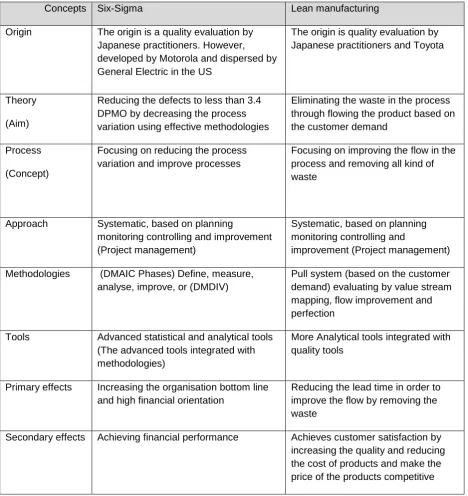
Dahlgaard (2006) argued that these approaches have the same origin; both of them are based on the development of the quality management in Japan after the second world war; however, the way of achieving the objectives for each concept are different. Andersson et al. (2006) studied the similarity and differences between Six-Sigma and come up with the comparison as in shown in table 2.4 below.
Table 2. 4 The differences and similarities between Six-Sigma and Lean manufacturing adopted from Andersson et al. (2006)
Concepts Six-Sigma Lean manufacturing
Origin The origin is a quality evaluation by
Japanese practitioners. However, developed by Motorola and dispersed by General Electric in the US
The origin is quality evaluation by Japanese practitioners and Toyota
Theory
(Aim)
Reducing the defects to less than 3.4 DPMO by decreasing the process variation using effective methodologies
Eliminating the waste in the process through flowing the product based on the customer demand
Process
(Concept)
Focusing on reducing the process variation and improve processes
Focusing on improving the flow in the process and removing all kind of waste
Approach Systematic, based on planning
monitoring controlling and improvement (Project management)
Systematic, based on planning monitoring controlling and
improvement (Project management)
Methodologies (DMAIC Phases) Define, measure,
analyse, improve, or (DMDIV)
Pull system (based on the customer demand) evaluating by value stream mapping, flow improvement and perfection
Tools Advanced statistical and analytical tools
(The advanced tools integrated with methodologies)
More Analytical tools integrated with quality tools
Primary effects Increasing the organisation bottom line
and high financial orientation
Reducing the lead time in order to improve the flow by removing the waste
Secondary effects Achieving financial performance Achieves customer satisfaction by
2.4. Total Quality Management (TQM)
Total quality management (TQM) is a philosophy and a method of optimisation and integration of all functions of the business, it aims to achieve continuous improvement and satisfy customer needs. ‘Word total’ refers to everything involved in the organisation, it also covers all the business activities - staff, process, jobs, resources and time (Powell, 1995). TQM was introduced at the beginning of 1980 as a quality management system, particularly in manufacturing field, many writers on quality such as Deming, Ishikawa, Crospy and Juran have made many contributions to its development (Juran, 1995). Mainly, TQM is not limited to manufacturing sectors; it also valid to services sectors. TQM is about changes to management in order to improve the quality output by focusing on three aspects: structural change, technological change and cultural change (Boaden, 1997). In response to that Hellsten and Klefsjö (2000) define TQM as management philosophy based on the core values of
customer focus, continuous improvement, process orientation and employees’
commitment. Consequently, TQM has become one of the powerful quality
initiatives in the field of quality management.
2.4.1. TQM definition
2.4.2. Concept of TQM
TQM is a quality management method by which the employees and management involved in the continuous improvement of the manufacturing and /or services process, TQM offers effective strategic tools and techniques to achieve improvement in quality and in the performance of the organisation (Mehra et al., 2001). In this regard, Hellsten and Klefsjö (2000) argued that the techniques in TQM are methods to achieve high-quality output for example self-assessment, process management and product design. These tools are useful for analysing the data to support the decision-making. Therefore, TQM covers all business aspects not only manufacturing; however, every function can be affected and improved on (Lewis and Smith (1994).
2.4.3. Essential elements of TQM
Deming (1994) believed that TQM system aims to increase internal and external customer satisfaction and reducing amount of resources, in this context Hellsten and Klefsjö (2000) pointed out that TQM is a method based on two precepts which are planning and communication; however, Boaden (1997) discussing the principle and practices of TQM, (ibid) declared that TQM consists of seven main elements:
Top management involvement and commitment; everyone involved in the
organisation goals and the customer needs; therefore, everyone should be aware of time, process and final product output.
Continuous improvement; TQM is not an end state, it never finishes.
Customer focus; All staff should be aware of the core of TQM which satisfy
Competitive benchmarking; employees should seek the best and trying to match it or exceed it.
Employees Empowerment; teamwork has wide responsibility and authority to
improve the process and production in every aspect of the organisation.
Team work; people in the organisation are incorporated for the purpose of
problem-solving and group ownership of the process.
Knowledge of TQM tools; all staff must be trained in quality control and
improvement techniques.
2.4.4. TQM strategy and organisation change
Strategy, in general, refers to identifying the vision and defining the organisational goals along with monitoring the implementation of the process which is the key role of the leadership. While Senge (1990) lists the key quality of leadership as the ability to build a shared vision. Bergman and Klefsjö (2002) advise the strategy of TQM must be built on the management's continuous commitment. On the other hand, TQM is considered as a comprehensive organisation-wide change (Bon and Mustafa, 2013), thus the process change is integrated with TQM philosophy into the organisation, and also the process change is based on the training and developing the employees along with changes to organisation structure, values attributes and management style. All of these factors should be taken into consideration once TQM is implemented.
2.4.5. The similarity and differences between Six-Sigma and TQM
approach, methodologies, tools and effects. Table (2.5) shows the author comparisons between Six-Sigma and TQM.
Table 2. 5 The similarity and differences between Six-sigma and TQM adopted
from (Andersson et al., 2006)
Concepts Six-sigma TQM
Origin Quality evaluation by Japanese
practitioners; However, developed by Motorola and dispersed by General Electric in the US
The origin is the evaluation of quality by Japanese
practitioners.
Theory Reducing the defects to less than 3.4
DPMO by decreasing the process variation using effective methodologies.
Focusing on satisfying the internal and external customers by armed the employees with quality management tools and methodologies to achieve customer satisfaction.
Process Focusing on reducing the process variation
and improve processes.
Focusing on the improvement by organising the process to produce the customer satisfaction.
Approach Project management. Employees commitment with
the target of the organisation.
Methodologies (DMAIC phases) for process improvement
(DMADV) for developing new product and/ or process.
(PDCA cycle) Problem-solving strategy.
Tools Advanced statistical and analytical tools
(The advanced tools integrated with methodologies).
Analytical and statistical tools.
Primary effects
Increasing the organisation bottom line and high financial oriented.
Increase or exceed customer satisfaction.
Secondary effects
Achieving financial performance. Obtains customer loyalty and
2.5. Integration approach in quality management
The integration approach in quality management is a method of combining one or more quality management methods or techniques to overcome the difficulties in a quality system and to achieve competitive advantages. Gijo and Rao (2005) defined integration quality management as a means of combining the appropriate quality management methods and techniques to attain improvement in the operation process. Bendell and Tony (2006) said that integration quality management demands discipline when improving the business process to avoid the weaknesses in the quality management methods. The meaning of integration in quality management, according to Johannes (2013), is the parallel the use of the applicable quality management methods in order to achieve significant improvement in the business process while adding value to the quality system.
2.5.1. The essential elements for incorporating the integrated approaches
Johannes (2013) discussed a holistic approach for integration method in quality management, it can be seen from his study that the basic elements for formulating the integration method in quality management comprises of five main elements:
The synergy between quality management methods; a stage of eliminating
the weaknesses of certain quality management methods which enables an exchange the results between them which resulted in value added.
Procedure model; the sequences of procedures that are taken as the basis
for modification and improvement of the quality system.
Consistency; the consistency refers to compatibility and the harmony in the
logical sequence of the activities in the procedure model which assure that the tasks are performed and contradictions are avoided.
Completeness; that all the component of the proposed methods must be
adequate to fulfil the integration between quality management methods which including method elements, procedure model and the consistency in the procedure model.
Value adding; adding value to the quality system means that to develop the
activities of the whole process in which to improve the quality of products and services and, hence, to satisfy the customer requirements.
2.5.2. How methods and techniques are being integrated?
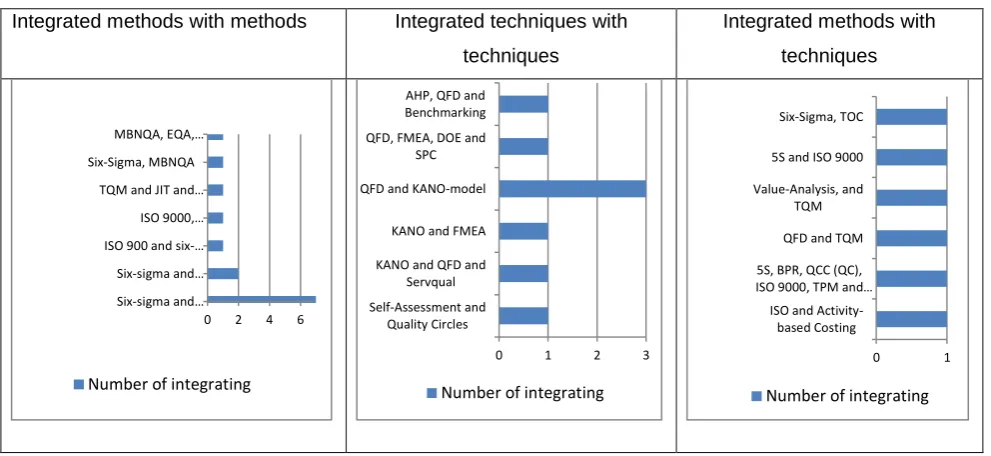
Essentially, the possible approaches to integration in quality management are either integrating methods with methods, techniques with techniques or methods with techniques (Johannes, 2011). Therefore, the literature shows that the common mechanism of the integrated method in quality management is based on the possibility of the following motivations; elimination of the weaknesses in the methods or techniques, the occurrence of synergies
between the homogeneity methods and or techniques and the prerequisite of
enhancing one method to another in the way to exchange the results (Pfeifer et
2.5.3. The key motivation for the integrated approach to quality management
Johannes (2013) stated that there are four key motivations for integrated approaches in quality management:
Eliminating the existing weakness in quality management methods and
techniques. The weaknesses and the failings in the quality management
methods and techniques is a critical indication encourage for integrating with other methods to eliminate those weaknesses and failings.
The existence of synergies between Quality Management Methods and
Techniques; The synergies between quality management methods are
considered the backbone of the integration approach when the synergy is the stage of exchanging the results between QMMs and techniques which result in value added.
One method is an existingprerequisite enhancing another one; Whatever the weaknesses in any method are irrepairable or if it can be eliminated by another method in a successive way, then methods or techniques need to be integrated
Fear of missing trends in quality management; This concern that areas of
quality management are flawed or absent can be a key factor that plays an important role in the way to improve the process in quality management
2.5.3.1 The key drivers of the integrated approach in quality management
integration between quality management methods or techniques can be incorporated by examining three stages;
Evaluating the quality methods and techniques in terms of homogeneity.
Deriving the synergies between quality management methods and techniques.
Ensuring and verifying the requirements of the integrated method are being met (the essential elements of the integration approach).
2.5.3.1.1. Evaluating the methods and techniques for integrated readability
In this stage, quality management methods or techniques are being evaluated based on their concepts and essential elements to identify the similarity and differences through which it can be identified to what extent the methods or techniques are interrelated, this view is supported by De Mast (2004) who stated that the quality management methods can be compared based on the following factors in order to identify its eligibility for integration (steps, rules, concepts, tools).
2.5.3.1.2. Deriving the synergies between quality management methods
Once quality management methods or techniques are selected the second step is to derive the synergies from the methods, where the synergy is considered the foundation of the integrated approach. Johannes (2011); however, to address the question of how to derive the synergies between methods or/and
techniques, adopted four factors from the literature which are frequently used to
Evaluate the weaknesses and strengths of quality management methods to derive the synergies.
Find out the common core concept between quality management methods to