Occupation in occupational therapy, a political perspective
POLLARD, Nicholas <http://orcid.org/0000-0003-1995-6902>
Available from Sheffield Hallam University Research Archive (SHURA) at:
http://shura.shu.ac.uk/17029/
This document is the author deposited version. You are advised to consult the
publisher's version if you wish to cite from it.
Published version
POLLARD, Nicholas (2013). Occupation in occupational therapy, a political
perspective. Doctoral, Sheffield Hallam University.
Copyright and re-use policy
See
http://shura.shu.ac.uk/information.html
Sheffield Hallsm University
Learning and IT Services
Collegiate Learning Centro
Collegiate Crescent Campus
Occupation in occupational therapy, a political perspective
Nicholas Charles Trent Pollard
Published works subm itted in partial fulfilm ent o f the requirements o f
Sheffield Hallam University
for the degree o f Doctor o f Philosophy on the basis o f published work;
Declaration
I, Nick Pollard, hereby declare that this submission is my own work and that it
contains no work published or written by another person except where
acknowledged in the text, nor does it contain material that has been accepted for
another degree at this or any other university.
Much of the work submitted here was co-authored; all collaborating authors have
signed forms to indicate their contributions to this work (see section 2.6 and
Abstract: Occupation in occupational therapy, a political perspective
Occupational therapy is broadly about the experience of ‘doing’ as the basis of
human participation. This requires access to the means of participation: space,
facilities and resources for different forms of human action. People who have
experienced disability are frequently prevented from engaging in activities which
other people can access, and can benefit from. Their rights to social participation at
all levels are restricted, and this is a political aspect of their impairment - something
that is recognized in feminist discourse in the recognition of the relationship between
the personal and the political. Consequently rehabilitation has a dimension which is
not just about restoring or adapting function, but also about addressing the social
and political circumstances which produce barriers to occupation.
The submitted works discuss a rights based approach to human occupation, which in
turn derives from a narrative understanding of ‘doing’ as an individual and collective
expression of actions. My most significant and original contributions to occupational
therapy and occupational science concern the development of an argument for the
understanding of a political dimension to human occupation. These works are
accompanied by research papers which evidence some aspects of my theories.
In its concentration on clinical and medically led objectives the profession has
infrequently recognized the relationship between health conditions and the wider
issues of social and economic disparities. Part of my work has called attention to the
occupation, and calls for therapists to work with their clients not only in terms of
Contents
1 List of publications submitted (Table 1) 7
2 Methodology and related issues 8
2.1 Rationale for selection of submitted works 8
2.2 Commitment to research and publication 14
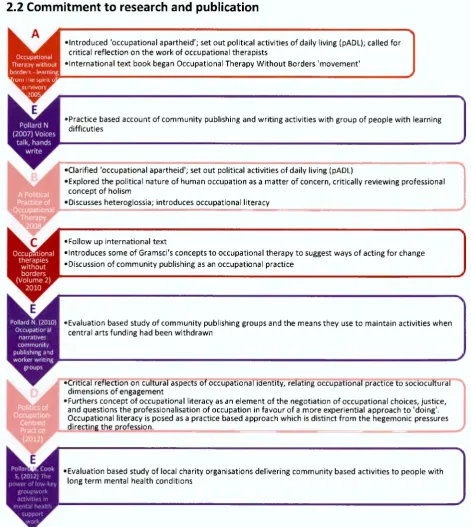
Figure 1 A timeline showing the development of the submitted texts 14
2.3 Quality 18
2.4 Coherence 20
2.5 Methodology 24
2.5.1 Editing major new texts in Occupational Therapy 24
2.5.2 The development of conceptual chapters 26
2.5.3 The relationship between empirical work and conceptual work. 28
2.5.4 Reflection on methodology 30
2.6 Contribution to research embodied in multi-authored works. 34
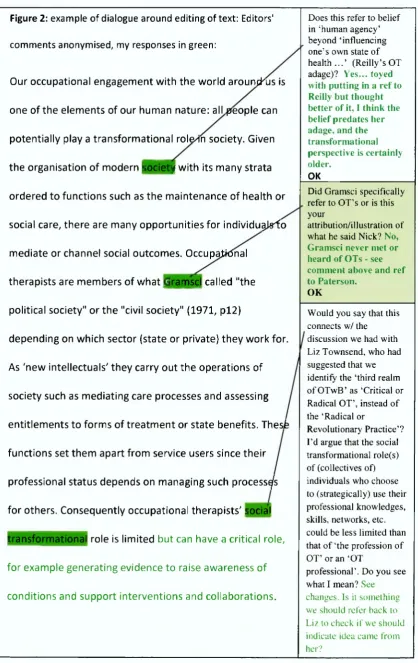
Figure 2: example of dialogue around editing of text 3 6
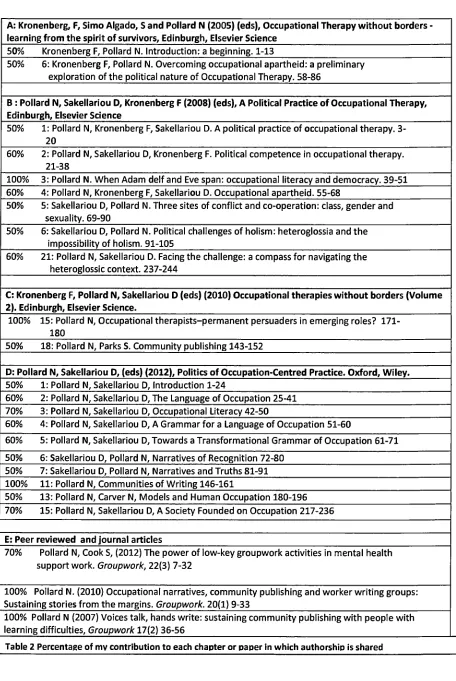
Table 2: Percentage of my contribution to each chapter or paper
in which authorship is shared 37
3 Contribution to knowledge 38
Figure 3: A conceptual destination board showing the fit'
of some of the ideas in this submission 38
3.1 Reconceptualising 42
Table 3: Reconceptualising - chapters relating to this theme 4 2
3.2 Occupational apartheid 46
Table 4: Occupational apartheid - chapters relating to this theme 4 6
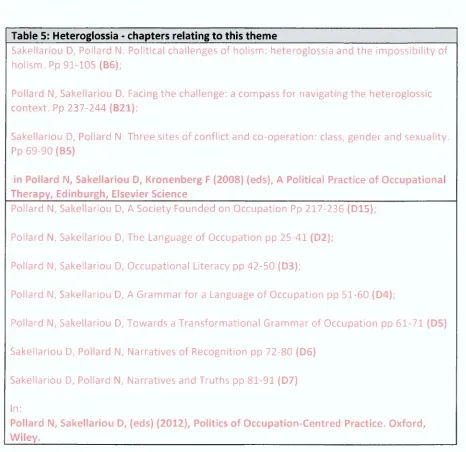
3.3 Heteroglossia 50
Table 5: Heteroglossia - chapters relating to this theme 5 0
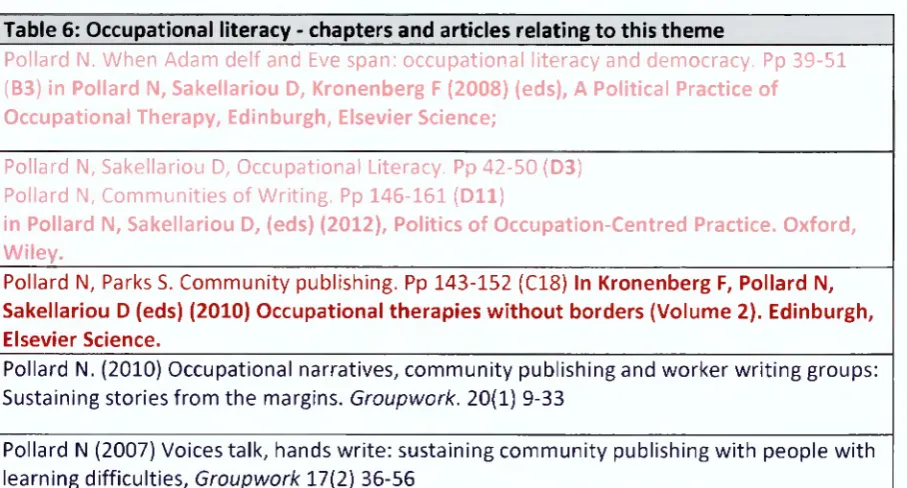
3.4 Occupational literacy 53
Table 6: Occupational literacy - chapters and articles relating to this theme 53
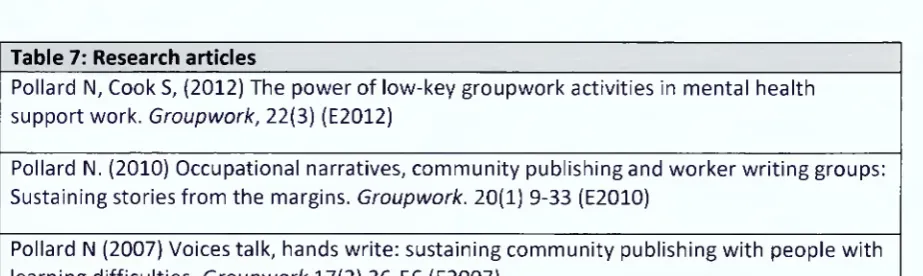
3.5 Research articles 55
Table 7: Research articles 55
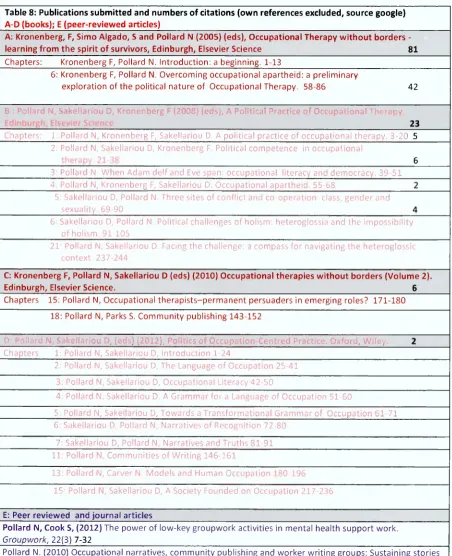
3.6 Impact on the profession 58
4 Conclusion 61
5 References 66
6 Complete list of publications 76
7 Appendices (NB this is included for reference but is om itted from the library version
for copyright reasons) 85
7.1 Appendix 1Occupation as an agent of social transformation
and intercultural dialogue. 85
7.2 Appendix 2 Evidence of critical recognition. 104
7.2.1 Example citations from occupational therapy and occupational science, social work, speech therapy and
medical anthropology 104
7.2.2 Reviews 110
1: South African Journal of Occupational Therapy 110
(Occupational therapy without borders/
A political practice o f occupational therapy)
2: British Journal of Occupational Therapy
(A politics o f occupation centred practice) 115
3: Ethos
(Occupational therapy without borders/
A political practice o f occupational therapy) 116
7.3 Appendix 3 Metasynthesis paper 120
7.4 Appendix 4 Evidence of contribution to multi-authored papers 149
7.5 Appendix 5 Publications submitted
E: Peer reviewed and journal articles:
1567.5.1 E2012: Pollard N, Cook S, (2012)
The power of low-keygroupwork activities in mental health support work.
Groupwork, 22(3) 7-32 156
7.5.2 E2010: Pollard N. (2010) Occupational narratives, community
publishing and worker writing groups: Sustaining stories
from the margins. Groupwork. 20(1) 9-33 198
7.5.3 E2007: Pollard N (2007) Voices talk, hands write: sustaining
community publishing with people with learning difficulties,
Groupwork17(2) 36-56 228
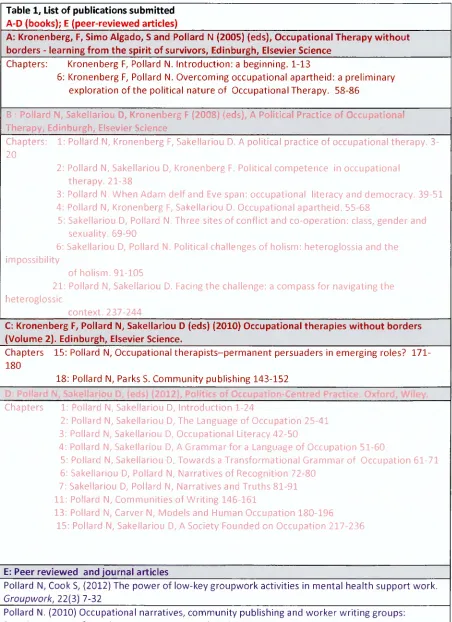
Table 1, List of publications submitted
A -P (books); E (peer-reviewed articles)________________________________________________________ A: Kronenberg, F, Simo Algado, S and Pollard N (2005) (eds), Occupational Therapy without borders - learning from the spirit of survivors, Edinburgh, Elsevier Science
Chapters: Kronenberg F, Pollard N. Introduction: a beginning. 1-13
6: Kronenberg F, Pollard N. Overcoming occupational apartheid: a prelim inary exploration o f the political nature of Occupational Therapy. 58-86
B : Pollard N, Sakellariou D, Kronenberg F (2008) (eds), A Political Practice o f Occupational
Therapy, Edinburgh, Elsevier Science_____________________________________________________________ Chapters: 1: Pollard N, Kronenberg F, Sakellariou D. A political practice of occupational therapy. 3-
20
2: Pollard N, Sakellariou D, Kronenberg F. Political competence in occupational therapy. 21-38
3: Pollard N. When Adam delf and Eve span: occupational literacy and democracy. 39-51 4: Pollard N, Kronenberg F, Sakellariou D. Occupational apartheid. 55-68
5: Sakellariou D, Pollard N. Three sites o f conflict and co-operation: class, gender and sexuality. 69-90
6: Sakellariou D, Pollard N. Political challenges of holism: heteroglossia and the impossibility
of holism. 91-105
21: Pollard N, Sakellariou D. Facing the challenge: a compass for navigating the heteroglossic
context. 237-244 ____________________________ ___________________________ C: Kronenberg F, Pollard N, Sakellariou D (eds) (2010) Occupational therapies without borders (Volume 2). Edinburgh, Elsevier Science.
Chapters 15: Pollard N, Occupational therapists-perm anent persuaders in emerging roles? 171- 180
18: Pollard N, Parks S. Community publishing 143-152
Chapters 1: Pollard N, Sakellariou D, Introduction 1-24
2: Pollard N, Sakellariou D, The Language of Occupation 25-41 3: Pollard N, Sakellariou D, Occupational Literacy 42-50
4: Pollard N, Sakellariou D, A Grammar fo r a Language o f Occupation 51-60
5: Pollard N, Sakellariou D, Towards a Transformational Grammar o f Occupation 61-71 6: Sakellariou D, Pollard N, Narratives of Recognition 72-80
7: Sakellariou D, Pollard N, Narratives and Truths 81-91 11: Pollard N, Communities o f W riting 146-161
13: Pollard N, Carver N, Models and Human Occupation 180-196 15: Pollard N, Sakellariou D, A Society Founded on Occupation 217-236
E: Peer reviewed and journal articles__________________________________________________________ Pollard N, Cook S, (2012) The power o f low-key groupw ork activities in mental health support work. Groupwork, 22(3) 7-32
Pollard N. (2010) Occupational narratives, com m unity publishing and w orker w riting groups: Sustaining stories from the margins. Groupwork. 20(1) 9-33
[image:9.564.48.500.68.690.2]2 Methodology and related issues
2.1 Rationale for selection of submitted works
This narrative covers the development of aspects of my writing and research within
occupational therapy and occupational science. The submitted works represent a
discussion of how occupational therapy can articulate itself politically to meet the
needs of individuals and communities. The core of my work concerns a rights based
approach to human occupation, which in turn derives from a narrative understanding
of ‘doing’ as an individual and collective expression of actions.
Occupational therapy is broadly about the experience of ‘doing’ as the basis of
human participation. This requires access to the means of participation, space,
facilities and resources for different forms of human action. People who have
experienced disability are frequently prevented from engaging in activities which
others can access and benefit from. Their rights to social participation at all levels
are restricted, which is a political aspect of their impairment - something that is
recognized in feminist discourse through the relationship between the personal and
the political. Consequently rehabilitation may involve more than restoring or adapting
function, and extend to addressing the social and political barriers to occupation.
Part of my work has explored the systematic nature of exclusions which prevent
access to meaningful and purposeful occupation, and calls for therapists to consider
interventions in the form of political alliance with client groups.
This submission refers to ‘my’ work, but I initially developed my writing skills within
the worker writing and community publishing movement, in which group processes
‘my’ work as the element which I can own within what has often been a collective
discussion. Even in the process of research I have invited participants to co-author
or to be acknowledged for their input, where appropriate and possible, since much of
the data depends on the narrative that they produce.
Although I have written more widely, this submission represents my most significant
and original contributions to occupational therapy and occupational science: the
development of an argument for the understanding of a political dimension to human
occupation. The works progress from a setting out of a political territory in the
chapters of submission A, through a more detailed exploration in submission B,
further conceptualization in submission C, and attempts to widen and reassert the
discussion in submission D. Thus I have drawn on aspects of the four internationally
significant edited books published in the period. Although I have written peer
reviewed papers on a range of topics, those included here in submission E (and
appendix 7.3) were three different research studies which concern my attempts to
evidence aspects of my theories (in referencing these submissions the capital letter
will refer to the submission and the number to the chapter or the date of the paper).
Chapter A6 is widely cited (appendix 7.2). In both A chapters I discussed ways in
which human occupational activities are restricted by disparities and social and
political structures, and how occupational therapists were citizens in a local and
global combination of contexts beyond the medical and clinical. Approaches to
occupation based interventions should therefore be negotiated; that the access that
clients of occupational therapists have to meaningful activity represents the litmus
paper by which notions of society and the enactment of citizenship could be judged.
category for the systematic exclusion of people from meaningful occupation, and
outlined a tool, political Activities of Daily Living (pADL), which could be used to
identify conflict and co-operation aspects of human occupation in communities.
These presentations did not satisfy me. I argued with my colleagues that a further
book should explore them further. The opportunity came with an invite to edit a
replacement for a sociological text on occupational therapy. This was the basis for B,
which expanded upon the arguments in A, drawing on evidence from the authors of
other chapters, some of whom had actually employed occupational apartheid and
pADL concepts. The chapter on occupational literacy (B3) drew upon my community
publishing interests. It attempted to explore how a narrative based in occupation
could be a tool for consciousness raising. Potentially then, the role of the
occupational therapist (which had been identified as catalytic in A-6) could have an
activist dimension. Rehabilitation or intervention might encompass critical processes
towards enabling health service clients to independently negotiate their participation
in community activity.
The setting out of these arguments in B was sometimes dense and difficult for
readers and the use of ‘political’ in the title limited scope for popular appeal.
Nonetheless, although it has had a smaller readership, it has been well received. It
became suggested reading on a good range of courses, and is cited in passing as
one direction in which aspects of the profession could develop (appendix 7.2).
During the process of writing A and B, particularly following a review article of these
works (see appendix 7.2) I began to feel that the concept of occupation is limited
both by its link with therapy and the way it is claimed for occupational science. The
concept has rarely been articulated by the professionals and academics laying claim
to it, let alone made available to a general readership.
A further development arose from C15, in which I had explored how the political
ideas of Gramsci related to occupational therapy. This began as a workshop
presentation with Rius-inspired slides for a European Network of Occupational
Therapists in Higher Education conference (See appendix 7.1). It stemmed from my
work on community publishing (C18) with Stephen Parks, who suggested that I read
Gramsci and De Certeau’s work. Gramsci’s paper on the New Intellectual seemed to
be especially relevant to the period in which professions like occupational therapy
developed. This presentation was the basis for C15, a chapter in the second volume
of Occupational Therapies Without Borders. This sets out the challenges of
representing occupation as a popular discourse and the task occupational therapists
may have in getting this across. This is my ‘desert island’ chapter; close to my gut
feelings about the profession and the issue of occupation as a right. I revised it again
for a keynote at the Universidad Andres Bello (appendix 7.1). Gramsci is not on the
reading list of many Western occupational therapy or occupational science
programmes though his ideas are included in some Latin American modules.
This might not make for easy reading, and conscious of this I attempted a cartoon
and collage presentation like Rius’s ‘Marx for beginners’ (1994). I would like to
popularise my ideas in this way. Part of Gramsci’s discussion relates to the role of
language in human occupation as a reflection of the culture of exchange. The
development of Italian as a lingua franca was a product of its role in facilitating the
vernacular business of trade. I explored with my colleague Dikaios Sakellariou the
idea that occupation might be understood as having a grammatical component, and
we proposed a further book, D, in which we argued this. We had already established
the grounds for some of this discussion with our exploration of occupational literacy
and heteroglossic contexts for occupation. Although we used the same format as B
in that other contributors were invited to provide chapters that we could refer to in our
discussion, the emphasis was on relating the language of occupational experience to
new areas of practice.
The considerable success of my publications has meant that I can draw on a wide
range of practitioners and experts to test ideas and provide underpinning evidence,
but it is also necessary that I develop this experience myself. While much of the
discussion of concepts in this submission is the product of desk-based research
referring to the literature of the profession, occupational science, politics, history,
cultural theory and other subjects, E is composed of peer reviewed articles based in
empirical or practice centred research activities. Representing an older interest that
predates my occupational therapy career, these papers comprise a related but
parallel engagement to the other submissions, the time line of which is discussed in
the next section. This is centred on different aspects of community based voluntary
practices in health services and community writing and the opportunities they
present for understanding the negotiation of occupational activities. People involved
in community based activities need to retain the ownership and autonomy of the
group beyond the point at which money runs out, a development barrier Turner
(2011) has referred to as the ‘iron rice bowl’. This question of sustaining community
based activities is discussed in the chapters forming A and B.
The considerable success of Occupational Therapy without Borders has also
produced tensions in my work. It has been described as originating a movement
(Frank, Baum and Law, 2010) and even a new paradigm within occupational therapy.
element. This Romantic reception of some of the ideas can be at odds with my
purpose as a writer, researcher and educator in mining out the seam of a discourse
on the essential nature of human occupation and the political implications this has for
rights. It is not a new paradigm, but builds on the work of Liz Townsend, Anne
Wilcock, Karen Whaley Hammell, Ruth Watson and Leslie Swartz amongst others.
My work has successfully posed questions of the profession. In section 3 I will return
2.2 Comm itment to research and publication
•Introduced 'occupational apartheid'; set out political activities o f daily living (pADL); called for critical reflection on the work of occupational therapists
►International text book began Occupational Therapy W ithout Borders 'movement'
•Practice based account of community publishing and writing activities with group of people with learning difficuties
•Clarified 'occupational apartheid'; set out political activities of daily living (pADL)
•Explored the political nature of human occupation as a m atter of concern, critically reviewing professional concept of holism
•Discusses heteroglossia; introduces occupational literacy
•Follow up international text
•Introduces some of Gramsci's concepts to occupational therapy to suggest ways o f acting fo r change •Discussion of community publishing as an occupational practice
•Evaluation based study of community publishing groups and the means they use to maintain activities when central arts funding had been withdrawn
•Critical reflection on cultural aspects o f occupational identity, relating occupational practice to sociocultural dimensions o f engagement
•Furthers concept o f occupational literacy as an element o f the negotiation o f occupational choices, justice, and questions the professionalisation o f occupation in favour of a more experiential approach to 'doing'. Occupational literacy is posed as a practice based approach which is distinct from the hegemonic pressures directing the profession.
•Evaluation based study of local charity organisations delivering community based activities to people with longterm mental health conditions
[image:16.561.45.517.72.600.2]Since 2000 I have:
• edited four international occupational therapy texts (A-D in which I have
contributed 24 chapters);
• significantly contributed to the publication of a new edition of Morley and
Worpole’s The Republic of Letters, an account of community publishing;
• written three chapters for major occupational therapy text books, one for a
public health text (in press), and others for a text on community literacy and
on therapeutic writing;
• written 27 peer reviewed papers;
• produced two evaluation reports;
• produced a number of editorials, served on editorial panels and reviewed
papers for several more, contributed widely to non-peer reviewed journals,
and to conference proceedings.
My submissions are part of a sustained programme of writing, research and
dissemination. Other projects include:
• A book and a further research paper exploring the relationship of meaning
and human occupation, a project commenced with Moses Ikiugu (Ikiugi et al
2012). This draws on the study of community published writing by working
class authors and aspects of my books, particular the occupational literacy
chapter in B.
• Editing an anthology which aims to bring together occupational therapists,
occupational scientists, anthropologists and disability activists around the
• Editor in chief of a projected new series of books framing critical perspectives
of occupational therapy and occupational science projected by publishers
Whiting and Birch, with an international editorial team.
• Autoethnographic research on the occupation of model making hobbies.
I began publishing academically during my MSc. In 2001 I took a 3 year post as a
part time research and development worker, still working as a practitioner. This job
gave me the time to develop other papers. The discussion in A6 around occupational
apartheid began in on-line forums during this period through which I was invited to
join the other Occupational Therapy Without Borderseditors in May 2003. That
September I joined the Occupational Therapy programme at Sheffield Hallam
University, retaining a research related role as the team’s research co-ordinator. My
modules on the social consequences of disability and working in communities in both
the BSc and MSc programmes drew on the access I had to a global panel of experts
through progressing Occupational Therapy without Borders. Much of my teaching,
for example elective modules on occupational science, or core modules on the
community context of occupational therapy, continues to be fed directly by a
dialogical writing process. As they have been written while at Sheffield Hallam
University, aspects of all these submissions have therefore, even while at draft stage,
been presented in class as well as at conferences.
E represents a line of research which has fed into the other submissions but began
earlier. E2010 includes some account of my 2001 MSc dissertation which had
explored the occupational elements of group activities in the Federation of Worker
Writers and Community Publishers (FWWCP). When the organization lost funding in
2007 I produced an evaluative study to evidence the occupational benefits such
revisitation of another FWWCP project in which I had worked. The Voices Talk,
Hands Write group of writers with learning difficulties was the most ambitious of the
submissions. This experientially based project was initially funded with a year-end
allocation of £14,000 in 2004 (Pollard, Smart, Voices Talk and Hands Write 2005;
Pollard, Voices Talk and Hands Write 2008). E2007 discusses the practices and
dilemmas of maintaining this self- constituted group and its volunteer support
following the end of the FWWCP engagement. The group, which still meets,
achieved a number of positive outcomes for its participants, such as publication and
active community participation in a range of local events.
E2012 evaluates two linked primary care voluntary organisations based around
enduring mental health needs. The focus group and interview based study explores
the organic way in which the groups worked maintained the health benefits of
occupational engagement in community based activities. A small local health
authority grant paid for some of my involvement. My interest in these groups
2.3 Quality
Although I have published frequently in peer reviewed journals, this PhD submission
is predominantly based on the book publication which represents the core of my
work. Peer review and journal impact are important criteria for assessing the quality
of published work, but other measures may include the breadth and depth of work,
the number of citations, adoptions by educational programmes and even its
popularity. Research tends to be understood in terms of the application of scientific
methods to gather and interpret data; my work has concerned the development of
ideas based in ‘desk top’ or library based research, lengthy discursive processes,
and the reflective interpretation of experience. A series of papers might have higher
impact in academic circles but does not facilitate the extended development of a
discourse as coherently as a book (Galheigo, 2011).
Part of the exercise of pursuing a PhD by publication is to determine whether
sufficient quality has been attained. External evidence of the value of work in the
occupational therapy profession can be thin. The World Federation of Occupational
Therapists estimates its professional membership at 350,000. With these numbers it
is difficult for occupational therapy journals to attain significant impact factors
compared to more numerous clinical disciplines. They are infrequently cited outside
the professional discourse; each group favours its own literature. Perhaps the
number of citations relative to the size of the professional literature indicates the
interest my work arouses - but not its depth. Most citations of my work occur in
passing, in introductory literature reviews. They are rarely critically explored (see
of submitted articles) and the occasion to complete a PhD by publication is therefore
a valuable opportunity for external inspection and perusal.
The profession has understandably concentrated on those issues which are
dominant in a medically oriented discourse. My view is that important aspects of the
occupational discourse have consequently been neglected, and the development of
occupational science has also been too narrow (to which end I am currently
developing the book series with Whiting and Birch mentioned earlier). Both
disciplines claim to be holistic, and this necessitates exploration of wider issues. Yet
widening the focus of occupational discourse threatens critical discussion; individuals
can only assimilate so much information and must specialize to be analytical. The
audiences with which an issue can be explored will also dwindle as they are taken
2.4 Coherence
Critical discussion of the relationship between politics and occupational therapy and
occupational science concepts of human occupation has been sparse (see appendix
7.3). Those people wanting to explore the issue coherently have had to demonstrate
the connections and the relevance. I have tried to address an occupational therapy
and occupational science audience and to make connections in fields of interest
outside that sphere, such as groupwork and disability studies. This has met with
some critical recognition from other professional disciplines (see appendix 7.2), but
my students have struggled with the breadth and depth of these connections and my
presentations have often had a mixed reception. While some recognize the content
as addressing essential challenges, others have questioned its relevance. I often see
things expansively, in terms of wider implications and bigger connections, and this
may not sit well with a theme of relating the personal to the political, which
recognizes that therefore everything has a political dimension.
One possible effect of the terms in which I have addressed aspects of occupational
injustice, i.e. occupational apartheid (A6), has been to obscure the depth of the later
arguments. If my work had developed logically rather than organically, it might be
made more coherent by beginning with the issues arising from E, moving on to their
relevance to the substance of C15 before their expansion in B and D, introduced by
submission A. However, such historical hindsights ignore the necessary rites of
passage the organic development of my work has undergone, the chronology of
which contributes to the process of critical reflection on it.
The problem then is to argue effectively why something so tacit, often expressed in
clinical priorities. Exhortations to actively develop a political understanding of
occupation and employ this in the process of negotiation of intervention and
resources may be at odds with a traditional and ethical perspective of clinical work
as based in a neutral science. Yet interventions which are person-centred
necessitate qualitative research to reveal the nuances of individual experiences to
support their ownership by the client or service user. This is key to a professional
ethos based around client needs. A critique often made of occupational therapy is
that it is merely applied common sense, that its techniques can be understood by
anyone. Indeed, this is necessary for person-centred, occupation-based and
bespoke intervention to be effective. Yet the importance of tacit knowledge and the
commonplace in the process of recovery can be neglected in favour of ‘more
scientific’ and clinical forms of intervention. The results do not come in standard
doses. In E2012 one participant describes how simply being given a plant to grow at
home provided something to talk about and made a significant difference in the
quality of his life. Much of the project with the Voices Talk and Hands Write group
(E2007) involved narrative exploration of the importance of everyday events.
In occupational therapy and occupational science the term ‘occupation’ means more
than its general understanding as ‘work’. It is connected with a broader concept of
purposeful human activity, expressed by ‘doing’. Occupation-based interventions are
therefore part of the narratives developed between people and communities from
which the stories of larger events can be built. I have been interested in the link
between occupation and the environment, and how societies are determined by the
means our ancestors used to manage their surroundings for agriculture and the
extraction of resources (B1; D1). This relationship between the personal and
scale of domain political processes, but arises from the everyday activity of engaging
with others (B3, C15, D). A tool for understanding this process may be occupational
literacy (B3; D3).
My understanding of ‘occupation’ derives partly from worker writing and community
publishing in which I’d been involved before becoming an occupational therapist (B,
D). The experience of professional training around a clinical understanding of
occupation in daily life seemed to be incongruous with the vernacular narrative of
experiences which were shared in this field. For example, experiences of work or of
domestic life are often the focus of community publication, which frequently had a
Freirean purpose of consciousness raising or developing a literacy (Friere, 1972;
Morley and Worpole, 2009) through critical dialogue about the everyday and familiar,
as will be explained in section 3. They offer a back story to the issues of ‘functions of
daily living’ concerning the profession; provide the reasons for particular medical
conditions, for clients having difficulty prioritizing their post treatment exercises or
appointment keeping, or for service users being able to successfully integrate to a
community.
Although occupational therapy is about working with clients from a range of social
backgrounds, its’ strongly female gendered, culture and class defined professional
milieu excludes discussion of aspects of everyday experience. This also creates
problems in defining its professional sphere (Pollard and Walsh, 2000; B, C, and D).
I’m making a common observation that the kind of work therapists and other health
and social care workers do often concerns social extremes, and suggesting that
professional distances contain politicised elements that could be renegotiated. Flere
a colleague has pointed out Marx’s shadowy workings in my thinking. Marxists such
political practices. I feel their revolutionary emphasis is not as useful as what they
obliquely tell the reader about the practices of maintaining organisations in difficult
circumstances. They cannot serve as models1, just as Foucault (1980) remarks of
Marx’s influence that invoking an orthodox obeisance to it is unnecessary. Gramsci
provides an acceptable face for most of them (C-15) in my attempt to pull strands of
occupational experience together that are sometimes over-ridden in the process of
achieving other unifying perceptions which arise from power relations in a
multiprofessional environment. These, concerning finance and the cost of health
care, professional hierarchies or a dominance of science and clinical concerns over
the human scale of intervention are considerable forces against an iteration of the
everyday or the power of the mundane suggested in the papers of E, and D13.
1 The chief contribution is that o f cell theory. In ‘What is to be done’ Lenin sets out the differences and the discipline that marks out Bolshevism from the other tendencies. Guevara and Debray offer more modern versions o f this. While it is a long step from Vienna, Cuba, The Congo, and Bolivia to the moderate
2.5 M ethodology
While I have drawn on wide ranging and interdisciplinary literature sources for much
of the writing submitted here, the basis of my research projects has been around the
investigation of occupational practices that are organic, low key, and can be applied
at grass roots level. The methodology used can be described under three headings
relating to i) editing, ii) conceptual work and iii) relating empirical and conceptual
work.
2.5.1 Editing major new texts in Occupational Therapy
When Frank Kronenberg and Salvador Simo Algado invited me to join them in
editing Occupational Therapy Without Borders none of us had previous experience
of editing a major text book. We discussed our own protocol: chapters would be
reviewed three times by all the editors who would give critical and discursive
feedback on all the submissions received using the 'comments' facility in Microsoft
Word. This approach was worked as a virtual version of the writers' workshop
method with which I was familiar through my years in the FWWCP, and is described
in Morley and Worpole (2009), Parks and Pollard (2009), Pollard (2004), C18, D11,
E2007, E2010. The three editors took it in turns to read a submitted chapter,
circulated comments between ourselves, sometimes adding to each others'
comments, before the text was collectively sent back to the author. We applied the
same process to our own writing. As he was not in regular work at the time, Frank
managed a lot of the editorial administration, but I did much of the fielding of this
Thus the process was broadly 'collective', employing methods that might be applied
in community publishing. The work generated by three rounds of critical feedback
was intensive with 60 contributors and 38 chapters, many of whom were not using
English as a first language. Although we used a similar approach to develop A
political practice of occupational therapy, generally one round of intensive feedback
has been the norm for subsequent editing. (I have encouraged colleagues on the
Occupying Disability editorial team to assume the same process, reverting to several
rounds of feedback as we navigate new territories of dialogue between occupational
therapy, occupational science, and disability theorists and activists).
The marketing and promotion of books is a process which has much changed since
the first of these submissions. Publishers now invest much less in marketing, and
editors need to consider how they can enlist their authors to assist them in promoting
the work, by developing accompanying papers or conference presentations to
generate interest. Our meetings and discussions also explored strategic ways to
target the occupational therapy and occupational science conference calendar to
ensure that we kept a high profile. We used journal editorials (e.g. Pollard 2006;
2007) to reference recent or forthcoming publications. We kept ourselves open to
contacts from students and other enquiries and passed these around amongst
ourselves so that we could collectively answer them. Being accessible is important to
maintaining advocacy that is not just about theorizing but also practising activism for
occupation-based approaches to intervention.
Finally it should be acknowledged that the editing of texts constitutes a
methodological process which transcends the key text itself. The formal process
begins with the submission of a proposal to the publisher which asks questions
texts and the rapidity with which the knowledge the proposed book contains will need
to be revised, information about the plan of the text and a sample chapter which will
be critically appraised by peer reviewers as well as the commissioning editors. It is a
rigorous process which demands at least two years’ commitment, involving liaising
effectively with contributors, including finding replacements for people who drop out
or - as I did with C15 and C18 - producing suitable chapters to replace those which
could not be developed by other authors.
2.5.2 The development of conceptual chapters
A further aspect of this approach emerged from the email dialogues which Frank and
I developed. This included what might now be recognised as a dialogical
autoethnographic examination of the concepts we were using in order to reveal their
coherence: my concern was that we grounded them by relating them to our personal
histories (Muncey 2010) and also ascertained whether they already existed in the
wider discourse. For example the term ‘occupational apartheid’ had been previously
applied to racial barriers in employment. In order to 'own' the arguments we were
developing we needed to debate them amongst ourselves.
This virtual ‘workshop’ approach derived from the community publishing movement,
and I took Frank to the 2004 FWWCP Festival of Writing to experience some of this
process. Community publishing was seen by some as a form of dialectic (Morley and
Worpole, 2009), which was based in the outcome of workshop dialogue. This was
not just about the form of writing but robustly arguing its content and the issues
arising from it, such as black, gay and feminist consciousness and forms of collective
Aside from the FWWCP, I had encountered these interrogative approaches through
association with various Marxist organisations, and work in a community arts media
centre. From this I gained a wide knowledge of literature, history and critical
approaches to social theory. Frank also saw the value in doing this, although his
perspective came from the style of upbringing he had had in the Netherlands. These
methods were essential in establishing common ground between the editors as a
team. Although we acknowledge our differences (not least because we have
different first languages and cultural backgrounds) they have enabled us to continue
to share similar goals.
The continuation of these dialectical dialogues framed the arguments that would
become A political practice o f occupational therapy(B). When Dikaios Sakellariou
joined the editorial team he also readily participated. Notomi (2004) suggests that
dialectic emerges from dialogue, and this describes our intentions in generating
knowledge through our discussions. Dikaios and I had already employed this
approach to explore the analysis of data from the WFOT CBR sub project. We were
to use it to steer our development of all the papers and presentations which drew on
this research or were stimulated by it (Sakellariou et al 2006; Sakellariou and Pollard
2006, 2012; Pollard and Sakellariou 2007a, 2007b, 2009). This working method also
underpinned A politics o f occupation-centred practice (D).
Developing our dialogue through email meant that we quickly had a working text for
our chapters, sections of which are lifted directly from our exchanges. We
supplemented this with meetings in which we developed the concepts we wanted to
2.5.3 The relationship between empirical work and conceptual work.
Although E2007 employed a participatory approach, this was based more on
community publishing and basic adult literacy education practices from which an
emergent narrative of experiences could be locally disseminated. These approaches
concern the testimony of the author as witness and guarantor of authenticity. The
significance of testimony in a narrative interpretation of occupation as a political
concept is repeated through my work, particularly B, which was being written
simultaneously with this study. This requires inclusive approaches which facilitate
witnesses to speak, which can be simply negotiated at grass roots level of political
occupations as set out in B1 and B2, and to critically reflect, B3, D3. The project
generated two book chapters and an article, all of which were negotiated with the
group members. It contributed to the thinking behind 'an alliance with clients' set out
in B2 (p29), the discussion of the therapist role in relation to community publishing
activities in C18, and as a literacy sponsor (one who facilitates people in verbal
articulation) and permanent persuader C15 (a social agent for change).
A further exploration of these approaches is discussed in E2010, which seemed
opportune to produce at a point when the community publishing movement that
began with the FWWCP was experiencing significant transition. A focus group
methodology enabled comparison with an earlier study with FWWCP members.
Having edited the FWWCP’s magazines for 17 years I was already embedded in it,
but my involvement in resolving the crisis which precipitated the study prevented me
from beginning earlier when more participants would have been available. The
evaluation took place over the period in which I was writing and editing B and C and
many references to FWWCP based research or publications inform the theoretical
participants, particularly those from Pecket Learning Community in both E2007 and
E2010 has been a significant influence on my thinking with regard to occupational
literacy, and the case I made for ‘literacy’ which went beyond the level of reading and
writing. The self advocacy of Pecket Well College basic adult learners’ principle that
‘a beginner writer is not a beginner thinker’ (Smart, 2005) as well as their practical
approach to peer-led tuition (see E2007; www.pecket.org) has inspired and informed
the belief in grass roots action and participation indicated throughout my work.
E2012 describes a multi-method realistic evaluation which was developed to reflect
the needs of two linked charitable organisations in community mental health.
Interviews and focus groups attempted to involve as many people as possible, and
generated rich data about an enthusiastic community concerned about the survival
of their organization. I have continued to pursue opportunities to write about this
(Pollard, in press). The evaluation coincided with the writing of C15 and the theory
chapters of D, Although the data was not available to influence C15, the issues
arising from it could illuminate the theoretical arguments, particularly the significance
of everyday activities for individuals and the readings they take from them. For
example, participants in E2012 agreed that without group support they might have
committed suicide; that having Marks and Spencer biscuits in groups signified their
personal worth; and that having a tomato plant gave a very isolated participant
something to talk about in the place of having nothing to do. These are telling pieces
of focus group data from participants with chronic mental health experiences, a
group which often finds expression difficult.
Rapporteur feedback in the process of submission suggested the need to bolster
evidence of my research capabilities. This gave me the opportunity to return to the
section 5) with a metasynthesis which has been submitted for publication (appendix
7.3).
2.5.4 Reflection on methodology
There is a continuous growth in qualitative approaches, and while the availability of a
diversity of methods might be integral to the processes of qualitative investigation,
the problem of methodology is that of the quality of best fit of any method to a study.
In the methodology used in my own work I have integrated working with the
investigation of ideas and experiences as they arise with concepts or ideas that have
been part of my own commitments (which nearly all this work represents). Of course
most researchers will have been involved in studies through happening to be there at
the time, or which reflect their personal interest in something. My writings on
community publishing and literacy began with my interest and empathies arising
from my experiences, but were opportune because my academic position gave me
access to the means to develop research papers and pursue their publication.
However, this is a necessary process, as Bhaskar (1989) points out, one of the
components of a critical theory alongside its philosophical and scientific elements
arises from examining the complexities of human activities, relationships and
individualities set against their historical and social context. However, this requires a
reflexiveness with regard to the academic researcher's or the occupational
therapist's own position. If working from the outside, there is a risk of reproducing
only a stereotypical characterisation of those complexities and contexts, an
Thus one challenge in producing and disseminating meaningful accounts of
experience which reflect issues like peer led advocacy (E2007) or the negotiation of
group diversities within communities like the FWWCP (E2010) as an ethnographer is
of representing what one has been allowed to see from the inside (as a witness) to
outsiders. As Ellis Adams and Bochner (2011:8) explain, for autoethnography, this
includes an account of an "epiphany" which arises from the understanding of a
cultural identity as a participant. The period described in this submission covers a set
of epiphanies in the development of ideas including concepts developed in the
chapters, for example: occupational apartheid applying to UK communities (A6);
occupational literacy connecting the tacit knowledge of doing to an occupation based
understanding of action (B3); the occupational therapist as a permanent persuader
(C15). These are not complete because the work of recognising and making clear
the political dimensions of occupation and occupational justice is still in development
within occupational science and occupational therapy, as Durocher et al's (2013a;
2013b) work as indicated. For myself the task of tracing the development of the
consciousness which led to these concepts is also incomplete although in the
process of producing this critical review a further ‘epiphany’ has occurred in relation
to thinking around methodology and the consideration of the editorial process
derived from community publishing practice as a method. Thus one appropriate
future method of exploration may be to employ an emancipatory research method
such as autoenthnography to investigate my acquisition of ideas through the
narrative of engagement in the FWWCP and community publishing groups. Ellis,
Adams and Bochner (2011) suggest that autoethnographic methods can deal with
the connection between research practices and the representation of others. These
representation were fundamental to the community publishing and worker writing
experience. It was a set of approaches to generating writing, developing
consciousness and publishing a body of literature which was developed in response
to the exclusions its authors perceived in relation to the mainstream of culture
(E2010). As is made clear in Morley and Worpole (2009) and the example of radical
approaches to adult literacy in Pecket Well College (E2007; Smart 2005), these were
grass roots processes, which were aligned to the work of Freire (1972) towards
democracy through emancipatory learning based in experience.
My view is that narrative methods, as a form of “situated research” (Whiteford and
Pereira, 2012:199), can describe experiences of human occupation as political in
impact, while empirical study through meta-synthesis and critical review would
determine their wider currency in the profession. The experiential work is necessary
first to determine whether the phenomena are 'real1 through a process of critical
reflection and dissemination, before the concepts that arise from this are represented
in the wider literature. Muncey's (2010) account of autonethnographic method may
offer a way to recapture some of the developments with which I have been involved,
and employs the use of literature forms amongst the means of eliciting themes from
experiences. This approach could be applied to the chapters in this submission.
These contain much of the dialectical exchanges that resulted from the dialogues
which are preserved in the drafts. I have, in the process of compiling with this
submission, struggled with the problem of recognising the significance my work has
clearly had. On reflection this difficulty has arisen from several aspects of its origin; 1)
the problem of distance from a participatory process of editing and dialectical
formation, which to me is perceived as a continuous process, a habituation derived
applied in the process of writing now; 2) the ‘marginalisation’ narrative in the worker
writing and community publishing process, which might be regarded as a form of
internalised oppression towards which the collective process of developing a counter
narrative works against claiming individual responsibility or achievement. I strongly
believe in participatory action, and this is of course compounded by my education
and training as an occupational therapist, in which the aim is to facilitate others
through occupation, rather than oneself; 3) one of the challenges in presenting
arguments about political aspects of human occupation is that the focus of
occupational therapy and occupational science has mostly been around health. My
arguments necessarily relate to experiences that are broader in scope, and have
their solution in economic and social as well as health outcomes, wherever political
actions may be applied. Whiteford and Pereira (2012) argue that occupational
science has to develop this wider focus in order to achieve fuller development as a
discipline, and this is something that I have also been arguing (e.g. B3, C15). In the
quest for knowledge and in the process of establishing theory the size of the task
does not diminish, but expands both in relation to the new frontiers and in the search
2.6 Contribution to research embodied in multi-authored works.
Worker writing and community publishing was often a collective endeavour for
cultural action. It involved much discussion of the purpose of work as well as content
and style to encourage dialectical thinking about concepts of social change (Morley
and Worpole 2009). Writing was often subjected to a group process of critical
feedback, participants were encouraged to revise and bring their work back to the
group. Thus the production of writing becomes a kind of Bakhtinian (1981) dialogue
animated through a hybrid of voices, languages, literatures and processes
contributed by group members’ suggestions.
I suggested we apply this dialogical approach to the first ‘without borders’ book. It
contributed to an intensive critical learning curve that enhanced the quality of our
work overall. The extensive critical discussion was too unwieldy a dialectical process
to use in subsequent books, sometimes producing over a hundred comments per
chapter in the process of clarifying and resolving the agreed text. This was, for
example, culturally and linguistically challenging where authors’ and most editors’
first language was not English, but it enabled us to introduce a number of new
authors, some (like Sandra Galheigo) well known in their native languages, to
readers of English texts. Most contributors valued this critical process, which several
remarked they had not experienced in other edited books. It remains an interrogative
practice that I still use with my colleagues (see figure 2 below), and makes each
edited book a learning opportunity, not only for myself but for my students, since I
have often had a close relationship with others’ material in the process and can draw
The table (table 2) below shows the estimated percentage of my contribution to each
chapter or paper in which authorship is shared: Although this has been a dialogical
process, the additional contribution I have made to much of the writing has been to
Figure 2: example of dialogue around editing of text: Editors'
comments anonymised, my responses in green:
Our occupational engagem ent with the world arounpKus is
one of the elem ents of our human nature: albareople can
potentially play a transform ational role/m society. Given
the organisation of modern society with its many strata
ordered to functions such as the m aintenance of health or
social care, there are many opportunities for individu^Js'fo
mediate or channel social outcomes. Occupational
therapists are m em bers of what pram sci called "the
political society" or the "civil society" (1971, p l2 )
depending on which sector (state or private) they work for.
As 'new intellectuals' they carry out the operations of
society such as mediating care processes and assessing
entitlem ents to form s of treatm ent or state benefits. Thes/
functions set them apart from service users since their
professional status depends on managing such processes
for others. Consequently occupational therapists' social
transform ational role is limited b u t can have a c ritic a l role,
fo r e xa m p le g e n e ra tin g e vidence to raise aw areness o f
c o n d itio n s and s u p p o rt in te rv e n tio n s and c o lla b o ra tio n s .
Does this refer to belief in ‘human agency’ beyond ‘influencing one’s own state o f h e a lth ...’ (R eilly’s OT adage)? Y es... toyed with putting in a ref to Reilly but thought better o f it, I think the belief predates her adage, and the transform ational perspective is certainly older.
OK
Did Gramsci specifically refer to O T’s or is this your
attribution/illustration of what he said Nick? No, G ram sci never met or heard o f OTs - see com m ent above and ref to Paterson.
O K
Would you say that this connects w/ the discussion we had with Liz Townsend, who had suggested that we identify the ‘third realm o fO T w B ’ as ‘Critical or Radical O T’, instead o f the ‘Radical or
Revolutionary Practice’? I’d argue that the social transformational role(s) o f (collectives of) individuals who choose to (strategically) use their professional knowledges, skills, networks, etc. could be less limited than that o f ‘the profession o f O T’ or an ‘OT
A: Kronenberg, F, Simo Algado, S and Pollard N (2005) (eds), Occupational Therapy without borders - learning from the spirit of survivors, Edinburgh, Elsevier Science
50% Kronenberg F, Pollard N. Introduction: a beginning. 1-13
50% 6: Kronenberg F, Pollard N. Overcoming occupational apartheid: a preliminary exploration of the political nature of Occupational Therapy. 58-86
B : Pollard N, Sakellariou D, Kronenberg F (2008) (eds), A Political Practice of Occupational Therapy, Edinburgh, Elsevier Science
50% 1: Pollard N, Kronenberg F, Sakellariou D. A political practice of occupational therapy. 3- 20
60% 2: Pollard N, Sakellariou D, Kronenberg F. Political competence in occupational therapy. 21-38
100% 3: Pollard N. When Adam delf and Eve span: occupational literacy and democracy. 39-51 60% 4: Pollard N, Kronenberg F, Sakellariou D. Occupational apartheid. 55-68
50% 5: Sakellariou D, Pollard N. Three sites of conflict and co-operation: class, gender and sexuality. 69-90
50% 6: Sakellariou D, Pollard N. Political challenges of holism: heteroglossia and the impossibility of holism. 91-105
60% 21: Pollard N, Sakellariou D. Facing the challenge: a compass for navigating the heteroglossic context. 237-244
C: Kronenberg F, Pollard N, Sakellariou D (eds) (2010) Occupational therapies without borders (Volume 2). Edinburgh, Elsevier Science.
100% 15: Pollard N, Occupational therapists-permanent persuaders in emerging roles? 171- 180
50% 18: Pollard N, Parks S. Community publishing 143-152
D: Pollard N, Sakellariou D, (eds) (2012), Politics of Occupation-Centred Practice. Oxford, Wiley.
50% 1: Pollard N, Sakellariou D, Introduction 1-24
60% 2: Pollard N, Sakellariou D, The Language of Occupation 25-41 70% 3: Pollard N, Sakellariou D, Occupational Literacy 42-50
60% 4: Pollard N, Sakellariou D, A Grammar for a Language of Occupation 51-60
60% 5: Pollard N, Sakellariou D, Towards a Transformational Grammar of Occupation 61-71
50% 6: Sakellariou D, Pollard N, Narratives of Recognition 72-80 50% 7: Sakellariou D, Pollard N, Narratives and Truths 81-91 100% 11: Pollard N, Communities of Writing 146-161
50% 13: Pollard N, Carver N, Models and Human Occupation 180-196 70% 15: Pollard N, Sakellariou D, A Society Founded on Occupation 217-236
E: Peer reviewed and journal articles
70% Pollard N, Cook S, (2012) The power of low-key groupwork activities in mental health support work. Groupwork, 22(3) 7-32
100% Pollard N. (2010) Occupational narratives, community publishing and worker writing groups: Sustaining stories from the margins. Groupwork. 20(1) 9-33
[image:39.558.42.498.53.734.2]100% Pollard N (2007) Voices talk, hands write: sustaining community publishing with people with learning difficulties, Groupwork 17(2) 36-56
3 Contribution to knowledge
•Awareness of the importance of everyday in personal and community narrative and expression o f \ identity
• Awareness of vernacular and tacit forms of knowledge •Introduction to Freire and literacy education
•Social exclusion through race, gender, disability and class = marginalisation
•Marginalisation reinforces cultural exclusion and under-representation leading to alternative practices__________________
•Concern with human occupation and doing
[image:40.558.53.483.82.714.2]•Training included woodwork and pottery, visits to factory environments • Barriers to occupation through disability and mental illness = exclusions
Figure 3. A conceptual destination board showing the ‘fit’ of som e of the ideas in this subm ission
~*The purpose and detimton oToccupation is contested througTTnarratives a cco rding to theTrftere^sThaTFaTTve >
serves
•Occupation is negotiated across different individual perspectives and contextual understandings, expectations, cultures and disciplines
•Occupation is heteroglossic and therefore subject to ommissions and emphasis in the way it is described or
expressed according to t he person narrat ing an account of 'doing'___________________________________________y
• Occupational therapists have a role in upholding the hegem onic position o f th e ir private o r governm ent em ployers > • This places them at an interface between th e people requiring occupation centred resources and those controlling supply of
resources
> The role occupational therapists have in assessing 'doing' enables them to question th e value o f occupation as determ ined by th e hegemonies
> Occupational literacy could be a critical lens thro ugh which the hegem onic pow er over the order o f doing (and its m eaningfulness is challenged
■ O ccupation is a much larger concept than adm itted by occupational therapy - requiring occupation-centred practice
Although everyday activities can be read as reason to change, many people are content with their achievements (research in progress)
Exploring the meaninfulness of occupation (book and paper in progress) Occupation and disability (book in progress)
Examinaton of occupation and disparity - the everyday nature of occupational justice and injustice in the consuming society and the definition of a 'good enough' occupational trajectory through life
• Everybody is responsible for everything • Process more important than outcome
•Social participation through the negotiation of doing suggests a right to meaninful activity
• Depriving people of occupational mean is injustice, and in extreme and systematic cases occupational apartheid • Therefore 'doing' is political and occupation requires reconceptualisation to acknowledge this
•A right to meaningful occupation has to be understood and owned by everyone.
•A political interpretation of doing requires consciousness, because doing has to be understood as a part of a process composed of the actions of individuals together
• Understanding is derived from narrative element of occupation
• O ccupation o ften takes place thro ugh organic processes and involves everyday, ordin ary and lo w key activities \ • A ctivities such as w ritin g groups and gardening o fte n in volve processes which can be elem ents o f self de fe te rm in a tio n and
consciousness raising
• Individual activities are sym pto m atic o f social conditions, and over a life tim e the sense o f having survived and preserved a sense o f th e self may be sig nificant
• The role occupational therapists and o th e r people w orking th ro ugh these activities m ay have is enablling people to recognise th e ir capacities