Qualitative evaluation of the implementation of the
interdisciplinary management tool: a reflective tool to
enhance interdisciplinary teamwork using structured,
facilitated action research for implementation
NANCARROW, Susan, SMITH, Tony, ARISS, Steven and ENDERBY, Pamela
M.
Available from Sheffield Hallam University Research Archive (SHURA) at:
http://shura.shu.ac.uk/12791/
This document is the author deposited version. You are advised to consult the publisher's version if you wish to cite from it.
Published version
NANCARROW, Susan, SMITH, Tony, ARISS, Steven and ENDERBY, Pamela M. (2015). Qualitative evaluation of the implementation of the interdisciplinary
management tool: a reflective tool to enhance interdisciplinary teamwork using structured, facilitated action research for implementation. Health & Social Care In The Community, 23 (4), 437-448.
Copyright and re-use policy
See http://shura.shu.ac.uk/information.html
Sheffield Hallam University Research Archive
NANCARROW, Susan, SMITH, Tony, ARISS, Steven and ENDERBY, Pamela M. (2015) Qualitative
evaluation of the implementation of the Interdisciplinary Management Tool: A reflective tool to enhance interdisciplinary team work using Structured Facilitated Action Research for Implementation (SaFARI).Health & Social Care In The Community, 23 (4), 437-448.
Abstract
Background: Reflective practice is used increasingly to enhance team functioning and service effectiveness; however there is little evidence of its use in interdisciplinary teams. Objectives: This paper presents the qualitative evaluation of the Interdisciplinary
Management Tool (IMT), an evidence based change tool designed to enhance interdisciplinary team work through structured team reflection.
Method: The IMT incorporates three components: an evidence based resource guide; a reflective implementation framework based on Structured Facilitated Action Research for Implementation (SaFARI) methodology; and formative and summative evaluation
components. The IMT was implemented with intermediate care teams supported by independent facilitators in England. Each intervention lasted for six months and was evaluated over a 12 month period. Data sources include interviews, a focus group with facilitators, questionnaires completed by team members and documentary feedback from structured team reports.
Results: The IMT was implemented with 10 teams, including 253 staff from more than 10 different disciplines. Team challenges included lack of clear vision; communication issues; limited career progression opportunities; inefficient resources use; need for role clarity; and service development. The IMT successfully engaged staff in the change process, and
resulted in teams developing creative strategies to address the issues above. Participants valued dedicated time to focus on the processes of team functioning, however some were uncomfortable with a focus on team work at the expense of delivering direct patient care. Conclusion: The IMT is a relatively low-cost, structured, reflective approach to enhancing team function. It empowers individuals to understand and value their own, and others’ roles and responsibilities within the team; identify barriers to effective team work, and develop and implement appropriate solutions to these. To be successful, teams need protected time to take the time for reflection and executive support to be able to broker changes that are beyond the scope of the team.
What is already known on this topic
Effective team work enhances patient outcomes, and ineffective team work detracts from patient outcomes.
Reflective team practices can enhance team performance. What this paper adds
Team work is often perceived by teams as a by-product of service delivery, rather than a vital prerequisite to effectiveness.
A structured facilitated process can effectively enhance interdisciplinary team work. Community based rehabilitation teams often lack several pre-requisites of effective team work such as accessible and effective meeting processes and internal communication structures.
Teams that commit resources to reflecting on the processes of team work can enhance their team integration, processes of team working, and identify novel and contextually relevant solutions to improve team effectiveness.
Introduction / Background:
The adoption of “New Public Management” strategies is attributed with increasing the emphasis on team work as a universal means to improve service-user outcomes efficiently and safely (Finn, 2008). The term “team” has become universally applied to all sorts of health and social care work groups based on an unquestioned assumption that it has positive effects. However, the reality of teamwork in health and social care may not be as clear cut as the accepted discourses within management theory and health policy would suggest. A recent study (Finn et al., 2010) revealed that team work initiatives often result in teamwork being co-opted by different health professions to reproduce existing divisions and hierarchies (Finn, 2008), or simply perceived as an irrelevant label and ignored (Learmonth, 2005).
To work effectively together, team members must possess specific knowledge, skills, and attitudes such as the ability to monitor each other's performance, knowledge of their own and teammate's responsibilities, and a positive disposition toward working in a team (Cannon-Bowers et al., 1995, Salas et al., 2005).
Teamwork is critical for the delivery of the common goal of delivering safe and effective care. However, despite the importance of teamwork in health and social care, team members are rarely given the explicit skills required to work together in multidisciplinary teams (Knox and Simpson, 2004). A focus on interdisciplinary team processes is a relatively new addition to the curriculum of some health care practitioners This is partially due to the fact that members of these teams often come from separate disciplines, are trained
separately, in diverse educational programs and may not have shared values and understanding of roles and goals.
Interdisciplinary team work is concerned with the way that different types of staff work together to share expertise, knowledge and skills to provide patient care (Nancarrow et al., 2013, Leathard, 2003). For the purpose of this paper, an interdisciplinary team is defined as
a team of individuals, including professionals, support workers and administrative staff, frequently from different agencies, working with common policies and approaches focused on a clear goal.
Several mechanisms support and promote interdisciplinary work (Nancarrow et al., 2012), for instance, ongoing coordination (Sveen et al., 1999), use of a common, single assessment procedure (Avlund et al., 2002); and role flexibility (Nancarrow, 2004). One, large scale Australian study successfully promoted interdisciplinary collaboration to address a range of service priorities (Braithwaite et al., 2012). However, there are few published and evaluated interventions that involve a comprehensive, reflective approach to enhancing
interdisciplinary team work.
There is growing understanding of the importance of reflective practice amongst most health professions, however the nature and role of reflection in teams is less well
identities, create a safe place for reflection, and enhance team focus (Heneghan et al., 2013).
This study integrated existing research evidence around interdisciplinary team work and workforce change to develop an Interdisciplinary Management Tool (IMT), a tool aimed at facilitating evidence-based reflective practice in order to improve interdisciplinary team work (Smith et al., 2012). The tool was implemented and evaluated to test the impact of the intervention on team work and the impact on staff and patient outcomes. This paper
describes the qualitative evaluation of the IMT. Methods:
The research design was a Structured, Facilitated Action Research for Implementation (SaFARI) approach. Action research engages the end recipients within the research while combining processes of data gathering and interpretation with action (Gummesson, 2000), to intervene in social systems, to solve problems and improve working processes (French and Bell, 1999). This approach was vital in the interdisciplinary team context where role boundaries are increasingly blurred and the contribution of individual team members largely context dependent. The action research approach used in this study drew on the synthesis of data from previous research (Nancarrow et al., 2010) and published literature to develop an intervention called the Interdisciplinary Management Tool (IMT). Ethics approval was granted by the Salford and Trafford local research ethics committee (08/H1004/124). The Interdisciplinary Management Tool
The IMT is a process undertaken by teams which integrates three components; a resource guide, an implementation methodology, and evaluation framework.
IMT resource guide
The IMT resource guide (Smith et al., 2012) was based on a theoretical framework capturing the domains of interdisciplinary team work alongside those factors contributing to best practice. It was developed as an information booklet which included a synthesis of evidence and reflective exercises for teams.
IMT Implementation tool
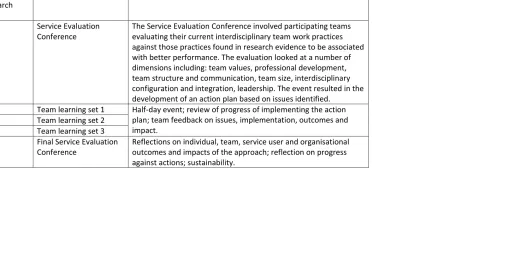
The implementation tool uses the SaFARI methodology which embeds a structured facilitation guide within action research. The action research was structured around a six month program involving six facilitated sessions comprising a longer, initial “Service Evaluation Conference”, drawing on the principles of the “search conference” (Emery and Purser, 1996) followed by four Team Learning Sets, and a final Service Evaluation
Conference (Table 1).
The Service Evaluation Conference guided participants through structured activities
orchestrated by an external facilitator, who prepared a report after each event. The report was provided to the teams as the basis for reflection at the next event. At the close of each event, participants completed a feedback questionnaire which formed part of the data collection process.
The intervention concluded with a final Service Evaluation Conference. Here, team members were provided with their team results with some benchmarking data from all of the teams involved in the study. This allowed an objective review of the team’s progress throughout the study. They were also consulted about their experience of participating in the project and completed a final feedback questionnaire.
Insert Table 1 about here: overall structure of the implementation
Trained facilitators implemented the IMT (Harvey et al., 2002) using a structured guide that standardised the facilitation process while allowing teams to reflect on their own issues and actions. By standardising the facilitation process, we were able to roll-out the IMT rapidly using a train-the-trainer approach whilst maintaining the integrity of the implementation methodology.
IMT evaluation
The IMT evaluation involved formative and summative components to capture the effect of the approach on team work, patients, and the service; and to reflect on the processes of implementation. Qualitative data were captured from the following documentary and primary data sources:
• Documentary data in the form of SEC and TLS reports prepared for each of the teams;
• Written feedback forms completed by each team member after every SEC and TLS event;
• In depth interviews with 15 participating staff and a focus group with the facilitators following service evaluation conference at the end of the study.
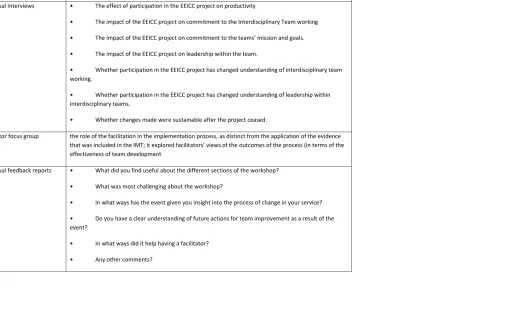
The questions asked in the interviews and feedback forms are outlined in Table 2. Analyses
Recruitment
Eligible teams were community based rehabilitation or community rehabilitation services providing transitional care (i.e. clients receive a package of care which aims to make them more independent) and whose primary client group is older people. Teams were recruited through the Community Therapists’ Network, an association for community based
rehabilitation teams. Many of these teams are now referred to as ‘intermediate care teams’. Study participants included all staff involved in delivering services within the selected teams, and a consecutively recruited cohort of patients who were admitted into the service over a three month recruitment period. Only staff perspectives are reported in this paper.
Results
The results are structured to focus on the impact of the impact of interdisciplinary team work.
Respondents
Ten teams participated in the IMT, including a total of 253 individual staff members (Table 2). The largest occupational groups represented were physiotherapists, support workers / assistant practitioners, occupational therapists and nurses respectively (Table 3). Other professions included social care workers, speech and language therapists, social workers, secretary / administrators, psychologists and dieticians. The characteristics of the
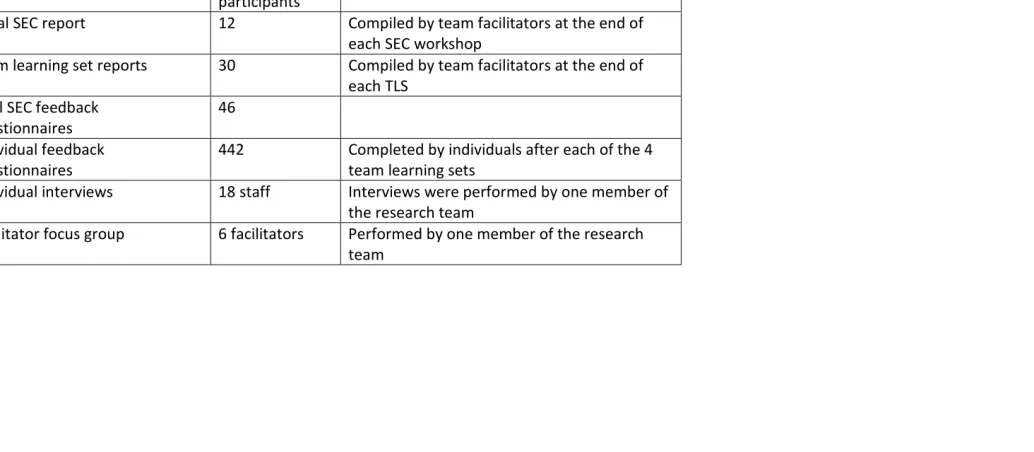
participating teams are provided in Table 3. Table 4 summarises the response rates from each of the data sources.
Issues and actions
For brevity, examples of the issues identified and actions undertaken by teams are
summarised thematically in Table 5. There was a great deal of consistency in issues; a key point being barriers to effective communication. The actions show the relative simplicity of many of the ideas, as well as the specificity to the particular teams. In many cases the actions adopted could be described as ‘good practice’, such as introducing formal mechanisms to capture patient feedback and scheduling meetings at a time that the majority of staff can attend. However, it is clear that several of the teams lacked good quality processes to facilitate team work.
Insert Table 5 about here
Benefits of reflective team processes facilitated by the IMT
Benefits of protected time to reflect on team practices
The most common area for improvement was the development and progress of team practices. The intervention enabled team members to work together more closely and effectively. Teams valued the investment of time in team development, as opposed to their sole focus on clinical work, and perceived that this time benefitted the service and provided
They never set time aside to think about themselves as an organisation or as a team and the way that they interact together and to be proactive in planning and
developing and thinking about their work and reflecting on it. Professional staff perceive that “when I work is patient time and clinical time and anything that happens outside of that is bureaucratic nonsense and impinges on my clinical time and stops me doing my job”. And I think there is a greater appreciation that time could be very well spent and there was real payback from that time. And actually . they decided to carry on meeting for half a day every couple of months when we finished (Facilitator focus group).
Three key areas of awareness arose around team work: understanding others’ opinions about team work; reaffirming how well they work together as a team; weaknesses of their team work and issues that might be improved.
This has been a fabulous opportunity for us to just take a breath and enjoy the fact that we’ve got such a good team and strengthen that. And I think the small projects that we’ve done have been beneficial for the team, not only as team building projects in themselves because of the time you’ve spent working with people but also because what we’ve done has been valuable stuff (Occupational Therapist).
Team members were less likely to see the team as a structural arrangement and more as a dynamic way of working.
I think it’s helped us to see ourselves less as a finished product and more as a work in action. I think it’s made me recognise that we are evolving and will continue and always be evolving. (Final feedback report)
One result of working together was an improvement in team members’ confidence and commitment to their team work.
I think it has emphasised to everybody in it (the team) what we do well; where there were some flaws; and that we can improve; and that we are integrated and working together; and we are all focused, and are all wanting the same outcomes …and that’s boosted everybody’s confidence and everybody’s self-esteem and you know made everybody feel proud of what they’re doing and giving them the boost to carry on and want to do more (Team Leader).
Improved team identity
Through the process of reflection teams were able to reshape the way they work together and create a team identity.
There was this sort of gathering awareness that they wanted to focus on what it was that they were doing, partly because they were getting this sense of
to communicate that to a wider audience, like this is what we do and this is what we do well. So it was a way of re-establishing, re-focusing on what we do because this is the most important thing (Facilitator focus group).
Participants found it useful to consider the wider context in which the team was working. This was particularly important regarding the changes that were taking place in the NHS and social care services during the project intervention. Other prominent themes were the consideration of service improvements from the service-user’s perspective, and integration with other services and organisations. Participants reflected on their role in relation to their wider networks, both individually and as a team.
Quite a lot of the work that we’ve done has been making sure that we’re aware of where we sit within other services and making sure that we make full use of other services so it’s not necessarily that our work has changed but we’re aware of what’s going on around us…. the wider network and using it more effectively and making personal links with people (Social worker).
Improved team communication
It was clear that in many cases, it was unusual for teams to have a meeting involving all team members. The facilitation process enabled all team members to discuss issues in depth, from different perspectives, in a neutral setting, and with the input of staff from all disciplines and grades.
Just everybody being there and being able to discuss it together, because a lot of the times when you’re in the office, we actually all aren’t together and sometimes you know if we have a meeting it could be people’s days off or something. So it’s actually nice to have absolutely everybody together and to have everybody’s point of view… rather than me making a suggestion, or somebody else making a suggestion, but not actually hearing what the other people that are involved have got to say (Team Leader).
One vehicle for improving communication was the development of more effective team meetings and case reviews.
We’ve changed how we do reviews and we’re trying to do those together more and that’s come out of that to try and help the effectiveness and use of time there. …. It’s really handy to hear about how other people have handled cases and have handled situations, because you get used to doing things your way and it’s nice to hear another perspective really and another option (Occupational Therapist).
Role clarity
One of the things it has taught us is how important it is to listen to each other because it gets very difficult sometimes when you become such a close working team, your identity tends to become a little bit lost or it can, but I feel that we’ve all learnt from each other’s roles, yeah most definitely (Occupational Therapy Assistant).
One team formalised this through the creation of role definitions.
One of the tasks that they set themselves was a written kind of document that says this is what we do and this is what each individual member of the team. So they say well actually I’m a social worker, this is what I do. I’m an OT, this is what I do. It was a document that people could then look at when they came into the team or you know for external purposes (Team Leader).
Integration
Participants perceived that the process of team reflection improved integration. A concrete manifestation of this in some teams was formalising joint reviews.
We make the time more often now to go and do joint reviews and spend time in the office, it’s something we’ve always done but it’s something we do better. It’s
something we’re actively aware of and we listen as well to each other’s opinions and each other’s opinions are valued (Occupational Therapy Assistant).
The IMT enhanced individual capabilities around interdisciplinary team work, enabling team members to become better participants in team processes and being better ‘integrated team members’. The down side of this was an increased risk of team insularity, reducing their ability to integrate with other teams or new staff.
What for me was really key for them it made them feel more integrated. And my concern was that actually it was going to make them more resistant to the new team coming in because they’d bonded in such a strong way that their anxieties about integrating more in another team were probably greater than at the beginning of the process when they hadn’t even thought about it. (Facilitator focus group)
Focus on goals and outcomes
Participants used the team reflection to increase their focus on goals and outcomes.
The goal planning I always thought was quite helpful in the study, the way you’ve done it …. it’s quite helpful when, we know what we’re aiming for (Support Worker).
Some of the changes we’ve made have really helped. I mean our discharge now is a lot tighter and we’ve got a better record (Team Leader).
forward. Feedback from the final team meetings indicated that teams maintained this focus on positive change as it became a part of the culture of the teams.
Feels good to have clear objectives for next 6 months and the team feels like it’s beginning to come together and improve efficiency. (Written feedback report)
Made us focus more on the outcomes of what we want to achieve and we need to celebrate what we do well and work together to improve other areas and grow. (Written feedback report)
Teams recognised that they lacked processes for obtaining feedback and acknowledging achievements. The events were opportunities for team members to directly address this issue. As such, they valued the feedback provided by the research team (such as patient satisfaction survey findings), and several teams developed their own internal reporting systems as an IMT action.
Leadership
The IMT helped participants gain a better understanding of leadership which in turn gave them insights into the processes of change. In particular, teams identified: better
understanding of the specific and general difficulties of leadership (including various competing pressures); leadership is a two way process which also requires effort on the part of ‘followers’; that every member of the team takes on a leadership role at times during their day-to-day work; and appreciating the importance of good leadership. Team leaders also valued understanding the way that team members viewed their leadership. Both team leaders and members suggested that the IMT had improved team leadership.
It has helped me as a manager with team issues and managing the team and I think it’s opened things up and allowed us to become … I want to say closer, I don’t know whether that’s the right word, but as a team (Team Leader).
I think it’s enabled [leader] to be less focused on the demands made by the system and enabled her to have a bigger picture of the team and what makes a team and why our team works and what you would want from a team. I think it’s helped [leader] to see what kind of manager she would want to be and she is, and what it takes to have that kind of team she would want. Whereas you know I think [leader] would be in danger of being absorbed by figures and reports and demands…. (Social Worker).
The process was seen to influence the leadership style of the team leader, and by promoting participation and empowerment, led to strengthening of shared leadership throughout the team. This in turn impacted positively on morale and satisfaction.
okayed… because of our department’s protocols. But you know they’ve grown in that respect and I’ve allowed that to grow and I haven’t felt like I can’t allow them to do that (Team Leader).
I think people are just maybe slightly happier at work… feel that their ideas have been taken on board with their groans and everything and things have changed because of it (Team Leader).
Team members also recognised their own leadership role:
Realising that at times, we are leaders; I never thought of myself as leader before. I realised I do act as a leader in certain circumstances (Physiotherapist).
Personal development
Participants benefitted personally by exploring their role in the team and wider service; considering their role in change processes; reflecting on their feelings and attitudes; focusing on individual objectives; and identifying their strengths and weaknesses.
Made me think that the areas of my development that need attention, and how to obtain it (Support Worker)
It was also clear that some team members were less used to working within a team and became more aware of their role within the team.
Even though I am a lone worker and I’ve got my own sort of case load, I don’t interact so much with the community team as it were. I’m sort of part of the community team but a separate part of it. I think I just became more aware that I could delegate my work a bit more and probably wasn’t earlier on. I was just trying to take everything on and do it all and …(Physiotherapist)
Understand change processes
Participants found that participating in the IMT helped participants identify issues, develop detailed action plans with timescales and designate specific roles to people to achieve these. This gave them insight into processes of change, which was enhanced by the ongoing process of reflection, reviewing actions and planning future changes.
It has allowed us to break down what is needed to change and also highlights what is working and allows an action plan to be made (Final written feedback)
By looking at our original goal plan, we had achieved 90% of what we were aiming for, which showed that we are putting into plan changes for the future (Final written feedback)
It has made me realise that we are changing naturally and still feel positive and welcome change. (Final written feedback report)
Barriers
Participation in the project presented some challenges. One barrier was the burden of additional data collection created by the project (specifically for the evaluation) and that time spent participating in the project came at the expense of clinical service delivery. Locus of control
An important issue identified by the teams was their limited ability to influence several problems that impacted on team practices.
The issue that I think was fundamental to our team was, "where is the locus of change". Influencing individuals and influencing teams and influencing team leadership and influencing the manager and if individuals within the team want to change, but there’s external pressures that are opposing those changes, then it’s very difficult to do that despite the best will in the team and so it’s very demoralising and it makes it very hard to do it. And I think that was one of the tensions with the teams. For instance, there was quite strong will for them (the team) to find their referral criteria. There was big opposition from outside the team to them doing that and also constantly changing policy directives to putting pressure on. (Facilitator)
Uncertainty
Two respondents were uncomfortable discussing personal development issues with their colleagues, and one respondent found the amount of problems others faced to be unwelcome news.
As a student it was disheartening in some ways to hear all the problems people working in my chosen profession face (Occupational Therapy Student)
Sustainability
Participants expressed some concerns about the sustainability of the project without the support of an external facilitator. They hoped that the team could build upon the work they had done, however some had reservations.
I think I’d like to see us carry on taking the time to recognise and focus on where the team’s going and how we’re going to get there. How we do that without a facilitator I don’t know. They were fabulous. I don’t think we would have got from where we started to where we are now without that. (Occupational Therapist).
When pressed however, participants were cautiously optimistic that they could continue to invest time in development activities.
take that forward and carry on with all that because I’ve found that really, really useful. And the actions we’ve done, I’d like to take forward as well. And then maybe even at some point, grow and do a mini, little project/study and have more action groups and more action plans to build …(Team Leader).
Basking in own glory
The facilitators expressed concern that being involved in the IMT process could make teams bask in the glory of what they do well at the expense of trying to improve:
They looked down the action plan and I felt that they were pretty good at saying where we are now, we can do this or we’ve got on with this but these things we’re not going to touch because of the impending changes. But that worries me a bit because they are becoming more and more entrenched in what they’ll do as that little unit.
Discussion
The purpose of this research was to enhance interdisciplinary team work using a structured, reflective Interdisciplinary Management Tool. The IMT provided a structured way of
developing teams by facilitating their collective attempts to work towards clear and
common goals within a changing environment, rather than as a group of semi-autonomous individuals.
An important output of the intervention was that team members collaborated in identifying barriers to their own team practices and took responsibility for changes that needed to be made within the team. Participating teams identified several common issues, which were often resolved using novel, low cost initiatives that were appropriate to that team context. However the findings from show that health and social care teams face a range of problems relating to team work, in common with those identified in previous studies (Finn,
2008)(Learmonth, 2005). Participating teams rarely set time aside for team building activities such as; reflecting on their team practices, individual roles within the team, or their understanding of others’ roles. A core issue identified by several of the teams was the lack of a clear goal or purpose. This is especially surprising given that one of the key
characteristics of a team is that it has specific performance objectives (Staniforth and West, 1995, LaFasto and Larson, 2001, Katzenbach and Smith, 1992, Cohen and Bailey, 1997). The actions showed that several, seemingly simple, but essential team activities were not taking place, such as having structured, documented team meetings that all members attend. Such activities are vital not just for agreeing goals and coordinating action, but for team building.
by the IMT allowed them to make some progress in improving integration and team work within their teams.
The study showed that health and social care teams need to spend more time developing effective team processes. Making time to meet regularly to reflect on practice and build team work is therefore crucial to develop and sustain team work.This requires high level buy-in to support the development of more effective teams, but also to provide external leverage for the issues that arise that are beyond the control of the team. It also requires training so the group can develop sustainable, embedded leadership skills to facilitate the team development process without the external facilitation provided in this research. The study has some limitations. Firstly, it draws on a relatively small number of teams from a specific type of service, therefore further analysis is required to determine whether the concepts identified in this paper hold true for other teams. However, within this sample of teams the extent of data saturation indicates an appropriate sample size.
Secondly, the pre-defined topics area explored in the IMT could have provided an a priori framework which limited the types of issues that the teams identified. However, it is notable that the types of barriers identified by the teams do not correlate directly with the IMT topic framework. Issues such as ‘morale and motivation’, and ‘facilities and resources’ emerged spontaneously through the process of investigation. This indicates that the IMT events successfully elicited the true barriers experienced by the teams, despite these not being explicitly focused on from the outset. The barriers identified in this study therefore represent a refinement of current evidence and would be a useful starting point for developing interdisciplinary team work.
The SaFARI method of implementation has the advantage that it is a structured but flexible process. These processes of implementation are replicable and transferable, and can adapt to the requirements of the local setting. The methodology differs from other action research based implementation models, such as the Interprofessional Praxis Audit Framework (IPAF) (Greenfield et al., 2010) in that it presents a reflective and replicable template to problem identification and action planning that can be applied to any team setting. The codification of the processes lends itself easily to a train the trainer approach so that large scale
implementation can take place quickly. Conclusions
Teams and organisations rarely reserve time to reflect on the effectiveness of their processes of working together. Indeed most of the interventions around team work are solution focussed, rather than reflective, such as the introduction of daily ward rounds, and monthly team meetings.
team and through this, helped them identify ways to enhance the way the team worked together.
As this study has shown, a relatively small investment of time (approximately 24 hours per person over a 6 month period) was valued by team members; led to new and sustainable insights into the ways that a team works together; generating multiple simple, low cost and effective interventions to help create the glue that develops an effective service.
The feedback from participants suggests a change in the way that they understood their team dynamics and their role within the team. The findings also suggest that individuals had a better understanding of their own responsibility as a team member, rather than a passive individual working within a larger structure. Team members appeared to value this
understanding.
References
AVLUND, K., JEPSEN, E., VASS, M. & LUNDEMARK, H. 2002. Effects of comprehensive follow-up home visits after hospitalization on functional ability and readmissions among old patients. A randomized controlled study. Scandinavian Journal of Occupational Therapy, 9, 17-22. BRAITHWAITE, J., WESTBROOK, M., NUGUS, P., GREENFIELD, D., TRAVAGLIA, J., RUNCIMAN, W.,
FOXWELL, A. R., BOYCE, R. A., DEVINNEY, T. & WESTBROOK, J. 2012. A four-year, systems-wide intervention promoting interprofessional collaboration. BMC Health Services Research,
12, 99.
CANNON-BOWERS, J. A., TANNENBAUM, S. I., SALAS, E. & VOLPE, C. E. 1995. Defining competencies and establishing team training requirements. Team effectiveness and decision making in organizations, 333, 380.
COHEN, S. G. & BAILEY, D. E. 1997. What makes teams work: Group effectiveness research from the shop floor to the executive suite. Journal of management, 23, 239-290.
EMERY, M. & PURSER, R. E. 1996. The search conference: A powerful method for planning organizational change and community action, Jossey-Bass San Francisco.
FINN, R. 2008. The language of teamwork: Reproducing professional divisions in the operating theatre. Human Relations, 61, 103-130.
FINN, R., LEARMONTH, M. & REEDY, P. 2010. Some unintended effects of teamwork in healthcare.
Social Science & Medicine, 70, 1148-1154.
FRENCH, W. & BELL, C. 1999. Organisation Development: Behavioural Science
Interventions for Organisational Improvement, Prentice Hall.
GREENFIELD, D., NUGUS, P., TRAVAGLIA, J. & BRAITHWAITE, J. 2010. Auditing an organization's interprofessional learning and interprofessional practice: the interprofessional praxis audit framework (IPAF). Journal of interprofessional care, 24, 436-449.
GUMMESSON, D. 2000. Qualitative Methods in Management Research, Sage.
HARVEY, G., LOFTUS‐HILLS, A., RYCROFT‐MALONE, J., TITCHEN, A., KITSON, A., MCCORMACK, B. & SEERS, K. 2002. Getting evidence into practice: the role and function of facilitation. Journal of advanced nursing, 37, 577-588.
HENEGHAN, C., WRIGHT, J. & WATSON, G. 2013. Clinical Psychologists' Experiences of Reflective Staff Groups in Inpatient Psychiatric Settings: A Mixed Methods Study. Clinical psychology & psychotherapy.
KATZENBACH, J. R. & SMITH, D. K. 1992. The wisdom of teams: Creating the high-performance organization, Harvard Business Press.
KNOX, G. E. & SIMPSON, K. R. 2004. Teamwork: the fundamental building block of high-reliability organizations and patient safety. Patient Safety Handbook, 379-414.
LAFASTO, F. & LARSON, C. 2001. When teams work best: 6,000 team members and leaders tell what it takes to succeed, Sage.
LEARMONTH, M. 2005. Doing things with words: the case of ‘management’and ‘administration’.
Public Administration, 83, 617-637.
LEATHARD, A. 2003. Interprofessional Collaboration: From Policy to Practice in Health and Social Care, London, Brunner-Routledge.
NANCARROW, S. 2004. Dynamic role boundaries in intermediate care services. Journal of Interprofessional Care, 18, 141-151.
NANCARROW, S., ENDERBY, P., ARISS, S., SMITH, T., BOOTH, A., CAMPBELL, M., CANTRELL, A. & PARKER, S. 2012. The impact of enhancing the effectiveness of interdisciplinary working. Section 1.
NANCARROW, S. A., BOOTH, A., ARISS, S., SMITH, T., ENDERBY, P. & ROOTS, A. 2013. Ten principles of good interdisciplinary team work. Human resources for health, 11, 19.
RITCHIE, J. & SPENCER, L. 1995. Qualitative data analysis for applied policy research. In: BRYMAN, A. & BURGESS, R. G. (eds.) Analyzing Qualitative Data. London: Routledge.
SALAS, E., SIMS, D. E. & BURKE, C. S. 2005. Is there a “big five” in teamwork? Small group research,
36, 555-599.
SCHIPPERS, M. C., HOMAN, A. C. & KNIPPENBERG, D. 2013. To reflect or not to reflect: Prior team performance as a boundary condition of the effects of reflexivity on learning and final team performance. Journal of Organizational Behavior, 34, 6-23.
SMITH, T., CROSS, E., BOOTH, A., ARISS, S., NANCARROW, S., ENDERBY, P. M. & BLINSTON, A. 2012.
Interdisciplinary Management Tool - Workbook Southampton, National Institute of Health Research Service Delivery and Organisation Program.
STANIFORTH, D. & WEST, M. 1995. Leading and managing teams. Team Performance Management,
1, 28-33.
SVEEN, E., BAUTZ-HOLTER, K., MARGRETHE, S., TORGEIR, B. W. & KNUT LAAKE, U. 1999. Association between impairments, self-care ability and social activities 1 year after stroke. Disability & Rehabilitation, 21, 372-377.
Acknowledgements
Table 1: The structure of the facilitated action research sessions used to implement the IMT
Stage of action research cycle
Facilitation stage Content
1 Service Evaluation
Conference
The Service Evaluation Conference involved participating teams evaluating their current interdisciplinary team work practices against those practices found in research evidence to be associated with better performance. The evaluation looked at a number of dimensions including: team values, professional development, team structure and communication, team size, interdisciplinary configuration and integration, leadership. The event resulted in the development of an action plan based on issues identified.
2 Team learning set 1 Half-day event; review of progress of implementing the action
plan; team feedback on issues, implementation, outcomes and impact.
3 Team learning set 2
4 Team learning set 3
5 Final Service Evaluation
Conference
Table 2: Summary of interview / survey topic guides
Data source Interview schedule / questions
Team Learning Set Reports Summarised the reflections, issues and actions identified by each team, and their progress against the actions.
Individual interviews • The effect of participation in the EEICC project on productivity
• The impact of the EEICC project on commitment to the Interdisciplinary Team working
• The impact of the EEICC project on commitment to the teams’ mission and goals.
• The impact of the EEICC project on leadership within the team.
• Whether participation in the EEICC project has changed understanding of interdisciplinary team working.
• Whether participation in the EEICC project has changed understanding of leadership within interdisciplinary teams.
• Whether changes made were sustainable after the project ceased.
Facilitator focus group the role of the facilitation in the implementation process, as distinct from the application of the evidence that was included in the IMT; it explored facilitators’ views of the outcomes of the process (in terms of the effectiveness of team development
Individual feedback reports • What did you find useful about the different sections of the workshop?
• What was most challenging about the workshop?
• In what ways has the event given you insight into the process of change in your service?
• Do you have a clear understanding of future actions for team improvement as a result of the event?
• In what ways did it help having a facilitator?
Final SEC • In what ways has your involvement in the project influenced the way the team works?
• In what ways could we improve the Inter disciplinary Management Tool booklet?
• How could the Interdisciplinary Management Tool be improved to make it more accessible (eg electronic format, interactive exercises)?
• Please comment on the ease of use of the outcome tools (TOM, EQ5D, Patient Satisfaction Questionnaire).
• What did you find useful about using the outcome tools?
• What was the most challenging aspect of using the outcome tools?
Table 3: Characteristics of participating teams
ID Service goal
Primary Location of Care Referrals / year Average duration of care Popn type Funding provider No. qual staff No. support staff Total staff b
Rehabilitation focus, prevent admission, facilitate discharge; maintain patients at home to prevent long term residential or nursing
home care Home 1650 3 weeks Mixed
75% PCT, 25%
Social services 14.82 10.82 26.64
d
Prevent hospital admissions, facilitate early
hospital discharge Home 358 45 days Rural PCT 4.14 3.51 7.65
do Community stroke specific rehabilitation Home 225 101 days Urban
PCT, some from social
services 8.8 10 18.8
e
Community rehabilitation facilitating early
discharge and/or hospital avoidance Home 350 41 days Rural PCT 8 4 12
f
Prevent admissions to hospital and community rehabilitation as well as facilitate hospital discharges
Communit y Resource
Centre 135
Enablement – 30 days; Rehab unit -
32.5 days Mixed
Adult Services
and PCT 2 7 9.3
my
Prevent admissions to hospital and community rehabilitation as well as facilitate hospital
discharges Home 8000 Unknown Mixed PCT 54 35 90.6
pb
Facilitate early discharge from acute hospital and to prevent admission to hospital
Communit
y Hospital 160 35 days Urban PCT 26.88 12.72 40.6
q
Prevent avoidable hospital or long term care admission; facilitate early discharges to home or appropriate community settings; to
minimise dependence as far as safely possible Home 38 49 days Mixed
PCT & social
services 8.8 4.4 14.2
r
Rehabilitation focus for preventing admission and facilitating discharge; Maintenance of patients at home to prevent long term
residential or nursing home care Home 1650 3 weeks Mixed
75% PCT, 25%
Social Care 16.39 10.66 28.05
u
Prevent admission to hospital, facilitate discharge from hospital and prevent
admission to long term care Home 280 5-6 Weeks Urban
PCT & social
Table 4: Description of data sources and respondents
Data source Number of
responses / participants
Detail
Initial SEC report 12 Compiled by team facilitators at the end of
each SEC workshop
Team learning set reports 30 Compiled by team facilitators at the end of
each TLS Final SEC feedback
questionnaires
46
Individual feedback questionnaires
442 Completed by individuals after each of the 4
team learning sets
Individual interviews 18 staff Interviews were performed by one member of
the research team
Facilitator focus group 6 facilitators Performed by one member of the research
Table 5: Overview of the issues and actions identified by teams
Issues identified Description Examples of the types of actions undertaken
Creating a clarity of vision and direction for the service
The extent to which values are shared by team members including goals and objectives of the team and definitions of the service.
Gaining information from service management (‘from above’) to clarify the purpose of the service The team to establish a shared vision:
Approach managers to ask for their view on the vision Look at the vision adopted of other teams
Consultation with the team through a team meeting to develop a vision within the team, which includes defining referral criteria.
Look at addressing the tensions between the dual purposes of goal setting (i.e. contractual/therapeutic)
Improving external communication & relationships
Communication and relationships with external
organisations/services and senior management.
Visit nursing homes/ community settings with a view to promoting the services; attending ward meetings and giving presentations on community rehabilitation; providing leaflets to patients
Improve the way that the service is viewed by others and maintaining awareness of the service (district nurses, GPs, social workers in acute settings, discharge coordinators etc).
Invite representatives from other organisations to team meetings for awareness and updates Introduction of a single point of access manned by clinicians
GP surveys
Rotation into the hospital with discharge liaison staff and emergency matron Providing feedback to wards in the form of vignettes
Direct targeting of patients, for instance by providing information in the pre-assessment packs Staff involved in pre-assessment of patients
Improving internal communication
Processes related to general team relationship and communication issues.
The use of a 'feedback' or 'honesty' box to provide feedback to the team about things that are working well, and that could be improved
Hold regular meetings with agenda posted on notice-board well beforehand
Ensuring that the discussion of important clinical matters is not lost in the general business of the team meetings Varying meeting times so that all staff are able to attend at least some meetings
Opportunities for continuing professional development, & career progression
Activities aimed at professional development: training, knowledge, skills, rotation, secondment & opportunities for promotion and progression.
Use of staff journal clubs
Using existing clinical time to facilitate joint learning experiences, for example, through joint assessments Inviting speakers to attend lunch time seminars
Develop in-house training programme Timetabling a rota for training for staff
Improving service efficiency
Organisational structures and processes to support interdisciplinary working practices.
General review of coordination processes and systems including: Possible coordination role of admin staff (to help free-up clinical time)
Keeping ‘new-patient’ slots open in the diary possibly every other day 1.00-2.00 p.m. (capacity/diary management). This would have the added benefit of having times when joint availability was more likely.
Ensure equity for new patient allocation
Exploring more productive use of ‘vacant hours’ (when the service is underutilised) Creating quiet areas so staff can concentrate on work and make important phone calls Care planning and documentation of care:
requires planning which integrates the relatives as well as the patient.
Review and clarification of what needs documenting. For instance frequency of bathing.
Enhancing joint-working Processes to support the way that staff members work together and observe each others’ work.
Individual Residential Rehabilitation staff to make requests to attend home visits (for continuity of care and increased understanding of the community care role of the team)
Staff shadowing workers from other disciplines Improved joint working with support workers Assessment/audit of current joint working practices
Management, Leadership, Decision-making and Autonomy
Roles of managers and management or leaders and leadership, especially regarding decision making and
coordination.
Communication so that the team is ‘all singing from the same hymn sheet’.
Try to delegate tasks, in particular where there are good learning and development opportunities.
Enhancing morale & Motivation
Activities designed to enhance the morale of team members.
Introduction of feedback box. Introducing team social events.
Capturing service impact and outcomes
Processes designed to enhance and capture the impact of team care on patients.
Introducing systems to provide feedback to the team at regular intervals, including embedded feedback in monthly supervision and locality meetings
Report positive items such as successful resolution of problems
Evaluate the impact of service and role changes, such as staff rotations and feed the results back to the team. Develop and integrate formal systems for capturing patient views, such as patient satisfaction surveys. Many teams already collect patient satisfaction information but not all of them incorporate it into their team feedback cycles. Introduction of a client ‘appreciation box’ to provide feedback to staff.
Service Development Activities
Processes for team building and enhancing team activities.
Visit other teams Develop a resource area
Development of a process of group reflection Process for debriefing in place & review & modify Time-out afternoon