A novel method of using accelerometry for upper limb FES
control.
SUN, Mingxu, KENNEY, Laurence, SMITH, Christine
<http://orcid.org/0000-0001-5354-953X>, WARING, Karen, LUCKIE, Helen, LIU, Anmin and
HOWARD, David
Available from Sheffield Hallam University Research Archive (SHURA) at:
http://shura.shu.ac.uk/13946/
This document is the author deposited version. You are advised to consult the
publisher's version if you wish to cite from it.
Published version
SUN, Mingxu, KENNEY, Laurence, SMITH, Christine, WARING, Karen, LUCKIE,
Helen, LIU, Anmin and HOWARD, David (2016). A novel method of using
accelerometry for upper limb FES control. Medical engineering & physics, 38 (11),
1244-1250.
Copyright and re-use policy
See
http://shura.shu.ac.uk/information.html
1 A novel method of using accelerometry for upper limb FES control
1 2
Mingxu Sun1, Laurence Kenney1*, Christine Smith2, Karen Waring1, Helen Luckie1, Anmin Liu1, David
3
Howard1,3
4
¹ Centre for Health Sciences Research, University of Salford, UK 5
2Department of Allied Health Professions, Sheffield Hallam University, UK 6
3School of Computing, Science and Engineering, University of Salford, UK 7
* Corresponding author. 8
Tel.: +44 161 295 2289 9
Email: [email protected] 10
11
Abstract
12This paper reports on a novel approach to using a 3-axis accelerometer to capture body segment 13
angle for upper limb functional electrical stimulation (FES) control. The approach calculates the angle 14
between the accelerometer x-axis and the gravity vector, while avoiding poor sensitivity at certain 15
angles and minimising errors when true acceleration is relatively large in comparison to gravity. This 16
approach was incorporated into a state-machine controller which is used for the real-time control of 17
FES during upper limb functional task performance. An experimental approach was used to validate 18
the new method. Two participants with different upper limb impairments resulting from a stroke 19
carried out four different FES-assisted tasks. Comparisons were made between angle calculated 20
from arm-mounted accelerometer data using our algorithm and angle calculated from limb-mounted 21
reflective marker data. After removal of coordinate misalignment error, mean error across tasks and 22
subjects ranged between 1.4 and 2.9 degrees. The approach shows promise for use in the control of 23
upper limb FES and other human movement applications where true acceleration is relatively small 24
in comparison with gravity. 25
Keywords: Accelerometer, Body segment angle, Functional electrical stimulation control, Upper limb 26
rehabilitation, Functional tasks 27
28
Introduction
29A recent systematic review concluded that the use of functional electrical stimulation (FES) to 30
promote recovery of upper limb activity after stroke was significantly more effective than activity 31
training alone[1]. Although the finding was positive, at least 4 of the included studies were based on 32
systems which either did not encourage voluntary effort to achieve a functional task, and/or did not 33
offer flexibility over the sequence of stimulation delivered [2-5]. Both voluntary engagement with, 34
2 programmes for motor re-learning [6, 7], suggesting limitations with the technologies used in these 36
studies. 37
In recognition of this, researchers have developed a number of systems which provide the patient 38
with FES support for a range of tasks and encourage voluntary engagement of the user. These 39
include devices based on iterative learning control [8], proportionally controlled systems using EMG 40
as an input signal [9] and, of most relevance to this paper, user-defined state machine controlled 41
systems [10, 11]. User-defined state machine control offers a potentially simple approach to 42
implementing task- and patient-specific FES support. However, in order to provide the user with the 43
opportunity to directly engage with the task by actively initiating or controlling stimulation, a 44
method is required to detect user intent. A range of sensors for this purpose have been investigated, 45
including EEG [12] and EMG[13]. Each of these sensing approaches has its limitations and for all bar 46
the most severely impaired, limb-mounted movement sensors offer an attractive alternative. 47
Although 6 degree of freedom inertial measurement units (IMUs), which typically include 48
accelerometers, rate gyroscopes and magnetometers, are available, they remain relatively bulky. 49
This precludes their use on, for example, individual fingers. Further, although the price of IMUs has 50
reduced over the past few years, compared with these devices, accelerometers remain cheaper, 51
simpler to use in terms of data processing, and lower power. A small number of researchers have 52
therefore investigated their application to upper limb FES [14-17]. However, as will be discussed 53
below the methods used to derive estimations of orientation from accelerometer data are limited in 54
these and many other papers. 55
Current methods for processing accelerometer signals to estimate orientation can be categorised 56
according to the number of independent measures (accelerometer axes) used. The first group of 57
methods are based on using just one accelerometer signal, either a single axis device or one axis of a 58
multi-axis device. In the first embodiment of these, a series of calibration measurements over a 59
range of angles is required and an interpolation algorithm can then be used to derive the angle of 60
the sensitive axis from the vertical [18-20]. As the calibration curve is significantly non-linear, the 61
accuracy is highly dependent on a thorough calibration. More commonly, a trigonometric approach 62
is used, based on arccos or arcsin functions (e.g. [21-24]). Both of these approaches require 63
calibration to accurately identify the value of the denominator. Regardless of which of these three 64
techniques is adopted for processing the accelerometer signal, they all suffer from the same 65
drawbacks. When the magnitude of acceleration on the sensitive axis approaches either 9.81 or -66
9.81, the sensitivity approaches zero because sin 𝛽𝛽 or cos 𝛽𝛽 approach 1, which means the signal to 67
noise ratio is very poor [21, 23, 25, 26]. A small number of papers ignore the issue of poor sensitivity 68
at zero or 90 degrees by suggesting a workable range for measurements [21, 23, 24]. For example, 69
Miroslav Husak [23] refers to the measurement range with zero sensitivity as being a “Dead zone” 70
and reports that, using the arcsin function, error increases from less than 2° over 4° when the 71
sensitive axis nears ±90°. 72
The second group of methods uses a dual axis accelerometer (or two axes of a 3-axis device). The 73
signals from both of the sensitive axes can be used to calculate the angle from the vertical 74
𝜃𝜃 = 𝑎𝑎𝑎𝑎𝑎𝑎𝑎𝑎𝑎𝑎𝑎𝑎 �𝑔𝑔𝑧𝑧⁄ �𝑔𝑔𝑥𝑥 . This method suffers from decreasing sensitivity and, hence, increasing angle 75
3 al [29] reports that, using the arctan function, error increases from 1.37° to over 4.5° when the 77
sensitive axis nears 0°. 78
When applying either approach to the analysis of accelerometers signals there remains the problem 79
that orientation can only be accurately estimated if the true acceleration is small compared with 80
gravity (as accelerometers measure the sum of true acceleration and gravity). While the use of 81
distributed multiple accelerometers provide a solution to this problem [30, 31], this is less than ideal 82
for application to upper limb FES because of the difficulty of donning the additional, rigidly 83
connected, accelerometers. 84
In upper limb FES applications, the way the accelerometer signals are used for control purposes can 85
be categorised as either direct use of the raw accelerometer signals [14, 16, 17] or using an angle-86
based approach [15], both of which suffer from one or more of the problems listed above. 87
In this paper we report on a novel approach to using accelerometry for upper limb FES control which 88
addresses the issues discussed above. The paper begins by introducing a new approach to estimating 89
angle relative to gravity from a 3D accelerometer, based on vector mechanics, which includes 90
methods for avoiding poor sensitivity at certain angles and minimising errors when true acceleration 91
is relatively large in comparison to gravity. The paper then reports on its application in our finite-92
state-machine (FSM) controlled FES system and evaluates its performance. 93
94
Methods
95Angle estimation algorithm 96
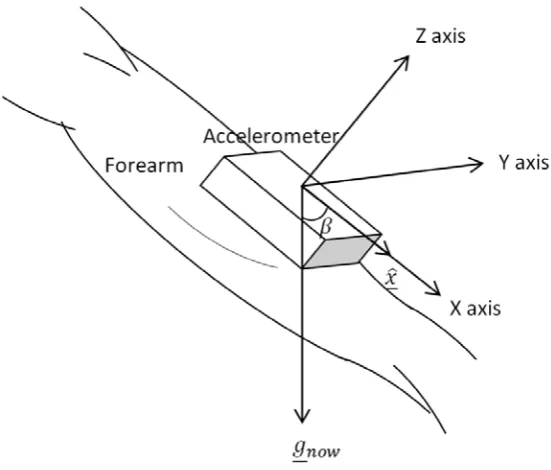
The new method calculates the absolute angle from the vertical of one axis of a 3-axis accelerometer 97
(for the purpose of the paper, the x-axis). Referring to Figure 1, the method calculates the angle 𝛽𝛽
98
between 𝑥𝑥� and 𝑔𝑔𝑛𝑛𝑛𝑛𝑛𝑛, where 𝑥𝑥� is the unit vector representing the accelerometer x-axis, and 𝑔𝑔𝑛𝑛𝑛𝑛𝑛𝑛is 99
4 101
Figure 1: Angle between unit vector along x-axis and gravity vector 102
103
We use the definitions of the dot product and cross product between the gravity vector and unit 104
vector along the x-axis to derive the following equations: 105
𝑎𝑎𝑐𝑐𝑐𝑐(𝛽𝛽) = 𝑔𝑔𝑛𝑛𝑛𝑛𝑛𝑛∙ 𝑥𝑥� �𝑔𝑔𝑛𝑛𝑛𝑛𝑛𝑛� �𝑥𝑥��
= 𝑔𝑔𝑥𝑥
��𝑔𝑔𝑥𝑥2+ 𝑔𝑔𝑦𝑦2+ 𝑔𝑔𝑧𝑧2�
(1)
sin(𝛽𝛽) =�𝑔𝑔𝑛𝑛𝑛𝑛𝑛𝑛× 𝑥𝑥�� �𝑔𝑔𝑛𝑛𝑛𝑛𝑛𝑛� �𝑥𝑥��
= �(𝑔𝑔𝑧𝑧 )
2+ � 𝑔𝑔 𝑦𝑦�2
��𝑔𝑔𝑥𝑥2+ 𝑔𝑔𝑦𝑦2+ 𝑔𝑔𝑧𝑧2�
(2)
As mentioned in the introduction, when sin(𝛽𝛽) or cos(𝛽𝛽) approach 1, their sensitivity to changes in 106
𝛽𝛽 approaches zero (the derivative tends to zero). Therefore, to maximise accuracy, we use sin(𝛽𝛽) for 107
calculating angles in the ranges 𝛽𝛽 = 0°− 45° and 𝛽𝛽 = 135°− 180° and cos 𝛽𝛽 for calculating angles 108
in the range 𝛽𝛽 = 45°− 135°. Furthermore, because arcsin does not have a unique solution in the 109
range 0⁰ to 180⁰, we use the sign of cos(𝛽𝛽) to determine whether the angle given by arcsin lies 110
between 0°− 45° or between 135°− 180°. Therefore, combining the principles described above, 111
5 If 𝑎𝑎𝑐𝑐𝑐𝑐(𝛽𝛽) ≥ 0.707107
𝜃𝜃 = 𝑎𝑎𝑎𝑎𝑎𝑎𝑐𝑐𝑎𝑎𝑎𝑎(𝑐𝑐𝑎𝑎𝑎𝑎𝛽𝛽)
Else if 𝑎𝑎𝑐𝑐𝑐𝑐(𝛽𝛽) ≤ −0.707107 𝛽𝛽 = 𝜋𝜋 − 𝑎𝑎𝑎𝑎𝑎𝑎𝑐𝑐𝑎𝑎𝑎𝑎(𝑐𝑐𝑎𝑎𝑎𝑎𝛽𝛽)
Else
𝛽𝛽 = 𝑎𝑎𝑎𝑎𝑎𝑎𝑎𝑎𝑐𝑐𝑐𝑐(𝑎𝑎𝑐𝑐𝑐𝑐𝛽𝛽)
End
(3)
113
The proposed approach overcomes the problem of poor sensitivity to changes in angle when sin(𝛽𝛽)
114
or cos(𝛽𝛽) approach 1 and does not suffer from the singularities seen in approaches which use 2-axis 115
accelerometer signals and arctan. 116
117
In addition to the approach outlined above we have included an algorithm to reduce the likelihood 118
of misinterpreting the accelerometer data when the true acceleration becomes significant compared 119
with g (9.81 m/s2). In cases where the magnitude of the measured accelerometer vector significantly
120
exceeds g (i.e. true acceleration is significant compared to g) the data point is ignored. This is 121
achieved by applying a g-tolerance band (9.81 ± g-tolerance) and only using good data points that 122
lie within that band. The FSM controller triggers a state transition when n good data points (i.e. 123
within the g-tolerance band) have exceeded the specified body-segment angle threshold (using n 124
good points acts as a noise filter). As the g-tolerance band narrows, it would be expected that a 125
larger number of bad data points would be ignored by the controller and hence this may lead to a 126
delay in moving between states. Conversely, if the g-tolerance band is too wide, errors in angle 127
estimation would be expected to increase. In this study, we explore the effects of different values 128
for the g-tolerance band on angle estimation and the trade-off between accuracy and number of 129
bad data points ignored. 130
131
Experimental protocol 132
Following ethical approval (REC ref: 10/H1005/26) two quite different participants, both with upper 133
limb impairments following stroke, were invited to the lab to participate in the study. The 134
[image:6.595.71.526.696.762.2]participants are described in table 1. 135
Table 1: Participants 136
No Gender Age Hemiplegic side
Dominant side
Years since onset
Fugl-Meyer Upper Extremity score
6
1 M 81 Left Right 3 years 29
2 F 42 Right Right 13 years 37
[image:7.595.72.525.72.202.2]137
Figure 2 shows the experimental setup for the “Drink from a cup” task. Two inertial sensing units or 138
IMUs (MT9 Xsens bv, NL), each with a cluster of four reflective markers on their upper corners, were 139
attached to the upper arm and forearm of the subject’s affected limb using self-adherent bandage. 140
The IMUs’ x-axes were approximately aligned with the long axes of the body segments. A Vicon 141
motion analysis system (Vicon Motion Systems Ltd, Los Angeles, USA) employing ten cameras was 142
used to capture the positions of the reflective markers on each IMU at a sampling frequency of 100 143
Hz. Only acceleration data was captured from the IMUs, at a sampling frequency of 20 Hz, using a 144
separate laptop. This laptop also ran the Finite State Machine controller that produced the 145
necessary stimulation profiles via a RehaStim 8-channel stimulator (Hasomed GmbH, Magdeburg, 146
Germany), and also ran the graphical user interface (GUI) used to set up the FSM controller. A pulse 147
signal from one of the Xsens system’s analog output channels was fed to an analogue input channel 148
in the Vicon system to provide synchronization between the Xsens and Vicon systems. This 149
experimental setup was also used to study another three tasks (see below for details of each task). 150
151
Figure 2: Experimental setup 152
153
Each subject was asked to carry out a series of functional tasks assisted by electrical stimulation to 154
[image:7.595.70.370.438.675.2]7 therapist at the start of each session as being very difficult or impossible for the user to perform 156
unaided. The four tasks were “Brush coins into the other hand”, “Drink from a cup”, “Place an object 157
onto a shelf” and “Pour water from a bottle to a cup”. For all tasks, the subject sat at a table with 158
their affected hand comfortably placed on the table or on the thigh (for “Place an object into a 159
shelf”) at the starting position. For each repeat of a task, the object(s) to be manipulated was/were 160
placed in a pre-defined starting location. 161
The therapist used the GUI mentioned earlier to define each task as a sequence of FSM states 162
(corresponding to movement phases), each of which was associated with a stimulation profile1 for
163
each of the muscles to be stimulated (see figure 3). Threshold values for each muscle were 164
established earlier in the setup process, leaving the therapist to define pulse width target and ramp 165
time for each stimulated muscle in each phase. Pressing a button on the keyboard to leave the 166
neutral phase, the therapist then used the GUI to manually adjust the pulse width target and ramp 167
time for each of the stimulated muscles in phase 1, until the relevant limb motion was achieved. This 168
process was repeated for each movement phase (FSM state). During each attempt, data were 169
recorded from both the Vicon and Xsens systems. Once the therapist was satisfied with the resultant 170
movement, he/she invited the participant to repeat the task until data on between 7 and 10 171
satisfactory repeats had been captured. 172
Descriptions of the finite state machines for each of the four functional tasks are as follows: 173
[image:8.595.79.514.381.646.2]174
Figure 3: Finite state diagrams for the following tasks (a) “Brush coins into the other hand”; (b) “Drink from a cup”; (c) 175
Place an object onto a shelf; (d) Pour water from a bottle to a cup. The controller moves between states when the 176
transition condition Btn is met (Btn = Button press). In each state (represented by a box), the specified muscles are 177
stimulated where: AD&Tr = Anterior deltoid and Triceps; Bi = Biceps; Pr = Pronator; WE = Wrist extensors. 178
179
8 “Brush coins into the other hand” (figure 3a)
180
The subject was required to reach for coins positioned on the table and brush them back into his/her 181
other hand. The position of the coins was such that (s)he could only achieve the task with FES 182
assistance. 183
“Drink from a cup” (figure 3b) 184
The subject was required to reach for a cup, grasp it, lift the cup to the mouth, replace the cup and 185
release it. The cup was positioned such that the subject could only achieve the task with FES 186
assistance. 187
“Place an object onto a shelf” (figure 3c) 188
The subject was required to lift his/her forearm towards an object, grasp it, reach forward to put it 189
on to a shelf and release it. The shelf was located such that (s)he could only achieve the task with 190
FES assistance. 191
192
“Pour water from a bottle to a cup” (figure 3d) 193
The subject was required to reach for a bottle, grasp it and pour the water into a cup, replace the 194
bottle and release it. The position of the cup was such that the subject could only achieve the task 195
with FES assistance. 196
197
Data processing 198
199
The absolute angles from vertical of the two IMU x-axes, based on the accelerometer signals and the 200
new algorithm described earlier, were recorded directly by the real-time FSM controller. The 201
coordinates of the reflective markers attached to the IMUs were exported using Visual 3D software 202
(C-Motion, Inc., Rockville, MD, USA). The Vicon marker data were down-sampled to provide data at 203
20Hz (frequency of the FSM controller) and synchronized with the IMU data. The calculation of the 204
angles from vertical of the x-axes of the two IMUs, based on the Vicon data, is described in [32] and 205
was implemented using Matlab (Mathworks inc. Natick, USA). 206
207
Data were checked post-collection and task repeats were discarded in cases where the marker 208
visibility was incomplete, or synchronisation between the Xsens and Vicon systems failed. 209
210
To account for small misalignment errors between the marker-derived sensor coordinate frame and 211
the accelerometer coordinate frame, the first 10 frames of static data were used to artificially 212
remove the offset. Comparisons between accelerometer and marker-derived angles were drawn 213
using RMS error and Peason Correlation coefficients, before and after removing the offset. 214
215
Finally, to investigate the effect of different g-tolerance bands on the angle estimation, we applied 216
three different tolerance bands to the data (9.81 ± 0.5 𝑚𝑚/𝑐𝑐2, 9.81 ± 0.3 𝑚𝑚/𝑐𝑐2 and 9.81 ± 217
0.2 𝑚𝑚/𝑐𝑐2 ). Comparisons are presented between maximum error and number of data points lying 218
outside of the tolerance band. 219
220
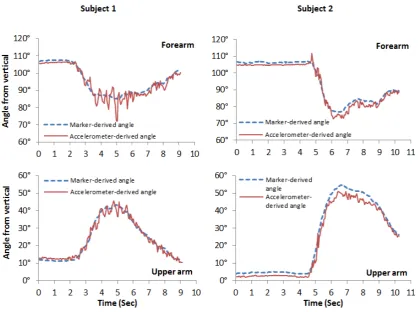
9 Figure 4 shows example data for forearm and upper arm angles from the vertical, obtained from 222
both reflective marker and accelerometer approaches, for the task “Brushing coins into the other 223
hand” (Left: subject 1; Right: subject 2) 224
[image:10.595.82.501.144.456.2]225
Figure 4: Example data from task “Brush coins into the other hand” 226
227
Table 2 compares the angles derived from marker data with accelerometer-derived angles for each 228
[image:10.595.61.530.617.719.2]subject and each task. 229
Table 2: Comparison between marker and accelerometer-derived angles (7-10 trials per subject). Pearson’s correlation 230
(r) and RMS error (ɛ) are shown before and after removal of alignment error. (UA = upper arm; FA = forearm) 231
Subject 1: 232
Task 1 Task 2 Task 3 Task 4
FA UA FA UA FA UA FA UA
r 0.947 0.986 0.992 0.993 0.943 0.988 0.985 0.994
ɛ (deg.) 3.12 2.27 2.48 1.62 1.61 1.67 1.63 2.06 ɛ after removal
of alignment
error (deg.) 2.91 2.46 1.73 1.60 1.56 1.50 1.72 2.75
233
10
Task 1 Task 2 Task 3 Task 4
FA UA FA UA FA UA FA UA
r 0.986 0.995 0.995 0.996 0.985 0.998 0.982 0.990
ɛ (deg.) 2.82 3.47 1.94 3.24 2.12 3.18 1.91 1.93 ɛ after removal
of alignment
error (deg.) 2.33 2.04 2.02 1.42 1.95 2.25 1.66 2.03
[image:11.595.69.529.73.173.2]235
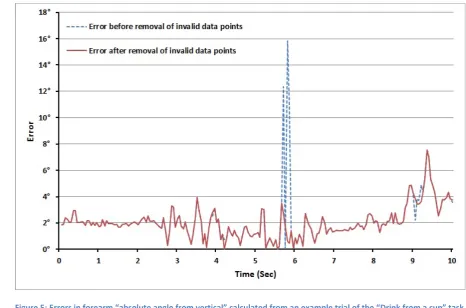
Figure 5 shows how maximum errors are reduced, but not eliminated by removing data points which 236
lie outside of the g-tolerance band. 237
[image:11.595.57.524.235.543.2]238
Figure 5: Errors in forearm “absolute angle from vertical” calculated from an example trial of the “Drink from a cup” task 239
(subject 1) before and after removal of data points using a g-tolerance ±0.5 m/s2.
240 241
Table 3 illustrates the effect of different g-tolerance bands on the accuracy of angle estimation and 242
number of data points lying outside of the tolerance band. 243
[image:11.595.70.526.691.771.2]244
Table 3: Effect of g-tolerance (on maximum error (δ) (.deg) and percentage of invalid data (p) (%) 245
Subject 1: 246
Tolerance
band FA Task 1 UA FA Task 2 UA FA Task 3 UA FA Task 4 UA
δ
Infinite 12.0±3.3 7.9±1.8 12.5±4.0 8.3±1.8 8.7±4.1 8.4±4.1 7.6±3.6 5.6±1.2 ± 0.5 m/s2 11.1±2.5 7.3±1.4 10.1±2.1 8.1±1.7 7.2±2.0 7.9±4.0 7.4±3.7 5.5±1.3
11 ± 0.2 m/s2 10.6±2.6 6.5±1.4 8.1±2.3 6.8±1.2 6.1±2.4 7.3±4.1 6.6±3.8 4.9±0.9
p
Infinite 0 0 0 0 0 0 0 0
± 0.5 m/s2 6.5±2.9 7.1±3.6 7.5±2.2 1.1±0.9 12.7±3.5 2.1±1.4 8.0±3.3 5.1±2.3
± 0.3 m/s2 17.4±4.5 22.1±8.7 16.0±3.6 6.5±2.1 33.1±6.8 8.6±2.6 18.1±3.7 17.6±4.2
± 0.2 m/s2 28.1±6.2 34.7±12.6 30.1±5.4 15.9±3.1 51.6±9.7 19.8±3.8 32.3±4.6 30.1±5.4
247
Subject 2: 248
Tolerance
band FA Task 1 UA FA Task 2 UA FA Task 3 UA FA Task 4 UA
δ
Infinite 11.3±3.2 9.5±1.4 6.5±2.6 7.2±0.9 10.27±4.4 9.43±2.3 8.16±1.3 5.5±0.6 ± 0.5 m/s2 8.9±3.7 8.9±1.8 6.1±2.8 7.0±0.8 6.83±1.1 8.29±3.1 7.39±1.8 5.5±0.6
± 0.3 m/s2 8.1±2.4 8.1±1.8 4.9±1.0 6.3±0.8 6.20±1.0 7.34±2.7 7.39±1.8 5.1±0.7
± 0.2 m/s2 8.1±2.4 7.3±1.3 4.6±0.6 6.1±1 5.50±1.0 6.53±2.0 6.86±1.7 4.8±0.8
p
Infinite 0 0 0 0 0 0 0 0
± 0.5 m/s2 9.5±3.0 15.2±2.8 3.8±1.3 2.2±1.2 8.6±1.5 15.9±2.9 7.9±2.4 3.9±3.1
± 0.3 m/s2 14.8±4.3 35.4±5.4 12.9±2.2 30.2±5.4 20.1±3.6 33.3±3.7 19.3±4.1 27.6±5.8
± 0.2 m/s2 20.3±4.8 50.8±7.1 23.6±2.6 61.0±4.8 30.7±5.1 44.7±5.0 31.9±6.0 49.4±6.1
249
Discussion and conclusions
250This paper has introduced a new method of calculating angle from vertical from a 3-axis 251
accelerometer. The approach avoids the key limitation of methods based on single or dual axis 252
accelerometer signals, namely when the magnitude of the accelerometer signal on the sensitive axis 253
approaches either 9.81 or -9.81, the sensitivity approaches zero and hence the signal to noise ratio 254
becomes very poor. Figure 4 and table 2 illustrate the performance of the method using upper limb 255
mounted IMUs during the performance of a range of typical FES assisted upper limb tasks. 256
Ignoring readings where the true acceleration is significant in comparison to gravity can remove 257
some unwanted spikes and thereby improve the robustness of angle triggering (Table 3). However, 258
referring to Figures 5, it is clear that not all peaks in error value are removed. This is because only 259
those peaks that alter the magnitude of the measured vector are interpreted as bad readings. 260
Clearly, depending on the direction of the true acceleration (or the equivalent noise from some 261
other source) the magnitude of the measured accelerometer vector may not fall outside the g-262
tolerance band. As can be seen in table 3, the tighter the g-tolerance band the greater the number 263
of bad data points which fall outside and hence the higher the potential delays in transitioning 264
between FSM states using angle triggering. In the worst case, when the g-tolerance is set at ± 0.2 265
m/s2, 61% of data points fall outside the tolerance band. Based on our findings a g-tolerance of ± 0.5
266
m/s2 appears to be an acceptable value and this was used in subsequent usability trials [33].
267
The approach shows promise for the application described in the paper. However, the method 268
would not be applicable to limb segments which experience significant accelerations during normal 269
daily activity (e.g. the shank during gait). 270
12 272
[1] Howlett O, Lannin NA, Ada L, McKinstry C. Functional electrical stimulation improves activity after 273
stroke: A systematic review with meta-analysis. Arch Phys Med Rehabil. 2015. 274
[2] Daly JJ, Hogan N, Perepezko EM, Krebs HI, Rogers JM, Goyal KS, et al. Response to upper-limb 275
robotics and functional neuromuscular stimulation following stroke. J Rehabil Res Dev. 2005;42:723-276
36. 277
[3] Mann GE, Burridge JH, Malone LJ, Strike PW. A pilot study to investigate the effects of electrical 278
stimulation on recovery of hand function and sensation in subacute stroke patients. Neuromodul. 279
2005;8:193-202. 280
[4] Page SJ, Levin L, Hermann V, Dunning K, Levine P. Longer versus shorter daily durations of 281
electrical stimulation during task-specific practice in moderately impaired stroke. Arch Phys Med 282
Rehabil. 2012;93:200-6. 283
[5] Tarkka IM, Pitkanen K, Popovic DB, Vanninen R, Kononen M. Functional electrical therapy for 284
hemiparesis alleviates disability and enhances neuroplasticity. . Tohoku J Exp Med 2011;225:71-6. 285
[6] Kahn LE, Zygman ML, Rymer WZ, Reinkensmeyer DJ. Robot-assisted reaching exercise promotes 286
arm movement recovery in chronic hemiparetic stroke: a randomized controlled pilot study. J 287
Neuroeng Rehabil. 2006;3:12. 288
[7] Timmermans AA, Seelen HA, Willmann RD, Kingma H. Technology-assisted training of arm-hand 289
skills in stroke: concepts on reacquisition of motor control and therapist guidelines for rehabilitation 290
technology design. J Neuroeng Rehabil. 2009;6:1. 291
[8] Meadmore KL, Hughes AM, Freeman CT, Cai Z, Tong D, Burridge JH, et al. Functional electrical 292
stimulation mediated by iterative learning control and 3D robotics reduces motor impairment in 293
chronic stroke. J Neuroeng Rehabil. 2012;9:32. 294
[9] Thorsen RA, Occhi E, Boccardi S, Ferrarin M. Functional electrical stimulation reinforced tenodesis 295
effect controlled by myoelectric activity from wrist extensors. J Rehabil Res Dev. 2006;43:247-56. 296
[10] Thrasher TA, Zivanovic V, McIlroy W, Popovic MR. Rehabilitation of reaching and grasping 297
function in severe hemiplegic patients using functional electrical stimulation therapy. Neurorehabil 298
Neural Repair. 2008;22:706-14. 299
[11] Popovic DB, Sinkjaer T, Popovic MB. Electrical stimulation as a means for achieving recovery of 300
function in stroke patients. Neurorehabil. 2009;25:45-58. 301
[12] Kim T, Kim S, Lee B. Effects of Action Observational Training Plus Brain-Computer Interface-302
Based Functional Electrical Stimulation on Paretic Arm Motor Recovery in Patient with Stroke: A 303
Randomized Controlled Trial. Occup Ther Int. 2015. 304
[13] Hara Y, Obayashi S, Tsujiuchi K, Muraoka Y. The effects of electromyography-controlled 305
functional electrical stimulation on upper extremity function and cortical perfusion in stroke 306
patients. Clin Neurophysiol. 2013;124:2008-15. 307
[14] Tresadern P, Thies S, Kenney L, Howard D, Goulermas JY. Artificial Neural Network Prediction 308
Using Accelerometers to Control Upper Limb FES During Reaching and Grasping Following Stroke. 309
IEEE Engineering in Medicine and Biology Society Annual Conference. 2006;1:2916-9. 310
[15] Mann G, Taylor P, Lane R. Accelerometer-triggered electrical stimulation for reach and grasp in 311
chronic stroke patients: a pilot study. Neurorehabil Neural Repair. 2011;25:774-80. 312
[16] Tresadern P, Thies S, Kenney LPJ, Howard D, Goulermas JY. Rapid prototyping for functional 313
electrical stimulation control. Pervasive Comput. 2008;7:62-9. 314
[17] Tong KY, Mak AF, Ip WY. Command control for functional electrical stimulation hand grasp 315
systems using miniature accelerometers and gyroscopes. Med Biol Eng Comput. 2003;41:710-7. 316
[18] Crago PE, Memberg WD, Usey MK, Keith MK, Kirsch RF, Chapman GJ, et al. An elbow extension 317
neuroprosthesis for individuals with tetraplegia. Rehabil Eng. 1998;6:1-6. 318
[19] Van de Dikkenberg N, Meijer OG, Van der Slikke RMA, C VLR, Van Dieën JH, Pijls B, et al. 319
Measuring functional abilities of patients with knee problems: rationale and construction of the 320
13 [20] Graham RB, Agnew MJ, Stevenson JM. Effectiveness of an on-body lifting aid at reducing low 322
back physical demands during an automotive assembly task: Assessment of EMG response and user 323
acceptability. Appl Ergon. 2009;40:936-42. 324
[21] Ohnishi K, Kajitani I, Morio T, Takagi T. Multimodal sensor controlled three Degree of Freedom 325
transradial prosthesis. IEEE International Conference on Rehabilitation Robotics, 2013. Seattle, 326
Washington: IEEE; 2013. p. 1-6. 327
[22] Lugade V, Fortune E, Morrow M, Kaufman K. Validity of Using Tri-Axial Accelerometers to 328
Measure Human Movement - Part I: Posture and Movement Detection. Med Eng Phys. 2014;36:169-329
76. 330
[23] Husak M. Model of tilt sensor system. 9th International Conference Electronics, Circuits and 331
Systems: IEEE; 2002. p. 227-30. 332
[24] Bazzarelli M, Durdle NG, Lou E, Raso VJ. A wearable computer for physiotherapeutic scoliosis 333
treatment. Instrum Measurement. 2003;52:126-9. 334
[25] Baek J, Yun BJ. Posture monitoring system for context awareness in mobile computing. Instrum 335
Measurement. 2010;56:1589 - 99. 336
[26] Williams AJ. A solid state tilt meter for current meter attitude determination. Oceans '04 337
MTTS/IEEE Techno-Ocean '04. Kobe2004. p. 1395 - 8. 338
[27] Rodriguez-Donate C, Morales-Velazquez L, Osornio-Rios RA, Herrera-Ruiz G, Romero-Troncoso 339
RDJ. FPGA-based fused smart sensor for dynamic and vibration parameter extraction in industrial 340
robot links. Sens. 2010;10:4114-29. 341
[28] Pallejà T, Tresanchez M, Teixidó M, Palacin J. Bioinspired Electronic White Cane Implementation 342
Based on a LIDAR, a Tri-Axial Accelerometer and a Tactile Belt. Sens. 2010;10. 343
[29] Šipoš M, Pačes P, Roháč J, Nováček P. Analyses of Triaxial Accelerometer Calibration Algorithms. 344
Sens J. 2012;12:1157-65. 345
[30] Giansanti D, Macellari V, Maccioni G, Cappozzo A. Is it feasible to reconstruct body segment 3-D 346
position and orientation using accelerometric data? IEEE Trans Biomed Eng. 2003;50:476-83. 347
[31] Madgwick SOH, Harrison AJL, Sharkey PM, Vaidyanathan R, Harwin WS. Measuring motion with 348
kinematically redundant accelerometer arrays: Theory, simulation and implementation. Mechatron. 349
2013;23:518-29. 350
[32] Sun M. A functional electrical stimulation (fes) control system for upper limb rehabilitation 351
[Doctoral Thesis]: University of Salford; 2014. 352
[33] Smith CL. Usability engineering in the design and evaluation of a functional electrical stimulation 353
system for upper limb rehabilitation [Doctoral Thesis]: University of Salford; 2015. 354
355
Acknowledgements. 356
This is a summary of independent research funded by the National Institute for Health Research New
357
and Emerging Applications of Technology (NIHR NEAT) Programme (grant ref L030). The views
358
expressed are those of the author(s) and not necessarily those of the NHS, the NIHR or the
359
Department of Health.
14 362
363
364
Declarations 365
The following additional information is required for submission. Please note that failure to respond to
366
these questions/statements will mean your submission will be returned to you. If you have nothing to
367
declare in any of these categories then this should be stated.
368
Conflict of interest
369
All authors must disclose any financial and personal relationships with other people or organisations
370
that could inappropriately influence (bias) their work. Examples of potential conflicts of interest include
371
employment, consultancies, stock ownership, honoraria, paid expert testimony, patent
372
applications/registrations, and grants or other funding.
373
Ethical Approval 374
Work on human beings that is submitted to Medical Engineering & Physics should comply with the
375
principles laid down in the Declaration of Helsinki; Recommendations guiding physicians in
376
biomedical research involving human subjects. Adopted by the 18th World Medical Assembly,
377
Helsinki, Finland, June 1964, amended by the 29th World Medical Assembly, Tokyo, Japan, October
378
1975, the 35th World Medical Assembly, Venice, Italy, October 1983, and the 41st World Medical
379
Assembly, Hong Kong, September 1989. You should include information as to whether the work has
380
been approved by the appropriate ethical committees related to the institution(s) in which it was
381
performed and that subjects gave informed consent to the work.
382
Competing Interests 383
None
384
Please state any sources of funding for your research 385
National Institute for Health Research New and Emerging Applications of Technology (NIHR NEAT) Programme (grant ref L030)
386
DOES YOUR STUDY INVOLVE HUMAN SUBJECTS? Please cross out whichever is not 387
applicable. 388
Yes
√
389No 390
If your study involves human subjects you MUST have obtained ethical approval. 391
Please state whether Ethical Approval was given, by whom and the relevant Judgement’s 392
reference number 393
Journal: MEDICAL ENGINEERING & PHYSICS
Title of Paper: Novel methods of using
15 Yes, we have obtained Ethical Approval.
REC ref: 10/H1005/26
394
This information must also be inserted into your manuscript under the acknowledgements 395
section prior to the References. 396