Iterative reactions of transient boronic acids enable
sequential C–C bond formation
BATTILOCCHIO, Claudio, FEIST, Florian, HAFNER, Andreas, SIMON, Meike,
TRAN, Duc, ALLWOOD, Daniel <http://orcid.org/0000-0002-3735-3198>,
BLAKEMORE, David and LEY, Steven
Available from Sheffield Hallam University Research Archive (SHURA) at:
http://shura.shu.ac.uk/11574/
This document is the author deposited version. You are advised to consult the
publisher's version if you wish to cite from it.
Published version
BATTILOCCHIO, Claudio, FEIST, Florian, HAFNER, Andreas, SIMON, Meike,
TRAN, Duc, ALLWOOD, Daniel, BLAKEMORE, David and LEY, Steven (2016).
Iterative reactions of transient boronic acids enable sequential C–C bond formation.
Nature Chemistry, 8 (4), 360-363.
Copyright and re-use policy
See http://shura.shu.ac.uk/information.html
Sheffield Hallam University Research Archive
Iterative reactions of transient boronic acids enable
sequential C-C bond formation
Claudio Battilocchio,aǂ* Florian Feist,aǂ Andreas Hafner,a Meike Simon,a Duc N. Tran,a Daniel M. Allwood,a David C. Blakemore,b and Steven V. Ley a*
a
Innovative Technology Centre, Department of Chemistry, University of Cambridge, Lensfield Road, CB2 1EW, Cambridge, UK; b
Pfizer Worldwide Medicinal Chemistry, The Portway Building, Granta Park, Cambridge, CB21 6GS, U.K.
*E-mail: [email protected], [email protected]
ǂC.B. and F.F. contributed equally to the work.
The ability to form multiple carbon-carbon bonds in a controlled sequence and thus rapidly build molecular complexity in an iterative fashion is an important goal in modern chemical synthesis. In recent times, transition metal-catalysed coupling reactions have dominated in the development of C-C bond forming processes. A desire to reduce the reliance on precious metals and a need to obtain products with very low levels of metal impurities has brought a renewed focus on metal-free coupling processes. Here, we report the in situ preparation of reactive allylic and benzylic boronic acids, obtained by reacting flow-generated diazo compounds with boronic acids, and their application in controlled iterative C-C bond forming reactions is described. Thus far we have shown the formation of up to three C-C bonds in a sequence including the final trapping of a reactive boronic acid species with an aldehyde to generate a range of new chemical structures.
Introduction
The generation of C-C bonds is at the heart of synthetic organic chemistry.1 The ability to form multiple C-C bonds using iterative or one-pot methods allows a rapid increase in molecular complexity.2-5 While many such sequences are known, there is still room to exploit new reactivity patterns and different chemical combinations derived from reactive intermediates.6 In recent times, transition metal chemistry has dominated C-C bond cross-coupling strategies.7-13 This powerful approach has been central to the planning and execution of modern synthesis programs both in academia and industry. Nevertheless, the desire of industry to reduce its reliance on the use of precious metals in coupling reactions and the need for very low metal levels in active pharmaceutical ingredients has increased interest in metal-free coupling processes considerably.14
Boronic esters15 and acids16 are considered to be important coupling partners as they are versatile intermediates for the preparation of a wide variety of molecules. For example, Barluenga17 and others18-20 recently demonstrated the powerful application of a reductive metal-free cross-coupling between tosylhydrazones and boronic acids. The reaction likely proceeds via a carbene-like species which on combination with a boronic acid initiates a sequence of reactions that terminates in the formation of a coupling product. However, high temperatures are necessary to affect these coupling processes so that any further exploitation of potentially useful intermediates in the reaction has not been possible so far.
From our own mechanistic studies based on the use of flow-generated diazo compounds,21 in the
This interesting result suggests that we might be able to exploit these highly transient benzyl boronic acid intermediates for further synthetic transformations. Due to the broad utility of boronic acids as starting materials in a number of key transformations, this approach could open up opportunities for new iterative C-C bond forming events which complement other elegant approaches.2,3, 22-26
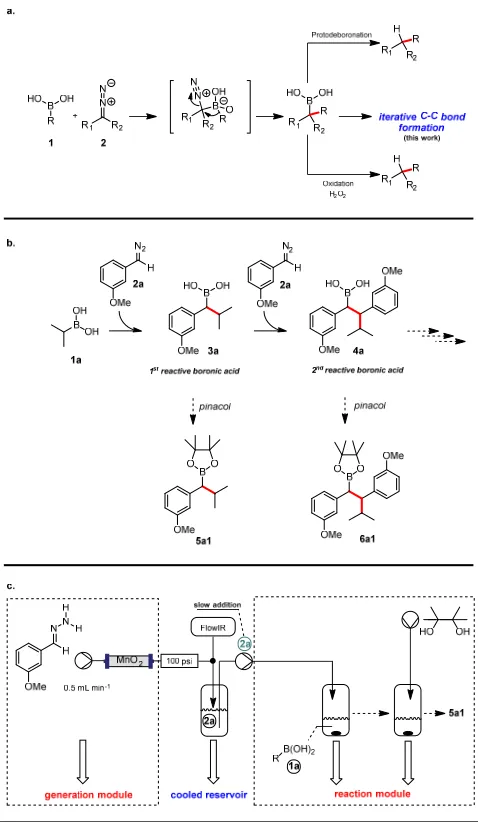
Figure 1|Prior work on boronic acids-diazo coupling and development of an iterative reaction strategy. a) Proposed mechanism for the combination of diazo species and boronic acids, followed by either protodeboronation and oxidation (previous work), or exploration of new reactivity of transient boronic acid species; b)mechanistic description for the sequential generation of the single addition product 3a and the double addition and generation of the corresponding products 5a1 and 6a1 viasubsequent trapping with pinacol; c) setup for the generation, storage and reaction of the diazo species with boronic acids under full machine assistance (description of the setup can be found within the Supporting Information).
Although boron compounds have been known and used extensively for decades, benzylic and allylic boronic acids are unstable and are not readily accessible using typical chemistries.27,28 These species are usually isolated as their more stable ester derivatives.29 Here, we report the controlled in situ
Results and discussion
Interception of transient boronic acids with pinacol
Using our previously established flow chemistry protocol for the generation of diazo compounds as a starting point, we first studied the formation of different transient boronic acids. Owing to their inherent instability, we chose to isolate them as their more stable pinacol ester derivatives to demonstrate reaction efficiency. Initial experiments began with the use of (3-methoxyphenyl)diazomethane (2a) as a model substrate, generated on demand under flow conditions, which was combined with isopropyl boronic acid 1a, followed by addition of pinacol (Figure 1b). In this early experiment, we obtained the corresponding boronic ester 5a1 in modest yield (35%). Additionally, we were able to isolate a further product 6a1 (along with some other minor by-products) derived from the addition of a second equivalent of the diazo molecule to the in situ generated benzyl boronic acid (Figure 1b).
This interesting result gave us encouragement that by exploiting these reactivity profiles we might be able to develop a new iterative coupling protocol where different flow-generated diazo compounds add to a boronic acid in a controlled sequential fashion. To achieve this we first needed to control the formation of the first boronic acid intermediate (3a), in order to determine the reaction scope under an optimised set of conditions.
Initial optimisation studies showed that slow addition of the diazo compound to a solution of the boronic acid was needed to achieve selectivity towards compound 5a1 (Figure 1b). Whilst at a standard rate of addition (i.e., 0.5 mL min-1 on a 5.0 mL scale) we obtained a 35% yield of 5a1 with approximately 18% of 6a1, by reducing the rate of addition of the diazo compound 2a we were able to increase both the yield and the selectivity of the reaction. This encouraging observation suggests that the starting boronic acid 1a is more reactive than the secondary benzyl boronic acid 3a formed from the first addition (Figure 1b), but that slow addition is required to avoid a local excess concentration of diazo compound 2a leading to double adduct 4a.
To ensure materials were prepared and used safely (due to the well-known hazardous nature of diazo compounds), we devised a reactor set-up that produced these compounds continuously in a cryogenic and contained system (Figure 1c). The solution containing diazo compound was briefly collected in a suitable cryogenic (double jacketed) buffering reservoir prior to being dispensed via
various pumps to the quenching and reaction vessels. At no point are these diluted reaction streams concentrated or exposed throughout the synthesis. The diazo solution, after its formation, is immediately reacted with the substrate. Under these conditions there is never a build-up of concentrated diazo compound and this therefore minimises any potential hazard.
We examined the role of trace water in the reaction and found that drying the solutions of both the diazo compound and the boronic acid with molecular sieves prior to reaction improved the yield of 5a1. Thus, under the optimised conditions, a dry solution of diazo 2a (5 mL) was slowly dispensed (41 µL min-1) into a flask containing a solution of the boronic acid 1a (1.2 equiv) and the reaction
mixture was stirred at room temperature for 30 min under inert atmosphere. A solution of pinacol was then added to this mixture, stirred overnight (ensuring complete reaction) and passed through a plug of SiO2. Purification by flash chromatography gave 5a1 in an 87% yield. Using these conditions,
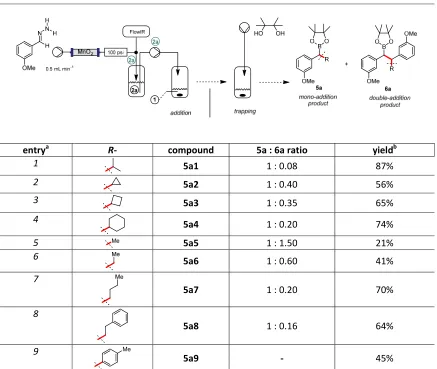
Table 1|Trapping of the boronic acid intermediates with pinacol.
entrya R- compound 5a : 6a ratio yieldb
1 5a1 1 : 0.08 87%
2 5a2 1 : 0.40 56%
3 5a3 1 : 0.35 65%
4
5a4 1 : 0.20 74%
5 5a5 1 : 1.50 21%
6 5a6 1 : 0.60 41%
7
5a7 1 : 0.20 70%
8
5a8 1 : 0.16 64%
9 Me
5a9 - 45%
a
Reaction conditions:0.3 mmol of 2a (41 μL min-1), 1.5 equiv of 1, CH2Cl2, rt (30 min), then pinacol (overnight); b
yields refer to the isolated mono-addition product based on the diazo species. CAUTION: diazo compounds are unstable species hence they should be handled on small scale.
In all cases, we believe that the selectivity observed reflects the relative reactivity of the initial and first formed boronic acids (Figure 1b). In some cases, the intermediate boronic acid was observed to be particularly unstable and prone to protodeboronation. For example, in the case of the coupling between the diazo compound and aryl boronic acids, we observed rapid addition of the diazo species to the boronic acid partner but noted that some protodeboronation occurred even at room temperature. However, we found that the newly formed boronic acid intermediate could be successfully reacted with pinacol in reasonable yield (Table 1, compound 5a9).
equally successful, resulting in high yields of the isolated tertiary pinacol ester products (5q and 5r, 92% and 78% respectively).
Table 2|Trapping the boronic acid intermediates with pinacol.
entry X Y R compound yield
1
-H 5b 69%
2
-H 5c 84%
3
-H 5d 84%
4
OMe MeO
OMe
-H 5e 90%
5 -H 5f 62%
6
-H 5g 61%
7
-H 5h 52%
8
-H 5i 94%
9
-H 5j 88%
10
-H 5k 86%
11
-H 5l 49%
12
-H 5m 68%
13
-H 5n 83%
14
-H 5o 78%
15
-H 5p 82%
16
17
5r 78%
Reaction conditions:0.3 mmol of 2 (41 μL min-1
), 1.5 equiv of 1, CH2Cl2, rt (30 min), then pinacol (overnight); yields refer to the isolated
mono-addition product and are based on the diazo species. CAUTION: diazo compounds are unstable species hence they should be handled on small scale.
Sequential C-C bond formation
These studies clearly demonstrate the general utility of the method. With a good understanding of the optimal conditions for the generation of these boronate species, we then wished to utilise these species in new bond formation reactions to rapidly build molecular complexity and chemical diversity. We envisaged that the interception of each newly formed intermediate with a second diazo species (either the same one or different one) should be possible in a controlled manner. In doing so it would allow an iterative C-C bond formation and also provide access to a novel set of elaborated structures.
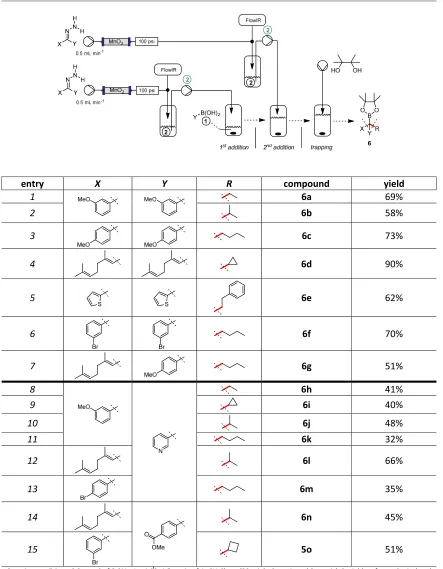
This concept was first validated by generating complex structures using repeated additions of the same diazo compounds and eventually trapping the final product as its pinacol ester. We found that the sequential coupling of both electron-rich and electron-poor diazo compounds could be successfully achieved with good isolated yields (Table 3). The applicability of allylic derivatives was demonstrated by the fact that the geranial diazo compound afforded a good yield of the double addition product 6d. Given these results, the next step was to elaborate the process by trapping an intermediate boronic acid species with a different diazo compound. This is illustrated by the preparation of 6g, which demonstrated that two different diazo compounds could be utilised in sequence, affording the final product as a pinacol ester. A final protodeboronation could also be used to complete the sequence, providing products 6h-o. For this specific class of compounds, where the presence of electron-withdrawing aromatic rings in the diazo partners reduces the reactivity of the system, the optimised conditions necessitated a slight excess of the second diazo compound (i.e. (3-pyridyl)-diazomethane and [4-(methoxycarbonyl)phenyl]–diazomethane). The use of equimolar quantities of these species led to lower conversion to the desired product. These compounds, which are readily prepared by this controlled sequential addition process, display novel molecular architectures that would be difficult to access using conventional chemistries other than by much longer sequences.
Table 3|Sequential interception of transient boronic intermediates.
entry X Y R compound yield
1 6a 69%
2 6b 58%
3 6c 73%
4 6d 90%
5 6e 62%
6 6f 70%
7 6g 51%
8
N
6h 41%
9 6i 40%
10 6j 48%
11 6k 32%
12 6l 66%
13 6m 35%
14 6n 45%
15 5o 51%
Reaction conditions:0.3 mmol of 2 (41 μL min-1), 1.5 equiv of 1, CH2Cl2, rt (30 min), then pinacol (overnight); yields refer to the isolated
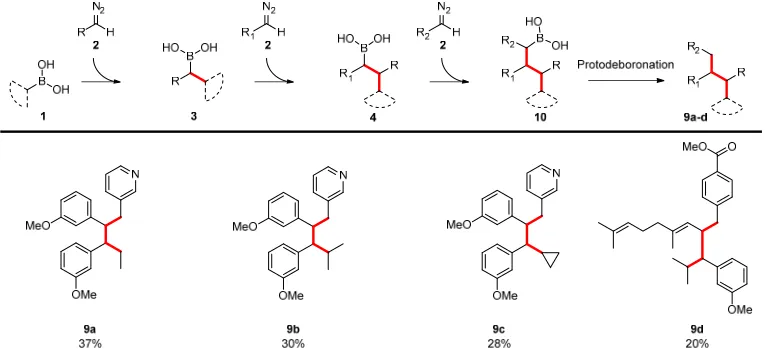
Having established the controlled addition of different diazo compounds in a sequential mode, we now wished to determine whether the approach could be extended with a third step. Under the previously optimised conditions, we could access structures 9a-d, each corresponding to the addition of three diazo compounds (Figure 2). In particular, the ability to construct a compound derived from three different diazo species, as in compound 9d, demonstrates the versatility of the method and presents opportunities which we believe have a very wide ranging of applications.
Figure 2|Iterative strategy for the sequential addition of three diazo species.
Interception of transient allylic boronic acids with aldehydes and extended C-C bond formation strategy
diastereoisomers although we note that high diastereoselectivity (anti) is achieved in these allylation reactions, as expected from mechanistic considerations.
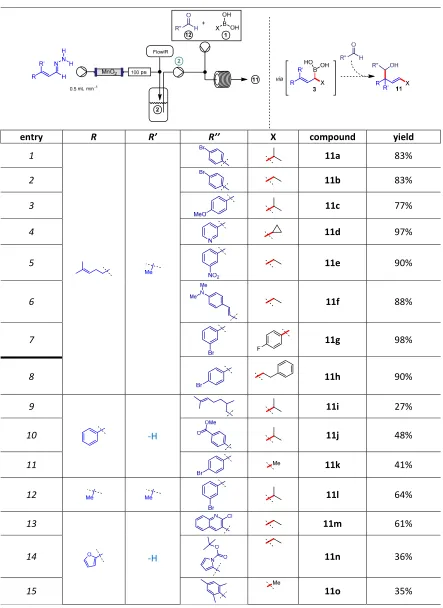
Table 4|Cascade interception of allylic boronic acids intermediates with aldehydes.
entry R R’ R’’ X compound yield
1 11a 83%
2 11b 83%
3 11c 77%
4 11d 97%
5 11e 90%
6 11f 88%
7 11g 98%
8 11h 90%
9
-H
11i 27%
10 11j 48%
11 11k 41%
12 11l 64%
13
-H
11m 61%
14 11n 36%
Reaction conditions:0.2 mmol of 2, 1 equiv of 1, 1.2 equiv of 12; yields refer to the isolated mono-addition product and are based on the diazo species. CAUTION: diazo compounds are unstable species hence they should be handled on small scale.
[image:11.612.121.497.158.220.2]Finally, to briefly demonstrate the utility of this method we showed that, in one single operation, we could prepare 11p (60% yield) as a valid precursor to the natural product Bakuchiol (Figure 3).31 In contrast the known route to this compound utilises a multi-step sequence of reactions.
Figure 3|Synthesis of Bakuchiol precursor (11p) using this new method.
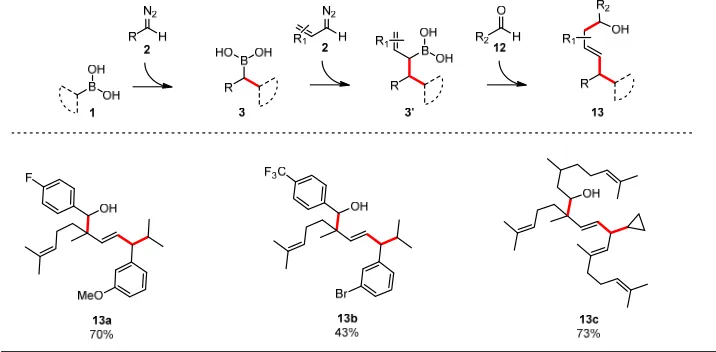
The versatility of the approach was broadened further when we investigated a combination of our procedures. Therefore, by reacting a boronic acid 1 with a diazo compound 2 we obtained boronic acid 3. This was then captured by another allylic diazo compound 2 resulting in the formation of allylic boronic acid 3’; this in turn was quenched by an aldehyde to terminate the sequence. Following this new cascade we were able to prepare the alcohols 13a-c as an illustration of what might be possible using this new iterative bond forming concept (Figure 4).
Figure 4|Sequencial interception of boronic acid species and final reaction with aldehydes.
In conclusion, we have developed a new approach for delivering iterative C-C bond formation sequences using transiently generated boronic acids. These intermediates were generated by a combination of diazo compounds (generated in flow) with boronic acids at room temperature. This method opens many opportunities for multiple C-C bond forming strategies by creating alternatives to conventional synthetic routes.
Acknowledgements
[image:11.612.126.484.338.514.2]Authors contributions
C.B., D.N.T. and S.V.L. conceived the project; C.B, A.H. and S.V.L. designed the experiments; C.B., F.F., A.H., M.S. and D.N.T. performed the experiments; D.M.A. analysed the data and prepared the supporting information; D.C.B. provided crucial information for the development of the project; C.B., A.H. and S.V.L wrote the paper.
Please address any queries or requests for material to: Dr. Claudio Battilocchio, email: [email protected], and Prof. Steven V. Ley, email: [email protected]
Methods
Given the complexity of the reactions setup and of the chemical variations we refer the reader to the Supporting Information section for detailed material.
References
1. R. Kumara, E. V. Van der Eycken, “Recent approaches for C–C bond formation via direct dehydrative coupling strategies” Chem. Soc. Rev., 2013,42, 1121-1146.
2. M. Burns, S. Essafi, J. R. Bame, S. P. Bull, M. P. Webster, S. Balieu, J. W. Dale, Craig P. Butts, J. N. Harvey, V. K. Aggarwal, “Assembly-line synthesis of organic molecules with tailored shapes” Nature, 2014, 513, 183-188.
3. J. Li, S. G. Ballmer, E. P. Gillis, S. Fujii, M. J. Schmidt, A. M. E. Palazzolo, J. Lehmann, G. F. Morehouse, M. D. Burke, "Synthesis of Many Different Types of Organic Small Molecules Using One Automated Process" Science, 2015, 347, 1221-1226.
4. J. C. Lo, J. Gui, Y. Yabe, C.-M. Pan, P. S. Baran “Functionalized olefin cross-coupling to construct carbon–carbon bonds” Nature, 2014, 516, 343–348.
5. S. N. Mlynarski, C. H. Schuster and J. P. Morken, “Asymmetric Synthesis from Terminal Alkenes by Cascades of Diboration and Cross-Coupling” Nature,2014, 505, 386-390.
6. J. Hartwig, J. B. Metternich, N. Nikbin, A. Kirschning, S. V. Ley, “Continuous flow chemistry: a discovery tool for new chemical reactivity patterns” Org. Bio. Chem. 2014, 12, 3611.
7. N. Miyaura, A. Suzuki, “Palladium-Catalyzed Cross-Coupling Reactions of Organoboron Compounds” Chemical Reviews, 1995, 95, 2457–2483.
8. C. Liu, H. Zhang, W. Shi, A. Lei, “Bond Formations between Two Nucleophiles: Transition Metal Catalyzed Oxidative Cross-Coupling Reactions” Chem. Rev. 2011, 111, 1780–1824.
9. C. C. C. Johansson-Seechurn, M. O. Kitching, T. J. Colacot, V. Snieckus “Palladium-Catalyzed Cross-Coupling: A Historical Contextual Perspective to the 2010 Nobel Prize” Angew. Chem., Int. Ed. 2012, 51, 5062–5085.
10. R. Jana, T. P. Pathak, M. S. Sigman, “Advances in transition metal (Pd, Ni, Fe)-catalyzed cross-coupling reactions using alkyl-organometallics as reaction partners” Chem. Rev. 2011, 111, 1417– 1492.
12. M. A. Molander, K. M. Traister, B. T. O'Neill, “Reductive Cross-Coupling of Nonaromatic, Heterocyclic Bromides with Aryl and Heteroaryl Bromides” J. Org. Chem. 2014, 79, 5771.
13. R. J. Phipps, M. J. Gaunt “A Meta-Selective Copper-Catalyzed C–H Bond Arylation” Science, 2009, 323, 1593.
14. A. J. Hunt, A. S. Matharu, A. H. King, J. H. Clark, “The importance of elemental sustainability and critical element recovery” Green Chem., 2015, 17, 1949-1950.
15. D. S. Matteson, “Boronic esters in asymmetric synthesis” J. Org. Chem., 2013, 78, 10009–10023.
16. D. G. Hall, “Boronic acids: preparation and applications in organic synthesis, medicine and materials” 2nd Volume, Wiley-VCH, 2011.
17. J. Barluenga, M. Thomás-Gamaza, F. Aznar, C- Valdés, “Metal-free carbon–carbon bond-forming reductive coupling between boronic acids and tosylhydrazones” Nat. Chem. 2009, 1, 494- 499.
18. D. M. Allwood, D. C. Blakemore, A. D. Brown, S. V. Ley, “Metal-Free Coupling of Saturated Heterocyclic Sulfonylhydrazones with Boronic Acids” J. Org. Chem. 2014, 79, 328-338.
19. S. Nakagawa, K. A. Bainbridge, K. Butcher, D. Ellis, W. Klute, T. Ryckmans, “Application of Barluenga Boronic Coupling (BBC) to the Parallel Synthesis of Drug-like and Drug Fragment-like Molecules” Chem. Med. Chem. 2012, 7, 233-236.
20. L. Kupracz, A. Kirschning, “Two-Step Flow Synthesis of Biarylmethanes by Reductive Arylation of Tosylhydrazones” J. Flow Chem. 2013, 3, 11-16.
21. D. N. Tran, C. Battilocchio, S. B. Lou, J. M. Hawkins, S. V. Ley, “Flow chemistry as a discovery tool to access sp 2–sp 3 cross-coupling reactions via diazo compounds” Chem. Sci. 2015, 6, 1120-1125.
22. A. Bonet, M. Odachowski, D. Leonori, S. Essafi, V. K. Aggarwal, “Enantiospecific sp2–sp3 coupling of secondary and tertiary boronic esters” Nat. Chem., 2014, 6, 584–589.
23. R. Rasappan, V. K. Aggarwal, “Synthesis of hydroxyphthioceranic acid using a traceless lithiation-borylation-protodeboronation strategy”Nat. Chem., 2014, 6, 810–814.
24. S. Balieu, G. E. Hallett, M. Burns, T. Bootwicha, J. Studley, V. K. Aggarwal, “Toward Ideality: The Synthesis of (+)-Kalkitoxin and (+)-Hydroxyphthioceranic Acid by Assembly-Line Synthesis” J. Am. Chem. Soc., 2015, 137, 4398-4403.
25. S. Roesner, D. J. Blair, V. K. Aggarwal “Enantioselective installation of adjacent tertiary benzylic stereocentres using lithiation–borylation–protodeboronation methodology. Application to the synthesis of bifluranol and fluorohexestrol” Chem. Sci., 2015, 6, 3718-3723.
26. E. M. Woerly, J. Roy, M. D. Burke "Synthesis of Most Polyene Natural Product Motifs Using Just Twelve Building Blocks and One Coupling Reaction" Nat. Chem. 2014, 6, 484-491.
27. A. G. Davies, B. P. Roberts, W. Ramsay, “Peroxides of Elements other than Carbon. Part XIP The Autoxidation of Optically Active I -Phenylethylboronic Acid” J. Chem. Soc. B., 1967, 17-22.
28. H. R. Snyder, J. A. Kuck, J. R. Johnson “Organoboron Compounds, and the Study of Reaction Mechanisms. Primary Aliphatic Boronic Acids” J. Am. Chem. Soc., 1938, 60, 105–111.
30. M. Raducan, R. Alam, K. J. Szabó “Palladium-Catalyzed Synthesis and Isolation of Functionalized Allylboronic Acids: Selective, Direct Allylboration of Ketones” Angew. Chem. Int. Ed. 2012, 51, 13050-13053.
Figu e |P io o k o o o i a ids-diazo oupli g a d de elop e t of a ite ati e ea tio st ategy. a P oposed e ha is fo the o i atio of diazo spe ies a d o o i a ids, follo ed eithe p otode o o atio a d o idatio p e ious o k , o e plo atio of e ea ti it of t a sie t o o i a id spe ies; e ha isti des iptio fo the se ue tial ge e atio of the si gle additio p odu t a a d the dou le additio a d ge e atio of the o espo di g p odu ts a a d a viasu se ue t t appi g ith pi a ol; setup fo the ge e atio , sto age a d ea tio of the diazo spe ies ith o o i a ids u de full
Figu e |Ite ati e st ategy fo the se ue tial additio of th ee diazo spe ies.
Figu e |Sy thesis of Bakuchiol p e u so p usi g this e ethod.
Ta le |T appi g of the o o i a id i te ediates with pi a ol.
e t ya R- o pou d a : a atio yield
a : . %
a : . %
a : . %
a : . %
a : . %
a : . %
a : . %
a : . %
a - %
aReaction conditions: . ol of a μL i - , . e uiv of , CH Cl , t i , the pi a ol ove ight ; yields efe to the isolated
Ta le |T appi g the o o i a id i te ediates with pi a ol.
e t y X Y R o pou d yield
-H %
-H %
-H d %
-H e %
-H f %
-H g %
-H h %
-H i %
-H j %
-H k %
-H l %
-H %
-H %
-H o %
-H p %
-Me %
%
Reaction conditions: . ol of μL i- , . e uiv of , CH Cl , t i , the pi a ol ove ight ; yields efe to the isolated
ha dled o s all s ale.
Ta le |Se ue tial i te eptio of t a sie t o o i i te ediates.
e t y X Y R o pou d yield
a %
% %
d %
e %
f %
g %
h %
i %
j %
k %
l %
%
%
o %
Reaction conditions: . ol of μL i- , . e uiv of , CH Cl , t i , the pi a ol ove ight ; yields efe to the isolated
Ta le |Cas ade i te eptio of allyli o o i a ids i te ediates with aldehydes.
e t y R R’ R’’ X o pou d yield
a %
%
%
d %
e %
f %
g %
h %
-H
i %
j %
k %
l %
-H
%
%
o %