BEARD, Colin <http://orcid.org/0000-0002-3836-3072> and RUSS, William
Available from Sheffield Hallam University Research Archive (SHURA) at:
http://shura.shu.ac.uk/14071/
This document is the author deposited version. You are advised to consult the
publisher's version if you wish to cite from it.
Published version
BEARD, Colin and RUSS, William (2017). Event evaluation and design : human
experience mapping. Event Management, 21 (3), 365-374.
Copyright and re-use policy
Event Management, Vol. 21, pp. 365–374 1525-9951/17 $60.00 + .00 Printed in the USA. All rights reserved. DOI: https://doi.org/10.3727/152599517X14942648527563
Copyright © 2017 Cognizant, LLC. E-ISSN 1943-4308
www.cognizantcommunication.com
Address correspondence to Professor Colin Beard, Events Management Subject Group, Sheffield Business School, Sheffield Hallam University, Sheffield, S1 1WB, UK. Tel: 01142252884; E-mail: [email protected]
(2014) suggests that an emerging professionalism is occurring within the events industry, and that a para-digm shift has occurred with a clear movement “from event management predominant to event (or experi-ence) design dominant” (p. 20). The more insight the events industry can gain about the consumption of experiences, the more the design of event experi-ences can develop as a predictive skill, based upon informed and purposeful action (Berridge, 2012).
How then is an event experience special in a way it might differ from an “everyday” experi-ence? A number of authors take up the comparison of an experience with everyday experiencing:the Introduction: Experience Design
In every event “there is the intent to create, or at least shape the individual and collective experi-ences of the audience or participants. By definition, events are experiential and the experience must be designed” (Getz, 2007, p. 20). The events indus-try is very much concerned with the challenges of evaluating, designing, and delivering experiences; to understand and define the essence of the human experience is therefore imperative (Peperkamp, Rooijackers, & Remmers, 2015; Poulsson & Kale, 2004; Walls, Okumus, Wang, & Kwun, 2011). Brown
EVENT EVALUATION AND DESIGN: HUMAN EXPERIENCE MAPPING
COLIN BEARD AND WILLIAM RUSS
Sheffield Business School, Sheffield Hallam University, Sheffield, UK
This article reports a phenomenological evaluation of a small-scale cause-related event. Three com-plimentary methods were applied to the interpretation of data obtained from interviewing participants who took part in an event involving the experience of sleeping on the streets with homeless people in a city in the UK. The participant experience data were first explored by applying a simple multiphasic interpretation. A second layer of exploration involved separating the data into six human experi-ence dimensions. A third and final interpretation method involved the collaborative construction of a schematic map as a composite-summative expression of the data. In order to further explore this collaborative schematic data interpretation approach, and its potential for application in event design, experience mapping has subsequently undergone further field trials with event experience designers from a range of private and public organizations across the globe, notably Singapore, Prague, Hong Kong, India, and the UK.
and understanding of human experiences within event design.
The Human Experience: A Literature Review A number of schools of thought on consumer behavior have developed over time. The post-war (1950s) “rational” school of thought began to wane and by the 1970s a new wave of interest in consumer behavior developed and matured as the “emotional” school of thought. By the end of the 20th century a number of authors developed con-vergent thinking about an emerging “experience” focus, with Schmitt (1999) producing a key text on ExperientialMarketing, in which he referred to a “new century of marketing” (p. 11), and Pine and Gilmore (1999) producing a key work on the Expe-riential Economy. Now, in the early 21st century, the continuing shift to experiences has resulted in a need to have more advanced understanding, partic-ularly as experience design is being influenced by a renewed interest in the commercial applications of neuroscience and evolutionary psychology. This has moved experience design to a more sophisti-cated level, and a number of companies that focus on experience design are becoming conversant with a considerable body of research about the psychol-ogy, neuroscience, and chemistry that drives human behavior. Equipped with new scientific knowledge specific human experiences are being fashioned, and, in some cases, deliberately designed to be addictive in form. Recent book titles such as Addic tion by Design (Schull, 2012), The Power of Habit (Duhigg, 2012), Impulse (Lewis, 2013) and Hooked (Eyal, 2014) all affirm such developments, in that they articulate how experiences can be made more compelling by applying habit forming, persuasive technologies that intentionally mold human life.
To illustrate the new science underpinning expe-rience design we briefly draw attention to two con temporary examples of Kidzania and Disney. Kidzaniais an experience design concept targeted at young people, with play, experience, and learn ing the three stated components within a real, scaled down shopping mall where kids spend money on play and leisure, and earn money by doing work at sponsored outlets. Promotional material reports that psychologists were and are extensively consulted in the development of every KidZania location difference, it is suggested, is that an event
experi-ence should possess a “wow factor,” and it should be memorable and special, and conceivably unique (Berridge, 2012; Mehmetoglu & Engen, 2011; Pine & Gilmore, 1999). However, experience is a com-plex, multidimensional conception, with founda-tional roots in many fields and disciplines, within both the social sciences and the natural sciences. The literature concerning consumer experiences reveals “a wide-ranging and perplexing set of definitions and theoretical meanings,” partially explained by this multidisciplinarity (Walls et al., 2011, p. 10). Furthermore, individuals construct their own unique experiences, based on their perception, and the expe-rience will be heavily influenced by factors such as personal needs, past experiences, and selective sensory focusing (McIntyre & Roggenbuck, 1998). Experiences are not static, but fluid, generating an ever-changing perceptual novelty, and people want to have experiences that “dazzle their senses, touch their hearts, and stimulate their minds” (Schmitt, 1999, p. 22). A number of difficulties also arise when attempting to understand human experiences: experience is a slippery concept, variably “read” so that a complete understanding is elusive. Burr (2003) suggests that some experiences are resistant to description, and therefore “extra discursive,” and in a similar vein Sheets-Johnstone (2009) notes that the “gap between experiential and the linguistic is not easily bridged” (p. 239). Thus, as Pettersson and Getz argue (2009), “experiences cannot be fully designed, they are both personal (i.e., psycho-logical) constructs that vary with the individual, as well as being social and cultural constructs related to influences on the individual and the (often) social nature of events” (p. 310).
HUMAN EXPERIENCE MAPPING 367
what people are doing, their behaviors (“conative” dimension), their emotions, moods, and attitudes (“affective” dimension), and their knowledge, awareness, perception, understanding (“cognitive” dimension). These three aspects of event experi-ence design are commonplace within the litera-ture, although other authors suggest that there are other equally important dimensions. For example, O’Sullivan and Spangler (1999) present a compre-hensive overarching notion of event experience, suggesting that any experience involves:
Participation and involvement; the state of being physically, mentally, socially, spiritually, and emo-tionally involved; the changing knowledge, skill, memory, or emotion; a conscious perception of hav-ing intentionally encountered, gone to live through an activity or event; and effort that addresses a psy-chological need. (p. 23)
In a similar vein, Beard and Wilson (2013) take a multidisciplinary approach to create six significant aspects of the human experience, notably belong-ing, bebelong-ing, sensbelong-ing, dobelong-ing, knowbelong-ing, and feeling.
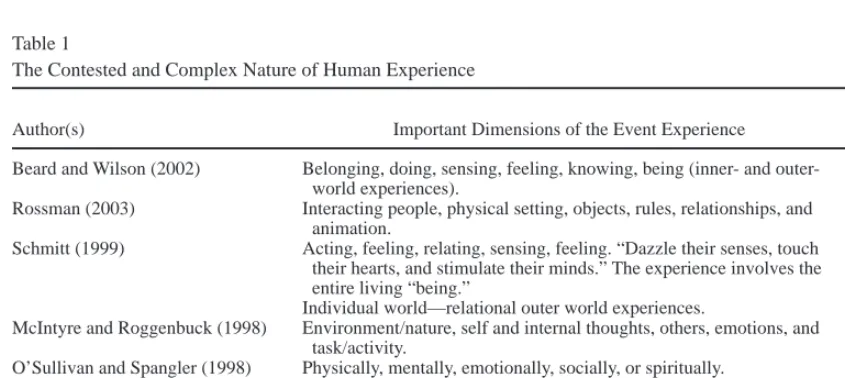
Table 1 summarizes some of the wide-ranging views about the key aspects of the human experi-ence emerging at the start of the 21st century. Event design is currently facing fresh challenges as further knowledge unfolds, and the multiple dimensions of human experience receive renewed attention. (http:// www.kidzania.com). Similarly, the Disney
experience is said to use new scientific under-standing, with Loeffler and Church (2015) suggest-ing that Disney’s theme parks demonstrate how the Disney experience focuses on four cognitive drivers that release the drugs of positive emotion that stim-ulate the human brain in reaction to a specific expe-rience. The four natural drugs said to be used to hook children into the experience of pleasure at Disney, receiving specific mention, are serotonin, oxytocin, dopamine, and endorphin. The new sci-ence underpinning experisci-ence design is evident in these two cases.
[image:4.588.61.484.464.653.2]However, there is much contention over what aspects of the human experience should be con-sidered as most important, particularly in terms of “experiential value” (Peperkamp et al., 2015). The extent to which an event experience is socially (with other people), psychologically (inner psyche/ self), emotionally (feelings), cognitively (mind/ thinking), environmentally (space/place/more-than- human world), or otherwise constructed is central to this debate. Mannell and Kleiber (1997), for exam-ple, suggest that all experiences have three essential dimensions: the cognitive dimension (think ing), the conative dimension (acting/doing), and the affective dimension (emotions/feelings). Getz (2007) simi-larly suggests that experiences should be studied in terms of these three interrelated dimensions:
Table 1
The Contested and Complex Nature of Human Experience
Author(s) Important Dimensions of the Event Experience
No. of Core Dimensions
Beard and Wilson (2002) Belonging, doing, sensing, feeling, knowing, being (inner- and outer-world experiences).
6
Rossman (2003) Interacting people, physical setting, objects, rules, relationships, and animation.
6
Schmitt (1999) Acting, feeling, relating, sensing, feeling. “Dazzle their senses, touch their hearts, and stimulate their minds.” The experience involves the entire living “being.”
Individual world—relational outer world experiences.
5
McIntyre and Roggenbuck (1998) Environment/nature, self and internal thoughts, others, emotions, and task/activity.
5
O’Sullivan and Spangler (1998) Physically, mentally, emotionally, socially, or spiritually. 5 Bitner (1992) Cognitive, emotional, physiological. 3 Mannell and Kleiber (1997) The cognitive (thinking), the conative (acting/doing), and the affective
(feelings).
3
Mannell (1984) A state of mind. 1
Thorne (1963) Sensual, emotional, cognitive, conative, self-actualization, climax/peak experiences.
throughout this article in recognition that the term analysis is problematic in phenomenology, imply-ing a breakimply-ing into parts that may lead to a loss of the whole (Hycner, 1999).
Eleven participants who attended one specific sleep-out experience were contacted to take part in this small-scale research project; the final sample consisted of six in-depth, semistructured, audio recorded interviews. The interviews took place sev-eral months after the event and so data were based on memorable experiences. Participants were encour-aged to talk freely about their experiences within multiphasic questioning parameters (Multi phasic Analysis is a term created by Clawson & Knetsch in 1966), related to antecedent experiences before the event (e.g., prior relationship with the charity; motivation to attend),involvement and engagement during the event (e.g., tell me about your experi-ences; most engaging aspects),and the reversion to normal life after the sleep-out event (e.g., changed views of the homeless; positive conversations with friends).This original interview data were first inter-preted within this temporal (chronological) jour-neyed focus. Two further interpretations were then applied.
The second interpretation involved a disaggre-gation of the original data into themes, notably the six human experience dimensions derived from the work of Beard and Wilson (2013): (1) sensory-bodily experiences, (2) affective experiences, (3) cognitive experiences, (4) conative experiences, and experi-ences relating to (5) belonging and (6) being. In reality no boundaries exist between these six dimen-sions as they are inextricably intertwined to form the whole. Davis and Sumara (1997) regard any artificial segregation as problematic, arguing rightly that any “focus of enquiry is not so much on the components of experience but, rather, on the relations that bind these elements together in action” (p. 108).
Concerns about disaggregation (Hycner, 1999) were overcome by applying a third interpretive pro-cess, which we termed experience mapping. This involved a collaborative construction of a schematic representation or experience map, as a summative visual representation of the “whole” whereby rela-tions were bound together (Davis & Sumara, 1997). This group mapping process was initially trialed with groups (4–5 people) from delegates attending Methodology
This research article seeks to contribute to the understanding of event experiences through a case study where innovative phenomenological approaches were applied to the understanding of human experiences. The case study, a dissertation topic by an undergraduate student (Russ, 2014) at a UK University, relates to a church-based, not-for-profit organization that developed the “Cathedral Archer Project” (CAP), which uses a broad crisis intervention approach to support people to prog-ress out of homelessness. The awareness-raising experiential event we investigated is popularly known as the “sleep out,” which is a small part of the work of the CAP. This sleep-out experience qualifies as an event in that it is a temporal phe-nomenon, with a beginning and an end, planned and publicized in advance, and taking place in spe-cific locations (Getz, 2007). It can be further clas-sified, according to Getz (2007) as a cause-related event in that it is underpinned by a charitable act of compassion and designed to “raise money, or to promote a cause, which makes them part of social marketing” (p. 26).
HUMAN EXPERIENCE MAPPING 369
sequential understanding of the participant expe-riences, with a particular focus on the conative (doing): we first went to . . . then we were shown around . . . then we got our cardboard to sleep on.
Second Stage Interpretation: Segregation Into Six Experience Dimensions
Our second interpretation involved a disaggre-gation of the original data into the six core human experiential dimensions. This created several new lenses through which we explored the complex-ity of the event experiences, notably the sensorial, affective, cognitive, conative, being, and belong-ing aspects of the experience. A sample of findbelong-ings from this second phenomenological approach is presented below to offer an insight into this layer of interpretation. Key words are highlighted in italics in order to foreground the dimensions located within the narratives.
Dimension 1: Participant Sensorial Experiences. The data from the sleep-out event with homeless people evidence the importance of the sensorial experience, and the relational connection of the senses to feeling and thinking:
I remember thinking that the trees rustling was quite a nice noise but I wondered what that might be like if you were cold and hungry and, I mean I was in my cozy warm sleeping bag and it made me think what would it be like if it was pissing with rain and I was under this tree, you know. Would I be getting wet? Would the leaves be making that noise? Would I be thinking how lovely they are? Would I be looking at the stars thinking gosh, you know. Or would I be stuck in a doorway or what-ever so it did make me think about the surround-ings that I was in. And I knew that I had people round about me, if I had been on my own I’d have felt incredibly vulnerable. (Participant 2)
Dimension 2: Participant Emotional Experiences. Human psychology suggests that we focus our experience on bad things and these experiences are said to be more prevalent than good (Baumeister, Brataslavsky, Finkenauer, Vohs, & Salovey, 2001); human survival adaptations create this dominant emotional dynamic, with attention directed more a conference of the Association of Event
Manage-ment Education held in Sheffield, UK in 2015. Con-ference attendees, considered to be “strangers” to the research (Denscombe, 2003), were given time to read data from the first two interpretations and then asked to transpose (by scribbling) data they felt had significance, or of interest to them as individual interpreters,onto six-foot-long rolls of paper on a desk top surface. The map was divided into three zones representing the three chronological phases, and when mapping was completed delegates had to explain their interpretations of the participant expe-riences to other participating groups. Each group was asked to first complete a “dress rehearsal” of this process before the final presentation.
After the completion and submission of the stu-dent dissertation a further set of experience map-ping field trials were opportunistically conducted by the supervisor, while attending a range of global events. These trails resulted in further data being collected about participant views on the experi-ence mapping processes. The events were as fol-lows: (1) 45 educators attending the Cocurricular and Extracurricular Education Internal Conference, Ministry of Education, Singapore (October 17, 2014); (2) 25 lecturers, outdoor sports, and experiential educators attending the International Mountain & Outdoor Sports Conference, Prague, Czech Repub-lic (November 20–23, 2014); (3) 30 experiential event designers from Kadoorie Farm and Botani-cal Gardens in Hong Kong (2015); (4) 40 outdoor experiential educators attending the Experiential Educators Conclave, Mumbai, India (December 11–13, 2015); and (5) 60 people in the US, who educate, train, and develop ambassadors and diplo-mats (May 2016).
Results
First Interpretations: A Multiphasic Focus
with the charity, similar to findings from Hover and van Mierlo (2006) and how this event aligned with their sense of the reality of the experience (Binstead & Stuart, 1979). The basic level of engagement is simply giving money, with low experience reality: it is passive, with little or no engagement. Sponsored adventure experiences, like abseiling or skydiving, although memorable, were perceived as low real-ity experiences with little connection to the cause. However, the act of sleeping out appears to have a high perceived reality and high engagement that is not only memorable but potentially transformative (Hover & van Mierlo, 2006):
I walk past people begging in the subway, every single day and that kind of constantly reinforces that, you know, something needs to be done and that perhaps the Cathedral Archer is a good way of contributing. (Participant 6)
It was more the talk and the tour around the facili-ties about what they actually do. A bit more detail about all the depth of what they do and the lengths that they go to, to help people. (Participant 1)
You see these appeals on telly and it pulls at a heart string but then once that adverts’ gone off and you’ve donated, it’s kind of, it’s forgotten because you’ve just handed some cash over and it’s like . . . but when you’ve actually done something like that and you get a real experience of what one night of their life’s like . . . definitely has a bigger impact than just handing money over. (Participant 4)
Dimension 5: Participant Experiences of Belong ing and Relating. Baumeister and Leary (1995) and Gilbert (2009) have identified the deep human need to belong: to people, to communities, nature, and spaces and places. Participant data from the sleep-out project reveal the significant people and places that contributed to their sense of belonging. “There was very much a feeling of oneness, you know, all being in it together kind of thing” (Par-ticipant 5).
Belonging also surfaced in relation to specific spaces:
If you were just in town that moment, not in a sleeping bag, not lying on the floor, not under a tree wouldn’t bother you at all but it kind of made you have a different kind of awareness of people who were around you. (Participant 4)
frequently at potentially negative scenarios. If neg-ative emotional experiences appear as more signi-ficant it is important for designers to acknowledge how the human condition gives prioritization for survival. Sleep-out event data presented above in the sensory data reinforce this; these negative emotions occur throughout participant data, reveal-ing a milieu of emotional experiences: “If I had been on my own I would have felt incredibly vener able” (Participant 2).
One person had previously completed an abseil to raise money for the charity:
The abseiling ones were just terrifying. What’s more . . . I think you kind of do that, and then for-get about the charity, not forfor-get about the charity but it doesn’t give you the same ties and emotional connection towards the charity as the sleep-out did. (Participant 4)
Dimension 3: Participant Experiences of Know ing. The participant desire for knowledge in order to understand the cause and the reality of the homeless is significant. Data reveal a pervasive acquisition and, in the opinion of participants, to experience the sleep out is to really know and appreciate home-lessness. The sleep out did produce a change in per-ception and an increased awareness of the plight of homeless people. The following extracts illustrate cognitive dimensions of participant experiences:
Would I be looking at the stars thinking gosh, you know. Or would I be stuck in a doorway or what-ever so it did make me think about the surround-ings that I was in. (Participant 2)
I thought it was little more than a soup kitchen to be honest, I didn’t realize how much they were involved with the clients. (Participant 5)
It just made us more knowledgeable. (Participant 1)
HUMAN EXPERIENCE MAPPING 371
the schematic map talking through their interpre-tations together. This dress rehearsal generated information exchange so that a storied explana-tion evolved to capture a sense of the whole while capturing subtle similarities and differences, as well as the spatial–relational complexity (Tversky, 2001). After approximately 90 minutes the groups were asked to present their findings to all the other groups by a similar process of walking and articu-lating their findings. The group interpretations produced a rich, holistic picture of the participant experiences in a remarkably short period of time (approx. 1.5 hours). Subsequent field trials have also generated very positive feedback, with partici-pating scholars and practitioners producing sensi-tive, empathetic interpretations of the participant experiences with remarkable consistency.
Discussion
The original qualitative interview transcripts proved quite difficult to interpret when in a textual form covering several pages of paper. Experienced researchers may find such processing less demand-ing. To reduce the spatial processing load for the stu-dent, data were disaggregated into six core human experience categories (Beard & Wilson, 2013), as themes for interpretation and further understand-ing. This second phase disaggregation gave some focus to specific aspects of the experience, such as emotions. However, the third phase of interpreta-tion involved the creainterpreta-tion of a schematic represen-tation of the data. Although there is little evidence of data mapping in phenomenology, maps are used for “service mapping,” involving the reengineering of the consumer experiences of service (Getz, O’Neil, & Carlsen, 2001; Pettersson & Getz, 2009).
The literature suggests that data interpretation can place a heavy relational processing load on the brain (Hummel & Holyoak, 1997), and that sche-matic representations may provide a supporting mechanism for the more abstract cognitive tasks such as the identification of category links, time or spatial frames, directionality, and other interpreta-tive patterns. It is difficult to identify the underly-ing reasons for the apparent success of the mappunderly-ing trials: however, it may be that sensory and motor I want to make an impact on my own doorstep and
Sheffield is my home now. (Participant 2)
The kitchens, the cathedral, the city, the outdoors, the skips (with waste cardboard that became the beds, and gave rise to the term “cardboard city”), and sheltering places were also some of the signifi-cant spaces referred to in the participant data.
Dimension 6: Participant Experiences of Being. Being is a complex state, not of form or things, but about who we are, our identity, our inner self. Being is about our ability to be mindful, to be self-aware, and present, involving the construction of the sense of “self.” Participants on the sleep-out project talked of the “impact” the event had on them, and using words such as “stunned”: this is a powerful, physical metaphor, suggesting such experiences can be unsettling, and potentially transformative (Mezirow, 2000). The “impact” on the sense of self, or one’s being in the world is evident (Getz, 2007). Below is the juxtaposition of two contrasting iden-tities, one a business woman, the other a homeless man and his dog:
Here was this laddie all disheveled and everything, put his arms around me and gave me a big hug and said “I bloody love you I do” and I said “come on then I’ll buy you a cup of tea.” What amazed me was that here was me in my business outfit and my suit and all the rest of it heading to meetings, posh briefcase and here was this laddie with his mangy dog giving me a hug in the middle of the street. (Participant 2)
Third Stage Interpretation: A Schematic Experience Map
Sharing copies of the original phasic interview data, as well as the thematic data, all participants in the field trails experienced periods of getting “stuck,” and this was overcome by persuading them to start the process of scribbling notes on the mapping paper after approximately 20 minutes into the activity. They were reminded to select any data that, to them, represented significant experiences.
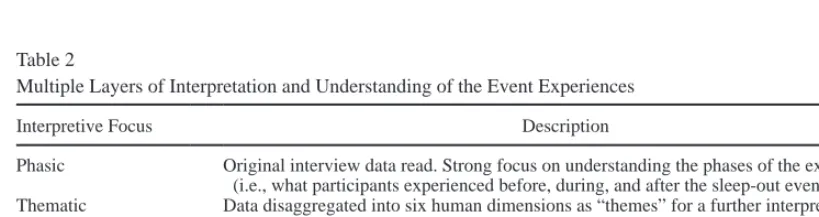
“private, mental conceptualizations to be made public, where they can be shared, examined, and revised” (p. 110) (Table 2).
There is an ongoing discussion within event lit-erature about the application of qualitative research for event design, with van Veggel (2005) highlight-ing that a tension has been noticed between apply-ing qualitative methods as a research method, and making use of qualitative methods as a way to inform design. The experience mapping process was relatively quick to undertake and so there appears to be considerable potential for such phe-nomenological methods to be used by event practi-tioners for both evaluation and design, as means of “translation from research to design” (Peperkamp et al., 2015, p. 147). During the international trials both academics and practitioners said they would consider using experience mapping for both the analysis and design of events. However, at this stage we only have informal, unrecorded anecdotal evi-dence from the many participants in these work-shops that experience mapping was valued. It is our intention to formally collect data on the value and outcomes of experience mapping, and so fur-ther research has recently been initiated with a postgraduate events student. One focus group and numerous questionnaires have provided us with some initial data that is currently being analyzed.
Schematic phenomenological interpretations, in this case derived from the original phasic and the-matic data, appear to have considerable potential to generate a rich understanding of event experiences. However, the potential synergy between the three approaches is worthy of further investigation. We systems are put to work in service of abstract
rea-soning, and navigating the data through oration (linguistic), walking (motor/corporeal), and visual schematics (spatial–relational). Pinker (1989) does suggests that human sensory and motor programs may have become adapted to support more abstract tasks concepts, and Lakoff and Johnson (1999) argue that spatial relations are at heart of any con-ceptual systems, and concepts and reasoning are also embodied.
The conversations between participants and the active experiential nature of the schematic mapping process also appears to facilitate data interpreta-tion. The collaborative, interactive dialogic process allowed both scholars and practitioners to speedily navigate and organize the data, and to understand the relational complexity, for example the partici-pant experience in relation to a specific time or location. Indeed Denscombe (2003) suggests that phenomenological descriptions of experiences “can tell an interesting story . . . in a way that is immedi-ately accessible and interesting to a wide range of readers” (p.106).
[image:9.588.58.468.533.641.2]What then is the role of experience maps in event evaluation? Tversky (2001) notes that “graphics serve a variety of functions, among them, attracting attention, supporting memory, providing models, and facilitating inference and discovery” (p. 79), and furthermore she argues that “visualizations have become increasingly important in organizing large databases enabling efficient search through them” (p.108). Noteworthy in terms of the col-laborative nature of experience mapping, Tversky (2001) suggests that spatial–temporal maps allow
Table 2
Multiple Layers of Interpretation and Understanding of the Event Experiences
Interpretive Focus Description
Phasic Original interview data read. Strong focus on understanding the phases of the experience (i.e., what participants experienced before, during, and after the sleep-out event). Thematic Data disaggregated into six human dimensions as “themes” for a further interpretation and
understanding of the sleep-out experiences.
HUMAN EXPERIENCE MAPPING 373
intention to analyze and collect further data on the mapping processes.
References
Baumeister, R. F., & Leary, M. R. (1995). The need to belong: Desire for interpersonal attachments as a fun-damental human motivation. Psychological Bulletin,
117(3), 497–525.
Baumeister, R. F., Brataslavsky, E., Finkenauer, C., Vohs, K. D., & Salovey, P. (2001). Bad is stronger than good.
Review of General Psychology, 5(4), 323–370.
Bitner, M. J. (1992). Servicescapes: The impact of physical surroundings on customers and employees. The Journal of Marketing, 56(2), 57–71.
Beard, C., & Wilson, J. P. (2013). Experiential learning: A handbook for education, training and coaching. Lon-don: Kogan Page.
Berridge, G. (2012). Designing event experiences. In S. J. Page & J. Connel (Eds.), The Routledge handbook of events (pp. 273–288). Oxon: Taylor Francis Group. Binstead, D., & Stuart, R. (1979). Designed reality into
man-agement learning events. Personnel Review, 8(3), 12–19. Brown, S. (2014). Emerging professionalism in the event
industry: A practitioner’s perspective. Event Manage ment, 18(1), 15–24.
Burr, V. (2003). Social constructionism. London: Routledge. Davis, B., & Sumara, D. J. (1997). Cognition, complexity
and teacher education. Harvard Educational Review,
67(1), 105–125.
Denscombe, M. (2003). The good research guide for small scale research projects. Maidenhead, UK: Open Univer-sity Press.
Duhigg, C. (2012). The power of Habit: Why we do what we do, and how to change. London: RH Books.
Eyal, N. (2014). Hooked: How to build habit forming prod ucts. London: Penguin.
Getz, D. (2007). Event Studies: Theory, research and policy for planned events. London: Butterworth-Heinemann. Getz, D. (2008). Event tourism: Definition, evolution, and
research. Tourism Management, 29(3), 403–428. Getz, D., ONeill, M., & Carlson, J. (2001) Service quality
evaluation at events through service mapping. Journal of Travel Research, 39(4), 380–390.
Gilbert, P. (2009). The compassionate mind. London: Con-stable & Robinson.
Hover, M., & van Mierlo, J. (2006). Imagine your event: Imagineering for the event industry. Unpublished manu-script, Bread University of Applied Sciences and NHTV Expertise, Event Management Centre, Netherlands. Hummel, J. E., & Holyoak, K. J. (1997). Distributed
repre-sentations of structure: A theory of analogical access and mapping. Psychological Review, 104, 427–466. Hycner, R. H. (1999). Some guidelines for the
phenom-enological analysis of interview data. In A. Bryman & R. G. Burgess (Eds.), Qualitative research (pp. 143– 164). London: Sage.
would also like to further explore the nature of the interaction between people creating the maps (e.g., in the generation of a collaborative view—similarity and difference), between private internal (mental) representations and external visual physical rep-resentations (schematic maps), between parts and the whole (e.g., disaggregated and aggregated), and the potential application of experience mapping as a means of reconstructing event experiences by scholars and practitioners alike (see, for example, recent work by Peperkamp et al., 2015). These questions characterize the next steps that we hope to take in order to further develop our research.
Conclusion
Pinker, S. (1989). Learnability and cognition: The acquisi tion of argument structure. Cambridge, MA: MIT Press. Poulsson, S. H. G., & Kale, S. H. (2004). The experience
economy and commercial experiences. The Marketing Review, 4, 267–277.
Rossman, J. R. (2003). Recreation programming: Designing leisure experiences. Urbana, IL: Sagamore Publishing. Russ, W. (2014). The significance of experiential events for
the charity sector and their impact on attendees through event analysis. Unpublished Undergraduate Project, Sheffield Hallam University, Sheffield, UK.
Schmitt, B. H. (1999). Experiential marketing: How to get customers to sense, feel, think, act, relate to your com pany and brands. New York: The Free Press.
Schull, N. (2012). Addiction by design: Machine gambling in Las Vegas. Princeton, NJ: Princeton University Press. Sheets-Johnstone, M. (2009). The corporeal turn, an inter
disciplinary reader. Exeter, UK: Imprint Academic. Spiegelberg, H. (1982). The phenomenological movement:
A historical introduction. Hague, Netherlands: Matinus Nijhoff.
Thorne, F. C., (1963). The clinical use of peak and Nadir experience reports. Journal of Clinical Psychology, 19
(2), 248–250.
Tversky, B. (2001). Spatial schemas in depictions. In M. Gattis (Ed.), Spatial schemas and abstract thought (pp. 79–112). London: MIT Press.
van Veggel, R. J. F. M. (2005). Where two sides of ethnogra-phy collide. Design Issues, 21(3), 3–16.
Walls, A. R., Okumus, F., Wang, Y., & Kwun, D. J. (2011). An epistemological view of consumer experiences.
International Journal of Hospitality Management, 30(1), 10–21.
Ziakas, V., & Boukas, N. (2014). Contextualising phenome-nology in event management research. International Jour nal of Event and Festival Management, 5(1), 56–73. Lakoff, G., & Johnson, M. (1999). Philosophy in the flesh:
The embodied mind and its challenge to western thought.
New York: Basic Books.
Lewis, D (2013). Impulse: Why we do what we do without knowing it. London: Random House.
Loeffller, B., & Church, B. T. (2015). The experience: The 5 principles of Disney service and relationship excel lence. Hoboken, NJ: Wiley.
Mannell, R. C. (1984). The playful side of laughter. Journal of Leisureability, 11, 4–7.
Mannell, R. C., & Kleiber, D. A. (1997). A social psychology of leisure. Pittsburgh, PA: Venture Publications. McIntyre, N., & Roggenbuck, J. W. (1998). Nature/person
transactions during an outdoor adventure experience: A multi-phasic analysis. Journal of Leisure Research,
30(4), 401–422.
Mehmetoglu, M., & Engen, M. (2011). Pine and Gilmore’s concept of experience economy and its dimensions: An empirical examination in tourism. Journal of Quality Assurance in Hospitality & Tourism, 12(4), 237–255. Mezirow, J. (2000). Learning as transformation: Critical
perspectives on a theory in progress. San Francisco, CA: Jossey-Bass.
O’Sullivan, E. L., & Spangler, K. J. (1999). Experience mar keting. State College, PA: Venture Publishing.
Peperkamp, E., Rooijackers, M., & Remmers, G. (2015). Evaluating and designing for experiential value: The use of visitor journeys. Journal of Policy Research in Tour ism, Leisure and Events, 7(2), 134–149.
Pettersson, R., & Getz, D. (2009). Event experiences in time and space: A study of visitors to the 2007 World Alpine Ski Championships in Are, Sweden. Scandinavian Jour nal of Hospitality and Tourism, 9(2–3), 308–326. Pine, J., & Gilmore, B. H. (1999). The experience economy,