Effects of different organic amendment on winter wheat yields
under long-term continuous cropping
B. Procházková
1, J. Hrubý
2, J. Dovrt
ě
l
3, O. Dostál
31
Mendel University of Agriculture and Forestry in Brno, Czech Republic
2
Research Institute for Fodder Crops, Ltd., Troubsko, Czech Republic
3
Research Institute of Crop Production, Prague-Ruzyn
ě
, Czech Republic
ABSTRACT
The observations were conducted on chernozem soil in a sugar-beet production region in 1971–2002. Six variants of organic amendment were examined: l – straw harvest, 2 – straw harvest + green manuring, 3 – straw incorporation, 4 – straw incor-poration + green manuring, 5 – straw burning, 6 – straw burning till 1977 + intercrop, incorincor-poration of farmyard manure at 10 t/ha since 1978. The effect of organic amendment on winter wheat continuous cropping was statistically significant. On average of the whole period (32 years), the highest yields were produced in variants with straw burning (var. 5) – 6.04 t/ha and with green manuring (var. 2) – 6.03 t/ha, and lower yields in variants with straw incorporation into soil (var. 3) – 5.65 t/ha, (var. 4) – 5.67 t/ha. The smallest differences between variants were found in the first decade of the experi-ment. Over time (in the second and third decades), the differences increased and positive effects of green manuring and straw burning and adverse effects of straw incorporation into soil increased. The yield level of winter wheat continuous cropping was high under the given conditions. The yield for the whole period of the experiment averaged 5.85 t/ha, the yields 5.19, 6.54 and 5.76 t/ha were obtained in the first, second and third decade, respectively.
Keywords: winter wheat; long-term continuous cropping; straw management; green manuring; farmyard manuring; grain yield
The concentration of cereals in crop rotations has been increasing, particularly in the fertile areas of maize and sugar-beet production regions, and in some cases they tend up to continuous cropping. The agricultural enter-prises specialized in cereal growing do not usually have livestock production or cattle breeding. Thus, cereal straw remains in the field and is a main source of essen-tial organic matters supplied to the soil.
As the results obtained from a number of experiments suggest, repeated cereal growing (in particular for a long time) is not without problems. It mostly leads to yield and yield stability decrease (Zawislak and Sadowski 1992, Arshad et al. 2002, Elen 2002, and others). The yield level depends on the site to a considerable extent. Under some conditions, high and stable yields can be produced even at the high proportion of cereals. In relation to the crop concentration and continuous cropping, the so-called an-tiphytopathogenic potential of soil is discussed, which means the soil is able to destroy pathogenic soil organ-isms.
A great number of researchers have been engaged in the evaluation of effects of straw incorporation into soil on yields of consecutive crops and changes in the soil environment (Christian and Bacon 1991, Smallfield, 1992, Borresen 1999, and others). Their results show that straw manuring, particularly combined with shallow soil tillage,
often generates problems associated with the proper stand establishment. Furthermore, straw can inhibit ger-mination, emergence and initial growth of consecutive crops. The inhibition mostly comprises physical and bio-chemical effects (water consumption for straw decompo-sition, phytotoxic substances released from straw or produced at its degradation). Such problems are more frequent under drier conditions and in growing winter cereals since there is a short period between straw incor-poration into soil and seeding. Annual straw manuring at repeated cereal growing usually leads to an abundant sup-ply of soil with organic matter. Both deficient and exces-sive supply of organic matter to soil can adversely affect the quality of the soil environment and grown crops.
The unfavourable effects of the higher cereal concen-tration can be compensated to a certain extent (Bower-man et al. 1995, Agenbag 1998, Berzsenyi et al. 1999, and others). It is recommended to take the following mea-sures: to increase nutrient supply to soil, to grow inter-crops as green manure, to support post-harvest residue and straw decomposition, to select appropriate varieties, and to apply chemical plant protection. Straw burning also has a favourable influence on yields and their sta-bility, especially due to its phytosanitary effects. How-ever, its application is markedly limited because of technical problems and environmental impacts.
The aim of the present paper is to evaluate the effects of different practices of organic amendment on yields of winter wheat under long-term continuous cropping.
MATERIAL AND METHODS
The study was conducted in a stationary field experi-ment carried out in a sugar-beet production region in the field of the Research Institute of Crop Production Prague-Ruzyně in 1971–2002. The experiment was arranged in a split-plot design in four replications. The plot size was 20 m2.
Characteristics of experimental site
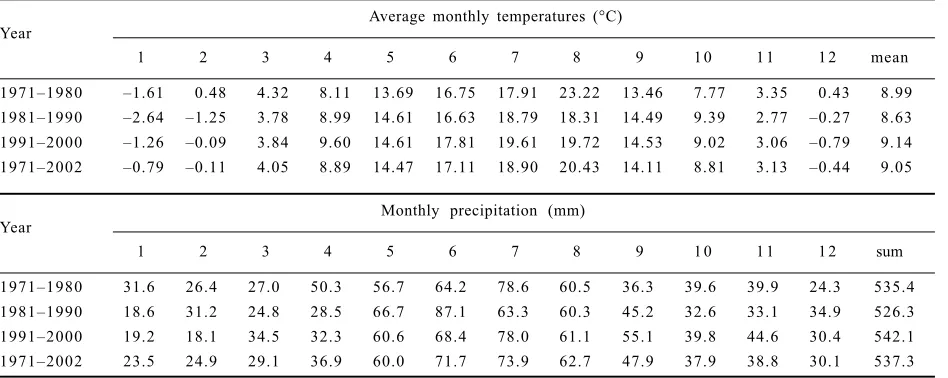
The site is 225 m above sea level, average annual tem-perature 9.05°C, and average precipitation 537.3 mm (av-erage of 1971–2002). Data on weather characteristics during the experiment are given in Table 1. Soil conditions of the experimental site: chernozem soil of medium tex-ture originated on pleistocene loess, neutral soil reaction, content of available phosphorus and potassium is good.
Variants
1. straw harvest
2. straw harvest + green manuring (white mustard) 3. straw incorporation
4. straw incorporation + green manuring 5. straw burning
6. till 1976 – straw burning + green manuring since 1977 – farmyard manure at a rate of 10 t/ha
Mineral fertilization regimes: phosphorus and potassi-um rates till 1975 – 24 and 66 kg pure nutrients per ha,
respectively, since 1976 – 40 and 100 kg pure nutrients per ha, respectively, nitrogen rate over the whole period of the experiment – 120 kg per ha.
The varieties were changed during the experiment; Soviet varieties were grown mostly in the first decade and home varieties in the second and third decades. Harmful agents were controlled uniformly in all variants of the experiment using methods of the State Phytosan-itary Administration. Yield data were statistically pro-cessed by analysis of variance and least significant differences were calculated. Relative yields were used to compute yield trends in individual variants of organic amendment (basic variant – straw harvest).
RESULTS
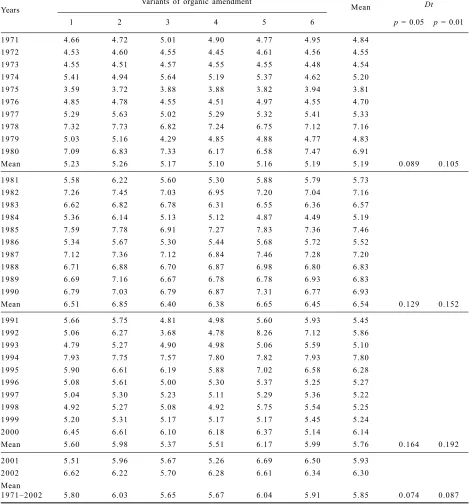
The effect of different organic amendment on yields of winter wheat under a long-term continuous cropping system was statistically significant for both individual decades and the whole period of the experiment. The re-sults are presented in Table 2 and Figure 1.
In the first decade (1971–1980), the differences between variants were smallest. The highest yield was obtained in the variant with straw harvest in combination with green manuring (var. 2) and in the control variant with straw harvest (var. 1).
In the second decade (1981–1990), the differences be-tween variants were larger. The highest yields were re-corded after green manuring (var. 2) and straw burning (var. 5). Yields began to decrease after straw incorpora-tion into soil (var. 3 and 4).
[image:2.595.64.538.571.760.2]In the third decade (1991–2000), the differences be-tween variants were the largest. The highest yields were obtained after straw burning (var. 5), after green manur-ing (var. 2), and after farmyard manurmanur-ing (var. 6). Straw incorporation into soil showed apparent negative effects. A highly significant difference was found between the
Table 1. Weather characteristics
Year Average monthly temperatures (°C)
1 2 3 4 5 6 7 8 9 1 0 1 1 1 2 mean
1971–1980 –1.61 0.48 4.32 8.11 13.69 16.75 17.91 23.22 13.46 7.77 3.35 0.43 8.99
1981–1990 –2.64 –1.25 3.78 8.99 14.61 16.63 18.79 18.31 14.49 9.39 2.77 –0.27 8.63
1991–2000 –1.26 –0.09 3.84 9.60 14.61 17.81 19.61 19.72 14.53 9.02 3.06 –0.79 9.14
1971–2002 –0.79 –0.11 4.05 8.89 14.47 17.11 18.90 20.43 14.11 8.81 3.13 –0.44 9.05
Year Monthly precipitation (mm)
1 2 3 4 5 6 7 8 9 1 0 1 1 1 2 sum
1971–1980 31.6 26.4 27.0 50.3 56.7 64.2 78.6 60.5 36.3 39.6 39.9 24.3 535.4
1981–1990 18.6 31.2 24.8 28.5 66.7 87.1 63.3 60.3 45.2 32.6 33.1 34.9 526.3
1991–2000 19.2 18.1 34.5 32.3 60.6 68.4 78.0 61.1 55.1 39.8 44.6 30.4 542.1
control variant with straw harvest (var. 1) and the variant with straw incorporation into soil (var. 3).
On average of the whole period of the experiment (1971–2002), the highest yield was obtained in the vari-ant with straw burning (var. 5) and in the varivari-ant with green manuring (var. 2); the lowest one in the variant with straw incorporation into soil (var. 3).
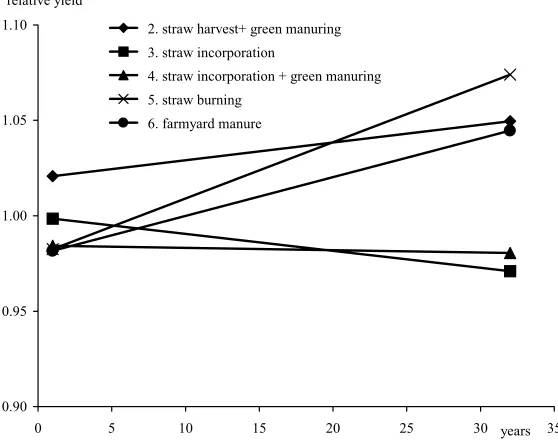
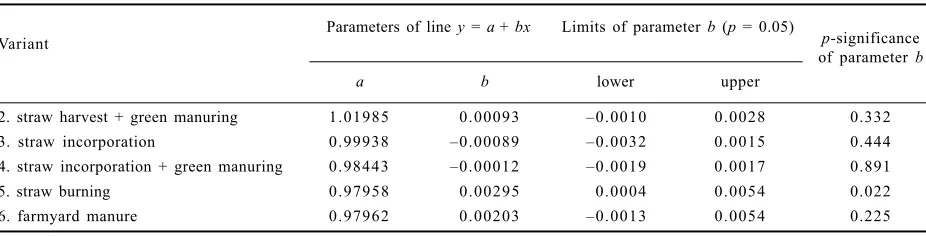
Relative yields were used to calculate yield trends in individual variants of organic amendment (basic variant – straw harvest). The results are given in Figure 2 and Table 3. The highest yield increase in comparison with
the control variant was recorded in the variant with straw burning (var. 5), in the variant with farmyard manuring (var. 6), and with green manuring (var. 2). Over time, straw incorporation into soil (var. 3) led to yield decrease in comparison with the control variant.
[image:3.595.63.532.85.589.2]Winter wheat continuous cropping produced high yields at the site on fertile chernozem soil in the sugar-beet production region. The yield for the whole period averaged 5.85 t/ha, the yields 5.19, 6.54 and 5.76 t/ha were obtained in the first, second and third decade, re-spectively.
Table 2. Yields of winter wheat continuous cropping at different organic amendment (t/ha)
Years Variants of organic amendment Mean Dt
1 2 3 4 5 6 p = 0.05 p = 0.01
1971 4.66 4.72 5.01 4.90 4.77 4.95 4.84
1972 4.53 4.60 4.55 4.45 4.61 4.56 4.55
1973 4.55 4.51 4.57 4.55 4.55 4.48 4.54
1974 5.41 4.94 5.64 5.19 5.37 4.62 5.20
1975 3.59 3.72 3.88 3.88 3.82 3.94 3.81
1976 4.85 4.78 4.55 4.51 4.97 4.55 4.70
1977 5.29 5.63 5.02 5.29 5.32 5.41 5.33
1978 7.32 7.73 6.82 7.24 6.75 7.12 7.16
1979 5.03 5.16 4.29 4.85 4.88 4.77 4.83
1980 7.09 6.83 7.33 6.17 6.58 7.47 6.91
Mean 5.23 5.26 5.17 5.10 5.16 5.19 5.19 0.089 0.105
1981 5.58 6.22 5.60 5.30 5.88 5.79 5.73
1982 7.26 7.45 7.03 6.95 7.20 7.04 7.16
1983 6.62 6.82 6.78 6.31 6.55 6.36 6.57
1984 5.36 6.14 5.13 5.12 4.87 4.49 5.19
1985 7.59 7.78 6.91 7.27 7.83 7.36 7.46
1986 5.34 5.67 5.30 5.44 5.68 5.72 5.52
1987 7.12 7.36 7.12 6.84 7.46 7.28 7.20
1988 6.71 6.88 6.70 6.87 6.98 6.80 6.83
1989 6.69 7.16 6.67 6.78 6.78 6.93 6.83
1990 6.79 7.03 6.79 6.87 7.31 6.77 6.93
Mean 6.51 6.85 6.40 6.38 6.65 6.45 6.54 0.129 0.152
1991 5.66 5.75 4.81 4.98 5.60 5.93 5.45
1992 5.06 6.27 3.68 4.78 8.26 7.12 5.86
1993 4.79 5.27 4.90 4.98 5.06 5.59 5.10
1994 7.93 7.75 7.57 7.80 7.82 7.93 7.80
1995 5.90 6.61 6.19 5.88 7.02 6.58 6.28
1996 5.08 5.61 5.00 5.30 5.37 5.25 5.27
1997 5.04 5.30 5.23 5.11 5.29 5.36 5.22
1998 4.92 5.27 5.08 4.92 5.75 5.54 5.25
1999 5.20 5.31 5.17 5.17 5.17 5.45 5.24
2000 6.45 6.61 6.10 6.18 6.37 5.14 6.14
Mean 5.60 5.98 5.37 5.51 6.17 5.99 5.76 0.164 0.192
2001 5.51 5.96 5.67 5.26 6.69 6.50 5.93
2002 6.62 6.22 5.70 6.28 6.61 6.34 6.30
Mean
DISCUSSION
Topical questions of current agricultural practice are if a higher concentration of cereals in crop rotations is pos-sible and if they can be grown repeatedly. The research on the higher cereal concentration and associated prob-lems shows that agroecological conditions play a critical role. Based on long-term investigations, Kos (1982) stat-ed that the most favourable conditions for the high cere-al concentration in crop rotations were in the sugar-beet chernozem production region. The high cereal
concen-tration in less favourable areas is mostly accompanied by a larger decrease in grain yields. The importance of soil suppressivity for higher cereal concentrations was report-ed by Smiley (1979).
In our experiments, the yields of winter wheat continu-ous cropping were high. The yield reduction vs. wheat in the crop rotation did not exceed 10%. This high pro-duction ability of long-term winter wheat continuous cropping evinces a high antiphytopathogenic potential of the soil concerned. The results are quite good and confirm that chernozem soils in the sugar-beet
produc-0.0 1.0 2.0 3.0 4.0 5.0 6.0 7.0 8.0
1971–1980 1981–1990 1991–2000 1971–2002 years
grain yield straw harvest straw harvest+ green manuring
[image:4.595.129.461.54.278.2]straw incorporation straw incorporation + green manuring straw burning farmyard manure
Figure 1. Effect of different organic amendment on yields of winter wheat continuous cropping (t/ha)
0.90 0.95 1.00 1.05 1.10
0 5 10 15 20 25 30 years 35
relative yield
2. straw harvest+ green manuring 3. straw incorporation
4. straw incorporation + green manuring 5. straw burning
6. farmyard manure
[image:4.595.160.439.506.730.2]tion region are favourable for higher cereal concentra-tion.
The higher concentration of cereals necessitates pay-ing attention to a complex of measures in order to elimi-nate adverse implications of their repeated growing.
Infection of cereals by stem-base diseases is one of the important factors that limit the higher cereal concentra-tion in crop rotaconcentra-tions. Comprehensive and long-term in-vestigations into the effect of higher cereal concentration in the crop rotation on the development of stem-base diseases were conducted by Kos (1982). The results con-firmed considerable importance of ecological conditions in relation to disease severity. He accounted the sugar-beet chernozem production region medium endangered and did not consider the infection by stem-base diseas-es as the only cause of yield reduction in cereals at their higher concentration in the crop rotation. He reported a slight decrease in disease severity in winter wheat con-tinuous cropping after green manuring, straw incorpora-tion, and application of farmyard manure. The infection was more suppressed after straw burning.
A problem of the higher cereal concentration can be repeated straw incorporation into soil. If straw is decom-posed slowly, particularly under drier conditions, a larg-er amount of undecomposed organic mattlarg-ers can induce the inhibition of germination and initial growth of a con-secutive crop (Řídký 1976, Ellis et al. 1979, Harper 1989). The unfavourable effect of straw on germination, emer-gence and tillering of winter wheat was stated by Small-field (1992). It resulted in grain yield reduction, particularly where there was shallow straw incorporation into soil. The increasing depth of incorporation abated this unfavourable effect.
Graham et al. (1986) recorded decreasing yields of win-ter crops if straw remained on the soil surface in compar-ison with burned straw. The incorporation of straw reduced its negative effect on yields, however, the yields were lower than after straw burning.
Lower yields of winter wheat continuous cropping af-ter shallow straw incorporation into soil in comparison with ploughing were reported by Prew and Lord (1988). In experiments aimed at the effect of different practices of straw management on the yield of winter wheat con-tinuous cropping, positive effects of straw burning and acceleration of straw decomposition using
organo-min-eral fertilizers (based on beet molasses stillage) were found (Procházková and Dovrtěl 2000).
The results obtained from the evaluation of long-term effects of different forms of organic amendment on yields and yield trends of winter wheat continuous cropping in our experiments demonstrate pronounced positive ef-fects of straw burning and green manuring and adverse effects of annual straw incorporation into soil. These effects increased in the course of time. Favourable effects of straw burning and green manuring on yields of winter wheat continuous cropping can be related to their phy-tosanitary effects and reduction of inhibition effects of straw and post-harvest residues, in green manuring also with positive effects on the soil environment.
The effect of different organic amendment on the con-tent of oxidable carbon and humus substances was eval-uated in the experiment. The results are presented by Procházka (1986) and Procházková et al. (2001). Nine to 11 years after the experiment establishment, the content of organic carbon was almost identical in all variants. The evaluations performed after 26 to 28 years showed a slight increase in both the content of oxidable carbon and humus substances in variants with green manuring, straw incorporation into soil and farmyard manuring. However, the differences between the variants were small. It is in accordance with the finding that the dynamic balance of soil organic matter needs a couple of decades to constitute (Kubát 1999).
[image:5.595.65.528.76.194.2]In general, the results of evaluating the effects of dif-ferent organic amendment on yields of winter wheat continuous cropping suggest a possibility of a higher concentration of cereals in the sugar-beet chernozem production region. However, the winter wheat continu-ous cropping system should be considered as an ex-treme form of specialization even under the presented conditions. The favourable effect on yields of winter wheat continuous cropping was found in straw burn-ing and growburn-ing intercrops for green manurburn-ing. Annual straw incorporation into soil showed a negative effect on grain yields under drier and warmer conditions of the sugar-beet production region. It deepened over time, however, it can be compensated for by supporting straw decomposition using special organo-mineral fer-tilizers, for instance, on the basis of beet molasses stil-lage.
Table 3. Statistical assessment of yield trend parameters
Variant Parameters of line y = a + bx Limits of parameter b (p = 0.05) p-significance
of parameter b
a b lower upper
2. straw harvest + green manuring 1.01985 0.00093 –0.0010 0.0028 0.332
3. straw incorporation 0.99938 –0.00089 –0.0032 0.0015 0.444
4. straw incorporation + green manuring 0.98443 –0.00012 –0.0019 0.0017 0.891
5. straw burning 0.97958 0.00295 0.0004 0.0054 0.022
REFERENCES
Agenbag G.A., Volder B., Vlassak K., Volder B. (1998): Effect of crop residue management, soil tillage and N fertilization on yield and quality of spring wheat (Triticum aestivum L.). Appl. Plant Sci., 12: 67–71.
Arshad M.A., Soon Y.K., Azooz R.H. (2002): Modified no-till and crop sequence effect on spring wheat production in northern Alberta, Canada. Soil Till. Res., 65: 29–36. Berzsenyi Z., Gyorffy B., Lap D.Q. (1999): Effect of crop
rotation and fertilisation on maize and wheat yields and yield stability in a long-term experiment. Eur. J. Agron., 13: 225–244.
Borresen T. (1999): The effect of straw management and re-duced tillage on soil properties and crop yields of spring-sown cereals on two loam soils in Norway. Soil Till. Res., 51: 91–102.
Bowerman P., Davies D.B., Jones A.E., Cook H.F. (ed.), Lee H.C. (1995): The long-term effects of straw incorporation on winter wheat yields. In: Soil management in sustainable agriculture. Wye College, Univ. London, UK: 448–452. Christian D.G., Bacon E.T.G. (1991): The effect of straw
dis-posal and depth of cultivation on the growth, nutrient up-take and yield of winter wheat on clay and a silt soil. Soil Use Mgmt, 7: 217–222.
Elen O. (2002): Plant production in spring cereal production with reduced tillage. III. Cereal diseases. Crop Prot., 21:195–201.
Ellis F.B., Elliot J.G., Pollard F., Cannel R.Q., Barnes B.T. (1979): Comparison of direct drilling, reduced cultivation and ploughing on the growth of cereals. 3. Winter wheat and spring barley on calcareous clay. J. Agric. Sci. Camb., 93: 391–401.
Graham J.P., Ellis F.B., Christian D.G., Cannel R.Q. (1986): Effect of straw residues on the establishment, growth and yield of autumn-sown cereals. J. Agric. Eng. Res., 24: 39–49. Harper S.H.T. (1989): Management of crop residues.
EUR-Rep., 11250: 127–132.
Kos M. (1982): Evaluation of invasion winter wheat by eye spot in crop rotations on the chernozem soils in the sugar beet growing region. Acta Univ., 30: 183–185. (In Czech) Kubát J. (1999): Keeping of organic matter composed balance
in the soil. Met. Zeměd. Praxi, Praha, ÚZPI, 1: 27. (In Czech)
Prew R.D., Lord E.I. (1988): The straw incorporation prob-lem. Asp. Appl. Biol., 17: 163–171.
Procházka F. (1986): Changes of some agrochemical proper-ties of chernozem soil by impact of different concentration of cereals. Rostl. Výr., 32: 23–33. (In Czech)
Procházková B., Dovrtěl J. (2000): Effect of different soil tillage and straw management systems on the yield of wheat. In: 15th ISTRO Conf., Texas, USA, CD-ROM. Procházková B. et al. (2001): Organic amendment in the
man-agement without animal production. Met. Zeměd. Praxi, Praha, ÚZPI, 14: 29. (In Czech)
Řídký K. (1976): Phytotoxicity of barley residua by different soil tillage. Rostl. Výr., 22: 525–535. (In Czech)
Smallfield B.M. (1992): Influence of straw residues on the growth of winter wheat. Diss. Abstr. Int. Sci. Eng., 53: 619B.
Smiley R.W. (1979): Wheat – rhizoplane pseudomonads as antagonists of Gaeumannomyces graminis. Soil Biol. Bio-chem., 11: 371–376.
Zawislak K., Sadowski T. (1992): The tolerance of cereals to continuous cultivation. Acta Acad. Agr. Techn. Olsten., Agricultura, 55: 137–147.
Received on May 7, 2003
ABSTRAKT
Vliv různého organického hnojení na výnosy ozimé pšenice pěstované v dlouhodobé monokultuře
Pokusy probíhaly na černozemní půdě v řepařské výrobní oblasti v letech 1971–2002. Bylo hodnoceno šest variant orga-nického hnojení (l – sklizeň slámy, 2 – sklizeň slámy + zelené hnojení, 3 – zaorávání slámy, 4 – zaorávání slámy + zelené hnojení, 5 – pálení slámy, 6 – do roku 1977 pálení slámy + meziplodina, od roku 1978 zaorávání chlévského hnoje (10 t/ha). Vliv organického hnojení na výnosy ozimé pšenice pěstované v monokultuře byl statisticky průkazný. V průměru za celé pokusné období (32 let) byly dosaženy vyšší výnosy na variantách s pálením slámy (var. 5 ) – 6,04 t/ha a se zeleným hnojením (var. 2) – 6,03 t/ha a nižší výnosy na variantách se zapravováním slámy do půdy (var. 3) – 5,65 t/ha, (var. 4) – 5,67 t/ha. Nejmenší rozdíly mezi variantami byly zaznamenány v první dekádě pokusu. S postupem času (ve druhé a ve třetí dekádě pokusu) se rozdíly zvětšovaly a docházelo ke zvyšování příznivého vlivu zeleného hnojení a pálení slámy a nepříznivého vlivu zapravování slámy do půdy. Výnosová úroveň ozimé pšenice pěstované v dlouhodobé monokultuře byla v daných podmínkách vysoká. Průměrný výnos za celé období pokusu byl 5,85 t/ha, v první dekádě 5,19 t/ha, v druhé dekádě 6,54 t/ha a ve třetí dekádě pokusu 5,76 t/ha.
Klíčová slova: ozimá pšenice; dlouhodobá monokultura; hospodaření se slámou; zelené hnojení; hnojení chlévským hnojem; výnos zrna
Corresponding author: