Vol. 5, 2016, 27-32
ISSN: 2349-0632 (P), 2349-0640 (online) Published 5 April 2016
www.researchmathsci.org
27
Journal of
Global Exponential Synchronization with respect to Partial State Variables in a Class of Chua’s System
Di Liu and Yuan Zhou
Research Center of Analysis and Control for Complex Systems Chongqing University of Posts and Telecommunications Chongqing– 400065, Chongqing, China. E-mail: [email protected]
Received 25 March 2016; accepted 4 April 2016
Abstract. The problem of global synchronization control for a class of Chua's system is studied in this paper. Several linear controlle rs are proposed to realize glob ally e xponential synchronization of t wo Chua's systems . Globally exponential synchronization with respect to (w.r.t) partial state variables is studied when one of the error variables is zero.
Additionally, numerical simulations show the effectiveness of the proposed controllers.
Keywords: Chua's system; globally exponential synchronization; partial state variables.
1. Introduction
It is well-known that Chua's system is the first analog circuit to realize chaos in experiments. The system can show rich dynamical behaviors though it is described by the following simple ordinary differential equations
( ( ))
x p y x g x y x y z z qy
(1)
where x y z, , are state variables,
1
b 2 a b
g x G x G G xE x E p0, q0 and G Ga, b are constants. Chua's system has the form of a simple circuit and it is easy to implement so that it results in a wide-range and in-depth research[1-2] Changing the parameters and the corresponding functions of Chua's system, the chaotic phenomenon is very rich, and it is more convenient to study the chaotic mechanism and characteristics.
In resent years, Chua's circuit has a lot of deformation in the form. For example, literature [2] studied global stability issues of Chua's circuit with smooth nonlinear functiong x( ) ax bx3
,
literature [3] studied the chaotic oscillation characteristics of the system wheng x( )x x| |, In this paper, we will study the global synchronization problem of a new Chua's system which was first proposed in[1]28
( ln 1 2)
x p x y x x
y x y z z qy
(2)
where x y z, , are state variables, p0, q0are constants.
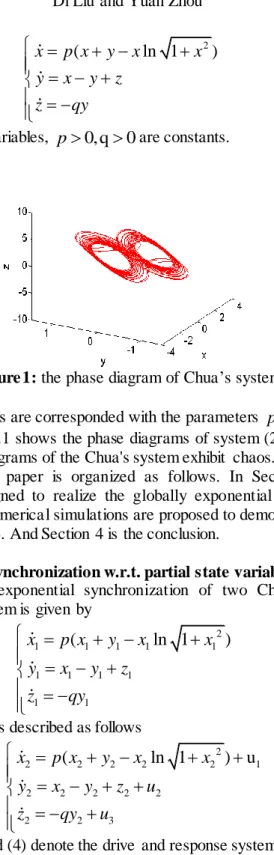
Figure 1: the phase diagram of Chua’s system
The chaotic characteristics are corresponded with the parameters p, q and the initial state values of system (2). Fig.1 shows the phase diagrams of system (2) with x(0)=0, y(0)=0, z(0)=0.001, the phase diagrams of the Chua's system exhibit chaos.
The rest of this paper is organized as follows. In Section 2, several linear controllers will be designed to realize the globally exponential synchronization w.r.t partial state variables, Numerical simulations are proposed to demonstrate the correctness of our results in Section 3. And Section 4 is the conclusion.
2. Global exponential synchronization w.r.t. partial state variables
In this section, global exponential synchronization of two Chua’s systems will be discussed. The drive system is given by
2
1 1 1 1 1
1 1 1 1
1 1
( ln 1 )
x p x y x x
y x y z
z qy
(3)
and the response system is described as follows
2
2 2 2 2 2 1
2 2 2 2 2
2 2 3
( ln 1 ) u
x p x y x x
y x y z u
z qy u
(4)
where the systems (3) and (4) denote the drive and response systems, respectively.
u (1, 2, 3)i is feedback control input which satisfies u (0, 0, 0)i .
system
29
Let exx2x1
, e
y y
2 y
1,ez z2z1, f (e )
x x
2ln 1 x
22 x
1ln 1 x
12 one obtains that1 2 3
( (e )) u
x x y x
y x y z
z y
e p e e f
e e e e u
e qe u
(5)
Chua's circuit is perhaps the earliest developed system from which chaos synchronization was observed [4] via a state signal taken from the transmitter system to drive the response system. Sometimes, the system have unstable states that we are not easy to find the controller to stabilize them, so partial states of them is considered. In this section, we use partial states stability theory and methodology [5] to study the globally exponential synchronization w.r.t partial state variables.
Case 1: For x2=x1, system (5) becomes
2 3
0, ) 0
( ( , ,
)
y y z y, z
z y y z
e e e u e e
e qe u e e
(6) Theorem 2.1. In system(5), Let u2 u3 0. Then, the zero solution of system (5) is globally exponentially stable, and thus when x2=x1
,
the two systems (3) and (4) are globally exponentially synchronized between the two pairs of ( ,y y1 2)and (z , z )1 2 . Proof: Construct the radially unbounded and positive definite Lyapunov function candidate as follows:2 2
1
1 1 2
1 2
T
y y
y z y z
z z
e e
V e e e e
e e
q
q
(7)
where
0 1
. Derivating (7) along the solution of (6) with u2 0,u3 0, it holds that2 2
1
q -2 2 ( q -2)
2
T
y y
y z y z
z z
e e
dV e e e e
e e
dt
when
e
y2 e
z2 0
for all0 1
.By choosing
2 8
0 min{ , }
4 1
q q
, it is easy to see that V1 is positive while dV1 dt is negative definite. Thus, the zero solution of system (6) is globally exponentially stable,30
which implies that when x2=x1, the two systems (3) and (4) are globally exponentially synchronized between the two pairs of ( ,y y1 2)and (z , z )1 2 . The proof is finished.
Case 2: Fory2=y1, the error system (5-) becomes
1 3
, 0,
( ) ( )
( , 0, )
x x x x z
z x z
e pe pf e u e e
e u e e
+ (8) Wheref (e )
x x
2ln 1 x
22 x
1ln 1 x
12Theore m 2.2. In system (5), choose
1 3
, 1
, 0
x x x
z z z
u p e
u e
(9) Then, the zero solution of system (5) is globally exponentially stable, and thus when y2=y1, the two systems (3) and (4) are globally exponentially synchronized between the two pairs of ( ,x x1 2)and (z , z )1 2Proof: Construct the radially unbounded and positive definite Lyapunov function candidate as follows:
2 2
2
2 2
x z
e e
V (10)
Derivating(10) along the solution of (8) with control input (9), it yields2
2 2
2 2
( 1) e (e ) e
( 1) e e
x x z z
x x x x z z
x x z z
dV e e e e dt
p pe f
p
When
e
x2 e
z2 0
. Obviously, Theorem 2.2 holds.Case 3: Forz2=z1, the error system (5) becomes
1 2
,
(e ) ( 0)
(
, , , 0)
y
x x y x x x
y x y x y
e pe pe pe f u e
e e e
e e
u e
(11) Theorem 2.3. In system (5), choose
1 2
, 2
0
x x x
u p e
u
(12) Then, the zero solution of system (5) is globally exponentially stable, and thus whenz2=z1, the two systems (3) and (4) are globally exponentially synchronized between the two pairs of ( ,x x1 2)and ( ,y y1 2)system
31
Proof: Construct the radially unbounded and positive definite Lyapunov function candidate as follows:
2 2 3
x y
V e e
p
(13)
Derivating (13) along the solution of (11) with control input (12), it yields2 2
3
2 2
2(1 ) e 4 2 2 ( )
2(1 ) e 4 2
2(1 ) 2
2 2
0
x x x y y x x
x x x y y
T
x x x
y y
dV e e e e f e
dt
e e e
e e
e e
When
e
x2 e
y2 0
. Consequently, the conclusion of Theorem 6 is true.3. Numerical simulations
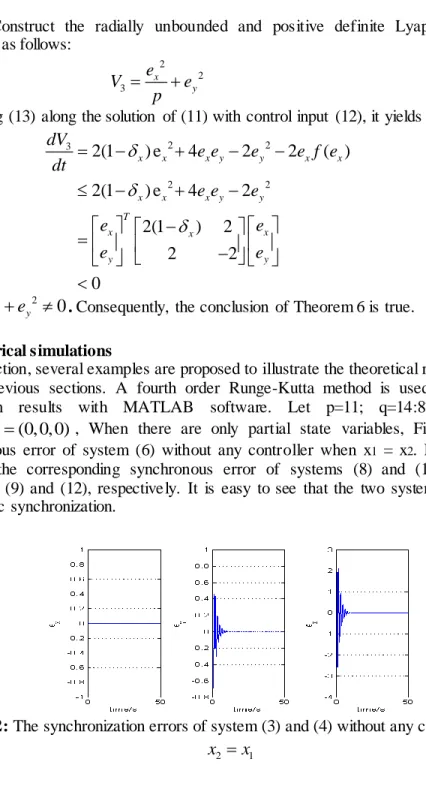
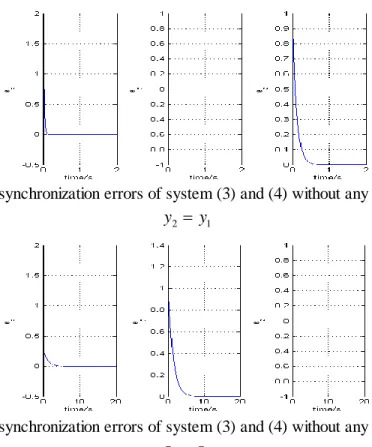
In this section, several examples are proposed to illustrate the theoretical results obtained in the previous sections. A fourth order Runge-Kutta method is used to obtain the simulation results with MATLAB software. Let p=11; q=14:87, the initial state x(0)(0, 0, 0), When there are only partial state variables, Fig.2 shows the synchronous error of system (6) without any controller when x1 = x2. Fig.3 and Fig.4 indicate the corresponding synchronous error of systems (8) and (11) with linear controller (9) and (12), respectively. It is easy to see that the two systems are globally asymptotic synchronization.
.
Figure 2: The synchronization errors of system (3) and (4) without any controller when
2 1
x x
32
Figure 3: The synchronization errors of system (3) and (4) without any controller when
2 1
y y
Figure 4: The synchronization errors of system (3) and (4) without any controller when
2 1
z z 4. Conclusions
The problem of global synchronization control for a class of Chua's system is studied in this paper. Globally exponential synchronization with respect to (w.r.t) partial state variables is studied when one of the error variables is zero, numerical simulations show the effectiveness of the proposed theoreticalresults.
Acknowledgements
This work is supported by the National Natural Science Foundation of China (No.
61104150) and Science Fund for Distinguished Young Scholar of Chongqing (cstc2013jcyjjq40001).
REFERENCES
1. G.P. Zhou, J.Huang, X.X.Liao and S.J.Cheng, Stability analysis and control of a new smooth Chua’s system, Abstract & Applied Analysis, 2013 (2013)
2. X.X.Liao, P.Yu and S.L.Xie, Study on the global property of the smooth Chua's system, International Journal of Bifurcation and Chaos, 16(10) 2815-2841.
3. K.S.Tang, K.F.Man and G.Q.Zhong, Generating chaos via
x x
, IEEE Trans. on Circuits and Systems I, 48(5) 635-641.4. L.M.Pecora and T.L.Carroll, Synchronization in chaotic systems, Phys. Rec. Lett, 64:
821-824.
5. X.X.Liao, Theory Methods and Application of Stability (2nd Ed.) (Huazhong University of Science and Technology Press) 2010.