
Ba
2Sb
4GeS
10Lei Geng
Department of Physics and Electronic Information, Huaibei Normal University, Huaibei, Anhui 235000, People’s Republic of China
Correspondence e-mail: [email protected]
Received 8 March 2013; accepted 22 March 2013
Key indicators: single-crystal X-ray study;T= 293 K; mean(Sb–S) = 0.001 A˚; Rfactor = 0.018;wRfactor = 0.042; data-to-parameter ratio = 23.2.
The title quaternary compound, dibarium tetraantimony germanium decasulfide, Ba2Sb4GeS10, crystallizes in a novel three-dimensional1
3
[Sb4GeS10] 4
network structure, which is composed of triangular pyramidal SbS3 (site symmetry m..), distorted SbS5 (m..) polyhedra and regular GeS4 (4..) tetra-hedra. The SbS3and SbS5units are connected with each other through corner- and edge-sharing, forming a Sb4S10 layer in
the ab plane. The GeS4 tetrahedra further bridge two
neighbouring Sb4S10 layers, forming a three-dimensional
1 3
[Sb4GeS10] 4
network. The Ba2+ cation (..2) is located between two Sb4S10layers and is coordinated by ten S atoms with Ba—S bond lengths in the range 3.2505 (9)–3.4121 (2) A˚ .
Related literature
The stereochemically active 5s2 lone-pair electrons possess a large electric dipole moment and can influence structures that contain Sb3+, see: Choi & Kanatzidis (2000); Babo & Albrecht-Schmitt (2012). SbS3, SbS4or SbS5units in a crystal structure are prone to form Sb—S chains through corner- or edge-sharing, see: Dorrscheidt & Scha¨fer (1981); Cordieret al.
(1984). GeS4tetrahedra can be utilized as the second struc-tural unit and introduced into crystal structures to connect Sb—S chains into a two-dimensional layer or three-dimen-sional framework structure (Feng et al., 2008). For crystal structures and optical properties, see: Denget al.(2005); Kim
et al. (2008); Ribes et al. (1973); Teske (1979); Lekse et al.
(2009).
Experimental
Crystal data
Ba2Sb4GeS10 Mr= 1154.87
a= 11.3119 (4) A˚ c= 13.6384 (9) A˚ V= 1745.16 (14) A˚3 Z= 4
= 13.40 mm T= 293 K
0.220.070.07 mm
Data collection
Rigaku SCXMini CCD diffractometer
Absorption correction: multi-scan (CrystalClear; Rigaku, 2007) Tmin= 0.530,Tmax= 1.000
12411 measured reflections 1046 independent reflections 1032 reflections withI> 2(I) Rint= 0.030
Refinement
R[F2> 2(F2)] = 0.018 wR(F2) = 0.042 S= 1.15 1046 reflections
45 parameters
max= 0.66 e A˚ 3
min=0.74 e A˚ 3
Data collection: CrystalClear (Rigaku, 2007); cell refinement:
CrystalClear; data reduction:CrystalClear; program(s) used to solve structure:SHELXS97(Sheldrick, 2008); program(s) used to refine structure: SHELXL97 (Sheldrick, 2008); molecular graphics:
DIAMOND(Brandenburg, 2005); software used to prepare material for publication:publCIF(Westrip, 2010).
The author gratefully acknowledges the support of the Natural Science Research Project for Colleges and Univer-sities of Anhui Province (KJ2013B238).
Supplementary data and figures for this paper are available from the IUCr electronic archives (Reference: JJ2163).
References
Babo, J. M. & Albrecht-Schmitt, T. E. (2012).J. Solid State Chem.187, 264– 268.
Brandenburg, K. (2005).DIAMOND. Crystal Impact GbR, Bonn, Germany Choi, K. S. & Kanatzidis, M. G. (2000).Inorg. Chem.39, 5655–5662. Cordier, G., Schwidetzky, C. & Scha¨fer, H. (1984).J. Solid State Chem.54, 84–
88.
Deng, B., Chan, G. H., Ellis, D. E., Van Duyne, R. P. & Ibers, J. A. (2005).J. Solid State Chem.178, 3169–3175.
Dorrscheidt, W. & Scha¨fer, H. (1981).Z. Naturforsch. Teil B,36, 410–414. Feng, M. L., Kong, D. N., Xie, Z. L. & Huang, X. Y. (2008).Angew. Chem. Int.
Ed.47, 8623–8626.
Kim, Y., Seo, I. S., Martin, S. W., Baek, J., Halasyamani, P. S., Arumugam, N. & Steinfink, H. (2008).Chem. Mater.20, 6048–6052.
Lekse, J. W., Moreau, M. A., McNerny, K. L., Yeon, J., Halasyamani, P. S. & Aitken, J. A. (2009).Inorg. Chem.48, 7516–7518.
Ribes, M., Olivier-Fourcade, J., Philippot, E. & Maurin, M. (1973).J. Solid State Chem.8, 195–205.
Rigaku (2007).CrystalClear. Rigaku Corporation, Tokyo, Japan. Sheldrick, G. M. (2008).Acta Cryst.A64, 112–122.
Teske, C. L. (1979).Z. Naturforsch. Teil B,34, 544–547. Westrip, S. P. (2010).J. Appl. Cryst.43, 920–925. Structure Reports
Online
supporting information
supporting information
Acta Cryst. (2013). E69, i24 [https://doi.org/10.1107/S1600536813007988]
Ba2Sb4GeS10
Lei Geng
S1. Comment
Sb-based chalcogenides have attracted a lot of attention in recent years due to their rich structures and interesting
physical properties, such as nonlinear optics and ion-exchange properties. The stereochemically active 5 s2 lone-pair
electrons possess a large electric dipole moment and can influence structures that contain Sb3+ (Choi et al. 2000; Babo et
al. 2012). SbS3, SbS4 or SbS5 units in a crystal structure are prone to form one-dimensional Sb—S chains through a
corner- or edge-sharing manner (Dorrscheidt et al. 1981; Cordier et al. 1984). GeS4 tetrahedron can be utilized as the
second structural unit and introduced into crystal structure to connect Sb—S chains into a two-dimensional layer or
three-dimensional framework structure (Feng et al. 2008). In this paper, a new title quaternary sulfide in the Sb—Ge—S
system is dexcribed. Ba2Sb4GeS10 represents the first example of a structure synthesized and structurally characterized by
single-crystal X-ray diffraction in the quaternary Ba—Sb—Ge—S system (Fig. 1). It crystallizes with one Ge atom on 4b
and three S atoms on 8h, 16i and 16i, respectively, in terms of the Wyckoff notation. There are two types of coordination
polyhedron of SbS groups, i.e. triangle-pyramidal SbS3 and distorted SbS5 polyhedra. SbS3 and SbS5 polyhedra are
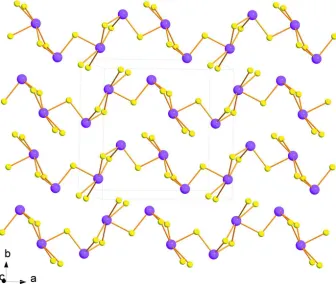
connected with each other through corner- and edge-sharing conformations to form Sb4S10 zigzag chains, which are
further arranged side by side into the Sb4S10 layer in the ab-plane (Fig. 2). The GeS4 tetrahedra further bridge two
neighbouring Sb4S10 layers, forming athree-dimensional ∞3[Sb4GeS10]-4 network (Fig. 3). The Ba atom is located between
two Sb4S10 layers and coordinates with ten S atoms with Ba—S bonding lengths in the range of 3.2505 (9)–3.4121 (2) Å,
which are typical values for sulfides (Dorrscheidt et al. 1981; Cordier et al. 1984).
S2. Experimental
The title compound, Ba2Sb4GeS10, was synthesized through a high temperature solid-state reaction in an evacuated and
sealed silica tube. A mixture of BaS (0.5 mmol, 0.0847 g), Sb (1 mmol, 0.1218 g), Ge (0.25 mmol, 0.0182 g),S (2 mmol,
0.0641 g) was loaded in a silica ampoule, sealed under 10 -2 Pa, heated gradually to 1173 K (holding for 10 h) in 60 h, and
then cooled to room temperature in 300 h. Rod-shaped crystals of Ba2Sb4GeS10 with a dark red color were obtained. The
crystals were stable under air and moisture conditions.
S3. Refinement
All atoms in Ba2Sb4GeS10 crystal structure were refined anisotropically without disorder. The highest residual peak (0.66
e×Å-3) in the difference electron density map was located at (0.1992, 0.3008, 1/4), 1.09 Å from atom Ba1. The deepest
Figure 1
Crystal structure of Ba2Sb4GeS10 in GeS4 polyhedral representation viewed along [001]. Green tetrahedra represent the
supporting information
Figure 2
SbS3 and SbS5 polyhedra are connected with each other through corner- and edge-sharing conformations to form the
Figure 3
The novel three-dimensional ∞3[Sb
4GeS10]-4 network viewed along [100] direction. GeS4 tetrahedra act as bridging units
for two neighbouring Sb4S10 layers.
Dibarium tetraantimony(III) germanium(IV) decasulfide
Crystal data
Ba2Sb4GeS10 Mr = 1154.87
Tetragonal, P42/mbc
Hall symbol: -P 4ac 2ab
a = 11.3119 (4) Å
c = 13.6384 (9) Å
V = 1745.16 (14) Å3 Z = 4
F(000) = 2032
Dx = 4.395 Mg m−3
Mo Kα radiation, λ = 0.71073 Å Cell parameters from 1877 reflections
θ = 2.3–27.5°
µ = 13.40 mm−1 T = 293 K Rod, dark-red
0.22 × 0.07 × 0.07 mm
Data collection
Rigaku SCXMini CCD diffractometer
Radiation source: fine-focus sealed tube
supporting information
Refinement
Refinement on F2
Least-squares matrix: full
R[F2 > 2σ(F2)] = 0.018 wR(F2) = 0.042 S = 1.15 1046 reflections 45 parameters 0 restraints
Primary atom site location: structure-invariant direct methods
Secondary atom site location: difference Fourier map
w = 1/[σ2(F
o2) + (0.0214P)2 + 3.2912P]
where P = (Fo2 + 2Fc2)/3
(Δ/σ)max < 0.001
Δρmax = 0.66 e Å−3
Δρmin = −0.74 e Å−3
Extinction correction: SHELXL97 (Sheldrick, 2008), Fc*=kFc[1+0.001xFc2λ3/sin(2θ)]-1/4
Extinction coefficient: 0.00225 (8)
Special details
Geometry. All e.s.d.'s (except the e.s.d. in the dihedral angle between two l.s. planes) are estimated using the full covariance matrix. The cell e.s.d.'s are taken into account individually in the estimation of e.s.d.'s in distances, angles and torsion angles; correlations between e.s.d.'s in cell parameters are only used when they are defined by crystal symmetry. An approximate (isotropic) treatment of cell e.s.d.'s is used for estimating e.s.d.'s involving l.s. planes.
Refinement. Refinement of F2 against ALL reflections. The weighted R-factor wR and goodness of fit S are based on F2,
conventional R-factors R are based on F, with F set to zero for negative F2. The threshold expression of F2 > σ(F2) is used
only for calculating R-factors(gt) etc. and is not relevant to the choice of reflections for refinement. R-factors based on F2
are statistically about twice as large as those based on F, and R- factors based on ALL data will be even larger.
Fractional atomic coordinates and isotropic or equivalent isotropic displacement parameters (Å2)
x y z Uiso*/Ueq
Ba1 0.232424 (19) 0.732424 (19) 0.2500 0.01704 (10) Sb1 0.13578 (3) 0.41567 (3) 0.0000 0.01543 (10) Sb2 0.46488 (3) 0.34169 (3) 0.0000 0.01796 (10)
Ge1 0.0000 0.0000 0.2500 0.01175 (15)
S1 0.27060 (10) 0.24355 (10) 0.0000 0.0136 (2) S2 0.01781 (8) 0.15428 (7) 0.34843 (6) 0.01631 (18) S3 0.02261 (7) 0.32137 (8) 0.13186 (6) 0.01777 (19)
Atomic displacement parameters (Å2)
U11 U22 U33 U12 U13 U23
Ba1 0.01715 (12) 0.01715 (12) 0.01683 (15) 0.00214 (11) −0.00097 (7) 0.00097 (7) Sb1 0.01518 (17) 0.01341 (17) 0.01771 (17) 0.00143 (11) 0.000 0.000 Sb2 0.01151 (17) 0.02030 (18) 0.02206 (18) −0.00225 (12) 0.000 0.000 Ge1 0.0126 (2) 0.0126 (2) 0.0101 (3) 0.000 0.000 0.000 S1 0.0101 (5) 0.0121 (5) 0.0184 (6) −0.0006 (4) 0.000 0.000 S2 0.0201 (4) 0.0142 (4) 0.0146 (4) −0.0020 (3) −0.0009 (3) −0.0026 (3) S3 0.0131 (4) 0.0254 (4) 0.0147 (4) −0.0025 (3) 0.0024 (3) −0.0028 (3)
Geometric parameters (Å, º)
Ba1—S2i 3.2505 (9) Sb2—S3viii 2.6576 (9)
Ba1—S2ii 3.2505 (9) Sb2—S2iv 2.9352 (9)
Ba1—S3ii 3.3596 (9) Sb2—S2ix 2.9352 (9)
Ba1—S3iv 3.3599 (8) Ge1—S2xi 2.2110 (8)
Ba1—S2iv 3.3849 (9) Ge1—S2xii 2.2110 (8)
Ba1—S2iii 3.3849 (9) S1—Ba1xiii 3.4121 (2)
Ba1—S1ii 3.4121 (2) S1—Ba1xiv 3.4121 (2)
Ba1—S1v 3.4121 (2) S2—Sb2xv 2.9352 (9)
Sb1—S3vi 2.4517 (9) S2—Ba1xiv 3.2505 (9)
Sb1—S3 2.4517 (9) S2—Ba1iii 3.3849 (9)
Sb1—S1 2.4732 (12) S3—Sb2xvi 2.6576 (9)
Sb2—S1 2.4621 (12) S3—Ba1xiv 3.3596 (9)
Sb2—S3vii 2.6576 (9) S3—Ba1iii 3.3599 (8)
S2i—Ba1—S2ii 130.04 (3) S3iv—Ba1—S1v 120.60 (3)
S2i—Ba1—S3ii 76.46 (2) S2iv—Ba1—S1v 68.80 (2)
S2ii—Ba1—S3ii 64.06 (2) S2iii—Ba1—S1v 111.96 (2)
S2i—Ba1—S3i 64.06 (2) S1ii—Ba1—S1v 177.82 (4)
S2ii—Ba1—S3i 76.46 (2) S3vi—Sb1—S3 94.37 (4)
S3ii—Ba1—S3i 74.69 (3) S3vi—Sb1—S1 88.82 (3)
S2i—Ba1—S3iii 153.52 (2) S3—Sb1—S1 88.82 (3)
S2ii—Ba1—S3iii 74.09 (2) S1—Sb2—S3vii 84.63 (3)
S3ii—Ba1—S3iii 129.53 (3) S1—Sb2—S3viii 84.63 (3)
S3i—Ba1—S3iii 122.17 (3) S3vii—Sb2—S3viii 85.17 (4)
S2i—Ba1—S3iv 74.09 (2) S1—Sb2—S2iv 80.46 (3)
S2ii—Ba1—S3iv 153.52 (2) S3vii—Sb2—S2iv 164.84 (3)
S3ii—Ba1—S3iv 122.17 (3) S3viii—Sb2—S2iv 90.69 (3)
S3i—Ba1—S3iv 129.53 (3) S1—Sb2—S2ix 80.46 (3)
S3iii—Ba1—S3iv 85.35 (3) S3vii—Sb2—S2ix 90.69 (3)
S2i—Ba1—S2iv 66.88 (3) S3viii—Sb2—S2ix 164.84 (3)
S2ii—Ba1—S2iv 131.76 (3) S2iv—Sb2—S2ix 89.54 (3)
S3ii—Ba1—S2iv 140.05 (2) S2—Ge1—S2x 111.63 (2)
S3i—Ba1—S2iv 75.40 (2) S2—Ge1—S2xi 105.23 (4)
S3iii—Ba1—S2iv 89.05 (2) S2x—Ge1—S2xi 111.63 (2)
S3iv—Ba1—S2iv 62.66 (2) S2—Ge1—S2xii 111.63 (2)
S2i—Ba1—S2iii 131.76 (3) S2x—Ge1—S2xii 105.23 (4)
S2ii—Ba1—S2iii 66.88 (3) S2xi—Ge1—S2xii 111.63 (2)
S3ii—Ba1—S2iii 75.40 (2) Sb2—S1—Sb1 101.27 (4)
S3i—Ba1—S2iii 140.05 (2) Sb2—S1—Ba1xiii 91.466 (19)
S3iii—Ba1—S2iii 62.66 (2) Sb1—S1—Ba1xiii 91.31 (2)
S3iv—Ba1—S2iii 89.05 (2) Sb2—S1—Ba1xiv 91.466 (19)
S2iv—Ba1—S2iii 142.24 (3) Sb1—S1—Ba1xiv 91.31 (2)
S2i—Ba1—S1ii 63.42 (2) Ba1xiii—S1—Ba1xiv 175.62 (4)
S2ii—Ba1—S1ii 115.56 (2) Ge1—S2—Sb2xv 96.58 (3)
S3ii—Ba1—S1ii 61.18 (2) Ge1—S2—Ba1xiv 92.47 (3)
S3i—Ba1—S1ii 116.86 (3) Sb2xv—S2—Ba1xiv 86.85 (2)
supporting information
S2i—Ba1—S1v 115.56 (2) Sb1—S3—Ba1xiv 92.95 (3)
S2ii—Ba1—S1v 63.42 (2) Sb2xvi—S3—Ba1xiv 108.63 (3)
S3ii—Ba1—S1v 116.86 (3) Sb1—S3—Ba1iii 151.51 (4)
S3i—Ba1—S1v 61.18 (2) Sb2xvi—S3—Ba1iii 89.30 (2)
S3iii—Ba1—S1v 61.24 (2) Ba1xiv—S3—Ba1iii 115.09 (3)
S3vii—Sb2—S1—Sb1 −137.18 (2) S3—Sb1—S1—Ba1xiv −41.05 (3)
S3viii—Sb2—S1—Sb1 137.18 (2) S2x—Ge1—S2—Sb2xv 157.74 (2)
S2iv—Sb2—S1—Sb1 45.572 (18) S2xi—Ge1—S2—Sb2xv 36.474 (13)
S2ix—Sb2—S1—Sb1 −45.572 (18) S2xii—Ge1—S2—Sb2xv −84.791 (7)
S3vii—Sb2—S1—Ba1xiii −45.55 (3) S2x—Ge1—S2—Ba1xiv −115.15 (4)
S3viii—Sb2—S1—Ba1xiii −131.19 (3) S2xi—Ge1—S2—Ba1xiv 123.59 (3)
S2iv—Sb2—S1—Ba1xiii 137.20 (3) S2xii—Ge1—S2—Ba1xiv 2.32 (3)
S2ix—Sb2—S1—Ba1xiii 46.06 (2) S2x—Ge1—S2—Ba1iii 2.23 (2)
S3vii—Sb2—S1—Ba1xiv 131.19 (3) S2xi—Ge1—S2—Ba1iii −119.04 (3)
S3viii—Sb2—S1—Ba1xiv 45.55 (3) S2xii—Ge1—S2—Ba1iii 119.70 (3)
S2iv—Sb2—S1—Ba1xiv −46.06 (2) S3vi—Sb1—S3—Sb2xvi 22.13 (4)
S2ix—Sb2—S1—Ba1xiv −137.20 (3) S1—Sb1—S3—Sb2xvi −66.60 (3)
S3vi—Sb1—S1—Sb2 132.80 (2) S3vi—Sb1—S3—Ba1xiv 130.615 (18)
S3—Sb1—S1—Sb2 −132.80 (2) S1—Sb1—S3—Ba1xiv 41.89 (3)
S3vi—Sb1—S1—Ba1xiii 41.05 (3) S3vi—Sb1—S3—Ba1iii −59.38 (9)
S3—Sb1—S1—Ba1xiii 135.44 (3) S1—Sb1—S3—Ba1iii −148.11 (7)
S3vi—Sb1—S1—Ba1xiv −135.44 (3)
![Figure 1Crystal structure of Ba2Sb4GeS10 in GeS4 polyhedral representation viewed along [001]](https://thumb-us.123doks.com/thumbv2/123dok_us/504633.549019/3.610.134.473.76.405/figure-crystal-structure-ges-ges-polyhedral-representation-viewed.webp)
![Figure 3The novel three-dimensional ∞3[Sb4GeS10]-4 network viewed along [100] direction](https://thumb-us.123doks.com/thumbv2/123dok_us/504633.549019/5.610.130.479.71.406/figure-the-novel-dimensional-ges-network-viewed-direction.webp)
