Soil pH Changes in Long-Term Field Experiments
with Different Fertilizing Systems
Filip VAŠÁK, Jindřich ČERNÝ, Šárka BURÁŇOVÁ, Martin KULHÁNEK
and Jiří BALÍK
Department of Agro-Environmental Chemistry and Plant Nutrition, Faculty of Agrobiology, Food and Natural Resources, Czech University of Life Sciences Prague, Prague, Czech Republic
Abstract
Vašák F., Černý J., Buráňová Š., Kulhánek M., Balík J. (2015): Soil pH changes in long-term field experiments with different fertilizing systems. Soil & Water Res., 10: 19–23.
The changes of soil pH in long-term 14-year field experiments with different fertilizing systems are described. The field experiments were located at four sites of the Czech Republic with different soil and climatic condi-tions (Červený Újezd, Hněvčeves, Lukavec, and Prague-Suchdol). At each site, the same fertilizing systems and crop rotation (potatoes – winter wheat – spring barley) were established. Six experimental treatments were ap-plied to crop rotation: (1) unfertilized treatments (control); treatments with organic fertilization: (2) farmyard manure (FYM), (3) sewage sludge (SS); treatments with mineral fertilizers: (4) nitrogen (N), (5) nitrogen with straw application (N + straw), and (6) nitrogen with phosphorus and potassium (NPK). The long-term effect of fertilizers significantly depends on soil conditions. At the site Prague-Suchdol minimal differences in the soil pH were observed by all treatments. This is caused by the high buffering capacity of Chernozems against the soil acidification. At Červený Újezd (Haplic Luvisol), Hněvčeves (Haplic Luvisol), and Lukavec (Stagnic Cambisol) sites, soil pH decreased by all treatments. Only at Hněvčeves site the soil pH did not change with N treatment. The highest soil pH decrease in the treatment with NPK (ΔpH –0.89) and N + straw (ΔpH –0.70) was observed at Hněvčeves site. By the treatments FYM and SS the highest decrease was registered at Červený Újezd (ΔpH of about –0.30 and –0.63, respectively). The highest decrease in control treatment (ΔpH of about –0.63) was observed at Lukavec site. The results showed that to evaluate long-term soil pH changes a whole complex of factors must be examined.
Keywords: acidification; crop rotation; mineral fertilization; organic fertilization; soil type
Soil pH is widely accepted as a dominant factor that regulates soil nutrient bioavailability, vegetation community structure, plant primary productivity, and a range of soil processes including soil microbial community structure and activity (Robson 1989). All the soil properties and the value of the soil pH can widely differ in reliance on soil type, topogra-phy, climate, vegetation, and anthropogenic activity, because all these factors influence the spatial vari-ability of the observed soil types (Shi et al. 2009). The value of soil pH is directly influenced by all five soil-forming factors (parent rock, climatic conditions, organisms, topography, and time) and further the
value of soil pH is dependent on the season influence, way of management, tested soil horizon, soil water contents, and time limit of sampling for analysis (Troeh & Thompson 2005).
Farmyard manure (FYM) is the main fertilizer maintaining soil potential fertility because with its application the soil receives biogenic elements that are assimilated by growing crops and thus removed from the soil (Repsiene & Skuodiene 2010). The manure application increases also soil pH (Ondrášek & Čunderlík 2008). Increasing of pH depends on the dose and timing of FYM application. Leahu et al. (2011) found during the experiment that the soil pH decreased for both versions: the control variant and the variants fertilized only with mineral fertil-izers or using both mineral fertilfertil-izers and manure. The aim of the study is to compare the change in the soil pH between treatments with mineral, organic fertilizers and unfertilized treatments applied during 14-years of experiments.
MATERIAL AND METHODS
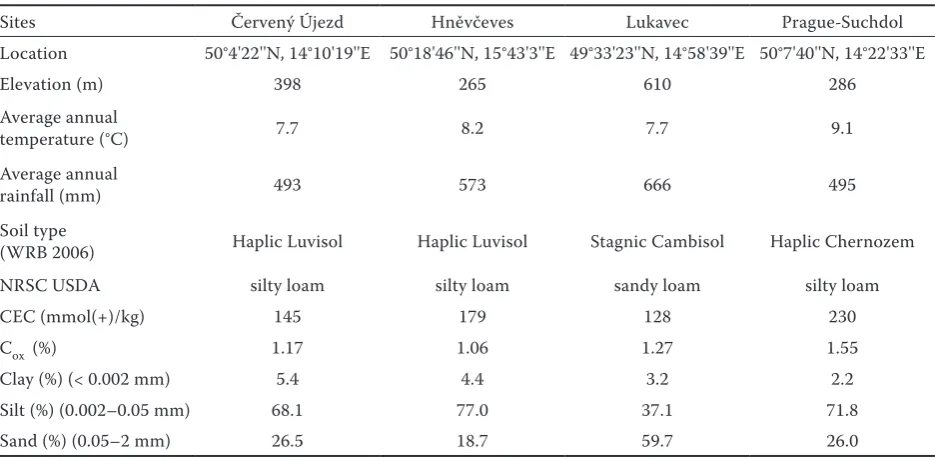
Changes in the values of the soil reaction in the course of long-term field experiments at four sites – Červený Újezd, Prague-Suchdol, Hněvčeves, and Lukavec with different soil and climatic character-istics were monitored. Climatic and soil conditions are showed in Table 1. Contents of plant available nutrients in soil were published by Černý et al. (2010).
The same fertilizing systems with organic, mineral, and unfertilized control treatments are used at all sites. Potatoes, winter wheat, and spring barley are grown in crop rotation. Only at Červený Újezd silage maize
is included to the crop rotation instead of potatoes because of agronomical conditions of the experimental site. Organic fertilizer (silage maize) is applied each au-tumn before planting the potatoes. Nitrogen is applied in the form of calcium ammonium nitrate. The area of the experimental plots at Hněvčeves and Lukavec is the same – 60 m2, at Suchdol the area of the plot is 60.5 m2, and at Červený Újezd it is 80 m2. At all the sites crops are rotated in the sequence potatoes – winter wheat – spring barley. Fertilizing system and doses of nutrients during crop rotation are shown in Table 2.
[image:2.595.64.532.514.744.2]Soil pH values were determined from the compos-ite soil samples taken at establishment experiments before the first application of fertilizer in 1996. Soil pH was measured after the end of the crops rotation (i.e. after spring barley) in the years 2004 and 2010. Soil pH value of 2004 corresponds with the changes between 1996 and 2010 and therefore samples from 2001 and 2007 were not evaluated. The composite soil sample consisted of ten subsamples collected throughout the plot to the depth of 30 cm. Soil samples were oven-dried at the constant temperature of 30°C. Dry soil samples were sieved through a 2-mm mesh. Soil pH was determined in 0.2 mol/l KCl 2:5 w/v ac-cording to the methodology of the Central Institute for Supervising and Testing in Agriculture (Zbíral 2001). Each sample was measured four times. The soil reaction was measured using a pH meter WTW pH340i and a glass electrode WTW SenTix 21 (both devices WTW, Weilheim, Germany).
Table 1. Soil and climatic conditions
Sites Červený Újezd Hněvčeves Lukavec Prague-Suchdol Location 50°4'22''N, 14°10'19''E 50°18'46''N, 15°43'3''E 49°33'23''N, 14°58'39''E 50°7'40''N, 14°22'33''E
Elevation (m) 398 265 610 286
Average annual
temperature (°C) 7.7 8.2 7.7 9.1
Average annual
rainfall (mm) 493 573 666 495
Soil type
(WRB 2006) Haplic Luvisol Haplic Luvisol Stagnic Cambisol Haplic Chernozem NRSC USDA silty loam silty loam sandy loam silty loam
CEC (mmol(+)/kg) 145 179 128 230
Cox (%) 1.17 1.06 1.27 1.55
RESULTS AND DISCUSSION
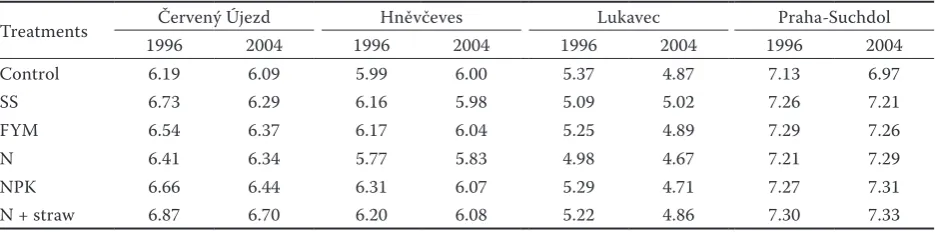
The measured pH values of 1996 and 2004 from all experimental sites are presented in Table 3. Figure 1 shows minimal changes in soil pH of Chernozem at the site Prague-Suchdol. The minimal changes in all variants are caused by the higher buffering capacity against soil acidification. The same result was published by Yang et al. (2007). In his 22-year field experiment with min-eral and organic fertilizers in soil with high carbonate content no change in the soil pH was observed.
In the control unfertilized treatments there was a decrease in the soil pH at all experimental sites (Table 4). The biggest decrease was ascertained at Lukavec, which is probably caused by lighter soil and lower sorption capacity. The decrease in pH is likely caused by leaching of basic ions and removal of basic ions by plants. For Ca and Mg leaching the annual rainfall is important. Lysimeter experiments conducted in the Czech Republic indicated that the annual rainfall higher than 600 mm may lead to calcium loss of about 27 kg/ha per year (Klement & Prchalová 2013). Lowering of pH in the control unfertilized treatment after a one-year observation was also documented by Arvas et al. (2011).
In the same study, pH reduction in treatments with sewage sludge application was traced after a
one-year observation (Arvas et al. 2011). A slight reduction in pH was observed also by Tsadilas and Samaras (1999) after two years of experiments with sewage sludge applications. Forsberg and Ledin (2005) explain the pH decrease after the applica-tion of the sewage sludge by the buffering capacity reduction. The pH decrease magnitudes depend on the sludge application dose (Navas et al. 1998). This corresponds with the observed decreases of soil pH at the sites Červený Újezd, Hněvčeves, and Lukavec (Table 4).
[image:3.595.64.532.112.227.2]At the present long-term field experiment the stabilizing effect of FYM on soil pH was not proved and after 14-years of FYM application pH decreased at all the sites (Table 4). The largest decrease was observed at Červený Újezd. However, the soil treated for 14 years with FYM exhibited higher pH than that treated with NPK at all the sites and with N at the sites Červený Újezd, Hněvčeves, and Lukavec. The lower soil pH decrease in treatments where organic fertilizers instead of mineral were applied is caused by the incorporation of organic matter in the soil minimizing pH fluctuation, which is consistent with the results of the 21-year-old experiment by Zhong et al. (2010). Bednarek et al. (2012), after 26 years of experiments, found higher pH and higher organic matter content by the soils with manure application Table 2. Doses of nutrients during crop rotation (kg/ha)
Treatment
Potatoes/maize Wheat Barley
N P K N P K N P K
Control – – – – – – – – –
SS 3301 2012 552 0 0 0 0 0 0
FYM 3301 1182 3742 0 0 0 0 0 0
N 120 0 0 140 0 0 70 0 0
NPK 120 30 100 140 30 100 70 30 100
N + straw 138 62 472 140 0 0 70 0 0
1total nitrogen in organic fertilizers; 2average dose of the fertilizers nutrient contents; SS – sewage sludge; FYM – farmyard
manure; NPK – nitrogen with phosphorus and potassium
Table 3. Soil pH values detected at the time of setting up the experiment (1996) and in 2004
Treatments Červený Újezd Hněvčeves Lukavec Praha-Suchdol 1996 2004 1996 2004 1996 2004 1996 2004 Control 6.19 6.09 5.99 6.00 5.37 4.87 7.13 6.97 SS 6.73 6.29 6.16 5.98 5.09 5.02 7.26 7.21 FYM 6.54 6.37 6.17 6.04 5.25 4.89 7.29 7.26
N 6.41 6.34 5.77 5.83 4.98 4.67 7.21 7.29
[image:3.595.64.532.628.744.2]compared to those where mineral fertilizers (NPK) were applied.
Nitrogen fertilizers generally caused soil acidifi-cation. Irrespective of whether the NH+
4-N is from ammonium nitrate, urea or anhydrous ammonia, the formed nitrate requires the same amount of compensating cations per unit of N applied. This requirement is theoretically 1.36 kg Ca/kg N (Gas-ser 1973). Practically Sluijsman (1970) calculated the acidity of nitrogen fertilizers separately for ar-able land and permanent grassland. The calculation includes only half the amount of nitrogen applied (50% utilization of N). Except for Lukavec, showing a quite significant pH reduction, no declines were recorded at the remaining sites (Table 4). This is prob-ably caused by lower acidity of the nitrogen fertilizer with calcium. As for the nitrogen fertilizer acidity degree, Peryea and Burrows (1999) stated that ammonium nitrogen fertilizers containing calcium are among those causing the lowest acidification.
In the variant with the application of NPK, af-ter 14 years of the experiments, there was a de-crease in pH at all studied sites (Table 4) except for Prague-Suchdol. The highest decrease occurred at Hněvčeves. The soil acidification after the ap-plication of NPK corresponds with the results pub-lished by Makinde et al. (2009) who described the acidification after the application of NPK in Orthic Luvisol. The decrease in pH of 0.28 after the ap-plication dose of 300 kg NPK 15/15/15 on Luvisol was also published by Ayeni etal. (2012). Soil pH
values during the experiment were also influenced by lowering sulphur deposition in the soil due to flue gas desulfurization in industry reducing the acidifying effect (Balík et al. 2009).
At Červený Újezd, Hněvčeves, and Lukavec sites, where nitrogen with straw was applied, the soil pH decreased (Table 4), which corresponds with the results stemming from the 27 long-term field experi-ments with ploughed straw with doses variants of 0, 25, 50, 75 kg N/ha/year. Soil pH decreased in all the variants, even in the variant with only ploughed straw (Malhi et al. 2011).
CONCLUSION
From the stated results it is evident that the evalua-tion of changes in soil pH must be assessed in relaevalua-tion to specific sites conditions. Chernozem at Prague-Suchdol site showed higher buffering capacity against acidification. The NPK treatment at Červený Újezd, Hněvčeves, and Lukavec sites caused higher soil pH decrease compared with the control treatment. The FYM treatment at the same sites led to lower soil pH decreases (or the N treatment at Hněvčeves) than the other treatments except for those with N. Mineral and organic fertilization proved to be one of the factors causing soil acidification.
[image:4.595.65.405.93.230.2]Acknowledgments. This research was supported by the Grant Agency of Czech University of Life Sciences Prague CIGA No.: 20112003.
Table 4. Soil pH changes (ΔpH) after 14 years of experiments (1996–2010)
Control SS FYM N NPK N + straw
Červený Újezd –0.38 –0.63 –0.30 –0.22 –0.46 –0.30 Hněvčeves –0.25 –0.56 –0.21 0.03 –0.89 –0.70 Lukavec –0.63 –0.22 –0.21 –0.46 –0.71 –0.40
Suchdol –0.11 –0.06 –0.03 0.06 0.02 0.02
SS – sewage sludge; FYM – farmyard manure; NPK – nitrogen with phosphorus and potassium 6.80
6.90 7.00 7.10 7.20 7.30 7.40
Control SS FYM N NPK N + straw
pH
1996 2004 2010 Figure 1. Soil pHKCl at site
[image:4.595.61.536.670.742.2]References
Arvas Ö., Celeb Ş.Z., Ylmaz I.H. (2011): Effect of sewage sludge and synthetic fertilizer on pH, available N and P in pasture soils in semi-arid area. Turkey. African Journal of Biotechnology, 10: 16508–16515.
Ayeni L.S., Adeleye E. O., Adejumo J.O. (2012): Comparative effect of organic, organomineral and mineral fertilizers on soil properties, nutrient uptake, growth and yield of maize (Zea mays). International Research Journal of Agricultural Science and Soil Science, 2: 493–497. Balík J., Kulhánek M., Černý J., Száková J., Pavlíková D.,
Čermák P. (2009): Differences in soil sulphur fractions due to limitation of atmospheric deposition. Plant, Soil and Environment, 55: 344–352.
Bednarek W., Dresler S., Tkaczyk P., Hanaka A. (2012): Available forms of nutrients in soil fertilized with liquid manure and NPK. Journal of Elementology, 17: 169–180. Černý J., Balík J., Kulhánek M., Čásová K., Nedvěd V. (2010):
Mineral and organic fertilization efficiency in long-term stationary experiments. Plant, Soil and Environment, 56: 28–36.
Forsberg L.S., Ledin S. (2006): Effects of sewage sludge on pH and plant availability of metals in oxidising sulphide mine tailings. Science of the Total Environment, 358: 21–35. Gasser J.K.R. (1973): An assessment of the importance of
some factors causing losses of lime from agricultural soils. Experimental Husbandry, 25: 86–95.
Hou X., Wang X., Li R., Jia Z., Liang L., Wang J., Nie J., Chen X., Wang Z. (2012): Effects of different manure application rates on soil properties, nutrient use, and crop yield during dryland maize farming. Soil Research, 50: 507–514. Hoyt P.B., Hennig A.M.F. (1982): Soil acidification by
ferti-lizers and longevity of lime applications in the peace river region. Canadian Journal of Soil Science, 62: 155–163. Klement V., Prchalová R. (2013): Lysimetric Monitoring.
Brno, Central Institute for Supervising and Testing in Agriculture. (in Czech)
Leahu A., Gutt S., Gutt G., Hretcanu C. (2011): The impact of fertiliser types on soil’s macronutrients and microele-ments content. Environmental Engineering, 1–3: 182–187. Makinde E.A., Eniola H.T. Fagbola O. (2009): Effect of
organic, organomineral and NPK fertilizers on soil pH, organic matter and micronutrient content in two soil types in Nigeria. Research on Crops, 10: 77–85.
Malhi S.S., Nyborg M., Harapiak J.T. (1998): Effects of long-term N fertilizer-induced acidification and liming on micronutrients in soil and in bromegrass hay. Soil and Tillage Research, 48: 91–101.
Malhi S.S., Nyborg M., Solberg E.D., McConkey B., Dyck M., Puurveen D. (2011): Long-term straw management and N fertilizer rate effects on quantity and quality of organic C and N and some chemical properties in two contrasting soils in Western Canada. Biology and Fertility of Soils, 47: 785–800.
Navas A., Bermúdez F., Machín J. (1998): Influence of sew-age sludge application on physical and chemical proper-ties of Gypsisols. Geoderma, 87: 123–135.
Ondrášek Ľ., Čunderlík J. (2008): Effects of organic and mineral fertilisers on biological properties of soil under seminatural grassland. Plant, Soil and Environment, 54: 329–335. Peryea F.J., Burrows R.L. (1999): Soil acidification caused
by four commercial nitrogen fertilizer solutions and subsequent soil pH rebound. Communications in Soil Science and Plant Analysis, 30: 525–533.
Repsiene R., Skuodiene R. (2010): The influence of liming and organic fertilisation on the changes of some agro-chemical indicators and their relationship with crop weed incidence. Zemdirbyste-Agriculture, 97: 3–14.
Robson A.D. (1989): Soil Acidity and Plant Growth. Mar-rickville, Academic Press Australia.
Shi W., Liua J., Dua Z., Songa Y., Chena Ch., Yuea T. (2009): Surface modelling of soil pH. Geoderma, 150: 113–119. Sluijsman C.M. (1970): Der Einfluss der Düngermittel auf den Kalkzustand des Bodens. Zeitschrift für Pflanzen-ernährung und Bodenkunde, 126: 97–103
Troeh R.F., Thompson L.M. (2005): Soils and Soil Fertility. 6th Ed. Ames, Blackwell Publishing.
Tsadilas C.D., Samaras V. (1999): Influence of sewage sludge application on soil quality: I. Organic matter, pH, phos-phorus, potassium, and inorganic nitrogen. In: Robert P.C., Rust R.H., Larson W.E. (eds): Precision Agriculture. Madison, ACSESS: 1709–1718.
Yang S.M., Malhi S.S., Li F.M., Suo D.R., Xu M.G., Wang P., Xiao G.J., Jia Y., Guo T.W., Wang J.G. (2007): Long-term effects of manure and fertilization on soil organic matter and quality parameters of a calcareous soil in NW China. Journal of Plant Nutrition and Soil Science, 170: 234–243. Zbíral J. (2001): Comparison of methods for soil pH
deter-mination. Rostlinná výroba, 47: 463–467.
Zhong W., Gu T., Wang W., Zhang B., Lin X., Huang Q., Shen W. (2010): The effects of mineral fertilizer and organic manure on soil microbial community and diversity. Plant and Soil, 326: 511–522.
Received for publication January 7, 2014 Accepted after corrections July 9, 2014
Corresponding author: