Boron (B) is an essential microelement engaged in proper growth and development of the plant. Among others, boron is responsible for carbo-hydrate transformation and transport in plants, growth of plant meristem tissues as well as pro-cesses of cell wall formation (Matoh 1997, Matoh and Kobayashi 2002). Plants have much differenti-ated nutritional needs as regards boron depending on their species or variety. Relatively low boron requirements are indicated by e.g. cereals, whereas beets and cruciferous plants show high nutritional requirements with regard to this element (Alloway 2008). In plants cultivated in Poland there is often observed boron deficiency, more than ever when grown on acidic, sandy soils with low contents of organic matter, from which boron is easily leached. Additionally, short-term boron deficiency can be
associated with application of lime to acidic soils as a result of increased B adsorption in soils at higher pH values (Sinclair and Edwards 2008).
Plants uptake boron from the soil solution as ions BO33– and B
4O72–. The concentration of boron in the soil solution is a characteristic of high dynam-ics of changes. For the duration of one vegetation season boron concentration can indicate toxic and deficiency values. At the same time, the distinc-tion between toxic and deficiency concentradistinc-tion levels is very fine (Zhu et al. 2007).
In view of the current research boron uptake by plants is mostly correlated with the concen-tration of this element in the soil solution, and only to a small extent builds upon boron quantity determined with the use of methods for assessing available boron (Goldberg 1997, Zhu et al. 2007).
Diagnostics of boron deficiency for plants in reference
to boron concentration in the soil solution
W. Szulc, B. Rutkowska
Faculty of Agriculture and Biology, Warsaw University of Life Sciences,
Warsaw, Poland
ABSTRACT
The determination of a range of boron concentration in the soil solution, evaluation of the effect of physico-chemical soil properties on boron concentration in the soil solution as well verification whether boron quantity in the soil solution is sufficient for nutritional needs of selected plants cultivated in Poland were comprised. Av-erage boron concentration in the soil solution of Poland’s cultivated soils ranges from 0.59 to 5.07 µmol/L and is differentiated by physico-chemical properties of soil. Taking into account decreasing effects of soil properties on the increase of boron concentration in the soil solution, the soil properties can be arranged as follows: organic C > soil abundance in available boron > soil texture > soil pH. The minimum boron quantity observed in the soil solu-tion of Poland’s cultivated soils was not sufficient to fulfil nutrisolu-tional needs of the plants. The maximum boron quantity observed secured nutritional needs of cereals and potatoes but not those of rape plants and sugar beets. Based on the study it can be concluded that the measurement of the concentration of boron in the soil solution can be used in the diagnosis of deficiency of this element for crops.
Keywords: boron; soil solution; plants; boron deficiency
The aims of the study comprised determination of a range of boron concentration in the soil solu-tion, evaluation of the effect of physico-chemical soil properties on boron concentration in the soil solution as well verification whether boron quan-tity in the soil solution is sufficient for nutritional needs of selected plants cultivated in Poland.
MATERIAL AND METHODS
Research material included 62 soil samples col-lected from the arable layer of Poland’s agricul-tural soils. Collected soil samples were dried and sieved thorough a sieve with perforation diameter 2 mm. Soil samples were characterized for: pH – by po-tentiometric method after extraction with 1 mol/L KCl (10 g of soil was suspended in 25 mL of KCl and left for 24 h to equilibrate) us-ing a pH meter (Schott, Mainz, Germany) with a glass electrode; available B – after extraction in 1 mol/L HCl (10 g of soil was shaken with 100 mL HCl on a rotary shaker for 2 h at 120 rounds per minute) by inductively coupled plasma atomic emission spectrometry (ICP-AES) (IRYS Advantage ThermoElementar, Cambridge, UK); total organic carbon content – by dry combustion at high temperatures in a furnace with the collec-tion and deteccollec-tion of evolved CO2 (Tiessen and Moir 1993); content of soil particles < 0.02 mm – by laser diffraction method (Ryżak et al. 2007). In Poland, the content of soil particles < 0.02 mm determines the agricultural usefulness of soils which are divided into four categories: very light (< 10% particles < 0.02 mm), light (10–20%), me-dium (20–35%) and heavy (> 35%). The samples were differentiated with regard to their physico-chemical properties, such as: soil texture, soil pH, organic carbon content and soil abundance in available boron forms (Table 1).
The soil solutions were obtained following the vacuum displacement method and using an oil vac-uum pump (Dynavac OP4, Melbourne, Australia) (Wolt and Graveel 1986). The total concentra-tion of boron in the soil soluconcentra-tions was assessed with inductively coupled plasma atomic emission spectrometry (ICP-AES). The ICP-AES apparatus calibration was made based on patterns prepared from single element standards for ICP Solution by UltraScientific company (Kingstown, USA). To check the instrument and the calibration (QC) the solutions were used at concentrations of 0.1 mg/L
and 1 mg/L – before the samples studied, and at every 20 samples combined quality control stan-dard from Ultra Scientific company. The quality of results obtained in an accredited laboratory was ensured by a control system based on the criteria contained in the standard PN-EN ISO/IEC/17025.
The results were statistically analyzed with mul-tifactor ANOVA and simple linear regression. Relevant data on average plant yields in Poland in the year 2011 (Concise Statistical Yearbook of Poland 2012) and average boron contents in plants (Jadczyszyn 2000) were used in evaluating whether boron quantity in the soil solution was sufficient for plant nutritional needs. The quantity of boron in the soil arable layer was assessed taking into account the maximum water holding capacity of the soils analyzed as well as their bulk density. At the same time, relationships between boron quantity in the solution of arable soil and boron uptake by plants were determined. The formula for the solution recovery coefficient (SRC) was used in the calculations:
[image:2.595.304.532.510.756.2]The solution recovery coefficient expresses the relation between plant nutrient uptake and nutri-ent quantity in the solution of arable soil (20 cm layer). Numerical values of the coefficient regard-ing boron provide information on how many times boron uptake is smaller or greater than boron
Table 1. Physico-chemical properties of investigated soils
Number of soil units
Content of fraction with particle diameter < 0.02 mm (%)
< 10 17
11–20 17
21–35 17
> 35 11
pHKCl
< 4.5 12
4.6–5.5 17
5.6–6.5 12
> 6.6 21
Content of organic carbon (g/kg)
< 5 3
5–10 30
Soil abundance in available B
low 40
medium 22
high –
SRC = B uptake with plant yield
quantity in soil. At SRC values < 1 boron quantity in the solution of soil arable layer is sufficient for plant nutritional needs regarding boron. When SRC value is > 1, the needs of plants with regard to boron exceed boron quantity in the solution of soil arable layer.
The differences between means were analyzed with the Tukey’s test at α ≤ 0.05. Statistical analyses were performed with Statgraphics 5.1. software (Warrenton, USA).
RESULTS AND DISCUSSION
Boron concentration in the soil solution of Poland’s cultivated soils was much differentiated and ranged from 0.59 to 5.07 µmol/L (Figure 1).
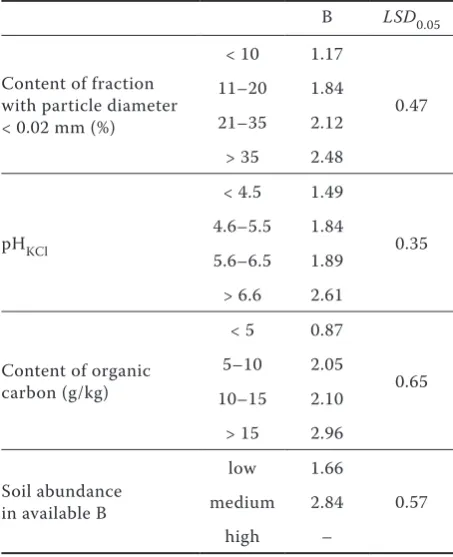
Boron concentration in the soil solution depend-ed on soil physico-chemical properties (Table 2). The concentration of boron significantly in-creased with increasing contents of soil fraction with particle diameter < 0.02 mm. Boron con-centration was more than two-fold higher in the solution of soil with the largest analyzed contents of fraction with particle diameter < 0.02 mm when compared with that observed in the soil with the least contents of this fraction. Comparable rela-tionships were found when soil pH varied. Almost two-fold increase of boron concentration was observed in soils with neutral soil reaction (pH > 6.6) when compared to strongly acidic soils (pH < 4.5). Nonetheless, the content of soil organic carbon had the strongest effect on the
concen-tration of boron in the soil solution. More than three-fold increase of B concentration in the soil solution was observed for soils with the content of organic carbon < 15 g/kg when compared with those with organic carbon at a level > 5 g/kg. Soil abundance in available boron also significantly increased the content of boron in the soil solution (Tables 2 and 3).
The concentration of boron in the soil solution depends on soil properties such as available bo-ron content, soil pH, soil texture, organic matter content, and these influence the direction and rate of the processes that occur between B in the soil solution and B adsorbed by the soil solid phase (Goldberg 1997).
[image:3.595.304.531.475.754.2]One of the most important factors influencing the concentration of boron in the soil solution is soil pH (Elrashidi and O’Connor 1982, Goldberg 1997). In acidic and neutral soils, boron mainly occurs as B(OH)30 and this form is fixed onto soil solid particles only to a small extent. In the solu-tion of soil with pH > 7, there rapidly increases the concentration of B(OH)4– ions which compete with hydroxyl anions for adsorption sites on soil solid particles. The latter results in decreasing boron
Figure 1. Boron (B) concentration in the soil solution of arable soils in Poland
Minimum Maximum Mean Standard
deviation coefficientVariation
0.59 5.07 1.91 0.94 49.20
Table 2. Average concentration of boron (B, µmol/L) in the soil solution according to physico-chemical proper-ties of investigated soils
B LSD0.05
Content of fraction with particle diameter < 0.02 mm (%)
< 10 1.17
0.47 11–20 1.84
21–35 2.12 > 35 2.48
pHKCl
< 4.5 1.49
0.35 4.6–5.5 1.84
5.6–6.5 1.89 > 6.6 2.61
Content of organic carbon (g/kg)
< 5 0.87
0.65
5–10 2.05
10–15 2.10 > 15 2.96
Soil abundance in available B
low 1.66
0.57 medium 2.84
high –
0 5 10 15 20 25
< 0.85 0.85-1.701.70-2.552.55-3.40 > 3.40
Nu
m
be
r of
soi
l
B (mmol/dm3)
[image:3.595.66.289.532.724.2]concentration in the soil solution. Maximum ad-sorption by iron oxides is observed at soil pH = 7–9, by aluminum oxides at pH = 6–8, and by clay minerals – at pH = 8–10 (Elrashidi and O’Connor 1982, Gupta et al. 1985, Goldberg 1997).
When compared to sandy soils, in the solutions of soils with greater contents of particles with diam-eter lesser than 0.02 mm larger quantities of boron are observed. This is related to soil mineralogical composition as well as the content of available boron in soil (Biggar and Fireman 1960, Singh 1964, Goldberg and Glaubig 1986, Nicholaichuk et al. 1988). Heavy soils indicate higher contents of available boron when compared to sandy soils (Bhatnager et al. 1979, Wild and Mazaheri 1979, Mezuman and Keren 1981, Elrashidi and O’Connor 1982). Boron enters the soil solution by leaving soil sorption complex so that its concentration in the system of solid phase/liquid phase is balanced. Much more boron enters the solution of heavy soil when compared to that of sandy soil due to the fact that in heavy soils there is more available boron. Furthermore, boron leaches from acidic sandy soils more rapidly than from heavy soils.
Up to date research on boron availability has shown strong correlations between quantity of plant available boron and the content of organic carbon in soil. In acidic soils, sandy and poor with
regard to the content of available B, an increase of boron contents in the soil solution as a result of mineralization of organic matter was observed, which decreases a risk of boron deficiency in plants. Moreover, increasing organic matter contents in such soils can help to impede boron leaching (Elrashidi and O’Connor 1982, Yermiahu et al. 2001). Then again, research results showed that organic matter indicates high ability to adsorb boron, which is higher than that of clay minerals. Intensity of this process depends on soil pH and it reaches the maximum at soil pH = 9 (Yermiyaho et al. 1988, Gu and Lowe 1990). The results of the present study show that the increase of the con-tent of organic substrate under the conditions of sandy soils is associated with the increase of the content of available boron. These points toward the importance of organic matter as boron source as well as the factor holding back boron leaching rather than toward organic matter capability in terms of boron sorption.
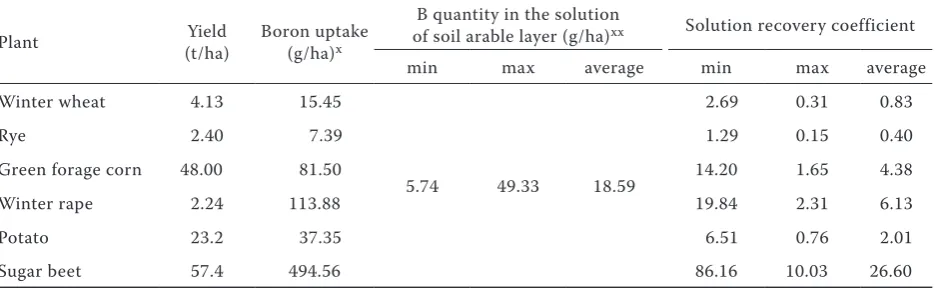
The solution recovery coefficients were calcu-lated based on boron concentration in the solutions of analyzed soils (Table 4).
[image:4.595.61.535.103.144.2]When comparing boron uptake by investigated plants with the amounts of this element in the soil arable layer it was found that the minimum quantity of boron observed in the solutions of
Table 3. Correlation coefficients (r) between boron (B) concentration and selected soil properties
Content of fraction with particle
diameter < 0.02 mm (%) pHKCl Content of organic carbon (g/kg) Soil abundance in available B
0.47* 0.42* 0.62** 0.54*
*α ≤ 0.05; **α ≤ 0.01
Table 4. Solution recovery coefficient (SRC) for selected plants cultivated in Poland
Plant (t/ha)Yield Boron uptake (g/ha)x
B quantity in the solution
of soil arable layer (g/ha)xx Solution recovery coefficient
min max average min max average
Winter wheat 4.13 15.45
5.74 49.33 18.59
2.69 0.31 0.83
Rye 2.40 7.39 1.29 0.15 0.40
Green forage corn 48.00 81.50 14.20 1.65 4.38
Winter rape 2.24 113.88 19.84 2.31 6.13
Potato 23.2 37.35 6.51 0.76 2.01
Sugar beet 57.4 494.56 86.16 10.03 26.60
[image:4.595.65.533.582.726.2]Poland’s cultivated soils was not sufficient for fulfilling plant nutritional needs with regard to boron. Foremost boron deficiency was found in sugar beets. In this case, the soil solution should be theoretically filled in with boron from the soil solid phase 86 times so as to fulfil beet boron nutritional needs. The minimum boron quantity observed in the soil solutions analyzed was also not adequate for fulfilling nutritional needs of cereals. Depending on cereal species the soil so-lution had to be complemented with boron from the soil solid phase 1.3–14.2 times to fulfil cereal nutritional needs with regard to boron.
The maximum quantity of boron observed in the soil solution of Poland’s cultivated soils was sufficient for nutritional needs of cereals and po-tatoes, however it was not enough for rape plants and sugar beets, in case of which the soil solution had to be filled in with boron 2 and 10 times, respectively. Average quantity of boron found in solutions of the observed soils was sufficient only for cereal nutritional needs with regard to this element, but not for the rest of cultivated plants which were analyzed.
Plants uptake boron from soil as BO33– and B4O72– ions that are circulated in plants as a result of transpiration processes. Therefore, plant boron content is correlated with the content of boron in the soil solution stronger than with the content of boron in soil. Boron deficiency is observed in plants cultivated on sandy soils because boron sorption capability of these soils is low. In the conditions of cultivation on sandy soils, boron quantities found in the soil solution are even not capable to fulfil the needs of cereals – the group of plants with low demands with regard to boron. Plants that survive on C3 fixation require minimum 1 µmol/L of boron available in the soil solution (Raven 1980). In soils with low boron concentra-tion, lower than 3 µmol/L, the soil solution has to be complemented with boron from the soil solid phase at least several times during the vegetation period so as to fulfil plant nutritional needs with regard to this element (Aitken and McCallum 1988).
REFERENCES
Aitken R.L., McCallum L.E. (1988): Boron toxicity in soil solution. Australian Journal of Soil Research, 26: 605–610.
Alloway B.J. (2008): Micronutrients and crop production: An introduction (Chapter 1). In: Alloway B.J. (ed.): Micronutrient
Deficiencies in Global Crop Production. Springer Science and Business Media B.V., Dordrecht.
Bhatnagar R.S., Attri S.C., Mathur G.S., Chaudhary R.S. (1979): Boron adsorption equilibrium in soils. Annals Arid Zone, 18: 86–95. Biggar J.W., Fireman M. (1960): Boron adsorption and release by
soils. Soil Science Society of America Journal, 24: 115–120. Concise Statistical Yearbook of Poland (2012): Central Statistical
Office, Warsaw.
Elrashidi M.A., O’Connor G.A. (1982): Boron sorption and desorp-tion in soils. Soil Science Society of America Journal, 46: 27–31. Goldberg S. (1997): Reactions of boron with soils. Plant and
Soil, 193: 35–48.
Goldberg S., Glaubig R.A. (1986): Boron adsorption on California soils. Soil Science Society of America Journal, 50: 1173–1176. Gu B., Lowe L.E. (1990): Studies on the adsorption of boron on humic acids. Canadian Journal of Soil Science, 70: 305–311. Gupta U.C., Jame Y.W., Campbell C.A., Leyshon A.J., Nicholaichuk
W. (1985): Boron toxicity and deficiency: A review. Canadian Journal of Soil Science, 65: 381–409.
Jadczyszyn T. (2000): The principles of fertilizer recommendation. Fertilizers and Fertilization, 4: 185–205.
Matoh T. (1997): Boron in plant cell walls. Plant and Soil, 193: 115–121.
Matoh T., Kobayashi M. (2002): Boron function in plant cell walls. In: Goldbach H.E., Rerkasem B., Wimmer M.A., Brown P.H., Thellier M., Bell R.W. (eds.): Boron in Plant and Animal Nutrition. Kluwer Academic/Plenum Publishers, New York. Mezuman U., Keren R. (1981): Boron adsorption by soils using a
phenomenological adsorption equation. Soil Science Society of America Journal, 45: 722–726.
Nicholaichuk W., Leyshon A.J., Jame Y.W., Campbell C.A. (1988): Boron and salinity survey of irrigation projects and the boron adsorption characteristics of some Saskatchewan soils. Cana-dian Journal of Soil Science, 68: 77–90.
PN-EN ISO/IEC/17025 General requirements for the competence of testing and calibration laboratories. Polish Committee for Standadization-PKN, Warsaw
Raven J.A. (1980): Short- and long-distance transport of boric acid in plants. New Phytologist, 84: 231–249.
Ryżak M., Bieganowski A., Walczak R.T. (2007): Application of laser diffraction method for determination of particle size dis-tribution of grey-brown podzolic soil. Research in Agriculture Engineering, 53: 34–38.
Sinclair A.H., Edwards C. (2008): Micronutrient deficiency prob-lems in agricultural crops in Europe (Chapter 9). In: Alloway B.J. (ed.): Micronutrient Deficiencies in Global Crop Produc-tion. Springer Science and Business Media B.V., Dordrecht. Singh S.S. (1964): Boron adsorption equilibrium in soils. Soil
Science, 98: 383–387.
Corresponding author:
Dr. hab. Wiesław Szulc, Warsaw University of Life Sciences, Faculty of Agriculture and Biology, Nowoursynowska 159, 02-776 Warsaw, Poland
phone: + 22 5932 628, e-mail: [email protected] Wild A., Mazaheri A. (1979): Prediction of the leaching rate of
boric acid under field conditions. Geoderma, 22: 127–136. Wolt J., Graveel J.G. (1986): A rapid routine method for obtaining
soil solution using vacuum displacement. Soil Science Society of America Journal, 50: 602–605.
Yermiyaho U., Keren R., Chen Y. (1988): Boron sorption on com-posted organic matter. Soil Science Society of America Journal,
52: 1309–1313.
Yermiyaho U., Keren R., Chen Y. (2001): Effect of composted organic matter on boron uptake by plants. Soil Science Society of America Journal, 65: 1436–1441.
Zhu D., Wang J., Liao S., Liu W. (2007): Relationship between plant availability of boron and the physico-chemical properties of boron in soils. In: Xu F., Goldbach H.E., Brown P.H., Bell R.W., Fujiwara T., Hunt C.D., Goldberg S., Shi L. (eds.): Advances in Plant and Animal Boron Nutrition. Springer, Dordrecht.