Selenium (Se) is an important element associated with the enhancement of antioxidant activity in plants, animals and humans (Rayman 2002). Beneficial ef-fects of Se were reported explored in terms of plant protection against abiotic stress (Hartikainen and Xue 1999), plant protection against reactive oxy-gen compounds (Ríos et al. 2009), activator of the protective mechanism that reduces oxidation stress for example in chloroplasts (Seppänen et al. 2003), phloem-feeding aphids and herbivorous caterpillars (Hanson et al. 2004), and fungal diseases (Hanson et al. 2003). Selenium has a positive effect also on potato carbohydrate accumulation and possibly on yield formation (Turakainen et al. 2004).
The theoretical explanation for the antioxidative effects of Se on plants is the increased activity of the enzyme glutathion-peroxidase (GSH-Px) in
selenium-treated plants. However, no Se-containing GSH-Px was identified in plants, in contrast to ani-mals (Dayer et al. 2008, Ríos et al. 2009). Seppänen et al. (2003) discovered that Se reduced the activity of superoxide dismutase (SOD) and in some cases the amount of tocopherols.
Notwithstanding the above effects, high rates of Se are detrimental to plants and reduce biomass production. At adequate rates, which are different for individual groups of plants, Se is beneficial to plants (Ducsay et al. 2009). In experiments of Turakainen et al. (2004) potato yields increased even at a rate of 0.3 mg Se/kg of substrate. In plants of wheat, Se toxicity was not observed within the range of 4–200 g Se/ha (Lyons et al. 2005). Most species of cultivated plants, including potatoes, rank among the so-called non-accumulators of Se. Under standard conditions
Effect of foliar application of selenium on the content of
se-lected amino acids in potato tubers (
Solanum tuberosum
L.)
P. Ježek
1, J. Hlušek
1, T. Lošák
1, M. Jůzl
1, P. Elzner
1, S. Kráčmar
2, F. Buňka
2,
A. Martensson
31
Faculty of Agronomy, Mendel University in Brno, Brno, Czech Republic
2Faculty of Technology, Tomas Bata University in Zlín, Zlín, Czech Republic
3
Department of Soil and Environment, Swedish University of Agricultural Sciences
Uppsala, Uppsala, Sweden
ABSTRACT
Selenium (Se) is an important element associated with the enhancement of antioxidant activity in organisms. Po-tato is very suitable for fertilisation with Se (biofortification). The experiment was performed to examine the effect of foliar application of Se as sodium selenite (200 or 400 g Se/ha) at the tuberisation stage on a spectrum of amino acids in tubers of varieties. The trends of amino acids were consistent in both years of the study. Application of Se increased the relative content of total essential (EAA) and non-essential (NEAA) amino acids relative to the con-trols (Karin: EAA 16.81–21.73% and NEAA 14.18–18.63%; Ditta: EAA 4.71–13.00% and NEAA 5.78–6.49%). The increase in the content of phenylalanine (Phe) was particularly significant (up to 48.9%) when also the contents of aspartic acid (Asp), glutamic acid (Glu), threonine (Thr), and tyrosine (Tyr) increased significantly compared with the controls. The results of changes in the content of isoleucine (Ile), leucine (Leu), lysine (Lys), methionine (Met), valine (Val), alanine (Ala), arginine (Arg), proline (Pro), cysteine (Cys), glycine (Gly), histidine (His), and serine (Ser) were also discussed. The highest dose of selenium is shown as a stress factor. Its toxic effects resulted in a change of amino acid contents.
Keywords: functional foods; human health; glutathion-peroxidase
they contain 0.01 to 1.0 mg Se/kg of dry matter and are capable of accumulating Se in amounts of up to 25 mg/kg of dry matter.
Replacing the sulphurous amino acids Cys and Met with the selenium amino acids selenomethionine (Se-met) and selenocysteine (Se-cys) can disrupt biochemical reactions. There are several ways in which selenium may express its toxicity (Spallholz and Hoffman 2002). The selenium present in plants that are resistant to high rates of Se is a component of non-protein amino acids (Whanger 2002).
Turakainen et al. (2006) reported that most of the Se in potato tubers is a component of the pro-tein fraction (49–65%) and that the concentration is lower than in leaves. Cuderman et al. (2008) reported that 30% of total Se in potato tubers is a constituent of protein. Munshi et al. (1990) discovered that selenite (SeO32–) increased the protein content in tubers and reduced the content of free amino acids. Some Se is a component of the non-protein fraction in tubers (starch, water) and the starch content is positively correlated with the Se rate applied (Ferri et al. 2007).
Selenium metabolism is closely connected with the metabolism of nitrogenous substances in plants but particularly with amino acids. Against this background we studied the effect of selenium fertilisation in relation to the content of amino acids, depending on the variety and year. This is one of the ways of producing functional foodstuffs providing the human organism with a higher intake of this important element.
MATERIALS AND METHODS
A small-plot field experiment with foliar ap-plications of Se in the form of sodium selenite (Na2SeO3) was carried out in the Czech Republic in 2007 and 2008, using divided plots at the ex-perimental station of the Potato Research Institute
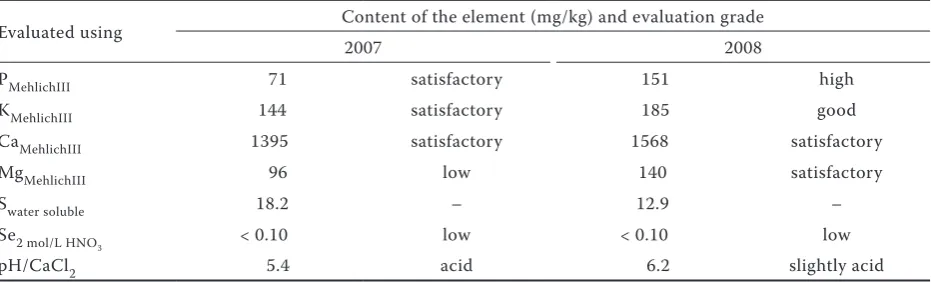
Havlíčkův Brod in Valečov. The site lies in the main potato-producing region, at an altitude of 450 m. In 2007 the mean annual precipitation was 664.3 mm and mean annual temperature was 8.8°C, while the corresponding values for 2008 were 695.7 mm and 8.9°C. The experiment con-sisted of three treatments and four replicates. The treatments comprised a control; application of a single dose of 200 g Se/ha; and application of a split dose of 400 g Se/ha (200 + 200 g Se/ha, with 7 days between the doses). The Se was applied as a foliar application at the tuberisation stage. Two varieties of consumer potatoes were tested in the experiment – the early variety Karin and the semi-early variety Ditta. Agrochemical properties of the soil at the site, which is characterised as a Cambisol, are given in Table 1.
During the growing season the plots were kept free of weeds and protected against Phytophthora infestans Mont. and Leptinotarsa decemlineata Say. The tubers were harvested at the beginning of physiological maturity (Karin on 16 August 2007, on 18 August 2008; Ditta 7 days later). After harvest, the potato tubers were washed in water, peeled, cut into slices and dried at 60°C. Dry samples were then homogenised in a test mill.
Tuber samples for Se assessment were min-eralised in a mixture of HNO3 and H2O2 in the microwave Milestone MLS 1200 MEGA (Sorisole, Italy) and then analysed using the method of atomic absorption spectrometry on UNICAM 939 SOLAAR (Cambridge, UK) by means of the method of hydride production using the vapour system UNICAM VP 90 (Cambridge, UK).
[image:2.595.65.531.621.762.2]The total content of amino acids was determined as described by Lošák et al. (2010). The results of the chemical analyses were processed statistically with the programme STATISTICA 8.0 using the multi-factorial variance analysis (MANOVA) and correlations were examined using the Pearson’s correlation coefficient (r).
Table 1. Agrochemical properties of the soil at the experimental site
Evaluated using Content of the element (mg/kg) and evaluation grade
2007 2008
PMehlichIII 71 satisfactory 151 high
KMehlichIII 144 satisfactory 185 good
CaMehlichIII 1395 satisfactory 1568 satisfactory
MgMehlichIII 96 low 140 satisfactory
Swater soluble 18.2 – 12.9 –
Se2 mol/L HNO3 < 0.10 low < 0.10 low
RESULTS AND DISCUSSION
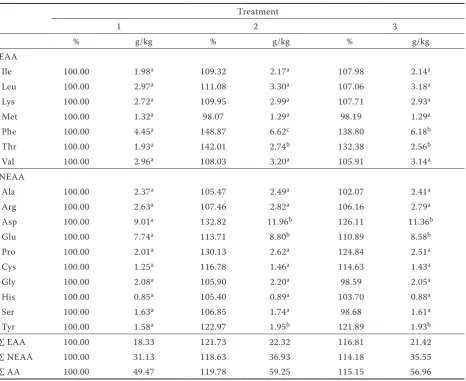
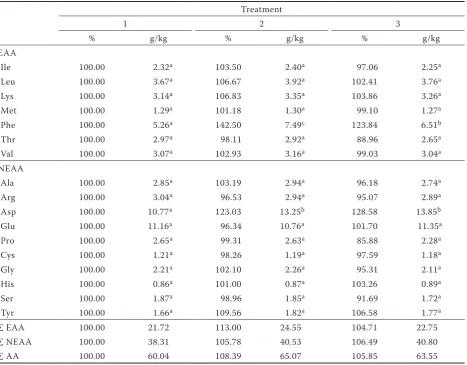
With further applications of Se its content in potato tubers increased as reported Turakainen et al. 2004. The content of Se was higher in the Karin tubers than in Ditta in both years of the study. The average content of Se in the dry matter of Karin tubers was 1.562 mg/kg at a rate of 200 g Se/ha and 2.027 mg/kg at a rate of 400 g Se/ha; in the dry matter of Ditta tubers the average Se contents ranged between 0.693 mg/kg at a rate of 200 g Se/ha and 1.129 mg/kg at a rate of 400 g Se/ ha. Plant nutrition and fertilisation can signifi-cantly influence the amino acid content in plant tissues (Lošák et al. 2010, Pavlík et al. 2010). The general trends in the spectrum of amino acids in tubers of both varieties were similar in both years of the experiment. The total content of selected amino acids was higher in tubers of all Se-treated plants than in the controls (Tables 2 and 3). This confirms the findings of Munshi et al. (1990),
[image:3.595.65.532.355.736.2]although they also found that the total content of amino acids increased continuously with the increasing rate of soil applications of Se. Guo and Wu (1998) also reported an increase in the content of amino acids in Melilotus indica L. plants after Se treatment. In the present study, foliar applica-tion of a single low dose of Se (200 g Se/ha) had a more positive effect than a double dose (400 g Se/ ha) on tuber amino acid content, increasing it by 19.8% in Karin (Table 2) and 8.4% in Ditta (Table 3) compared with the control plants. The increase in amino acid levels with the Se dose of 400 g/ha was 15.2% in Karin and 5.9% in Ditta compared with the controls. The results also showed that the response of both varieties comprised a different intensity of amino acid synthesis. This trend was similar in the case of essential and non-essential amino acids. After application of the higher dose of Se, a further small (< 1%) increase in the total content of non-essential amino acids was detected in Ditta. In contrast, Koutník (1996) discovered
Table 2. Relative and absolute content of amino acids in potato tuber DM of Karin variety
Treatment
1 2 3
% g/kg % g/kg % g/kg
EAA
Ile 100.00 1.98a 109.32 2.17a 107.98 2.14a
Leu 100.00 2.97a 111.08 3.30a 107.06 3.18a
Lys 100.00 2.72a 109.95 2.99a 107.71 2.93a
Met 100.00 1.32a 98.07 1.29a 98.19 1.29a
Phe 100.00 4.45a 148.87 6.62c 138.80 6.18b
Thr 100.00 1.93a 142.01 2.74b 132.38 2.56b
Val 100.00 2.96a 108.03 3.20a 105.91 3.14a
NEAA
Ala 100.00 2.37a 105.47 2.49a 102.07 2.41a
Arg 100.00 2.63a 107.46 2.82a 106.16 2.79a
Asp 100.00 9.01a 132.82 11.96b 126.11 11.36b
Glu 100.00 7.74a 113.71 8.80b 110.89 8.58b
Pro 100.00 2.01a 130.13 2.62a 124.84 2.51a
Cys 100.00 1.25a 116.78 1.46a 114.63 1.43a
Gly 100.00 2.08a 105.90 2.20a 98.59 2.05a
His 100.00 0.85a 105.40 0.89a 103.70 0.88a
Ser 100.00 1.63a 106.85 1.74a 98.68 1.61a
Tyr 100.00 1.58a 122.97 1.95b 121.89 1.93b
∑ EAA 100.00 18.33 121.73 22.32 116.81 21.42
∑ NEAA 100.00 31.13 118.63 36.93 114.18 35.55
∑ AA 100.00 49.47 119.78 59.25 115.15 56.96
that the total content of amino acids decreased after foliar application of Se.
In terms of essential amino acids, the most in-tensive increase after Se treatment in both years of the experiment and in both varieties was in the content of Phe, which increased significantly (r = 0.586; P = 0.003). On application of 200 g Se/ha the average increase was by 46% higher than in the control, while on application of 400 g Se/ha it was higher by 31%. Munshi et al. (1990) also detected an increase in the Phe content after Se fertilisation. In their experiment, the Phe content in potato tubers increased from 20% to 53% with an increasing rate of Na2SeO3 application. Adámková et al. (2006) reported that one of the defence mechanisms of plants against stress is the production of phenyl-propanoids, which are derived from Phe and Tyr. In our experiment the Tyr content increased in Se-treated potato tubers of both varieties. The metabolism of phenylpropanoids forms many substances that have significant antioxidant effects and biological significance (Harmatha 2005). The
[image:4.595.66.534.370.735.2]positive correlation observed here between Se application and Phe synthesis is probably another mechanism which is triggered under conditions of stress. The total anti-oxidative activity of potatoes is the combined result of the anthocyan and phe-nylpropanoic acid content (Lachman et al. 2005). As regards the essential amino acids, the content of Thr also underwent some noteworthy changes. In the variety Karin (Table 2), the Thr level increased significantly after application of 200 and 400 g Se/ ha, by 42.0% and 32.4%, respectively, compared with the controls (r = 0.721; P = 0.008). However, when the variety Ditta was treated with these two rates of Se the Thr level decreased, although not by a statistically significant amount (Table 3). Thus in our case, the positive effect of Se application on the Thr content was connected with the variety. In their experiments with potatoes, Munshi et al. (1990) discovered that Se application had a positive effect on the Thr content. The contents of other essential amino acids in potatoes of both varieties treated with Se in the present study were similar
Table 3. Relative and absolute content of amino acids in potato tuber DM of Ditta variety
Treatment
1 2 3
% g/kg % g/kg % g/kg
EAA
Ile 100.00 2.32a 103.50 2.40a 97.06 2.25a
Leu 100.00 3.67a 106.67 3.92a 102.41 3.76a
Lys 100.00 3.14a 106.83 3.35a 103.86 3.26a
Met 100.00 1.29a 101.18 1.30a 99.10 1.27a
Phe 100.00 5.26a 142.50 7.49c 123.84 6.51b
Thr 100.00 2.97a 98.11 2.92a 88.96 2.65a
Val 100.00 3.07a 102.93 3.16a 99.03 3.04a
NEAA
Ala 100.00 2.85a 103.19 2.94a 96.18 2.74a
Arg 100.00 3.04a 96.53 2.94a 95.07 2.89a
Asp 100.00 10.77a 123.03 13.25b 128.58 13.85b
Glu 100.00 11.16a 96.34 10.76a 101.70 11.35a
Pro 100.00 2.65a 99.31 2.63a 85.88 2.28a
Cys 100.00 1.21a 98.26 1.19a 97.59 1.18a
Gly 100.00 2.21a 102.10 2.26a 95.31 2.11a
His 100.00 0.86a 101.00 0.87a 103.26 0.89a
Ser 100.00 1.87a 98.96 1.85a 91.69 1.72a
Tyr 100.00 1.66a 109.56 1.82a 106.58 1.77a
∑ EAA 100.00 21.72 113.00 24.55 104.71 22.75
∑ NEAA 100.00 38.31 105.78 40.53 106.49 40.80
∑ AA 100.00 60.04 108.39 65.07 105.85 63.55
and the effect of Se application on their metabolism was not statistically significant. The lower dose of Se had a more positive effect on the content of the individual essential amino acids than the higher dose. Methionine was the limiting essential amino acid, as previously reported by Millard (1986) and Eppendorfer and Bille (1996). Application of Se to our plants did not affect the Met content in the potato tubers, confirming previous results reported by Koutník (1996). In contrast, Munshi et al. (1990) reported an increase in Met after Se application. The effect of the year on the Met content in our study was statistically significant only in the variety Ditta (P = 0.027).
The results for non-essential amino acids are summarised in Tables 2 and 3. The application of Se most markedly influenced the content of Aspartic acid (Asp), which increased significantly in Se-treated tubers of both varieties in both experi-mental years. Asp increased on average by 27.6% compared with the controls. In both varieties there was a strong positive correlation (r) between the application of Se and the Asp content; r = 0.740 (P = 0.006) and r = 0.827 (P = 0.001) in the varieties Karin and Ditta, respectively. The Asp content was also affected differently depending on the variety (r = 0.548; P = 0.006). Asparagine (Asn) results from amidation of aspartic acid (Asp). Munshi et al. (1990) discovered that the total content of Asn increased on average by 13% in Se-treated potato tubers.Aspartic acid and Asn are important in the transport and storage of nitrogen in plant tissues. They perform this function even under stress when the plant is not able to ensure the standard level of proteosynthesis (nutrient deficiency, drought, salt-ing, heavy metal contamination, pathogen attack) (Lea et al. 2007). Aspartic acid is yet another amino acid the content of which was positively affected by Se application and which in plant metabolism is connected with reaction tostress. The elevated content of Tyr is also worth noting (Tables 2 and 3). In the variety Karin it increased by as much as 23% and in the variety Ditta by almost 10%. The correlation between the increased content of Tyr and Se rate was positive (r = 0.501) and the effect of the year was significant (r = 0.585; P = 0.003). These results are in agreement with Munshi et al. (1990), who found that the Tyr content increased only when the lowest rate of Na2SeO3 was applied. Together with Phe, Tyr is a precursor of phenylpro-panoids (Adámková et al. 2006), which participate in the defence reactions of plants. The production of phenylpropanoids is triggered by stress factors, such as UV radiation; insufficient nitrogen,
phos-phorus and iron nutrition; low temperature; injury; and pathogen attack (Dixon and Paiva 1995).
The content of Pro, the free form of which is con-nected with the resistance of plants to drought and salinisation (Lea et al. 2007), was not statistically significantly influenced by Se application (Tables 2 and 3). The effect of the variety on the Pro content was noticeable; in the variety Karin it increased by as much as 30%, while in the variety Ditta the Pro content decreased by up to 14% after the Se treatment. Munshi et al. (1990) observed that after Se application the content of Pro increased and was positively correlated with the increasing rate of Se application. Other authors, e.g. Guo and Wu (1998), did not detect any significant change in the Pro content after Se application.
In Karin, the Glu content also increased signifi-cantly after the Se treatment. The content of Cys in Karin increased by 16.8% and 14.6% after applica-tion of 200 and 400 g Se/ha, respectively, whereas in Ditta the Cys content decreased after Se application. We were unable to prove statistically that Se ap-plication influenced the content of Cys. Its content was significantly affected in relation to the variety (P = 0.001). In experiments by Ríos et al. (2009) with lettuce plants (Lactuca sativa L.), the Cys content in leaves was influenced by the form of Se applied. The Cys content decreased with the increasing rate of selenite (SeO32–) application and increased with the increasing rate of selenate (SeO42–) application. Ramos et al. (2010) described different effects of various forms of Se on the metabolism of lettuce plants (Lactuca sativa L.). These results imply that the response of Cys metabolism to Se is the result of a combination of effects determined by plant species, variety and form of applied Se. In the group of non-essential amino acids, the lowest content detected in this study was of His.
REFERENCES
Adámková Š., Luhová L., Petřivalský M., Peč P. (2006): Characteri-zation of enzyme phenylalanine ammonia-lyase and its role in activation of defensive mechanisms in plants. Chemické listy,
100: 486–494. (In Czech)
Cuderman P., Kreft I., Germ M., Kovačevič M., Stibilj V. (2008): Selenium species in selenium-enriched potatoes and drought-exposed potatoes. Journal of Agricultural and Food Chemistry,
56: 9114–9120.
Dayer R., Fischer B.B., Eggen R.I.L., Lemaire S.D. (2008): The peroxiredoxin and glutahione peroxidase families in Chla-mydomonas reinhardtii. Genetics, 179: 41–57.
Dixon R.A., Paiva N.L. (1995): Stress-induced phenylpropa-noid metabolism. American Society of Plant Physiologists,
7: 1085–1097.
Ducsay L., Ložek O., Varga L. (2009): The influence of selenium soil application on its content in spring wheat. Plant, Soil and Environment, 55: 80–84.
Eppendorfer W.H., Bille S.W. (1996): Free and total amino acid composition of edible parts of beans, kale, spinach, cauliflower and potatoes as influenced by nitrogen fertilisation and phos-phorus and potassium deficiency. Journal of the Science of Food and Agriculture, 71: 449–458.
Ferri T., Favero G., Frasconi M. (2007): Selenium speciation in foods: prelimenary results on potatoes. Microchemical Journal,
85: 222–227.
Guo X., Wu L. (1998): Distribution of free seleno-amino acids in plant tissue of Melilotus indica L. grown in selenium-laden soils. Ecotoxicology and Environmental Safety, 39: 207–214. Hanson B., Garifullina G.F., Lindblom S.D., Wangeline A., Ackley
A., Kramer K., Norton A.P., Lawrence C.B., Pilon-Smits E.A.H. (2003): Selenium accumulation protects Brassica juncea from invertebrate herbivory and fungal infection. New Phytologist,
159: 461–469.
Hanson B., Lindblom S.D., Loeffler M.L., Pilon-Smits E.A.H. (2004): Selenium protects plants from phloem-feeding aphids due to both deterrence and toxicity. New Phytologist, 162: 655–662. Harmatha J. (2005): Structural abundance and biological
signifi-cance of lignans and related plant phenylpropanoids. Chemické listy, 99: 622–632.
Hartikainen H., Xue T. (1999): The promotive effect of selenium on plant growth as triggered by ultraviolet radiation. Journal of Environmental Quality, 28: 1372–1375.
Koutník V. (1996): Content of selenium in potato tubers. Rostlinná výroba, 42: 63–66. (In Czech)
Lachman J., Hamouz K., Orsák M. (2005): Red and purple po-tatoes – a significant antioxidant source in human nutrition. Chemicke listy, 99: 474–482. (In Czech)
Lea P.J., Sodek L., Parry M.A.J., Shewry P.R., Halford N.G. (2007): Asparagine in plants. Annals of Applied Biology, 150: 1–26. Lošák T., Hlušek J., Filipčík R., Pospíšilová L., Maňásek J., Prokeš
K., Buňka F., Kráčmar S., Martensson A., Orosz F. (2010): Effect of nitrogen fertilisation on metabolisms of essential and non-essential amino acids in field-grown grain maize (Zea mays
L.). Plant, Soil and Environment, 56: 574–579.
Lyons G.H., Stangoulis J.C.R., Graham R.D. (2005): Tolerance of wheat (Triticum estivum L.) to high soil and solution selenium levels. Plant and Soil, 270: 179–188.
Millard P. (1986): The nitrogen content of potato (Solanum tu-berosum L.) tubers in relation to nitrogen application – the effect on amino acid composition and yields. Journal of the Science of Food and Agriculture, 37: 107–114.
Munshi C.B., Combs G.F., Mondy N.I. (1990): Effect of selenium on the nitrogenous constituents of the potato. Journal of Ag-ricultural and Food Chemistry, 38: 2000–2002.
Pavlík M., Pavlíková D., Balík J., Neuberg M. (2010): The contents of amino acids and sterols in maize plants growing under dif-ferent nitrogen conditions. Plant, Soil and Environment, 56: 125–132.
Ramos S.J., Faguin V., Guilherme L.R.G., Castro E.M., Ávila F.W., Carvalho G.S., Bastos C.E.A., Oliveira C. (2010): Selenium bio-fortification and antioxidant activity in lettuce plants fed with selenate and selenite. Plant, Soil and Environment, 12: 584–588. Rayman M.P. (2002): The argument for increasing selenium intake.
Proceedings of the Nutrition Society, 61: 203–215.
Ríos J.J., Blasco B., Cervilla L.M., Rosales M.A., Sanchez-Rodriguez E., Romero L., Ruiz J.M. (2009): Production and detoxification of H2O2 in lettuce plants exposed to selenium. Annals of Ap-plied Biology, 154: 107–116.
Seppänen M., Turakainen M., Harikainen H. (2003): Selenium ef-fects on oxidative stress in potato. Plant Science, 165: 311–319. Spallholz J.E., Hoffman D.J. (2002): Selenium toxicity: cause and
effects in aquatic birds. Aquatic Toxicology, 57: 27–37. Turakainen M., Hartikainen H., Ekholm P., Seppänen M.M. (2006):
Distribution of selenium in different biochemical fractions and raw darkening degree of potato (Solanum tuberosum) tubers supplemented with selenate. Journal of Agricultural and Food Chemistry, 54: 8617–8622.
Turakainen M., Hartikainen H., Sepänen M. (2004): Effect of selenium treatments on potato (Solanum tuberosum L.) growth and concentration of soluble sugars and starch. Journal of Agricultural and Food Chemistry, 52: 5378–5382.
Whanger P.D. (2002): Selenocompounds in plants and animals and their biological significance. Journal of the American Collage and Nutrition, 21: 223–232.
Received on February 2, 2011
Corresponding author: