JOURNAL OF FOREST SCIENCE, 56, 2010 (5): 218–224
Natural regeneration is an important part of the mountain forest ecosystem. It is an indicator of forest vitality and stability. The character and progress of natural regeneration in mountain forest conditions are influenced by many factors which are interact-ing. The influence of micro-relief on regeneration was studied by many authors, for example by Vacek (1981), Hanssen (2002, 2003), Kuuluvainen and Kalmari (2003) or by Diaci et al. (2005). Their results show that natural regeneration is linked with special site, i.e. relief (either in a micro-pan or on an elevation, also slope and flat terrain) and character of soil surface. Of course, the micro-relief is not the only driving variable for natural regeneration. Micro-pans have higher humidity which is important for seedlings (Kozlowski 2002) but at the same time seedlings could suffer from light deficiency and high competition due to excessive and high weeds
such as Calamagrostis sp. and high ferns, especially
Athyrium distentifolium (Jonášová, Prach 2004). Micro-pans also have higher seedling mortality due to longer snow cover, where seedlings are attacked by pathogenic fungi, especially Herpotrichia nigra
(Vacek 1981). Elevations could cause reverse prob-lems, i.e. there is light enough but, on the other hand, there could be rather dry conditions.
The other driving variables for natural regen-erations are canopy closure, frost, snow melting and sliding, etc. Plant society is also an important factor in forest regeneration. Ulbrichová et al. (2006) found out that favourite places for natural seedlings in mountain forests are mostly dead wood and, on the other hand, the worse ones are high and dense plant associations like ferns and weeds which rep-resent strong competition for small seedlings above and/or under the ground.
Influence of micro-relief and weed competition
on natural regeneration of mountain forests
in the Šumava Mountains
V. Štícha
1, I. Kupka
1, D. Zahradník
2, S. Vacek
11
Department of Silviculture, Faculty of Forestry and Wood Sciences, Czech University
of Life Sciences Prague, Prague, Czech Republic
2
Department of Forest Management, Faculty of Forestry and Wood Sciences,
Czech University of Life Sciences Prague, Prague, Czech Republic
AbStrAct: Natural regeneration and its relationship to micro-relief and weed competition were studied on 6 re-search plots in mountain spruce forests in the Šumava Mountains. The data on density regeneration, total height and height increment of each seedling were recorded on 50 by 5 m transects. The position of each seedling was adjusted by a satellite system “Field map”. The data show that an elevation is a significantly (significance level P = 0.99) preferable micro-relief for seedlings in most cases (7 of the total 9 cases). The regeneration density is low in a high-competition environment, i.e. in grass and ferns, where the number of seedlings is significantly low on all surveyed plots. But dead wood, which is also an elevation in terms of the micro-relief, is the most preferable micro-site. The data show no sig-nificant differences in seedling heights due to differently dominant competing plants. Neither was the hypothesis about the beneficial influence of stem or stump in close surroundings on seedlings confirmed by our data.
Keywords: Czech Republic; micro-relief; mountain forests; natural regeneration; weed competition
The aim of the present paper is to evaluate the re-lationship between natural regeneration and micro-site conditions, especially micro-relief and character of soil surface, i.e. abundance and dominance of herbal species at a moss and herbal level.
MAterIAlS AnD MethoD
Research plots are located in Modrava and Plechý areas in Šumava National Park. The altitude ranges from 1,120 to 1,370 m a.s.l., annual precipitation var-ies between 900 and 1,380 mm and average annual temperature is 3.5–5°C.
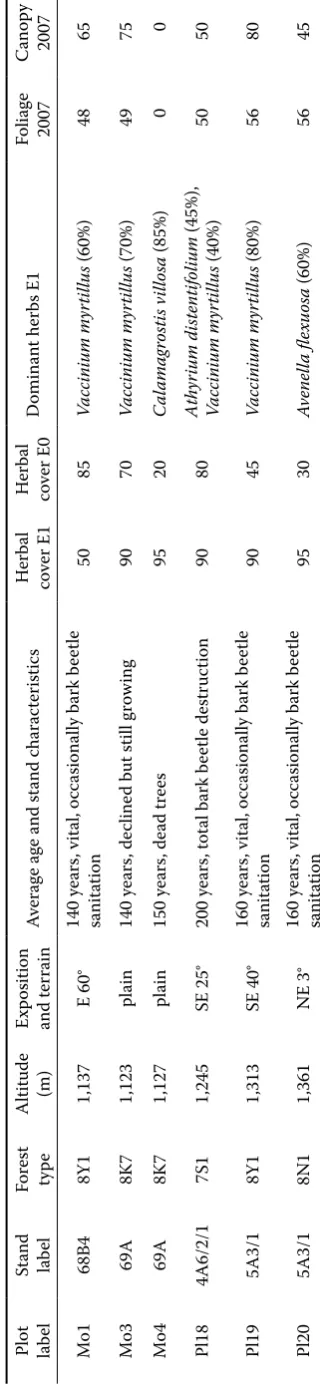
There are three research plots in Modrava area (designated Mo1, Mo3, Mo4) and three plots in Plechý area (designate Pl18, Pl19, Pl20) – Table 1 shows their basic description (data from 2007). Two plots in Modrava area (Mo1 and Mo3) with liv-ing mature trees are mostly covered by Vaccinium myrtillus and plots with dead mature trees (Mo4) by Calamagrostis villosa. Plot Pl20 situated at the highest altitude is markedly influenced by specific ecological conditions in a climax spruce mountain forest, therefore this stand has naturally open canopy and the herbal layer is mostly dominated by Avenella flexuosa. In lower stony plot Pl19 it is Vaccinium myrtillus and in the lowest plot Pl18, which is almost destroyed by the bark beetle, it is Athyrium disten-tifolium and Vaccinium myrtillus whereas the share of Athyrium distentifolium has increased due to the bark beetle destruction in the last several years. In the moss layer Polytrichum formosum dominates; there is also Sphagnum girgensohnii on plot Mo3. The first three plots represent three different sites and stand conditions, i.e. growing stand on the slope (Mo1), stand destroyed by the bark beetle in a plain terrain (Mo4) and growing stand in the same terrain (Mo3). The plots in Plechý area represent an altitude gradient (from 1,200 m to 1,350 m) in the mountains at comparable conditions.
Abundant plant species under growing stands are: Vaccinium myrtillus, Calamagrostis villosa, Avenella flexuosa and Athyrium distentifolium.
They are followed by Trientalis europea, Homogyne alpina, Oxalis acetosella, Lycopodium annotinum
and Maianthemum bifolium. The plant society under stands destroyed by the bark beetle is dominated by
Chamaerion angustifolium. Dominant moss species in stands at higher altitude are Polytrichum formo-sum, Dicranum scoparium and Sphagnum sp.
The detailed description of research plots is given in Table 1. It should be mentioned that according to our research the age of single trees within the stand
varies a lot. Table 1. I
den
tific
ation and b
asic de
sc
ription of r
es
ear
ch plot
s
Plot labe
l
St
and label
For est ty pe Altit ude (m) Ex po sition and t er rain
Average age and st
and c harac ter istic s H erb al cover E1 H erb al cover E0 D ominan t herb s E1 Foli age 2007 C
anopy 2007
M o1 68B4 8Y1 1,137 E 60° 140 ye ars , v ital, o cc asionally b ar k b ee tle sanit ation 50 85 Vacci ni um m yr til lu s (60%) 48 65 M o3 69A 8K7 1,123 pl ain 140 ye ars , de cline
d but still g
[image:2.595.337.500.63.759.2]The investigation on regeneration was carried out in transects 50 m in length and 5 m in width, ori-ented down the slope or with the longer side of the stand. The position of each seedling was determined by “Field-map” satellite technology. Total height and species were recorded for each seedling as well as micro-relief and dominant herb species. The mi-cro-relief was set to four basic forms: plain, slope, elevation and depression (micro-pan). The terrain was considered in the circle of 0.5 m around the seedling and the differences among the micro-eleva-tions should be more than 5 cm within the circle to be classified as not plain. The dominant plant cover (herbal and moss level, potentially substrate or litter) was determined by means of ocular estimation of the most dominant species. Dead wood is a part of wood lying on the ground at different stages of disintegra-tion. Height of seedlings could also be positively in-fluenced by preferable microclimate due to a nearby stem or stump. Therefore these circumstances are also taken into account.
Statistical evaluation was done using STATISTICA v 8.0 software. The degree of successful regeneration was based on the following assumptions: if there are
n seedlings on the plot, then the probability of living seedling on i plot is Pi. The number of seedlings on the plot is a random variable with binominal distri-bution with parameters n, Pi. The probability Pi of living seedling on the site should be equal to the area proportion ai if the micro-relief does not influence the seedling existence. Therefore the null hypothesis about the micro-relief influence on the number of seedlings is formulated as follows (with the above-mentioned variables):
H0 : Pi = ai (1)
and its alternative (opposite) hypothesis
H1 : Pi ≠ ai (2)
The relative abundance of seedlings was evaluated by the test of fit at a significance level α = 0.01. The asterisk (*) denotes the proportion of regeneration at a significance level α = 0.05 .
The test of fit was used for evaluation of total seed-ling height and its normal distribution. Leven’s test proved that the seedling height variance for differ-ent micro-reliefs and weed competition is iddiffer-entical. The influence of these two factors on seedling height could then be evaluated by one-factor analysis of variance. Tukey’s test was used to determine which sets of data are different if the null hypothesis could be rejected. The sets which have no differences (at a significance level α = 0.05 ) in height differ in symbols (“A” or “B”).
reSultS AnD DIScuSSIon
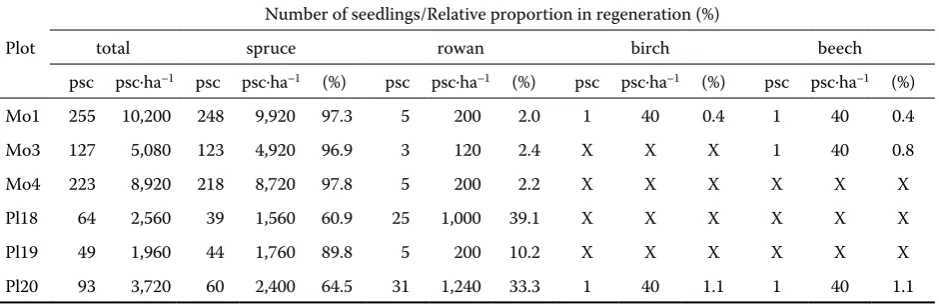
An overview of the species composition of regen-eration on research plots is given in Table 2.
On plots Mo1, Mo3, Pl19 and Pl20 the share of spruce regeneration on dead wood was markedly higher than on the other micro-site types. This fact is caused by the special wood-decay fungus called
Fomitopsis, when the dead wood (stems) is decom-posed still with bark and that means better condi-tions for natural spruce regeneration (cf. Jankovský 1999). On the other hand, on plot Mo4 the regenera-tion on dead wood is very poor although the share of dead wood on this plot is very high. This can be explained by another wood-decay fungus Gleophy-llum, which decomposes stems without bark after the great bark beetle destruction.
[image:3.595.64.534.594.747.2]Modrava plots (Mo1, 3, 4) are nearly purely re-generated by Norway spruce (more than 97% of the total seedling number) while Plechý plots (Pl18, 19, 20) show an increasing number of rowan (Sorbus aucuparia [L.]) between 10 to nearly 40% although
Table 2. Species composition of natural regeneration on plots
Plot
Number of seedlings/Relative proportion in regeneration (%)
total spruce rowan birch beech
psc psc.ha–1 psc psc.ha–1 (%) psc psc.ha–1 (%) psc psc.ha–1 (%) psc psc.ha–1 (%)
Mo1 255 10,200 248 9,920 97.3 5 200 2.0 1 40 0.4 1 40 0.4
Mo3 127 5,080 123 4,920 96.9 3 120 2.4 X X X 1 40 0.8
Mo4 223 8,920 218 8,720 97.8 5 200 2.2 X X X X X X
Pl18 64 2,560 39 1,560 60.9 25 1,000 39.1 X X X X X X
Pl19 49 1,960 44 1,760 89.8 5 200 10.2 X X X X X X
Norway spruce is still the main species in regenera-tion.
The influence of micro-relief on natural regenera-tion was evaluated by the test of fit. The evaluaregenera-tion was carried out not only for Norway spruce seedlings but also for rowan seedlings on the second series of research plots. The results are given in Table 3. In the cases where the micro-relief has a highly significant influence on the number of seedlings, the data are in bold (significance level P = 0.99) and where it is still significant (significance level P = 0.95), the data are designated by asterisk (*).
Data suggests that an elevation is the most pref-erable micro-relief for seedlings as in most cases (7 out of the total 9 cases) there is a significantly higher proportion of seedlings. On two plots in
[image:4.595.66.536.73.267.2]Plechý area even the majority of the seedlings (more than 70%) are growing on elevations while the slope and depression (pan) are the micro-reliefs which are not preferable sites for seedling germination and growth. In the conditions of the high altitude gradient on Plechý Mt. a major part of regeneration grows on elevations because of the temperature which is the main limiting factor, on elevations snow also melts sooner (by about two weeks) and seedlings are not seriously damaged by pathogenic fungi (mainly in early spring). This trend is partly reduced by introskeletal erosion, which is very marked on plot 19 (cf. Vacek, Krejčí 2008). The regeneration on slopes and in depressions is attacked by Herpotrichia nigra. Elevations also have lower abundance and dominance of the herbal and Table 3. Evaluation of the micro-relief influence on regeneration density (%)
Plot speciesTree
Depression Swelling Plain Slope
plot cover number of seedlings plot cover of seedlings plot cover number of seedlings plot cover number of seedlings number
Mo1 spruce 25 9.7 6 27.8 19 12.5 50 52.8
Mo3 spruce 7 6.5 9 43.1 48 33.3 36 20.3
Mo4 spruce 24 13.8 19 20.6 33 28.0 24 39.9
Pl18 sprucerowan 4 2.6 3 28.2 21 2.6 72 66.7
0 20.0 4.0* 76.0
Pl19 sprucerowan 36 0 12 70.5 13 0* 39 29.5
0 0 40.0 60.0
Pl20 sprucerowan 27 1.7 14 78.3 39 13.3 20 6.7
9,7* 32.3 29.0 29.0
* Significance level α = 0.05
Table 4. Evaluation of the influence of dominant plants or close environment on regeneration density (%)
Plot speciesTree
Bare ground Dead wood Blueberries, mosses Grass, ferns
plot cover of seedlings plot cover number of seedlings plot cover number of seedlings plot cover number of seedlings number
Mo1 spruce 29 8.1 2 28.2 65 56.9 1 0
Mo3 spruce 28 15.3 7 40.3 55 35.5 2 0
Mo4 spruce 12 5.0 21 8.3 33 48.6 33 0
Pl18 sprucerowan 37 15.4 2 0 31 46.2* 30 5.1
52.0 8.0* 28.0 12.1*
Pl19 sprucerowan 11 0* 1 56.8 82 36.4 0 0
40* 0 60.0 0
Pl20 sprucerowan 8 1.7 9 38.3 22 6.7 58 13.3
6.5 0 38.7* 45.2
[image:4.595.65.533.550.743.2]Table 5. Seedling height differences according to different micro-site conditions
Plot No. Dominant species, substrate
significance level microhabitat type average height (cm) homogenic groups
1 0.07200
stump 15.0000 A
food of tree 35.6400 A
dead wood 44.6300 A
bluberries 46.3900 A
grass, ferns 60.0000 A
bare soil 80.6700 A
3 0.00000
dead wood 29.0200 A
bluberries 62.8600 B
food of tree 77.5000 B
bare soil 87.5800 B
4 0.66000
dead wood 116.2200 A
bluberries 117.5600 A
grass, ferns 124.8300 A
food of tree 127.6200 A
bare soil 145.2700 A
18 0.45600
bare soil 37.6600 A
food of tree 56.3300 A
bluberries 36.2800 A
grass, ferns 60.0000 A
19 0.00000
food of tree 12.0000 AB
dead wood 16.1600 A
stump 30.5000 AB
bluberries 72.7500 B
20 0.54200
bare soil 15.0000 A
dead wood 12.8700 A
stump 18.7300 A
food of tree 7.5000 A
bluberries 24.2500 A
grass, ferns 14.0000 A
moss level, thus the competition of species is lower such as air humidity, so in this micro-site the patho-genic fungi are not so dangerous. Further, seedlings in depressions are covered by Calamagrostis vil-losa during winter, which nearly always causes the mortality of seedlings in connection with the attack by pathogenic fungi (cf. Vacek, Krejčí 2008). The results are the same for seedlings of Norway spruce and rowan, even for the latter species our data is rather poor. These results are in accordance with
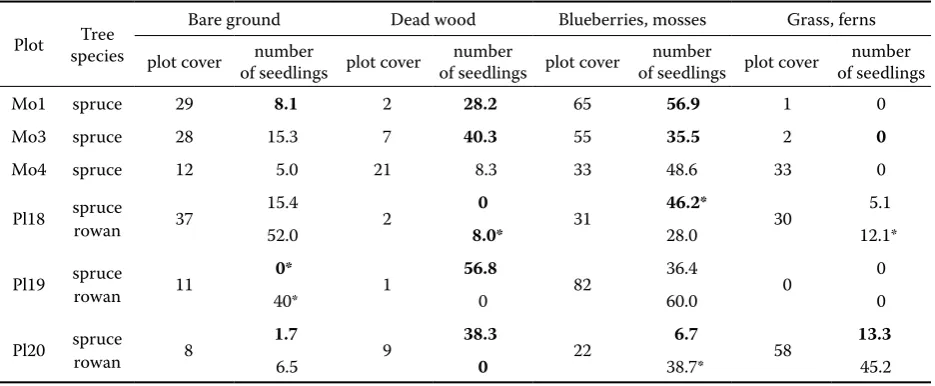
findings of Kuuluvainen and Kalmari (2003) and Diaci et al. (2005). Similar evaluation was done for the influence of dominant plants and/or close environment, i.e. bare ground and dead wood, on the density of regeneration. Data and statistical evaluation are given in Table 4 based on the same hypothesis (1, 2) as the previous table.
Table 6. Seedling height differences according to different micro-relief
Plot No. Micro-relief
significance level microhabitat type average height (cm) homogenic groups
1 0.29400
elevation 38.94 A
depression 44.22 A
slope 51.30 A
flat 55.03 A
3 0.00015
elevation 35.06 A
flat 60.19 B
slope 71.24 B
depression 98.75 B
4 0.00070
depression 103.60 A
slope 112.55 A
elevation 120.16 AB
flat 147.97 B
18 0.08150
depression 44.00 A
elevation 21.72 A
flat 34.00 A
slope 46.69 A
19 0.00039 elevation 22.29 A
slope 73.08 B
20 0.48470
depression 5.00 A
elevation 15.64 A
flat 13.38 A
slope 25.00 A
significantly low in grass and ferns on all plots (except for rowan seedlings on plot Pl20). A surprisingly low number of seedlings is also on the bare ground where no competition exists. This fact could be explained by severe microclimatic conditions which are prob-ably too harsh for the germination and survival of seedlings. But dead wood, which is also an elevation in terms of the micro-relief, is the most preferable micro-site. The stage of wood decomposition seems to be an important precondition for successful re-generation on dead wood. There is a lot of lying but not yet decaying logs on plot Mo4 and the density of regeneration is low on their surface (Ulbrichová et al. 2006; Štícha et al. 2008).
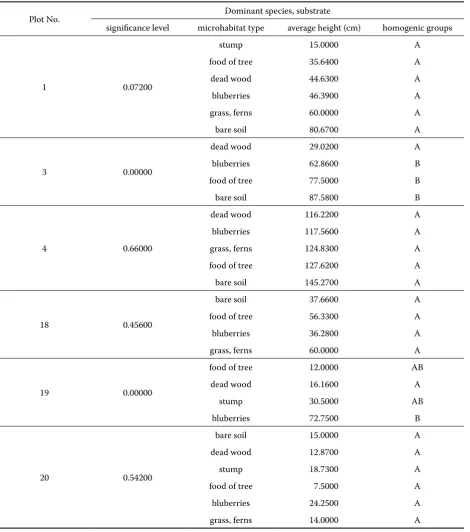
The seedling heights (influenced by different weed competition and micro-site conditions) are analyzed in Table 5.
The data show no significant differences in seedling height due to different dominant plants except for plot Mo3 and partly for plot Pl19. The former plot Mo3 has statistically significantly lower heights of seedlings growing on dead wood compared to other types of micro-sites, i.e. berries, bare ground and stem foot. The latter plot has even less clear interpretation of gathered data. The differences on plot Mo3 are not statistically proved on all other plots. The hypothesis about the beneficial influence of stem or stump in close surroundings on seedlings was not confirmed by our data.
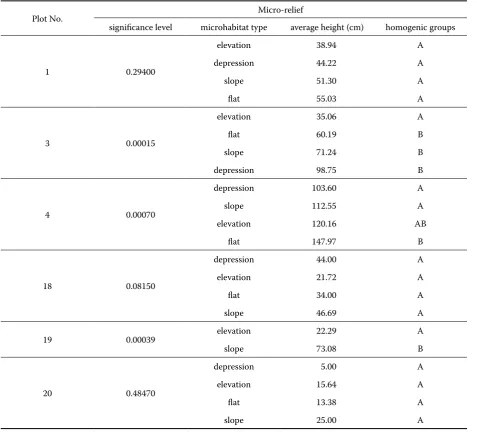
The analysis of micro-relief influence on seedlings height is given in Table 6.
that the micro-relief has no significant influence on seedling growth as shown in Table 6.
concluSIonS
Our results suggest that an elevation is the most preferable micro-relief for seedlings as in most cases (7 out of the total 9 cases) a significantly higher pro-portion of seedlings was found there. On two plots on Plechý Mt. even the majority of the seedlings (more than 70%) are growing on elevations while slope and depression (micro-pan) are the micro-relief which does not represent preferable sites for seedling germi-nation and growth. These facts are in accordance with Holeksa et al. (2007).
The regeneration density is low in a high-competi-tion environment, i.e. in grass and ferns where the number of seedlings is significantly low on all surveyed plots. But dead wood, which can also be considered as an elevation in terms of the micro-relief, is the most preferable micro-site.
The data show no significant differences in seedling heights due to different dominant plants. The hypoth-esis about the beneficial influence of stem or stump in close surroundings on seedlings was not confirmed. Special microhabitat conditions are of higher im-portance (Kuuluvainen, Kalmari 2003). Natural regeneration is also influenced by the bark beetle disturbance, not only due to the decay of mature trees but also due to different stage of dead wood decompo-sition. An important factor is also the decay rate which influences the ground vegetation development and soil processes (especially in skeletal soils on plot Pl19 and Mo1) such as litter mineralization.
It can be concluded that micro-reliefs (namely el-evations) have a positive influence on the density of regeneration but not on their height growth. Domi-nant herbs as main competitors diminish the seedling growth but, on the other hand, herbs can protect the germinating seedlings since regeneration density is significantly lower under conditions of bare ground.
Acknowledgements
The authors thank Ing. Lukáš Bílek, Mgr. et Mgr. Bc. Filip Dostál and Jan Štícha for their help dur-ing research works.
references
Diaci J., Pisek R., Bonina A. (2005): Regeneration in experi-mental gaps of subalpine Picea abies forest in the Slovenian Alps. European Journal of Forest Research, 124: 29–36. Hanssen K.H. (2002): Effects of seedbed substrates on
regen-eration of Picea abies from seeds. Scandinavian Journal of Forest Research, 17: 511–521.
Hanssen K.H. (2003): Natural regeneration of Picea abies on small clear-cuts in SE Norway. Forest Ecology and Manage-ment, 180: 199–213.
Holeksa J.,Saniga M., Szwagrzyk J., Dziedzic T., Ferenc S., Wodka M. (2007): Altitudinal variability of stand struc-ture and regeneration in the subalpine spruce forests of the Pol’ana biosphere reserve, Central Slovakia. European Journal of Forest Research, 126: 303–313.
Jankovský L. (1999): Some aspects of wood decaying by wood fungi in forests. In: Vrška T. (ed.): Importance and Function of Decaying Wood in Forest Stands. Proceedings of 8–9th
October 1999 in National Park Podyjí. Znojmo, Národní Park Podyjí and Česká lesnická společnost: 49–60. (in Czech) Jonášová M., Prach K. (2004): Central-European mountain
spruce (Picea abies [L.] Karst.) forests: regeneration of tree species after a bark beetle outbreak. Ecological Engineer-ing, 23: 15–27.
Kozlowski T.T. (2002): Physiological ecology of natural regen-eration of harvested and disturbed forest stands: implications for forest management. Forest Ecology and Management,
158: 195–221.
Kuuluvainen T., Kalmari R. (2003): Regeneration microsites of Picea abies seedlings in a windthrow area of a boreal old-growth forest in southern Finland. Annales Botanici Fennici
40: 401–413.
Štícha V., Bílek L., Dvořák J. (2008): Preliminary analysis of natural regeneration on the one plot in the Šumava Mts. In: Proceedings of Coyous 2008, Conference of young Scientist. 2. 4. 2008 Praha, Česká zemědělská univerzita: 228–237. (in Czech) Ulbrichová I., Remeš J., Zahradník (2006): Development
of the spruce natural regeneration on mountain sites in the Šumava Mts. Journal of Forest Science, 52: 446–456. Vacek S. (1981): Chances of successful natural regeneration in
the Krkonoše protective mountain forests. Lesnická práce,
60: 118–124. (in Czech)
Vacek S., Krejčí F. (2008): Forest Ecosystems in the National Park of the Šumava Mts. Kostelec nad Černými Lesy, Les-nická práce: 504.
Received for publication: February 25, 2009 Accepted after corrections: April 26, 2010
Corresponding author:
Ing. Václav Štícha, Česká zemědělská univerzita v Praze, Fakulta lesnická a dřevařská, 165 21 Praha 6-Suchdol, Česká republika