in ill-structured decision situations, it is often difficult to evaluate the correct decision solution beforehand; that is unless some influential future events occur (see e.g. Svoboda 2008, 2007; Michalski 2008; Franěk at al. 2007). in such situations, usually not all affecting variables are known; secondly, some of the known variables are usually stochastic, vague, and qualitative in nature. This is why this decision- making environment necessitates the reliance on multiple experts’ opinions, in order to enhance the quality of the obtained decision solution. crucial and necessary to be associated with those opinions are the weights, which are important to distinguish the information that may assist in resolving the po-tential conflict among those multiple judgments,
and to provide information for differences in the experts‘competencies.
in many group Decision Making (gDM) contexts and applications, it is not always valid that all group members’ or expert decision makers have equal impor-tances with respect to the decision being made or to the particularity of the decision- making transaction. This is because the degree of relevancy, knowledge, and experience may not be equal among those experts or decision makers. Therefore, there must be an allow-ance for such differences in weights or importallow-ances. over and above, most of the real world gDM takes place in an ambiguous decision situation, in which the value of inputs as well as pertinent data and the sequences of the possible actions are vague or not
Evaluating the knowledge, relevance and experience
of expert decision makers utilizing the Fuzzy-AHP
Použití Fuzzy-AHP pro hodnocení znalostí, relevantnosti
a zkušeností expertů
S. Aly, I. Vrana
Department of Information Engineering, Faculty of Economics and Management,
Czech University of Life Sciences, Prague, Czech Republic
Abstract: The reliance on experts’ decision is considered a very efficient solution especially in case of ill-structured and vague decision making situations. This necessitates being able to identify the expert or experts group whose decision must be particularly assigned a greater weight or importance. This paper is concerned with a method of how to determine the weights of a group of expert decision makers, taking into account the vagueness associated with such evaluation.
Key words: group Decision Making, Analytical hierarchy Process (AhP), Fuzzy-AhP, experts judgments, ill-structured decision making, decision making weights/importance’s
Abstrakt: Spolehnout se na stanovisko expertů je velmi účinný přístup zejména pro rozhodování ve špatně strukturovaných a vágních situacích. To ovšem vyžaduje schopnost rozpoznat experty nebo skupiny expertů, jejichž stanovisku je možné přisoudit velkou váhu či význam. Článek se zabývá metodou, jak určit váhy pro skupinu expertů s uvažováním neurčitosti takového posouzení.
Klíčová slova: skupinové rozhodování, analytický hierarchický proces AhP, Fuzzy-AhP, posudky expertů, špatně struktu-rovaný rozhodovací problém, váhy při rozhodování
precisely known. Therefore, it is very important to manipulate fuzzy values and concepts of evaluation in order to approximate the vague elements of the decision making environment. This is also in order to be comprehensive in taking into account all relevant effects in the solution of the decision-making prob-lem. Within the context of the complex ill-structured problem of evaluating the importances of decision making experts, it is a major prerequisite to be able to handle vagueness and fuzzy measures associated with such decision- making situation. in this paper, the issue of how to reflect objectively the differences in importance’s among the participating expert decision makers is considered, and particularly within vague or ambiguous decision making contexts. The main concern is about using a practical, computationally simple and effective approach. Keeping this point in mind, the paper introduces the Fuzzy-AhP as a tool for weighting the importances of experts.
THE AHP
The analytic hierarchy process (AhP) developed by Saaty (1980) is a decision-making tool that can handle unstructured or semi-structured decisions with multi-person and multi-criteria inputs. it is a decision model that relaxes the measurement of related factors to subjective managerial inputs on multiple criteria. The AhP has several advantages, including its acceptance of inconsistencies in managerial judg-ments/perceptions and its user friendliness because users may directly input judgment data without requir-ing further mathematical knowledge. it also allows users to structure complex problems in the form of a hierarchy or a set of integrated levels. The AhP can also be combined with well-known techniques of operation research to handle more difficult problems. one of the main advantages of this method is the relative ease, with which it handles multiple criteria. in addition to this, the AhP is easier to understand and can effectively handle both qualitative and quan-titative data. The use of the AhP does not involve cumbersome mathematics. The AhP involves the principles of decomposition, pair wise comparisons, and priority vector generation and synthesis (Duran, Aguilo 2008). Saaty uses the eigenvector method to determine the relative weights among the various criteria based on the pair-wise comparison matrix,
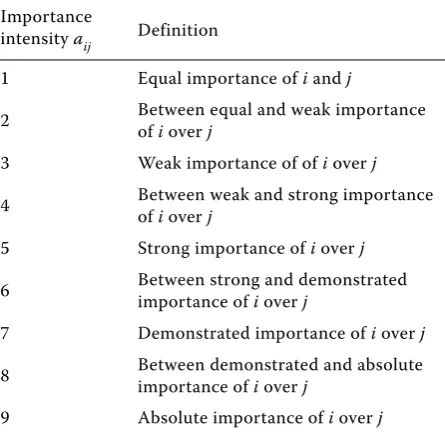
positive reciprocal matrix A = [aij]. Table 1 gives the scales of intensity importance used to compare alternatives and criteria.
Saaty defined λmax as the largest eigen vector of
the matrix A, and the weight wi as a component of the normalized eigen vector corresponding to, λmax,
where:
wi = ri /(r1 + r2 + … + rn) (1)
and ri is the geometric mean of each row:
n n
j ij
i a
r
1
1 ¸
¸ ¹ · ¨ ¨ © §
(2)Saaty’s approach has provided with the capability to assess the consistency of the assigned relative importances in the pair-wise comparison matrix. This can be done through computing the consistency ratio (CR) from the consistency index (CI) and the random index (RI), as follows:
CR = CI/RI (3)
1 Ȝmax
n
n
CI (4)
where:
[image:2.595.308.531.98.314.2]n = the number of compared criteria, alternatives, or factors
Table 1. The fundamental scale of the AhP importance intensity value
importance
intensity aij Definition
1 Equal importance of i and j
2 Between equal and weak importance of i over j 3 Weak importance of of i over j 4 Between weak and strong importance of i over j 5 Strong importance of i over j
6 Between strong and demonstrated importance of i over j 7 Demonstrated importance of i over j 8 Between demonstrated and absolute importance of i over j 9 Absolute importance of i over j
Table 2. The random index RI versus the number of assessed factors n
n 1 2 3 4 5 6 7 8 9 10 11 12
[image:2.595.63.529.731.766.2]The values of RI for different values of n is given by the Table 2.
The use of RI is a basic element of the AhP and this table (used in all books) was determined experi-mentally. its meaning is as follows: the random index
RI is the average consistency index of 100 randomly generated (inconsistent) pairwise comparisons ma-trices.
Though the purpose of the AhP is to capture the expert’s knowledge, the conventional AhP still can-not reflect the human thinking style. in spite of its popularity, this method is often criticized because of a series of pitfalls associated with the AhP tech-nique, which can be summarized as follows (Duran, Aguilo 2008):
– its inability to adequately handle the inherent un-certainty and imprecision associated with the map-ping of the decision-maker’s perception to exact numbers (Lefley, Sarkis 1997).
– in the traditional formulation of the AhP, human judgments are represented as exact (or crisp, ac-cording to the fuzzy logic terminology) numbers. however, in many practical cases the human prefer-ence model is uncertain and decision-makers might be reluctant or unable to assign the exact numerical values to the comparison judgments.
– Although the use of the discrete scale of 1–9 has the advantage of simplicity, the AhP does not take into account the uncertainty associated with the mapping of one’s judgment to a number.
given the aforementioned limitations, one solution is the use of fuzzy set theory to allow incorporating unquantifiable, incomplete and partially known in-formation into the AhP decision model. Therefore, in this paper, a fuzzy extension of the AhP; that is Fuzzy-AhP is proposed to enable considering vague-ness associated with evaluating relative importances of decision making experts. in the next sections, the basic elements and procedures of the Fuzzy-AhP technique is described, and an application of the proposed technique for the evaluation of knowledge, experience and relevance of the expert decision makers is introduced and illustrated by an example.
FUZZY-AHP
The Fuzzy-AhP extends the Saaty’s AhP by com-bining it with the fuzzy set theory. in Laarhoven, Pedrycz (1983) and Boender et al. (1989) a fuzzy version of the Saaty’s AhP method was developed. in that version of fuzzy AhP, triangular fuzzy numbers were used with pair-wise comparisons in order to
compute the weights of importance of the decision criteria. Thus, all elements in the judgment matrix and weight vectors are represented by triangular fuzzy numbers. A fuzzy number A~ expresses the meaning ‘about A’. For fuzzy numbers we use triangular fuzzy numbers (that is, fuzzy numbers with lower (l), modal (m), and upper (u) values), because they are simpler than trapezoidal fuzzy numbers. A fuzzy triangular number is defined as follows:
DEFiniTion (Dubois, Prade 1980): A fuzzy number
M on R is defined to be a fuzzy triangular number if its membership functionµm: R → [0,1] is equal to:
ߤൌ
ͳ ݉ െ ݈ ݔ െ
݈
݉ െ ݈ ݔ ൌ Ԗሾ݈ǡ ݉ሿ ͳ
݉ െ ݑ ݔ െ ݈
݉ െ ݑ ݔ ൌ Ԗሾ݉ǡ ݑሿ
Ͳ
(5)
Where l ≤ m ≤ u, and l and u stand for the lower and upper values of the support of the fuzzy number
M, respectively, and m for the modal value. A fuzzy triangular number, as expressed by Equation (5), will be denoted by (l, m, u). Fuzzy membership function and the definition of a fuzzy number are shown in Figure 1.
Figure1. The membership of a fuzzy triangular number
Some basic relevant operations on fuzzy triangular numbers, which were developed and used in Laarhoven and Pedrycz (1983), Triantaphyllou and Lin (1996), are defined as follows. For any two fuzzy triangular numbers A~ = (a1, a2, a3), B~ = (b1, b2, b3):
A~ ⊕ B~= (a1 + b1, a2 + b2, a3 + b3) for addition
A~ ⊗ B~= (a1× b1, a2 × b2, a3 × b3) for multiplication
A~ / B~= (a1/b3, a2/b2, a3/b1) for division
1/A~ = (1/a3, 1/a2, 1/a1) for reciprocal
(A~ )n = (a
1n, a2n, a3n) for power
Therefore, using fuzzy triangular numbers, the decision-maker, facing a complex and uncertain prob-lem, can express his/her comparison judgments as uncertain ratios, such as ‘about two times more im-portant’, ‘between two and four times less important’.
x
P
m
1
l
u
l m u x
µ
To accomplish this, the standard AhP steps were extended to incorporate the operations on the fuzzy triangular numbers. Thus, fuzzy judgment matrices are built using fuzzy triangular numbers instead of crisp numbers as was in the AhP. recently several approaches (Laarhoven and Pedrycz 1983; Buckley 1985; Boender et al. 1989; chang 1996) have been proposed to extend the AhP into Fuzzy-AhP. in this paper, we adopt the simpler and most transparent and direct procedure, which is described as follows:
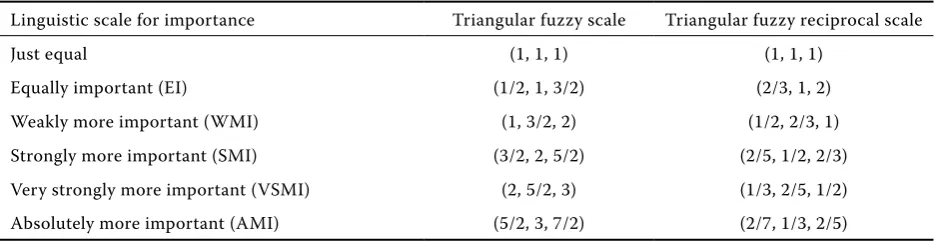
Step 1 – Using the fuzzy judgment scale given in Table 3, adopted from Dagdeviren and Yuksel (2008) scale operations on triangular fuzzy numbers, a fuzzy positive reciprocal matrix is constructed:
> @
aijA~ ~ (6)
and the geometric mean of each row are computed
~aij =(lij, mij uij):
n j ij n a r 1 ~~ (7)
Then the normalized weight ~wi is determined using the following formula (Dagdeviren, Yuksel 2008):
¸¸ ¸ ¸ ¸ ¸ ¹ · ¨¨ ¨ ¨ ¨ ¨ © §
¦
¦
¦
n i i i n i i i n i i i i l u m m u l w 1 1 1 , , ~ (8)Step 2 – Consistency check: The decision maker has to redo the ratios when the comparison matrix fails to pass the consistency test. The value of λmaxis
computed as the modal value of the resulting fuzzy number, through employing the original Saaty’s pro-cedure, but using the operations on fuzzy triangular numbers. Then, if the CR > 0.1, then the fuzzy judg-ment matrix must be revised until reaching or being below 0.1 consistency value.
Step 3 – Synthesizing: the weights obtained for each alternative under each criterion is first multi-plied respectively to the weight of the criterion, and then summed up over all criteria to obtain the final weight for each alternative. The same procedure can be utilized between each two subsequent level in the Fuzzy-AhP evaluation hierarchy.
Step 4 – Ranking: given the final weights of alter-natives, expressed in fuzzy triangular form, now we need to defuzzify these fuzzy weights in order to be able rank alternatives in a non-fuzzy forms (here in this paper alternatives are the evaluated experts’ importances). This could be accomplished through utilizing the Best non-fuzzy Performance BnP values defuzzification method (chen et al. 2008). Thus, the overall judgmental priorities of experts opinions can be now determined using defuzzification by the BnP, since a fuzzy number represents the fuzzy synthetic decision reached for each alternative, we need to defuzzify these fuzzy numbers in order to compare the alternatives ranking method. in previous works, the procedure of defuzzification has been to locate the best non-fuzzy performance (BnP) value, based on the center of area (coA). The coA is a simple and practical method, and there is no need to introduce the preferences of any evaluators. The coA method’s BnP value for triangular fuzzy performance score can be calculated as follows:
3 ) ( ) (u l m l l
BNP (9)
next section, the proposed Fuzzy-AhP is applied to the evaluation of experts’ importances.
EVALUATING EXPERTS’ DECISION MAKING IMPORTANCES
[image:4.595.64.532.645.766.2]Suppose that the company’s chief executive officer (cEo), considered as a supra decision maker, who
Table 3. Linguistic scales for intensity importance
Linguistic scale for importance Triangular fuzzy scale Triangular fuzzy reciprocal scale
Just equal (1, 1, 1) (1, 1, 1)
Equally important (Ei) (1/2, 1, 3/2) (2/3, 1, 2)
Weakly more important (WMi) (1, 3/2, 2) (1/2, 2/3, 1)
Strongly more important (SMi) (3/2, 2, 5/2) (2/5, 1/2, 2/3)
Very strongly more important (VSMi) (2, 5/2, 3) (1/3, 2/5, 1/2)
has a sufficient knowledge and experience to assess the relative importance of every experts, will assign the relative importance intensity values in pair-wise comparisons using the fuzzy linguistic scale (Table 3). Three criteria are considered to be related to the as-sessing experts’ decision making capabilities, and are to be included as basic parameters in comparisons:
– Knowledge: the amount of important knowledge and information each expert bears.
– Experience: the age and historical deepness of the expertise contained in each expert.
– relevance: the degree of how much each expert has knowledge pertaining and relating to the decision problem.
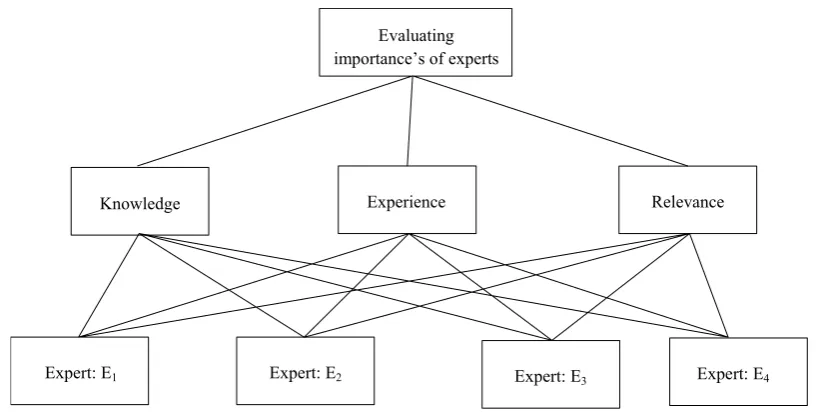
Then, following the AhP hierarchy shown in Figure 2, the supra decision maker is to conduct all the needed pair-wise comparisons judgments
us-ing the fuzzified scale in Table 3. Suppose that his judgments and matrices were as in Tables 4–7. The computations and the associated consistency ratios are then presented below.
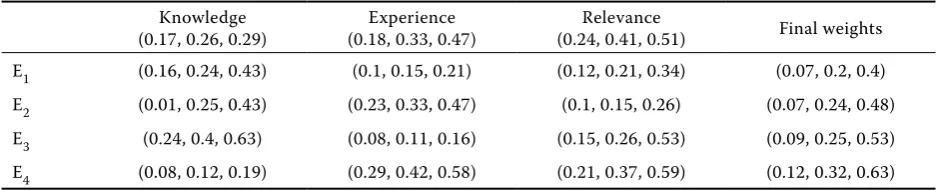
having computed the weights of each expert un-der each judgment criteria, these weights are then synthesized for all criteria to give the final weights of each expert as a whole. Table 8 shows these syn-thesizing computations.
Thus in order to rank the experts’ final weights uti-lizing crisp values, the final fuzzy triangular weights shown in Table 8 are defuzzified using equation (9) to compute the best non-fuzzy performance value (BnP), and gives:
ܤܰܲாభൌ ͲǤʹʹܤܰܲாమൌ ͲǤʹܤܰܲாయ ൌ ͲǤʹͻܤܰܲாరൌ ͲǤ͵
Relevance Experience
Knowledge
Evaluating importance’s of experts
[image:5.595.84.496.64.271.2]Expert: E1 Expert: E2 Expert: E3 Expert: E4
[image:5.595.63.534.564.630.2]Figure 2. Experts’ weights evaluation hierarchy
Table 4. comparison matrix of the importance of the three judgment criteria
Knowledge Experience relevance Weights
[image:5.595.63.534.674.754.2]Knowledge (1, 1, 1) (2/3, 1, 2) (2/5, 1/2, 2/3) (0.17, 0.26, 0.29) Experience (1/2, 1, 3/2) (1, 1, 1) (2/3, 1, 2) (0.18, 0.33, 0.47) relevance (3/2, 2, 5/2) (1/2, 1, 3/2) (1, 1, 1) (0.24, 0.41, 0.51) cr = 0.046 < 0.1 (Acceptable)
Table 5. comparison matrix of the four experts with respect to knowledge criterion
E1 E2 E3 E4 Weights
E1 (1, 1, 1) (2/3, 1, 2) (2/5, 1/2, 2/3) (2, 5/2, 3) (0.16, 0.24, 0.43) E2 (1/2, 1, 3/2) (1, 1, 1) (1/2, 2/3, 1) (3/2, 2, 5/2) (0.01, 0.25, 0.43) E3 (3/2, 2, 5/2) (1, 3/2, 2) (1, 1, 1) (5/2, 3, 7/2) (0.24, 0.4, 0.63) E4 (1/3, 2/5, 1/2) (2/5, 1/2, 2/3) (2/7, 1/3, 2/5) (1, 1, 1) (0.08, 0.12, 0.19) cr = 0.009 < 0.1 (Acceptable)
Then, these values could be normalized into, 0.2, 0.23, 0.25, & 0.32 to sum up 1. clearly the opinion of the expert number four should be deemed the most important. however, it is obvious in the result of this example that relatively the importances or weights of these experts are close to each other, but anyway, there is still a little difference that could be useful in resolving the potential conflict.
CONCLUSION
The problem of evaluating the importances of the ex-pert decision makers in conducting a critical decision making is extremely important because the resulting weights can serve as an important tool for the conflict resolution, a typical case and frequent in complex ill-structured situations. The importance’s evaluat- ion itself is ill-structured, because factors deter-mining importances are all not known and mainly are subjective. The extension of the efficient AhP into Fuzzy-AhP enables handling the vagueness
associated with subjective assignments and com-parisons. The merit of using a fuzzy approach is to assign the relative importance of attributes using fuzzy numbers instead of crisp numbers. Finally, the adopted procedure of the Fuzzy-AhP in this paper is simple and computationally not cumbersome.
REFERENCES
Boender c.g.E., de graan J.g., Lootsma F.A. (1989): Multi-criteria decision analysis with fuzzy pair-wise comparisons. Fuzzy Sets and Systems, 29
(2): 133–143.
Buckley J.J. (1985): ranking alternatives using fuzzy numbers. Fuzzy Sets and Systems, 15 (1): 21–31. chang D.Y. (1996): Applications of the extent analysis
method on fuzzy AhP. European Journal of op-erational research, 95 (3): 649–655.
[image:6.595.63.533.84.171.2]chen M.F., Tzeng g.h., Ding c.g. (2008): combining fuzzy AhP with MDS in identifying the preference
Table 6. comparison matrix of the four experts with respect to experience criterion
E1 E2 E3 E4 Weights
[image:6.595.65.534.218.306.2]E1 (1, 1, 1) (1/3, 2/5, 1/2) (1, 3/2, 2) (2/7, 1/3, 2/5) (0.1, 0.15, 0.21) E2 (2, 5/2, 3) (1, 1, 1) (5/2, 3, 7/2) (1/2, 2/3, 1) (0.23, 0.33, 0.47) E3 (1/2, 2/3, 1) (2/7, 1/3, 2/5) (1, 1, 1) (2/7, 1/3, 2/5) (0.08, 0.11, 0.16) E4 (5/2, 3, 7/2) (1, 3/2, 2) (5/2, 3, 7/2) (1, 1, 1) (0.29, 0.42, 0.58) cr = 0.015 < 0.1 (Acceptable)
Table 7. comparison matrix of the four experts with respect to relevance criterion
E1 E2 E3 E4 Weights
E1 (1, 1, 1) (3/2, 2, 5/2) (1/2, 1, 3/2) (2/7, 1/3, 2/5) (0.12, 0.21, 0.34) E2 (2/5, 1/2, 2/3) (1, 1, 1) (1/2, 2/3, 1) (2/5, 1/2, 2/3) (0.1, 0.15, 0.26) E3 (2/3, 1, 2) (1, 3/2, 2) (1, 1, 1) (2/3, 1, 2) (0.15, 0.26, 0.53) E4 (5/2, 3, 7/2) (3/2, 2, 5/2) (1/2, 1, 3/2) (1, 1, 1) (0.21, 0.37, 0.59) cr = 0.056 < 0.1 (Acceptable)
Table 8. Synthesizing experts’ weights respect to the evaluation criteria Knowledge
[image:6.595.63.535.354.449.2]similarity of alternatives. Applied Soft computing,
8 (1): 110–117.
Dagdeviren M., Yuksel i. (2008): Developing a fuzzy analytic hierarchy process (AhP) model for be-havior-based safety management. information Sciences, 178 (6): 1717–1733.
Dubois D., Prade h. (1980): Fuzzy Sets and Systems. Academic, new York.
Duran o., Aguilo J. (2008): computer-aided ma-chine-tool selection based on a Fuzzy-AhP ap-proach Expert Systems with Applications, 34 (3): 1787–1794.
Froněk P., Jelínek L., Medonos T. (2007): The multic-riterial evaluation of agricultural enterprises. Ag-ricultural Economics – czech, 53 (3): 123–131. Laarhoven P.J.M., Pedrycz W. (1983): A fuzzy
ex-tension of Saaty’s priority theory. Fuzzy Sets and Systems, 11: 229–241.
Lefley F., Sarkis J. (1997): Short-termism and the appraisal of AMT capital projects in the US and
UK. international Journal of Production research,
35 (2): 341–368.
Michalski g. (2008): operational risk in current as-sets investment decisions: Portfolio management approach in accounts receivable. Agricultural Eco-nomics – czech, 54 (1): 12–19.
Saaty T.L. (1980): The Analytic hierarchy Process. Mcgraw-hill, nY.
Svoboda E. (2007): Knowledge-management in mana-gerial work of business management. Agricultural Economics – czech, 53 (7): 298–303.
Svoboda E. (2008): Strategic decision-making of the company management using the findings of knowledge management. Agricultural Economics – czech, 54 (9): 406–412.
Triantaphyllou E., Lin c.T. (1996): Development and evaluation of five fuzzy multi-attribute deci-sion-making methods. international Journal of Approximate reasoning, 14 (4): 281–310.
Arrived on 30th May 2008
Contact address:
Shady Aly, ivan Vrana, czech University of of Life Sciences in Prague, Kamýcká 129, 169 51 Prague 6-Suchdol, czech republic