‘Mmrecord’ -more than just an annotation tool
Benny .
Benjamin Jabold -Univserity of Twente
S1472879 First Supervisor: Prof. Dr. F. Van der Velde
1
Table of Content
Abstract ... 2
1.0 Introduction... 3
1.1 Group Decision Making ... 4
1.2 Decision Support Systems ... 7
1.3 The Study conducted for this paper ... 9
2.0 Method ... 12
2.1 Design ... 12
2.2 Participants ... 13
2.3 Materials ... 13
2.4 Procedure ... 16
2.5 Data Analysis... 17
3.0 Results ... 18
3.1 Words and turns... 18
3.2 Means of tags... 18
3.3 Distribution of tags over time ... 19
3.4 Correlations between tags ... 27
4.0 Discussion... 27
4.1 Findings of this study ... 27
4.2 Limitations ... 30
4.3 Future research ... 31
5.0 Conclusion ... 31
References ... 33
Appendix... 35
Appendix A ... 35
Instructions for the researcher ... 37
Form 1... 38
Informed consent... 43
2
Abstract
This study was conducted under the umbrella project of the Living Smart Campus at
the University of Twente. The thesis tries to contribute to the theoretical base for the use of
Group Decision Support Systems (GDSS). The effectiveness of the app Mmrecord, originally
designed as a meeting recording and annotation tool, when used as a GDSS in order to enhance
collaborators awareness of the content of their collaborators speech to promote the creation of
a collaborative frame was examined. A one factorial design was applied to test the impact of
the app on the discussion progress in a conjunctive design task in a face to face setting. No
impact was found on the quantity of participants speech, however participants needed les
propositions, arguments and counter arguments to reach more decisions in the given period of
time when using the app. The app Mmrecord can be used as an effective tool to enhance the
efficiency of the discussion-making process in conjunctive design tasks in face to face
3
1.0
Introduction
The Living Smart Campus (LSC) Project is a collection of research projects at the
University of Twente (UT) dedicated to the development of the university campus into a
digitally aided environment. The project was initiated as a response to indications of external
parties that they are lacking awareness of on-campus projects that might be worth getting
involved into (Lankhaar, 2016). The idea is to use the campus as a laboratory for a digitalized
environment to make it easier for external companies to get involved into projects. The LSC
tries to realize the UT’S main goals – innovate, experiment and pioneer. The UT tries to pioneer
the field of a digitally aided environment, hand in hand with companies working in the field,
by experimenting with innovative technologies at the UT campus, which is functioning as a
living laboratory. The campus is thought to be a suitable ground for a living laboratory because
of the nature of its small society, in which students and scientist are living and worki ng close
to each other. The in sub-projects of the LSC introduced innovative technologies are solutions
to mostly societal matters which are tested in the small society of the campus before applying
them to the real-world society outside of the campus. An example of a sub-project of LSC is
the ‘Privacy Preserved Crowd Monitoring’ (Winkler, 2016). In the project, 150 wi-fi scanners
were used to locate mobile devices broadcasting information to connect to the wi -fi network.
By locating their mobile devices, crowd movements and their patterns could be monitored.
External parties were consulted to consider the ethical component of the project, as privacy
issues were clearly involved. A possible application of the system would be a smart navigation
system on the UT campus. The research presented in this thesis was conducted as sub project
of the LSC as well. The societal matter to addressed in this sub-project is the issue of
group-decision making. Due to the technical orientation of the UT and the practical oriented
curriculum, naturally a lot of meeting of student and employee project groups meet on the UT
4
in the process by which groups of people make decisions on all kind of issues, how the
decision-making process of individuals can be aided by technology and how the thereby acquired
knowledge can be used to design technology suited to aid the decision-making process of
groups. In this paper, the app ‘Mmrecord’, which is thought to support the decision-making
process of groups, is presented. On the campus ground in meeting rooms, tablets featuring the
app and possibly other tools to support the group’s work could be installed, taking a step
forward to a digitally aided campus environment. The goal of this thesis is to contribute to the
theoretical basis of how the decision-making processes of groups can be aided.
1.1 Group Decision Making
Each person has their own understanding of how the world works. This understanding
was formed by association between ideas of causes i.e. circumstances, events or actions and
effects, thus their outcomes (Owen, 2015). These associations of ideas are strengthened when
they frequently occur simultaneously or with little temporal delay. They are retrieved fast by
an automatic mental process and can yield a complex representation of how the world works.
This representation is what we sense or feel how the world works. Owen (2015) calls this our
‘vision’. Because of the limited knowledge every single person possesses, the vision of the
world constructed by these associations is naturally simpler but more coherent than the actual
world it represents. However, the danger exists to confuse one’s vision with the actual world.
The vision determines one’s interpretation of the present and possible predictions of the future.
Using active (non-automatic) mental effort, the vision can be applied to a specific domain in
an ordered series of steps. This logically ordered representation of the world constitutes one’s
frame of a given problem. This frame consists of information available to a person, their values,
preferences and already taken decisions. A person’s frame, thus, depends on their experience.
As different people, in sum, naturally have different experiences during their lifetime, their
5
proposed a necessity for aggregation of the decision makers’ understanding of the problem
during the discussion to yield optimal results. For a group of people to effectively discuss a
given problem, they first need to construct a shared frame of the problem at hand. If they fail
to construct such a shared representation, this might lead to a feeling that the wrong problem
was discussed or to distrust of the discussion result .
Surowiecki (as cited in Owen, 2015, p.32; as cited in Letho, Nah & Yi, 2006, p.
229-230) developed the concept of ‘wisdom of the crowds’ based on a series of experiments
demonstrating a better performance of the whole group than that of any member on a range of
tasks. He proposes that the joined understanding of a given problem is better than the
understanding of one individual. This joined understanding is formed by aggregating the
overlap in understanding between group members. For the aggregation of frames to function
properly and to yield a better result than any single frame of a group member, he identified four
conditions that need to be satisfied. The opinion of the group members should differ in some
points, that is, even if the same known facts are shared between group members. the
interpretation thereof should be distinct. The opinion of group members should be formed
independent of that of the others. The knowledge in the group has to be decentralized, that is,
the members of the group should be specialized and be able to draw from their own knowledge
distinct of that of the other group members. Finally, a mechanism to aggregate the
understanding, that is to transform a private opinion into a shared one, needs to be in place.
A proposed mechanism for aggregation of the collaboration members’ understanding
is to have a dialogue, defined as a well-structured discussion of previously prepared materials
facilitated by a decision professional applying classical ‘decision analysis’ to the collaborative
decision process (Owen, 2015). Decision analysis applies classical decision theory in order to
improve human decision making of a single agent. For decision analysis to work, the agent is
6
A more detailed discussion of decision analysis for single agents can be found in Lehto and
colleagues (2006). Owen (2015) argues that applying the concepts underlying decision analysis
to collaborative decision-making results in a discussion structure of four phases. It is worth
noting that the term ‘collaborative decision-making’ is used instead of ‘group decision-making’
in order to put emphasis on the mental effort of the whole group that is required to build a
shared frame of a problem. The first phase is the development of a ‘collaborative frame’ of the
decision problem that is accepted by all members of the discussion by aggregating the personal
frame of all collaboration members to a shared more complete frame. The second phase is the
creation of ‘collaborative alternatives’, which represent the span of the collaborative frame.
This includes all possible alternatives that are allowed for within the boundaries of the frame.
In the third phase, a ‘collaborative understanding’ is created. To achieve this, the underlying
premises for each collaborative alternative must be examined. When all collaborators agree on
all premises, the understandings of the collaborators have been aggregated. In the last phase, a
‘collaborative connection’ between the proposed alternatives is established, combining the best
features of each alternative in one solution for the decision problem, which most likely is a
course of action to be taken. Because this course of action lies within the shared frame of the
problem and is a combination of the alternatives, on which’s premises have been agreed upon
by all collaborators, all collaborators feel ownership for the course of action and are willing to
implement it subsequently.
Though, along with these findings, a possible problem that could impede this process
was identified as well. This problem is called ‘frame blindness’ and is conceptualized as a
wrong cogitation ignoring the best possible option or important processes (Owen, 2015). To
prevent this, it is necessary to look for what is right in the contributions of other collaborators
instead of looking for what is wrong. Because of the social nature of a collaborative process, a
7
well (Brashers, Adkins & Meyers, 1994). These are submission to the higher status and thus
the opinion of another individual, acceptance of expert opinions in their field of specialization
as a matter of fact, the democratic conception that the majority should be allowed to rule and
the avoidance of conflict and confrontation whenever possible. A number of possible solutions
for the described problems have been identified by Likert & Likert (as cited in Letho et al.,
1976). One of these solutions is not to conceptualize a decision as a win or lose situation, as
when voting or negotiating, but rather as reaching consensus. This proposed strategy is
consistent with the collaborative decision-making process described above.
1.2 Decision Support Systems
In addition to the methods described above, which can be used to reach a shared
understanding of the problem at hand, research has put great emphasis on how to aid the
decision-making process with technical devices. Decision Support Systems (DSS) were
originally designed as single user programs to aid managers when making ill-structured
decisions. With the goal of a user centred design, emphasis was put on decision models,
databases and interactive usability, for example for the creation of graphs (Bui & Jarke, 1986).
The three classical functions of a DSS were data base management, modelling tools and user
interface designs (Shim, Warkentin, Courtey, Power, Sharda & Carlsson, 2002). Baumeister
and Striffler (2015) distinguish between five different forms of DSS depending on their
emphasis. These are Data Driven DSS, which provide support by analysing big amounts of
data; Model Driven DSS, which provide access to models for various purposes such as
accounting or financing and a workspace to work on them; Document Driven DSS, which
provide support for the collection and classification of large amounts of unstructured
information; Knowledge Driven DSS, which provide support by using problem solving
capabilities to propose a course of action to solve a given problem; and lastly Communicatio n
8 purposes of a DSS.
This last type of DSS has constantly gained greater attention in the scientific research,
as a great deal of decision making in real world organizational settings takes place in a
collaborative context (Baumeister & Striffler 2015; Bui & Jarke, 1986; Lam, 1997). DSS
designed to specifically support the group interaction process are also called Group Decision
Support Systems (GDSS). By focusing on group rather than on individual process a GDSS tries
to enhance effectiveness and efficiency of collaborative decision-making processes (Lam,
1997). Bui and Jarke (1986) identified functions and roles of a GDSS within the
decision-making process. To foster the understanding between group members and to prevent the
development of distrust, the system should adopt the degree of communication as appropriate
to the group size and the decision situation. It should support structured communication to
reduce negative group effects (for example the “surveillance effect”) and try to adjust to
individually preferred communication forms while keeping consistency within the group. The
system should monitor the form of communication in accordance with previously agreed rules
and finally adapt these rules as fitting to the current stage of the discussion process. While the
system is performing these functions, it should be considered as taking on three roles within
the discussion. In the role of the coordinator the system helps to recognize and formalize the
problem that needs to be solved. As a detective, the system should enforce the communication
structure agreed on in advance. As an inventor, it should analyse the data transferred between
users to detect incompatible information exchange and foster communication forms that enable
an information exchange. In short, “GDSS aim to increase the efficiency, reliability and quality
of group decision making” (Lam, 1997, p. 194).
Consistent with the aim of GDSS, research in the field usually tries to examine how
systems can be used to support the efficiency and quality of the decision-making process (Shim
9
with the effectiveness of non-supported groups as so far let to contradictory results (Lam,
1997). Todd and Benbasat (1991) state the need for models and hypotheses for further research,
as there is “[…] yet no strong theoretical base for predicting how DSS will influence decision
making” (p. 87). Because of this missing theoretical base, adoption of the system remains
difficult (Kolfschoten, Lukosc & Leimeister, 2013). The effectiveness of GDSS often depends
on the presents of a skilled facilitator. A possibility to overcome the need for the facilitator is
to incorporate the facilitator into the system. The so called ‘facilitator in the box’. Kolfschoten,
Lukosc and Leimeister (2013) proposed the ‘facilitator in the box’ as a next step for a future
research direction. They differentiate between a range of levels of collaborative guidance: the
setting of the agenda, proposal of techniques, moderating the discussion, monitoring of the
quality, analysis of results and the creation of awareness.
1.3 The Study conducted for this paper
Lam (1997) argued that no single theory would be able to capture the complexity of
factors influencing the functioning of GDSS. There is rather the need for many smaller theories
focusing on the functioning of specific forms of GDSS in specific conditions. The research
presented in this paper tries to contribute to the theoretical ground for the development of
GDSS by testing the effectiveness of a ‘facilitator in the box’, which is setting a short agenda
and trying to enhance the awareness of participants for specific parts of the discussion and
thereby supporting the development of a collaborative frame. Used as ‘facilitator in the box’
was an app originally developed as meeting annotation or meeting report tool by the research
group Tech-cico at the Université de Technologie de Trtoyes in France. The app is called
Mmrecord and can record meetings while being used as an annotation tool annotating meta
information to the recordings (Dai, Matter&Ducellier, 2015). The meta information to be
annotated to the recordings during the current study was based on concepts that have been
10
(2015). These concepts are ‘issue’, ‘proposition’, ‘argument’ and ‘decision’. Issue is the larger
problem that needs to be addressed. Propositions are solutions to the problem specified through
the issue. Arguments can specify the issue or evaluate a proposition (positive and negative).
Propositions can evolve due to arguments in a more elaborated proposition. Decisions are
selections of propositions. These concepts were transferred to the app Mmrecord. To
differentiate between its positive or negative evaluating nature, the concept ‘argument’ was
divided into two different concepts named ‘argument’ (positive evaluation of a proposition or
other arguments) and ‘counter-argument’ (negative evaluation of a proposition or a previous
argument). The concept ‘off-topic’ was added to characterize utterances of collaborators that
are not referring to the statement that preceded it and are therefore conceptualized not to be of
value to the discussion process. The concepts are represented by buttons that can be pressed to
annotate meta information to the speech recorded by a microphone. A short agenda was set by
the identification of three issues that are sub-problems of the discussion topics used for the
study. One of these sub-problems can be selected at a time and has to be selected before the
other buttons, which are representing the concepts, can be pressed. Selecting the current
sub-problem of the discussion is theorized to enhance the awareness of the agenda to be worked
through. A more detailed description of the app layout can be found in the material section.
The identified concepts can be described as well regarding their relation to the members
of the collaborative process. Members evoke propositions. They evoke arguments to justify
propositions and make decisions based on propositions (Dai et al., 2015). Using the app to tag
every statement made by any member of the discussion with one of the available concepts is
hypothesized to enhance the awareness of the content of statements of other discussion
members and thereby promoting the aggregation of a collaborative understanding, as theorized
by Owen (2015), resulting of in more decisions when using the app.
11
collaboration in different task types, and found out that the communication structure was
altered for conjunctive and disjunctive tasks, but not for additive tasks, when using a GDSS.
Additive tasks are tasks in which all group members possess similar information and contribute
to the decision of the group. Group success depends on the quality of the aggregated
contributions of all group members. Disjunctive tasks are those w here each group member
proposes their own solution to the problem defined by the task and the group must select the
best proposed solution. Group success depends on the ability of the best group member to solve
the task and the ability of the others to recognize this to be able to accept the solution proposed
by the best group member. The success in these kinds of tasks is theorized to be influenced
mostly by the contribution of the best group member. Conjunctive tasks are those in which all
group members own different information relevant to the defined problem. Similar to additive
tasks, group success depends on the aggregation of the contributions of all group members and
the problem can only be solved by effortful contributions off all group members, because no
single group member owns enough information to propose an optimal solution to the given
problem. Group performance is theorized to be influenced heavily by the performance of the
group member making the least contribution to solve the problem. In these conjunctive tasks
Lam (1997) found the group to recognize the requirements of the conjunctive task and adopt
the decision aids provided by the GDSS. Significantly more arguments and more group
interaction in general in terms of total number of comments were found. These findings are
consistent with the results of Todd & Benbasat (1991) who found participants of a discussion
to adopt their discussion style to the support of the system to the given task when available.
The design tasks assigned in this study can be conceptualized as being conjunctive in
nature, as no participant was an expert in the domains of the discussion topics and people
naturally own different information. In accordance with the results of the studies conducted by
12
discussion, provided by the app was hypothesized as well as a resulting alternation of the
communication pattern of the discussion. Furthermore, more group interaction in terms of
contributions to the discussion was expected. The hypothesis tested in this research are
summarized below.
H1: The app Mmrecord promotes the aggregation of a collaborative understanding leading to
a greater total number of decisions in a discussion when using the app.
H2: The other concepts provided by the app (proposition, argument, counter argument) are
used more frequently during the discussion when using the app, except for off-topic, which is
used less frequently when using the app.
H3: Using the app in a discussion alters the pattern of communication.
H4: More total interaction in terms of word-count can be found when using the app during the
discussion.
H5: More meaningful contributions to the discussion of each participant (in terms of turns
taken) can be found when using the app.
2.0 Method
The Data used for this study were collected in cooperation with Mira Oberhagemann
who used it for her master thesis at the University of Twente.
2.1 Design
The study used a 1x1 factorial design. The factor was use of the app. Four groups with
four participants each were attending two sessions. In one of the sessions the app was used, in
the other it was not. The participants were discussing one of two different design problems
with respectively three sub-topics in each of the sessions. The two design problems were
13
communication (something that combines e.g. buying/selling things, searching for room,
planning parties, offer study support etc.)’. More detailed descriptions of the design problems
and the sub-questions can be found in the instruction manual in Appendix A. The two factors
possibly affecting the results (session and design topic) were counterbalanced across groups.
These factors were treated as nuisance variables and, therefore, were not subject of further
analysis
2.2 Participants
All participants were psychology students from the University of Twente and were
recruited via the participant management system SONA. Twenty participants signed up for the
study. One of the participants of the pilot group did not show up during the second session and
was replaced by the supervisor of the master study. The sixteen participants that participated
in the sessions used for the actual data collection had an age of 18-22 years (mean age 20.19).
Three were male and thirteen were female. All groups contained three female and one male
participant, with one exception. The students earned three SONA credits for the participation
in the study and were given the possibility to leave their email address to participate in a lottery
in which they could win a twenty Euro coupon.
2.3 Materials
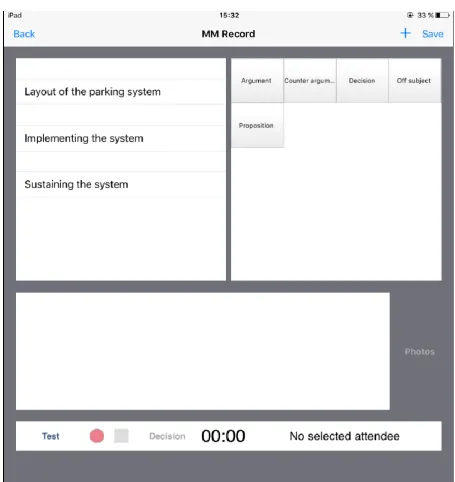
Four iPads with the app Mmrecord loaded were used for the study. As already
mentioned in the introduction the app was originally designed as a meeting record and
annotation tool. Buttons on the app can be used to annotate meta information to the audio
recordings at any given moment. The concepts ‘issue’, ‘proposition’, ‘argument’, ‘counter
argument’, ‘decision’ and ‘off topic’ were used as basis for the labels of the buttons depicted
at the top right-hand side of the screen. These buttons are labelled with ‘Proposition’,
14
‘issue’ three separate buttons, each representing a sub-question to the discussion topic, are
located on the left-hand side of the screen, they are labelled with the respective sub-problems.
One of these issues can be selected at a time. A screenshot of the app is depicted in Figure 1.
Four microphone headsets plugged into the iPads were used to record the audio of the sessions.
A separate voice recorder was used to record the audio of the session and the interviews. Two
cameras each focusing on the faces of two participants while showing the other two participants
peripherally were used to film the sessions. One copy each of the sheet ‘groups’, ‘instruction
for the researcher’, ‘form 1’ and each interview, five copies of the ‘instruction sheet for
participants’ and four copies of the ‘informed consent’ as well as four empty pages were needed
for each session. All documents can be found in Appendix A. The questionnaires and
15
Figure 1. Screenshot of the app Mmrecord. Buttons for the selection of the current sub-question
to be discussed are shown on the left-hand side. The buttons for the different tags are shown
16 2.4 Procedure
For each session, the four participants were seated at a table. Two participants each sat
at opposite sides of the table. The participants were greeted and told that they would be
explained the experiment in the first ten minutes and were going to be given the opportunity to
ask questions afterwards. The Microphones and tablets were prepared. Participants were
explained the experiment and handed the ‘instruction sheet for participants’. The instruction
sheet contained information about the discussion process and duration, the issue to be discussed
during the session and the three sub-questions that should be discussed during the session with
no need to reach a conclusion. Information about typical elements that can be found in a
discussion (proposition, argument, counter-argument, decision, off-topic) were given and an
example for each of these elements was provided. In the app-condition, participants were
instructed to select the current issue of the discussion by pressing the respective button and tag
every utterance of a participant that fitted into one of the concepts represented by the buttons .
The participants were given the opportunity to ask questions. The informed consent form was
handed out and signed. The possibility for questions was given again. Recording was started.
Participants were instructed to start discussing for the next thirty minutes on a sign by the
researcher. During the discussion participants had the opportunity to make notes and to draw
on blank sheets of paper. After 25 minutes, they were told that only five minutes were left.
After five more minutes, they were instructed to stop discussing. The recording was stopped.
Participants were given the opportunity to ask questions. Thereafter, participants were
interviewed individually with audio recording. After the interview, the questionnaire was
handed out and filled out by the participant. The interviewed participant was given the
possibility to ask question. In the first session, the appointment for the next session was
17
in until all four participants of a group took the interview and questionnaire and confirmed the
appointment for the next session. In the second session, all steps were repeated.
2.5 Data Analysis
For further analysis, the audio recordings of the discussion sessions were transcribed.
Words per participant per session were counted using the word count tool of Microsoft Word.
Turns, defined as meaningful contribution to the discussion, so no attentive utterances like ‘go
on’ or ‘yeah’, were counted per participant and session. For the statistical analysis Microsoft
Excel was used. Means of words and turns per minute per session were calculated. The means
were compared between app and no-app conditions with one sided t-tests, as means of words
and turns per minute were hypothesized to be greater in the app condition. Cohen’s d was
computed as a measure of effect size, as the sample size was relatively small. Even with small
samples sizes, the effect size can be used as an indicator for a possible impact of the researched
variable.
The discussions were coded using the same tags and instructions for tagging as
available to the participants during the sessions (‘Proposition’, ‘Argument’, ‘Counter
argument’, ‘Decision’ and ‘Off topic’). The tags were counted per participant per session and
the total tag-count per session for each tag was calculated. The sums of all tags per category
were calculated for and compared between app and no-app conditions. The standard deviations
per category of tag were calculated. Per session, the number of occurrences of each tag was
plotted against two and a half minute intervals in order to make the discussion process visible.
Correlations between the number of tags in two and a half minute intervals per session were
calculated. Mean correlations for app and no app conditions were calculated using Fisher’s
18
3.0 Results
3.1 Words and turns
Table 1 shows the results of t-tests on the differences between word and turn count in
the app and no-app condition and the Cohen’s d-values of the effect of use of the app for word
[image:19.595.75.492.275.384.2]and turn count.
Table 1.
Results of a t-test on differences between words and turns in the app- and no-app-condition. Effect size calculated with Cohen’s d.
Variable DF t-value p
Differ ence Mean Mean SD Cohen’s d
Turns 3 -1.95 .07 -1.08 0.66 -1.62
Words 3 -1.25 .15 -2.33 2.99 -0.78
There were no statistically significant differences of word and turn count between app
and the no-app conditions. On the other hand, Cohen’s d-value indicates a large effect size of
the app use on the number of turns taken and a medium effect size on the number of words
spoken in the negative direction. Cohen’s d-value thus suggest an effect of the app towards less
words and turns per participant.
3.2 Means of tags
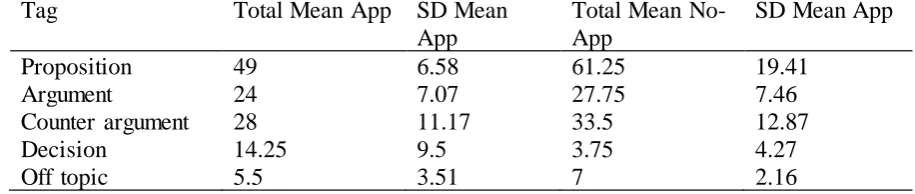
Table 2 shows the mean number of tags per session for each category for the app and
[image:19.595.67.525.675.772.2]the no-app conditions and the standard deviation between groups per condition.
Table 2.
Mean number of tags per session for app and no-app condition and the standard deviation between groups.
Tag Total Mean App SD Mean
App
Total Mean No-App
SD Mean App
Proposition 49 6.58 61.25 19.41
Argument 24 7.07 27.75 7.46
Counter argument 28 11.17 33.5 12.87
Decision 14.25 9.5 3.75 4.27
19
The mean number of tags per session are higher in the no-app condition for the tags
‘Proposition’, ‘Argument’, ‘Counter argument’ and ‘Off topic’. The difference is never greater
than a factor of 1.27. Only the mean number of the tag ‘Decision’ is higher in the app condition.
The difference has the factor 3.8. The standard deviation for propositions is considerably higher
in the app condition. It was almost the same between conditions for the arguments and counter
arguments. The standard deviation of decisions was considerably higher in the app condition.
It should be noted, that the tags with the greatest difference in their means between conditions
are at the same time those with the most variations within conditions. However, for
propositions all but one group had more propositions in the no-app conditions and all four
groups had more decisions in the app condition.
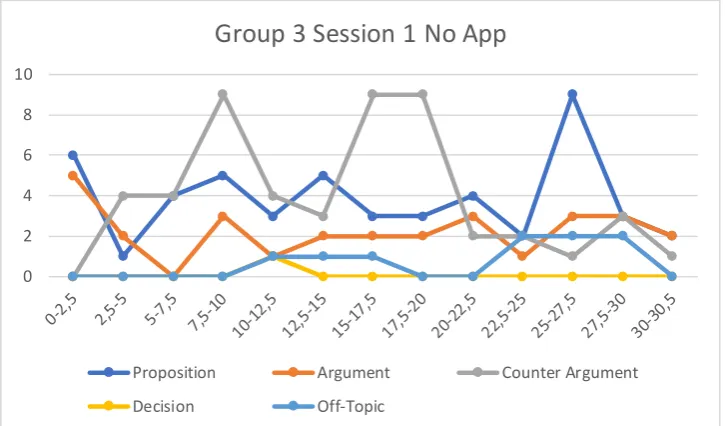
3.3 Distribution of tags over time
Figure 2 till 9 show the distribution of tags over time for all groups in both conditions.
The x-axis shows two-and-a-half-minute time intervals and the y-axis the number of tags that
has been coded. Which colour indicates which tag is explained in the legend of each graph.
For consistency for each group the app condition is shown first, regardless whether the app was
used in the first session of that group. The plots for the two conditions for each group are
described separately and are compared subsequently. For all figures the graphs do not show
flat lines but do have ups and downs, thus communication is changing over time. Other general
20
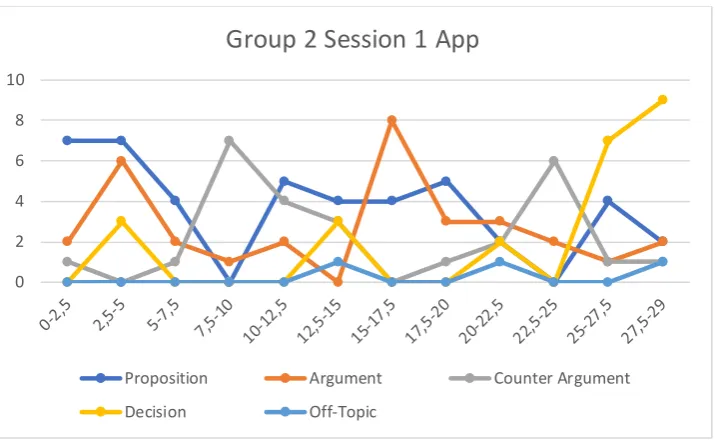
Figure 2 - Discussion pattern of group 2 in the app condition
Figure 2 shows the discussion pattern of group two in the app-condition. Propositions
are present almost throughout the whole session. Arguments have two main ups but are present
almost throughout the whole session as well. Ups and downs of propositions and
counter-arguments are interchanging. Phases of decisions are clearly visible. Off-topic comments seem
[image:21.595.71.433.497.709.2]to occur infrequently but only in times where decisions are made.
Figure 3 – Discussion pattern of group 2 in the no-app condition
0 2 4 6 8 10
Group 2 Session 1 App
Proposition Argument Counter Argument
Decision Off-Topic
0 2 4 6 8 10 12
Group 2 Session 2 No App
Proposition Argument Counter Argument
21
Figure 3 shows the discussion pattern of group 2 for the no-app condition. Almost in
each time interval propositions are visible. A few arguments do occur almost throughout the
whole session. Ups and downs of propositions and counter arguments are again inter changing.
No clear pattern of decision-making can be observed, but decision making takes place only
towards the end of the session. Off-topic comments are only used sparely.
Different patterns of discussion between both conditions can be observed. Arguments
seem to be used more often in the app condition. Interchanging ups and downs of propositions
and counter arguments can be observed in both conditions. Only in the app condition a pattern
of decision making in four phases is apparent. Off-topic comments are used sparely in both
[image:22.595.74.439.361.582.2]conditions.
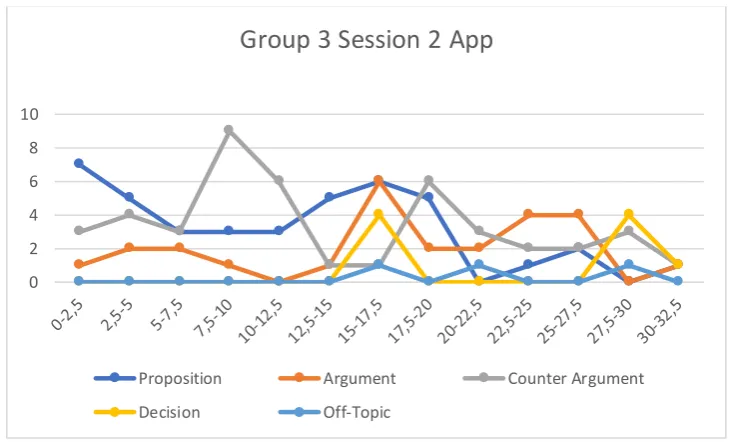
Figure 4 – Discussion pattern of group 3 in the app condition
Figure 4 shows the discussion pattern of group 3 in the app condition. Propositions are
stronger present until shortly after the first half of the session. Arguments do have stronger
presents in the second half of the discussion. Ups and downs of propositions and counter
arguments are again inter changing, although not always as clearly as before. Two phases of
0 2 4 6 8 10
Group 3 Session 2 App
Proposition Argument Counter Argument
22
decision making can be observed. Off-topic comments are only used sparely, as well when no
[image:23.595.77.440.135.348.2]decision was made during that time.
Figure 5 – Discussion pattern group 3 in the no-app condition
Figure 5 shows the discussion pattern of group 3 in the no-app condition. Propositions
do occur relatively stable throughout the session with a greater up toward the end of the session.
Arguments do occur relatively stable throughout the session. Counter Arguments do have high
ups. Ups and downs of propositions and counter arguments are again inter changing for all
occasions but one. No phases of decision making can be observed. Off-topic comments are
used more strongly.
Again, different patterns of discussion between both conditions can be observed.
Propositions are used more often in the no-app condition. Arguments do occur more stable in
the no-app condition over time. Only in the app condition a change in frequency of propositions
and arguments at about the half of the session can be observed. Again, interchanging ups and
downs of propositions and counter arguments can be observed in both conditions. A pattern of
decision making again is only visible in the app condition, but this time with only two phases.
Off-topic comments are used way more frequently in the no-app condition.
0 2 4 6 8 10
Group 3 Session 1 No App
Proposition Argument Counter Argument
23
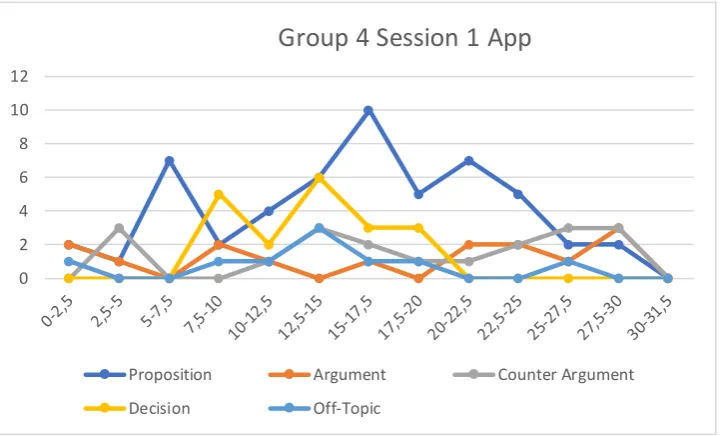
Figure 6 – Discussion pattern group 4 in the app condition
Figure 6 shows the discussion pattern of group 4 in the app condition. Propositions are
present throughout the whole session and do have three high ups. Arguments are only sparely
used. It is not visible that ups and downs of counter arguments and propositions are
interchanging, however the most counter arguments are visible in the time intervals with the
least propositions. Only one greater phase of decision making can be observed, though with
three clearly visible ups and only in the first two thirds of the session. Propositions and
decisions seem to have a very similar pattern over time. The Off-topic comments seem to be
used more frequently in the time intervals in which decisions are made.
0 2 4 6 8 10 12
Group 4 Session 1 App
Proposition Argument Counter Argument
24
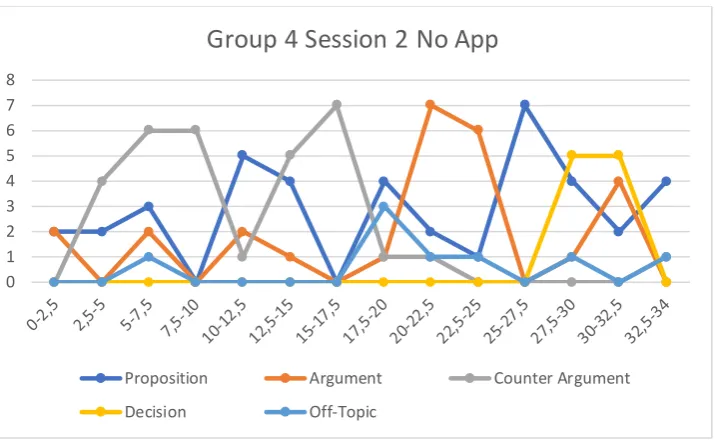
Figure 7 – Discussion pattern group 5 in the no-app condition
Figure 7 shows the discussion pattern of group 4 in the no-app condition. Propositions
seem to occur in phases. As well, arguments seem to occur in phases. Here again, interchanging
peaks of counter arguments and propositions are clearly visible. As well, only one greater phase
of decision making can be observed, though this time with a plateau towards the end of the
session. The Off-topic comments are distributed throughout the whole session.
Yet again, different patterns of discussion between both conditions can be observed.
Propositions have more ups and deeper downs in the no-app condition. The arguments are more
evenly distributed over time in the app condition. Interchanging ups and downs of propositions
can only be clearly observed in the no-app condition. Both condition seem to have one larger
phase of decision making, however with more than one up in the app condition, indicating
different phases which might not be visible due to the chosen time interval. The point in time
of decision making alters greatly between conditions. Off-topic comments seem more
randomly distributed throughout the session in the no-app condition.
0 1 2 3 4 5 6 7 8
Group 4 Session 2 No App
Proposition Argument Counter Argument
25
Figure 8 – Discussion pattern of group 5 in the app condition
Figure 8 shows the discussion pattern of group 5 in the app condition. Propositions are
present through the whole session with altering phases of many and few propositions.
Arguments seem to occur in general after many propositions have been made and timel y related
to counter arguments. Once more, interchanging peaks of counter arguments and propositions
are clearly visible, although with some smaller ups of counter arguments in phases with many
propositions. Two phases of decision making are visible. Off-topic comments are occurring
more stable in the second half of the session.
0 1 2 3 4 5 6 7 8 9
Group 5 Session 2 App
Proposition Argument Counter Argument
Decision Off-Topic
0 1 2 3 4 5 6 7 8 9
Group 5 Session 2 No App
Proposition Argument Counter Argument
[image:26.595.76.441.532.749.2]26
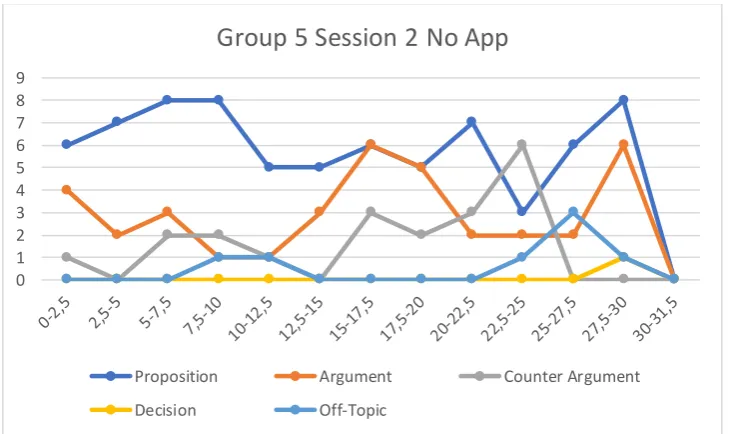
Figure 9 – Discussion pattern of group 5 in the no-app condition
Figure 9 shows the discussion pattern of group 5 in the no-app condition. Many
propositions are visible in the in all time intervals. Arguments were made throughout the whole
session with two higher ups occurring together with ups of propositions. During two extended
time intervals, the graph of arguments seems to be parallel to that of the counter arguments.
Ups and downs of counter arguments and propositions are only interchanging twice during the
end of the session and seem to be somewhat parallel before. There is only one up of decisions.
Off-topic comments seem to occur during tow extended time intervals.
Also in the last session, different patterns of discussion between both conditions can be
observed. Overall, there seem to be many propositions more constantly in the no-app condition.
The ups of the argument graph are higher in the app condition. Interchanging ups and downs
of propositions can only be clearly observed in the app condition. Decision making took place
more often in the app condition. The use of off-topic comments was more stable in the app
condition.
Analysis of the distribution of tags over time revealed a changing distribution of tags
over time, as tags plotted against time do not show flat lines but do have ups and downs. For
all groups, the distribution of tags over time was very different between experimental
conditions. In these changing distribution, patterns consistent over groups were revealed. The
ups and downs of propositions and counter arguments are interchanging for both conditions
quite consistently trough all sessions. There is no other relationship between two tags which
could be observed as consistently. Decision in the app condition appear to occur in phases as
indicated by different ups. This pattern was never found in the no-app condition. However, the
pattern of decisions in the app condition was never the same between groups, but altered
27 3.4 Correlations between tags
[image:28.595.75.523.166.276.2]Table 3 shows the mean correlations between the tags over time for both conditions.
Table 3.
Mean correlation between tags for both conditions. Correlations for the app condition are shown under and for the no-app condition above the main diagonal.
Proposition Argument Counter argument
Decision Off topic
Propositions 1 0.25 -0.24 0.15 0.05
Argument 0.06 1 -0.14 0.04 0.03
Counter argument
-0.25 -0.14 1 -0.15 -0.06
Decision 0.01 -0.08 -0.21 1 0.17
Off topic -0.20 -0.03 -0.04 0.62 1
No strong correlation between any two tags was found. Some tags like ‘Proposition’
and ‘Counter argument’ are negative correlated. More tags were negatively correlated in the
app condition than in the no-app condition. However, tags that showed a different correlative
relationship between conditions had either correlation close to zero or were correlated to ‘Off
topic’. The strongest correlation was found between Off-Topic and Decision in the app
condition. At the same time, this correlation had the greatest difference between conditions.
The largest difference between conditions which was not a correlation to ‘Off topic’ was found
in the correlation of proposition and argument, being considerably higher in the no-app
condition.
4.0 Discussion
4.1 Findings of this study
The findings suggest that there is no difference of both total amount of words and turns
taken by participants between app and no-app condition, as t-tests show statistically
insignificant results. On the other hand, Cohen’s d suggests a medium effect of the app on the
total word count and a strong effect on the number of turns taken by each participant in the
28
and turns in the app condition. The insignificant results of the t-tests might be due to the fact
that the observed effect was in fact in the opposite direction than the hypothesized effect. The
aggregated evidence of both measures suggests thus that participants use less words and take
less turns when using the app. Therefore, H4 and H5 must be discarded. This seems to
contradict the findings of Lam (1997), who found a positive effect of GDSS of participant
interaction in terms of total comments. However, the GDSS used in the study of Lam (1997)
was designed for computer mediated collaboration, while both conditions in this study took
place in a face to face setting.
Recall from the introduction that H2 was a greater number of propositions, arguments,
counter-arguments in the app condition and a greater number of off-topic comments in the
no-app condition. Again, findings suggest an effect in the opposite direction as hypothesized for
all tags but off-topic comments. Off-topic comments, on the other hand, were found more
frequently in the non-app condition as well, as hypothesized. However, the high correlation
between off-topic comments and decisions in the app condition lets one doubt the negative
nature of off-topic comments. This could be due to the definition of off-topic comments (see
instruction manual for reference). Off-topic comments were defined as not fitting under the
current issue, even when addressing the overarching design problem. For example, the
suggestion to gather propositions that can be agreed upon would be an off-topic comment. For
this reason, the tag ‘Off topic’ will be ignored when considering H2, which has to be rejected
on the basis of the evidence. This dissents the results of Lam (1997) again, as the total number
of arguments was higher when using the GDSS in his study. Recall though that the correlation
between argument and proposition was found to be higher in the no-app condition. This
suggests greater need to justify propositions in the no-app condition, at least for the majority
of groups. The smaller frequency of propositions and arguments seems to contradict the results
29 to the aids offered by the GDSS.
However, evidence was found that more decisions are reached in the app condition than
in the non-app condition, as hypothesized in H1. Although the range measurement suggests
that the effect had not the same strength across groups. Nevertheless, H1 should not be rejected.
A possible explanation is that the app indeed supports reaching of a collaborative frame as
conceptualized by Owen (2015). Once a collaborative frame was established one could
arguably suppose that less propositions and especially arguments to justify these will be
needed. Less arguments in total arguably will lead to less words and turns in total. This line of
reasoning could explain the discrepancy between the findings of these study and those found
by Lam (1997).
The greater total number of decisions per session is also reflected in the discussion
structure as conceptualized as use of propositions, arguments, counter-arguments and decisions
over time. It could be shown that decisions occur in phases in the app condition but not in the
non-app condition. As hypothesized in H3, the discussion structure therefore was altered when
using the app. H3 should not be rejected. A possible explanation is the short agenda set by the
different issues in the app as well as the ‘Decision’ button, which reminds participants to reach
a decision. Agendas are known as often being essential to the structuring of a group discussion
process, especially with loosely coupled groups as the ones in this study (Lehto et al., 2006).
In this aspect, the findings of this study are consistent with those of Todd & Benbasat (1991),
as participants adapted to the discussion structure proposed by the app. Although the degree of
adoption differed between groups. The effect of the agenda tool of the app on the structure of
the discussion can probably be enhanced by enforcing participants to make a decision on an
30 4.2 Limitations
Due to the nature of the GDSS used in this study the findings should only be applied to
GDSS functioning as a facilitator of the discussion by setting an agenda and creating awareness
as characterized by Kolfschoten et al. (2013). The applicability of the findings can further be
limited to conjunctive design tasks as opposed to managerial tasks as supported by classical
DSS (Bui & Jarke, 1986) due to the nature of design tasks used in this study.
Furthermore, in this study strong evidence for a greater number of decisions in a given
time frame was found. However, the assessment of the decision quality was out of scope of
this study. Although more decisions where reached in the given time when using the app, the
quality of these decisions could be poorer. Yates, Veinott and Patalano (2003) defined five
criteria to assess the quality of the decision. The first of these criteria is the minimal cost of the
decision. The only cost for a decision to be reached, which was considered in this study, is the
time to reach a decision. Arguably a decision is less costly when less time is needed for it to be
reached. However, the cost for the solutions to the design problems, as proposed by the groups,
in monetary terms was not considered. Neither were the four other criteria proposed by Yates
and colleagues (2003) considered. The by the task specified aims should be met by the proposed
solution. The actual needs of the party that gave the task should be med, even in terms not
included in the aims of the task itself. The solution should, when implemented, lead to a better
status than the current one. Last, the best of all options that were considered during the
discussion should be selected. In the terms of the design of a bicycle stand, the cost for the
proposed stand should me minimal, the outcome of the discussion should indeed be a functional
bicycle stand, possibly other logistical problems of the UT could be addressed by the solution
as well, the new system should be more functional than the current one and the best option for
a bicycle stand considered during the discussion should be selected. An analysis in these terms
31 discussions.
A limitation to the validity of the results is proposed as well, as the transcripts were
only tagged by a single coder and no inter-rater reliability was calculated, due to a missing data
set of a co-researcher.
4.3 Future research
As the findings can only be justifiably applied to conjunctive design tasks as discussed
above, the study could be repeated for different types of tasks, like additive or disjunctive tasks
to examine whether the found effect of the app holds for these kinds of tasks.
To assess whether the app only leads to more decisions with poorer quality the study
should be repeated with the inclusion of measures assessing the quality of the reached
decisions, as proposed by Yates and colleagues.
Because the effect of the app on the discussion structure did not seem to be the same
for all groups, the study could be repeated controlling for personal variables of group members,
which could possibly mediate the effect of the app. An example of such personal factors is
discussion proficiency. As well, the effect of the app could possibly fit on all groups in the
same way when enforcing participants to come to a decision before proceeding to the next
issue, whole removing the time limit for discussions.
5.0 Conclusion
The app Mmrecord can not only be used as a meeting recording and annotation tool but
can as well be used in the function of a GDSS, which promotes reaching of a collaborative
frame and thereby decision making, when set up appropriately.
In the light of Lam’s (1997) encouragement to formulate small theories about specific
types of GDSS in specific contexts, the following theory summarizing the results of this study
is proposed: GDSS, which are combining means to enhance the awareness of collaborators for
32
the problem to be addressed and agenda setting features, can be effective to promote reaching
decisions in conjunctive design tasks in face to face settings.
These kinds of GDSS should be fine-tuned by further research to build a valuable tool
that can be used on any campus that would like to use smart technologies in order to promote
33
6.0 References
Baumeister, J., & Striffler, A. (2015). Knowledge-driven systems for episodic decision support.
Knowledge-Based Systems, 88, 45-56. doi:10.1016/j.knosys.2015.08.008
Brashers, D. E., Adkins, M., & Meyers, R. A. (1994) Argumentation and Computer Mediated
Group Decision Making. In L.R. Frey (Ed.) Group Communication in Context,
Lawrence Erlbaum Associates, Mahwah, NJ
Bui, T. X. & Jarke, M. (1986) Communication Design for Co-oP: A Group Decision Support
System. ACM Transactions on Office Information Systems, 3(2), 81-103.
Dai X. J., Matta, N. & Ducellier, G. (2015). cooperative knowledge representation and
classification: application for design projects. Paper presented at the IJCAI, Buenos
Aires.
Kolfschoten, G. L., Lukosc, S., & Leimeister, J. M. (2013). Introduction to the Intelligent
Collaboration Support Systems Minitrack. 490-490. doi:10.1109/hicss.2013.331
Lam, S. S K. (1997). The Effects of Group Decision Support Systems and task Structures on
Group Communication and Decision Quality. Journal of Management Information
Systems. 13(4), 193-215.
Lankhaar, B. (2016). Living Smart Campus Program. Retrieved from
https://www.utwente.nl/.uc/e97/living-smart-campus-programme-
34
Lehto, M. R., Nah, F. & Yi, J.S.. (2006). Decision-making Models and Decision Support. In
G. Salvendy (Ed.), Handbook of Human Factors and Ergonomics, Third Edition.: John
Wiley & Sons, Inc.
Owen, D. (2015). Collaborative Decision Making. Decision Analysis, 12(1), 29-45.
doi:10.1287/deca.2014.0307
Shim, J. P., Warkentin, M., Courtney, J. F., Power, D. J., Sharda, R., & Carlsson, C. (2002).
Past, present, and future of decision support technology. Decision Support Systems, 3,
111-126.
Todd, P., & Benbasat, I. (1991). An Experimental Investigation of the Impact of Computer
Based Decision Aids on Decision Making Strategies. Information Systems Research,
2(2), 87-115.
Winkler, M. (2016). Privacy Preserved Crowd Monitoring. Retrieved from
https://www.utwente.nl/.uc/e97/living-smart-campus-programme-
7e2dc60102aac50d000500c902083c0b0092b2ac0100.pdf?whs-download=living-smart-campus-programme.pdf
Yates, J. F., Veinott, E., & Patalano, A. L. (2003). Hard decisions, bad decisions: On decision
quality and decision aiding. In S. Schneider & S. J. (Eds.), Emerging Perspectives in
35
7.0 Appendix
Appendix A
Group number Participant number A B
1 (Pilot) 1, 2, 3, 4 Without app With app
2 5, 6, 7, 8 With app Without app
3 9, 10, 11, 12 Without app With app
4 13, 14, 15, 16 With app Without app
5 17,18,19,20 Without app With app
A B
Main theme Design a bicycle parking system for the university.
Website for student and employee communication. (something that combines e.g. buying/selling things, searching for room, planning
parties, offer study support etc.)
Sub questions 1.) Structure of the parking system. (How will it actually look like?)
2.) Implementing the system (Are you going to need employees for everyday work or is it going to be automated?)
3.) Sustaining the
system (how will you make sure that the system is used?)
1.) Functions of the website? (What should you be able to do on the website?)
2.) Implementation (how will you motivate students and employees to actively use the website?)
37 Instructions for the researcher
The researcher needs:
1 copy of the page “groups”, 1 copy of the page “instructions for the researcher”, 1 copy of “form 1”, 5 copies of the instruction sheet for the participants”, 4 copies of the “informed
consent”, 4 empty pages for the participants to draw on, 1 copy of each interview.
A room to use for the discussion, 4 IPads with the app installed, equipment for audio and video recording.
Use of the IPad: The IPad needs the app MM Records and every app needs to be set as seen on display one and two.
1) Greeting of the participants Hello, thank you for coming and participating in my experiment. In the first
ten minutes, I will explain what we are going to do and you will have the
opportunity to ask questions.
2) Fill in Form 1 (only researcher)
3) Set up mics and tablets Not recording yet
4) Explain experiment and the set-up of the mics and tablets.
Information sheet for the participants
5) Time for questions
6) Hand out informed consent 7) Time for questions
8) Start recording
9) Start discussion 30 minutes
10)Stop recording 11)Time for questions
12)Interviews with audio recording One by one, using the interview that is applicable (1 or 2), additionally use interview 3 if it is the second discussion 13)Time for questions
38 Form 1
To be filled in by the researcher, needed one time for every group
Date:
Group number:
Condition:
Participant numbers:
Important comments about the data collection:
39
Condition 1: without app, design A
Instructions about the procedure:
You and your group will have 30 minutes to discuss a given subject. In this discussion, you have the possibility to draw or make notes on the given sheets, but this is not obligatory. Also it is not mandatory to actually make a decision if you think you don’t have the time or if you cannot agree on something. It is more important to have a good discussion about possible options. In this discussion, you need to concentrate only on the discussion without doing any secondary tasks. The researcher will give a sign if the time is almost up (last five minutes) and when the time is up. Then you will be individually interviewed about the session. The data collected with the short interview will be used confidentially and will therefore only be registered with your participant number. Every part of this discussion will be filmed and recorded. All recordings will be treated confidentially.
In this session you will discuss the design of a bicycle parking system for the University of Twente. Our society is becoming smarter by implementing sensors everywhere, our environment is monitored and detected by computers, or social networks are becoming a trendy communication tool to share information which is changing our behavior etc. How does our bike parking system can use these new technologies to be more efficient. The three questions that you should consider in this design decision are:
1.) Layout of the parking system. (How will it actually look like? For example: where do you want it to be, do you want to focus your design on the whole campus or only on problem areas such as the “O&O-plein”, do you want additional parking spots (how will that look like?) or use the old ones better (how?) etc.)
2.) Implementing the system (For example: are you going to need employees for everyday work or is it going to be automated?)
3.) Sustaining the system (For example: how will you make sure that the system is used?)
Instructions about the theory:
The questions that are defined above are entered in the app. You can see them on the left side of the screen. In the discussion, you, as a group, will decide with which of those three issue you want to start with. Whilst discussing the issue, the tablet will record what you say automatically and register it to your participant-ID. A discussion contains a number of elements typical for a good structure of discussions. Those are: proposition, argument,
40
Condition 1: without app, design B
Instructions about the procedure:
You and your group will have 30 minutes to discuss a given subject. In this discussion, you have the possibility to draw or make notes on the given sheets, but this is not obligatory. Also it is not mandatory to actually make a decision if you think you don’t have the time or if you cannot agree on something. It is more important to have a good discussion about possible options. In this discussion, you need to concentrate only on the discussion without doing any secondary tasks. The researcher will give a sign if the time is almost up (last five minutes) and when the time is up. Then you will be individually interviewed about the session. The data collected with the short interview will be used confidentially and will therefore only be registered with your participant number. Every part of this discussion will be filmed and recorded. All recordings will be treated confidentially.
In this session you will discuss the design of a website for student and employee communication. Imagine a website, that combines e.g. buying/selling things like on the Facebook market place of the university, searching for a room on the campus or in the city, like for example on kamernet, planning parties, offer study support etc. How could you combine all those features in one website? The three questions that you should consider in this design decision are:
1.) Functions of the website (What should you be able to do on the website?)
2.) Implementation (how will you motivate students and employees to actively use the website?)
3.) Administration (Who is going to control the website?)
Instructions about the theory:
The questions that are defined above are entered in the app. You can see them on the left side of the screen. In the discussion, you, as a group, will decide with which of those three issue you want to start with. Whilst discussing the issue, the tablet will record what you say automatically and register it to your participant-ID. A discussion contains a number of elements typical for a good structure of discussions. Those are: proposition, argument,